| Surveying | |
| Ramsden's Delayed Accuracy, for the Paris-London Baseline | Click on any image for a larger view. Scroll to view more items. |
 |
 |
|
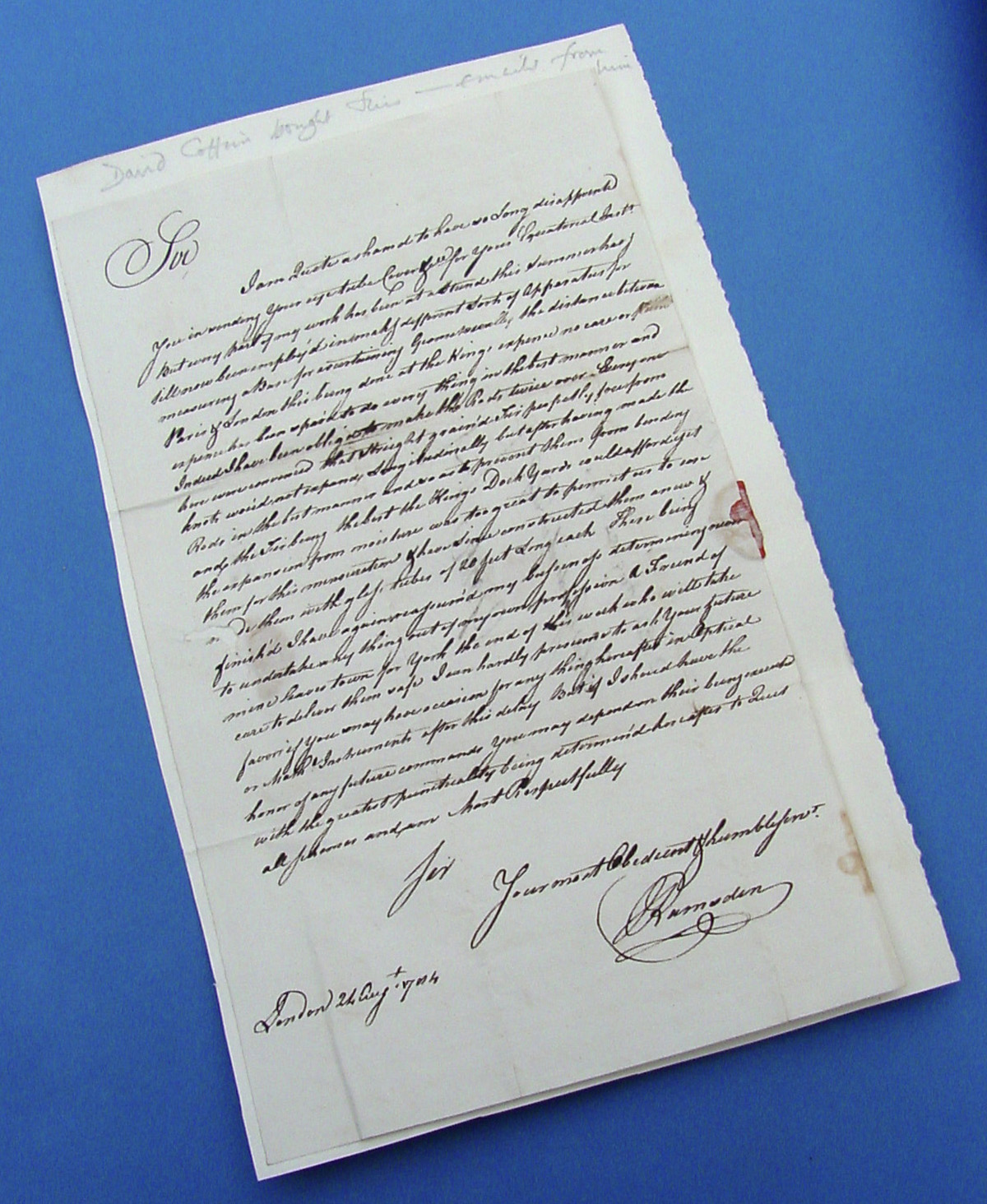
"I have mentioned that Ramsden, the celebrated optician, was of our society. Besides his great mechanical genius, he had a species of invention not so creditable, the invention of excuses. He never kept an engagement of any sort, never finished any work punctually, or ever failed to promise what he always failed to perform." (Edgeworth, a fellow member of the Lunar Society along with Ramsden; McConnell, p.275) Notorious for his inability to say "NO" to a new commission, and for his willingness to promise deadlines he would never meet, Ramsden is credited with putting improvement and innovation above all else. Here we offer classic evidence of this -- a manuscript letter by Ramsden -- one of apology as well as discussion of his ongoing search for optimum approaches to new projects. |
 |
 |
|
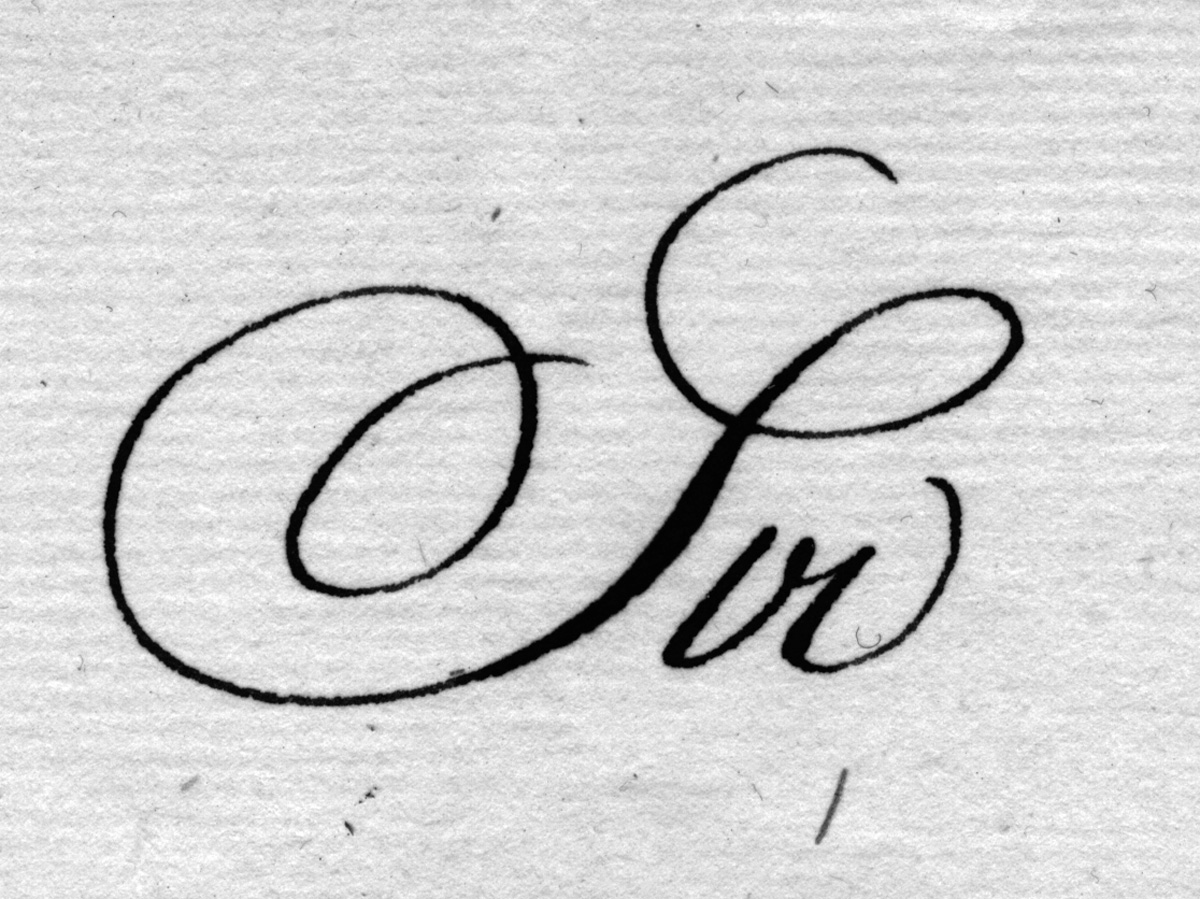
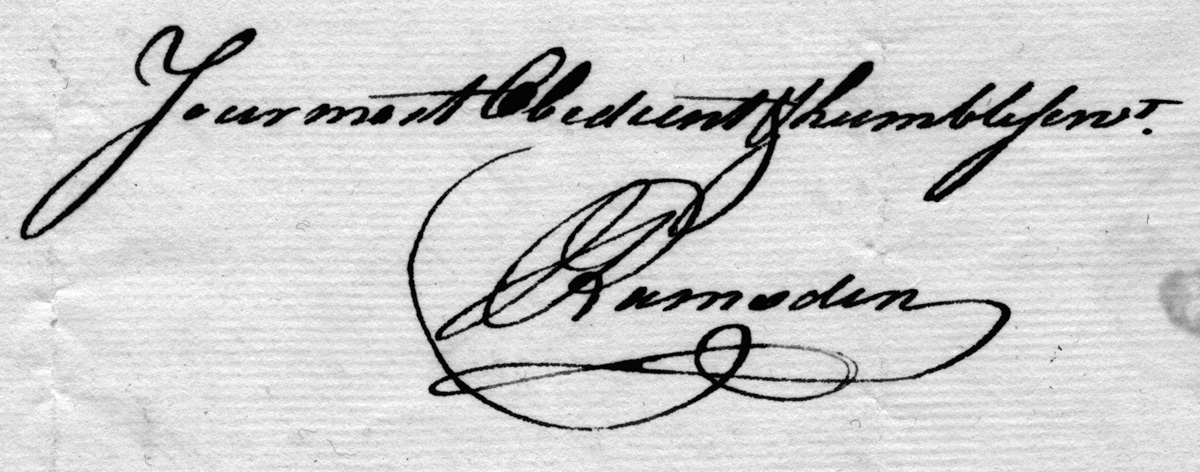
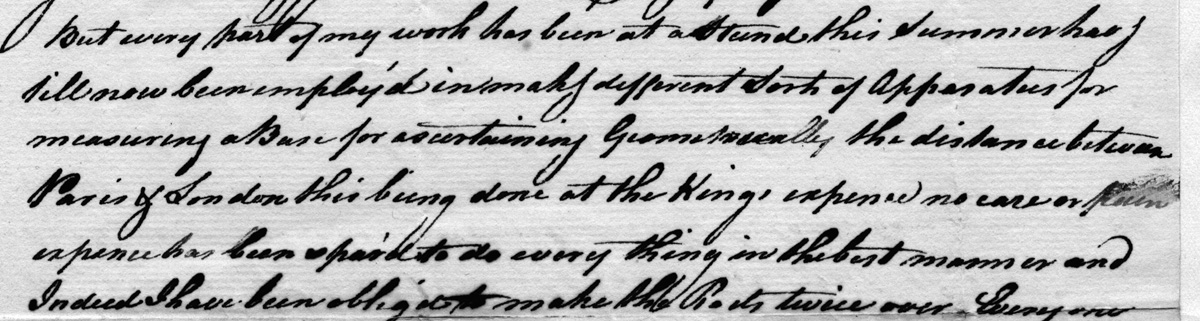
AUTOGRAPH LETTER FROM RAMSDEN, English, 24 August 1784, addressed to "John Goodriche, Esq'r" in York, and bearing a postal marking and the wax seal of "JR." The 7-3/4" x 12-3/4" (20 x 32 cm) sheet is beautifully written and signed by Ramsden. He opens with an apology "I am Quite ashamed to have so Long disappointed you in sending your eye tube Cover &c...," but then immediately turns to fascinating details of his excuse "...every part of my work has been at a stand this summer...in making... Apparatus for measuring a Base... between Paris and London this being done at the King's expense...." He discusses the long standard rods of fir, and replacing them with glass tubes 20 feet long. At last there is hope for Goodriche's accessories: "A Friend of mine leaves town for York..." but finally Ramsden seeks yet more business "...if you may have occasion for any thing hereafter in Optical or Math¹l Instruments...." Condition is very fine, with one tiny piece torn away, the folded sheet mounted along one edge to modern laid paper. This is a classic letter, illuminating Ramsden's passionate interest in his projects, yet inability to deliver even simple orders on time, and continued solicitation of yet more business. The recipient was John Goodriche (1764 - 1786), who despite his short life of 22 years, and being deaf-mute, became famous for his discovery of the first known Cepheid variable star, and was elected to the Royal Society. 1784 was indeed a busy year for Ramsden; among other activities, by March his wife had left him, in July the standard rods were indeed delivered to Hounslow Heath, and just three days before this letter was written, the King had come to the Heath to inspect Ramsden's activities there for Roy¹s triangulation survey. A significant document; we are unaware of other Ramsden letters in private hands. (8156) $6500. |
| Tools of the Trade, on a Surveyor's Button | Click on any image for a larger
view. Scroll to view more items. |
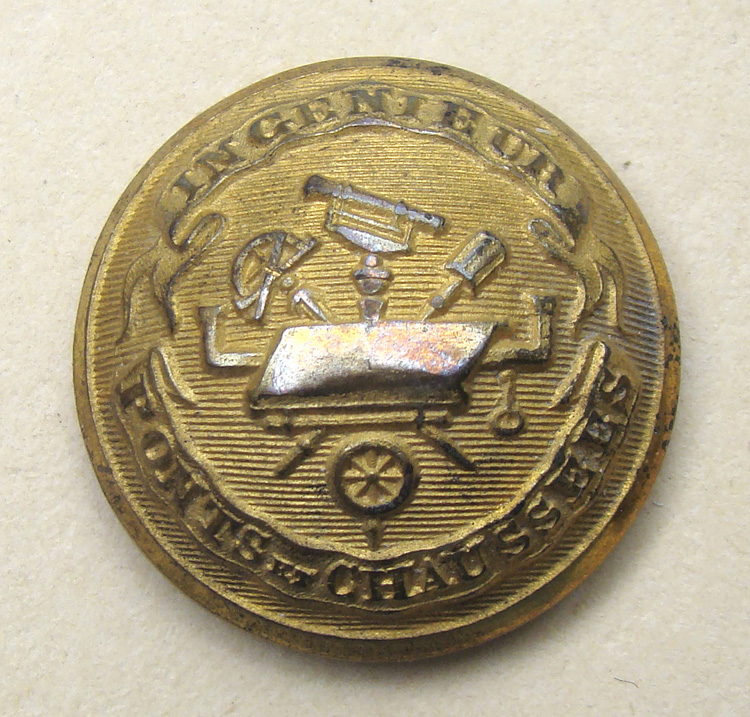 |
FRENCH ENGINEER¹S BUTTON, c. second half 19th century,
the 7/8" (22 mm) diameter gilt brass button bearing the identification
"Ingénieur Ponts et Chaussées" (Engineer, Bridges and Roads),
plus a field of surveying instruments including graphometer, surveying
square, and telescopic builder's level, each staff-mounted, plus a water
level. A most unusual surveyor's insignia, in very fine condition. (10255)
$95.
|
| Direct-Plotting of Surveys in the Field, in 18th c. | Click on any image for a larger view. Scroll to view more items. |
|
"The Table it felf is a Parallelogram, containing
in Length about 14 inches and a half, and in Breadth 11 inches: it is
compofed of three feveral Boards, which may be taken afunder for Eafe
and Convenience in Carriage. For the Binding of thefe three Boards faft
when the Table is fet together, there belongeth a joynted Frame, fo contrived,
that it may be taken off, and put on the Table at Pleafure. This Frame
alfo is to faften a fheet of Paper upon the Table, when you are to defcribe
the Plot of any Field, or other Inclofure thereupon. This Frame muft have
upon it, near the inward Edge, Scales of equal Parts on both fides, for
the Speedy drawing of parallel Lines upon the Paper; and alfo for the
fhifting of your Paper, when one fheet will not hold your whole work."
(William Leybourn, 1722)
|
 |
 |
|
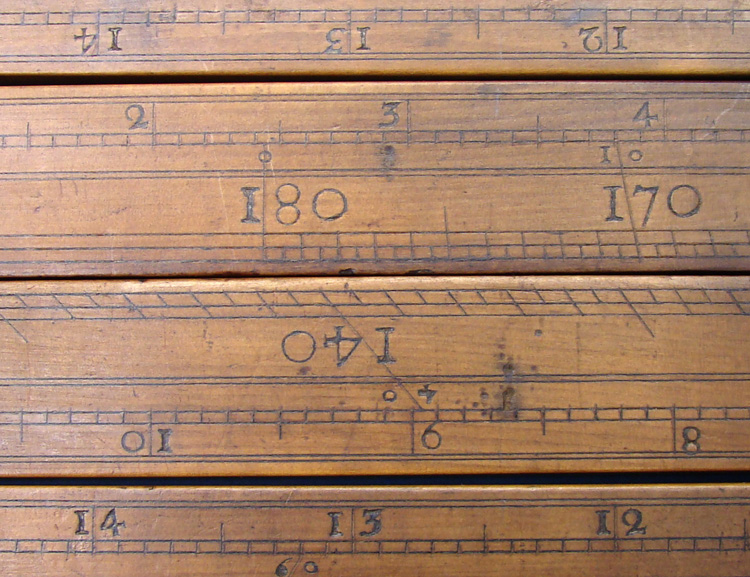
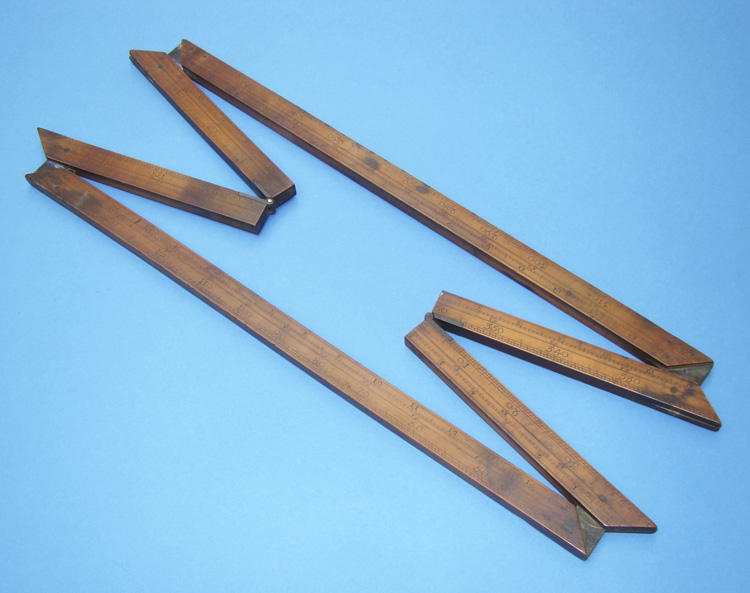
SIX-FOLD PLANE TABLE RULE, English, first half 18th century, the six-segment hinged boxwood rule 7/16" thick, opening to 13-1/2" x 16-1/2" (34 x 42 cm). It is stamped "F. Fletton" for a later owner. In use it would be slipped over an 12" x 15" plain board to hold down the paper, and provide direct plotting of angles and distances. It is divided and boldly numbered on both sides all around with scales in inches (divided every tenth) and in degrees (every half degree CW and CCW). One peripheral degree scale is centered on the plane table center, the other on a point just 2-1/2" in from the table's edge. Condition is good, noting some stains. The boxwood has a wonderful deep honey colored patina. This was an important tool for the early surveyor, and seems to have been made for several standard format boards, including a 12" x 15" one (as here and in Tesseract Catalogue 98, Item 24) and an 11" x 13-3/4" one (68/26). We find an illustration of such a folding rule as early as 1611, by Arthur Hopton in The Topographicall Glasse. (10275) $1950. |
| Leveling by a French Master Craftsman | Click on any image for a larger view. Scroll to view more items. |
 |
 |
|
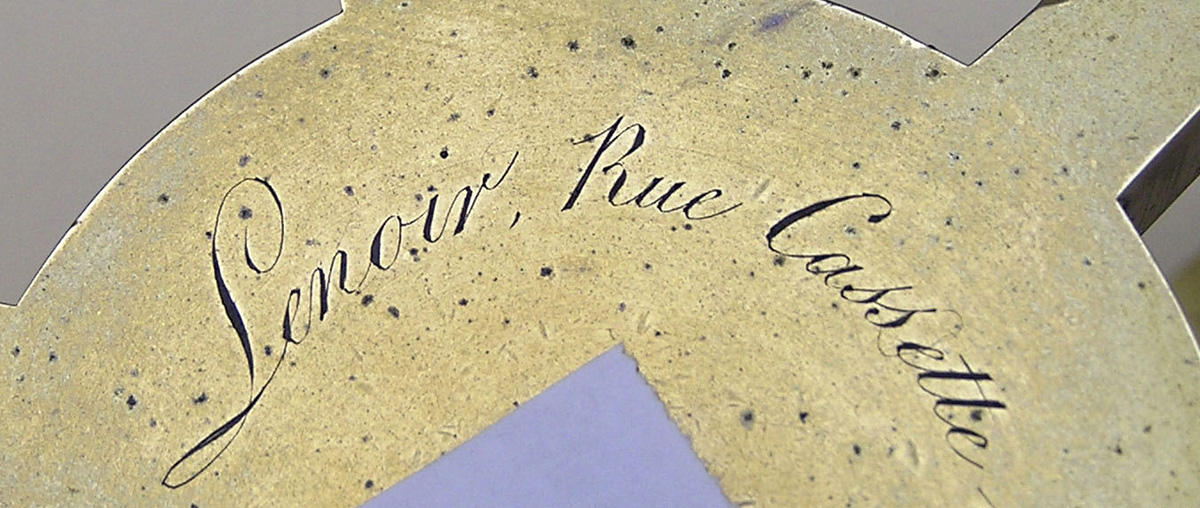
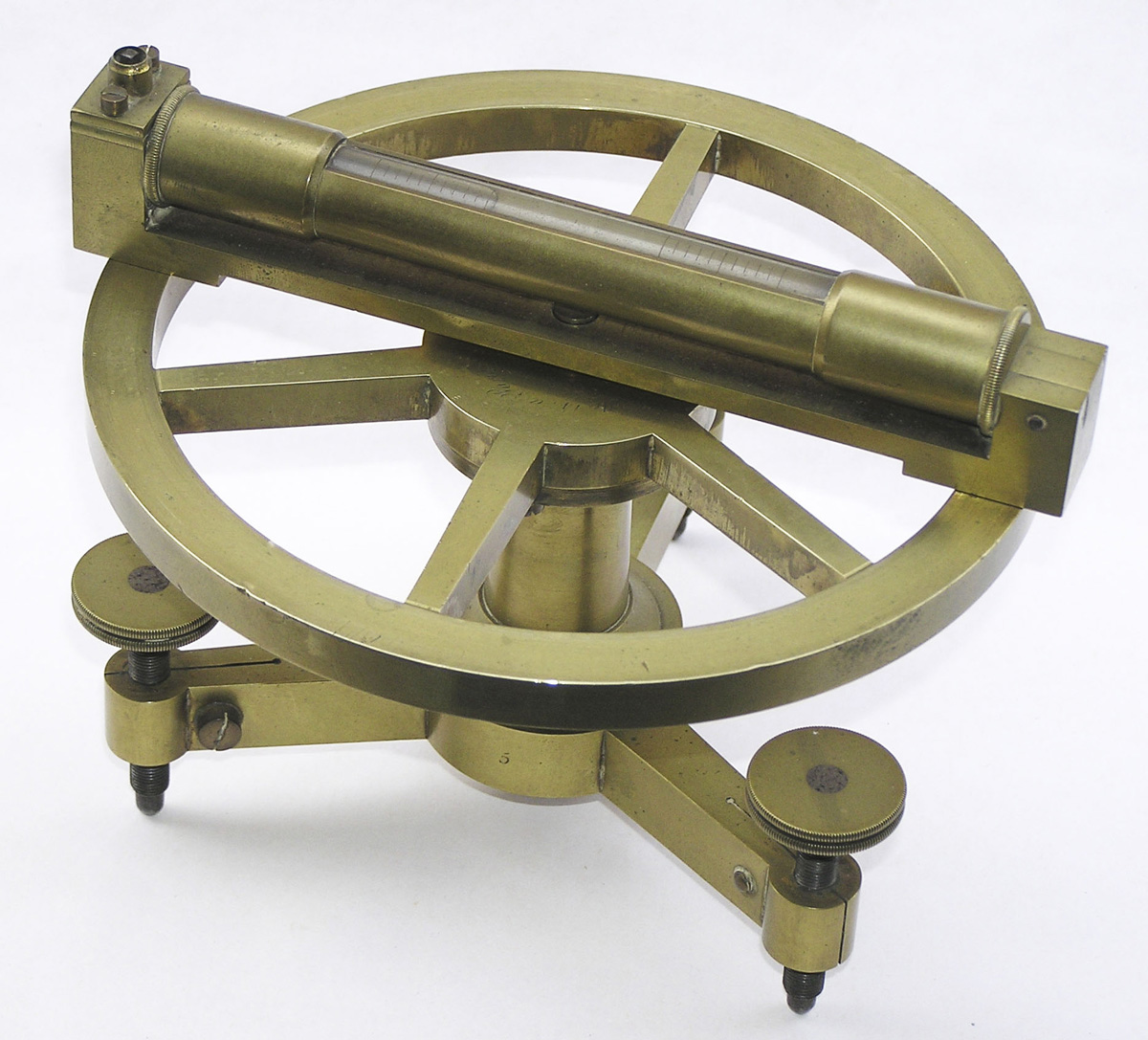
PRECISION LEVELING SYSTEM, French, c. 1830, signed in fine script "Lenoir, Rue Cassette 14, Paris." The sturdy brass leveling base has a 6-3/8" diameter (16 cm) six-spoked ring over a three-footed base with precision adjustment screws. A calibrated spirit level is set in a brass housing, with fine adjustment for tilt, and can ride on the plain flat top of the ring. When perfectly leveled, the assembly could carry a horizontal telescope, or be used for simple sighting in laying out foundations, water systems, etc. Condition is fine throughout. Marcelin lists Etienne Lenoir at this address only from 1830 until his death in 1832. (8646) $1150. |
| Extremely Rare Direct-Plotting Perspective Compasses | Click on any image for a larger view. Scroll to view more items. |
|
|
 |
 |
|
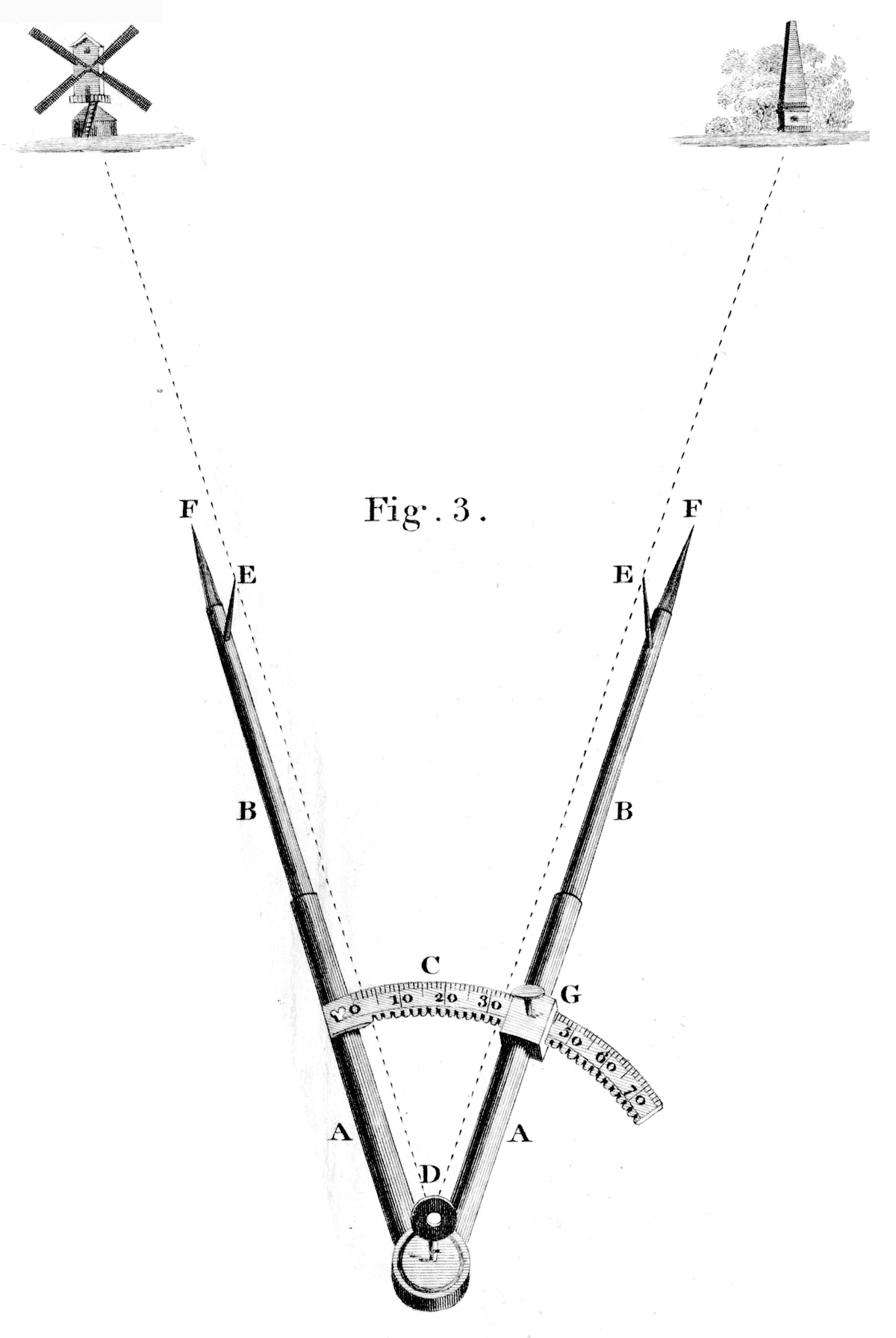
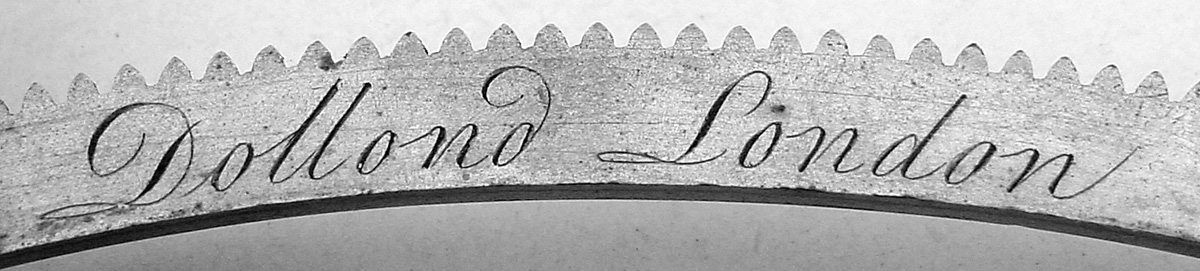
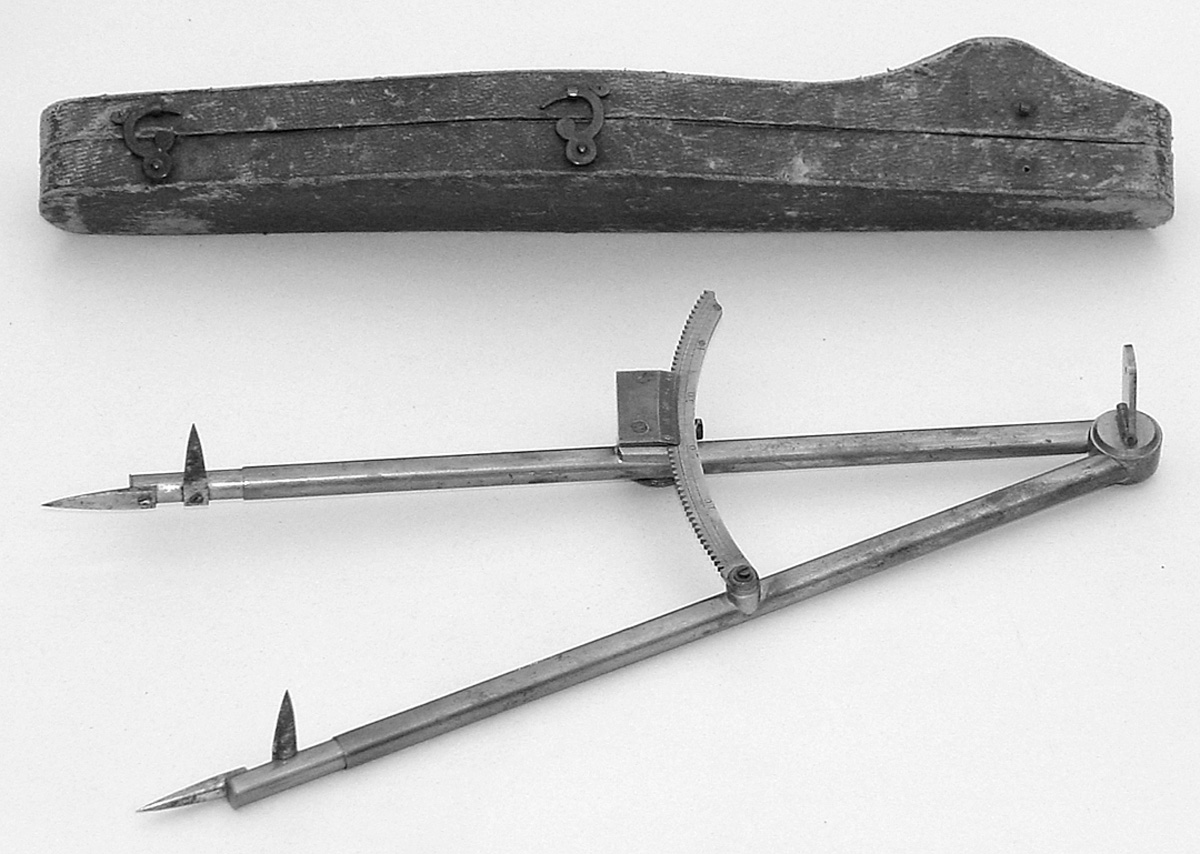
DOLLOND'S "POCKET PERSPECTIVE COMPASSES", English, late 18th c., signed "Dollond London," extending from 10-3/8" to 17" (26 - 43 cm) long by hollow drawtube on each arm. This fascinating instrument is made of brass, with two arms and two pairs of orthogonal half-round sharp steel points at the extremities. A hinged swiveling sight vane is mounted at the vertex, and an arc swings into place for thumbscrew rack-and-pinion adjustment of the separation of the arms, the arc divided every degree from 0° to 45°, with vernier readout to 5 arcminutes. Condition is very fine noting some surface rust to the points. It is contained in its original wonderfully-shaped wood case covered in red morocco leather and lined with silk and velvet, the case now rough from wear. With the instrument horizontal, one sights thorough the 1" high pinhole, aligning the two now vertical 1" tall points with two distant targets. The angular subtense is read directly on the arc, and a linear separation can be immediately plotted on paper. The scaling can be adjusted by extending the drawtubes, increasing the separation of the points for a given angle. Conversely one can start with a map or architectural drawing, and sight landmarks or establish a simple layout on the ground. This clever direct-plotting drafting / surveying instrument is described by George Adams and William Jones in their Geometrical and Graphical Essays (e.g., 2nd ed. of 1797). We read, following a description of two elaborate table-top perspective drawing instruments: "To these may be added the parallel rule, and the perspective compasses. The distance of the rule from the eye,... must be regulated by a piece of thread tied to it, and held between the teeth.... ...a pair of pocket brass perspective compasses, by Mr. Jones,... have been found very useful and convenient for taking readily the relative proportions of buildings landscapes, &c. and protracting them on the drawing. A,A, are the two legs, made of small tubes about six inches in length;... E,E, are two steel points to take the sights by; F,F, are two more small steel points at the ends of the sliders to mark down the distance on the paper, after an observation;..." (8336) $4950. |
| Landmark Compass | Click on any image for a larger view. Scroll to view more items. |
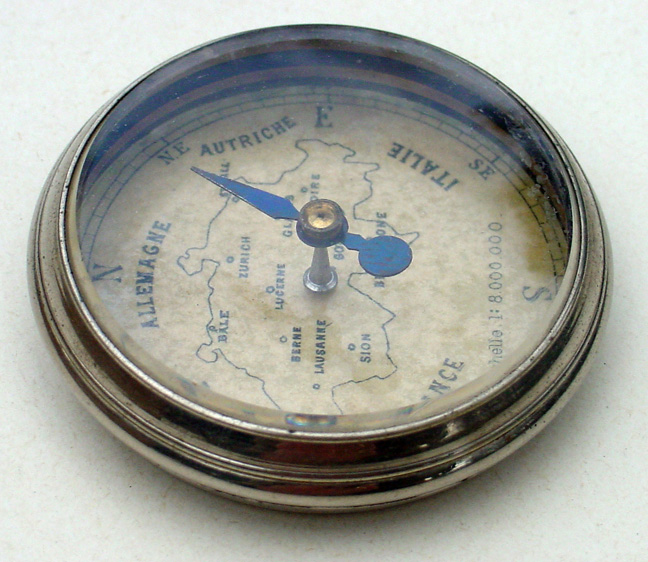 |
CARTOGRAPHIC POCKET COMPASS, Swiss, c. early 20th century, the 2-1/4" (5.7 cm) diameter plated brass case nicely glazed, and fitted with printed paper under its own protective glass disk, with a raised counterbalanced blued needle. The paper shows the pivot centered on a map of Switzerland, with cities, surrounding countries, and directionals all labeled in French, and with the map scale specified "Echelle 1:8,000,000." The center is in the region of the highest mountains of the Swiss Alps, and from there the compass serves as the tourist's panoramic guide to distant landmarks. Most unusual, and in excellent condition. (8222) $425. |
 |
||
| Innovation in Northern Italy, c. 1730 | Click on any image for a larger view. Scroll to view more items. |
 |
 |
 |
 |
|
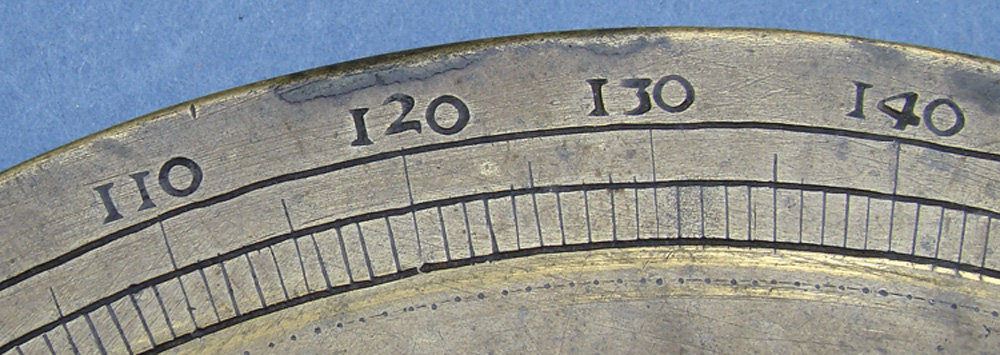
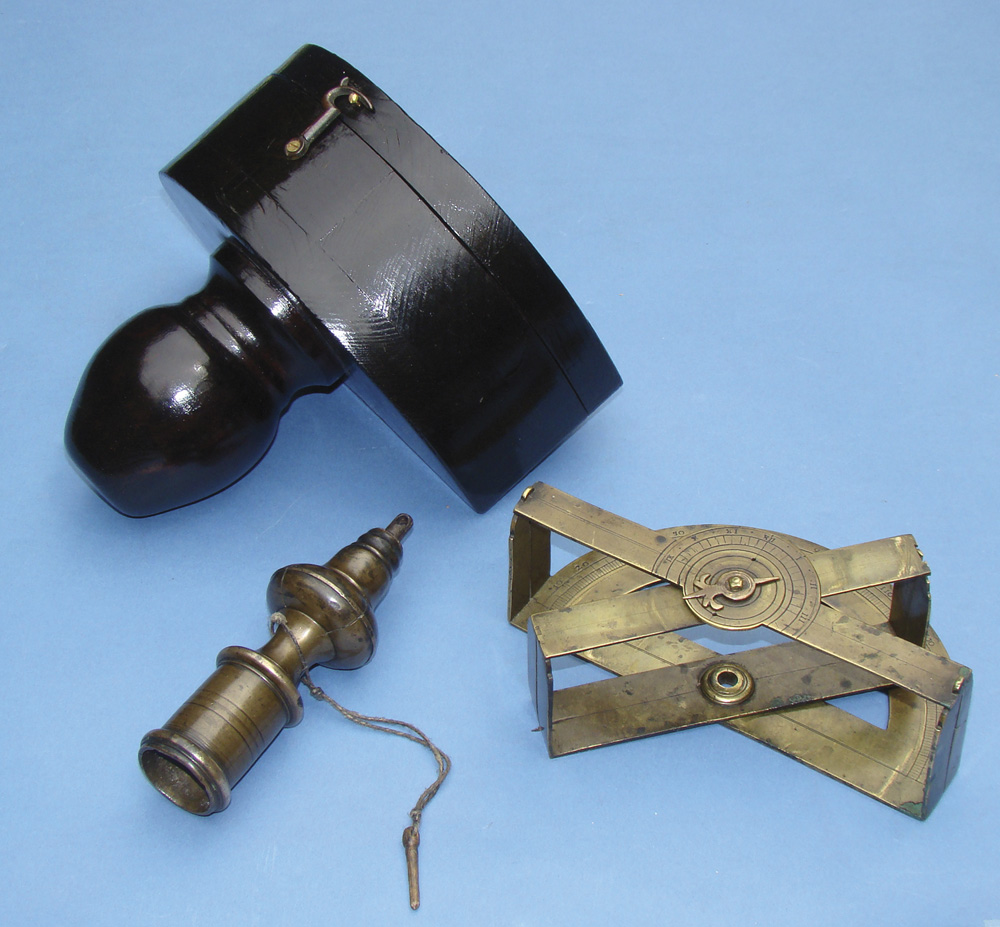
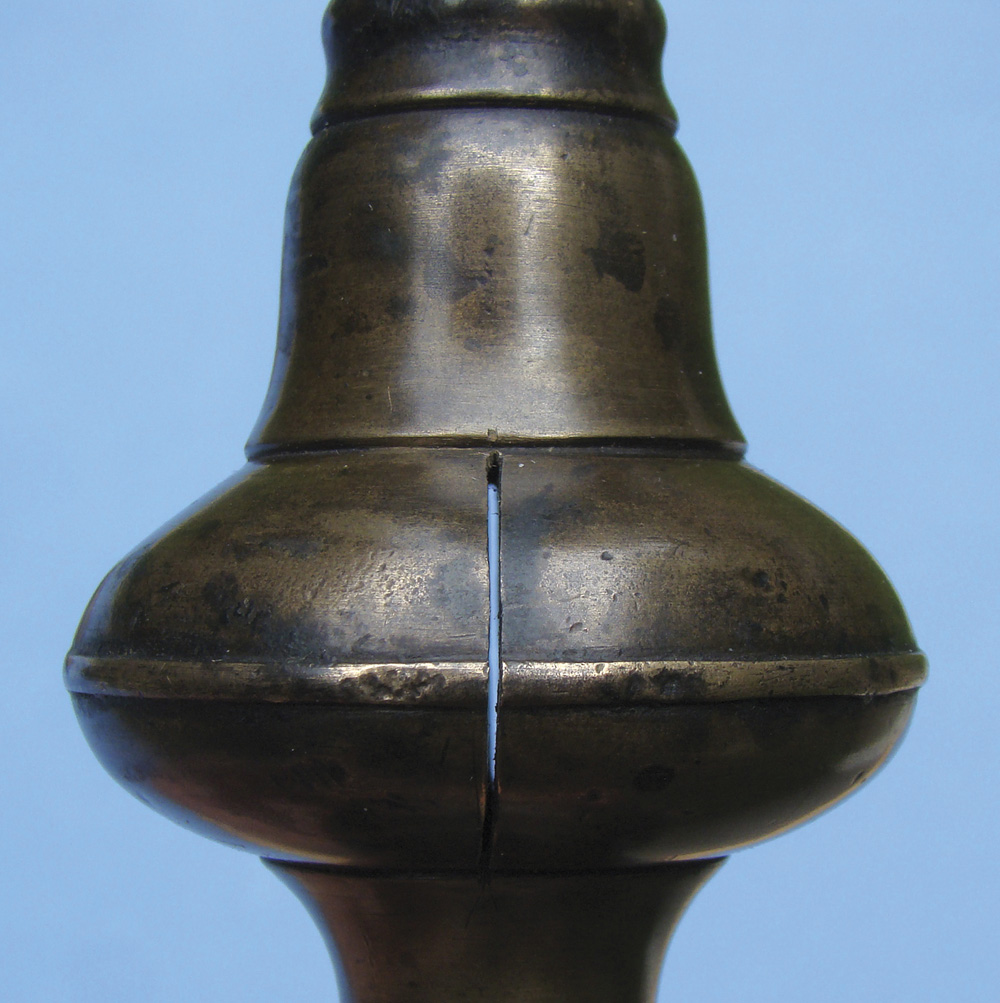
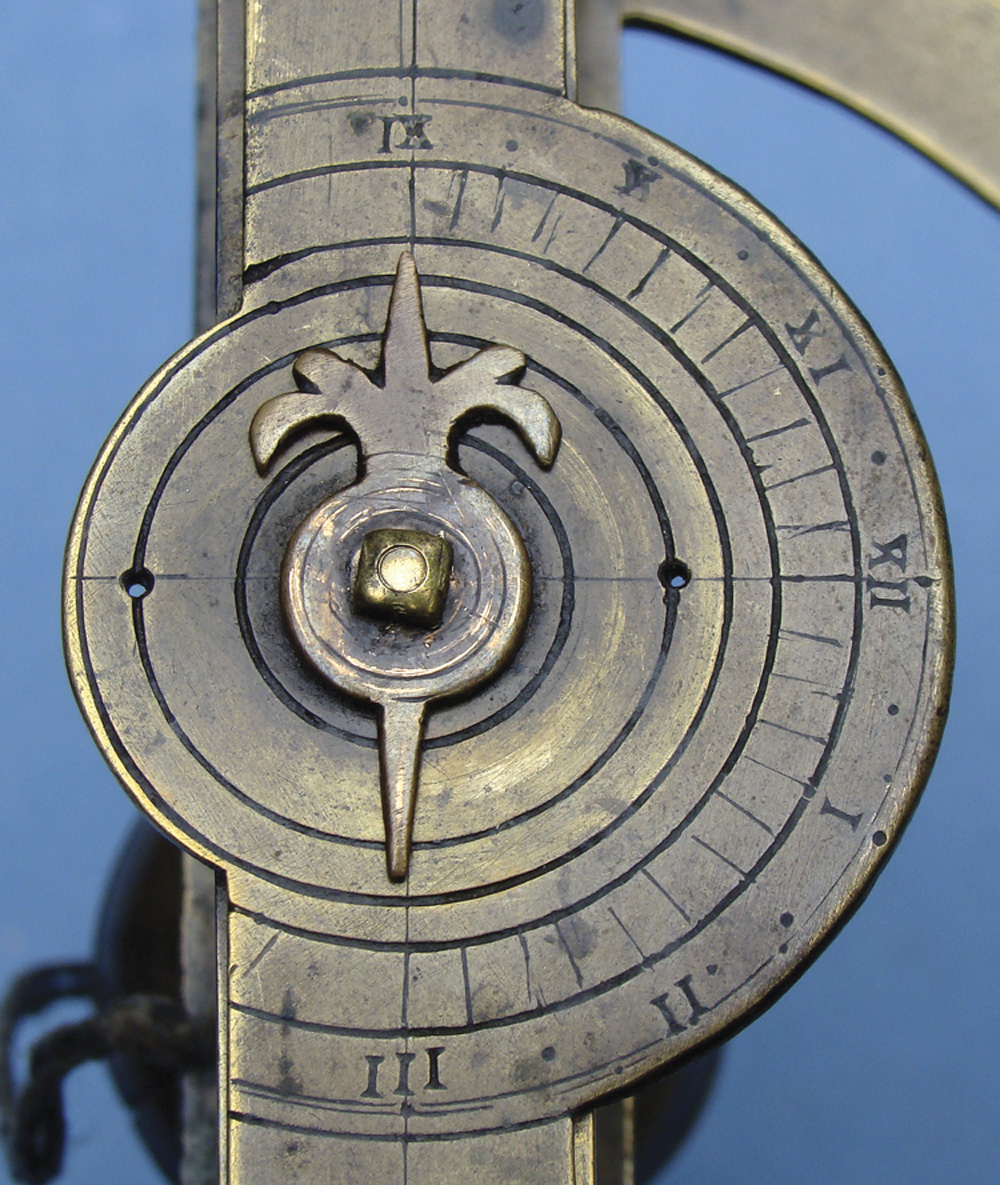
UNUSUAL SURVEYING RECTANGLES, Italian, c. early 18th c. Constructed somewhat like a graphometer, but in a cage-work construction incorporating the sight vanes, this all-brass instrument measures 6-1/8" x 3-1/2" x 2" (16 x 9 x 5 cm) with a 4-7/8" tall staff mount. The main plate has a semicircular scale divided every degree from 0 to 180, with stamped numerals every 10°. Opposing slit sight vanes rise at each end, and are joined at their tops with a brass plate including a smaller semicircle divided every quarter hour from 9 "am" through 12 to 3 "pm." Within this rectangle pivots the smaller "alidade" rectangle, with its opposed slit vanes, inset steel pointer reading against the large semicircle, and finely shaped brass "fleur-de-lys" pointer reading against the upper, smaller semicircle. The scale on the latter is the old fashion of defining directions on a circular hour scale (although this is usually twice-12 hours). The whole assembly can be pinned to a vertical staff mount which has the unusual feature of a bulbous surveying square (with four narrow vertical slits spaced every 90°) built into it. Condition is fine, noting an old splint repair to one sight, and the brass darkened and stained. The whole is contained in a recent fitted wood case lined in chamois leather. This unusual early instrument was found in, and probably made in, Northern Italy, perhaps in Brescia or Bergamo in Lombardy, c. 1730. We have seen no other instrument like it. (10272) $5500. |
| Impressive Combination Instrument, c. 1750 | Click on any image for a larger view. Scroll to view more items. |
 |
 |
 |
 |
 |
 |
|
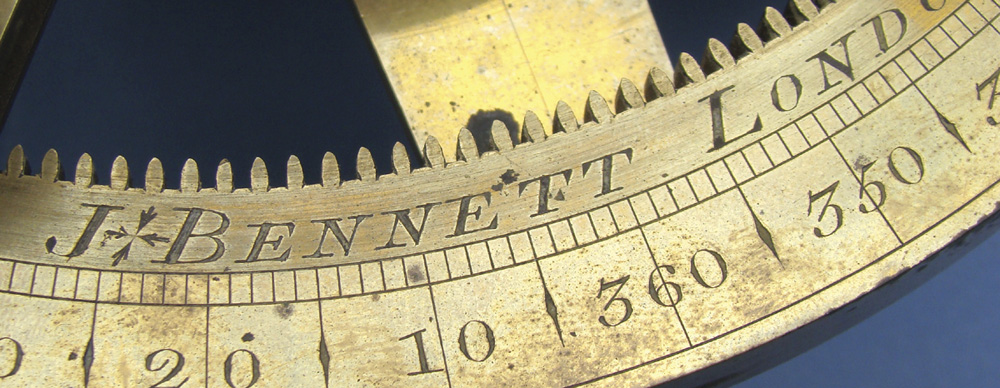
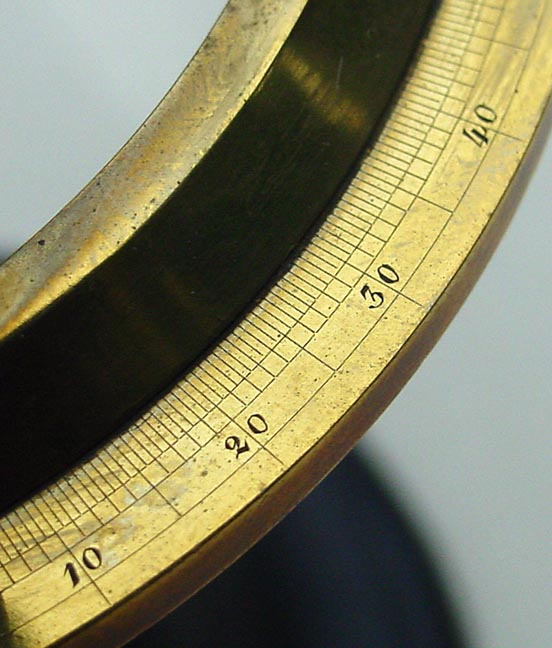
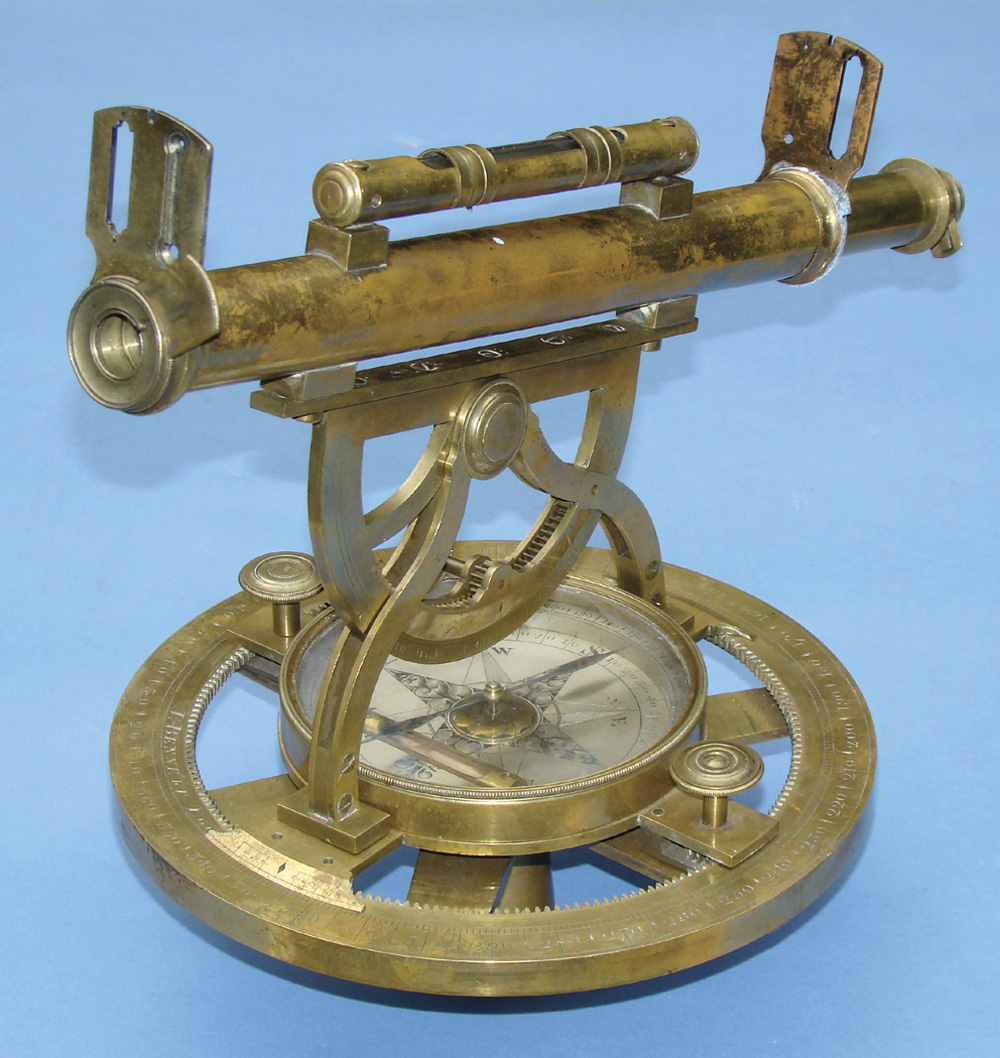
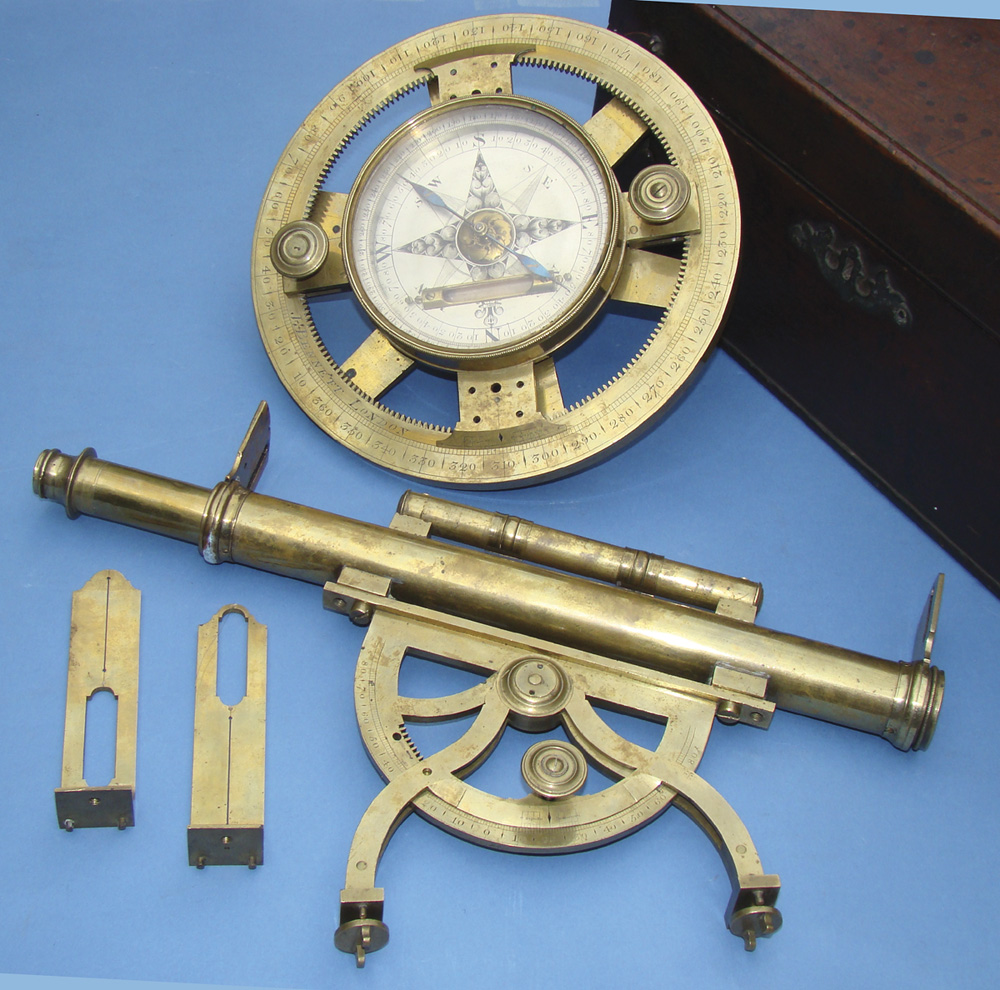
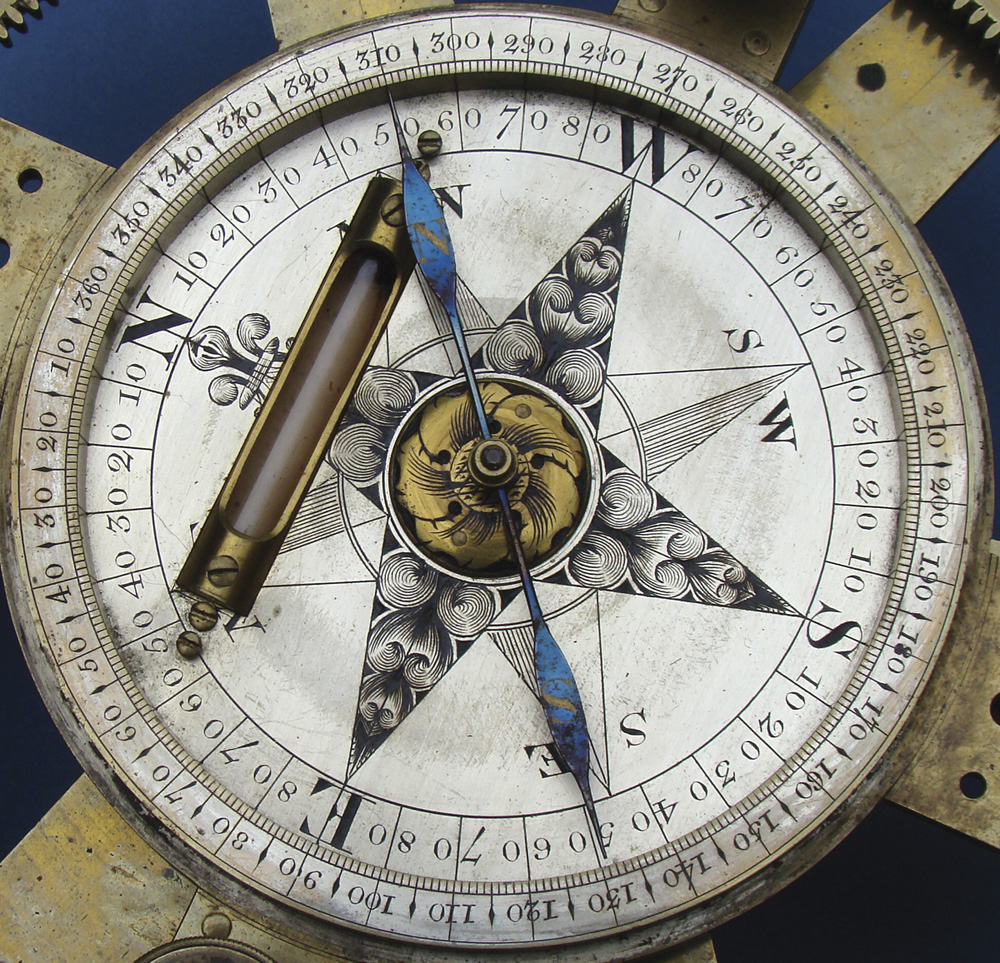
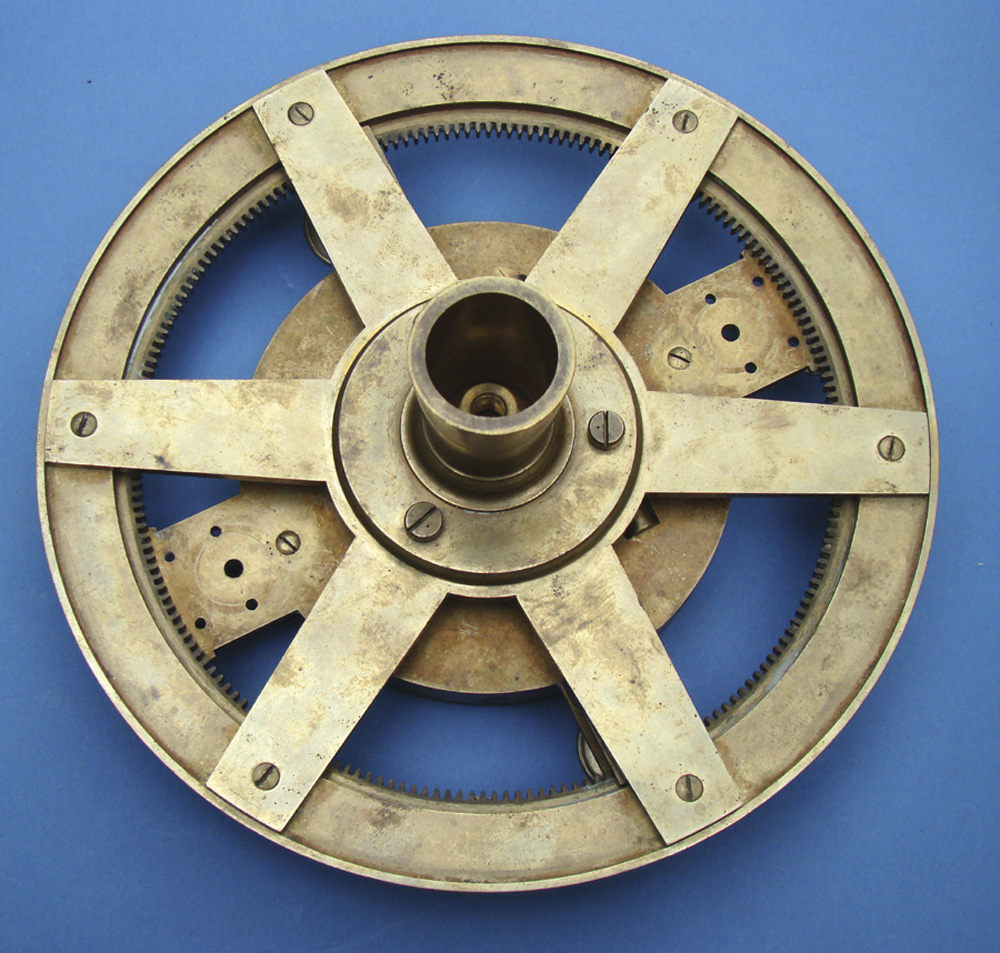
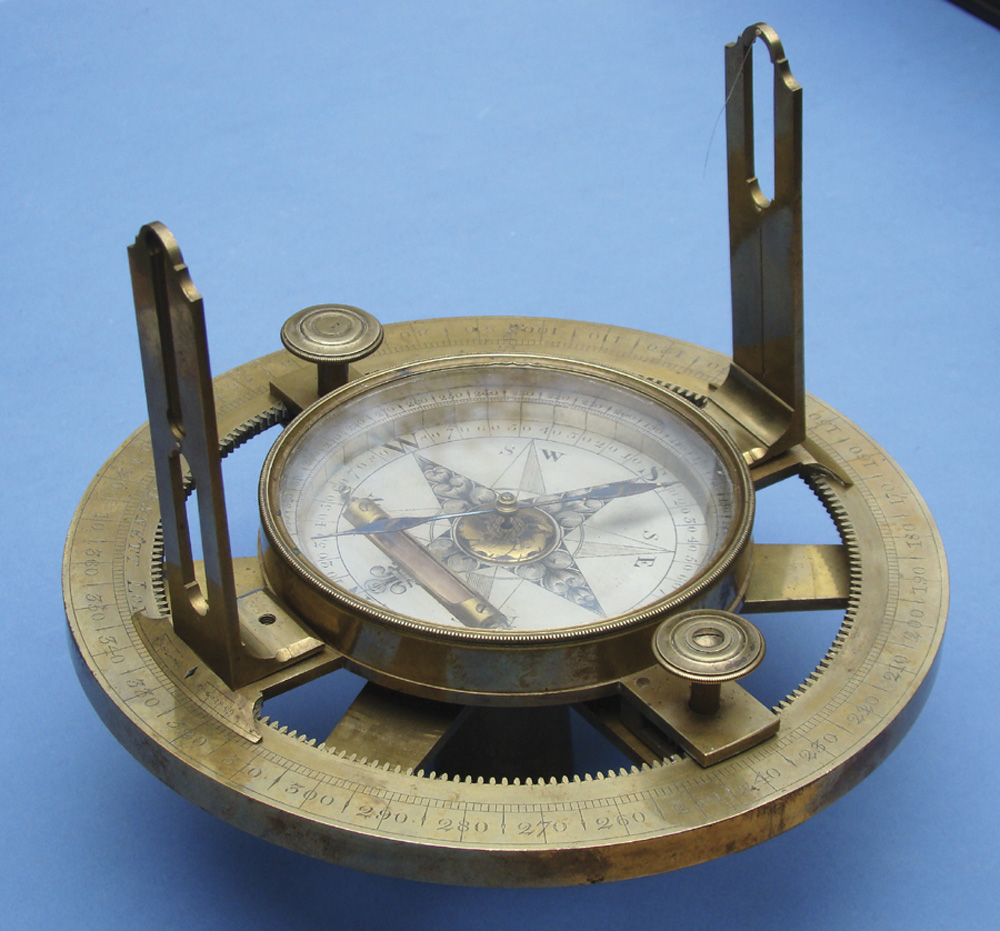
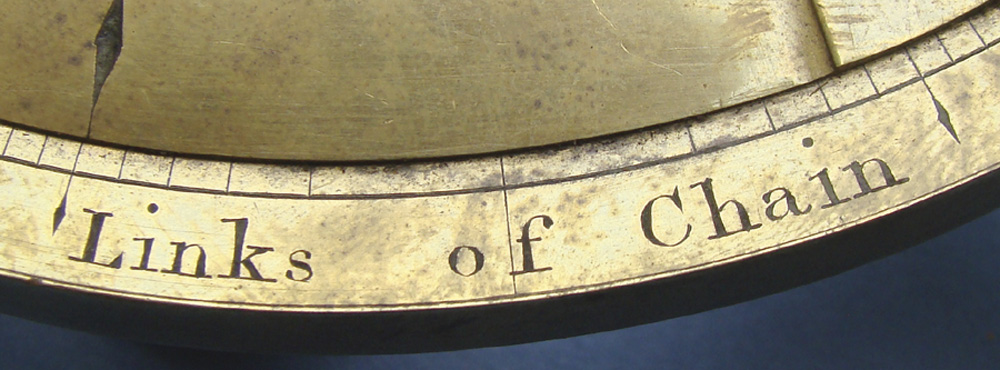
EIGHTEENTH CENTURY CONVERTIBLE CIRCUMFERENTOR/THEODOLITE, English, c.1750, signed on the brass "J * Bennett London." The circumferentor has a heavy brass outer ring, 8" (20 cm) in diameter, with fully divided degree scale and cog gearing, and the bold signature of the maker. The ring is mounted on a six spoked support plate with conical staff mount. The compass plate has four arms, carrying pinion gear, clamp screw, simple index, and index with lovely split vernier reading to five arcminutes. The compass is 4-1/2" across, with beautifully engraved silvered face, decorative central brass hub, and inset level. The two index arms support the sight vanes, 4-1/2" high, held by winged thumb screws below. Alternatively, one can mount the theodolite head, with its geared elevation motion, scales engraved 0°-80° twice, "Links of Chain" scale, and telescope (11-1/2" long closed) mounted with double sight vanes and spirit level. This rare example of an eighteenth century theodolite is in fine condition, noting that the telescope has been considerably restored (one vane replaced, some optics replaced, etc.), and there is some spotting to the brass. The gearing is in excellent condition; the engraving is crisp and not worn; the compass face is spectacular. The instrument is housed in its original mahogany case with decorative brass hooks and escutcheon, in fine condition. John Bennett (I) was apprenticed in 1723, and died in 1770. As a significant maker of fine mathematical and optical instruments he worked throughout his active career in Soho, London. Clifton has identified no less than eleven of his apprentices and trade associates, including James Ferguson, for whom he made instruments. A somewhat similar "altazimuth theodolite" by Bennett is associated with the King George III collection (see Morton & Wess, pp. 394-5). A splendid example of his work. (9218) $9500. |
|
|
| Political Correctness for a Great Astronomer | Click on any image for a larger view. Scroll to view more items. |
 |
 |
 |
 |
|
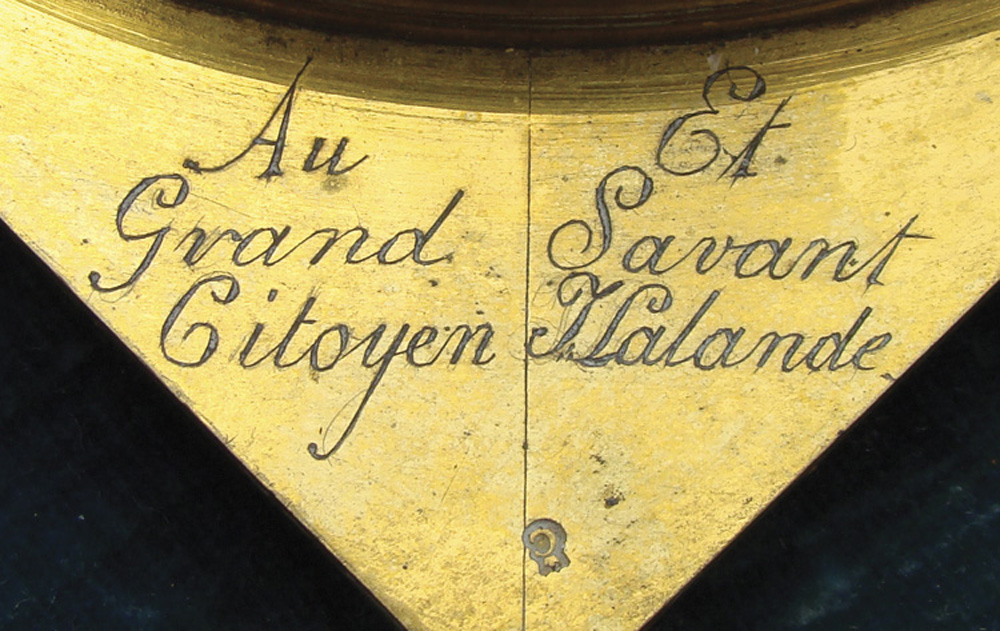
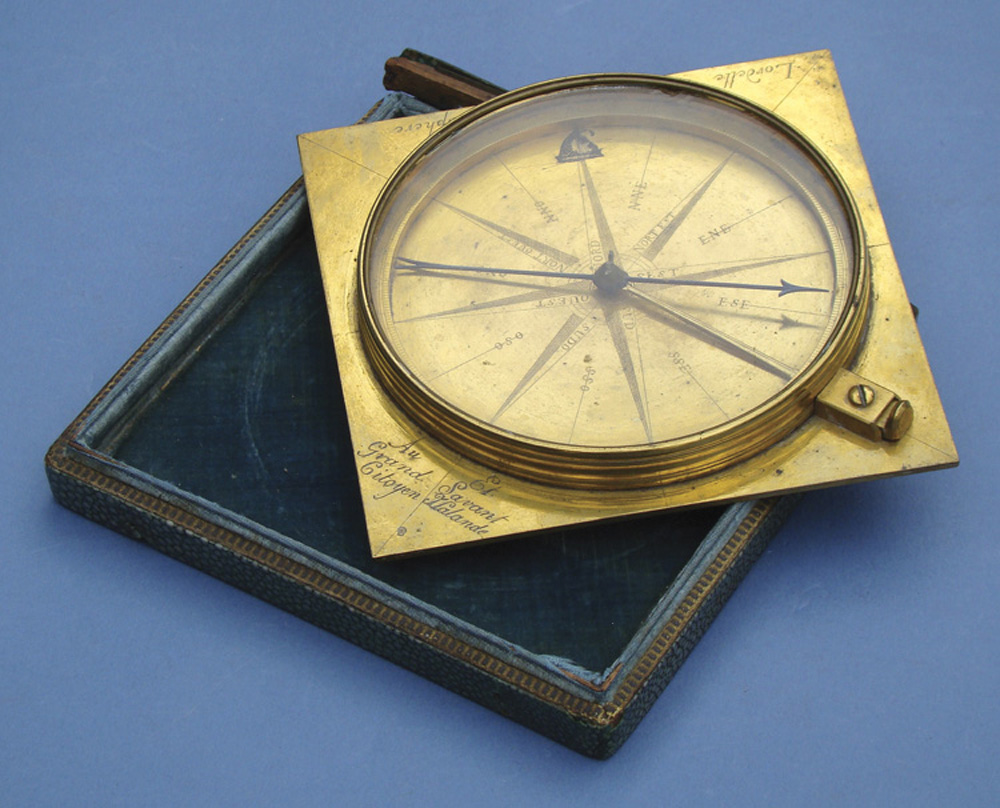
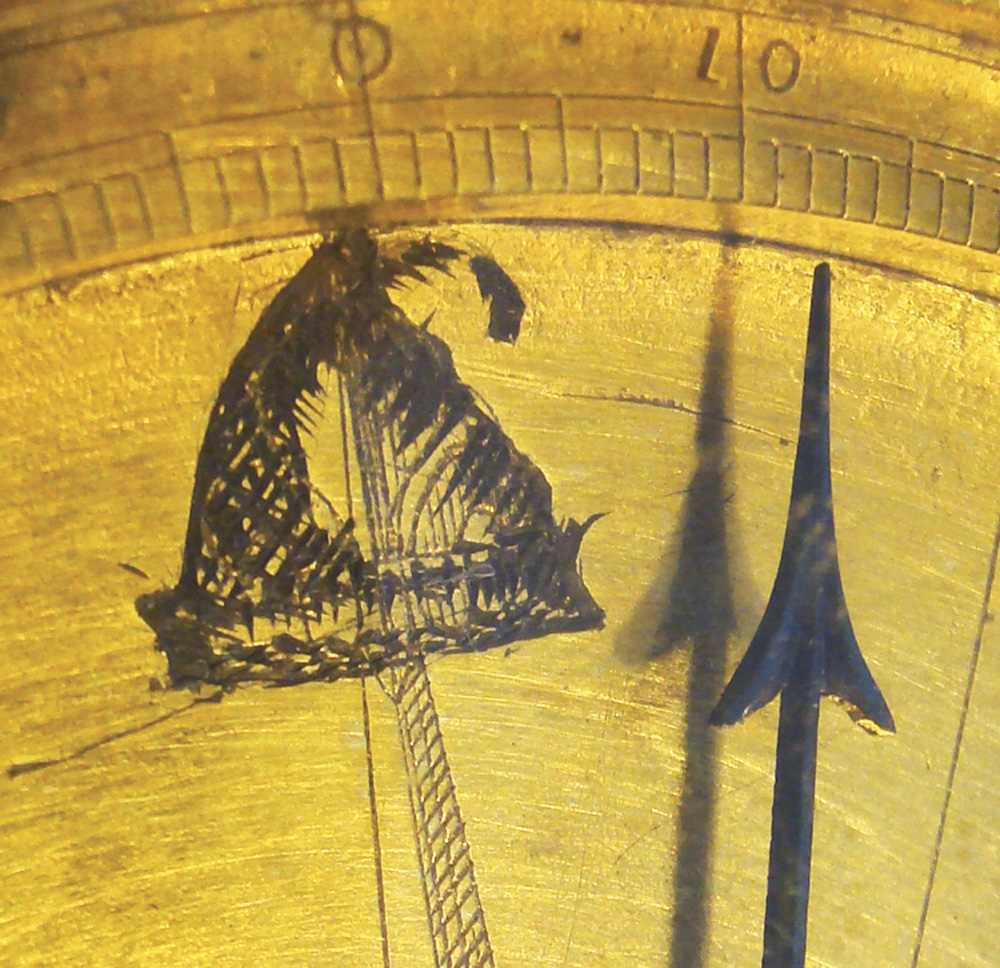
IMPORTANT GILT-BRASS REVOLUTIONARY COMPASS, French, c. 1745 -1747, finely signed by the maker "Lordelle A Paris à la Sphère," and in a presentation "Au Grand Citoyen Et Savant J. Lalande," and with a "crowned-C" hallmark. This finely crafted gilt brass compass measures 4-3/4" (12 cm) on a side, mounted with glazed compass featuring hand-engraved 16-point rose (labeled interestingly NORT.EST, SEST, SUDEST, SUDO, ONO, etc.), circumferential twice-180° scale, elegant "arrow" needle, and external needle lifter. The North point fleur-de-lys has been dramatically re-engraved as a bold Phrygian cap, the "bonnet rouge" of France, representing loyalty to the revolutionaries revolting against the nobility and establishment. (Display of the Royal fleur-de-lys could be dangerous at the time, and the "liberty cap" was a much safer symbol from 1790 onwards. We note one other such re-engraved object, the compass of a Butterfield-type sundial listed in Tesseract Catalogue 41, as Item 22.) Condition of the present instrument is very fine. The case lid is missing, but the bottom is most elegant, of wood covered in fine green shagreen and lined in green velvet. The maker was Jean Baptiste Lordelle, who became master founder in 1737, and died in 1747; he was nephew of Langlois and cousin of Canivet (who took over Lordelle's trade sign in 1747). He is known for several interesting mathematical instruments, including a universal ring dial provenanced to la Condamine (the great French explorer) in 1735. We have had one other object by him, that a fine ring dial (Tesseract Catalogue 87 Item12). The "crowned-C" poinçon was used for only four years (1745 - 1749), and indicated a tax paid on copper alloys. Thus we can reliably date the production of this compass to a two-year period. The recipient was the leading French astronomer Joseph-Jérôme Lefrançais de Lalande (1732 - 1807), father of modern positional astronomy, editor of the astronomical almanac Conaissance des temps (from 1760), elected head of the Collège de France (1791), appointed director of the Paris Observatory (1795), created a catalogue of 47,000 stars (1801), notable freemason, proclaimed atheist, traveler, popularizer of astronomy, and extensive writer. He safely transited the Reign of Terror and its consequences, even changing his name at the time of the Revolution, from the aristocratic "de la Lande" to simply "Lalande." The present compass demonstrates such political correctness, with its Phrygian symbol and inscription to the "great Citizen and Scholar." We suggest that the cap and the presentation were both engraved in those years, perhaps at the moment of Lalande's ascension to a directorship. An important survival with very special connections. (10243) $13,500. |
| The Dexterity of Hermes and Mercury | Click on any image for a larger view. Scroll to view more items. |
 |
 |
|
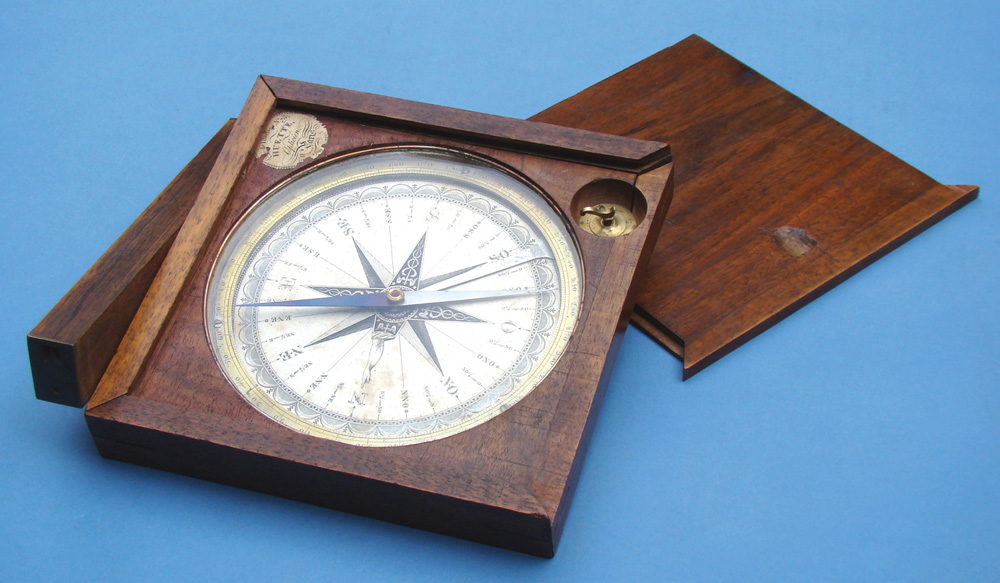
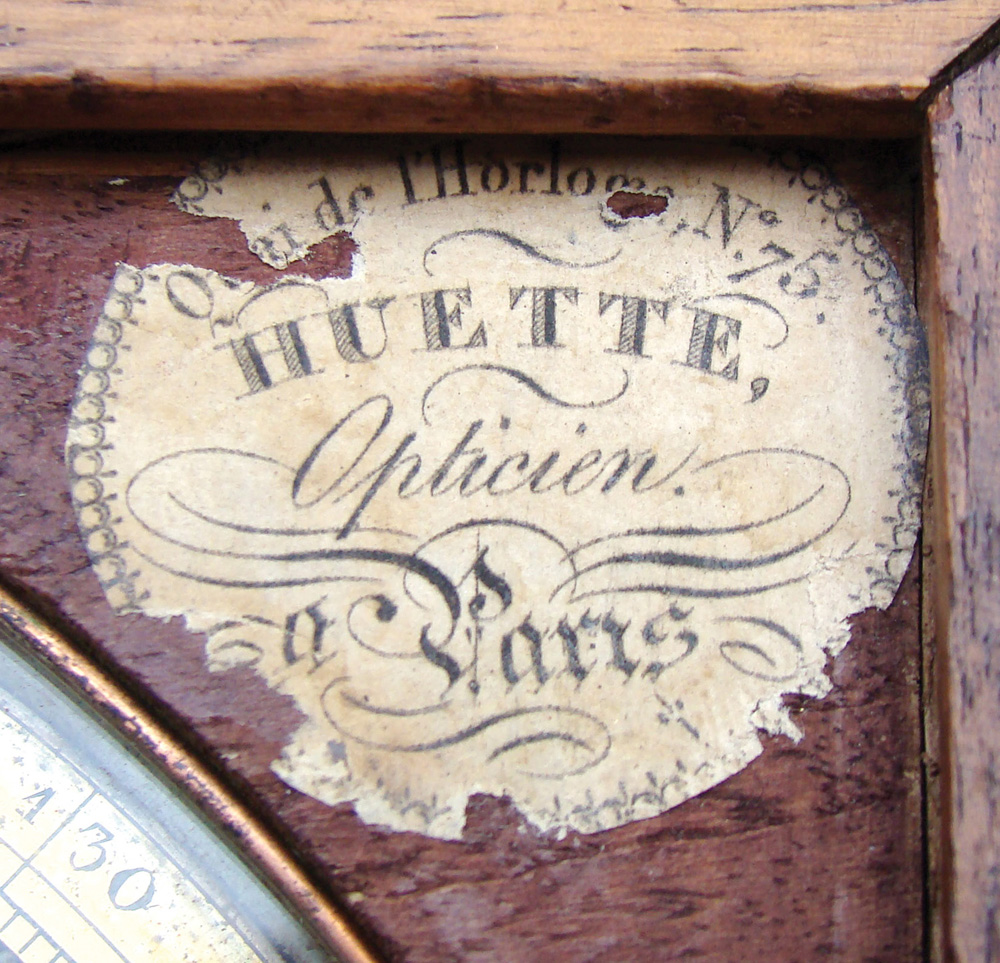
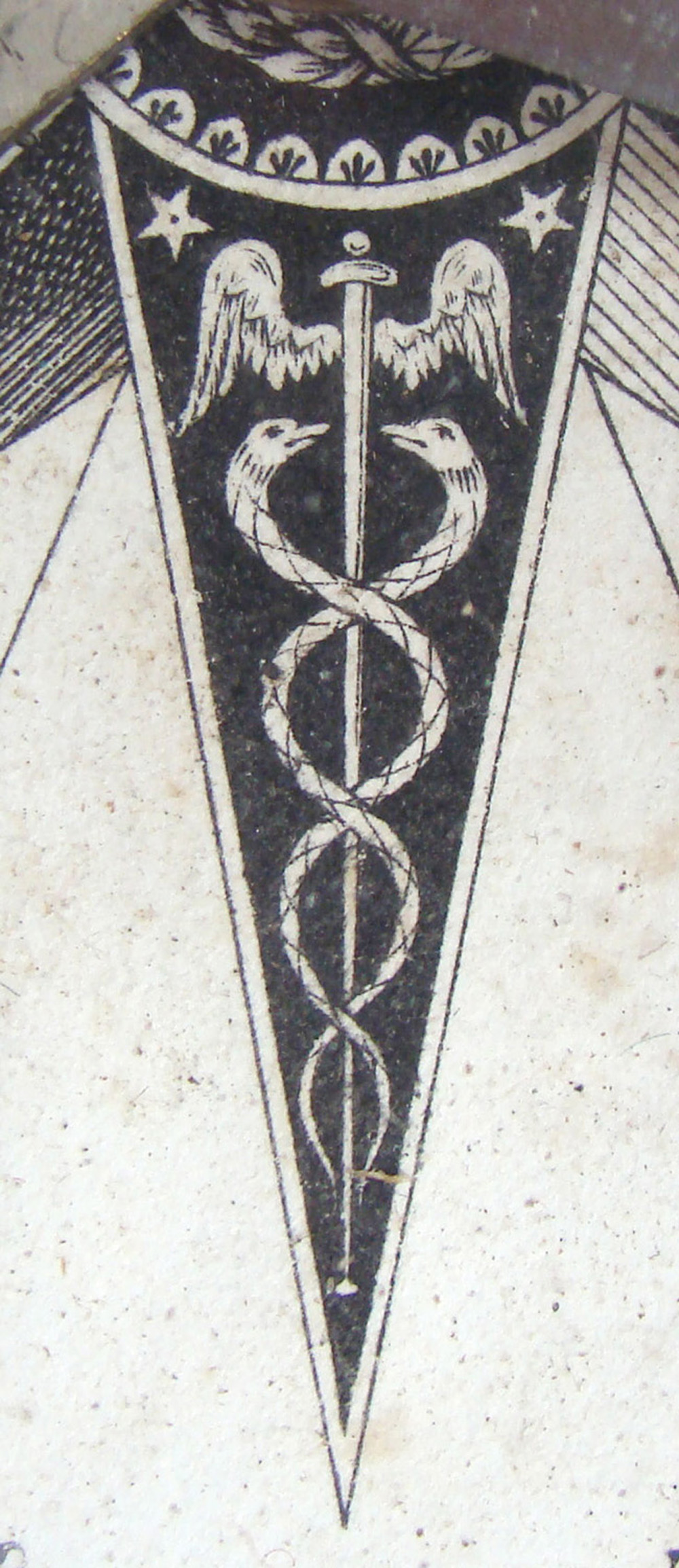
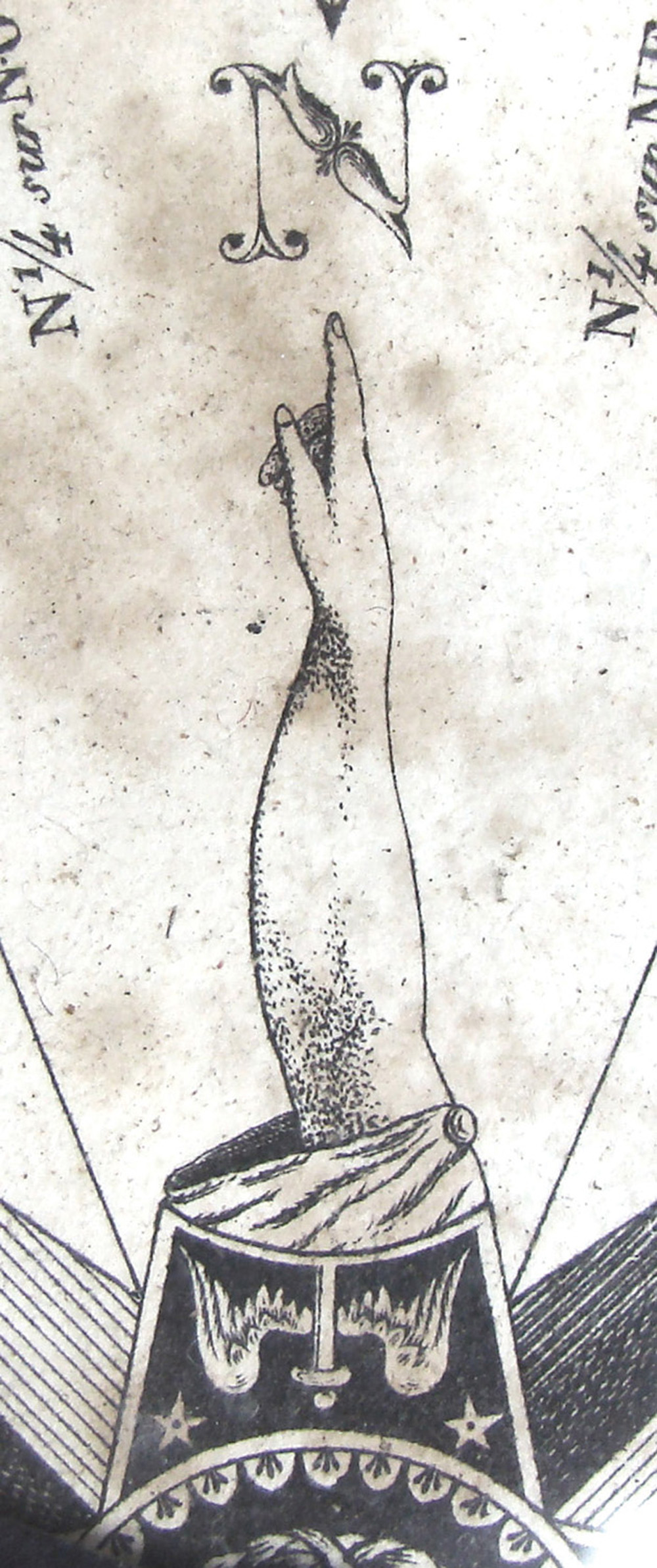
FRENCH SURVEYING COMPASS, c. 1835, bearing the fragmentary trade label of "Huette, Opticien, Quai de l¹Horloge, No. 75, à Paris." Measuring 7-1/2" x 8-1/4" x 1-1/4" (19 x 21 x 3 cm) overall, it is constructed of lovely walnut(?) with 6" diameter inset glazed compass featuring printed paper rose, circumferential brass scale divided every degree, blued tapered needle with stone pivot, and needle lifter activated by external finger screw. The compass rose is quite special, divided to sixty-fourths of a circle and labeled with 32 directionals (e.g., "N.E 1/4 sur E" and "O 1/4 sur S.O"). The outer edge has geometric and swag decoration, and the four principal directionals display the caduceus, a winged staff entwined by two snakes, the symbol of the Greek god Hermes and Roman counterpart, Mercury (the caduceus not to be confused with the single-serpent-entwined rod of Asclepius, the deity associated with medicine and healing). Mercury, the messenger of the gods, was associated with skill and dexterity, particularly in commerce, finance, thievery and even gymnastics. His name derives from the Latin word for "merchandise." Finally an intriguing bared arm points directly North. There are brass-reinforced mounting holes underneath the compass box, a slide-off cover, and mounted to the side a rectangular wooden sighting tube with brass double sights at each end. Condition is fine noting some foxing to the paper rose. Huette is known for a mercury barometer, and was in business for some years prior to his activity being taken over by Loiseau in 1841 (according to Nachet). A fine little theodolite by Huette is listed in Tesseract Catalogue 87 (item 31). (10283) $1400.. |
 |
 |
| All-purpose Compass/Sundial, patented 1893 | Click on any image for a larger view. Scroll to view more items. |
|
|
 |
 |
|
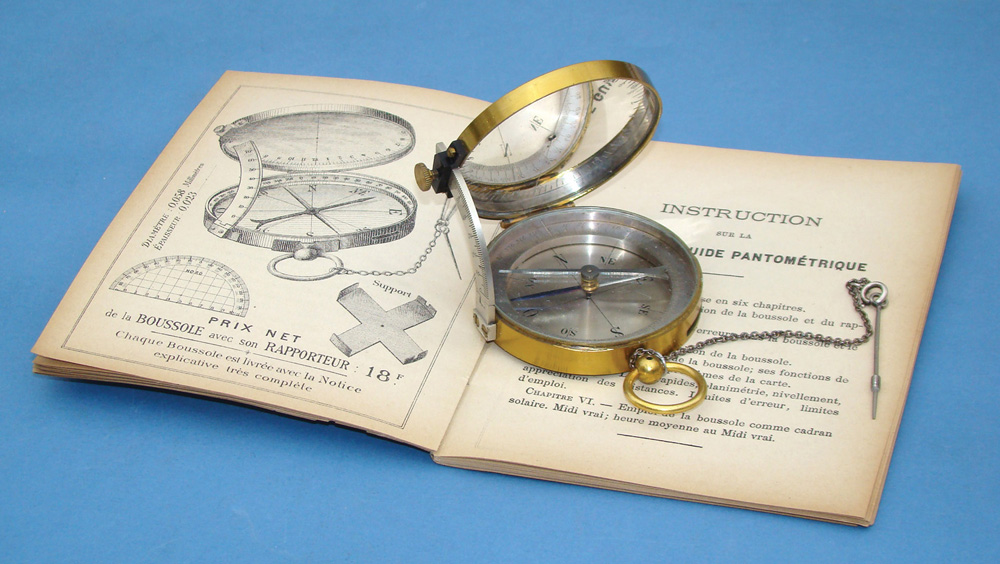
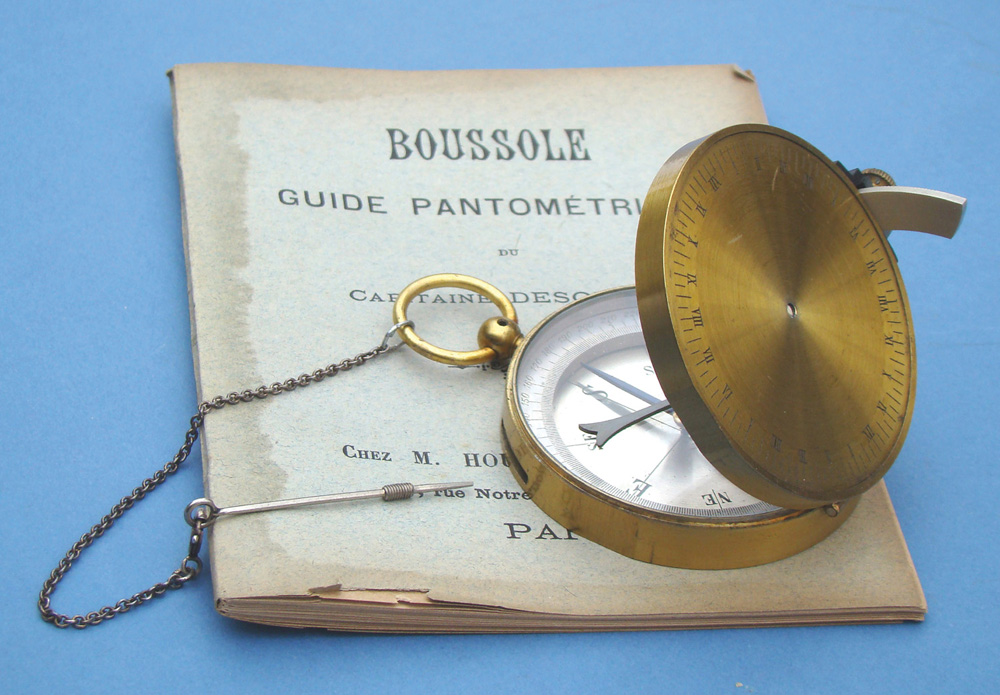
CAPTAIN DESOMBRE'S "BOUSSOLE GUIDE PANTOMETRIQUE," French, c. late 19th century. Constructed by M. Houlliot, of 60 rue Notre-Dame-de-Nazareth in Paris (according to the instruction booklet), and numbered "28," the lacquered-brass-cased compass is 2-1/4" (5.5 cm) in diameter, mounted with pendant ring and pin gnomon / stylus on fine chain. The lid is hinged, and sets up as an equinoctial sundial adjustable against a folding arc for all latitudes from 0° to 70°. Both sides of the inclined cover are divided with twice-12 hour scales for use with the gnomon mounted from either side (summer and winter respectively). The inner dial face is plated to serve as a sighting mirror. The glazed compass itself is set with needle, circumferential scale divided every degree to 360° and rotatable (by external holes) for magnetic offset, and with manually rotatable needle indicator atop the glass. Condition is excellent throughout. Included is the original 64-page instruction booklet with light wear and browning. Not present is an auxiliary transparent protractor. Desombre was an infantry captain who received a patent for his "pantométrique" compass in 1893. Houilliot is listed by Marcelin as compass maker from 1865 until at least 1901. The device was recommended for its portability and its ability to determine directions of both magnetic north and geographic north. An unusual compass in exceptional condition. (10323) $950. |
| Mountain Surveying in 18th century Italy | Click on any image for a larger view. Scroll to view more items. |
 |
 |
|
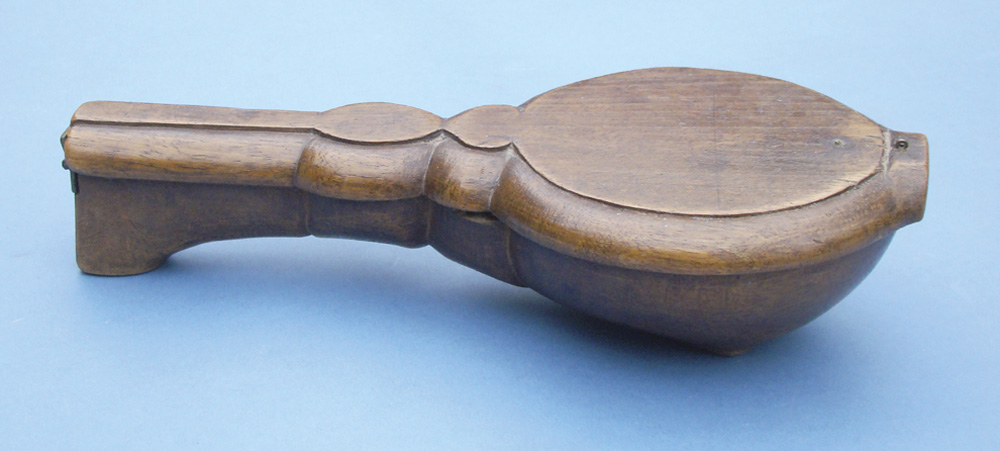
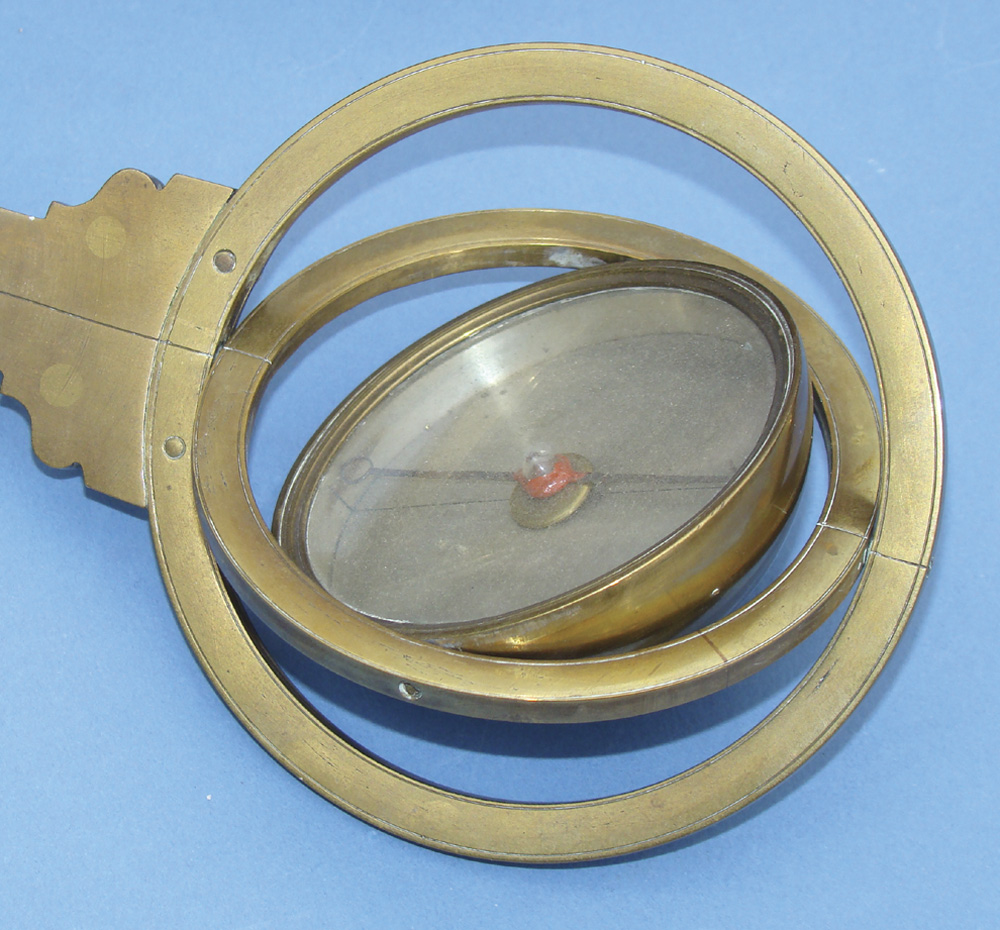
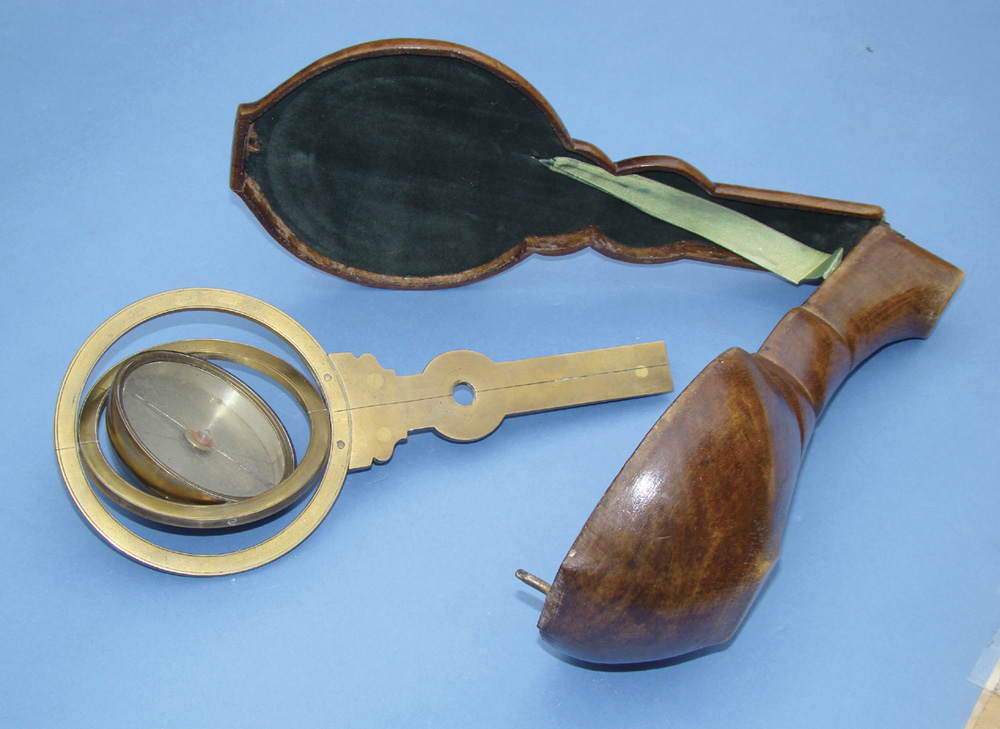
EARLY GIMBALED COMPASS, probably Italian, c. mid-18th century. Made of substantial brass 8-1/4" (21 cm) overall, it has a decoratively shaped support arm with finger grip, mounting hole, and twin gimbal rings maintaining the compass always in the horizontal. The compass itself is set in a weighted brass bowl and features silvered plate scribed with north line, fine arrow-shaped needle with glass hub, and central brass needle lifter activated by thumbscrew below. Condition is very fine throughout, complete with its splendid carved wood fitted case with hinged lid and lined in green velvet. The case follows the shape of the compass, fits wonderfully in the hand, and sits stably on its two flat base areas. Although the fully gimbaled design suggests nautical use, it perhaps was made for surveying in mountainous terrain or in mines. It is a known form; we had a similar one (Tesseract Catalogue 58 Item 35), and there is one in the Whipple Collection in Cambridge. The use of a blown glass pivot hub for the needle strongly suggests a Venetian or neighboring origin. We have had glass hubs on the gimbaled compasses of other presumably Northern Italian instruments, notably a large graphometer and a very fine and early compass (Catalogue 79 Item 16). (9189) $2950. |
|
|
| Schmalcalder's Best, c. 1827 | Click on any image for a larger view. Scroll to view more items. |
 |
 |
 |
 |
 |
 |
|
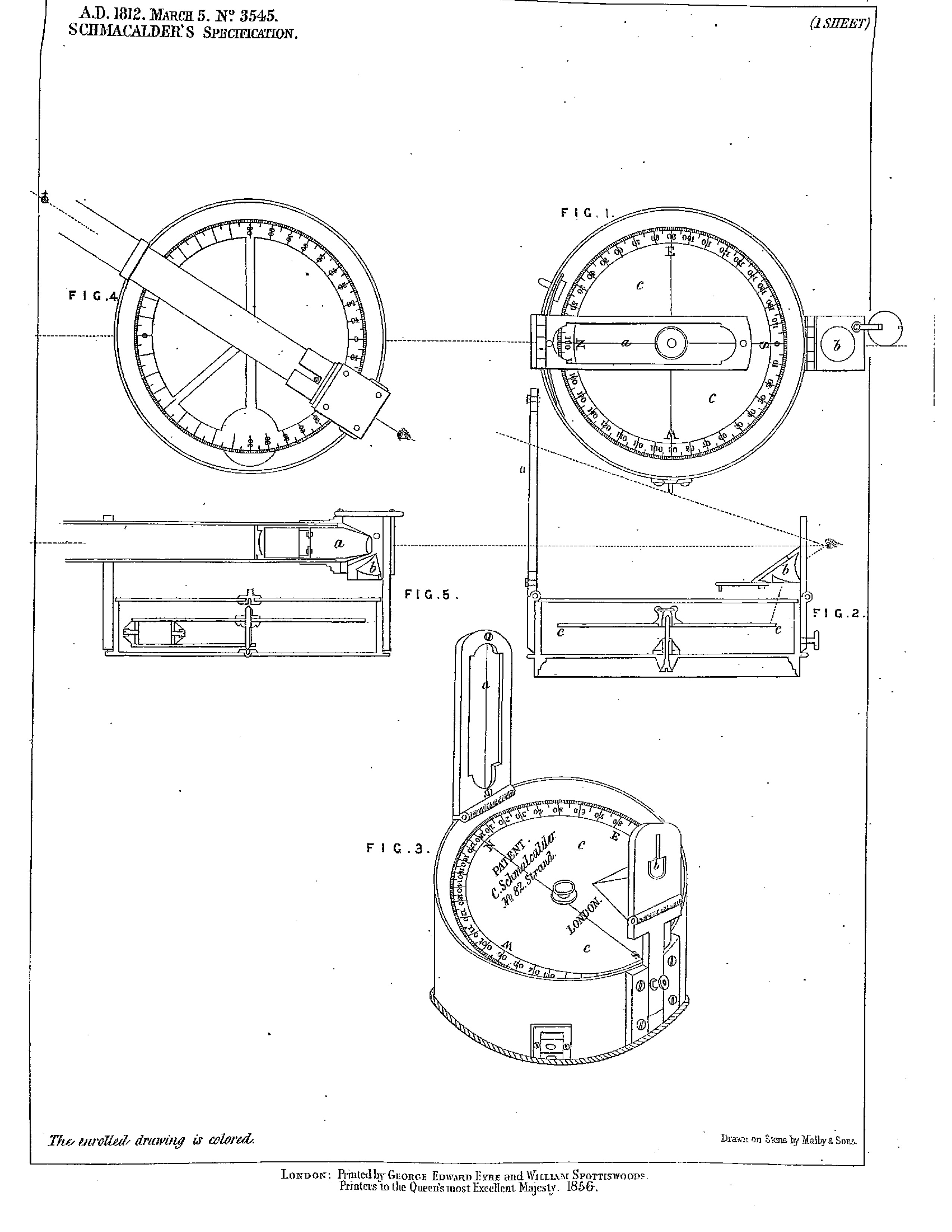
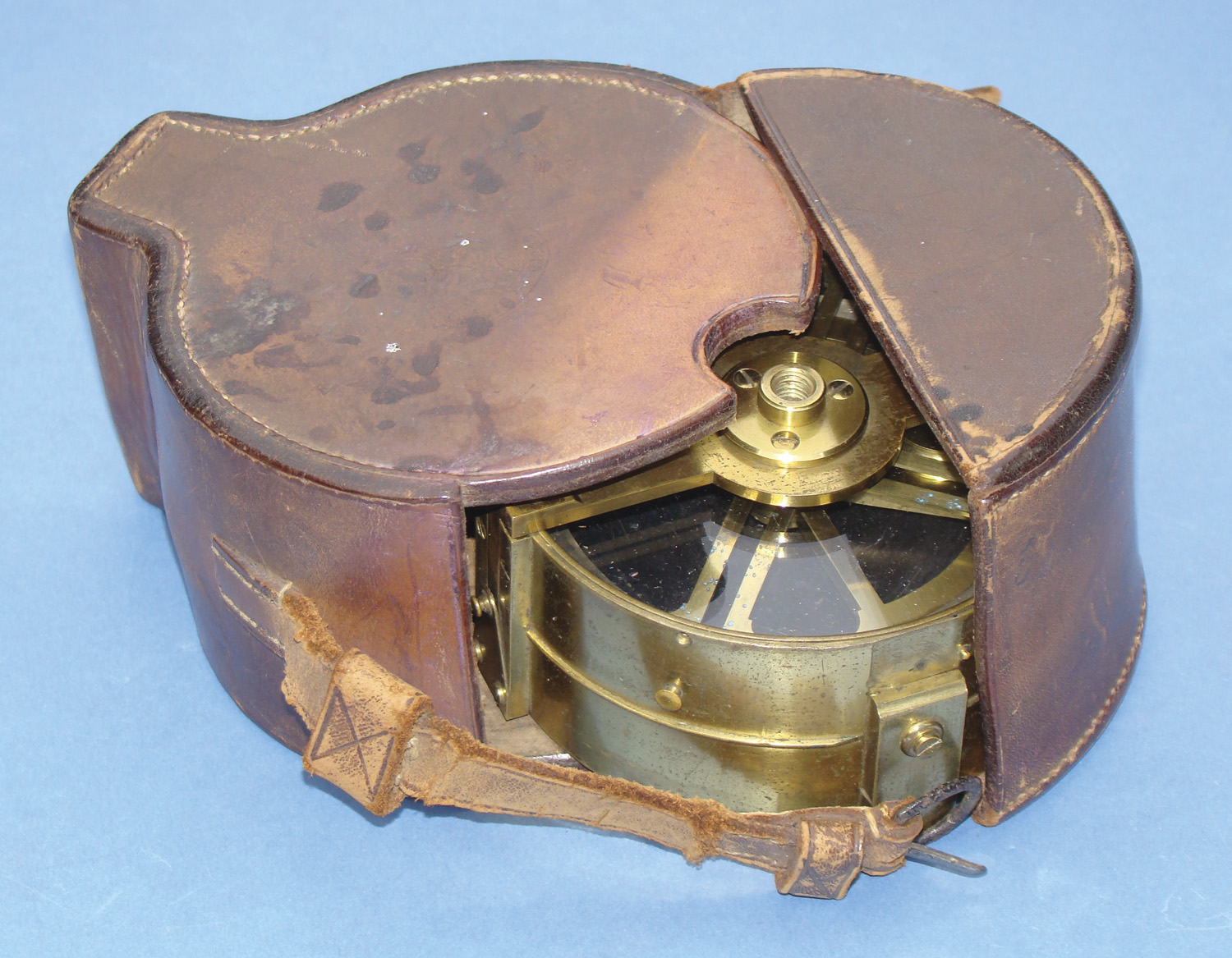
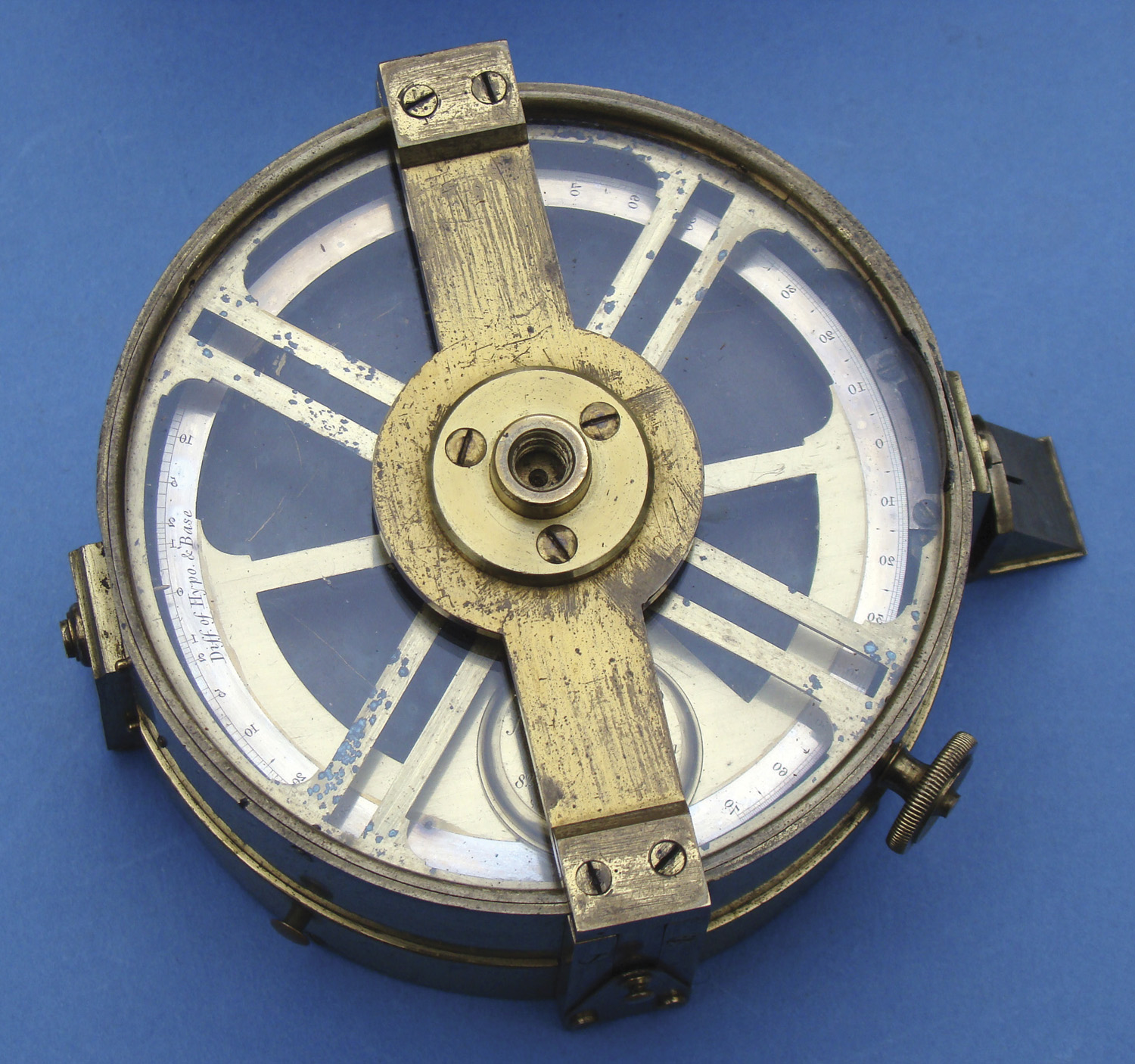
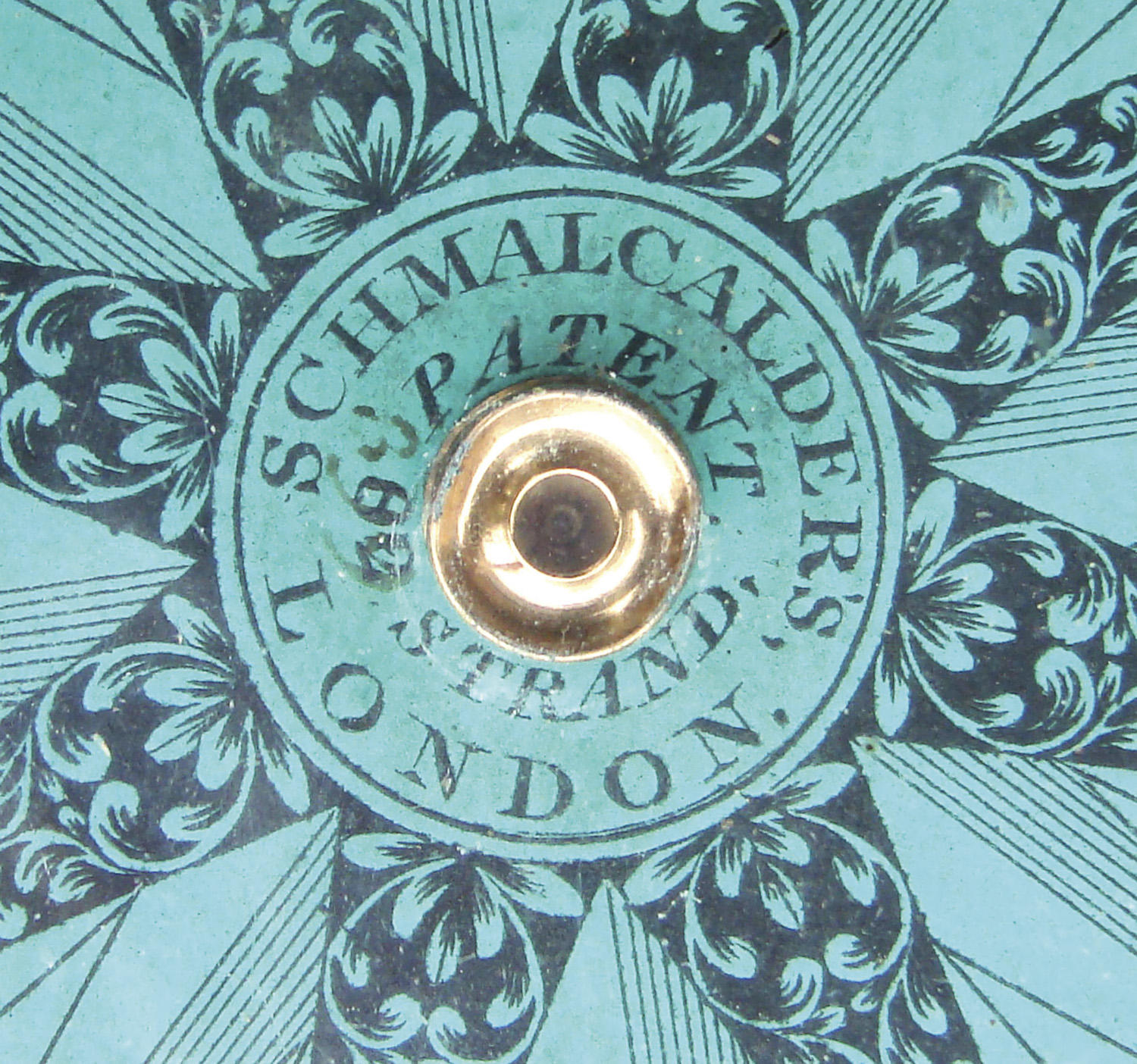
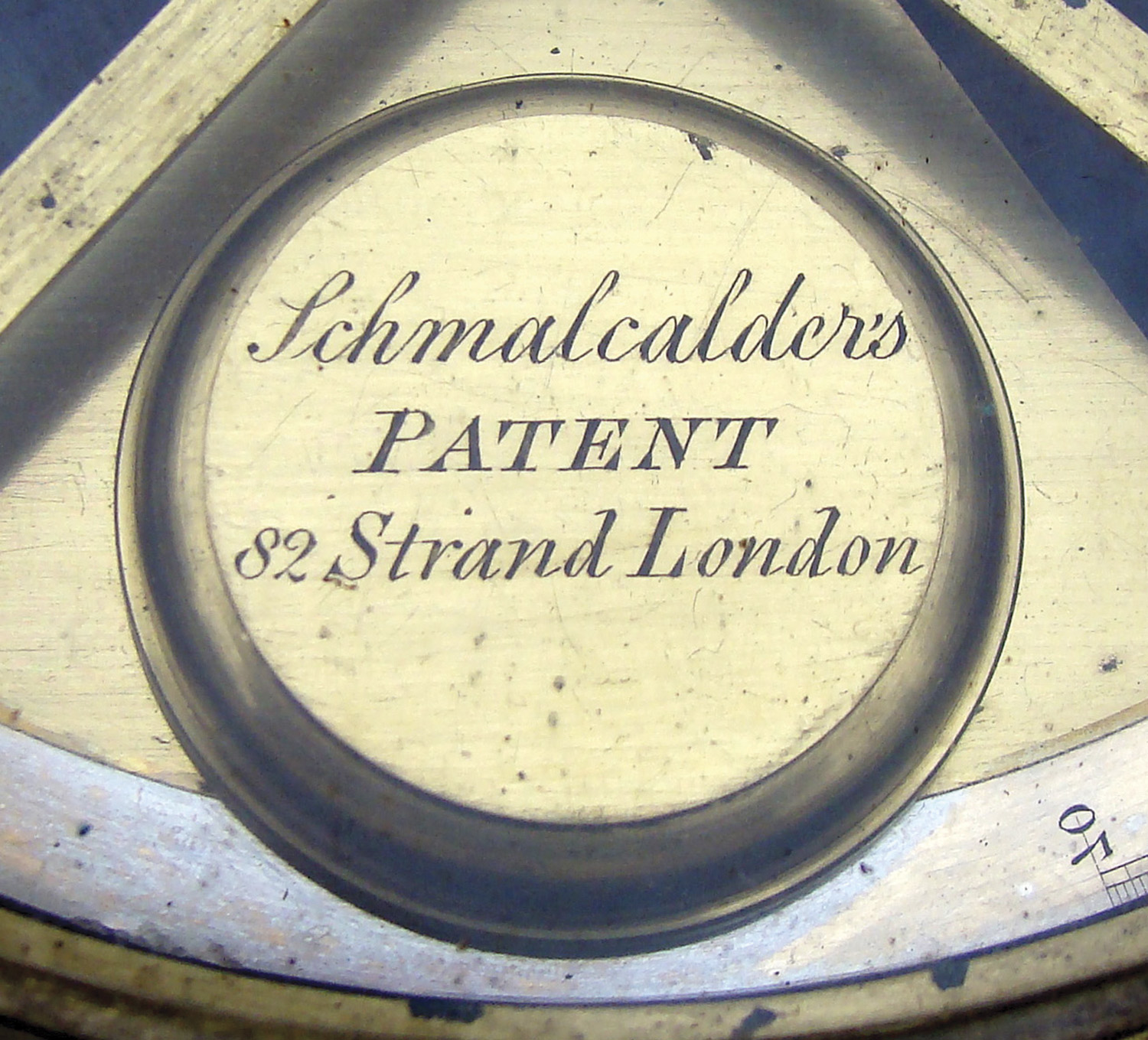
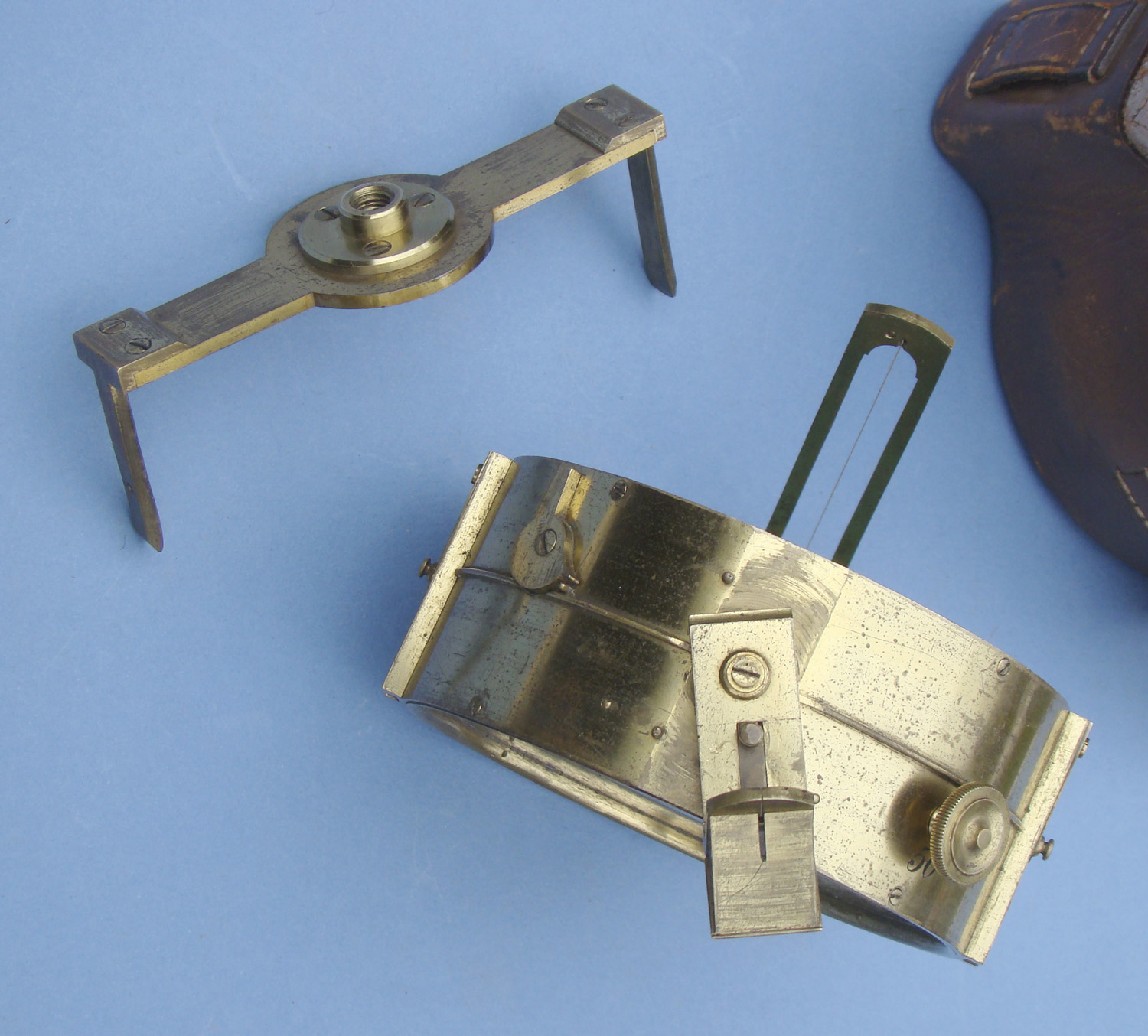
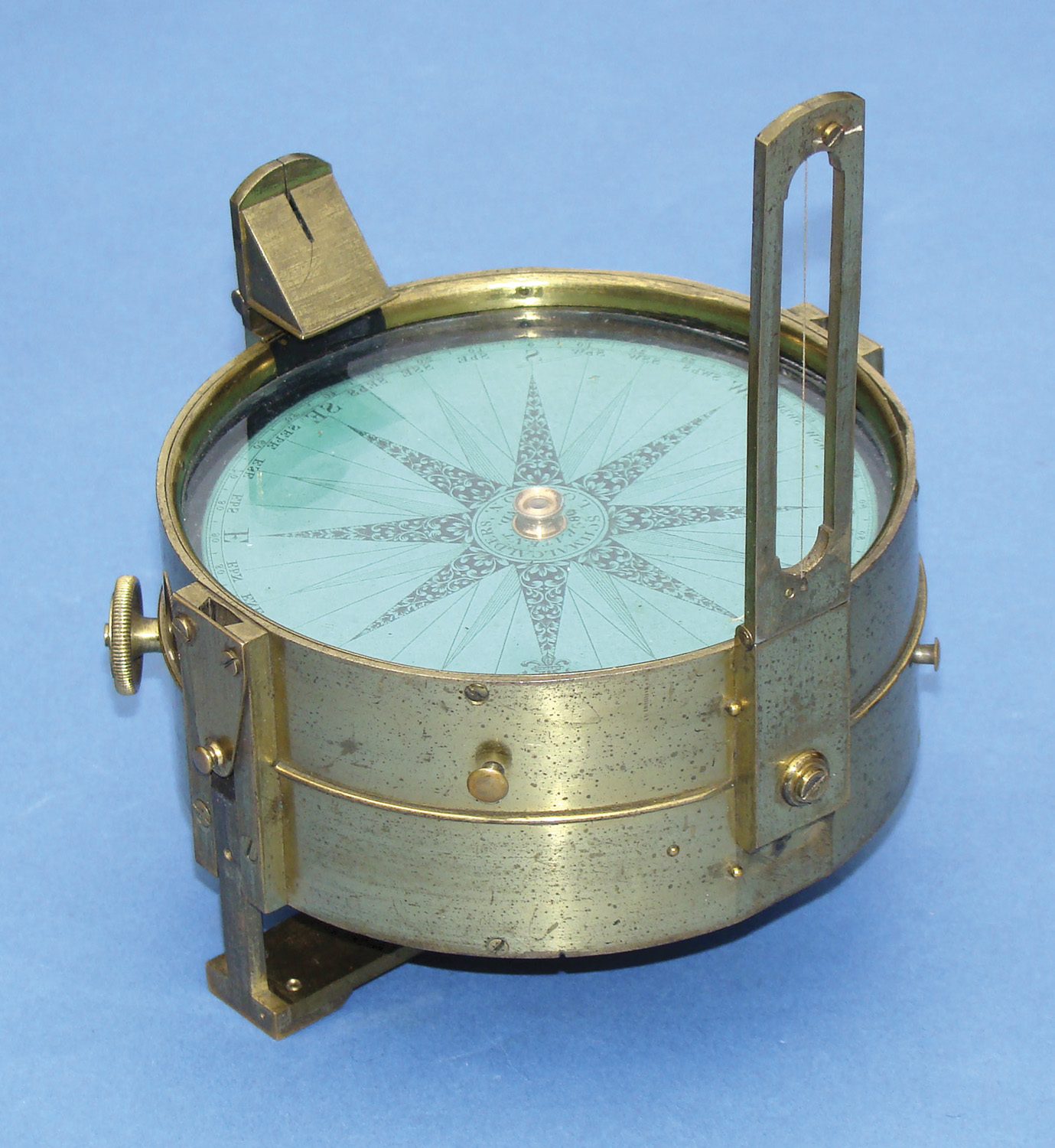
A MAJOR METAMORPHIC COMPENDIUM BY SCHMALCALDER, English, c. 1827. With structures of bright lacquered brass, the stowed compendium forms a compact drum 4" across and 2" thick (10 x 5 cm). One side has a large glazed prismatic compass, with tall folding sight vane, hinged and adjustable prism sight, green compass card printed with beautiful florally decorated 32-point rose and circumferential degree scale divided every 20 arcminutes and labeled in reverse with viewing through the lenticular prism. The card bears the signature "Schmalcalder¹s Patent, 82 Strand, London," and with a faint manuscript correction to "399" Strand. There is a compass card arrestor, card lifter for stowage, and dust cover for the prism sight. Both the prism assembly and the tall sight vane are on clever swivel fittings, and can be brought into use on the other side of the drum, where a precision weighted inclinometer wheel is mounted under glass and suspended on a horizontal axle. The wheel is beautifully engraved "Schmalcalder's Patent, 82 Strand, London" and very finely divided on the silvered (?) circumference, every 20 arcminutes from 0°±70°, and divided nonlinearly from 0±30 in a scale labeled "Diff. of Hypo. & Base" (i.e., "difference of hypotenuse and base," being, as a function of inclination, the number of units longer a sloping terrain is than the underlying horizontal terrain). The weighted wheel can be temporarily arrested by push button, or can be secured for travel by inserting a thumbscrew at the 50° position. And for the pièce de résistance, a U-shaped staff mount can be inserted from either side of the drum, giving a choice of instruments for staff mounting. The compendium is in very fine condition, noting a little spotting on the inclinometer's support members. Included is the original shaped leather case in good condition. In 1812 Charles Augustus Schmalcalder (c. 1786 - 1843) received Royal Patent 3545 (photocopy included) for the application of a right angle prism, with one of its sides ground spherically convex, to all manner of optical, surveying, and navigation instruments, in order to see a degree circle, for example, in the same view while sighting through the instrument . His simplest form of prismatic compass was a huge success, was made by various London instrument makers, and continues in basically the same form today. We have never, however, seen such a large, complex, versatile, and well-crafted form by Schmalcalder as the present compendium of twin prismatic instruments. It seems possible to date it fairly closely; Schmalcalder was listed at #82 Strand from 1810 until 1826, then at 399 from 1827. The handwritten address change on the compass card would indicate c. 1826 / 1827. (10301) $5500. |
|
|
| Four Vanes in your Hand | Click on any image for a larger view. Scroll to view more items. |
 |
 |
|
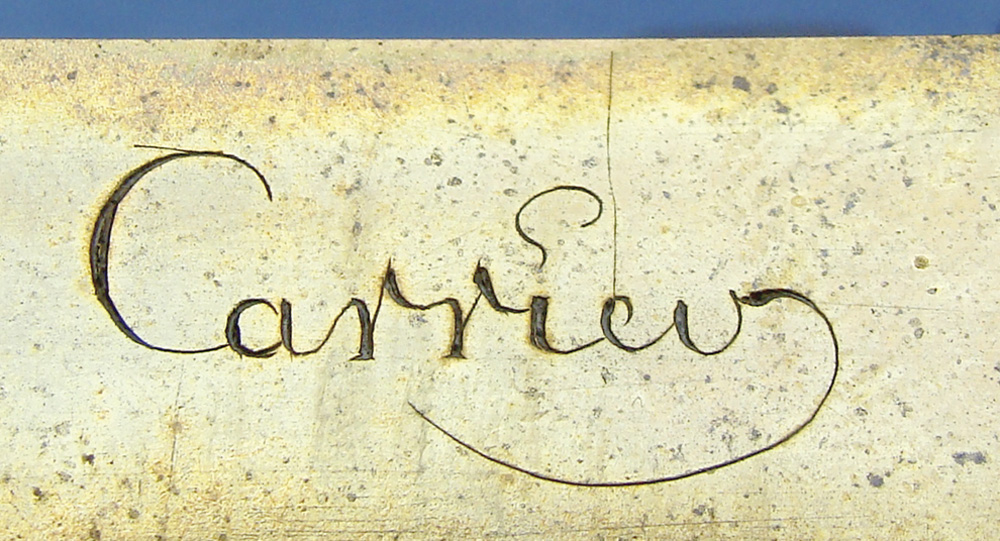
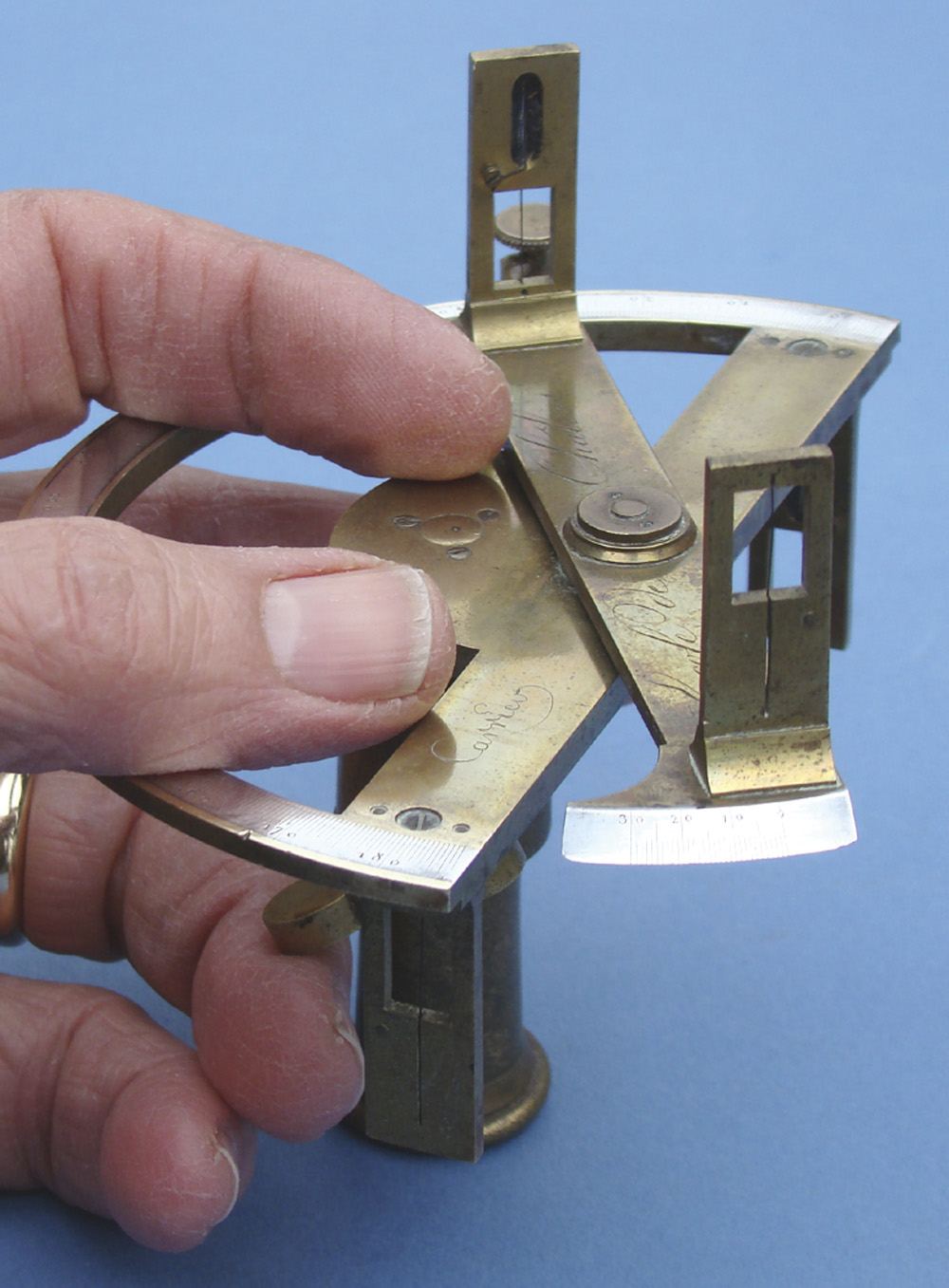
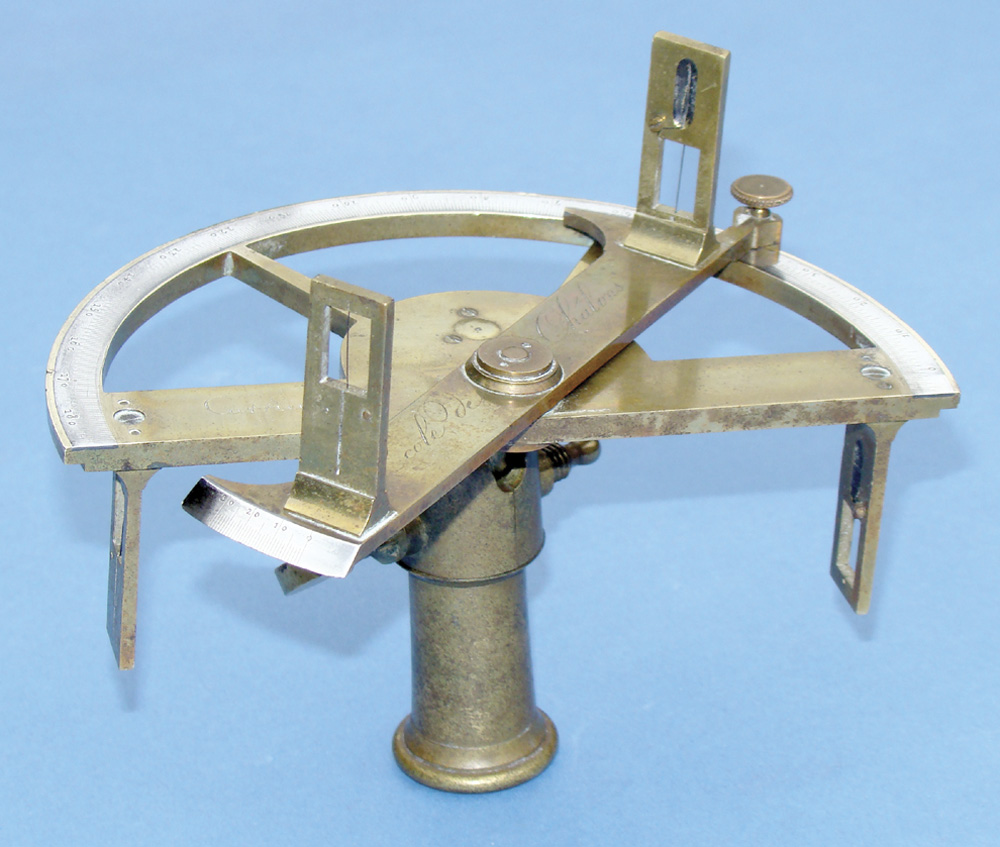
EXCEPTIONAL MINIATURE GRAPHOMETER, French, early 19th century, signed in fine script "Carrieu; Ecole de Chalons." One of the smallest graphometers we have ever seen, this finely crafted instrument is made of brass with inset scales of silver. The actual radius of the divided scale is only 2-1/8" (5.4 cm); overall width of the instrument 4-11/16" (12 cm). In a clever arrangement the two fixed slit-and-string sight vanes hang below the main plate, and the two movable vanes are on the clampable rotating alidade above the plate. The main scale is divided every half-degree from -6° to 186°, and the verniers, divided on their canted surfaces, are each divided to one arcminute. A small staff mount below has ball and socket joint (notched to permit vertical or horizontal use, or anything between) with a fine butterfly clamp screw. Condition is very fine noting some spotting to the mount and underside. Designed for land surveying, construction projects, cartography, and really any use where the apparent angle between any two distant points is required, the graphometer held sway in France from its late 16th century invention by Philippe Danfrie until the early 20th century. The maker of this miniature version was affiliated with the highly reputed technical school in Chalons. With origins as a technical institute founded in the Oise in 1780, this professional school has seen numerous transformations, transfers, and name changes over the past 235 years. It was moved to Châlons-sur-Marne by Napoleon in 1806 as an Ecole Impériale d¹Arts et Métiers (see Gardet, 1975, L¹Ecole de Châlons, Deux Siècles d¹Histoire aux Arts et Métiers). Age of admission was from 12 to 15 years with a 3-4 year program of study. Carrieu is listed in the Webster's Index of makers, but only for one other instrument, that a good 8" diameter surveying circle (Tesseract Catalogue 60 Item 29). And Marcelin records a "Carrieu-Feral" graphometer. (9249) $3800. |
|
|
| Crafted in the Galleries of the Louvre, c. 1640 | Click on any image for a larger view. Scroll to view more items. |
 |
 |
 |
 |
|
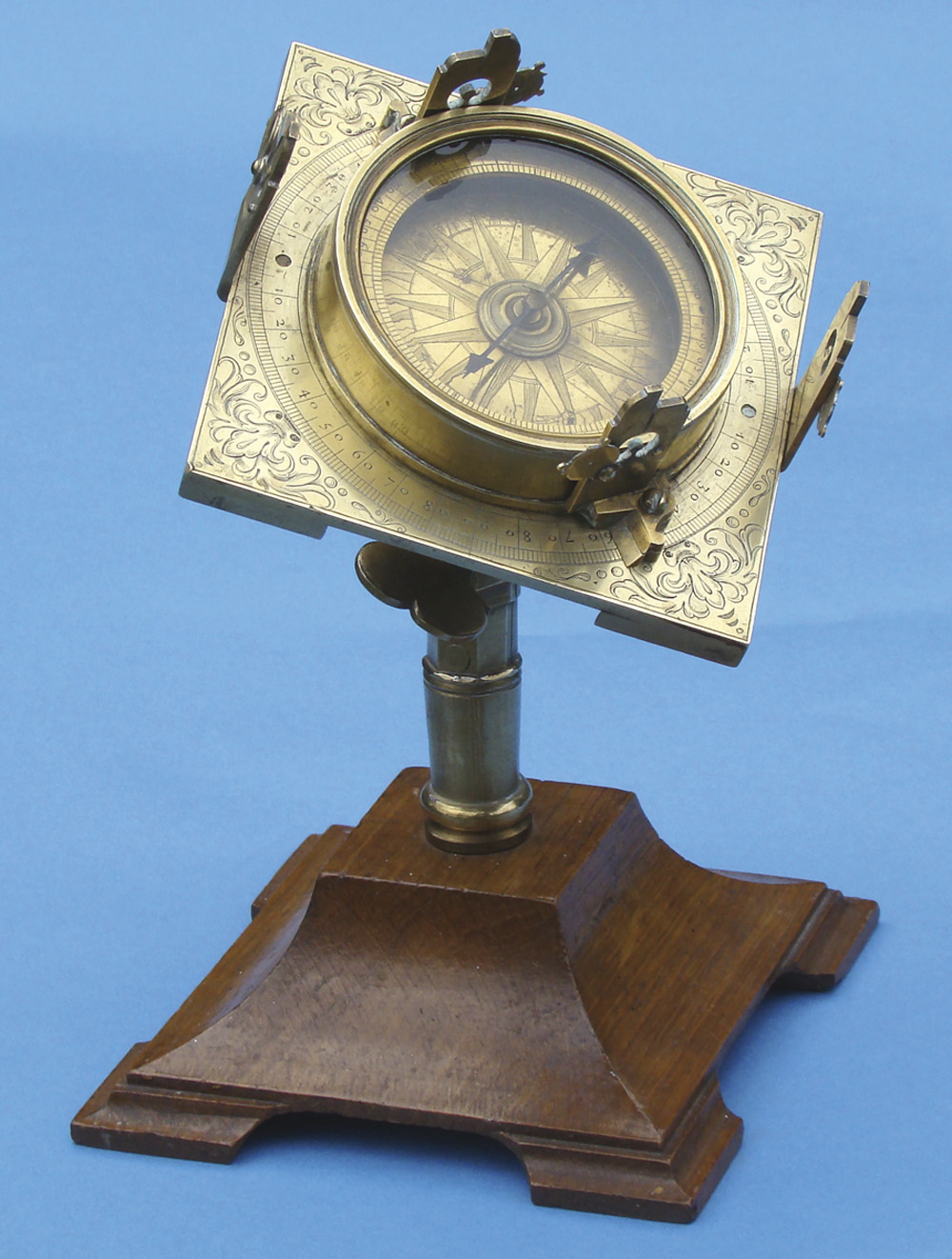
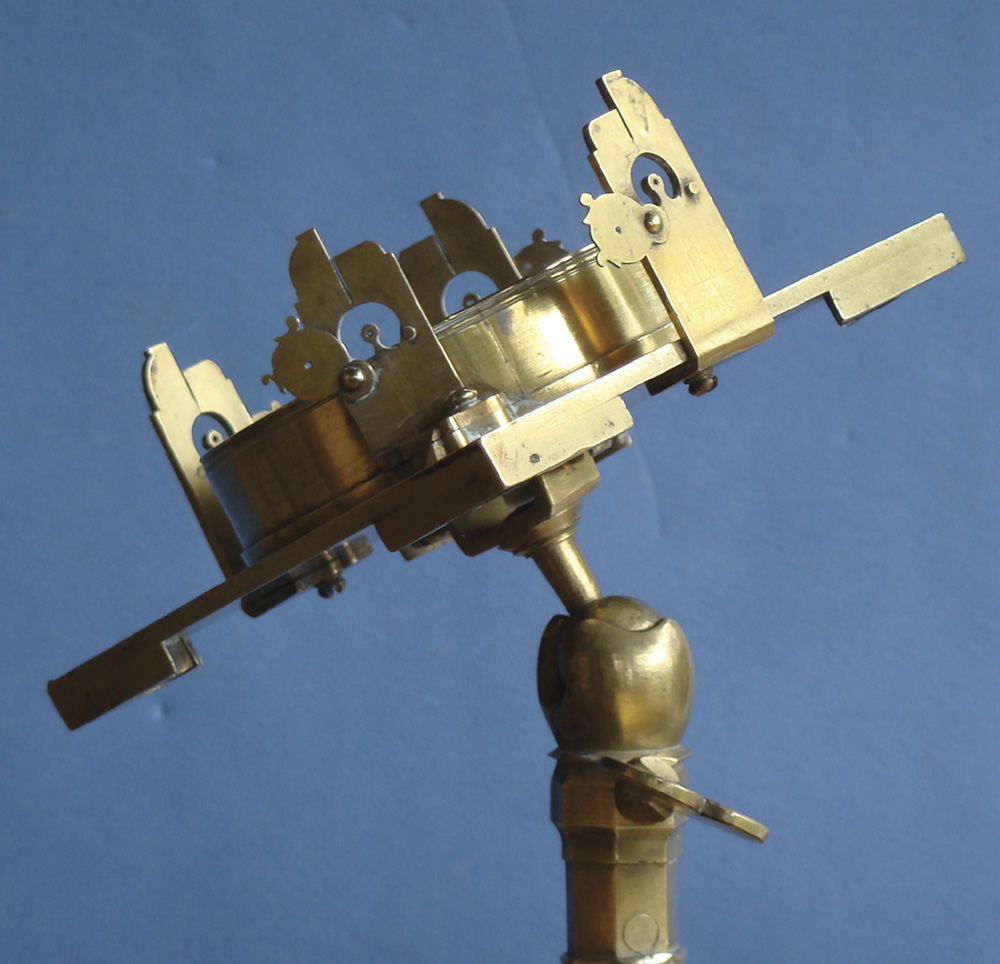
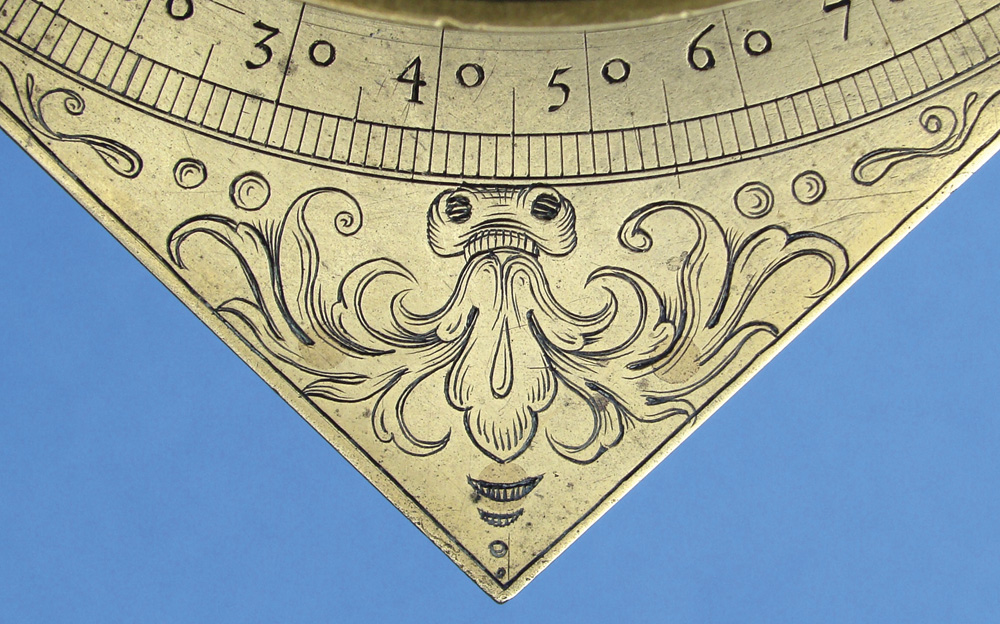
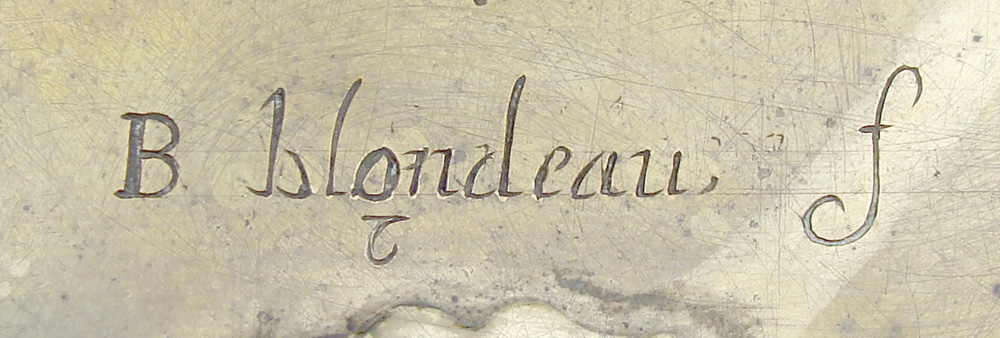
EARLY BRASS CIRCUMFERENTOR, French, c. second quarter 17th century, signed "B. blondeau f". Constructed on a substantial brass plate 4-3/8" (11 cm) square, this early surveying instrument has two fixed sight vanes, two mobile sight vanes mounted to the ends of an alidade rotating against a circular scale divided every degree in four quadrants, and a relatively large (3-1/4" diameter) central glazed compass rotating with the alidade. This compass has a 32-point rose and a circumferential degree scale divided 0(1)90 four times. Each sight vane has a staggered slit, an "open" pinhole, and a fine rotating aperture forming a "closed" pinhole. The spandrels of the main plate bear splendid 17th century decorative engraving. Laminated underneath are four finely shaped brass corners, providing a flat surface probably designed for plane table use. A good clampable ball-and-socket staff mount is attached to the base with two screws. The whole sets up on a very handsome but relatively new wooden display base. The instrument is in fine condition, noting the compass needle and glass probably replaced, and the staff mount possibly an 18th century addition. This is an early and uncommon example of the form, especially in its diminutive size. It relates to the large early Holland circles (see Kiely p. 161; and a similar small four-sight instrument with dominant central compass is shown on p. 212). And we note a much later (c. 1800) small example in Tesseract Catalogue 97 (Item 19). The maker was Baptiste Blondeau, one of a family of important 17th century scientific instrument makers. Baptiste worked c. 1630 - 1655 (see Marcelin), and was named "Ingénieur du Roi" in 1642, working in the galleries of the Louvre. Few instruments by him have survived, noting a large graphometer (this constructed only about 50 years after its c. 1595 invention by Danfrie) at the Marseille Observatory, and a finely decorated one (signed simply "blondeau") sold in 1994. (9269) $9500. |
| French Surveyor's Square, signed & dated 1668 | Click on any image for a larger view. Scroll to view more items. |
|
|
 |
 |
|
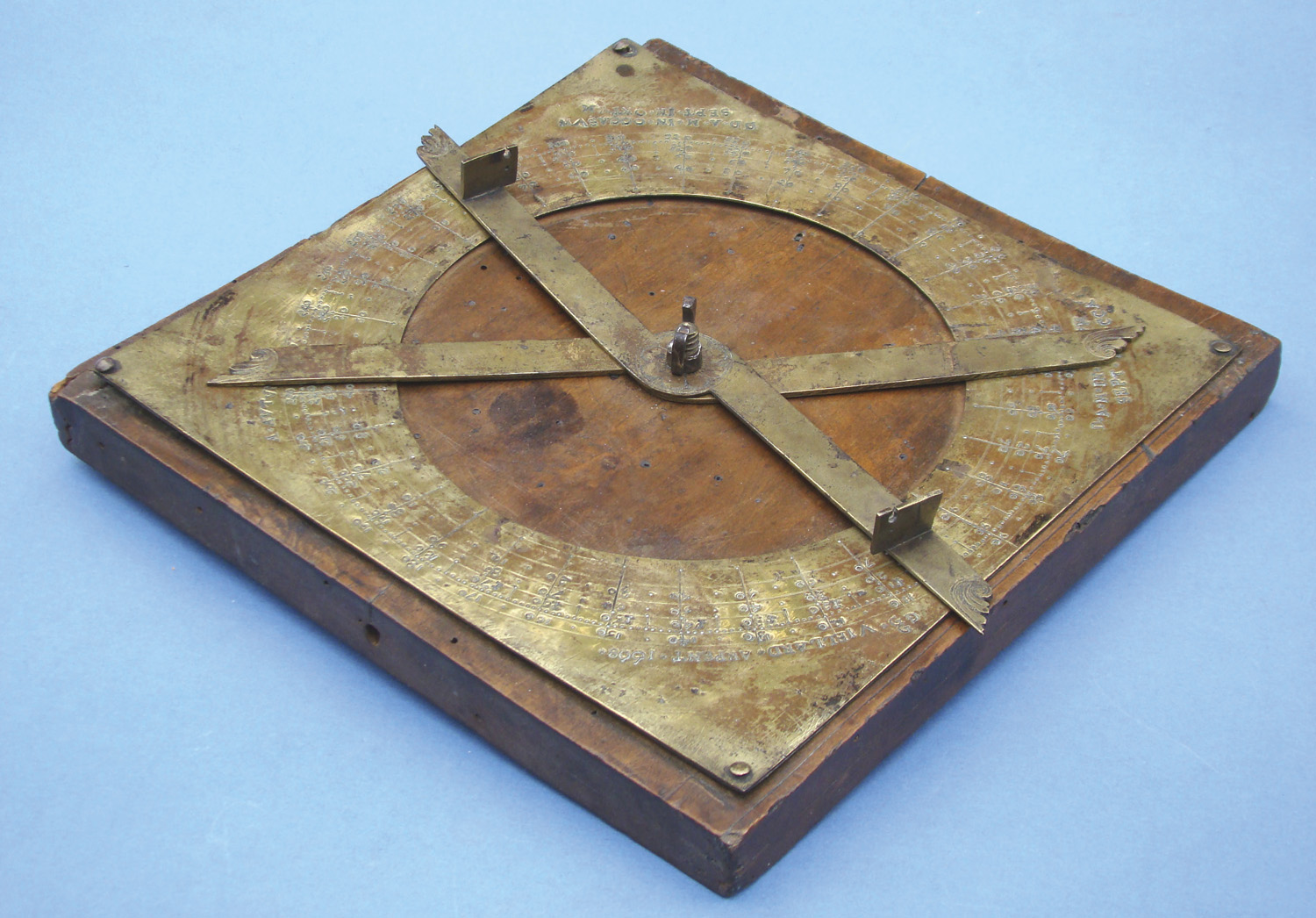
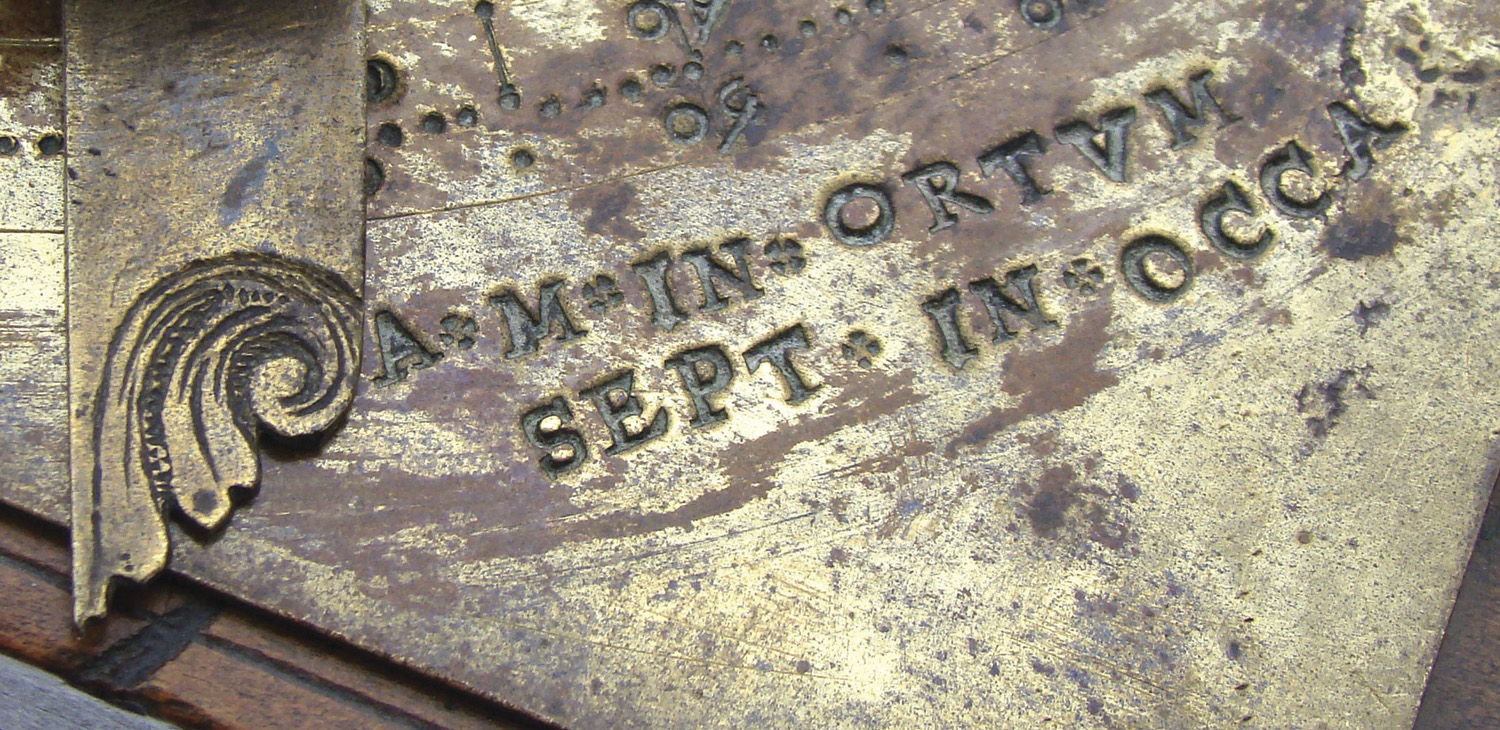
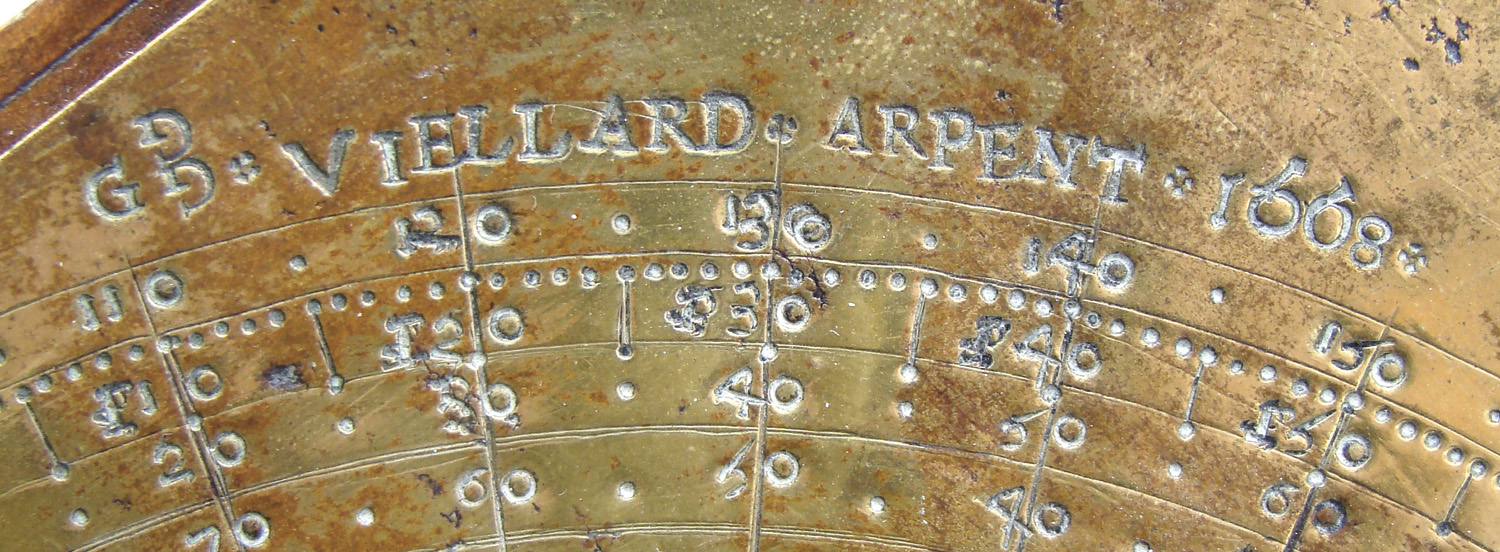
PROVINCIAL FRENCH SURVEYING SQUARE FROM THE SEVENTEENTH CENTURY, 1668, signed "G. VIELLARD Arpent 1668 à Autun." The surveying square is made of sheet copper or brass, gilded and pinned to a 7-3/4" (20 cm) square block of dense walnut (?). This plate has an open center and is inscribed with four degree circles, punch divided every five degrees and every degree, labeled with punched numerals every ten degrees in each quadrant running from 0 to 90 and from 90 to 0, and running full circle from 0 to 360 (noting half a dozen punched numeral errors corrected by the maker). Two spandrels are labeled respectively "D A M IN ORTUM SEPT IN OCCA" and "D A M IN OCCASUM SEPT IN ORTUM." Two alidades rotate about the center, clampable with hand-shaped iron wing nut. The alidades may be used singly or in combination; each has decoratively shaped and engraved ends and central engraved eight-petaled flower. One alidade is flat, the other mounted with twin sight vanes each with double sighting holes. Condition is fine noting the central screw probably replaced, wear to the gilding, brown patina to the exposed brass / copper, and old worm holes to the wood. This is a fine and rare example of early surveying instrument, by an unlisted maker who calls himself an "arpent," i.e., a surveyor, and who worked in Autun in Burgundy in east central France. Searching through the published inventory of the Archives Departementales of the Cote-d¹or, we find existence of the drawn survey of the forest of Fouchères, made by Guy Viellard, listed not just as surveyor, but as "arpenteur juré du Roi." Another document records permissions for wood harvesting in the forest, from 1645 - 1674, just when this instrument was made and used. (10251) $9500. |
| With Italian Wind Directions | Click on any image for a larger view. Scroll to view more items. |
|
|
|
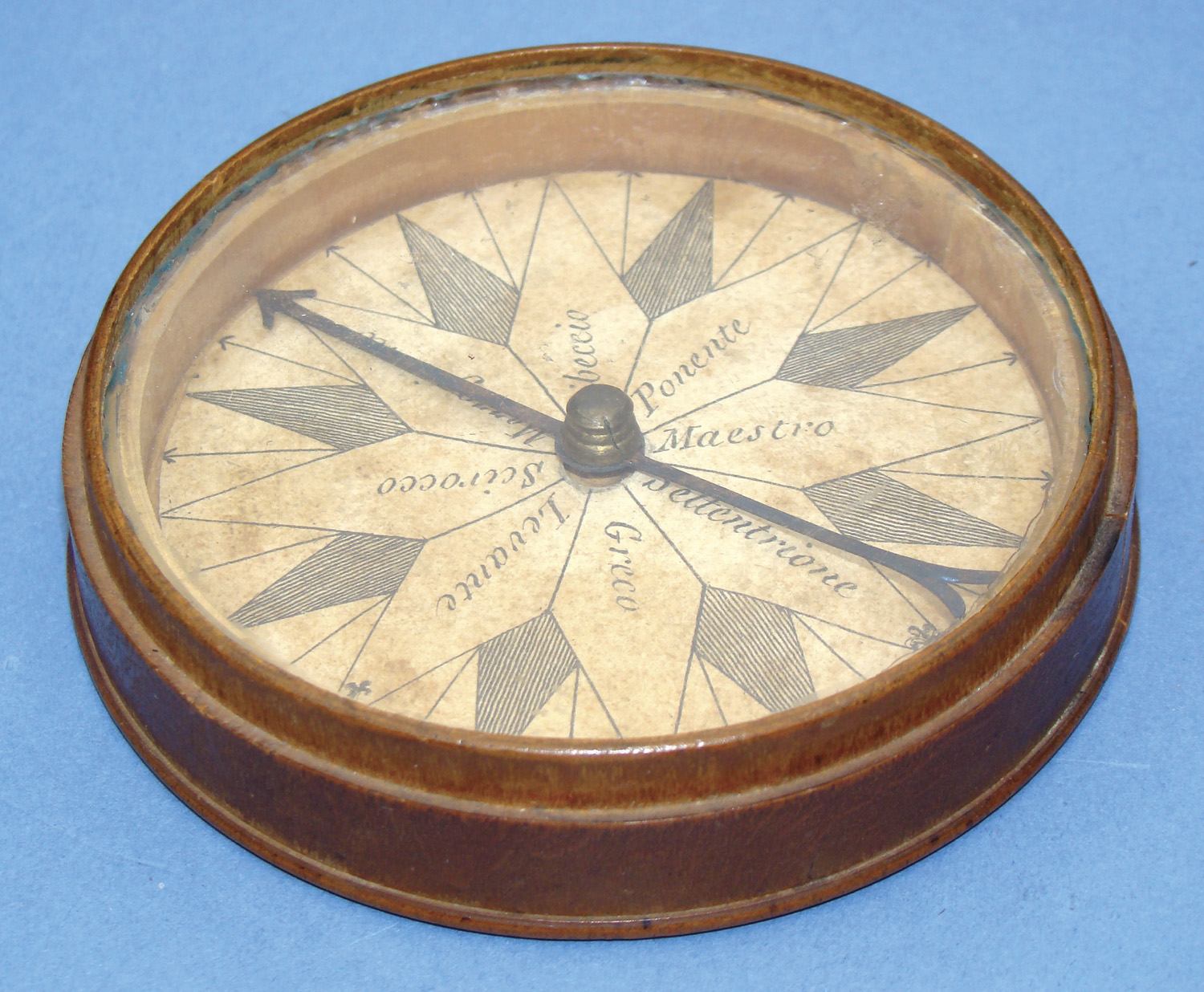
ITALIAN WIND-ROSE COMPASS, probably Northern Italy, c. late 18th / early 19th century. The printed compass card and arrow-shaped needle with brass hub are set under glass in the 3-1/2" (9 cm) diameter compass box of turned box- or fruitwood. The card shows a fleur-de-lys north point, a decorative "cross" east point, and 32 directionals, eight of which are labeled with Italian wind directions: Settentrione, Greco, Levante, Scirocco, Mezzogiorno, Libeccio, Ponente, and Maestro. The north wind is more commonly known as Tramontana, "from across the mountains;" here Settentrione is used, a term for Northern Italy. Condition is fine but lacking lid. (10261) $650. |
| Fine Swiss Pocket Barometer | Click on any image for a larger view. Scroll to view more items. |
 |
 |
|
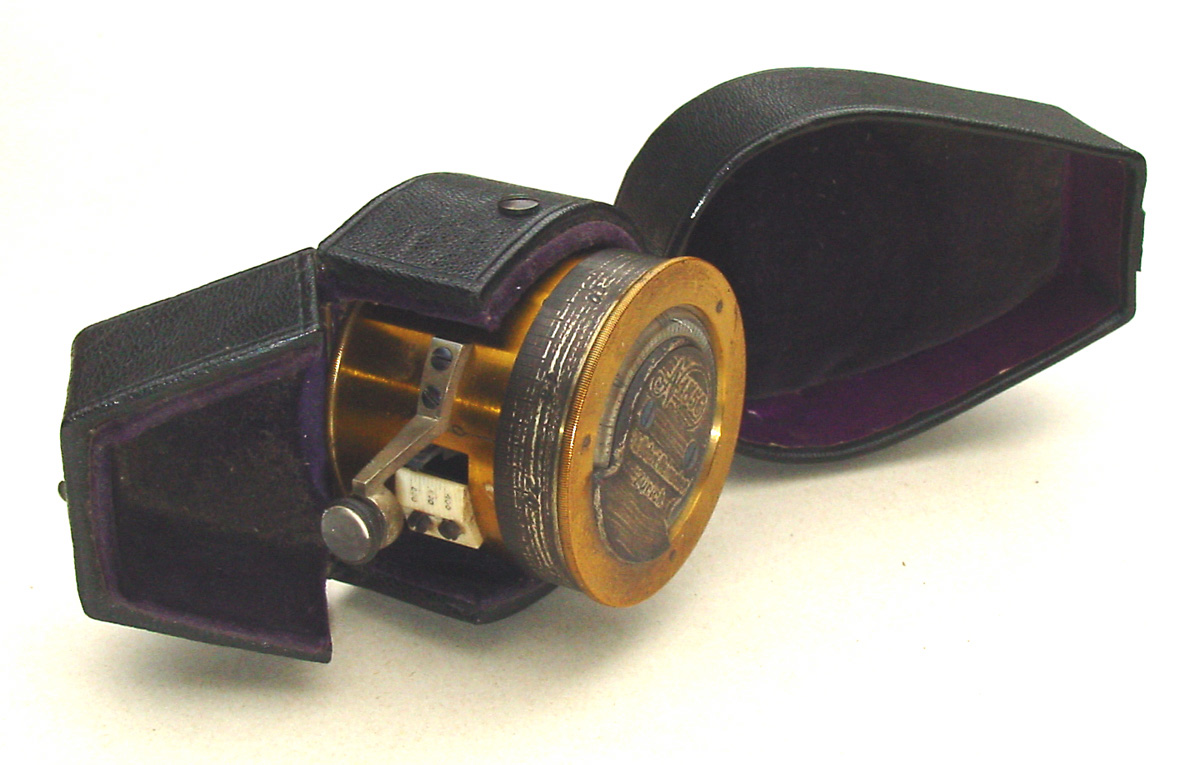
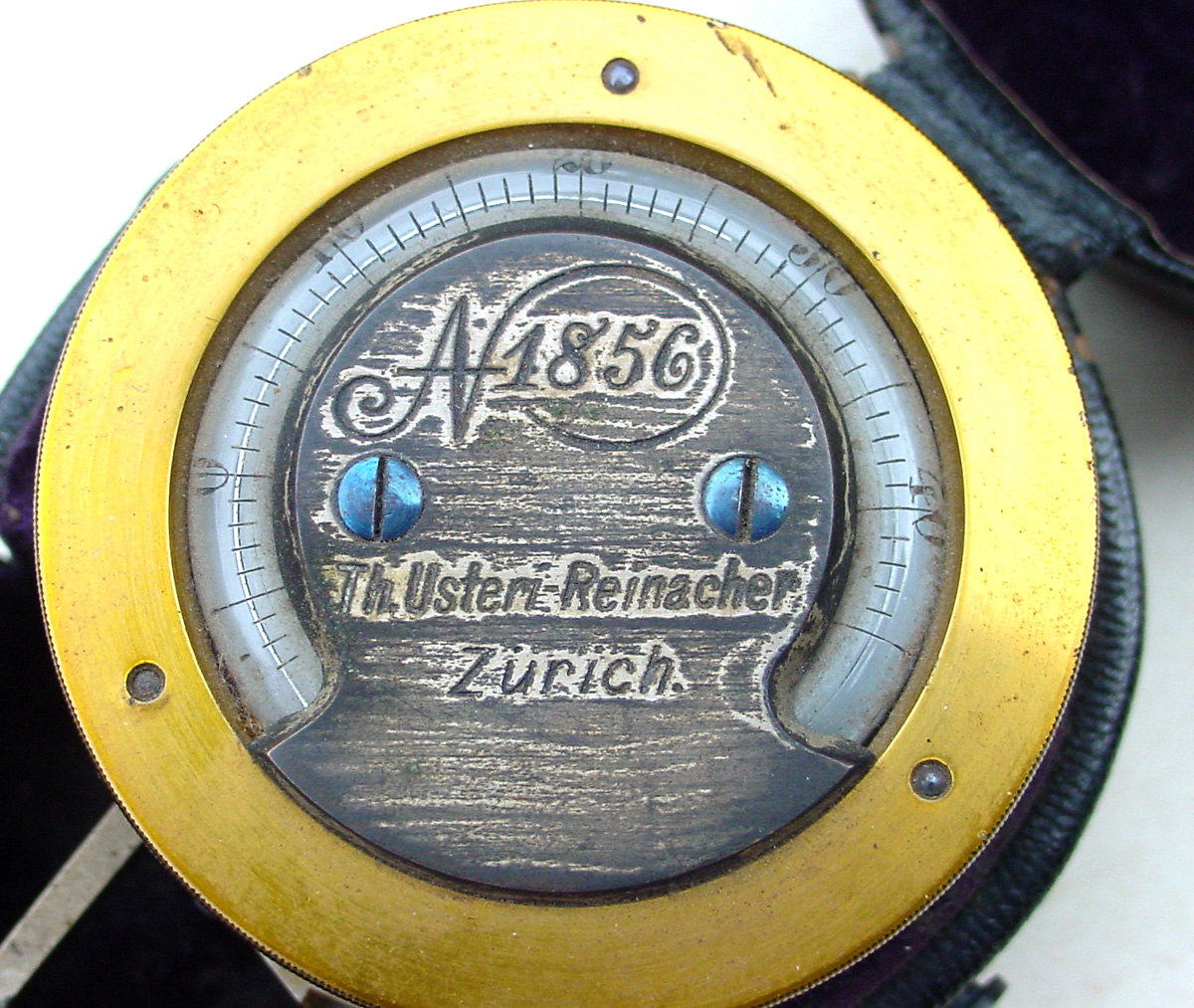
GOLDSCHMID-FORM POCKET BAROMETER, Swiss, late 19th century, signed "Th. Usteri-Reinacher, Zurich, N. 1856." This beautifully constructed aneroid barometer is contained in a shaped pebbled-leather covered doubly-hinged case, and consists of a 1-7/8" (19 mm) diameter lacquered brass drum with twin index arms reading against a 400 - 800 scale, readout magnifier, and rotating top with inset circular thermometer and silvered cylindrical scale divided every half unit from 0 to 50. Condition is fine throughout. Invented by the instrument maker J. Goldschmid c. 1857, the device consists of a totally unconstrained evacuated chamber bearing only against a tension spring which extends to the readout window, with a second spring alignable by rotation of the calibrated disk above. The long thermometer permits temperature corrections. According to Middleton (The History of the Barometer, pp. 418 - 420) "It was a remarkable first attempt at a null instrument of this sort...." (8280) $1350. |
| Nuremberg Work by Böhmländer | Click on any image for a larger view. Scroll to view more items. |
 |
 |
|
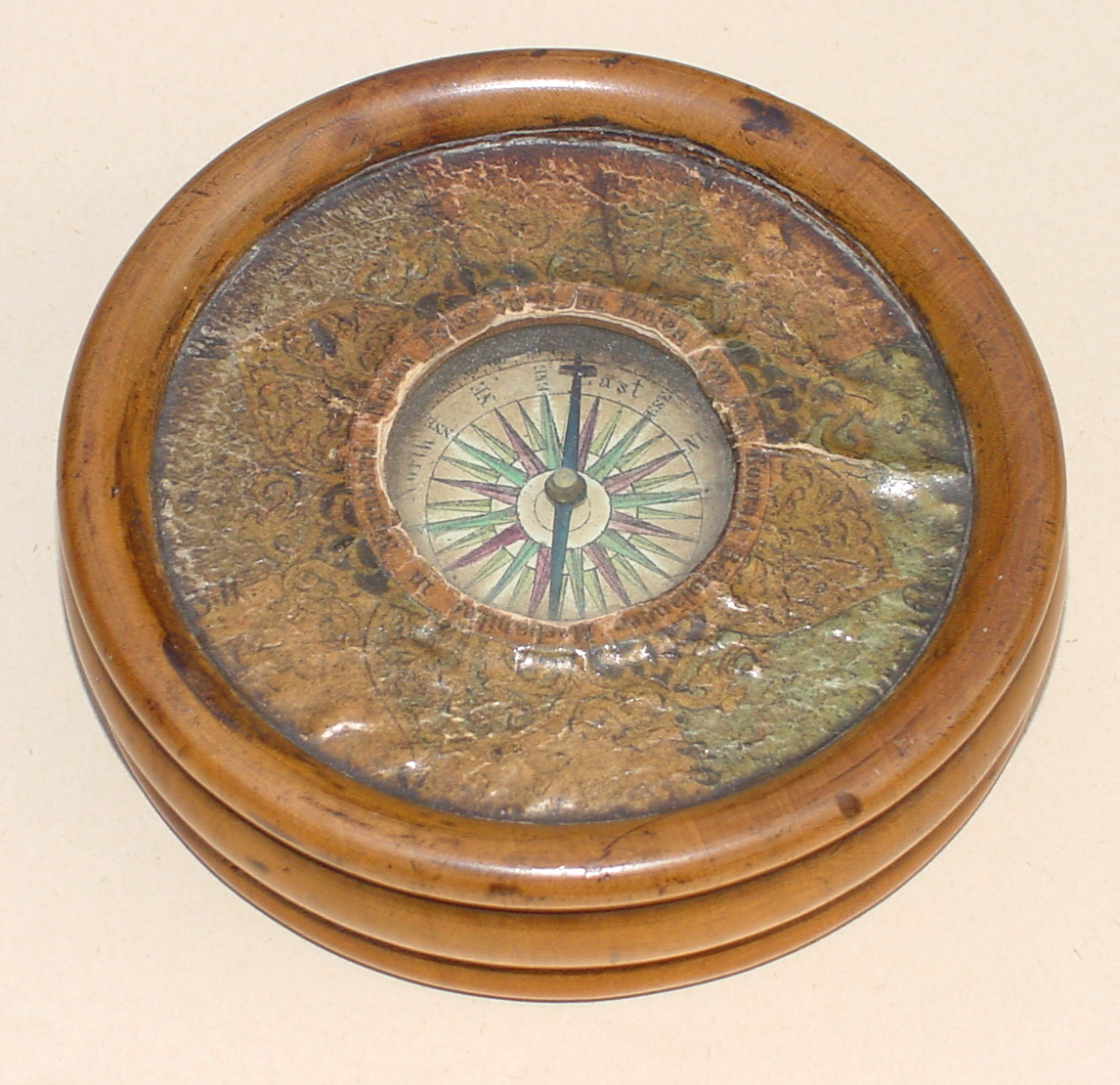
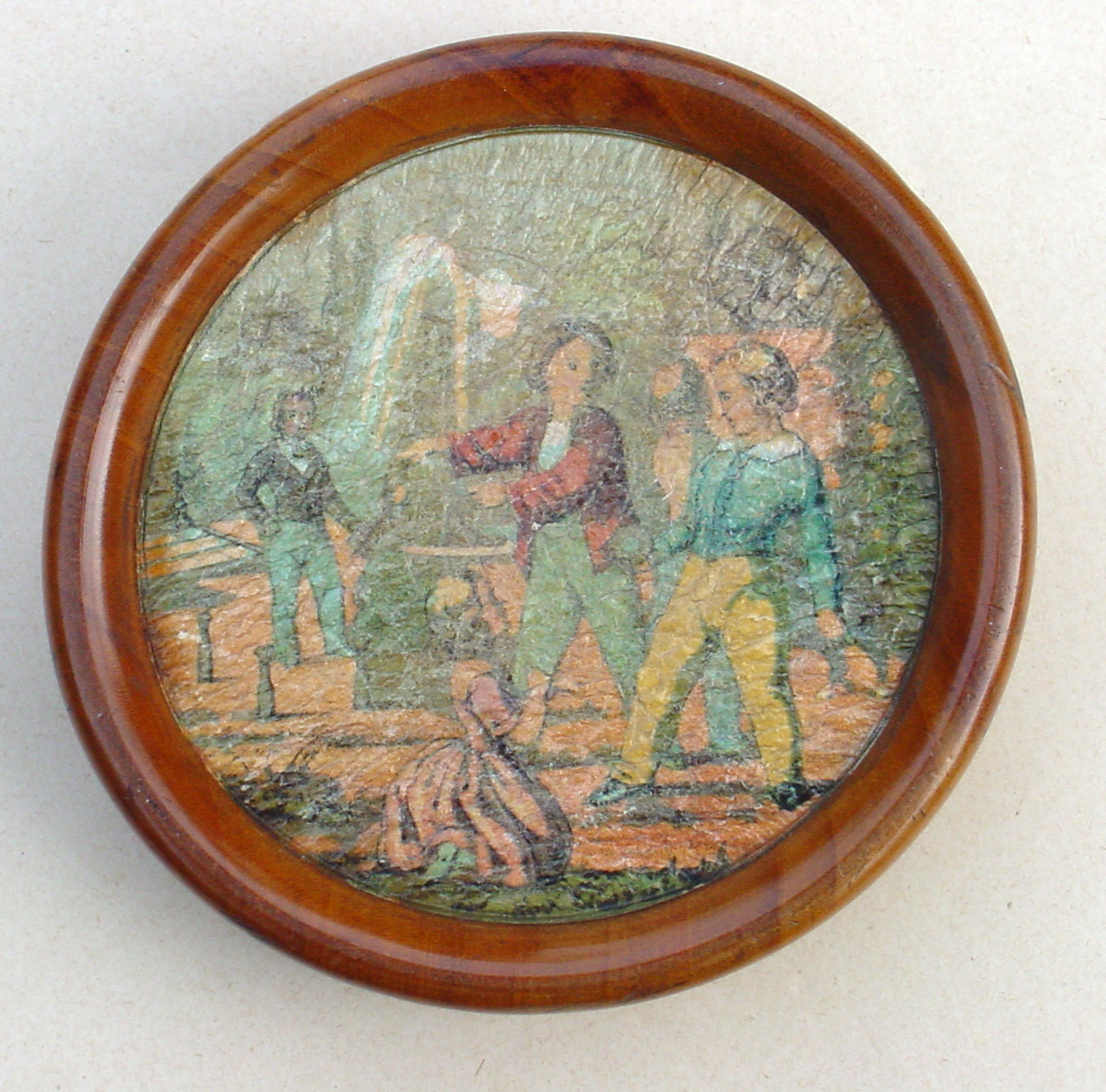
HAND-HELD COMPASS, German for the English market, c. 1800, signed "Neues Polar S..el im Freien von Joh. Konrad Böhmländer Mechaniker in Nürnberg." The fine turned wood cell is 4" (10 cm) in diameter, set on one side with a colored print of children at play, and on the other with a floral print with German directionals, surrounding the glazed compass with its colored 32-point rose, directionals printed in English, and magnetic declination of 18° West. Condition is good, the wood considerably shrunk with age, and the varnished paper crinkling. Little is known of Böhmländer, but the piece reminds us of other late 18th century Nuremberg work, e.g., the pillar sundial compendium of W. Burucker (Tesseract Catalogue F Item 29). (8290) $950. |
| Instantaneous Triangulation in the Field | Click on any image for a larger view. Scroll to view more items. |
 |
 |
 |
 |
|
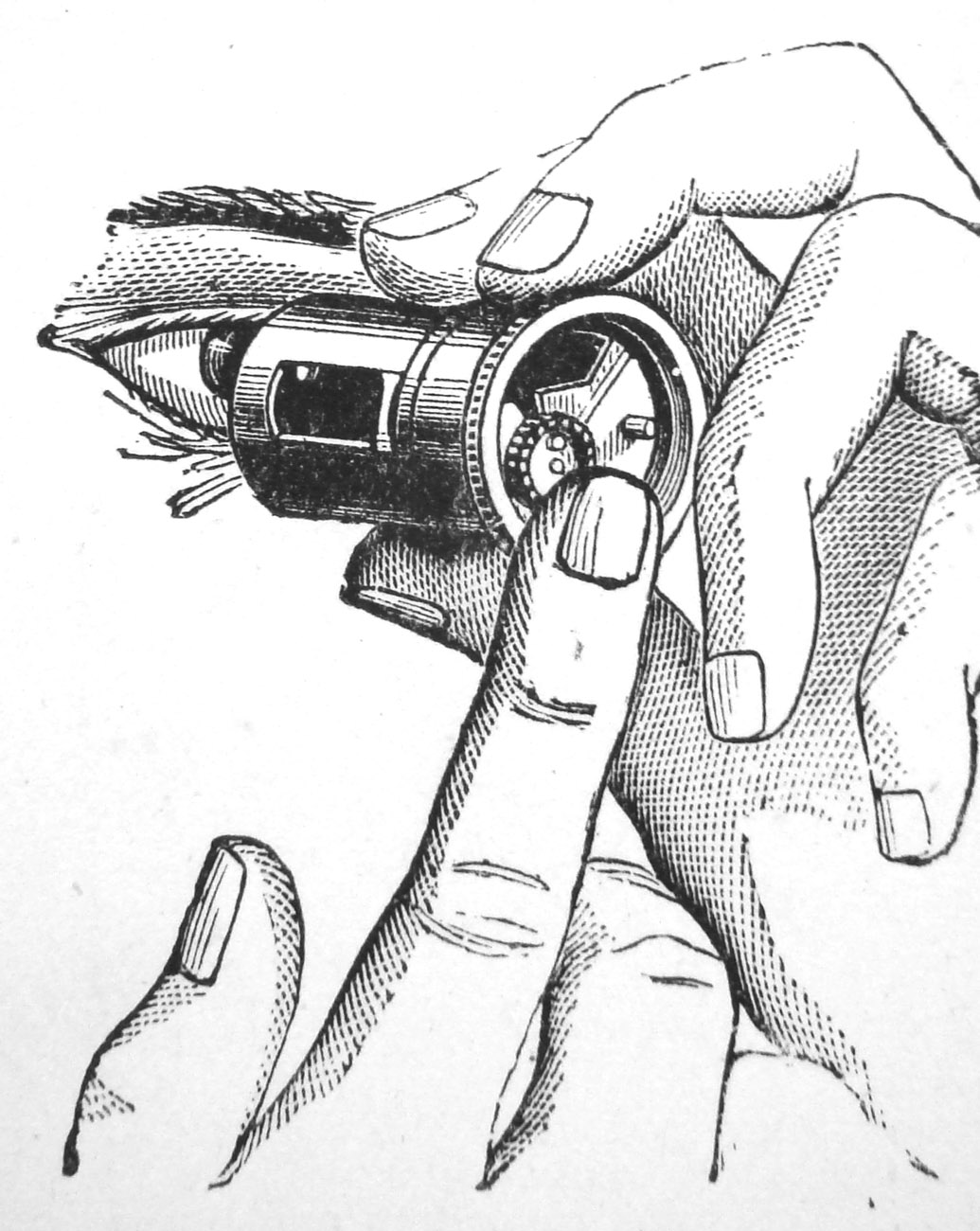
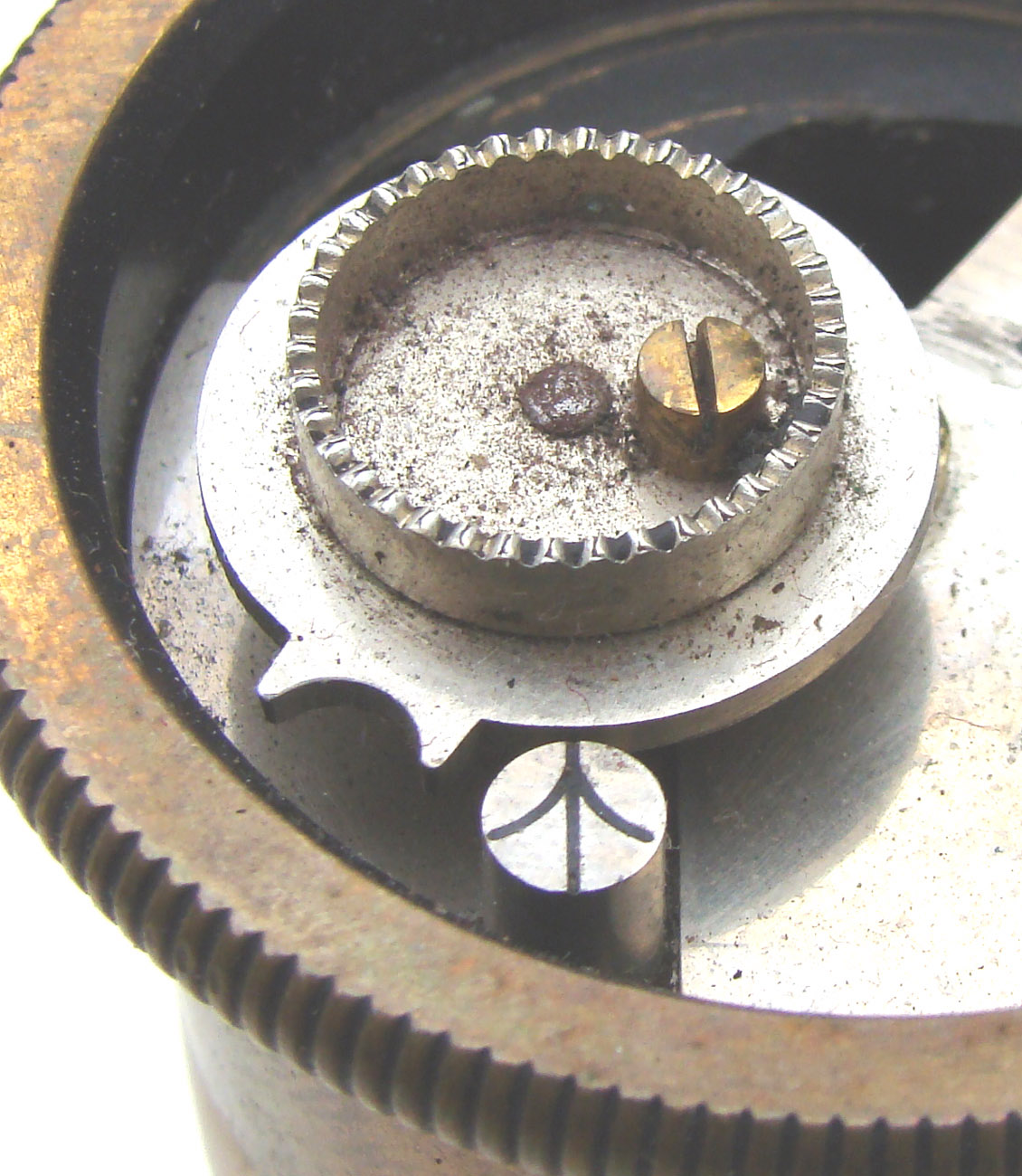
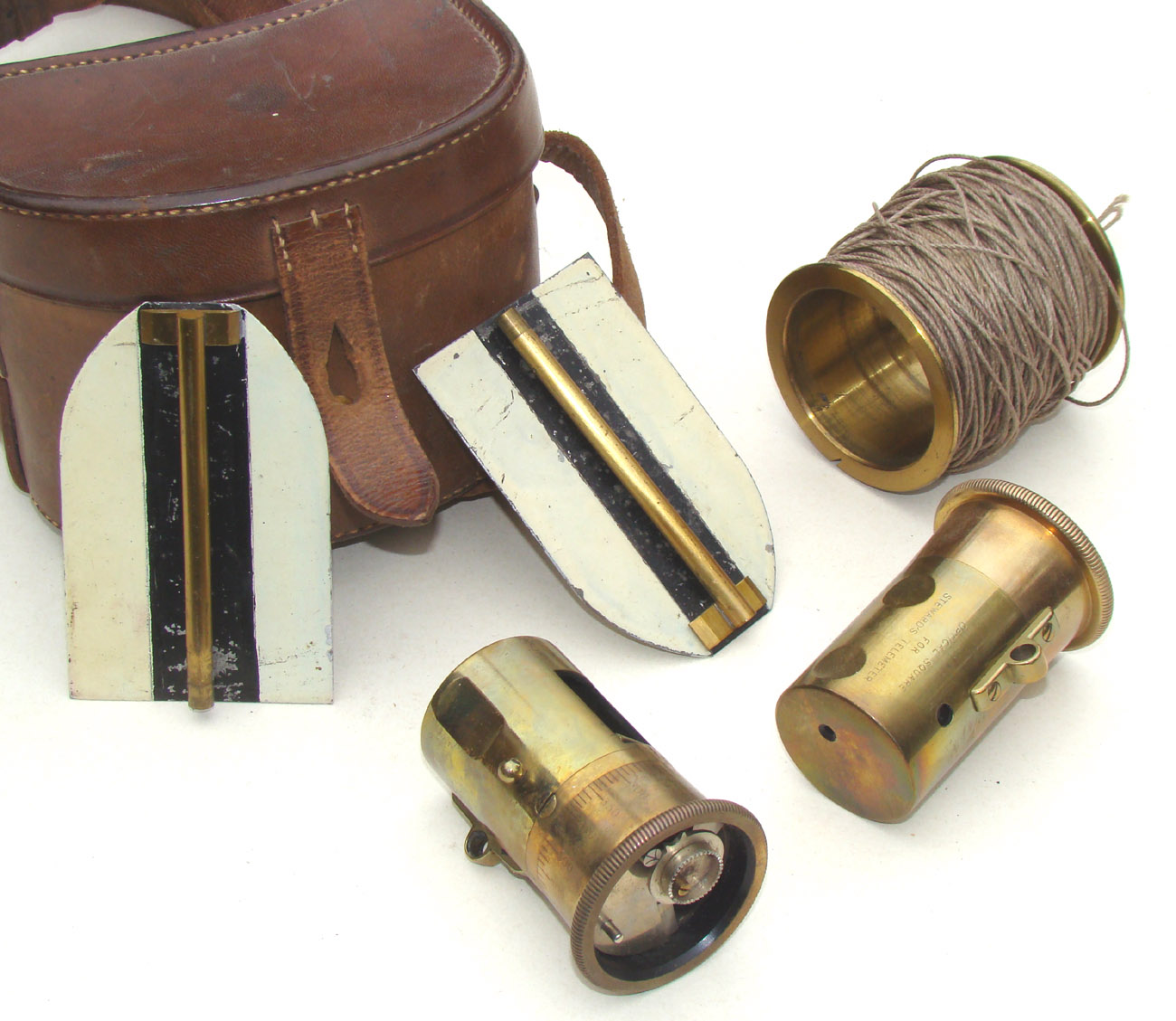
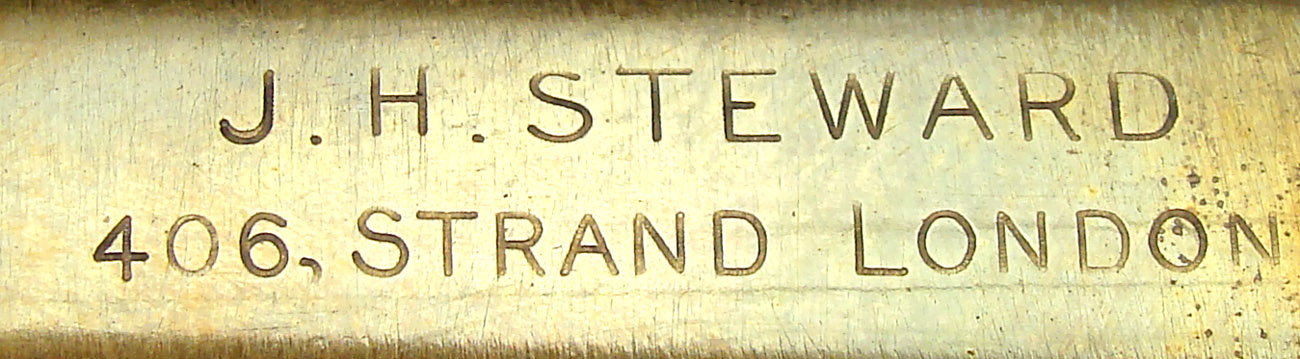
STEWARD'S TWO-OBSERVER TELEMETER OUTFIT, English, early 20th century, signed "The 'Steward' Patent Telemeter, J.H. Steward, 406 Strand, London, No. 70." This complete outfit comprises two 2-3/8" (6 cm) long brass sighting cylinders, a brass reel wound with a long cord, two sighting targets, and the original fitted leather carrying case with shoulder strap. One cylinder is labeled "Optical Square," and incorporates a fixed mirror, peephole, viewing port, three finger grips, and target and cord attachment points. Held to the eye it gives side-by-side views straight ahead and at 90° to one side. The other cylinder is similar but the mirror angle is adjustable by finger wheel and by calibrated thumb wheel, and there is a rotatable sector diaphragm. Condition is fine noting some scraping to the black and white enamel on the targets. In a 1908 revision of Beazeley, we find a basic description, and comment: "This is an exceedingly clever little instrument invented by Labbez, and is designed to give, without any calculation whatever, the distance of objects from 250 to 3000 yards." With the optical square and the cord, one can establish the baseline as the short side of a narrow right triangle having a distant target at the apex. A second observer can simultaneously use the other device to sight the first observer and the target, adjusting the mirror angle for the deviation from 90°, and read the range on the scale. It provides rapid instantaneous triangulation in the field. (9295) $1450.
|
| Fine Four-Vane Surveying Instrument | Click on any image for a larger
view. Scroll to view more items. |
 |
 |
|
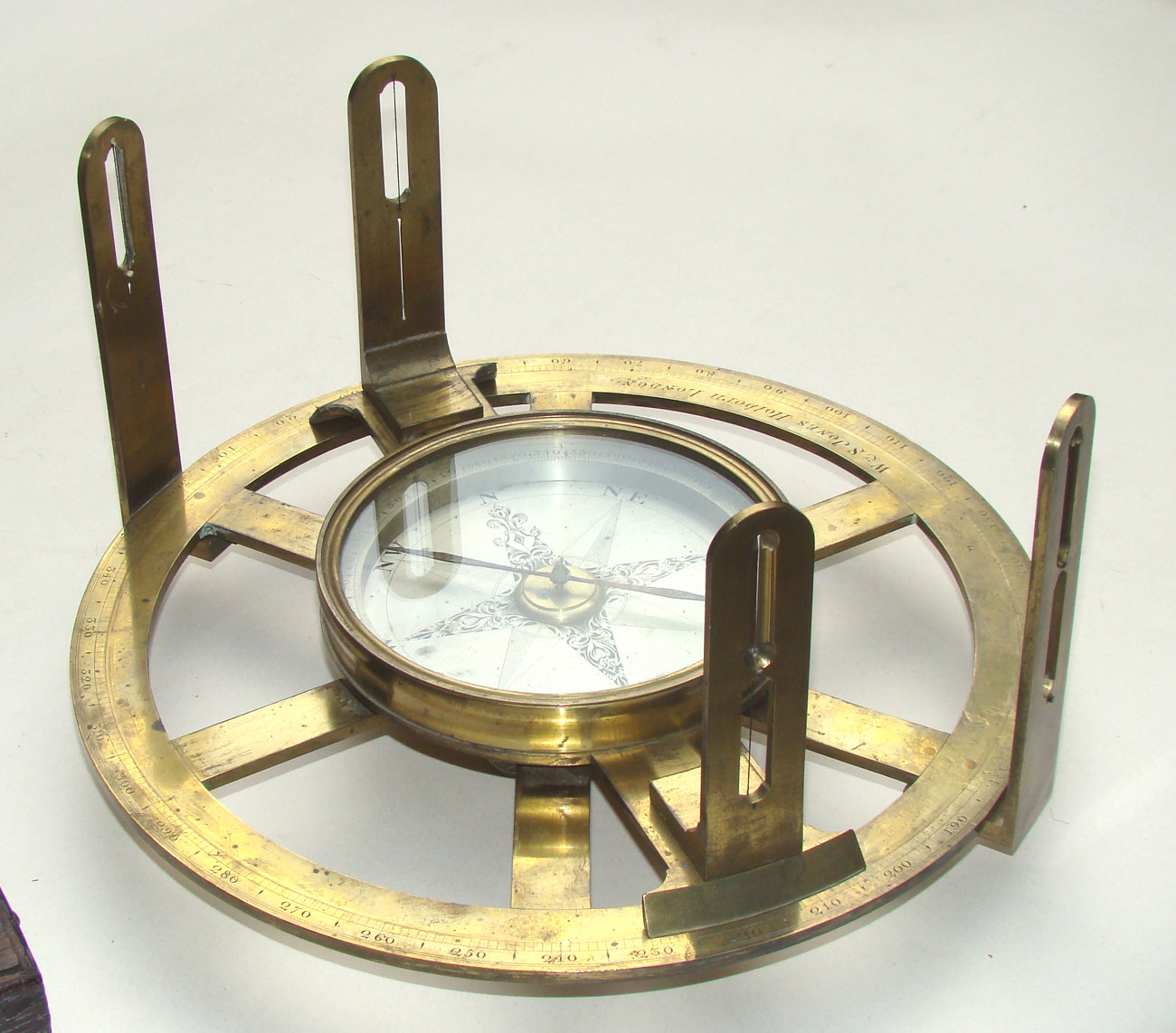
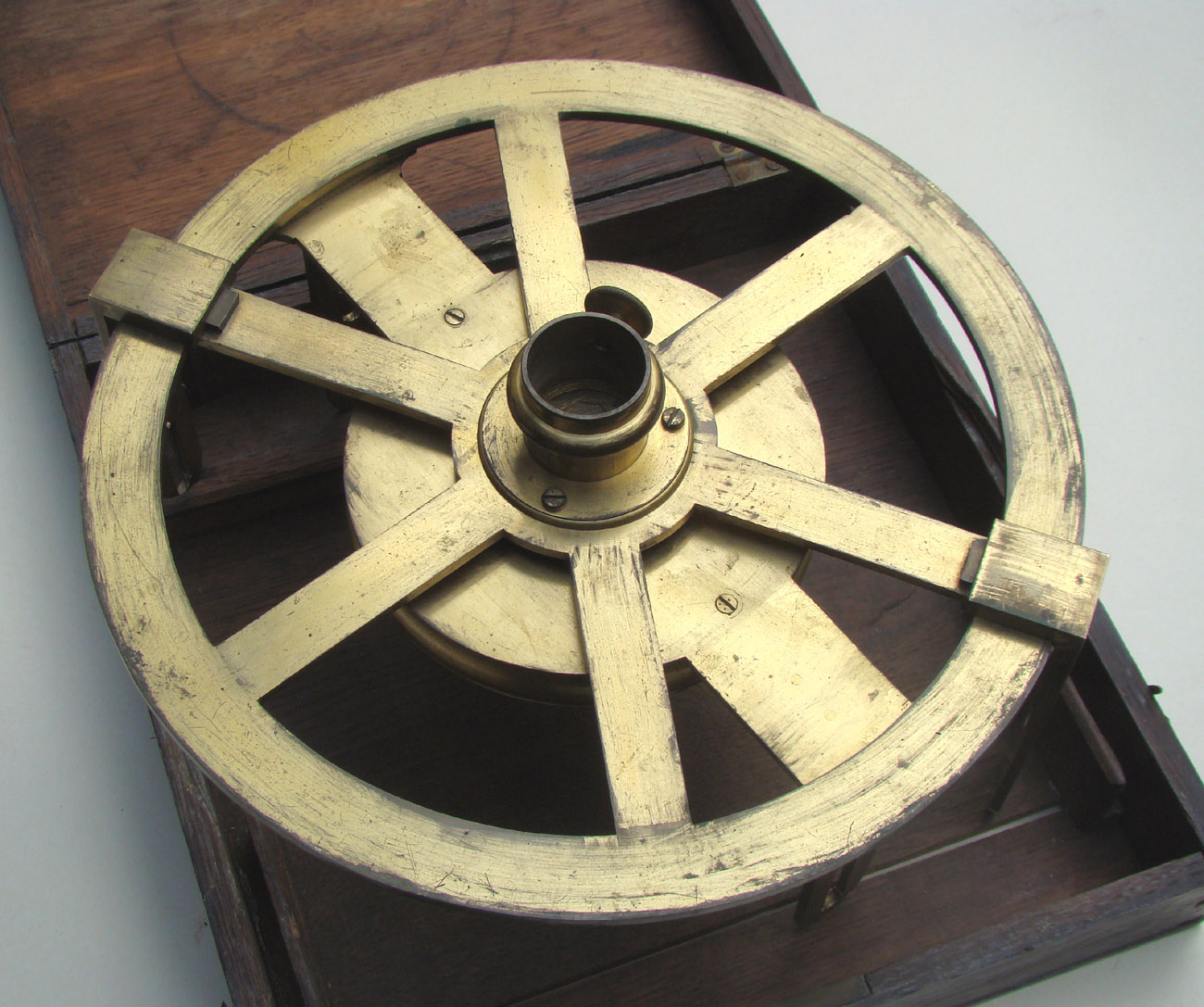
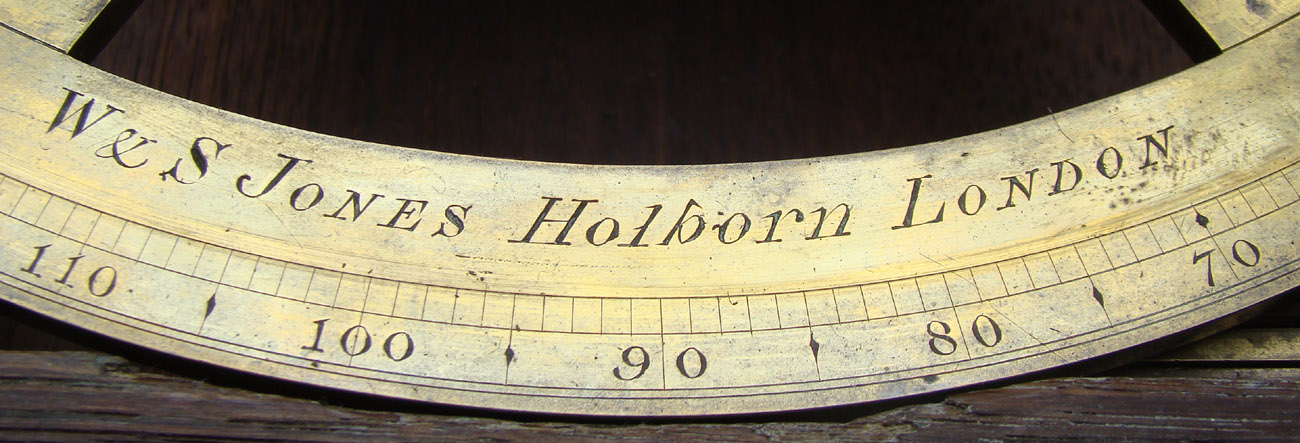
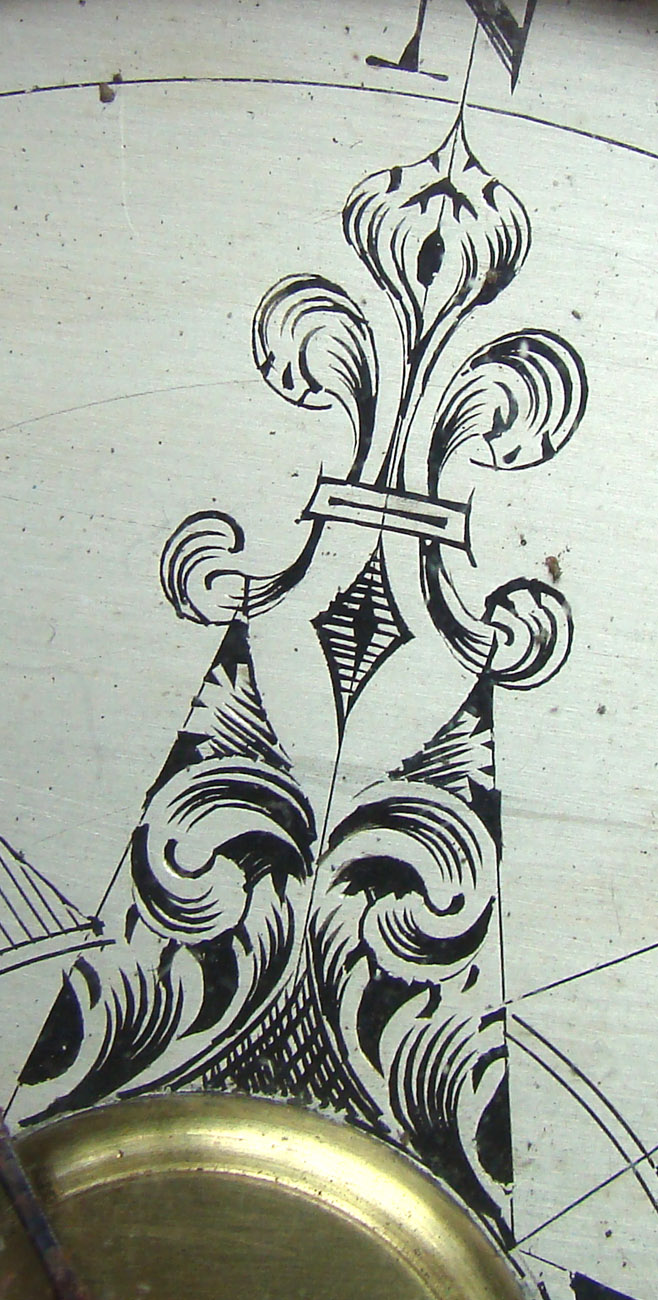
FINE FOUR-VANE SURVEYING CIRCLE, English, c. 1800, signed "W. & S. Jones, Holborn, London." This substantial brass circle is 9-3/4" (25 cm) in diameter, with its six-spoked design and outer degree scale divided 0° - 360°. It is set with staff mount below and rotating alidade above, the alidade with canted five-arcminute vernier and glazed compass with silvered dial face, circumferential 0° - 360° degree scale, and shaped needle. The compass face is engraved with an eight-point rose, the principal directionals with exuberant foliate decor and a fine fleur-de-lys. Two tall sight vanes dovetail in place on the underside of the main plate; two short ones dovetail atop the ends of the alidade. The four vanes, which have string and slit sights, thus all reach the same height. The outfit stows in its original lovely oak case. Condition is fine throughout, noting a few stains, and no ball-joint fitting. Brothers William and Samuel Jones were in partnership as optical, mathematical, and philosophical instrument makers, in Holborn, from 1791. According to Clifton, William died in 1831, Samuel 1859. They constructed all manner of fine instruments, including some spectacular physics demonstration apparatus once part of the famous Bancker collection. The present instrument is a fine example of their work. It permitted the land surveyor to take accurate bearings on two landmarks simultaneously, to survey lands, to perform triangulations, etc. In addition it is a beautiful instrument with its highly refined compass decoration. (Featured in "Wondrous Devices" exhibition, Hudson River Museum, 2018) (9233) $3950. |
 |
 |
| Testimony to the French Revolution | Click on any image for a larger view. Scroll to view more items. |
 |
 |
|
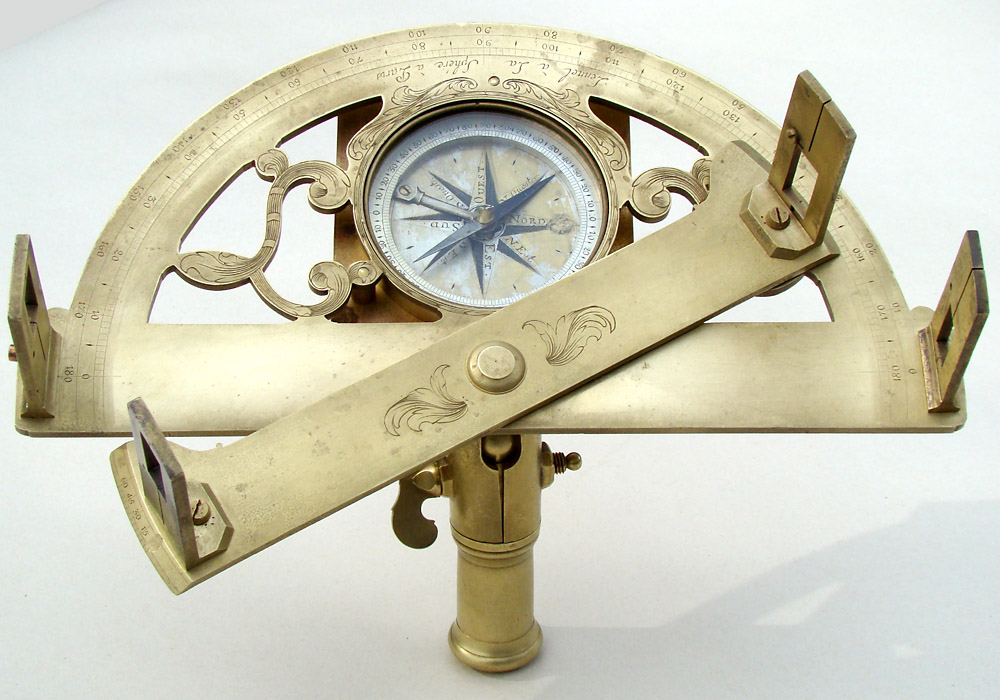
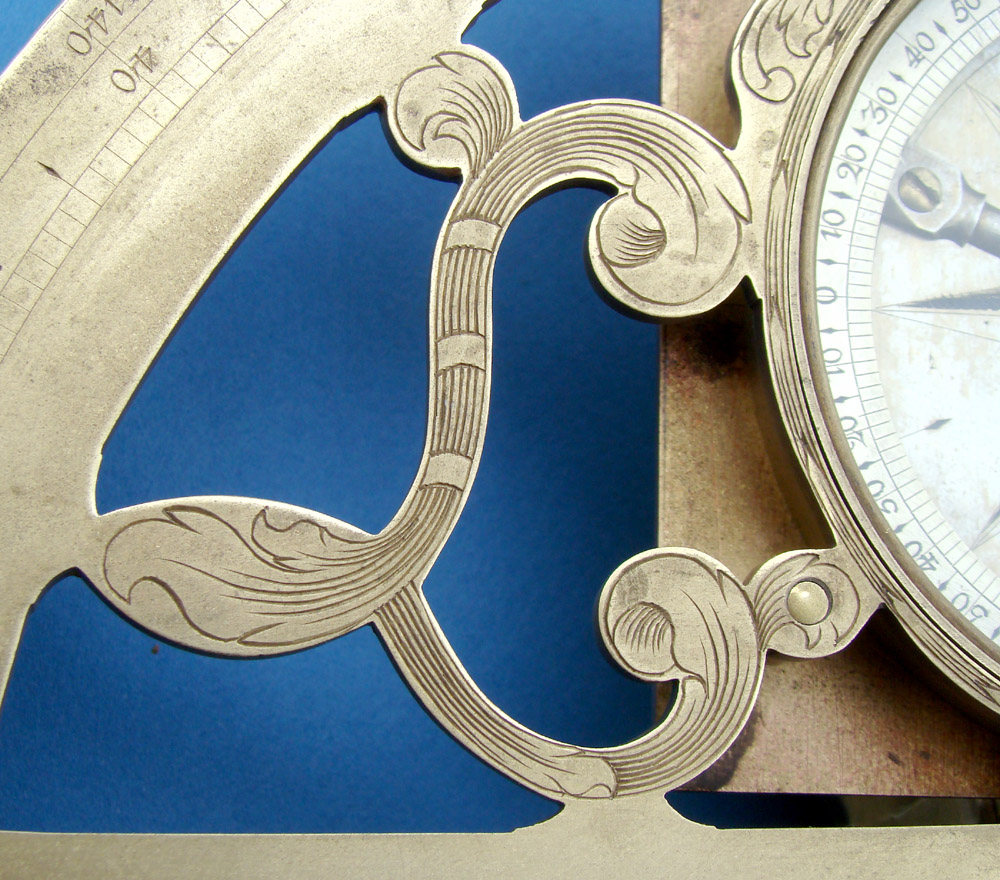
SURVEYING GRAPHOMETER INCORPORATING THE MAKER'S INITIAL, French, c. 1780, signed "Lennel à La Sphere a Paris." This substantial brass graphometer is 9-5/8" (24 cm) wide, with the traditional two fixed sight vanes, two sight vanes on rotating alidade, semicircular degree scale (divided every degree and numbered in both directions), pair of verniers on the alidade (reading to five-arcminutes), inset silvered compass (with lozenge needle, needle lifter, 16-point rose, and degree scale), and staff mount (with universal ball joint using split clamp and fine butterfly thumb screw). It is decorated with floral patterns and, most impressively, with twin pierced L-shapes as compass supporters. The North point of the compass had had an engraved fleur-de-lys, but this is crudely effaced. Overall condition of the instrument is fine, noting light stains and the compass lifter screw worn. The brass is cleaned but not polished. This is a standard form of French surveying instrument, capable of measuring angles in any plane, even vertical. For horizontal use one finds, additionally, angles from magnetic north. But this example has two special features. It is one of the few where the decorative supporters proudly and elegantly announce the maker; the only other such letters we have seen are "C" (Canivet), "F" (Ferat), and "G" (Gourdin). We have had one other "L" graphometer, that dated 1775 and constructed without a compass (Tesseract Catalogue 20 Item 40). Secondly, we have here evidence of the unpopularity and danger of displaying symbols of Royalty (the fleur-de-lys) during the Revolution. This people's revolt began in 1789, ending with the execution of King Louis XVI in 1792, and the Reign of Terror 1793 - 1794. It was much better to efface the symbol than be arrested. Louis Pierre Florimond Lennel became Master in 1771, was successor to Canivet, and worked until his death in 1784 (Marcelin). (9280) $2950. |
| Wooden Instrument from Southern France | Click on any image for a larger
view. Scroll to view more items. |
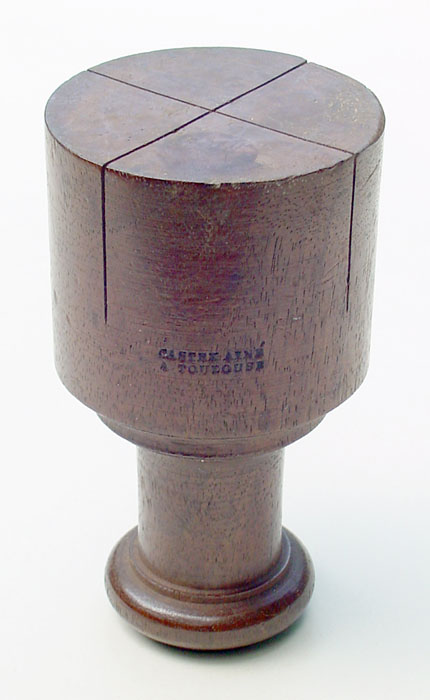 |
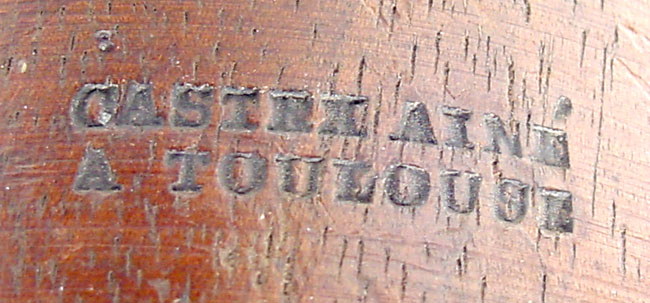
WOODEN SURVEYING SQUARE, French, c. second quarter 19th
century, signed "Castex Aine a Toulouse." The turned walnut(?)
instrument measures 4-3/4" (12 cm) tall, with integral staff fitting
and orthogonally cut sighting slits to lay out right angles for fields,
buildings, etc. It is an unusual all-wood instrument, in very fine condition.
This "Castex the elder" maker is probably connected with the
balance maker listed by Marcelin, working in Toulouse in 1852. (8229)
$495.
|
|
|
| Early Surveying / Dialling Instrument | Click on any image for a larger view. Scroll to view more items. |
 |
|
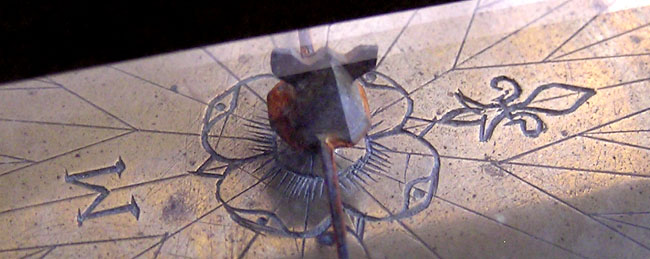
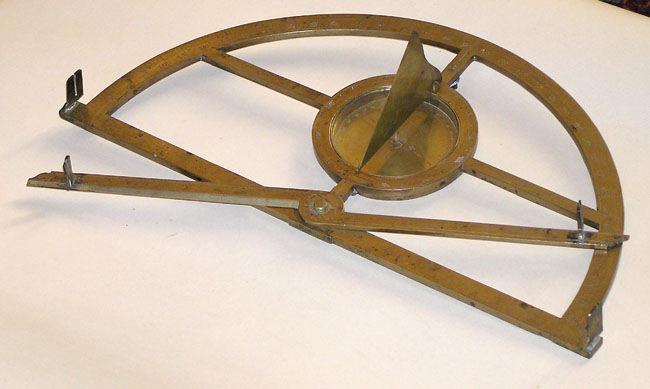
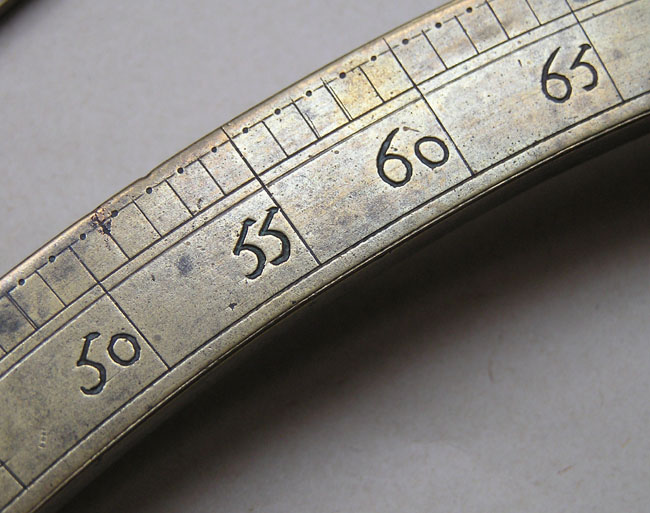
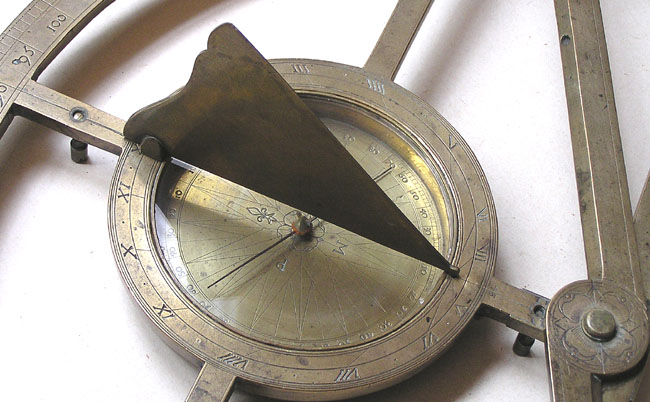
SEVENTEENTH CENTURY ITALIAN GRAPHOMETER WITH CENTRAL SUNDIAL, constructed of sturdy brass, 16-9/16" (42 cm) in overall width. This surveying graphometer has a mainplate with a large semicircular arc divided every half-degree and numbered every 5°; we note distinctive early hand-engraved numeral shapes, especially the 5's. The plate is mounted with two small fixed sight vanes, and carries a rotating alidade which reads against the scale and which has its own pair of small vertical-slit vanes. This alidade is engraved with a lovely central four-lobed rose and terminal "leaves." The plate has cruciform supporters to the 4-3/8" (11 cm) diameter circular sundial and glazed compass. This horizontal dial is ruled and numbered every hour from 5am to 7pm, and is engraved for latitude 43° North. The thin gnomon is removable with pin feet. The compass itself has a 32-point rose on brass, with circumferential scale divided every 2° and punch-numbered every 10°, and is engraved with four directionals of a fleur-de-lys (for North), a cross (East), "M" (for Mezzodi, South), and "P" (Ponente, West). Condition is good, noting some very old minor repairs / reinforcements to the frame. Threaded holes either side of the compass probably allowed use with a staff mount, now lost. This is a very early example of a graphometer, the classic Continental surveying instrument invented by Philippe Danfrie in the late 16th century. The use of a central sundial is known on some other early surveying instruments (e.g., see the fine Metz circle with dial, Tesseract Catalogue 26, item 49). Note that the present instrument has neither transversals nor vernier interpolation, also that some of the brass members have edge outlining characteristic of the early date. Italian graphometers are particularly rare, this one consistent (at 43° latitude) with Umbria, Southern Tuscany, and Elba. (8258) $9500. |
 |
|
 |
| A Miniature Theodolite from Paris | Click on any image for a larger
view. Scroll to view more items. |
 |
 |
|
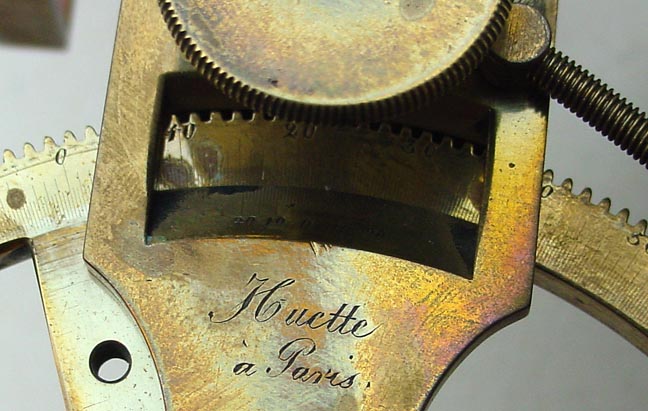
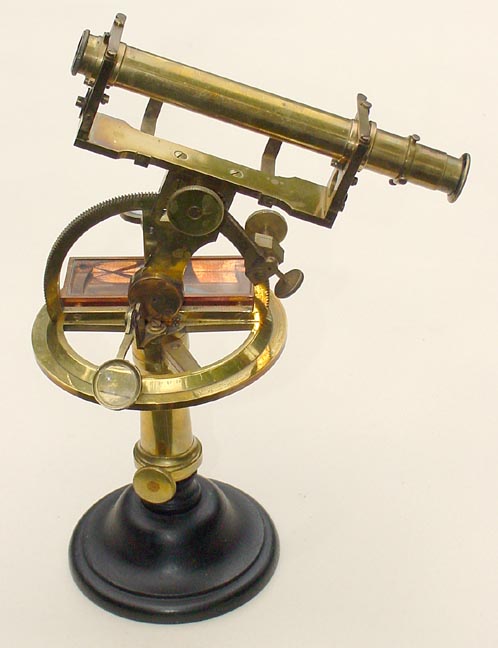
MINIATURE BRASS AND COPPER THEODOLITE, French, c. 1830, finely signed "Huette a Paris," standing only 7" (18 cm) tall from bottom of staff mount to top of telescope. The upper assembly rotates in azimuth on a 4" diameter horizontal circle which is precision divided every half degree full circle, with twin one-arcminute verniers and an articulated scale magnifier. A copper-bodied (copper presumably to minimize magnetic disturbances) trough compass rotates with the assembly, and has twin magnetic declination scales divided ±0(0.5)20, and its own swiveling scale magnifier. The vertical semicircle is divided every one-third degree over the range 0±100, and is cut with external rack gearing. The telescope's motion in altitude is by pinion gear, with clamp, long tangent screw fine motion, and one-arcminute vernier. The telescope itself is reversible in its wyes, and gives inverted images. Condition is fine, the brass cleaned, and an auxiliary spirit level apparently lacking. A system of swing-away peep sights gives naked eye sighting parallel to the telescope axis. We find only limited information about Huette; Nachet records him as working at what was possibly the former workshop of Canivet, and as being succeeded by Loiseau in 1841; Marcelin finds him at 75 quai de l'Horloge in Paris. (8317) $3400. |
|
|
| Well-Dressed Surveying Team, c. 1880 | Click on any image for a larger
view. Scroll to view more items. |
 |
 |
|
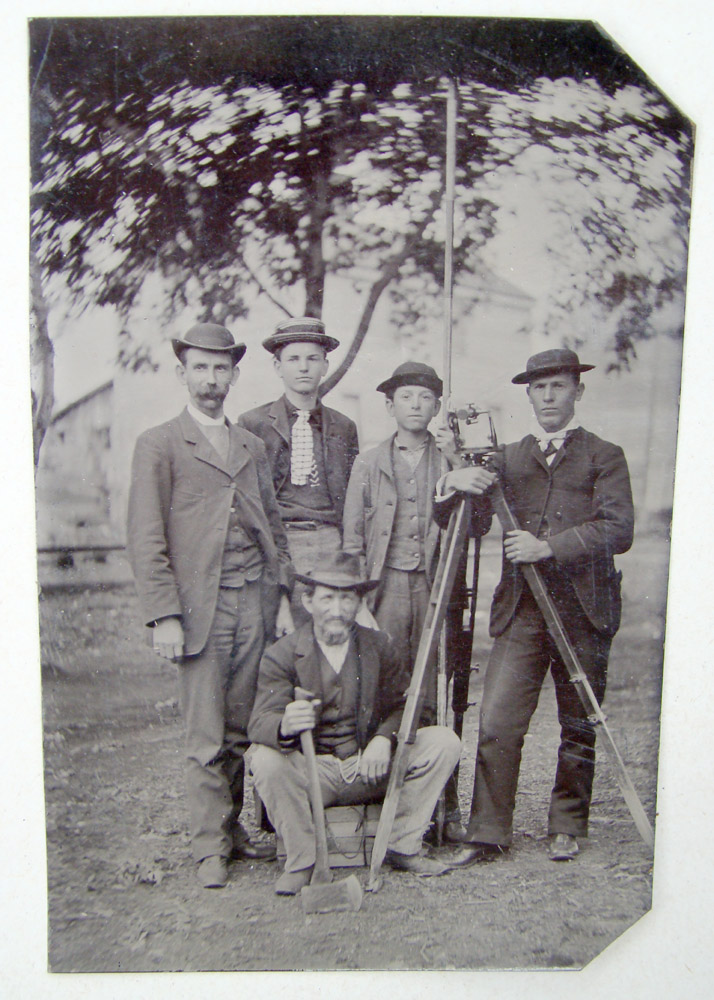
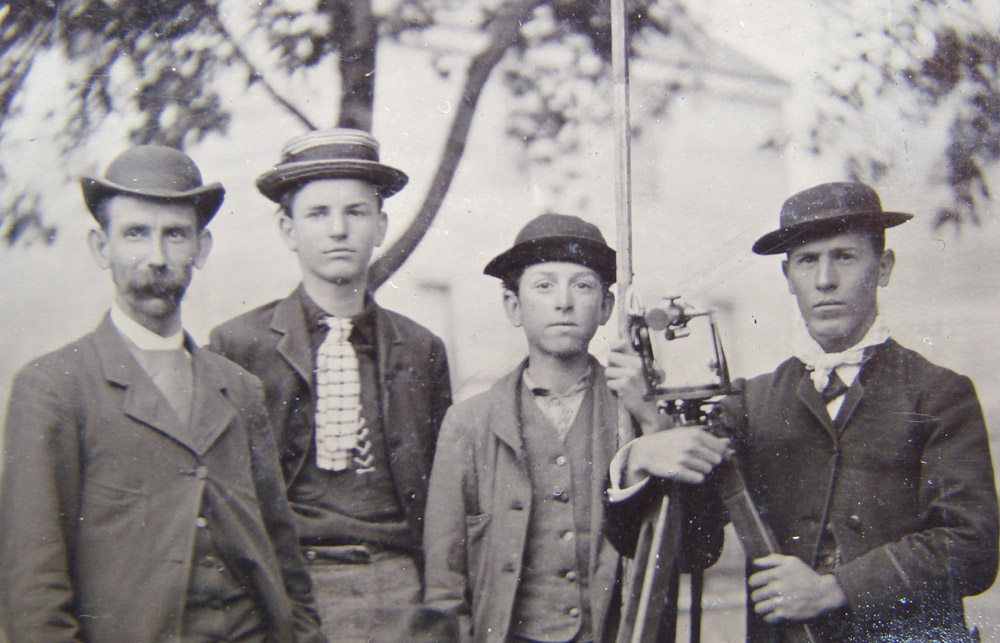
ORIGINAL TINTYPE PHOTO OF SURVEYING CREW, American, c.1880. Measuring 2-1/4" x 3-1/2" (5.7 x 8.9 cm) , this outdoor tintype shows a full party of five relatively well-dressed men, including the bearded axe man with his gold watch chain, sitting on a bundle of wood stakes, the transit man with his well-polished shoes, protecting his instrument, a very young rod man with long banded rod, and two supervisors(?), one wearing a remarkable multiple tie. Despite some creases to the tintype the image is in excellent condition. It was clearly taken outdoors rather than with a studio backdrop, and shows gravelly ground, distant trees and buildings. (9242) $750. |
| Surveying Sighting "Sector" | Click on any image for a larger view. Scroll to view more items. |
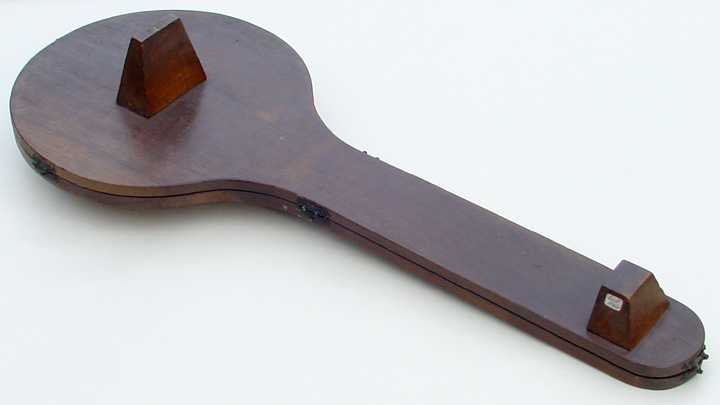 |
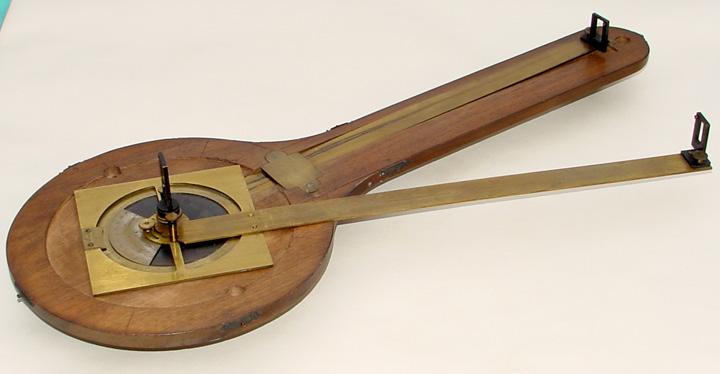
| LONG-ARM SURVEYING INSTRUMENT, French, c. early 19th century, signed "Brevet, J. Dartois." Made of brass with an integral walnut case, the assembly measures 25-1/4" (64 cm) overall. Two brass arms carry removable string sights, with removable string-and-slit eye sight at the vertex. One arm has clampable rotation about this center, with readout against a full circle degree scale. An adjustable and clampable segment is divided with scales of "Vernier" and "Declinaison." The iron-reinforced base of the case has central thread for tripod mounting. The protective case cover is finely shaped to accommodate the sights. A most unusual instrument, in fine condition, by a maker not recorded in the standard references. (8242) $2450. | 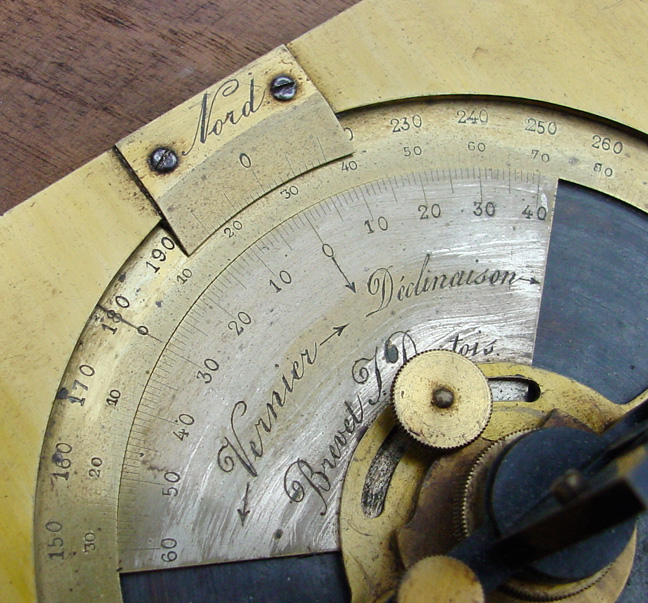 |
 |
| Surveying in Russia | Click on any image for a larger
view. Scroll to view more items. |
 |
 |
|
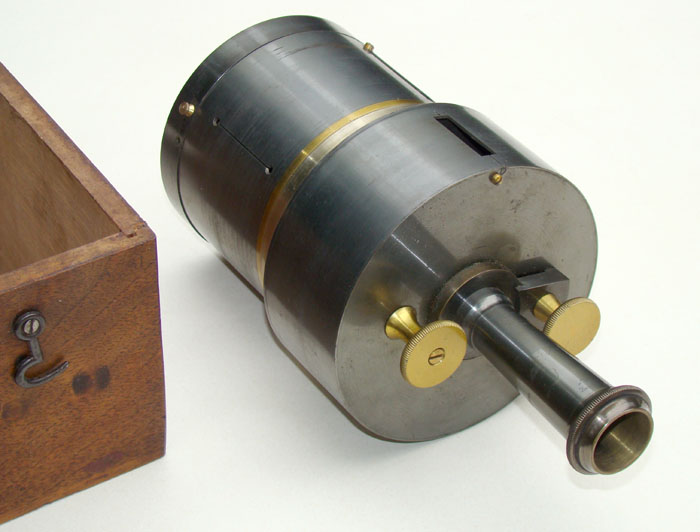
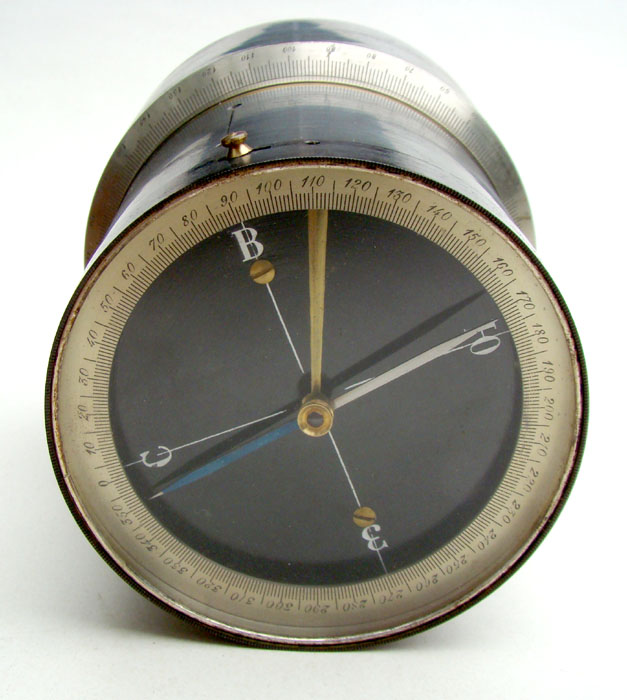
LARGE GEARED SURVEYING CROSS WITH COMPASS AND VERNIER, Russian, c. late 19th century. Standing a full 8" (20 cm) tall, of blue-grey anodized, clear lacquered, and silvered brass, this sophisticated surveying "cross" has tapered staff mount supporting the full assembly, which is manually rotatable and clampable. The lower drum has opposing sights. The upper drum, with its four orthogonal sights, is separately rotatable by geared thumbscrew, with readout against a canted 0 (1) 360 degree scale and two-arcminute vernier. This is surmounted by a 3-1/2" diameter glazed compass with Cyrillic directionals, circumferential degree scale, blued steel needle with stone pivot, and needle lifter. This impressive instrument is in excellent condition throughout with its original walnut(?) carrying case. (8219) $975. |
| Sir Howard Douglas Quadrant | Click on any image for a larger view. Scroll to view more items. |
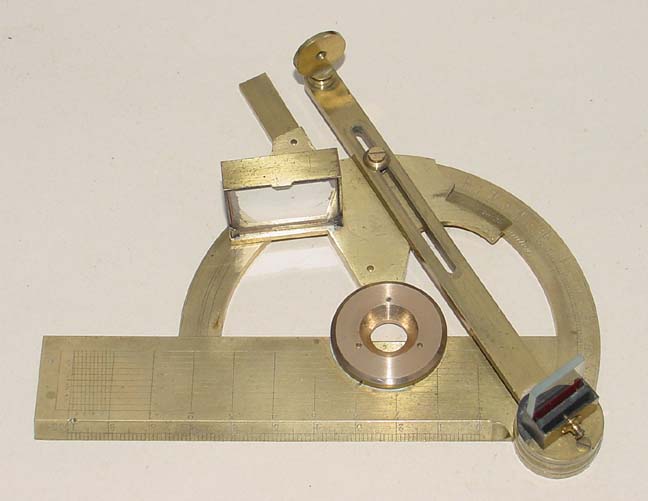 |
RARE PATENTED "REFLECTING SECTOR", English, c.1840, signed "A. Rofs & Co., 33 Regent St., London." Measuring 5-1/2" (14 cm) overall, this unusual sighting / plotting instrument is made of brass. It is a direct plotting third-circle, designed rather like a sextant, with peepsight, half-silvered "horizon" mirror, index mirror, divided degree scale engraved on brass, and vernier reading to one arcminute. However the index / plotting arm moves not only the index mirror and vernier, but also, through a sliding linkage, the peepsight and horizon mirror. As a result, one can make instantaneous sightings on objects as much as 120 degrees apart, making this neither octant, nor sextant, nor quintant, nor quadrant, but sort of a direct plotting "tridant." The semicircular degree scale is connected to a 4" long linear plotting rule divided every ten units from 0 to 1000, with an interpolation grid divided every one unit. Condition is very fine, the brass retaining most of its original bright lacquer finish. |
| This instrument was the invention of Sir Howard Douglas of the Royal Military College at Farnham, as a combination of Hadley's quadrant and a protractor, enabling observed angles to be plotted directly, without having to read the angular scales. It is the first example of Douglas' instrument we have encountered by this maker, Andrew Ross & Co., in business under this name only from 1839 to 1842. (7289) $1850. | 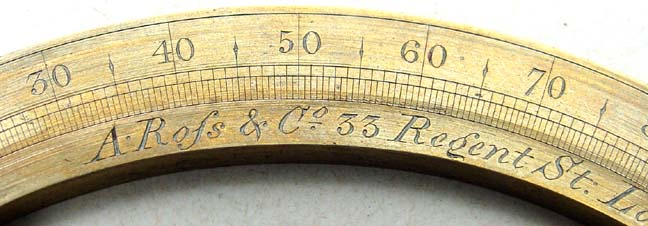 |
| Ohio Surveying Compass | Click on any image for a larger view. Scroll to view more items. |
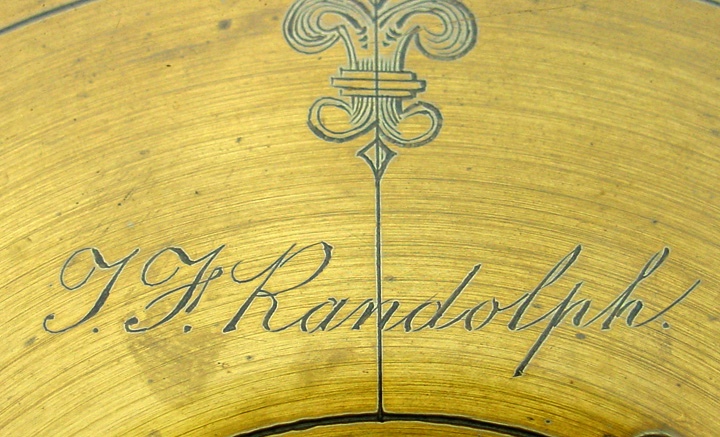 |
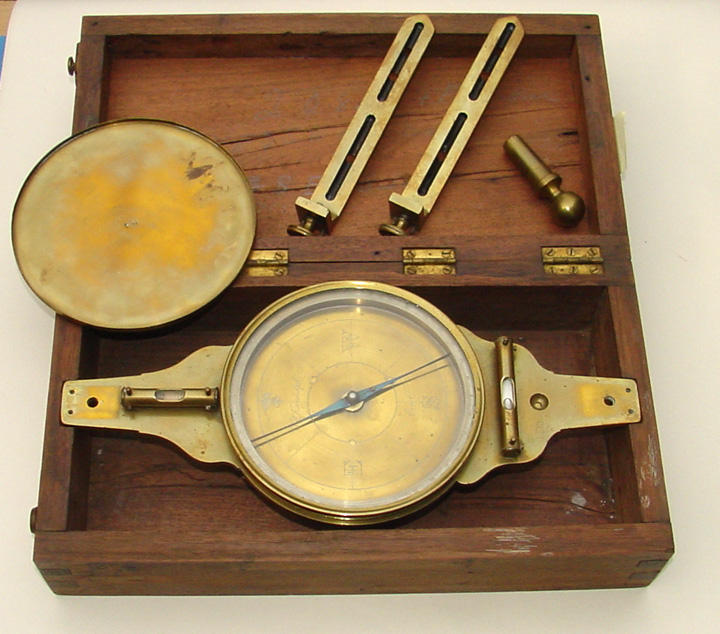
| LARGE OHIO SURVEYING COMPASS, American, c. 1880, signed "T.F. Randolph, Cin., O." The thick main plate is 15-3/4" (40 cm) long, mounted with twin spirit levels, outkeeper adjustable 1-16, and 7" diameter glazed compass with simple face, silvered degree ring divided full circle every half-degree, and very finely crafted needle (blued, with horizontally flat center and vertically flat ends, set with steel pivot, brass hub, and balance adjustment for needle dip). Below is an outkeeper knob, a canted needle lifter knob, and large mounting fixture for staff or tripod. The outfit includes the 7-3/4" tall sight vanes, turned brass compass cover, and brass mounting peg. Parts are numbered "2" throughout. Condition is good; the instrument has been cleaned at some time, and now shows a bit of spotting. Included is the massive, probably later, walnut carrying case. This Ohio maker, Theodore F. Randolph (1829-1898), received a number of patents for surveying instrument inventions, his instruments winning numerous medals at industrial expositions in the 1850's, 60's and 70's. (8315) $1850. | 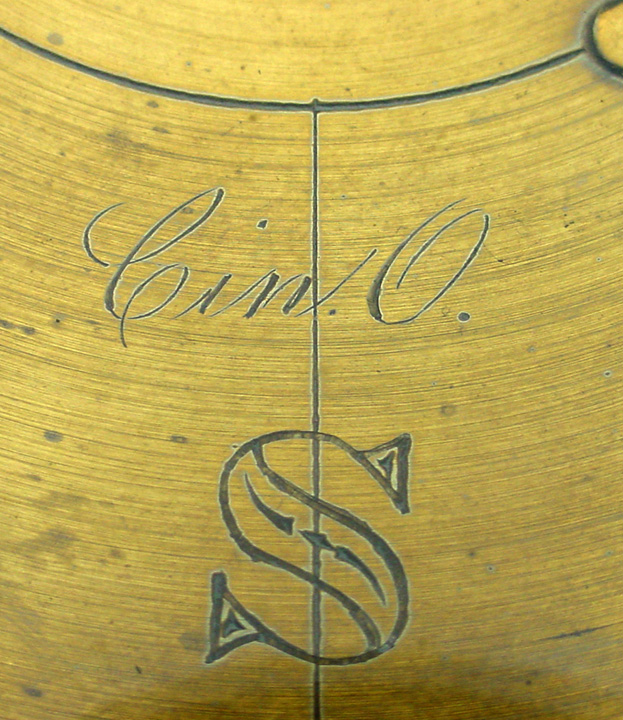 |
 |
| Four-Vane Surveying Compass from Warsaw | Click on any image for a larger view. Scroll to view more items. |
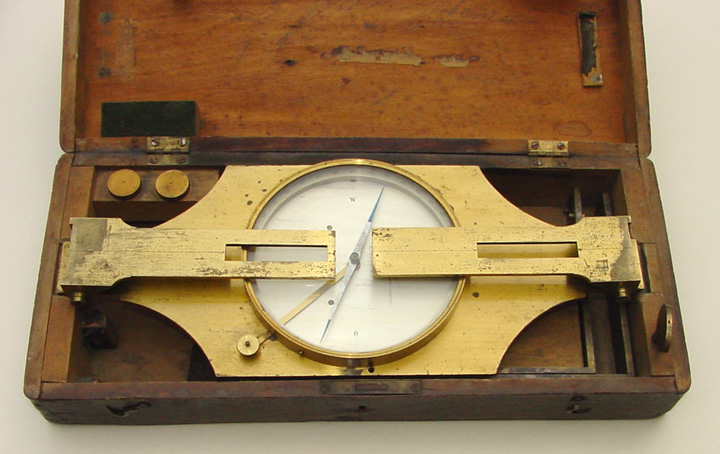 |
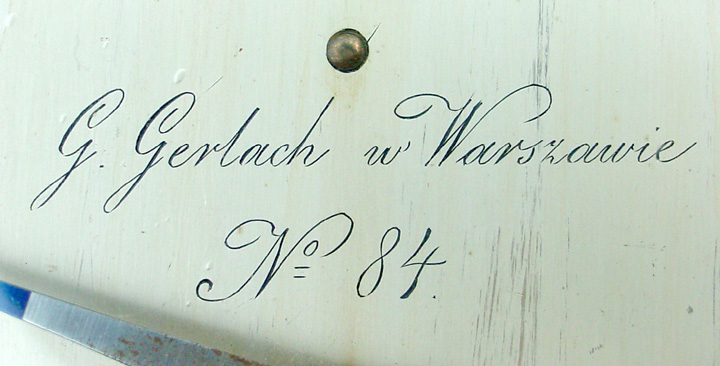
| POLISH FOUR-VANE SURVEYING COMPASS, c. second half 19th century, finely signed on the silvered compass face "G. Gerlach w. Warszawie No. 84." Measuring 16" (41 cm) overall, this fine solidly made brass surveying compass has two folding vanes and two fixed vanes which mount from underneath. It is complete with the original carrying case and a large brass pin, but lacks the universal staff mount. Condition is very fine noting only a few spots to the original clear lacquer finish. The Gerlach firm was in business from 1816 to 1944. An 1884 catalogue proclaims G. Gerlach as the "Only Russian manufacturer of geodesic, mathematical, drawing and optical instruments," and lists his factory at 30 Tamka St. (his home) and the store at 2 Tchistaya St., Warsaw. (Warsaw was, of course, part of Russian Poland under the tzars at the time). A rare and very fine example of a Polish instrument. (8265) $4950. | 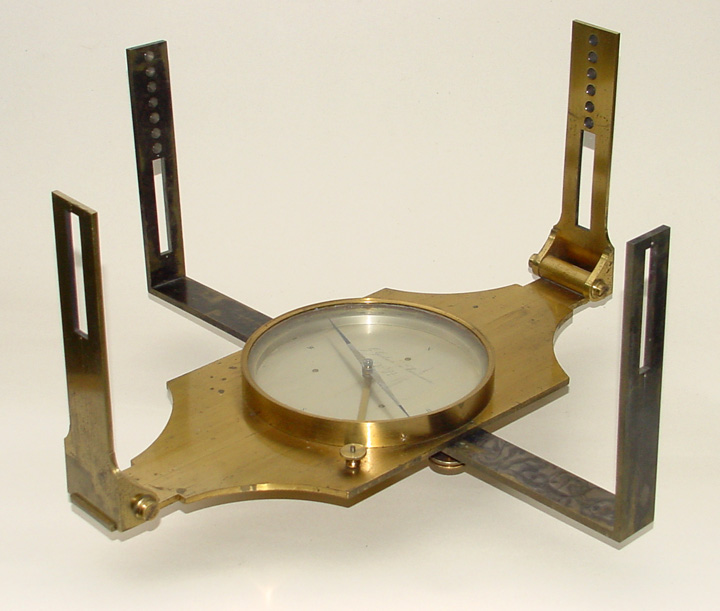 |
 |
| Astronomy |
| Microscopy |
| Dialling |
| Navigation |
| Demonstration & Experimentation |
| Calculation |
| Medical |
| Specials |
| Books New and Old |
| Tesseract Catalogues |