Demonstration
|
Demonstration
|
|
| Cross-Channel Activity (or Industrial Espionage?) | Click on any image for a larger view. Scroll to view more items. |
 |

|
|
FOLDING GOLD BALANCE, French, c.1800, engraved "Jecker à Paris." Constructed of brass with a hinged mahogany case 6-7/8" (17.5 cm) long closed, the scale erects in the case and carries a folding coin pan on one arm, and sliding weight with double calibration scale on the other. Possibly lacking is an auxiliary hanging weight. A printed paper label has a detailed list of European coins and their weights. Condition is fine noting darkening of the brass, and lacking the small end of the case lid. Jecker¹s coin balances, which enjoyed considerable commercial success, bore a very strong resemblance to the English ones (see Schelcher, 1993, La Vie et les Oeuvres de François Antoine Jecker; and see a Ramsden example, McConnell p.185) (8446) $895. Jecker, who worked five years with Ramsden, returned to Paris to develop dividing engines, produce standard meters, and set up a workshop which by 1801 apparently had a staff of forty workmen (see Daumas). Some of Jecker's productions were clearly in the English taste. |
| Sixty-Seven "Stones", all Identified and Characterized | Click on any image for a larger view. Scroll to view more items. |
 |
 |
 |
|
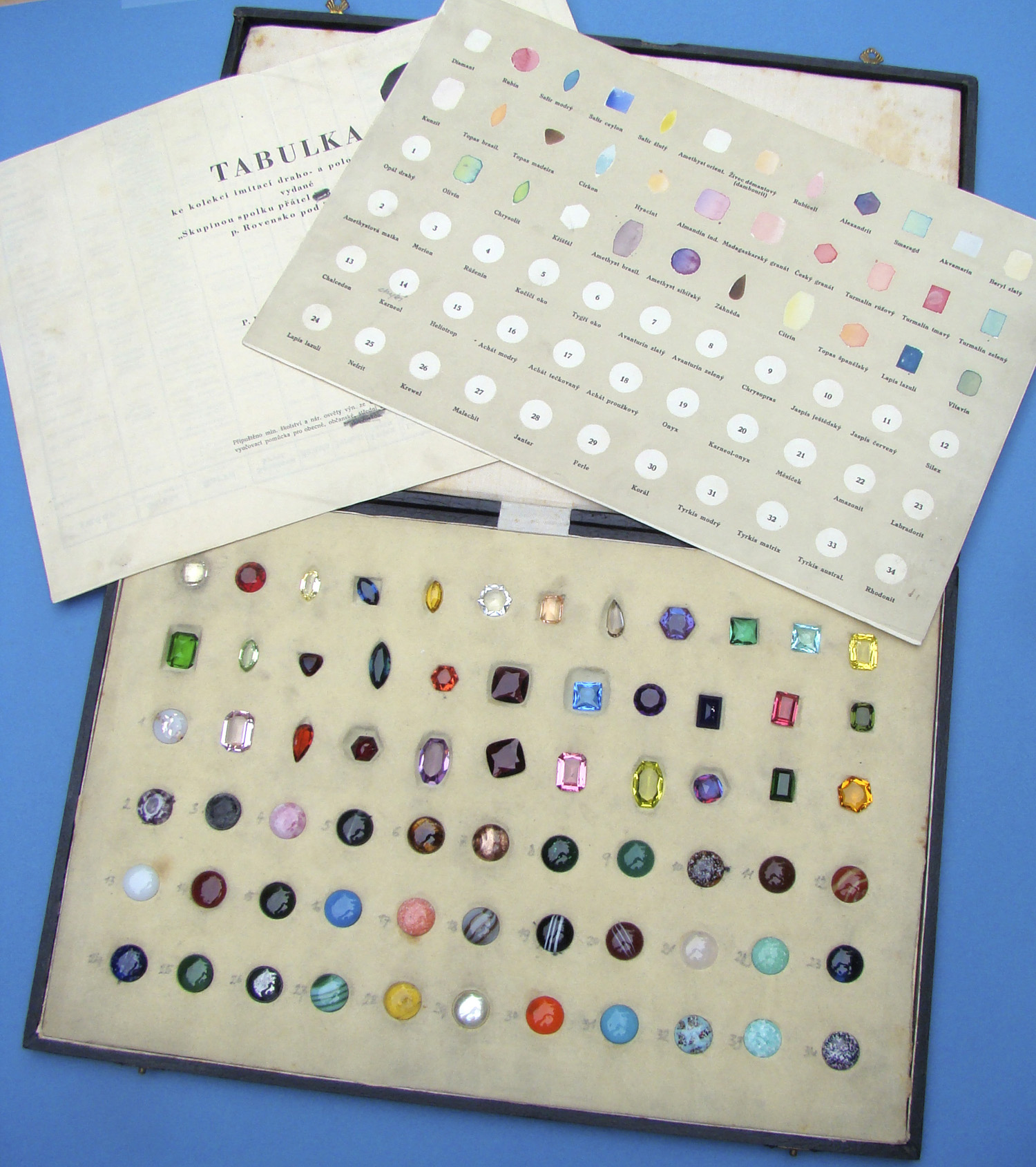
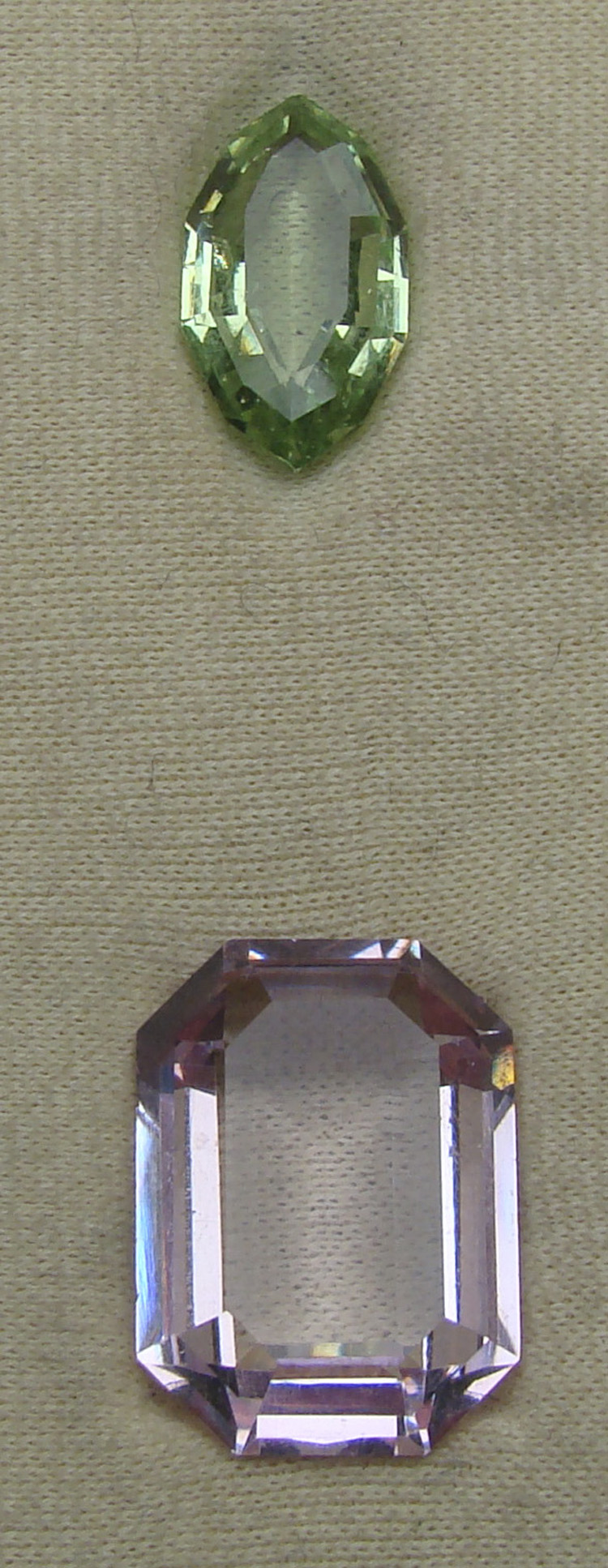
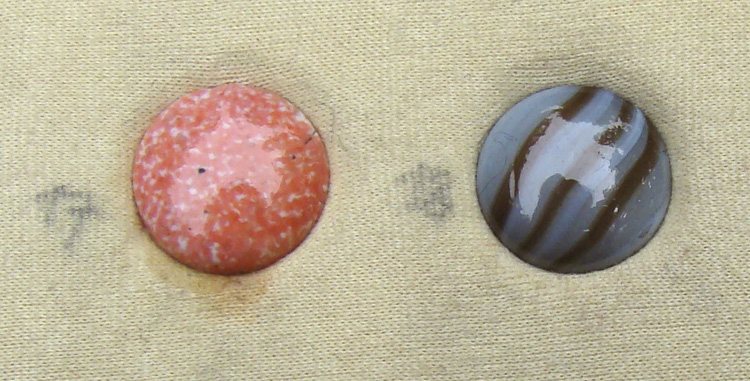
FULL SET OF CZECH-GLASS REPRESENTATIONS OF PRECIOUS AND SEMI-PRECIOUS STONES, c. 1935, contained in a 10" x 14-3/4" (25 x 37 cm) wood case bound in dark patterned paper. The 67 "stones" include 33 of variously faceted glass and 34 domed cabochons of patterned glass. Colors and patterns are intense and realistic. The faceted ones are not attached in the case, so it is unsure whether all are correctly placed. The set is complete with a placement chart and a large table of all stones and their properties (in Czech). Condition is very fine noting ink stain in the case, and one "stone" with an edge break. This is a product of the high quality glass craftsmanship from Rovensko pod Troskami, in the commune of Turnov, then in the northern Czech Republic. The area is an historic center for gemstone polishing and glass production. (10535) $2400. |
| An Elegant "Instrument" -- for Home or Laboratory | Click on any image for a larger view. Scroll to view more items. |
 |
 |
|
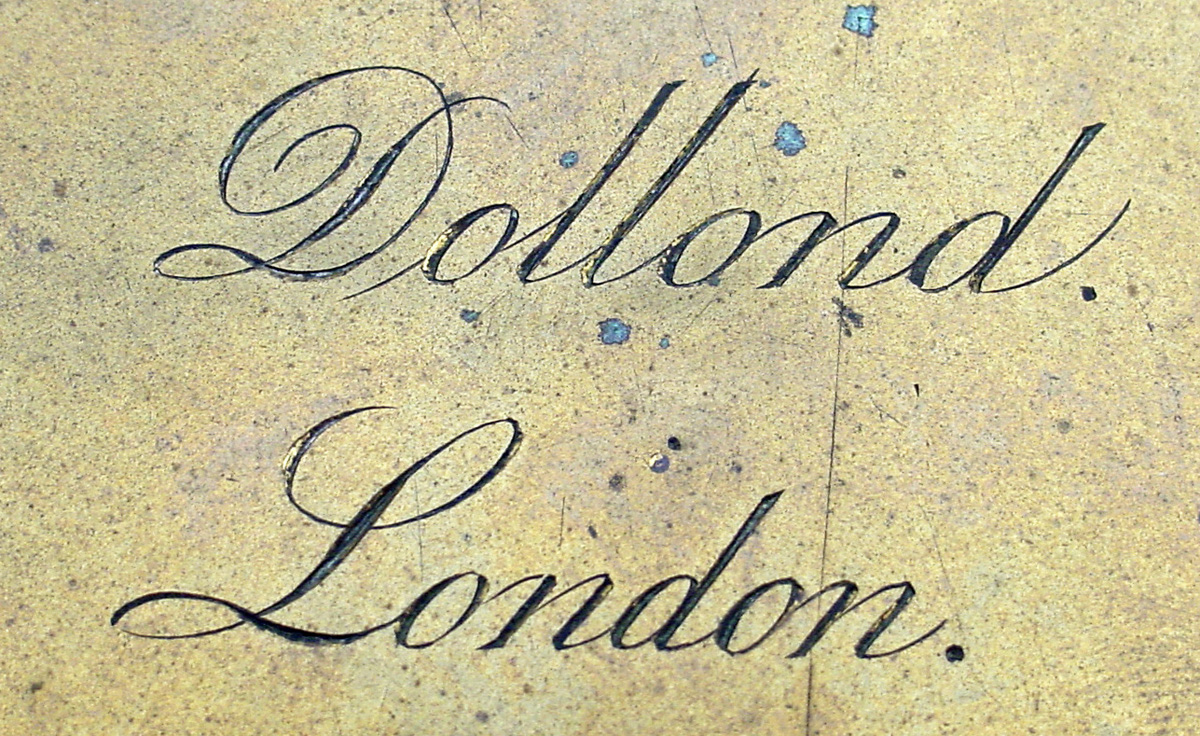
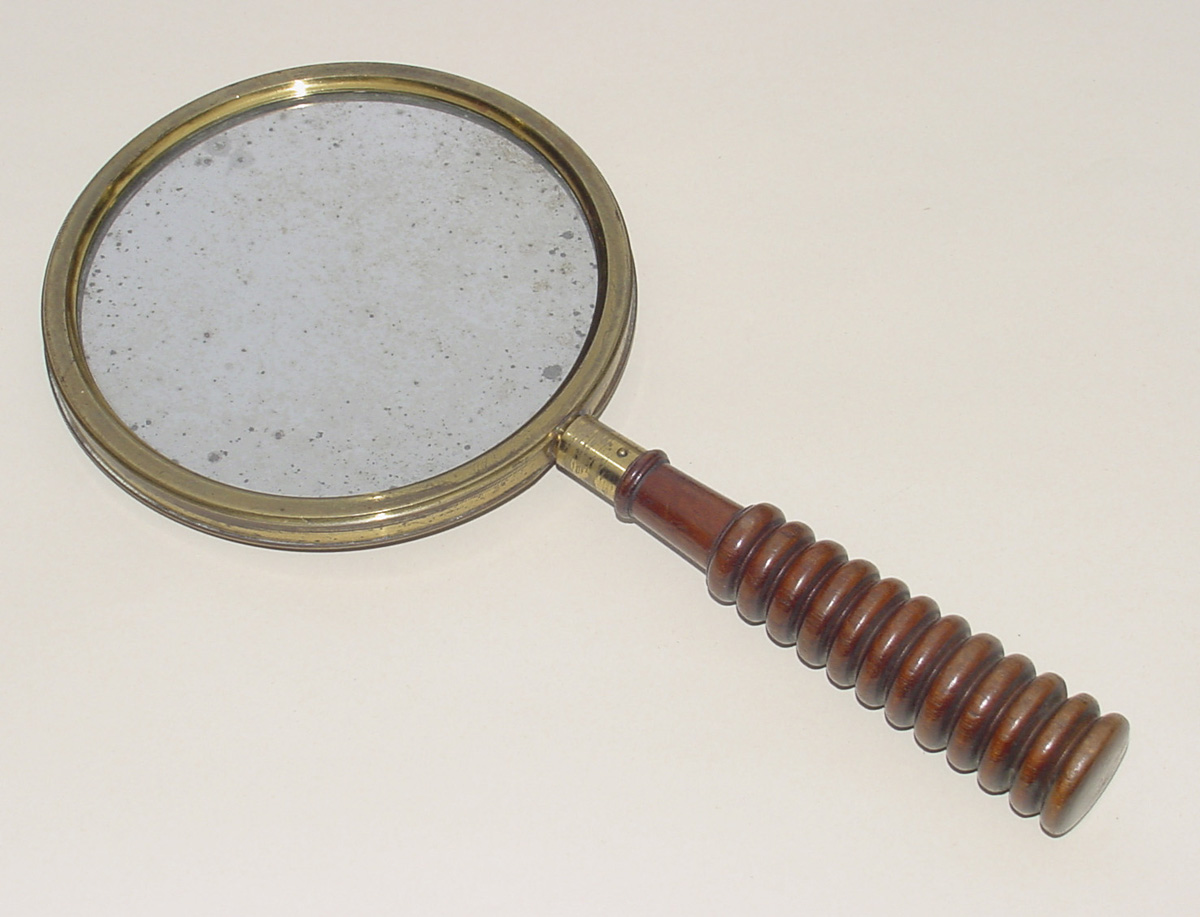
DOLLOND HAND MIRROR, English, c. 1800. This unusual, finely crafted "instrument" measures 11-3/4" (30 cm) overall, with a tapered turned wood handle with deeply ringed hand grip. The brass structure contains a plane glass mirror 5" in diameter; the convex brass back plate has the lovely engraved signature of the maker. A handsome object in very fine condition, noting some spotting of the mirror silvering. (8306) $1600. |
| Instrument of Quality, as yet Unidentified | Click on any image for a larger view. Scroll to view more items. |
 |
 |
 |
|
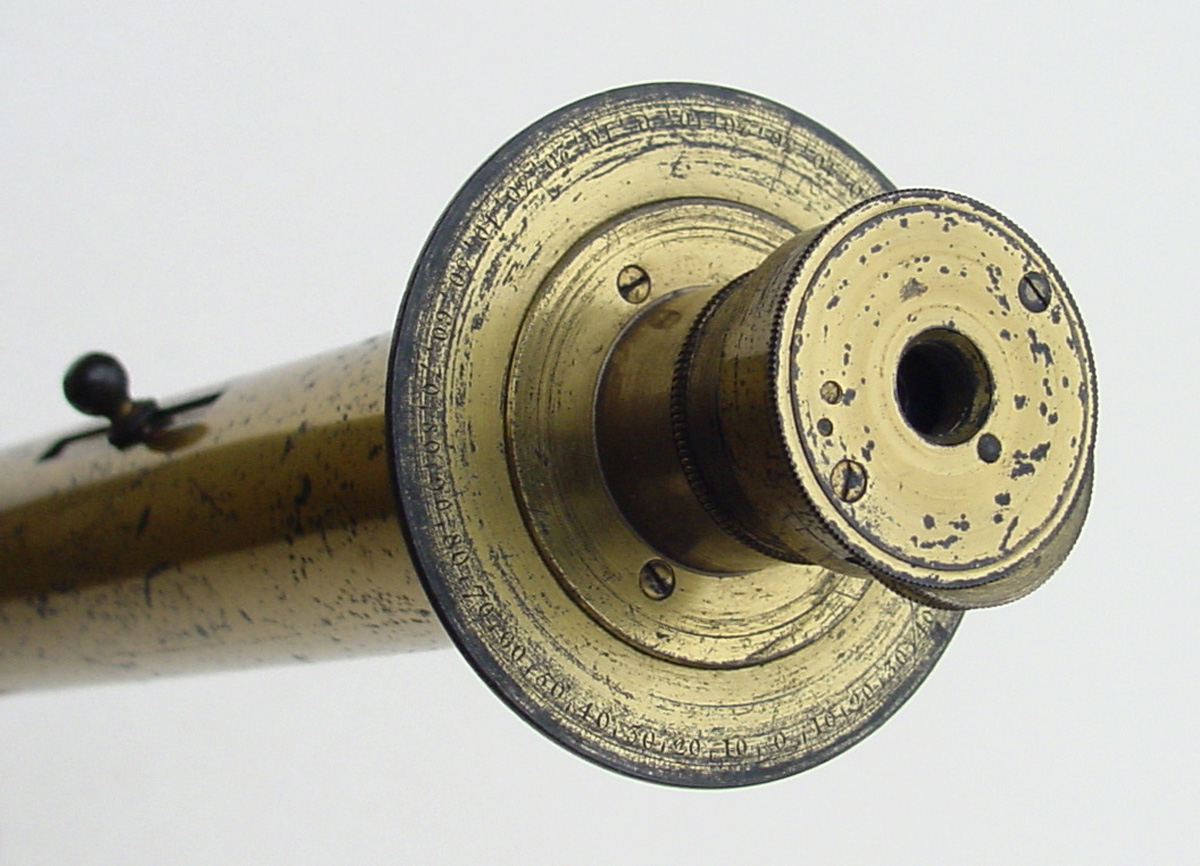
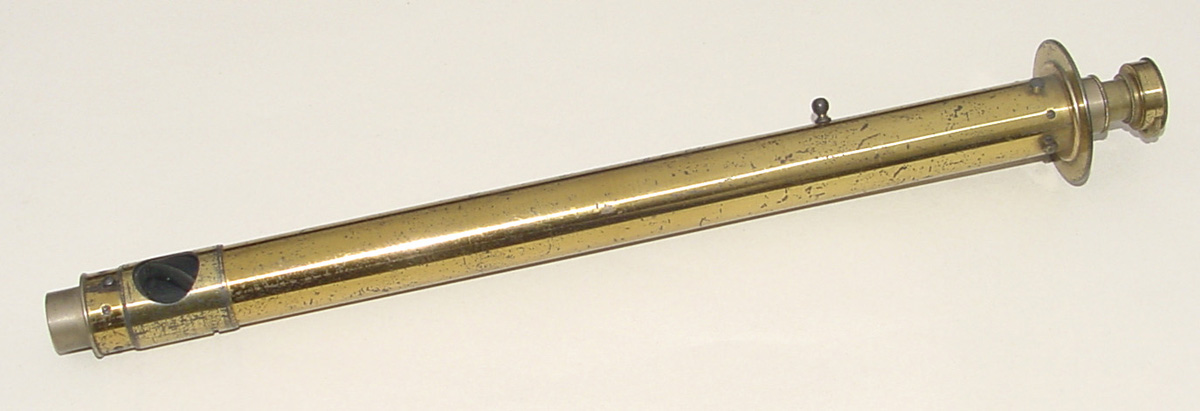
A MYSTERY TELESCOPE, English, c. 1812, signed "Tho's. Jones, 21 Oxendon Street." This very unusual lacquered brass telescope measures 14-3/4" (37 cm) long, and has a relatively small diameter objective mounted in internal sliding tube, permitting focussing from infinity down to 12 feet. Just beyond the objective is a transparent glass plate mounted at 45°, with rotating shutter, so one can view along and / or at 90° to the optical axis. In the focal plane is a reticle of four fine wires. Focussed on this is the eyepiece, composed of just two elements in the design developed by Ramsden (PC/CP; or nearly so, as the surface nearest the eye in the present example seems to have a very slight curvature), to produce the flattest possible achromatic field for viewing micrometer wires (see King, and Ramsden's 1782 paper A Description of a new Construction of Eye-glasses for such Telescopes as may be applied to Mathematical Instruments). A filter wheel over the eyepiece presents open, green, red, and dark red positions, and a rotatable disk surrounding the eyepiece is very finely divided every degree full circle, and calibrated 0° - 90° in each quadrant. Condition is very fine, retaining much of the original clear lacquer finish. Near each end are 1/2" long cylindrical areas which were never lacquered, suggesting areas of mounting (?). We have yet to identify this fascinating instrument, which typifies Jones' innovation and craftsmanship. It bears some similarities to Ramsden's rare optigraph, yet it differs... Jones is listed at this address in Piccadilly only from 1811 until 1814. (8546) $2500. |
| Ramsden as Scientist | Click on any image for a larger view. Scroll to view more items. |
 |
|
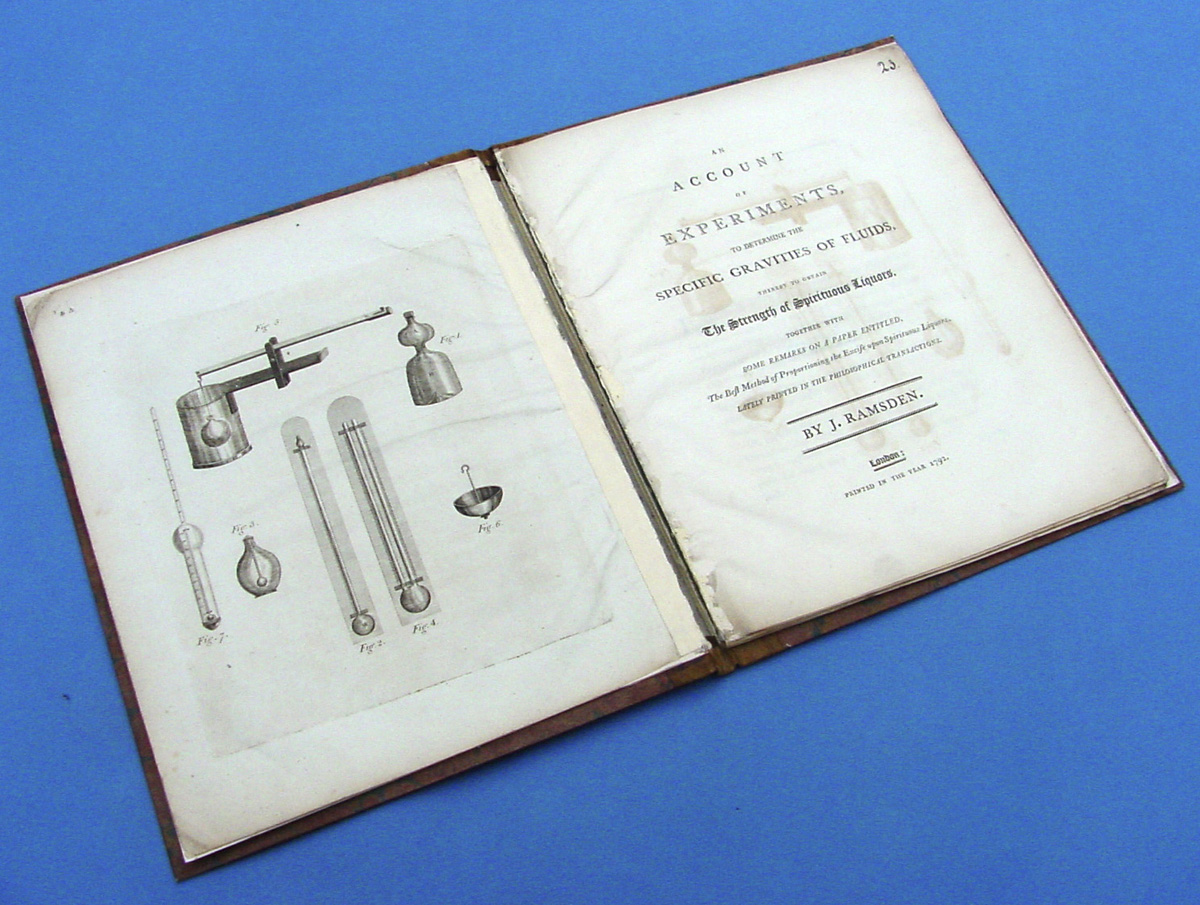
RAMSDEN'S VENTURE INTO CHEMISTRY -- "AN ACCOUNT OF EXPERIMENTS, TO DETERMINE THE SPECIFIC GRAVITIES OF FLUIDS,...," English, 1792, 33pp plus one full-page plate, rebound in boards 8-3/4" x 10-3/4" (22 x 27 cm). Condition is good noting the plate edge reinforced, and the pages somewhat wavy. All publications by Ramsden are rare. Here Ramsden shows his strength as a scientist, describing in detail experiments he undertook to develop the most precise and the most practical form of balance hydrometer. The Royal Society had been charged with finding the best methods for excise officers to determine duties, especially on various spirits; Ramsden finds a better way. "Thus, we have an inftrument, the making of which I confider more as the bufinefs of an inftrument-maker than of a philofpher, whereby we may obtain the contraction or expanfion of a fluid, in ten thoufandth parts of its volume, for each degree of the thermometer, by an eafy procefs... Thus far my object has been precifion. But the balance hydrometer being a new inftrument, and the revenue officers not in the habit of ufing them,... I am confident, that after an hour's practice, an officer will be able to afcertain the fpecific gravity of any fpirituous liquor in the fpace of two minutes..." (8176) $1750. |
| Measuring the Packing Density of Cables | Click on any image for a larger view. Scroll to view more items. |
|
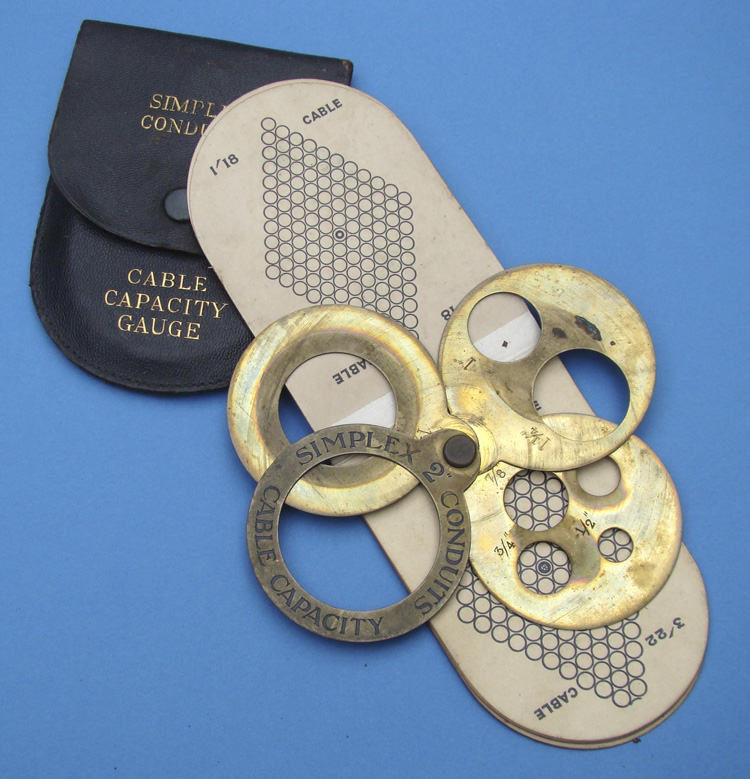
THE CABLE CAPACITY GAUGE, English, c. 1915, by Simplex Conduits Ltd. of Birmingham. The four 2-1/2" diameter (6 cm) swivelling brass disks have holes labeled from 1/2" to 2", although the actual hole diameters are (intentionally) approximately 1/8" less than these numbers. The set is complete with leather pocket case and booklet illustrating the packing density of cables of various diameters. This unusual measuring outfit is in fine condition, by a company specializing in the manufacture of steel conduits for carrying electric cables.(10515) $220. |
 |
| Gold Ore on the Lapel | Click on any image for a larger view. Scroll to view more items. |
|
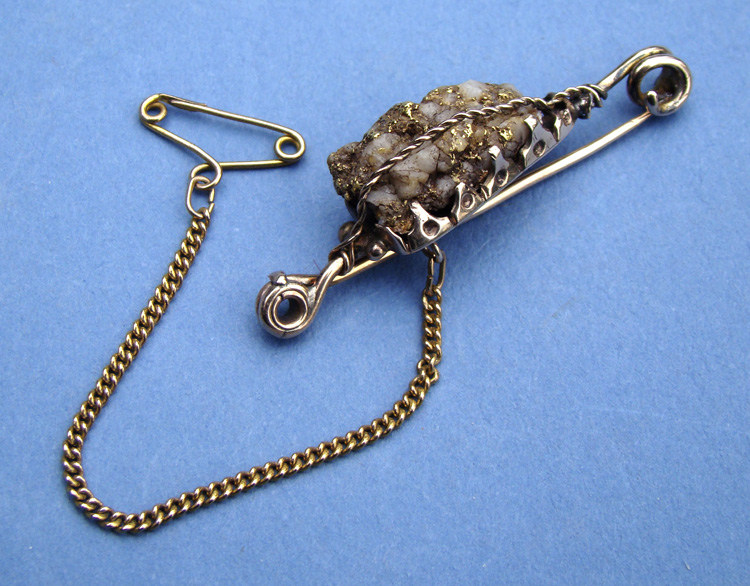
GOLD BROOCH WITH NATURAL GOLD-BEARING QUARTZ, probably English, 19th century. With an overall length of 1-5/8" (4 cm), this nine carat (and so stamped) gold brooch has integral pin with hook and attached safety chain. Set centrally is a natural specimen of quartz showing glitters of pure gold throughout. Condition is very fine. An unusual item of "natural" jewelry. (10485) $450. |
 |
| Fame and Legacy: Ramsden "Mementos" from the past 100 Years | Click on any image for a larger view. Scroll to view more items. |
|
Ramsden's name continues in current usage, whether as
the "Ramsden disk" (the exit pupil of a telescope), the "Ramsden
eyepiece" (his design, with twin plano-convex lenses, the curves
facing each other), or "Point Ramsden" (in present day British
Columbia, named by Captain Vancouver on his 1793 explorations). Even a
lunar crater bears his name, located at lunar latitude -32.9°, longitude
-31.8° And much of his instrumentation has had a long productive life:
his (or Troughton's version of his) dividing engine in the Science Museum
was put into service in World War II in the division of scales on sextants
(see Calvert). Here we present a group of rather modern objects which
carry on his name.
|
 |
 |
 |
 |
|
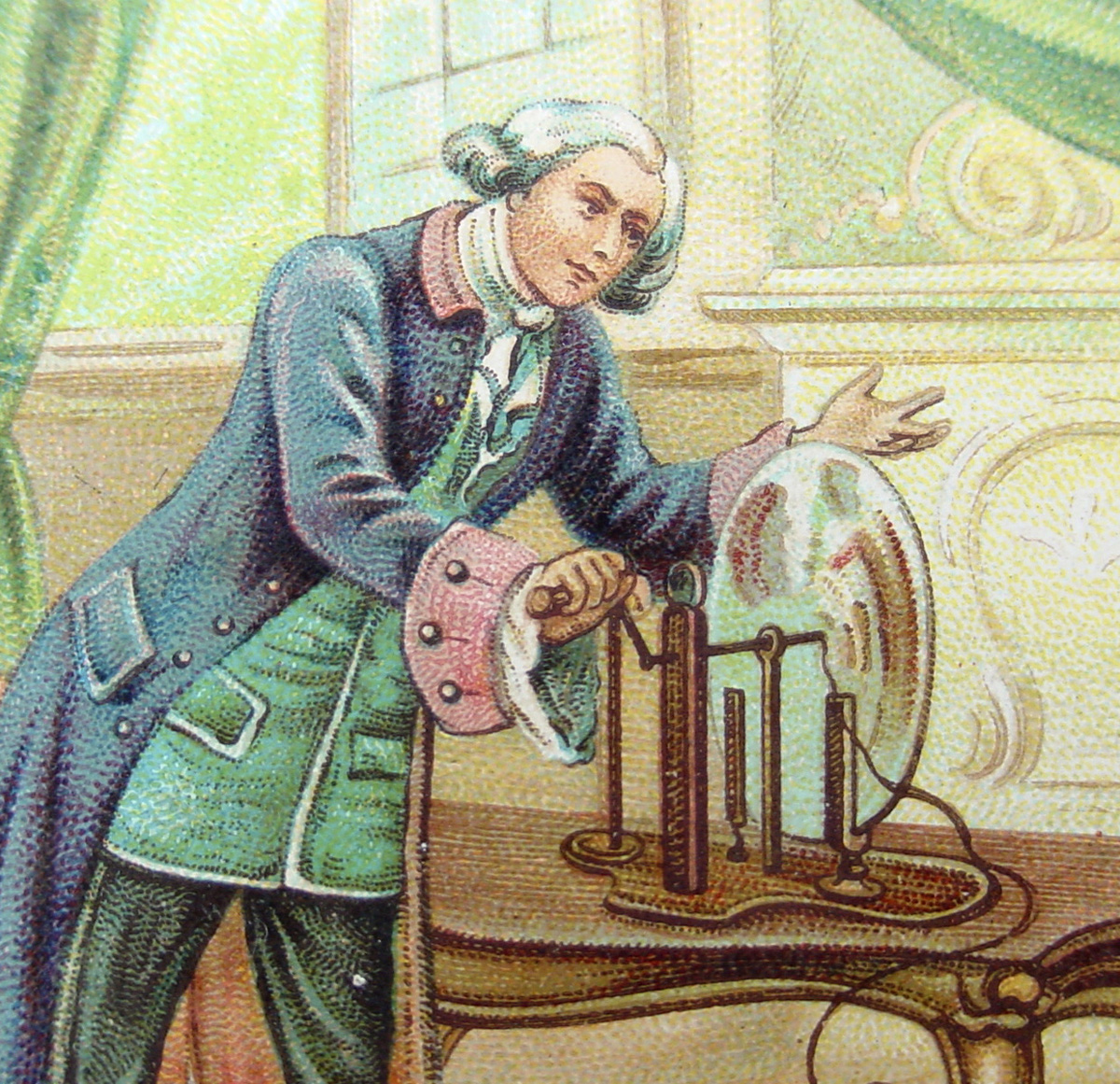
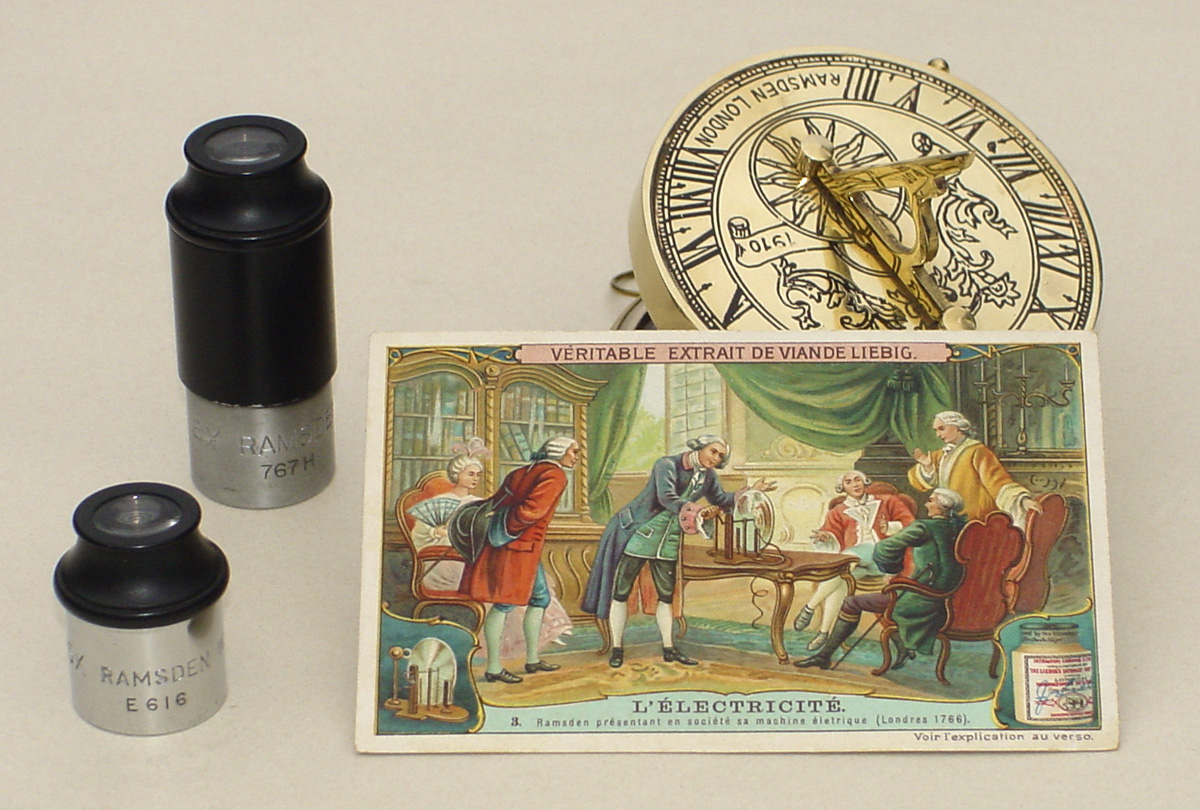
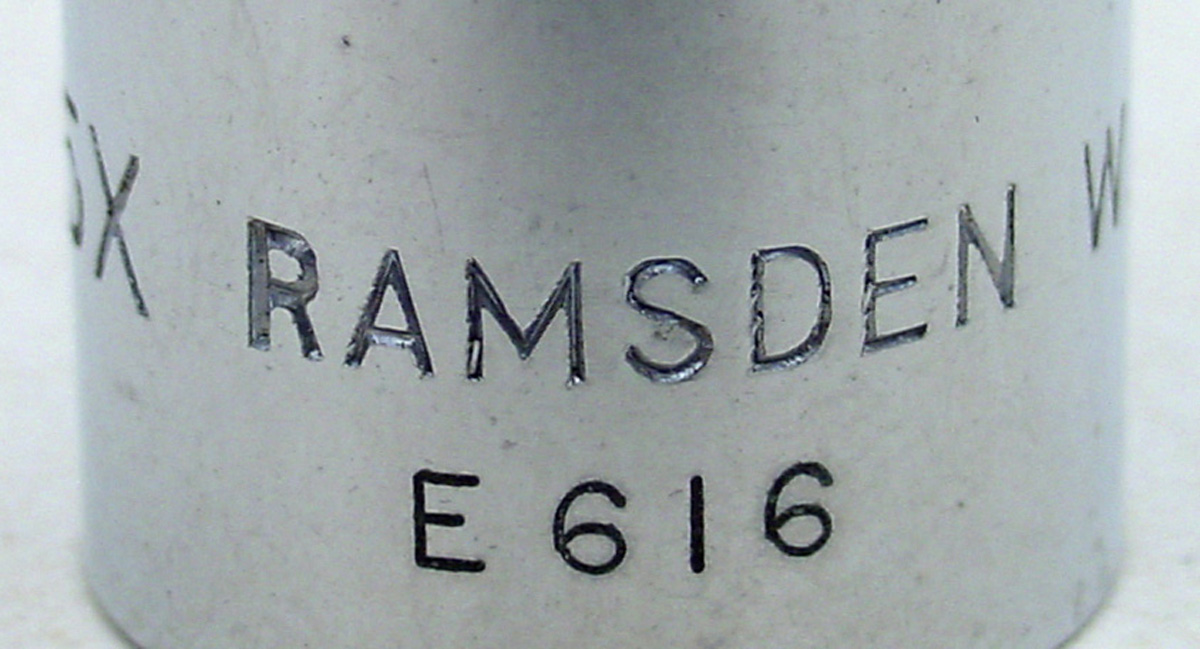
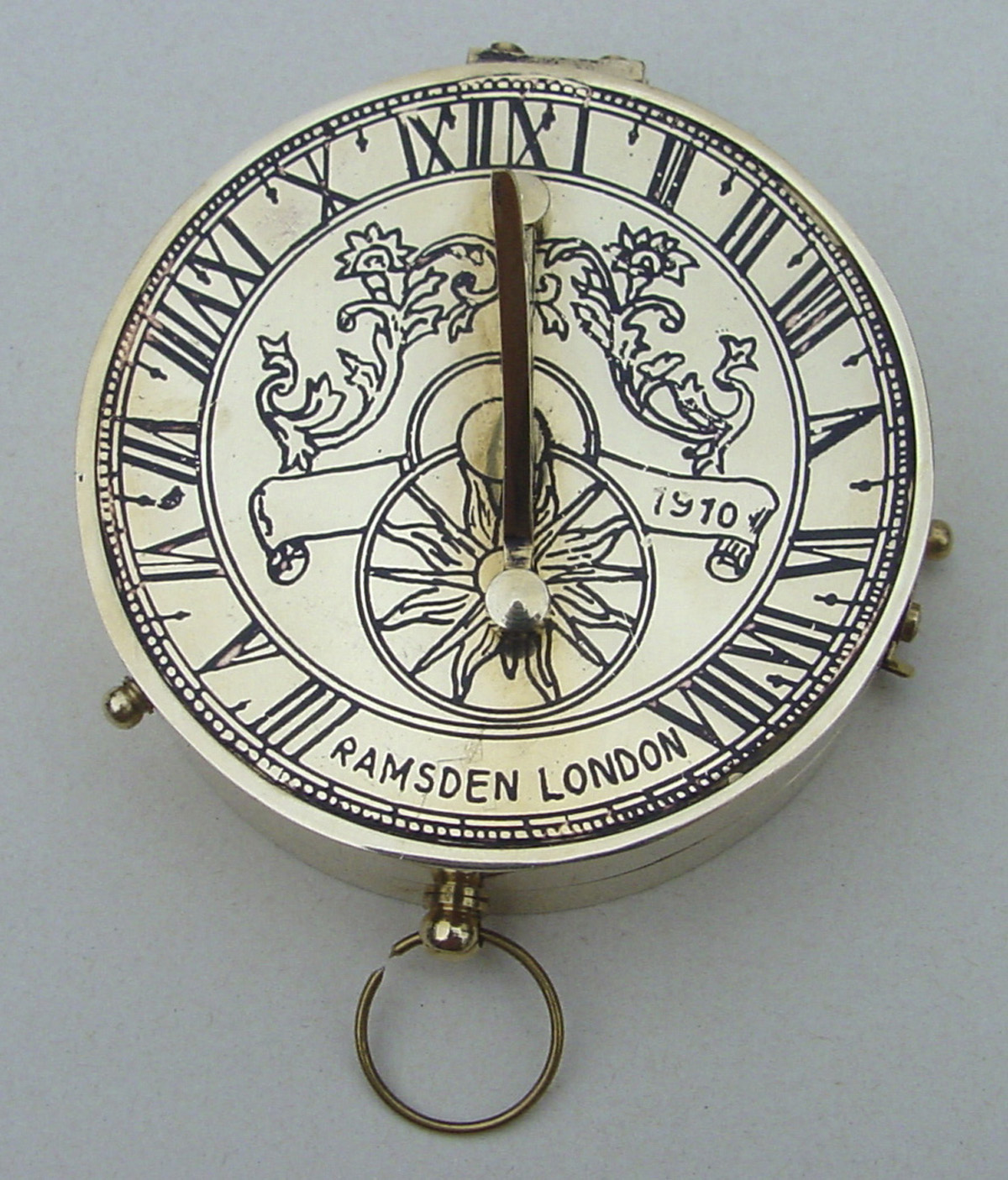
--ADVERTISING CARD FOR BEEF EXTRACT, English for the French market, c. 1910, signed "Bouillon Oxo de la Comp'ie. Liebig." This 2-7/8" x 4-3/8" (7 x 11 cm) color lithographed card depicts a salon scene (with typically Continental Baroque 18th century furniture) showing Ramsden presenting his electrostatic machine in 1766. A legend credits him with the flat plate design and with improvements in the collectors and conductors. Very fine. --A PAIR OF MODERN FLAT-FIELD "RAMSDEN" EYEPIECES FOR MICROSCOPES, American, second half 20th c., engraved "6x (and 15x) Ramsden W.F." (i.e., wide field). Made of plated brass, with coated optics, each eyepiece is the modern standard size of 23 mm (about 7/8") outside diameter. Giving magnifications of 6 and 15 power respectively, the eyepieces conform to Ramsden's design giving a flat field with focal point beyond the furthest lens. It is thus a design ideal for use with micrometer or reticle. Very fine throughout. --EGREGIOUS "FAKE / REPLICA" POCKET SUNDIAL, Indian, early 21st (!) century, signed "Ramsden, London." Made of bright cast brass, the sundial is constructed (poorly) with a 3" (7.5 cm) diameter housing, folding gnomon over decorated chapter ring "divided" from 4 am to 8 pm, and suspension ring. The upper assembly is hinged; when tilted up, in a thereby useless position as sundial, it exposes the glazed compass with rose, degree scale, needle, and needle lifter. Condition is new. This is one of the flood of mass market "replicas" coming out of Mumbai (Bombay), here curiously carrying on the Ramsden name! (8656) $350./the group of three. |
| Attractive Thermometer needing neither Battery nor Liquid | Click on any image for a larger view. Scroll to view more items. |
 |
 |
|
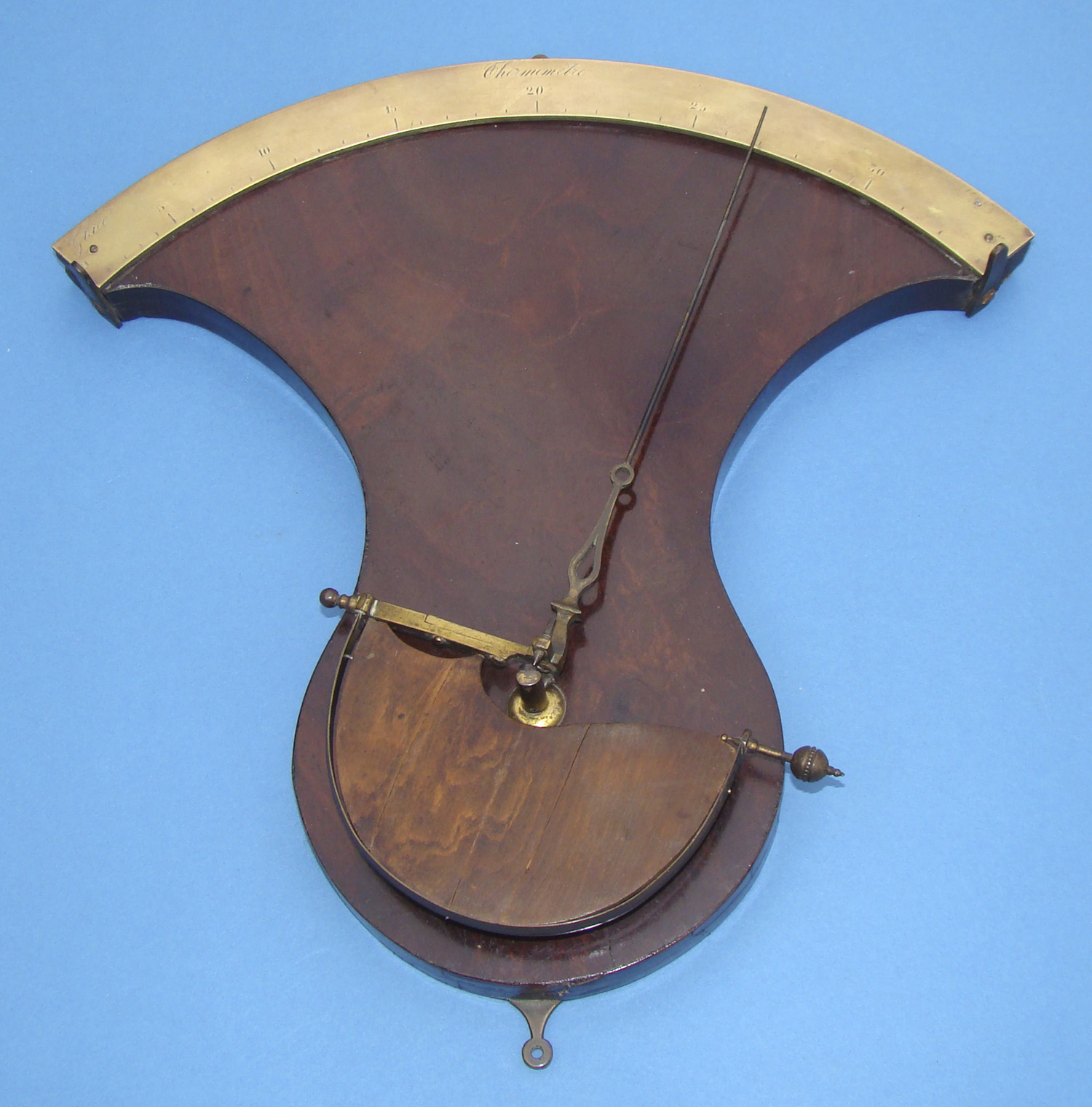
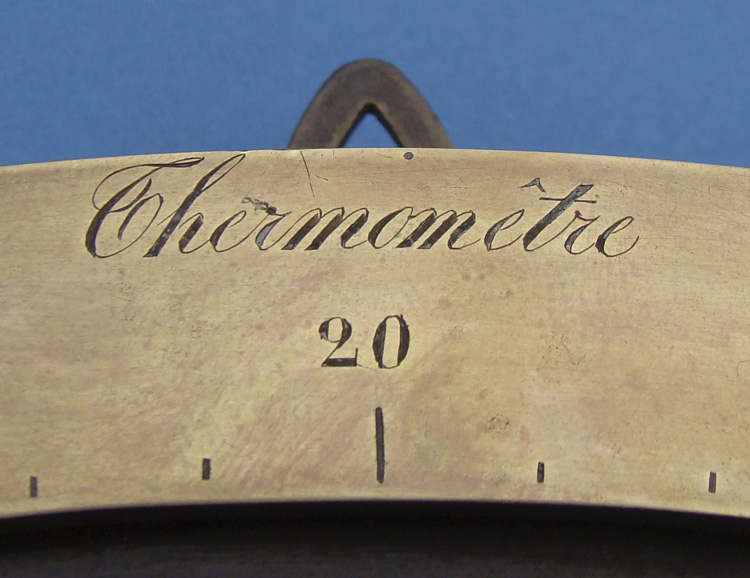
ELEGANT METALLIC THERMOMETER, French, c. first half 19th century. The large wall-mounting wood support is 9-5/8" x 10" x 5/8" (24 x 25 x 1.6 cm) with a fine mahogany veneer and set with a Centigrade (Celsius) degree scale running from "Glace" at 0° up to 33° (equivalent to 91° Fahrenheit), the brass scale divided every degree. A short support arm has two little concave wells, the arm¹s tilt adjustable from behind. And there are two wall mounting lugs. The thermometer itself has two adjustable pins that sit in the wells and lead to a long index pointer, and to a side arm supporting the metal half-round which expands and contracts with the temperature. The end bears a ball weight, its position adjustable for calibration. The central area of the metal arc is filled with a thin wood panel. Condition is fine noting small cracks to this panel. This professionally made instrument is the only one of its kind we have seen. Middleton (1966, A History of the Thermometer) discusses various "Deformation thermometers," primarily bimetallic. (10465) $2800. |
| Could it have been carried on the HMS Beagle? | Click on any image for a larger view. Scroll to view more items. |
 |
|
|
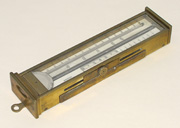
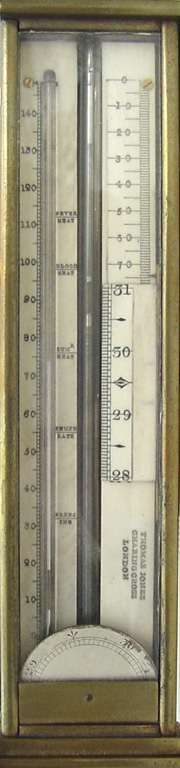
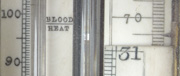
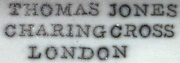
SYMPIESOMETER BY THOMAS JONES, English, second quarter 19th century, signed "Thomas Jones, Charing Cross, London." The rugged brass housing measures 9-5/8" x 2-1/4" x 1-3/8" (24 x 6 x 3.5 cm) and is fitted with screw plates for the cabin wall. Mounted under glass is the glass tube thermometer over its ivory scale (reading 0° to 147° F.), and the doubly-curved glass tube of the "air barometer" beside the ivory pressure scale (28 to 31 mm Hg, divided every 0.05), this sliding scale adjustable with external rack and pinion and sliding over the fixed temperature compensation scale. A silvered brass reminder wheel can be set to the latest pressure reading. Condition is fine although there are gas pockets in the column of barometer fluid. This is a fine example of the air barometer which was (re)invented and patented by Alexander Adie of Edinburgh, in 1818, and henceforth termed the sympiesometer. In the original design the barometer tube has a hydrogen-gas-filled reservoir at its top, and almond oil fluid below. An increase in atmospheric pressure pushes on the oil from below, compressing the hydrogen and lifting the top of the oil column. In use one notes the temperature, slides the pressure scale to that temperature reading on the compensation scale, and reads off the pressure at the top of the oil column (see Middleton, The History of the Barometer). The sympiesometer was compact and did not require gimbal mounting on board ship. One was tested on the Ross expedition to the Arctic; the Commander writes: "The instrument acts as a marine barometer; it has the advantages of not being affected by the ship's motion, and of taking up very little room in the cabin. I am of opinion, that this instrument will supersede the marine barometer when it is better known." (Ross, A Voyage of Discovery, made uder the orders of the Admiralty, in His Majesty's Ships Isabella..., 1819). Sailing in 1831, Captain Fitzroy carried no less than five examples of sympiesometer (plus one Charles Darwin) on the HMS Beagle. Unusual. (8576) $3500. |
 |
|
| Power at the Fingertips | Click on any image for a larger view. Scroll to view more items. |
 |
 |
|
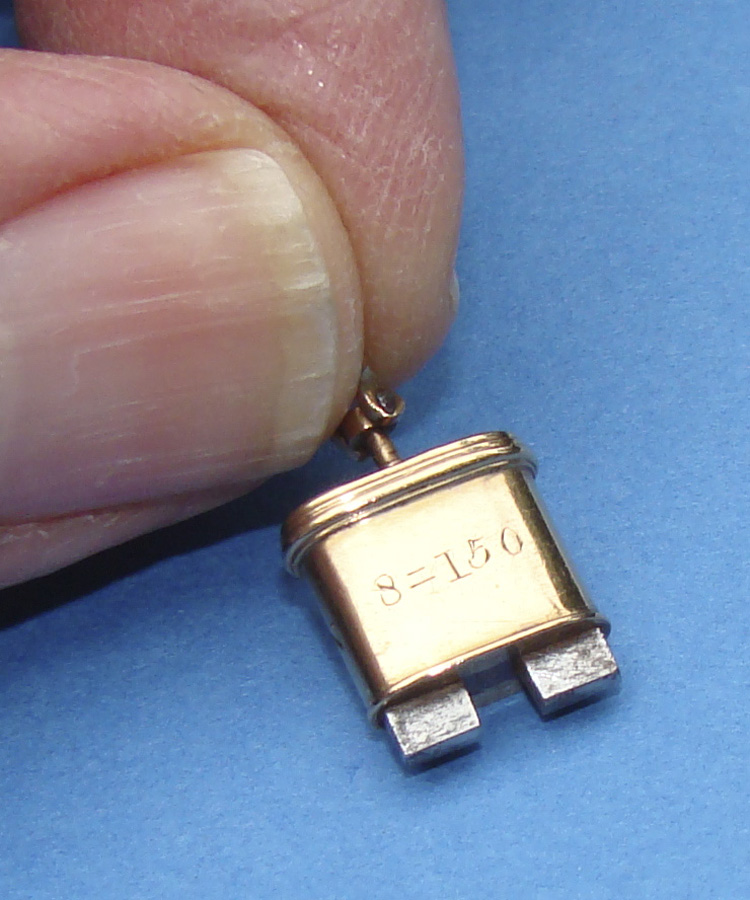
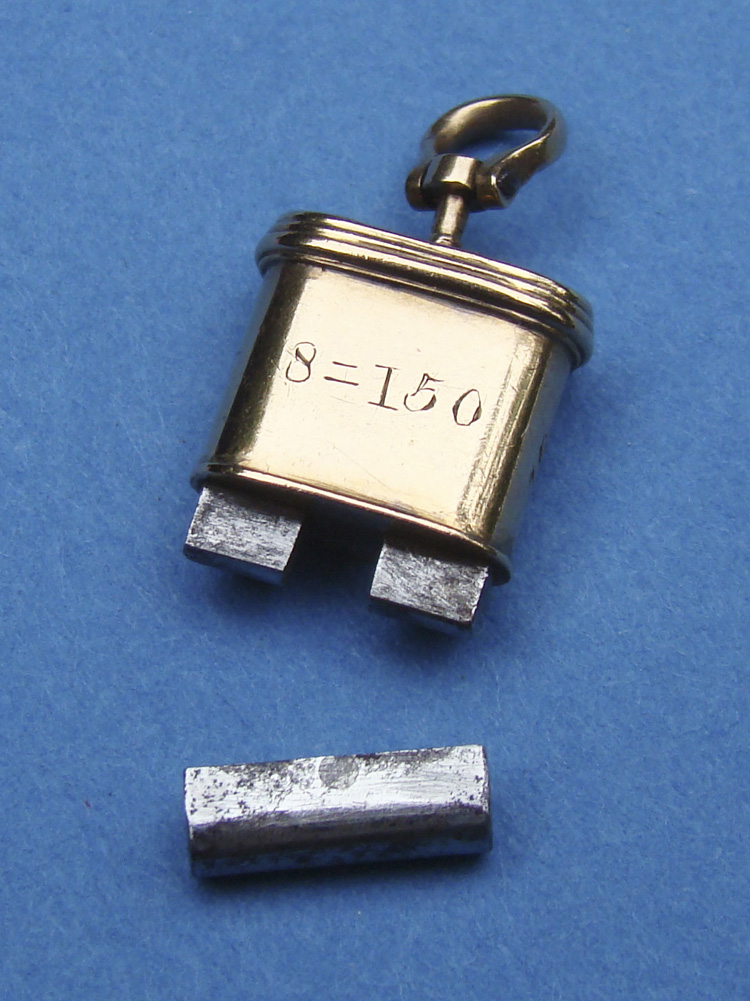
MINIATURE GOLD-CASED MAGNET, probably English, c. 1800, only 0.42" (11 mm) wide and 0.70" tall including suspension ring. The case ends are engraved "N" and "S," for the iron poles, and the side "8=150," implying that this magnet weighs 8 units, and could at one time lift 150 units, or almost 19 times its own weight! The finely made mounting is beautiful rose gold, in very fine condition throughout noting a tiny dent. A remarkable miniature magnet, useful for educational demonstrations in elegant society, or even for remagnetizing needles of tiny compasses in sundials, etc. (10455) $3200. |
| The Dividing Engine | Click on any image for a larger view. Scroll to view more items. |
 |
 |
|
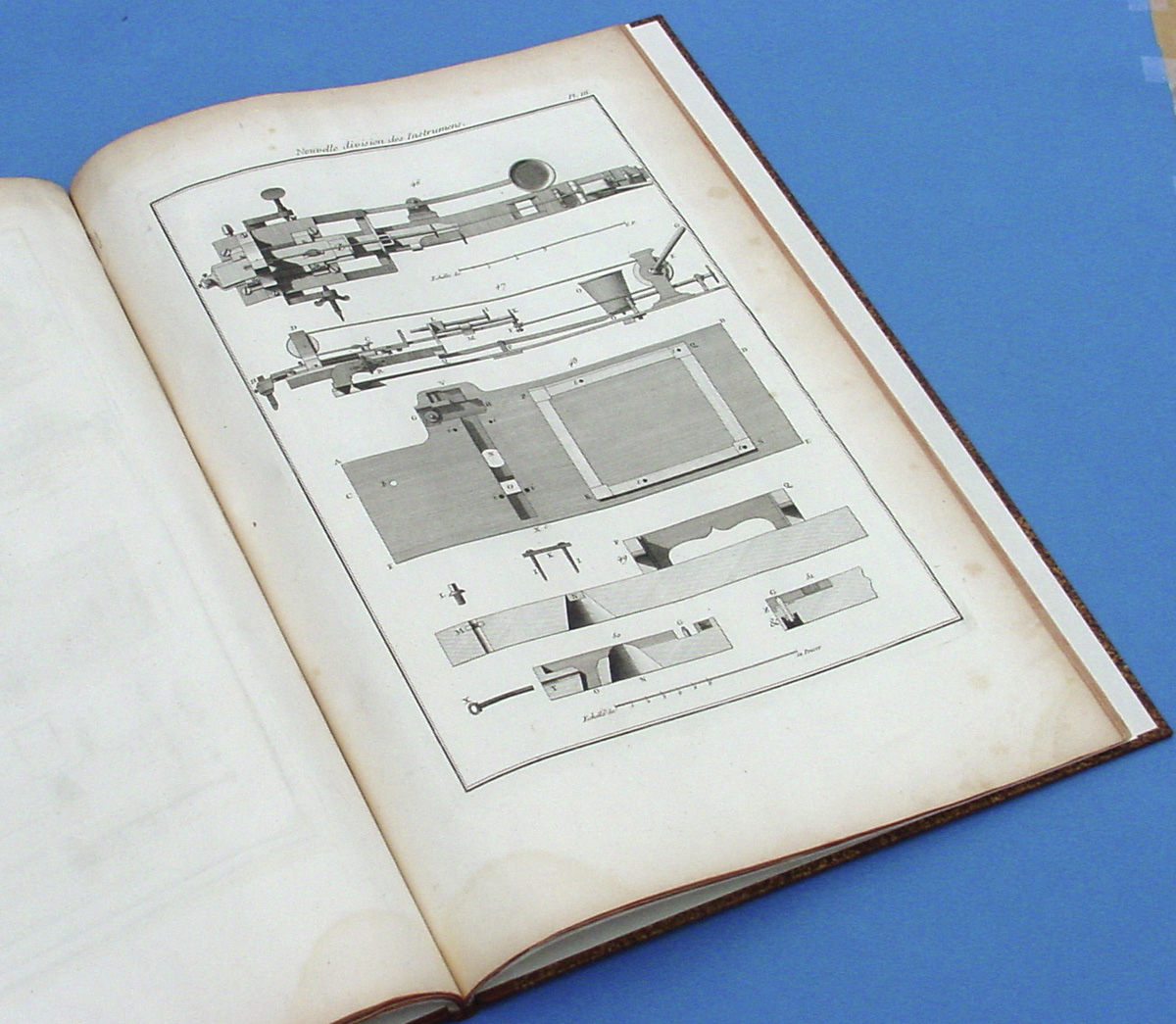
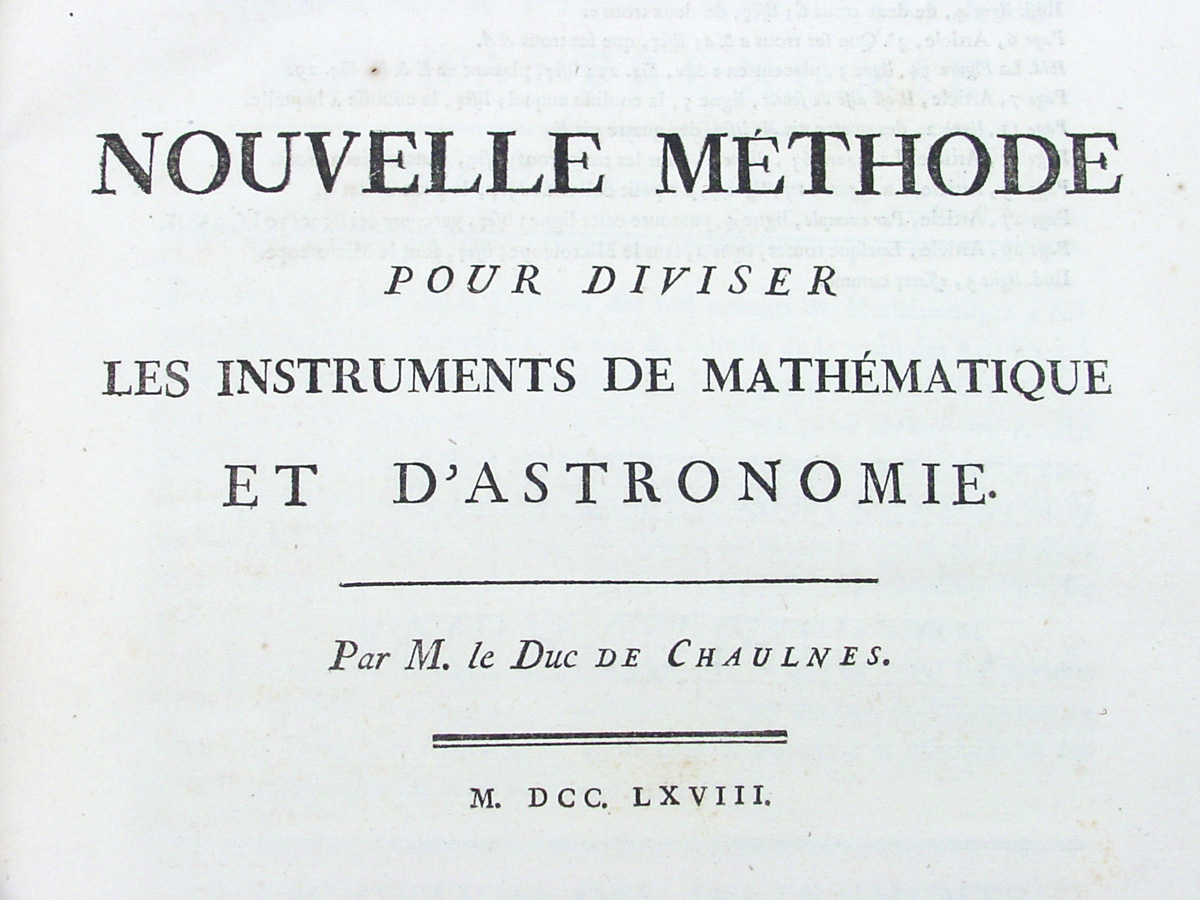
THE FRENCH INITIATIVE -- "NOUVELLE METHODE POUR DIVISER LES INSTRUMENTS DE MATHEMATIQUE ET D'ASTRONOMIE," 1768, by M. le Duc de Chaulnes, [2] + 44pp +15 highly detailed full page plates, rebound in boards 11-5/8" x 17-1/2" (30 x 44 cm) overall. Condition is fine with wide untrimmed margins, noting one margin torn and light browning to some pages. There are elaborate circular and straight-line dividing engines, shown in the plates fully assembled as well as broken down into all component parts, even to the bolts and screws. Over the years many designers and tool makers had roles in the developments which led to Ramsden's first practical dividing engine of high precision, realized in 1768. This began with simple rotating platforms used by early clock makers; by the mid-18th century various designs were being constructed. Most impressive were those of Michel-Ferdinand d'Albert d'Ailly, duc de Chaulnes, who employed microscopes and micrometers in his engines, and whose impressive monograph was published in the very same year, 1768. An important record of the cross-Channel activity. (8196) $1950. |
| The Revolution in Accuracy | Click on any image for a larger view. Scroll to view more items. |
|
"His sextants of fifteen inches he warranted to be correct to within six seconds. From that size he made them to an inch and a half radius, and in the latter the minutes can be clearly distinguished; but he recommended for general use those of ten inches, as being more easily managed, and susceptible of the same exactness." (Aikin, 1813; McConnell p. 298) |
 |
|
"RAMSDEN'S MACHINE FOR DIVIDING MATHMATICAL INSTRUMENTS," disbound section from the third edition of the Encyclopedia Brittanica, published in Edinburgh in 1797. A quite detailed description of the 45" diameter engine, Ramsden's second engine, the large one for which he won recognition and success, is followed by a full-page (8-1/2" x 10-1/2") plate of the machine, and a plate showing a breakdown of its principal elements, plus details of the engine built to cut the endless screw of the dividing engine. Condition is good noting some stains just in the margins. The detail is considerable, e.g., "...the furface of the wheel A was worked very even and flat, and its circumference turned true. The ring C, of fine brafs, was fitted very exactly on the circumference of the wheel, and was faftened thereon with fcrews, which, after being fcrewed as tight as possible, were well rivetted." The text is probably based on Ramsden's initial 1777 report where the details were made public to meet requirements of the Board of Longitude. (8206) $225. |
| Patented by Sir William Crookes | Click on any image for a larger view. Scroll to view more items. |
|
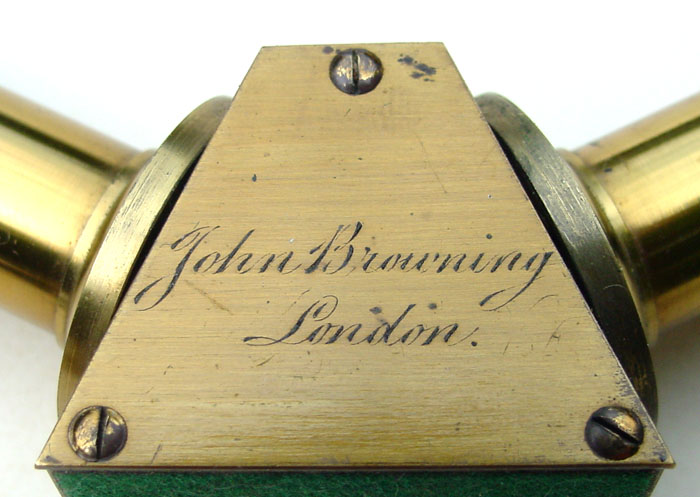
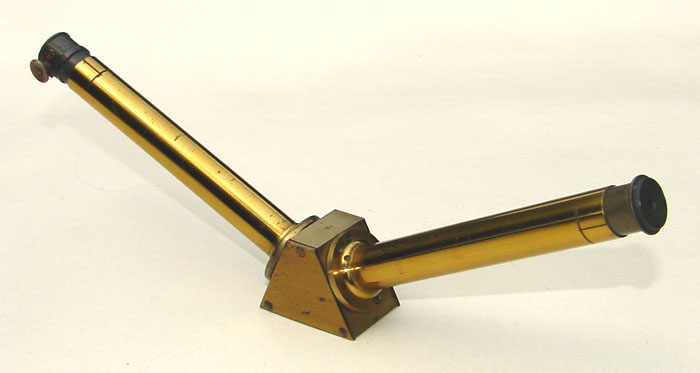
CROOKES' SPECTROSCOPE IN MINIATURE, English, c. 1875, signed "John Browning, London." This fine little spectroscope has a central trapezoidal box containing the glass prism, and two 4" (10 cm) long tubes, one with extending tube containing the two-element eyepiece, the other with extending tube containing the simple adjustable slit. Each tube can be adjusted slightly for tilt with respect to the prism. Spectra are clearly visible. The instrument is in very fine condition, with its beautiful clear lacquered finish to the brass. It possibly had been stand-mounted at one time. This is a diminutive version of the spectroscope patented by Sir William Crookes in 1861. The large version was manufactured by Spencer Browning and Co., and was stand-mounted with horizontal collimator tube; it was exhibited at the 1862 International Exhibition. One example is in the Whipple Museum in Cambridge, a second one in the Power House Museum in Sydney. But the makers also advertised "a most efficient, portable and convenient instrument...Crookes' Pocket Spectroscope for tourists...." Spencer Browning and Co. are listed in the London directories until c. 1870, and John Browning on his own, at the same address, from c. 1872. We are aware of one other miniature example of this form. (8349) $2750. |
|
| With an Unusual "Static" Vernier | Click on any image for a larger view. Scroll to view more items. |
 |
 |
 |
 |
|
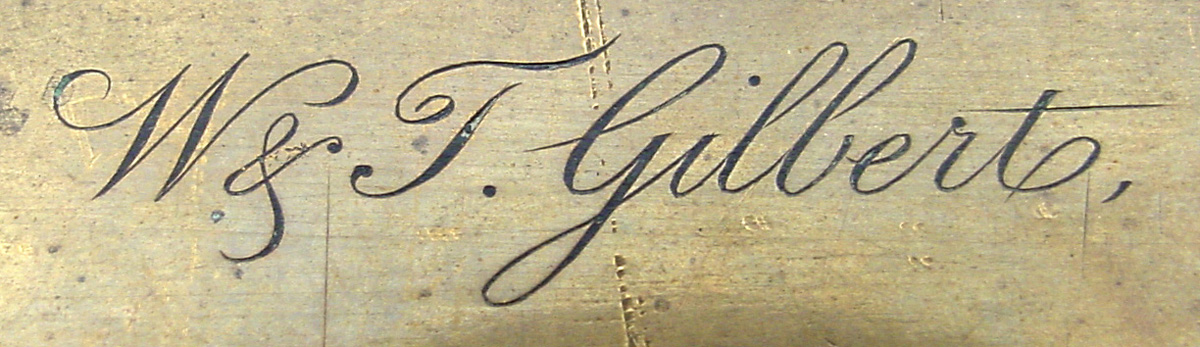
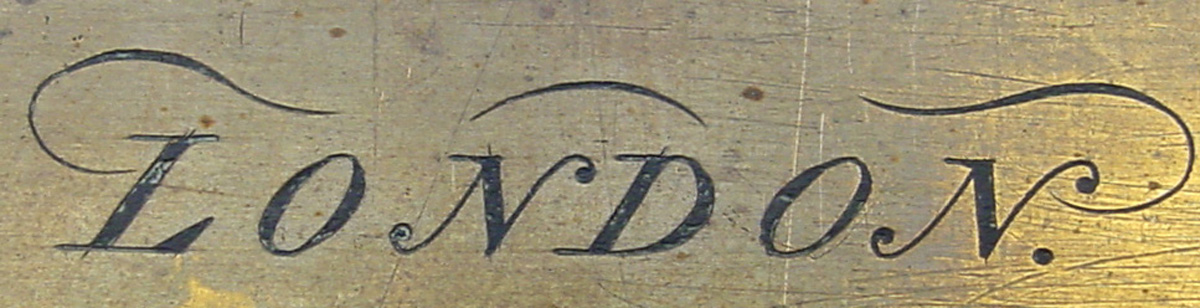
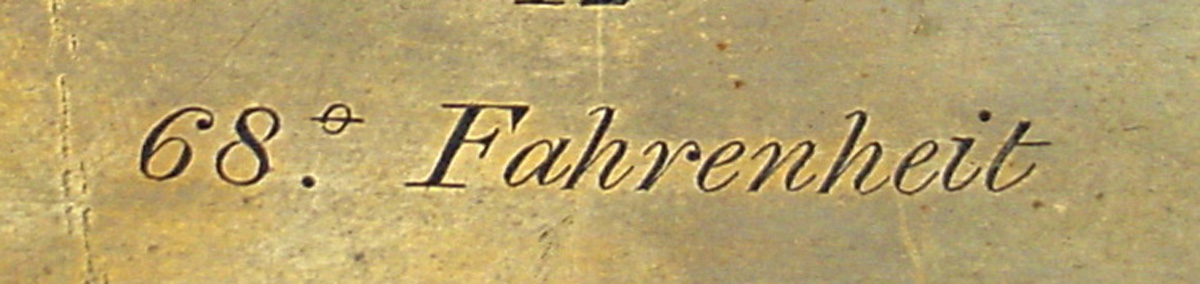
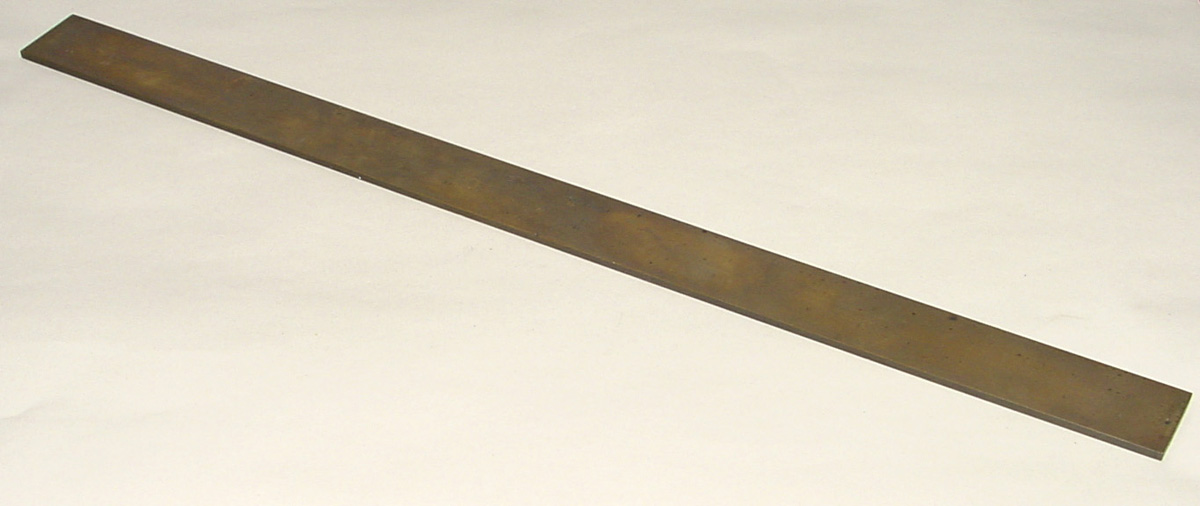
EARLY STANDARD RULE, English, early 19th century, beautifully signed "W. & T. Gilbert, London." Designed for standard use at 68°F, this 26" (66 cm) long brass rule is engraved in inches and tenths from 0" to 24", and has an additional 9.9" scale divided in 100 parts, apparently for "vernier" use. In fine condition, noting surface scratching and browning of the brass, this is a significant early scientific standards rule. (8586) $1750. |
| A Florida Lion with a Mouthful | Click on any image for a larger view. Scroll to view more items. |
|
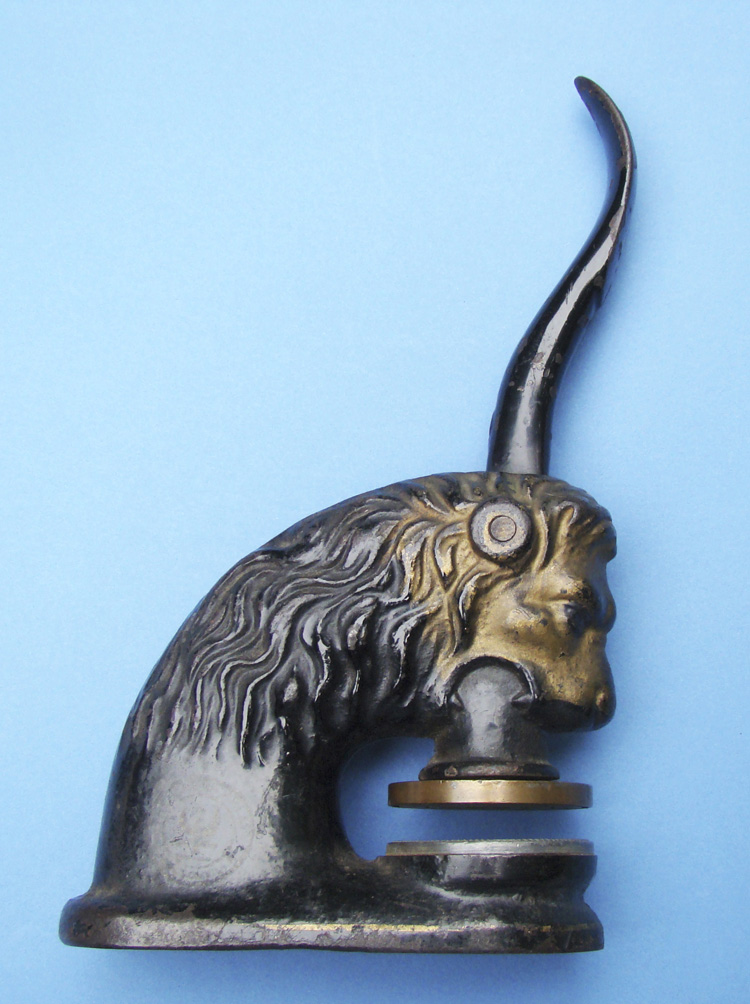
FELINE EMBOSSING PRESS, American, second half 19th century, signed indistinctly "The Drew Press, Jacksonville" and with an eagle logo. This substantial cast iron press has a 5-3/8" x 2-1/8" (14 x 5 cm) oval base, and is modeled as a particularly hairy lion's head grasping the seal in his mouth. Pulling the handle down 90° presses the incised brass seal against the matching raised lettering on the base plate. The seal is for J.H. Follett, Inc. of West Palm Beach, Florida. Condition is fine and functional, noting some wear and losses to the black enamel and golden finishes to the iron. We note that the Drew Press was an historic Florida printing company founded 1855. A fine desk accessory. (10505) $495. |
 |
| Early American Telegraphy -- in a Sculptural Form | Click on any image for a larger view. Scroll to view more items. |
 |
 |
 |
 |
|
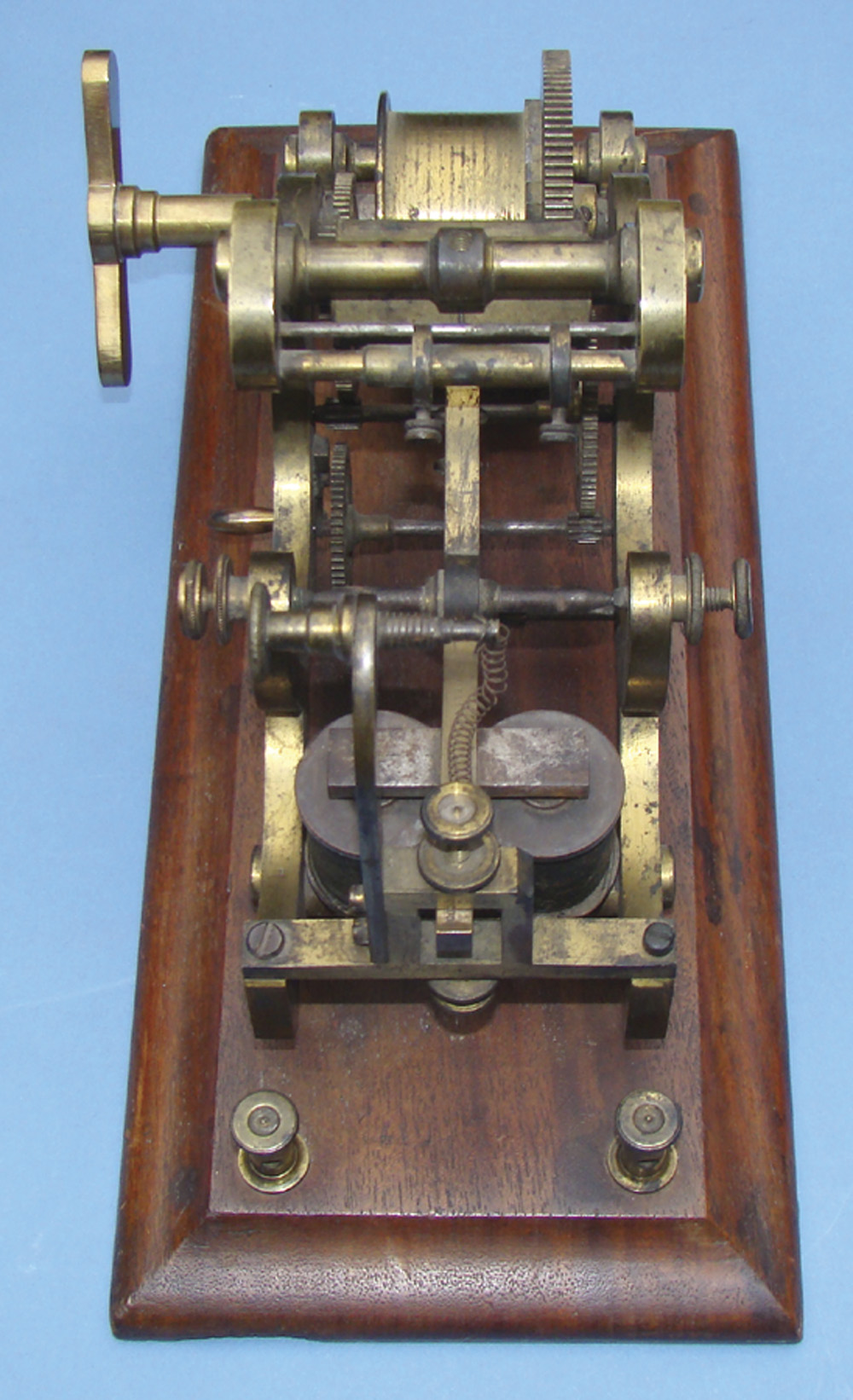
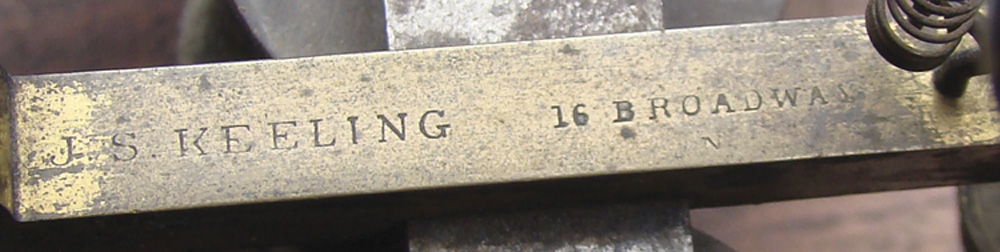
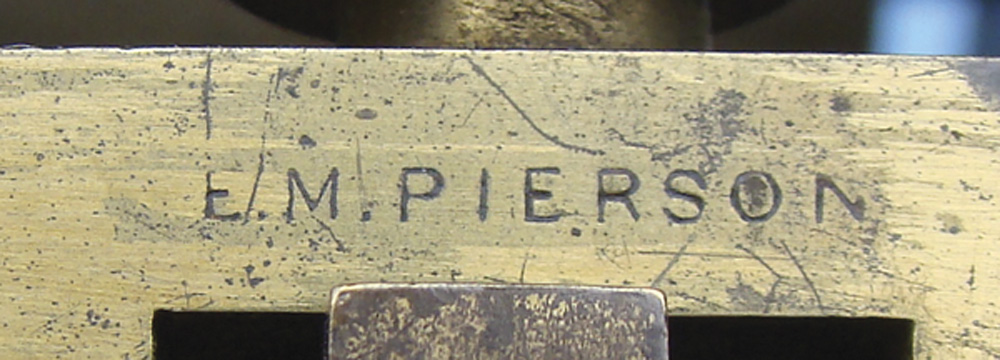
EARLY RECORDING TELEGRAPH REGISTER -- THE SAMUEL MORSE / ALFRED VAIL DESIGN, American, c. 1865, signed "J.S. Keeling, 16 Broadway" and "E.M. Pierson" and numbered "1." This substantial brass device is mounted to a 5-3/4" x 13" (15 x 33 cm) mahogany board, with two terminal posts wired to a pair of electromagnetic coils. The main structure is most elegantly designed, with aesthetic recurved shaping of the 5/16" thick solid brass side plates. The brass mechanism consists of a large winding drum which would carry a cord to a heavy weight below (not included). The descending weight drives a gear train to a governor and to ridged rollers advancing a paper tape. An electrical impulse to the coils creates a momentary magnetic field, pulling down an iron bar attached to a spring-loaded brass lever arm with a pricker point which cuts a short slot in the tape, thus permanently recording a serious of short (and long) slots, transmitted to this register over telegraph lines. The lever arm has four clampable adjustments for play, and there is a finger lever to arrest the motion of the tape. Condition is fine, the brass retaining much of its original lacquer finish. This is an excellent example of the first commercially successful recording telegraph receiver. It was developed by Samuel F.B. Morse and in particular by his assistant Alfred Vail (who incidentally also developed the "Morse" code). James S. Keeling is listed as working in lower Broadway, New York City, c. 1864 - 1867. He had been briefly associated with Luther Tillotson in forming Tillotson & Co. in 1862. Then c. 1865 Tillotson hired one Edward M. Pierson as shop superintendent, and the business prospered. Thus we have found the connection between Keeling and Pierson, the two names on our instrument. The Tillotson firm became a major supplier in the railroad / telegraph market, selling other manufactures as well as their own. Perhaps Keeling and Pierson were in a sort of partnership c. 1865, either within the Tillotson firm or outside it. (9348) $4950. |
| Twenty-Two Tools for the Barrel-Maker | Click on any image for a larger view. Scroll to view more items. |
|
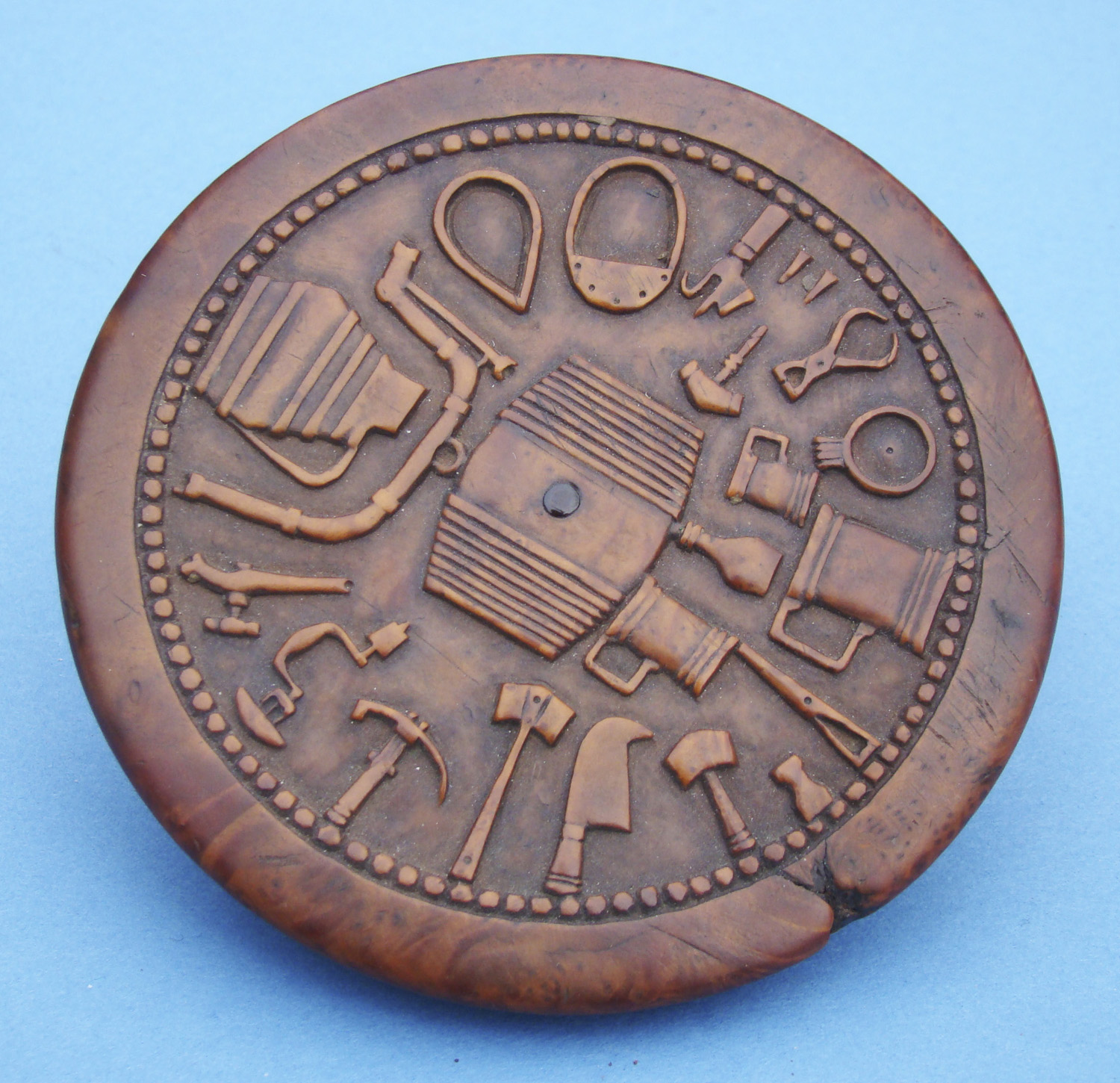
LID CARVED WITH COOPER'S AND VINTNER'S TOOLS, French, c. early 19th century. The 3-3/8" (8.5 cm) diameter turned wood lid has an interior lining, and is carved with approximately 22 tools of the barrel maker's and wine maker's trades, plus central barrel with inset "bung." Condition is very fine noting a small natural imperfection at the edge. The first such "tools of the trade" presentation we have seen. ex: Brophy collection (10525) $1500. |
 |
| Industrial Revolution in the Home | Click on any image for a larger view. Scroll to view more items. |
 |
 |
 |
|
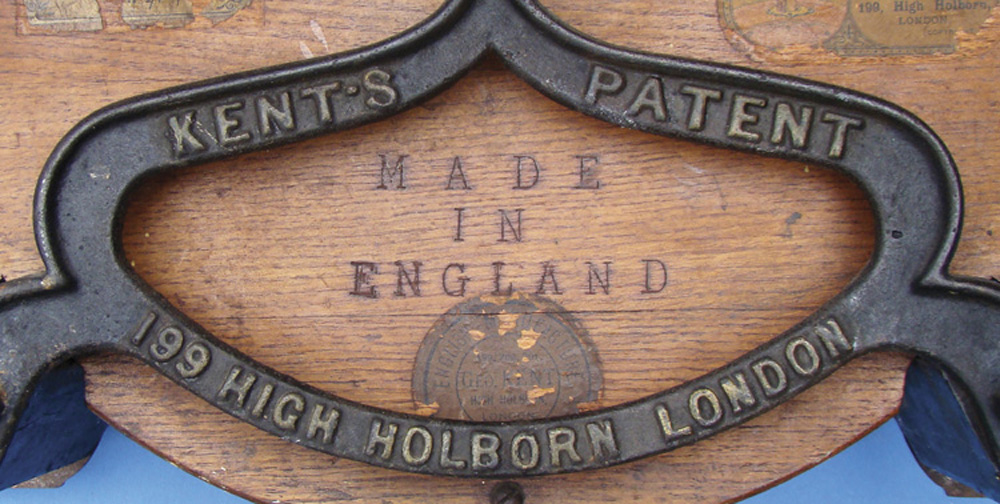
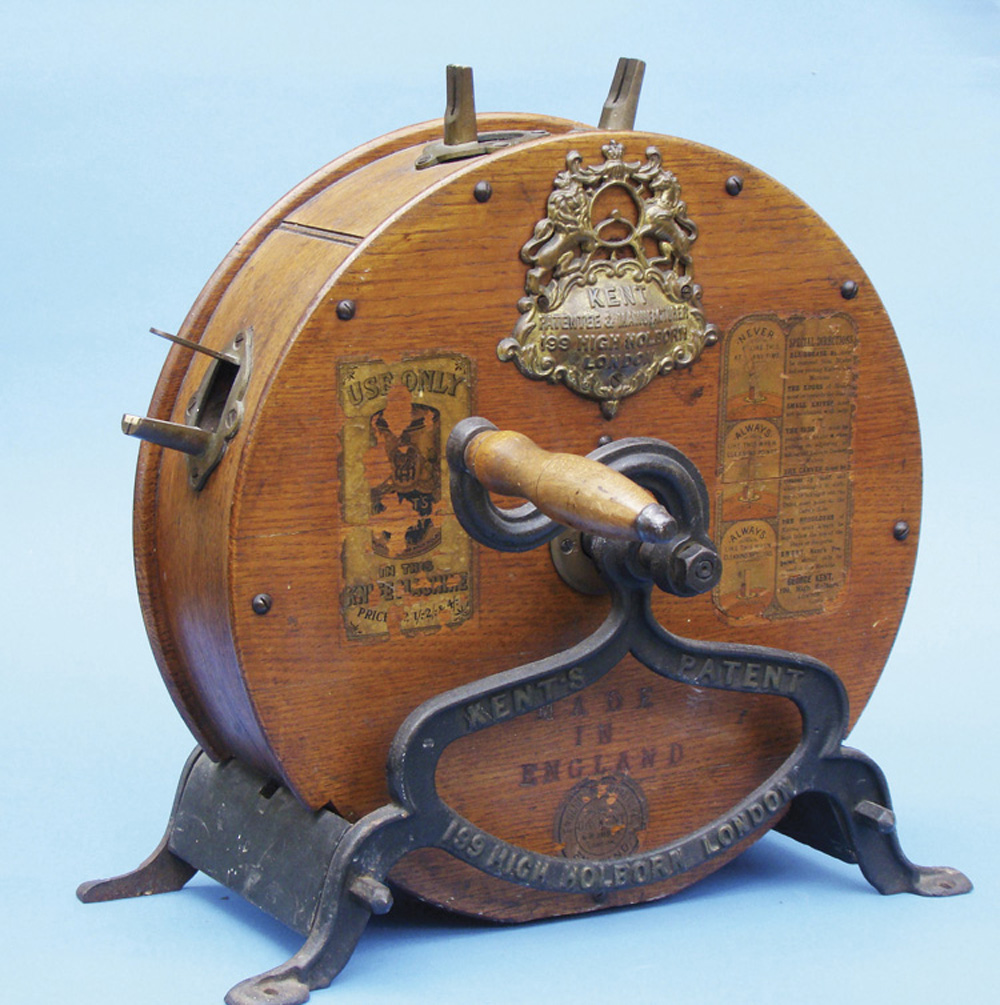
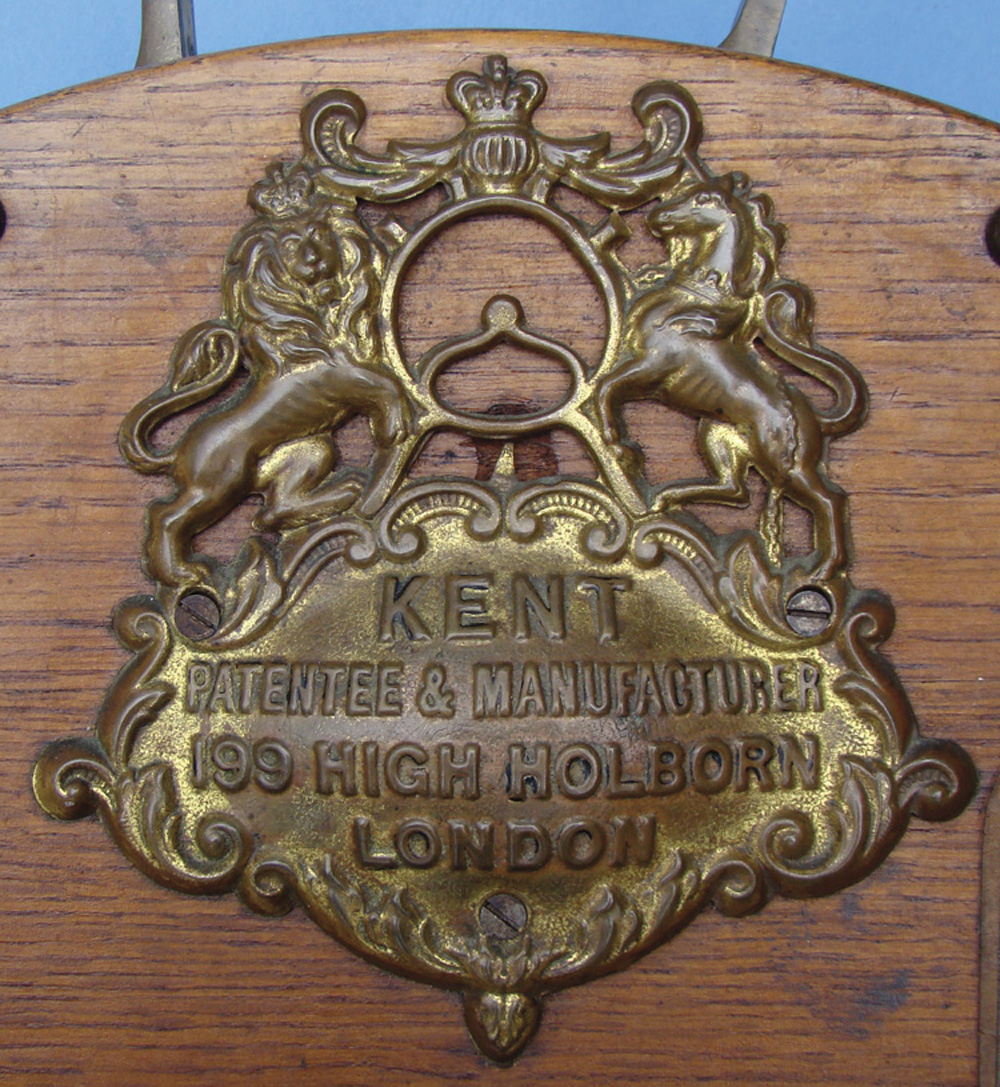
THE KENT KNIFE SHARPENER, English, c. 1900, signed "Kent, Patentee & Manufacturer, 199 High Holborn, London, Size 9, No. 16906, Made in England," and with remains of instructional decals. Standing 17" (43 cm) high, this very substantial machine has a rather Art Nouveau shaped cast iron base, also signed, large oak drum, hand crank turning internal flywheel of abrasive brushes, emery applicator port, and three ports for insertion of dull or rusted knives. Condition is generally fine, with its wonderful applied brass plaque. This is a good example of George Kent¹s knife sharpener, which was popular in large Victorian households. It was made in nine different sizes, this apparently the largest. We find records of Kent's various sharpening devices patented in 1844, 1852, 1864, and 1870. He advertised a variety of other household machines, including "Kent's Marmalade Cutter," and "Six-Minute Churns." (10553) $650. |
| Parsing the Liter | Click on any image for a larger view. Scroll to view more items. |
 |
 |
|
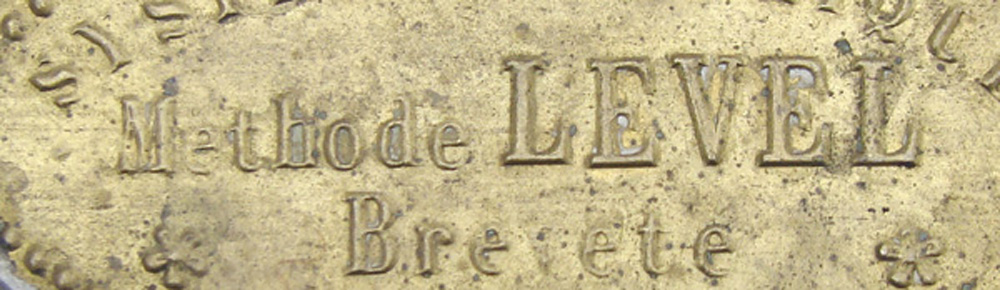
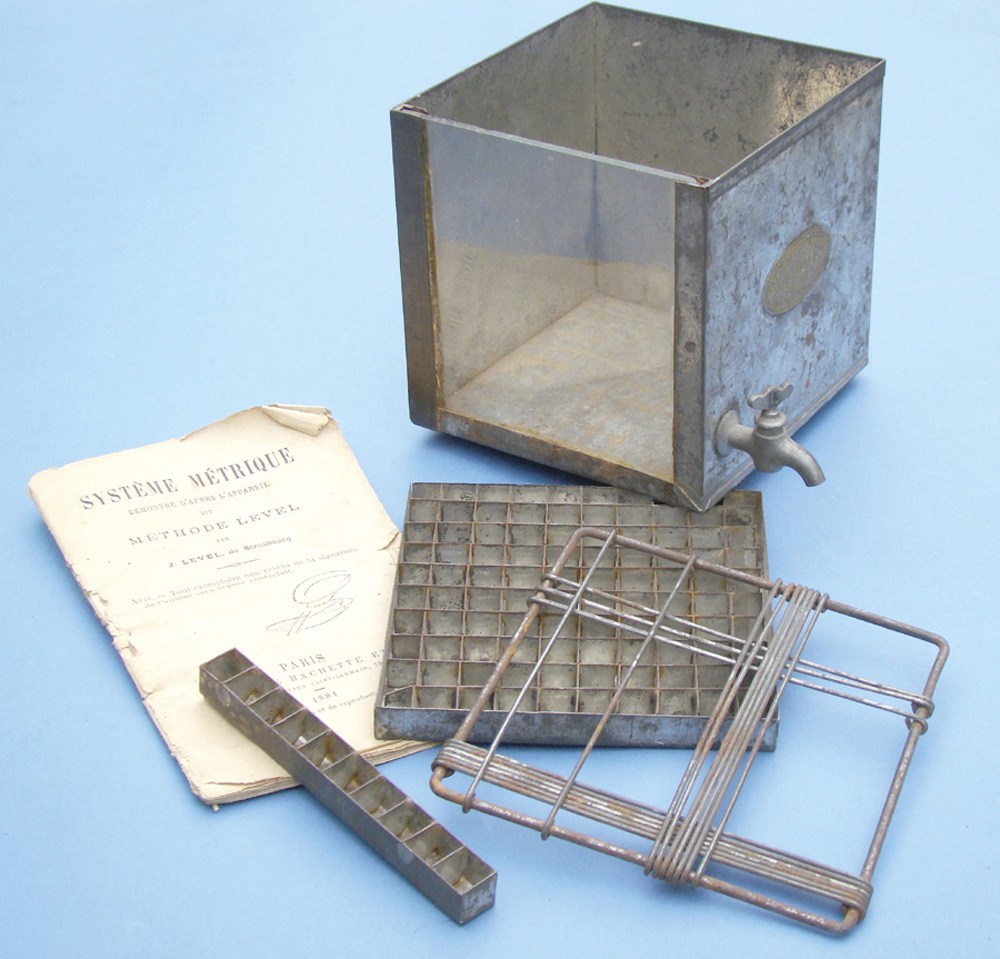
VOLUME DEMONSTRATION BY THE "SYSTEME METRIQUE" OF J. LEVEL OF STRASBOURG, French, c. 1885, signed on a brass plaque "Système Métrique, Methode LEVEL, Breveté, S.G.D.G." The system comprises linear, square, and cubical containers of plated sheet steel, plus a square wire grid, plus the original instruction manual. The containers are life size; thus the linear one is constructed with ten compartments each one centimeter on a side, and thus each with a volume of one cubic centimeter. The square pan has a square insert with 100 such compartments, and thus with a total volume of 100 cc. The large container measures 10 x 10 x 10 cm, and thus has a volume of 1000 cc or one liter; one side is glazed and mounted with an edge rule in brass graduated every mm from 0 to 10 cm, and one side is mounted with a tiny spigot drain. Finally the wire frame has a grid of 9x9 moveable wires permitting, among others, a uniform 10x10 cm grid. The 36 page manual was published in Paris in 1881. Condition is good, with general spotting to the plating. Apparently lacking is a tiny 1 cc cube, and the back cover of the manual. This unusual didactic system is used to demonstrate the volumetric properties of the metric system, as well as the volume measure of irregular bodies by noting the amount of water displaced when they are immersed in the large container filled with water. Booklets describing his method were produced by Jacques Level throughout the third quarter 19th c. (10503) $895. |
| Standardized for a Specific Temperature | Click on any image for a larger view. Scroll to view more items. |
 |
 |
 |
|
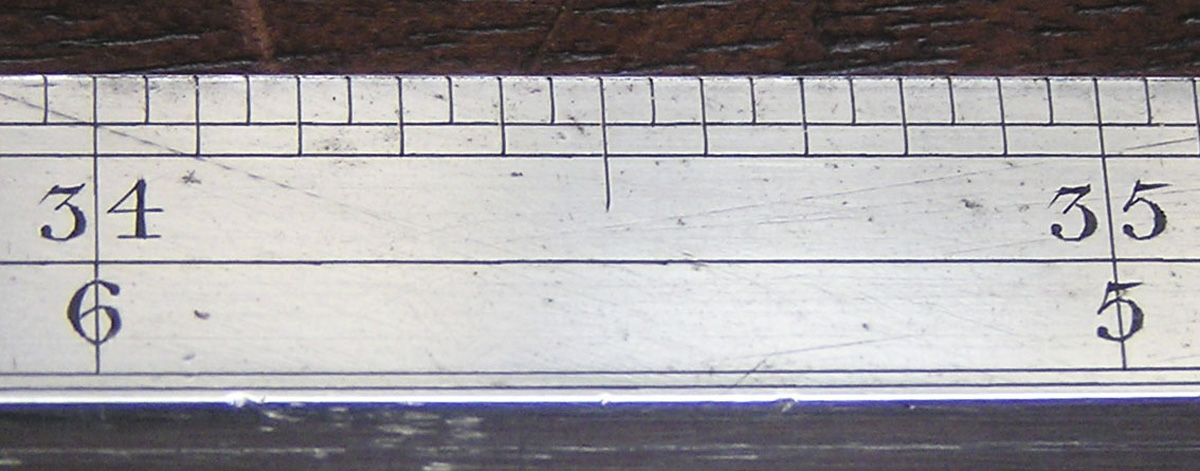
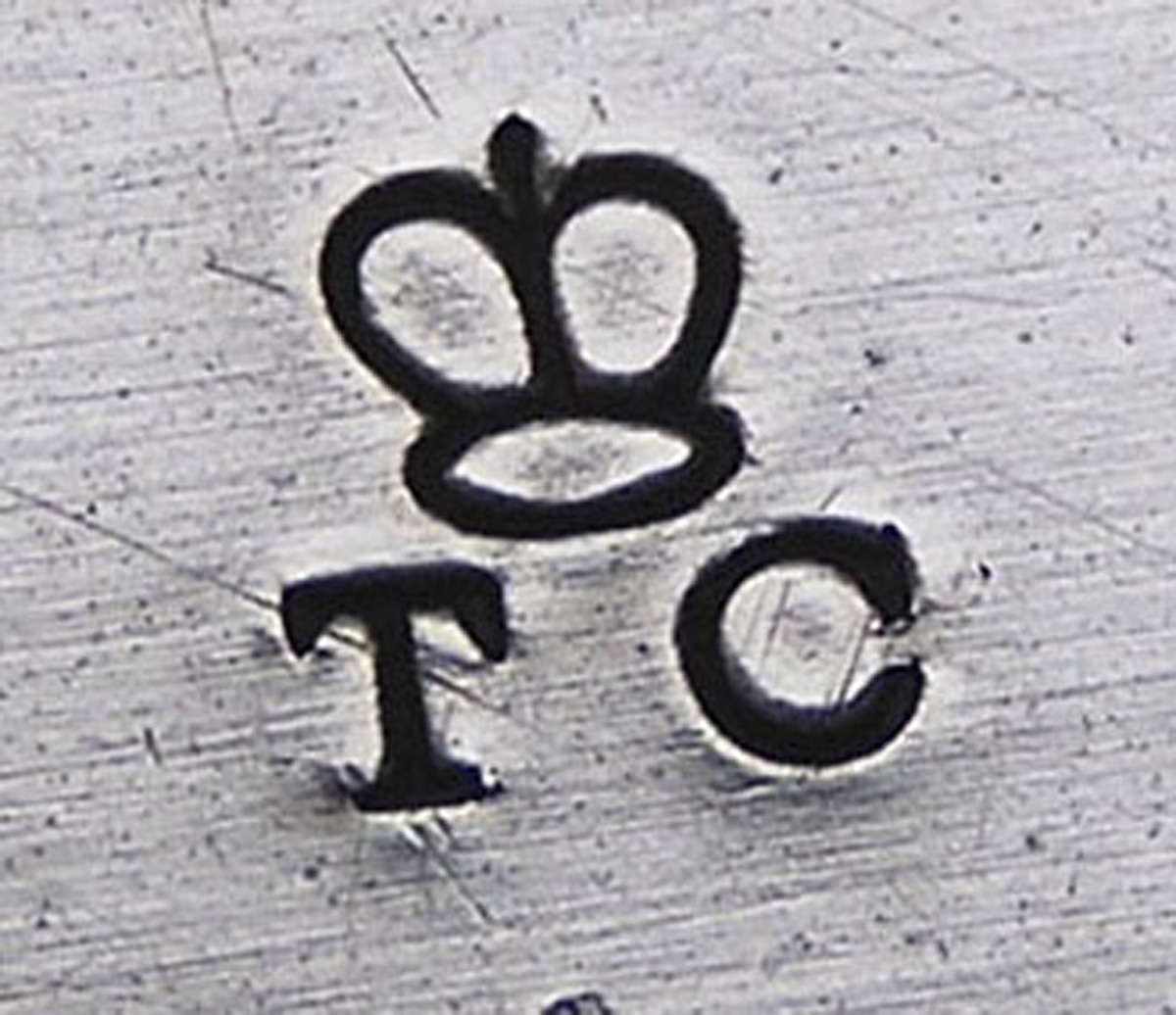
IMPRESSIVE STANDARD RULE, English, second quarter 19th century, engraved for the maker "Thomas Jones, 62 Charing Crofs, London," for the owner "Richard Gouthwaite," and for the calibrated usage "Temperature 48°," and stamped with a crowned "TC." Made of electrum, 40-9/16" (102 cm) long, the rule has long beveled edges divided by twentieths (and by thirtieths) of an inch from 0" to 40" and back again. Condition is good noting several deep scratches. It is complete with the original mahogany carrying case. This beautifully engraved rule poses some interesting questions. Was it really calibrated for use at low temperature, or is "48" an engraver's error? We have not yet identified the "TC" certification(?). And was the rule made for the surveyor Richard Gouthwaite, recorded in Lumby (North Yorkshire, east of Leeds) in the mid-19th century? (8556) $1950. |
 |
 |
| Eighteen Square Feet of Marvelous Prints | Click on any image for a larger view. Scroll to view more items. |
 |
 |
 |
|
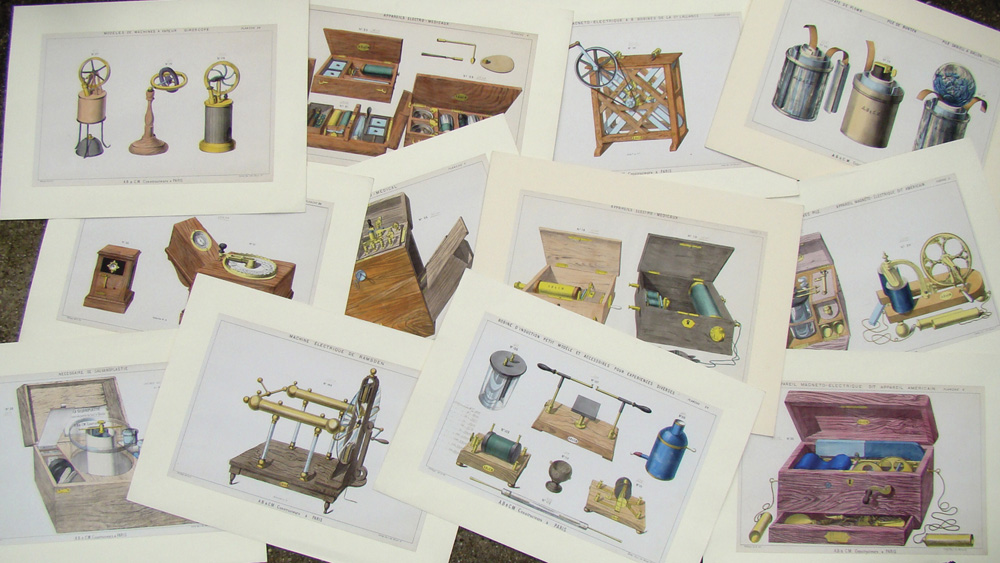
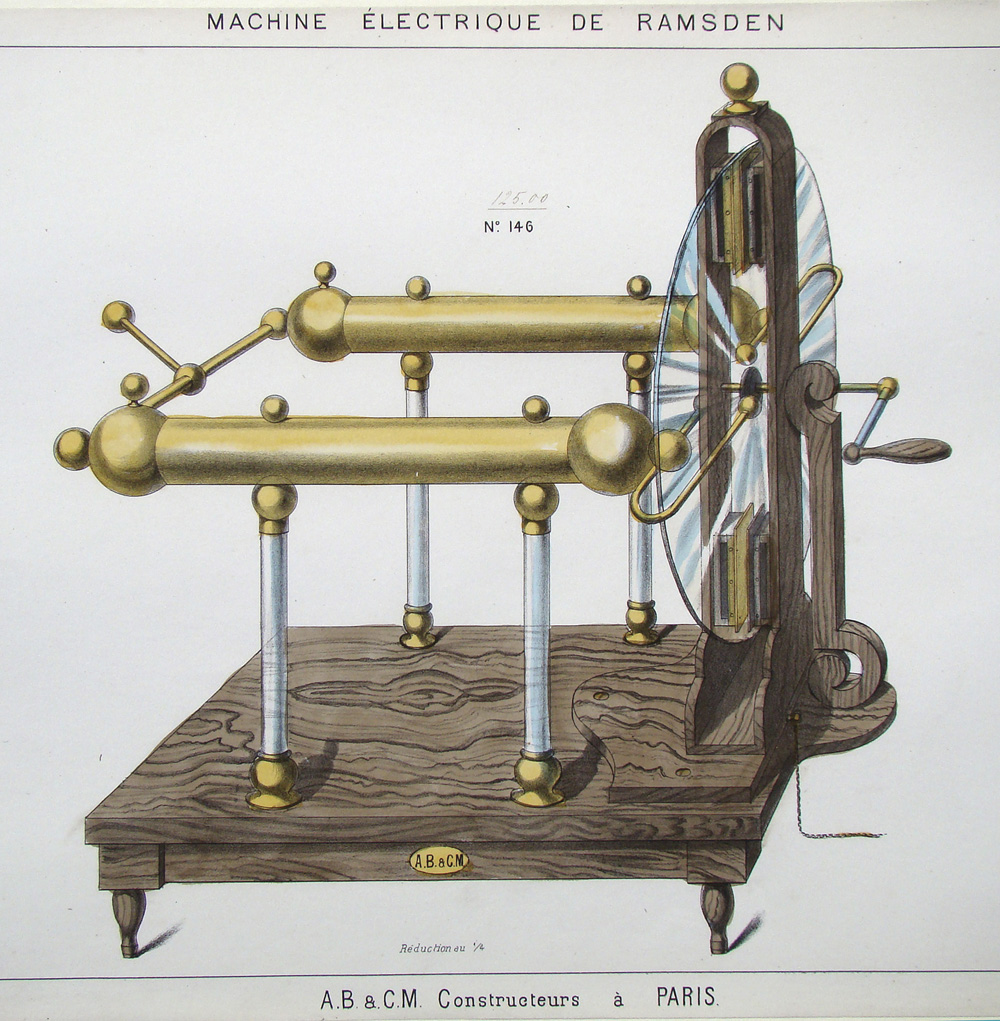
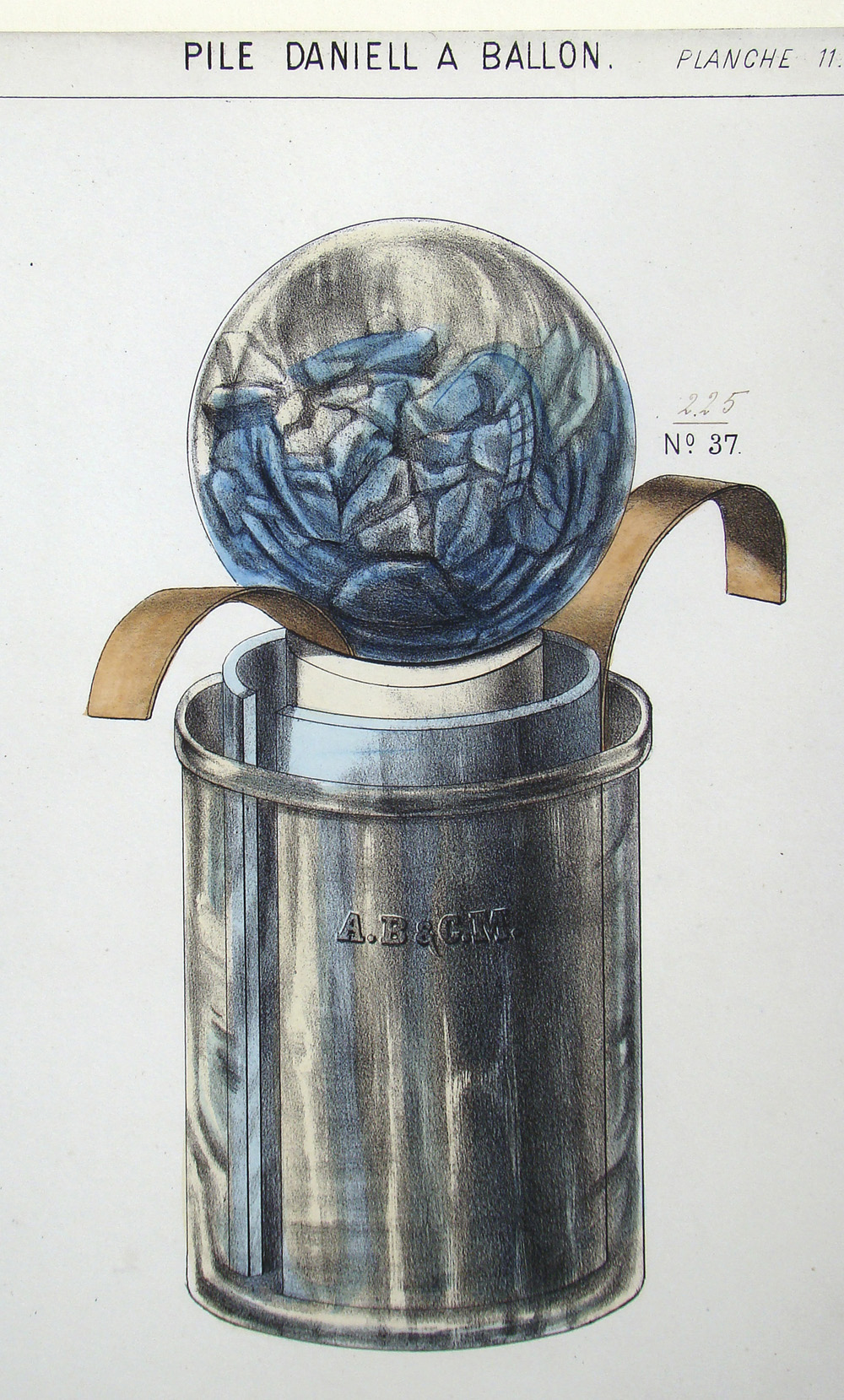
TWELVE PLATES FROM THE MAGNIFICENT BILORAT AND MORA TRADE CATALOGUE, French, c. 1860's. Each large plate measures approximately 12" x 18" (30 x 46 cm), mounted on card 16-1/2" x 22-1/2". The plates are engraved and lithographed by Willaeys, and printed by Leroy at 66 r. des Marais in Paris. They are colored and preserved with a wonderful freshness, depicting a wide range of electric devices including hand-cranked and liquid-battery-powered electro-medical devices (with one known as the "American apparatus"), galvanoplasty and telegraph instruments, Ramsden electrostatic machine, etc. The constructors were established at 57 rue du Faubourg St. Denis in Paris, and had an outlet in London. We find record of Biloret at that address in 1864, but find the firm at 93 blvd. Richard-Lenoir in an 1883 electrical directory. Biloret and Mora seem to have been significant Parisian manufacturers of early and ingenious electrical devices, but rarely if ever signed their products. An exquisite group, in excellent condition. (10342) $2500./the group of 12 |
| Demonstrating Archimedes' Principle | Click on any image for a larger view. Scroll to view more items. |
 |
 |
|
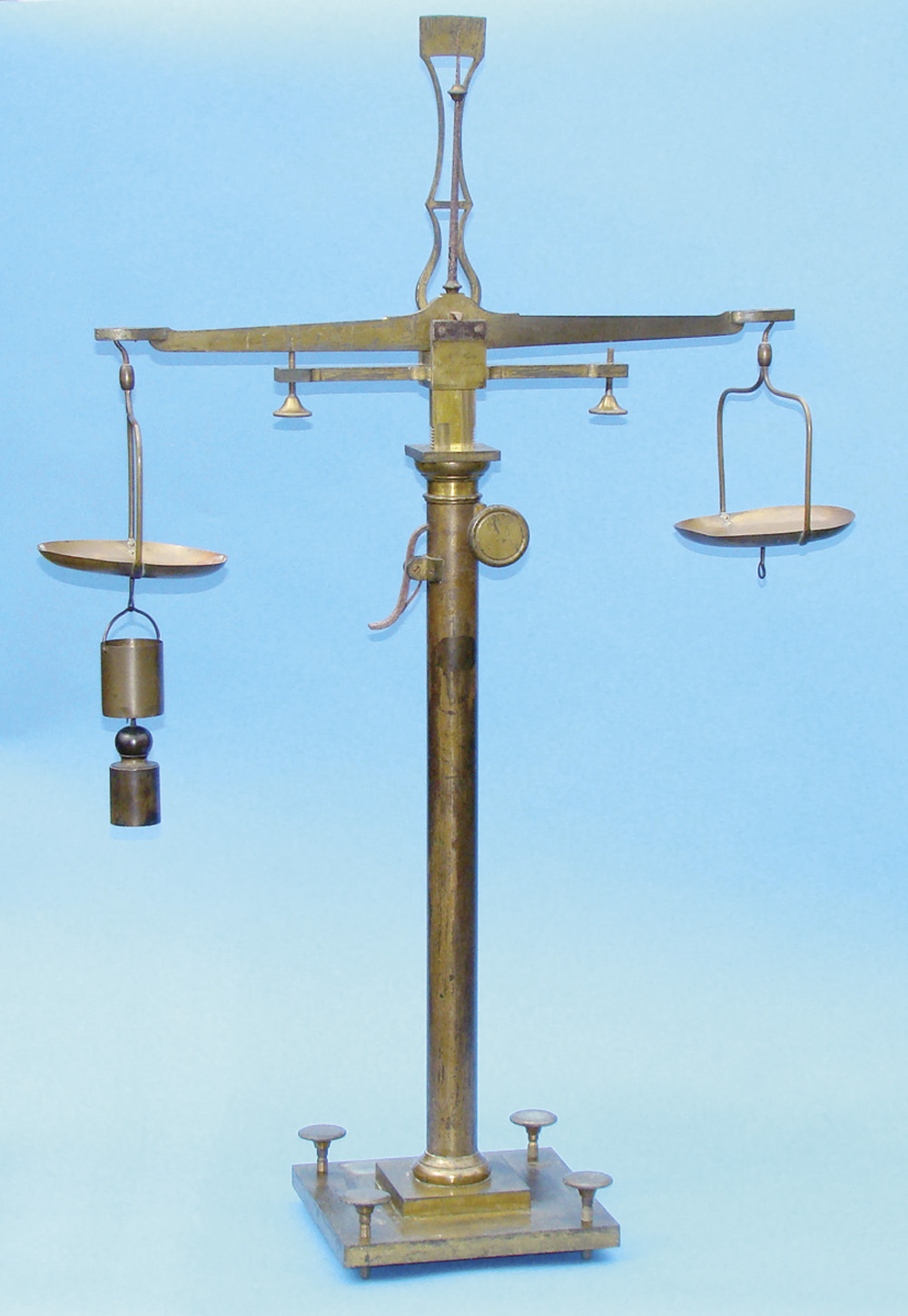
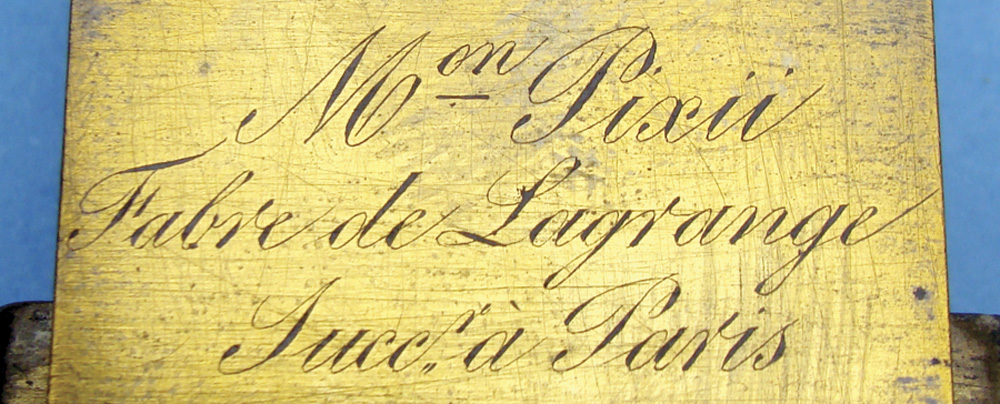
LARGE HYDROSTATIC BALANCE, French, c. 1860, signed "M'on Pixii, Fabre de Lagrange, Succ'r à Paris." Standing a maximum of 34-1/2" (88 cm) tall, this impressive brass balance has cylindrical pillar rising above the square base with four leveling screws. Within the pillar a rectangular bar is elevated by rack and pinion, with quick release latch. Atop the bar the 18-1/4" (46 cm) wide balance beam rests on inset steel pivots, and a crossbar has adjustable stops for damping oscillations of the beam. A long pointer reads against an upper 0±10 scale. There are matching balance pans with hooks underneath, a cylindrical bucket with hanger and hook, and a hanging weight, all of brass. Condition is fine although the original lacquer finish is quite streaked and worn and darkening, and the few iron parts are oxidized. This is a rather uncommonly found example of the classic hydrostatic balance demonstrating the principle of Archimedes. In the many editions of Adolphe Ganot's famous text on experimental and applied physics we find a fine illustration of just such a balance, and the explanation of its principle and use. Archimedes realized that if a body is immersed in a liquid, the upper buoyant force, the upward pressure, exerted upon it is equal to the weight of the fluid which the body displaced. This is demonstrated directly by elevating the balance, and, with the little cylindrical bucket empty, placing weights on the right side pan to achieve balance. Then one fills the bucket with water, causing imbalance, and finally lowers the balance enough that the hanging weight (which needs to have the same volume as the bucket), is fully immersed in a vessel of water. Balance is suddenly restored, proving the principle: the upward pressure on the hanging weight is now equal to the weight of the water displaced by its volume, which is exactly that which is now in the little bucket. Similarly, with the hydrostatic balance one can easily determine the volume of a solid object, no matter how irregular its shape, by hanging it from the pan, and weighing both in air and immersed in a liquid. Knowing its volume and its weight gives, furthermore, its specific gravity. The maker of this good balance was Fabre de Lagrange, successor to the firm of Nicolas Constant Pixii (1776 - 1861, himself nephew and successor to the Dumotiez brothers) and his son Hippolyte Pixii (1808 - 1835), the latter the innovative French maker who developed an early electric generator superior to Faraday's. Pixii retired in 1855, and the firm passed to "Fabre & Kunemann." But after several address changes, in 1858 it became just "Fabre de Lagrange," and continued only until 1862 (see Brenni, 2006). Gaulon (1996) could find no other surviving instrument signed by Fabre de Lagrange alone. It is a very good example of the hydrostatic balance, reminiscent of those by Dumotiez from the late 18th century, but here less decorative, much more spartan and functional. (9358) $2800. |
 |
| (Ganot, 1868) |
| The Telescope Indoors | Click on any image for a larger view. Scroll to view more items. |
 |
|
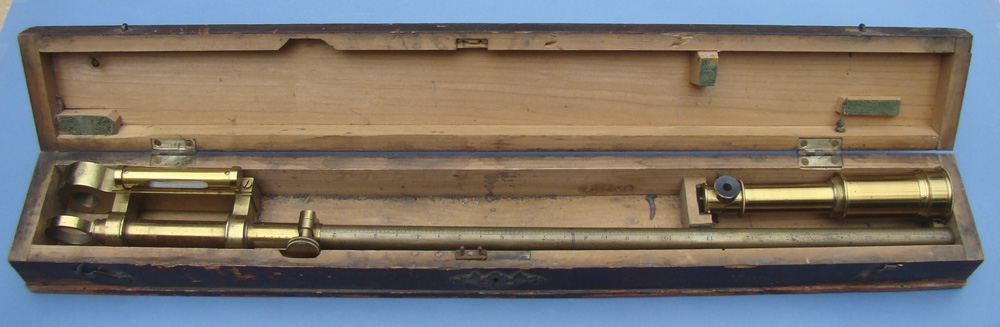
TRAVELING READING TELESCOPE FOR LABORATORY RESEARCH, probably English, c. early 19th century. This lacquered brass instrument has a threaded assembly (for attachment to stand, not present) with spirit level, the assembly carrying a 22-1/2" (57 cm) long sliding and clampable cylindrical rod labeled every inch (and divided every tenth inch) from 0" to 17". A vernier is divided to hundredths of an inch. A threaded fitting on one end of the rod carries a small telescope with achromatic objective and right angle eyepiece with internal mirror. This gives good erect images and focuses by drawtube over a broad range from infinity to as close as three feet. The apparatus is in excellent condition, contained in the original, now somewhat worn, fitted pine case, with finely shaped brass escutcheon. The reading telescope, with its calibrated horizontal travel and close-focusing possibilities, was especially designed for accurate readout of galvanometer deflections, especially for the mirror type as developed by Poggendorff in 1826, and patented by William Thompson in 1858. Here we have a fine and particularly early example of the telescope system. (10362) $950. |
| Ingenious Portability in a Specific Gravity Outfit | Click on any image for a larger view. Scroll to view more items. |
 |
|
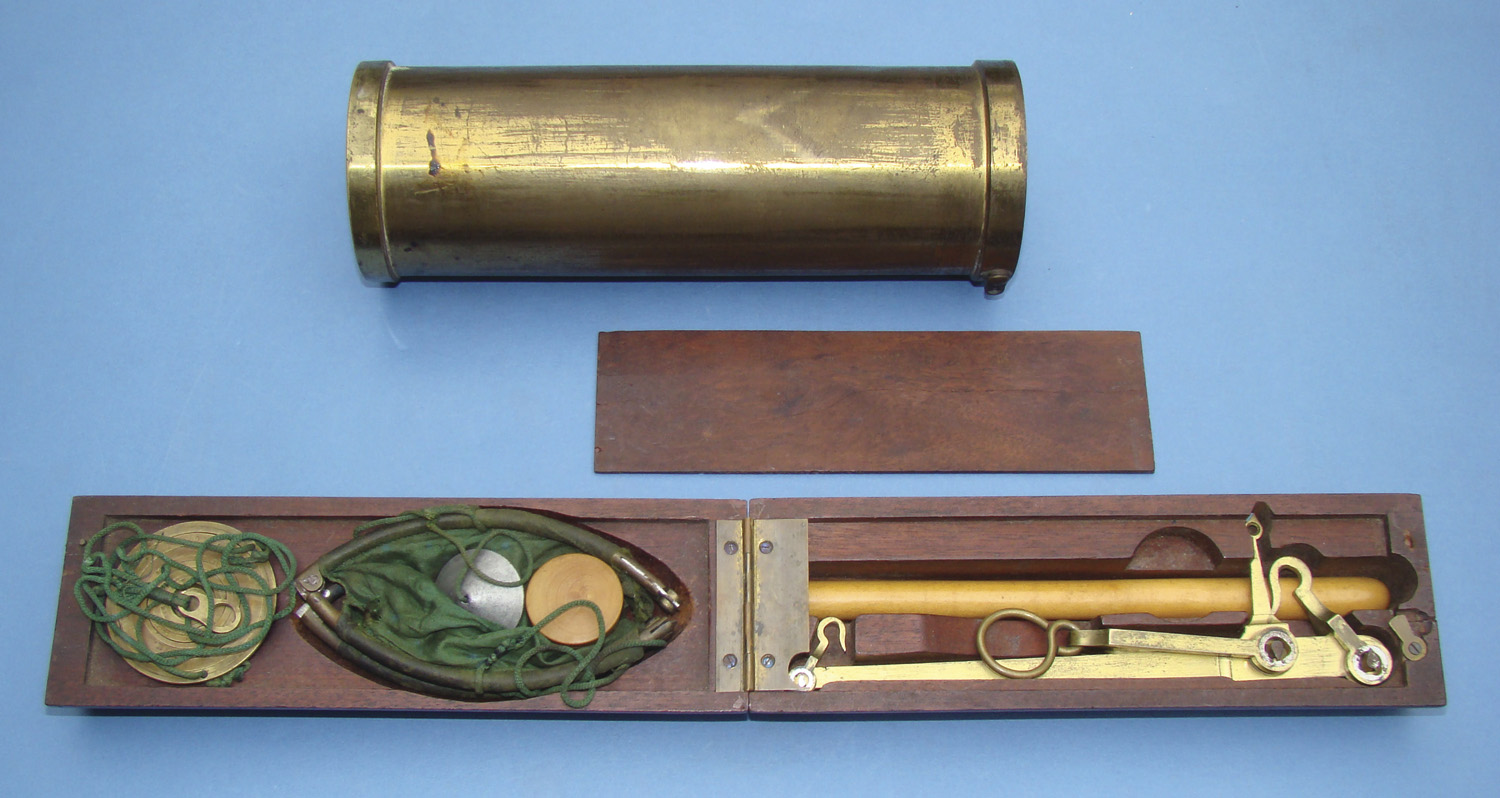
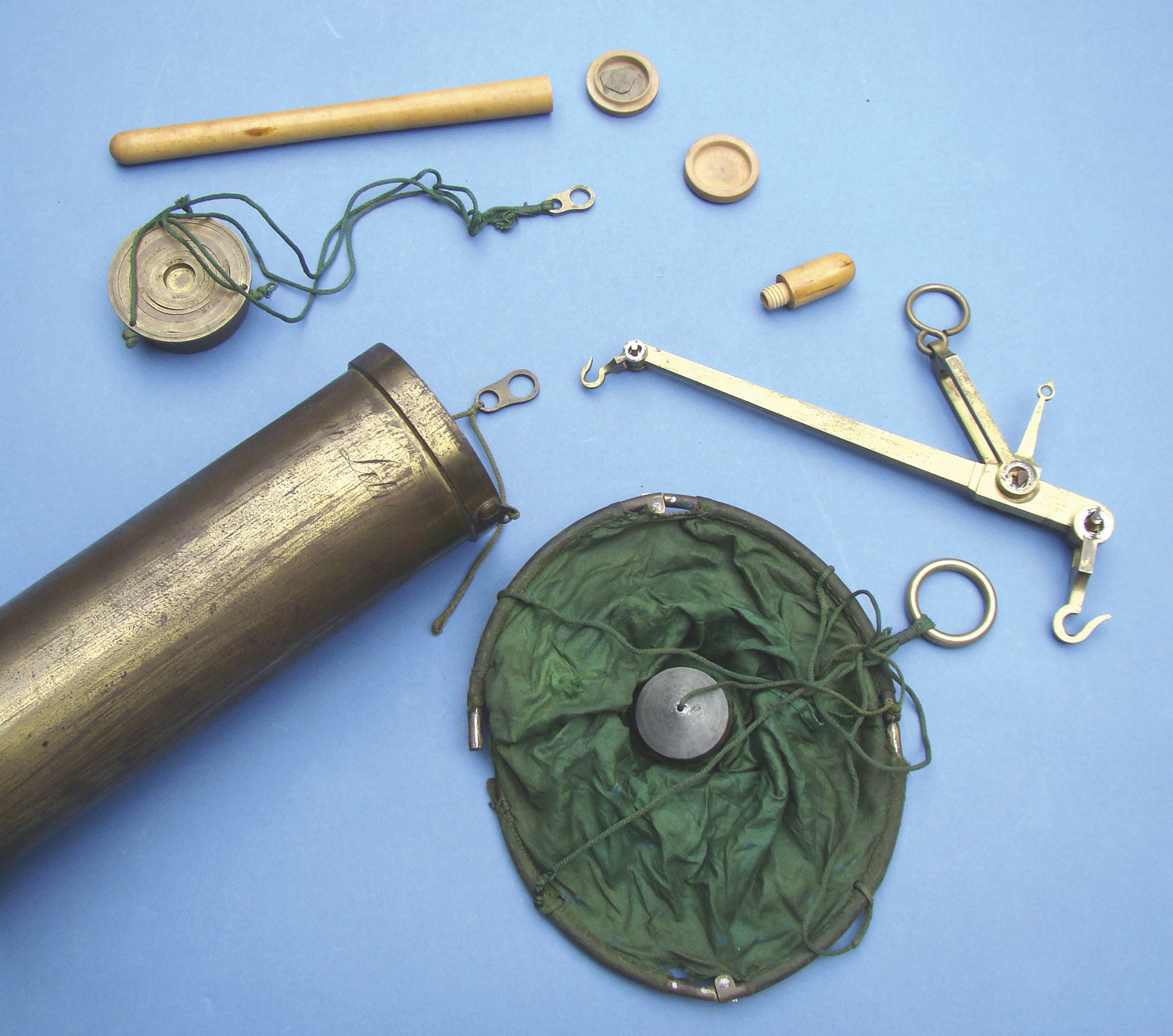
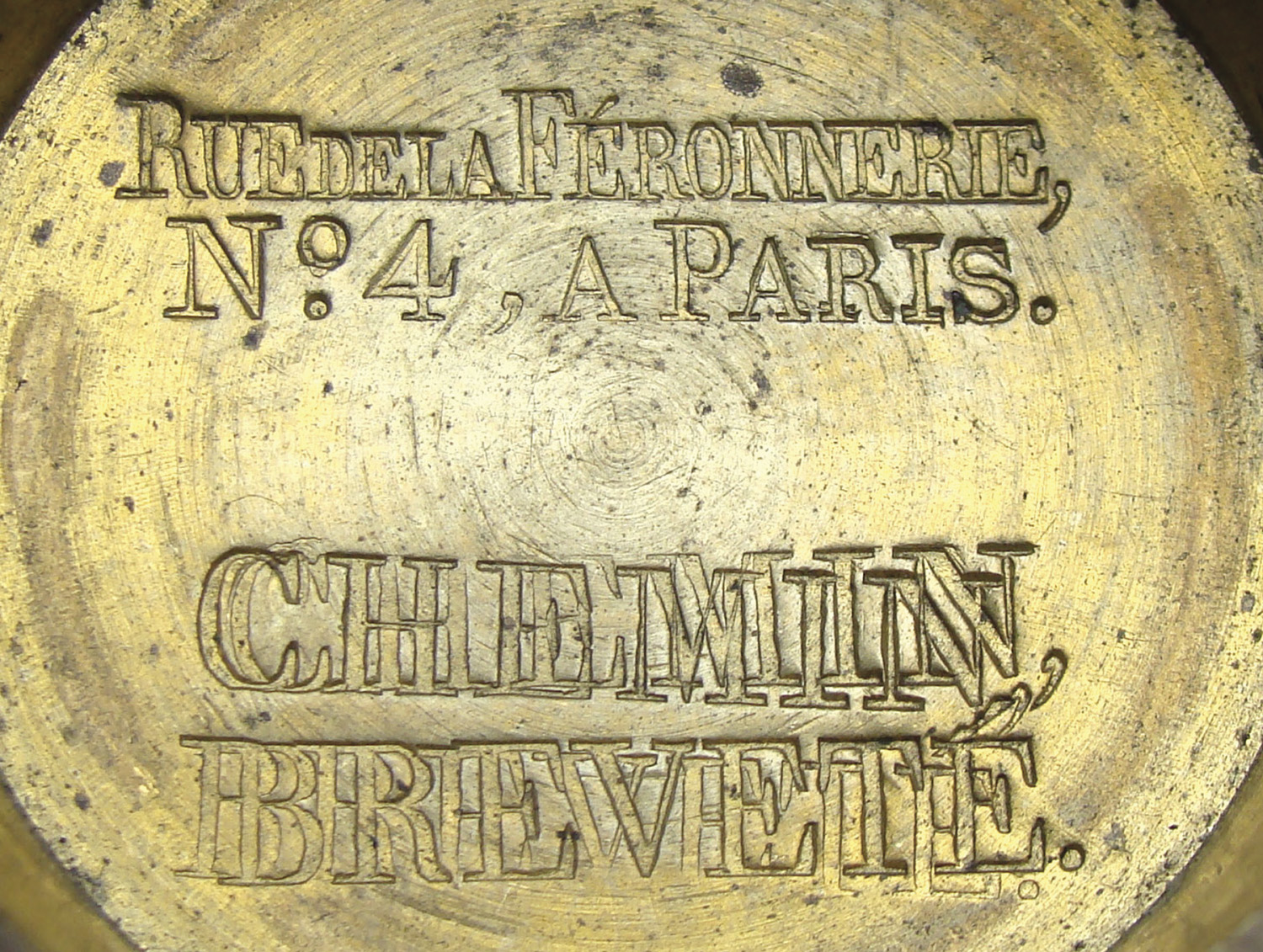
COMPACT GRAIN SCALE OUTFIT, French, c. first third 19th century, signed "Chemin à Paris" and "Chemin, Breveté, Rue de la Feronnerie, No. 4, à Paris." A 7-3/8" (19 cm) long lacquered brass cylinder compactly contains a cylindrical wooden fitted case filled compactly with an entire outfit for measuring and weighing a standard volume. There is an asymmetric brass beam balance, the suspendable brass measuring cylinder (marked "Demi-Litre"), a suspendable set of seven nested brass eights (2 to 100 grams), three small sheet brass weights (5 and 2 decigrams, 5 centigrams) in boxwood case, green silk funnel in collapsible frame with finger suspension and pewter pull-stopper, wooden plate for topping off, and empty wooden tube (for thermometer?). Condition is fine except for some minor losses and wear. This is a rarely seen, cleverly designed portable outfit for pouring out a given volume of grain and weighing it to determine the specific gravity of a sample. It was patented and constructed by a member of the Chemin dynasty of scale and weight makers. Marcelin lists four, ours being Chemin III (c. 1776 - 1838), made free in 1792, and described as "Membre de l¹Athénée des Arts, inventeur de la balance portative pour connaître la pesenteur du blé." (10351) $1950. |
 |
 |
| Three-Dimensional Portability | Click on any image for a larger view. Scroll to view more items. |
 |
|
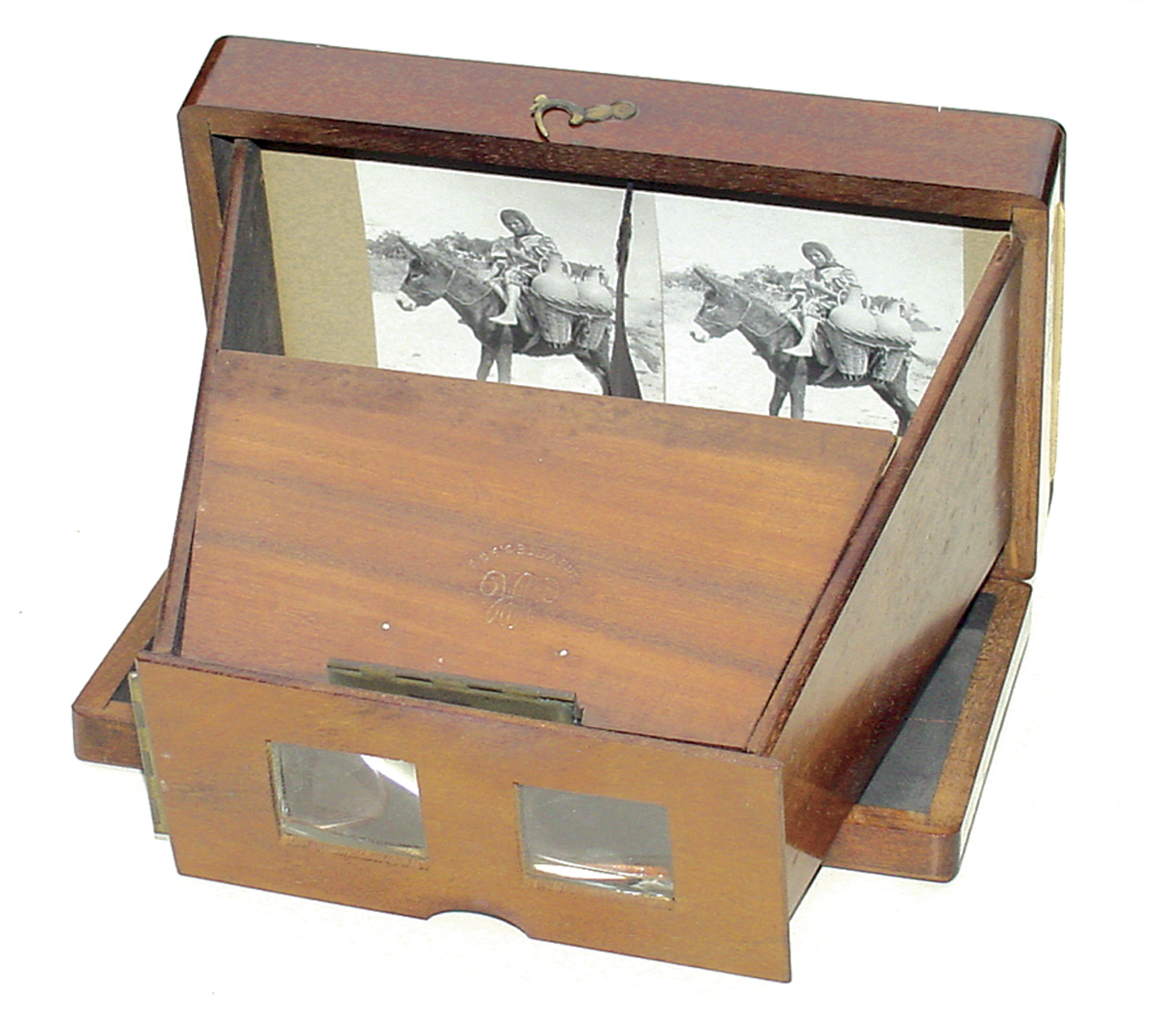
FOLDING STEREOSCOPIC VIEWER, French, c. last quarter 19th century, stamped with the maker's monogram and "Breveté S.G.D.G." This lovely stereoscope is made of fine mahogany, and stands 6-3/4" (17 cm) tall when set up. There are two square-cut glass lenses for the eyes, and a notch for the nose. The interior is blackened, and a black cloth separates the two halves. The base has an open slot for insertion of stereo cards or slides, viewable by reflected or transmitted light, and the "lid" can be latched into position to form a hand held stereoscope. The whole apparatus folds in on itself, quite cleverly, with three brass hinges, to form a box only 1-1/2" tall. In fine condition, noting age cracks to the lid and an old chip to the base, this is an ingenious form of portable instrument complete with stereo card. (9386) $675. |
| The Beauty of Water Power | Click on any image for a larger view. Scroll to view more items. |
 |
|
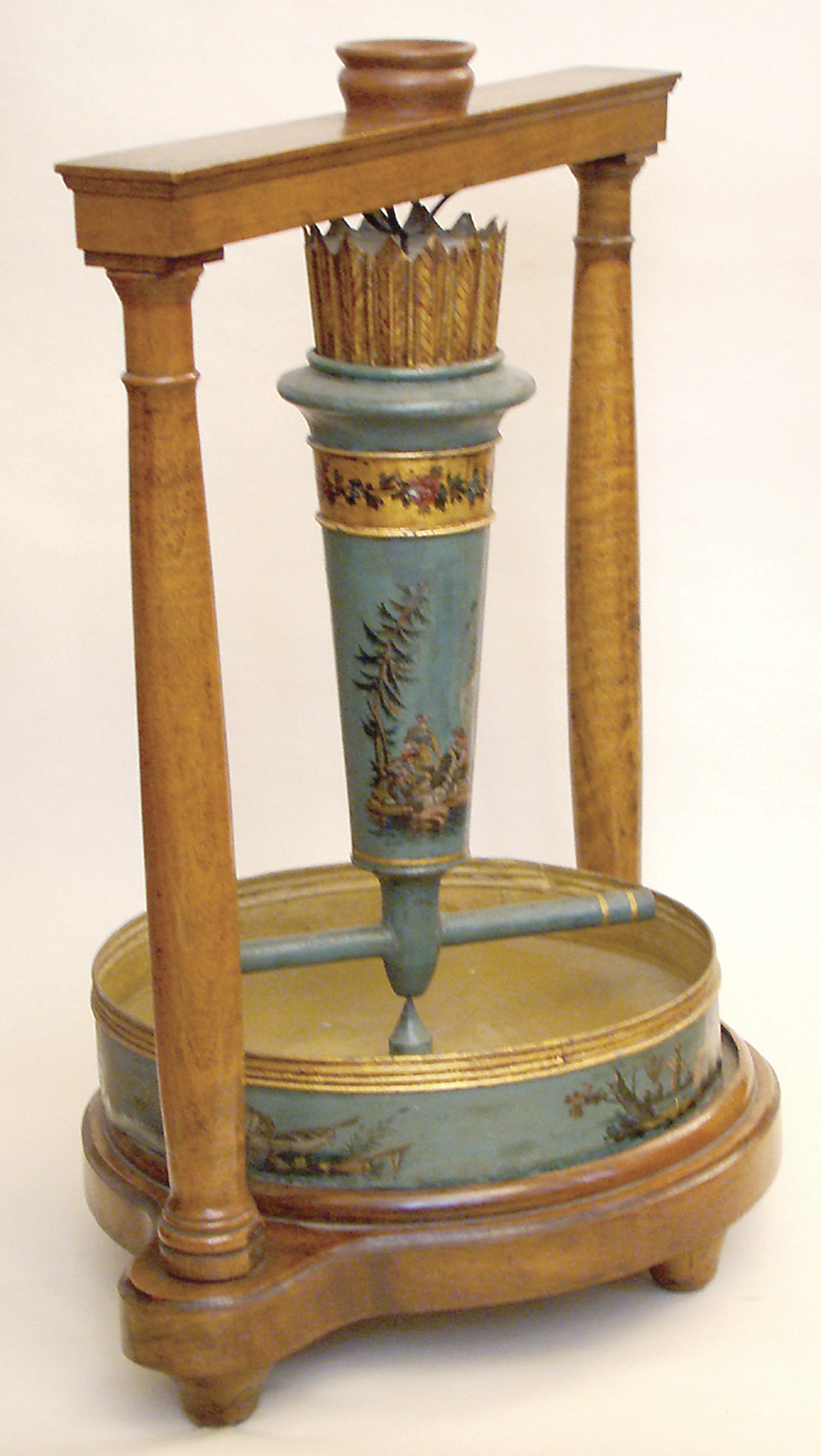
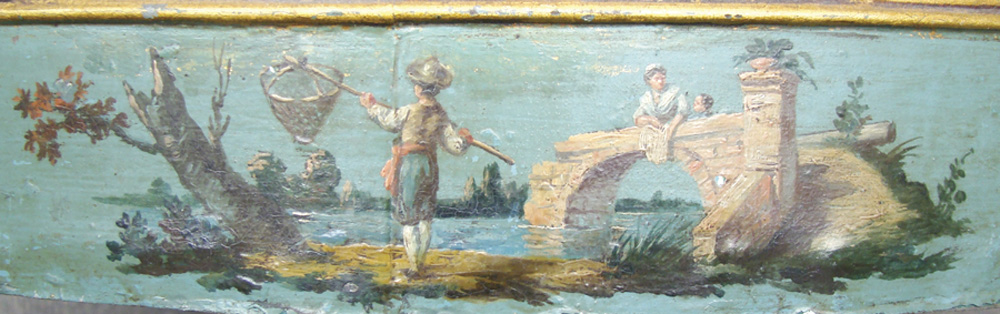
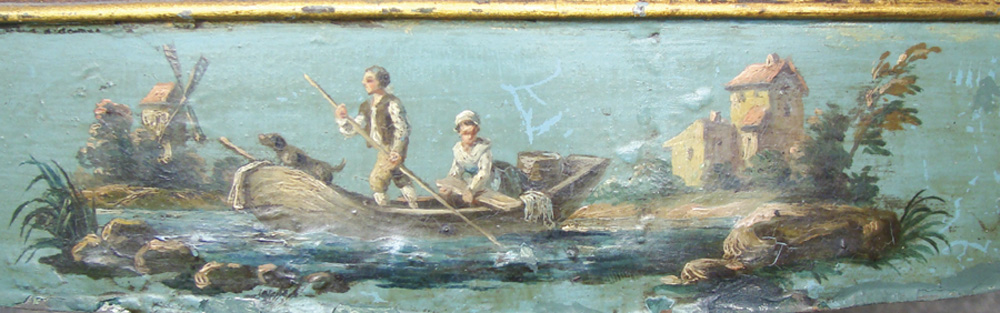
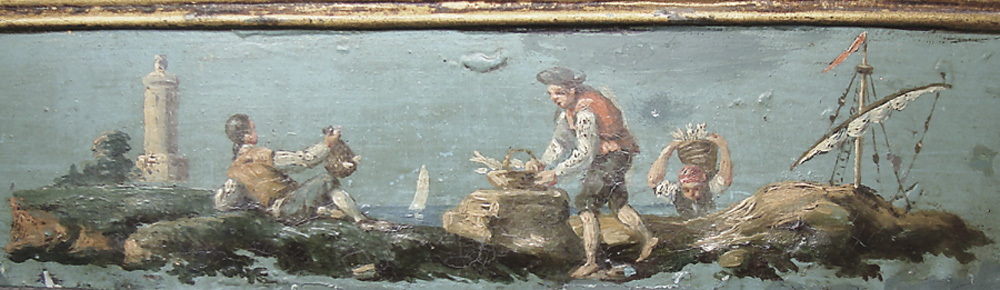
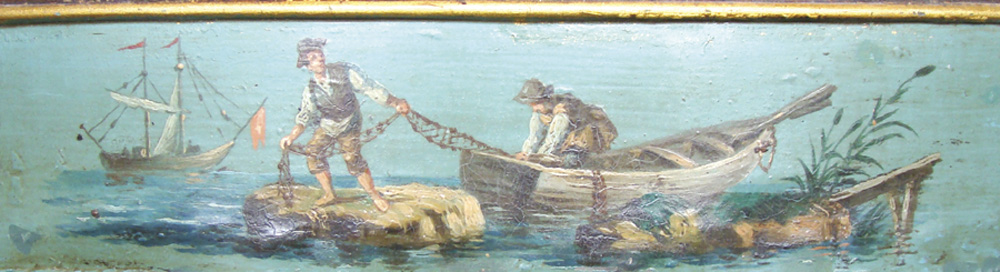
THE "TOURNIQUET HYDRALIQUE" -- A DEMONSTRATION WATER MOTOR, probably French, c. third quarter 18th century, this a remarkable example of Revolutionary design, with fine painted images of water scenes. The device stands 23-1/4" (59 cm) in overall height, and 20" (51 cm) across. The base and framework are constructed of beautifully grained hardwood, perhaps French walnut. The frame supports a rotatable cone shaped as a quiver full of arrows, and a lower 12" (30 cm) diameter pan, both made of sheet steel and painted blue-green with golden highlights, and with painted scenes of waterside activities (loading a small sailboat, fishing under a bridge, washing clothes, net fishing at sea, ferrying past home and windmill, and reaping the harvest of the sea beside a light house). The theme of water world is ubiquitous, the paintings in a Mediterranean spirit of the third quarter 18th century. Various clues are given by the styles of costumes, hairdos, boat trappings, etc. The instrument is likely Southern French, or possibly Italian or Spanish. Such painted decoration of scientific instruments is reminiscent of that of Abbé Nollet (1700 - 1770), although his decor was almost invariably floral (see Pyenson & Gauvin, The Art of Teaching Physics, 2002). Condition is fine noting a little worming to the wood, and some rather minor retouching of background paint. The tourniquet is a fine demonstration of the conversion of potential energy to kinetic energy. One lifts a pitcher of water up in the air, against the force of gravity, pours it through the funnel on top, where it enters the hollow cone, exiting through right angled holes at the ends of the arms below. The exiting water is collected in the lower pan; meanwhile the entire cone assembly spins as the arms ³recoil² from the exiting water. The higher the liquid in the cone, the greater the pressure and thus the faster the rotation. It is a form of physics demonstration instrument that was popular from the 18th century into the 20th. This example is the finest we have seen, a wonderful combination of art and science. (10332) $14,500. |
 |
 |
 |
 |
| American Technology in the Home | Click on any image for a larger view. Scroll to view more items. |
 |
 |
|
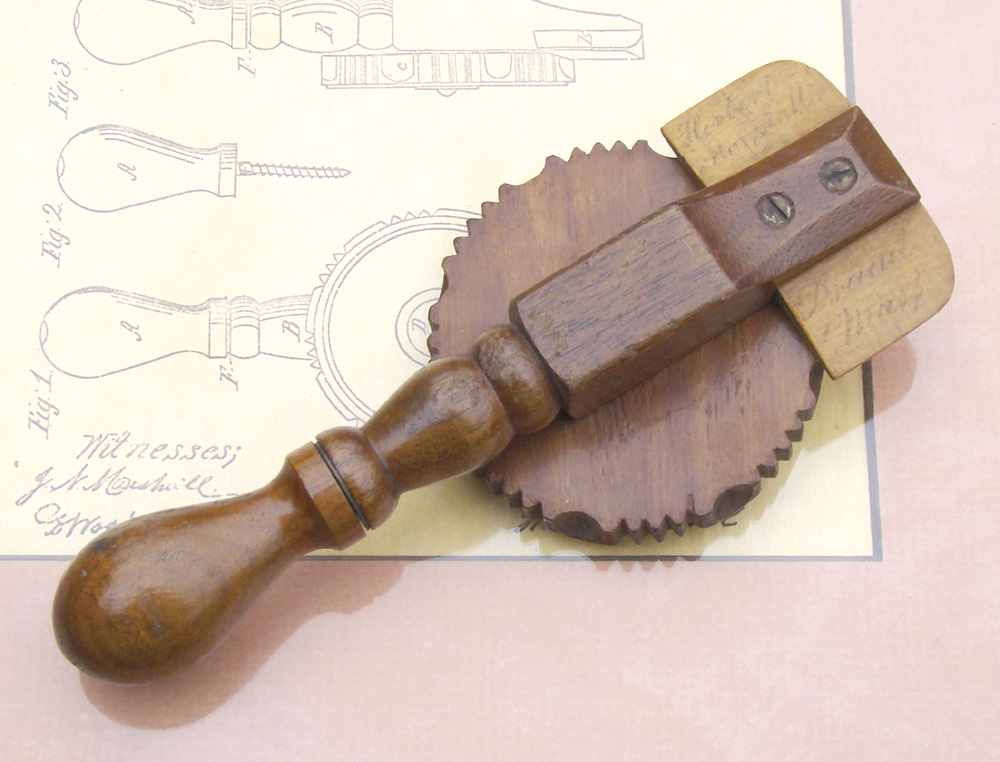
NOVEL PIE CRIMPER -- AN ORIGINAL U.S. PATENT MODEL, American, 1863, signed in ink by the inventor "Herbert Marshall, Dracut, Mass." Well crafted of three woods, this 7" (18 cm) long full size model has a fine turned handle which swivels, curved brace block to follow the curvature of a pie plate, and the cut wheel with repeating patterns of lines and circles to impress a professional looking design on the dough all around the circumference of the unbaked pie crust top. Condition is very fine, complete with well-framed reproductions of the patent drawings, specifications, and claims. Mr. Marshall was awarded U.S. patent 37,761 on 24 February 1863 for his novel "Improved Pie-Stamp" with its swivel handle and "lever-guide" by which "the edges of the crusts of pies...can be easily and rapidly pressed together and stamped with a handsome border or figure,...in a neater and more effective manner than it can be done by hand or the ordinary methods." (10372) $950. |
| Complex Outfit for Frictional Testing in the Laboratory | Click on any image for a larger view. Scroll to view more items. |
 |
|
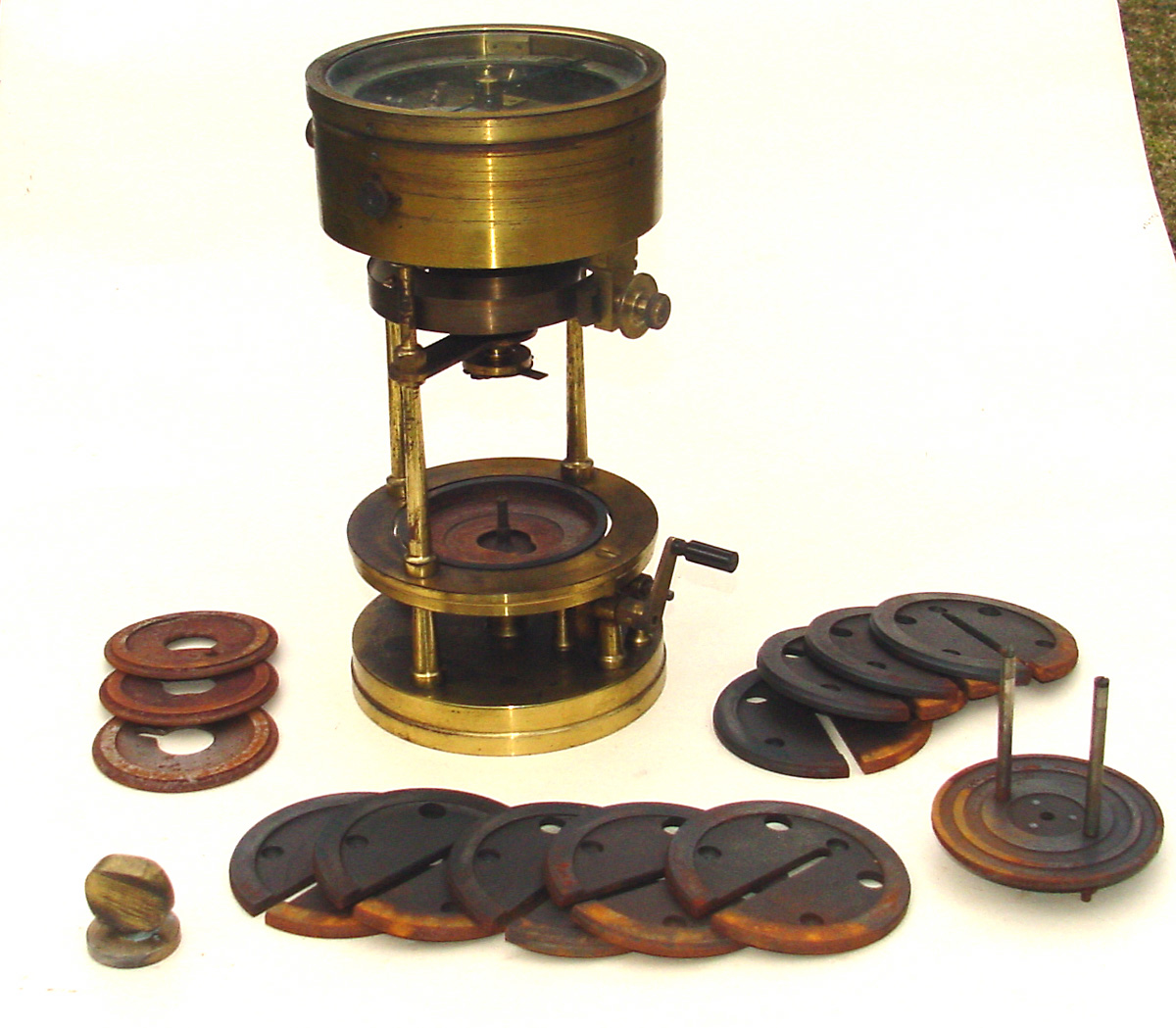
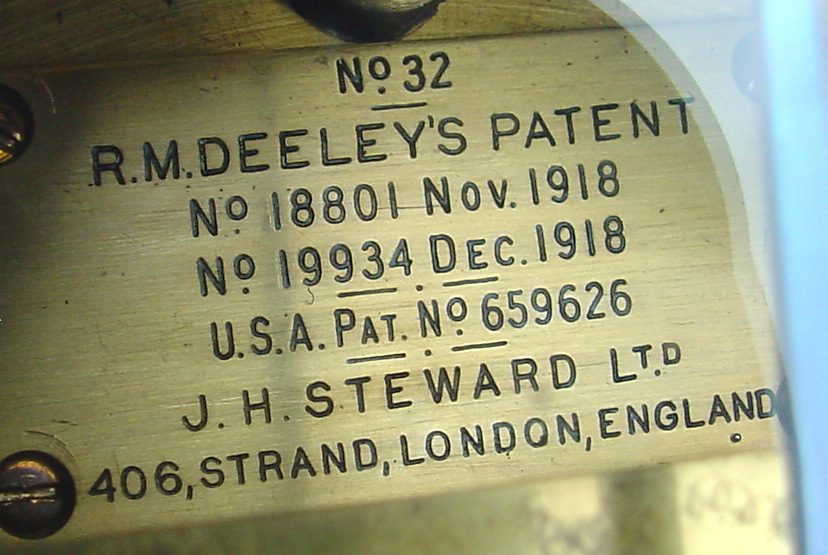
DEELEY¹S ADSORBED FILM TESTING MACHINE, English, c. 1920, signed by the maker on an interior plaque "No. 32, R.M. Deeley¹s Patent; J.H. Steward Ltd., 406 Strand, London, England," with three patent numbers c. 1918, and signed by the retailer on a case plaque "Herman A. Holz, Testing Machines of High Quality, 17 Madison Avenue, New York." Made of bright lacquered brass, this unusual instrument stands 11-3/4" (30 cm) tall on four levels separated by turned brass columns. The lowest section has gearing with two crankshafts for low and medium speed rotation of the main stage at the second level. The third level holds the mainspring, and the rotating shaft assembly which drives the dials in the glazed readout canister on top. Two blued steel pointers, which are mounted to a squiggle-worked lacquered brass gearbox, read against silvered scales of 0 (1) 100 and 0 (0.01) 1.00. There are several control knobs, for zero-adjustment rotation of the main scale, for zeroing and locking the small pointer, for engaging a train of steadying wheels, etc. The finely made 19" tall fitted mahogany carrying case has a large drawer of accessories, including four interchangeable steel stage plates, upper assembly with three stud feet and nine stackable cast-iron weights, crank handle, etc. Condition is fine noting some wear to the finish, and some rust on the iron and steel. Workmanship is of high quality throughout, and the machine has quite an intriguing "look." Identifying this unusual device was something of a challenge for us. Despite the professional plaques, the three patent numbers may well be rogue numbers. And R. Mountford Deeley, onetime locomotive superintendent for the Midland Railway, was a bit hard to track down. But finally we have in hand the 1927 (5th) edition of Lubrication and Lubricants, by Archbutt and Deeley. Described in detail on pages 412 to 420, the machine was designed for quantitative frictional testing of lubricants, and was made by Steward in two models, the Simplex and the more sophisticated Laboratory, as offered here. In use the weighted assembly engages the spring and gearing to the pointers, but its stud feet sit freely on the lower stage plate. One applies lubricant to the stage plate, then cranks this plate slowly, and records the point at which the studded assembly slips, when the static friction of the surfaces is balanced by the strain on the spring above. It is a simple test, but a rather complex mechanical design is necessary for accurate and reliable results. We are pleased to offer this example of a rare and interesting apparatus. (and see back cover of this catalogue) (8400) $2800. |
 |
 |
| Unusual Form of Min/Max Recording Thermometer, with Royal Provenance | Click on any image for a larger view. Scroll to view more items. |
 |
|
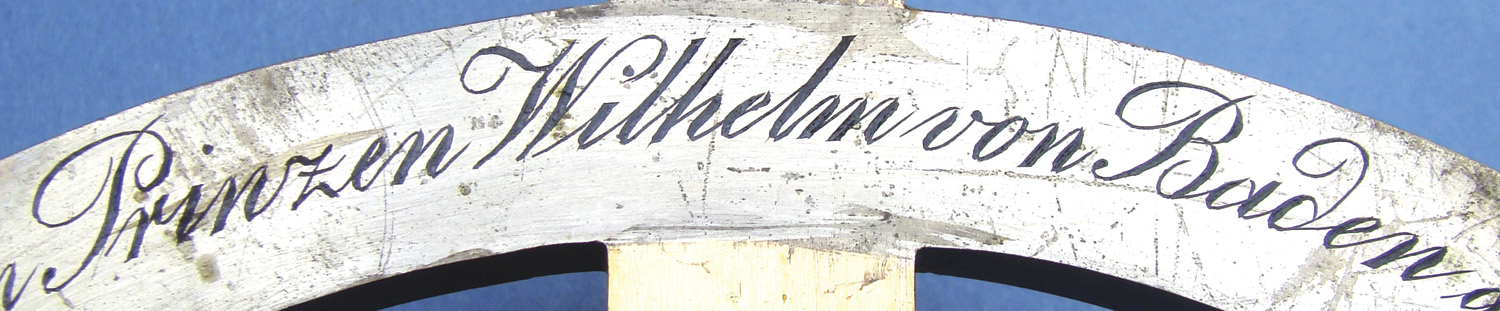
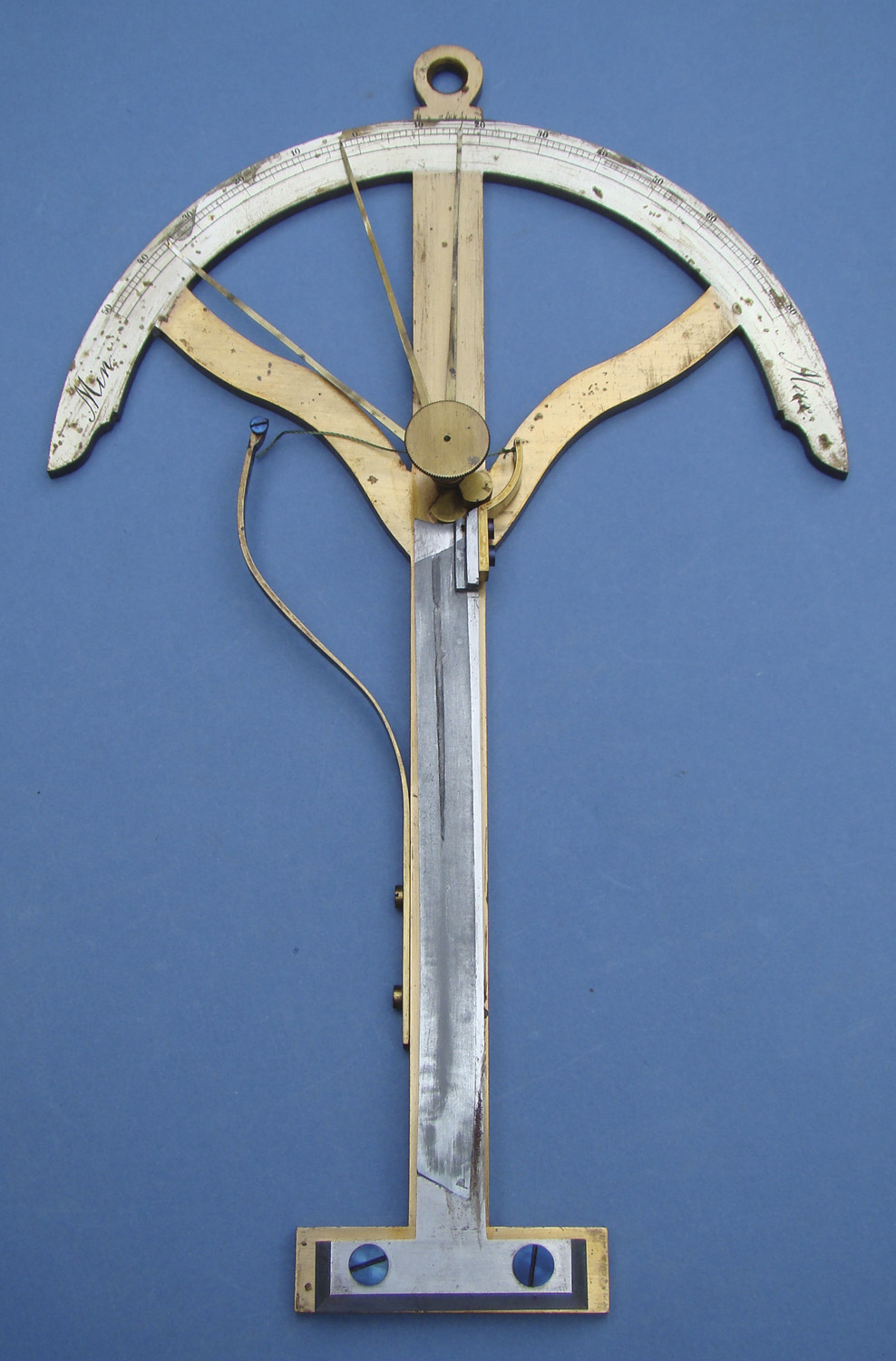
FINE BIMETALLIC THERMOMETER WITH ROYAL PRESENTATION, probably German, c. mid-19th century. Made of clear lacquered and silvered brass, the "gallows" shaped instrument stands 10-7/8" (28 cm) tall surmounted by suspension / mounting hole. On one side is mounted a long bar of two joined metals of different thermal expansion, the bar bending as the temperature changes. A string is fixed to a brass fitting on one side of this moving bar, the other end fixed to the spring-load on the unmoving main plate. In the middle the string is attached to a long arm pointer, and carries this pointer along as the temperature changes and the string moves. The pointer registers against the circular arc divided every degree from -50 to +80, the scale ends labeled "Min." and "Max." Two loose pointers are pushed by the main pointer, thus leaving a record of the highest and lowest temperatures achieved. Condition is very fine and functional. The other side is plain but for the splendid script engraving "Sr. Grossherzogl. Hoheit dom Prinzen Wilhelm von Baden gewidmet von einem Seiner Kanoniere." (Dedicated to His Royal Highness Prince William of Baden by one of his artillery men.) Prince William (1829 - 1897) served in the Prussian Army, becoming major and then Commander of the Guard Artillery c. 1860. But in 1866, during the short-lived Austro-Prussian War, he sided with Austria and acknowledged a truce. During the Franco-Prussian War of 1870/71, Wilhelm led some of the 24,000 Prussians who took, lost, and retook Dijon, France in fierce battles. This is a rare form, in very fine condition, and with a splendid presentation provenance. We have seen one other bimetallic thermometer of this shape, that one in the fabulous collections of the Collegium Maius of the Jagiellonian University in Krakow. (10361) $6500. |
 |
| How Fluid is the Fluid? | Click on any image for a larger view. Scroll to view more items. |
 |
 |
|
MICHELL¹S PATENT VISCOMETER, English / Australian, c. 1920, signed on the lid including the UK patent number (117234). Contained in the 6-7/8" (17 cm) wide fitted mahogany case is a hollow steel cylinder with hard rubber grip and lower weighted steel assembly with three tiny polished steel grasping "pads" arranged on a cup-like segment of a sphere. There is also a polished steel ball which mates to these pads, a 0 - 100° C. thermometer, and instruction sheet. The outfit is complete and in fine condition. To determine the viscosity of lubricating oils or other liquids, one places a couple of drops on the pads, and noting the temperature of the unit, presses the ball onto the pads, quickly inverts the assembly, and measures precisely the time required for the ball to drop free of the cup. That duration in seconds, divided by the constant of the instrument (engraved on its plaque), gives the true viscosity of the liquid in C.G.S. units. Patented in the UK in 1918, it is the invention of A.G.M. Michell of Melbourne. (10392) $295. |
| German Craftsmanship | Click on any image for a larger view. Scroll to view more items. |
 |
 |
|
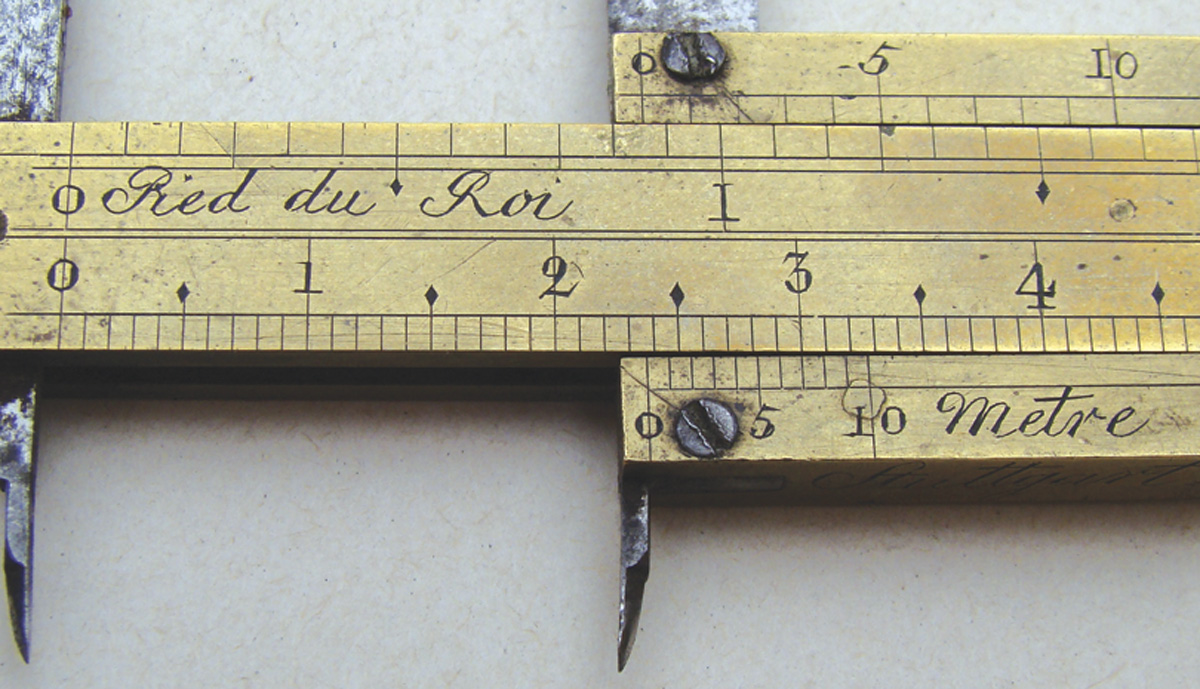
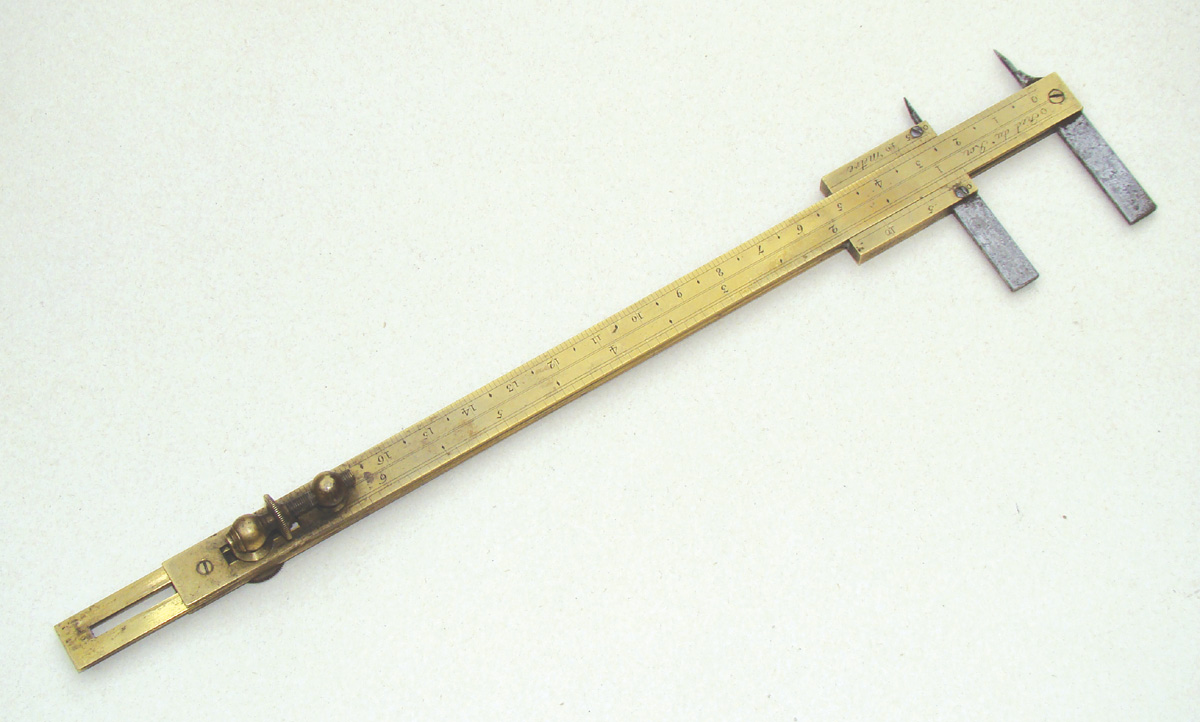
PRECISION CALIPERS FROM STUTTGART, German, early 19th
century, signed "Baumann, Stuttgart." Made of brass with steel
tips, these sliding calipers open from 8-1/2" to 15-1/2" (22
- 39 cm), with clampscrew and fine adjustment screw. Setting is made with
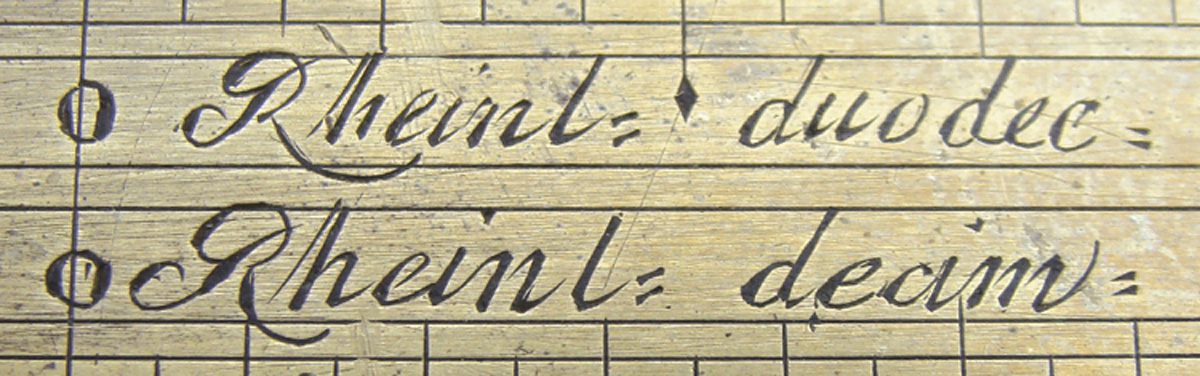
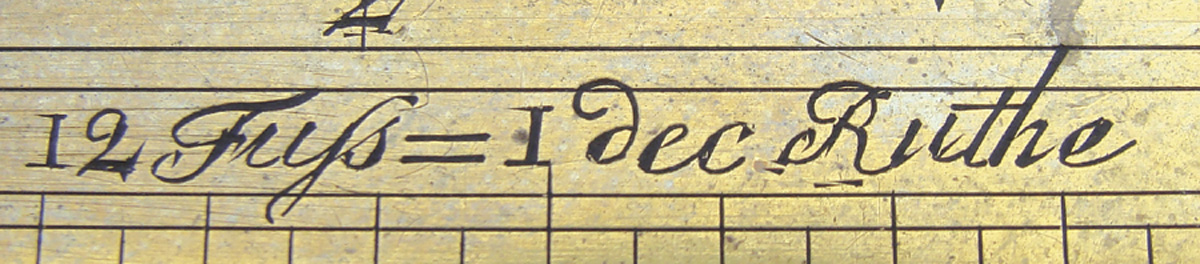
fine steel points or flat parallel jaws. The sides are engraved with scales
of Rheinland measure and French measure, including both "Pied du
Roi" and "metre." There are four verniers with readouts
to tenths of a division (e.g., tenths of a millimeter). The scales are
finely divided and beautifully engraved (e.g., "Fufs = 1 dec Ruthe").
Condition is fine, the instrument of particularly high quality. Baumann
was a maker of precision surveying instruments. The Websters reckon him
c. 1760 - 1830, and record a circumferentor and a repeating circle by
him. Another of his instruments, a fine brass theodolite, has recently
appeared on the market. (9426) $1495.
|
 |
 |
 |
| No Weights Needed, for the Hungarian Ducat | Click on any image for a larger view. Scroll to view more items. |
 |
|
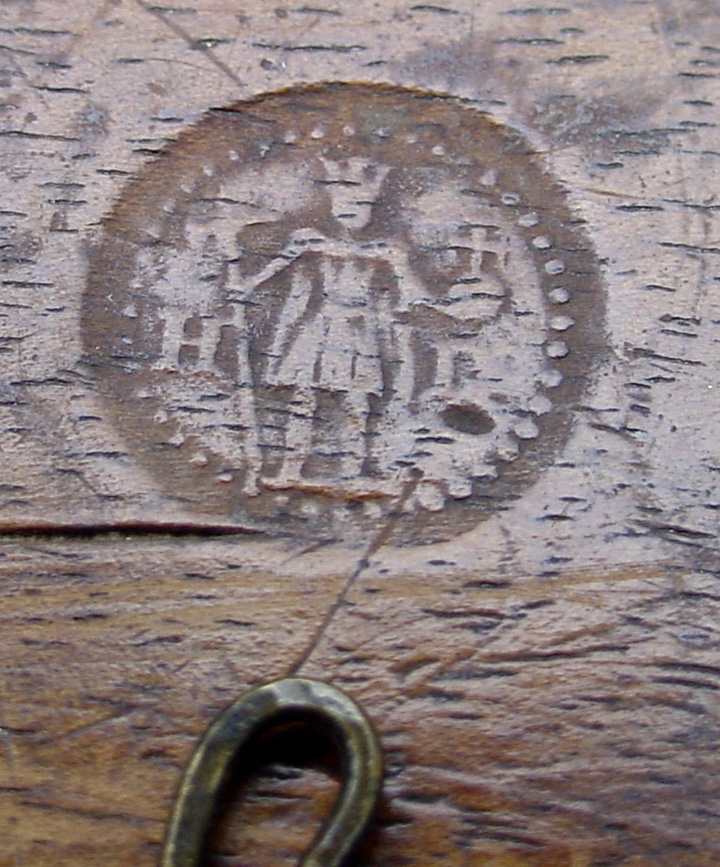
"WEIGHT-LESS" SELF-INDICATING DUCAT SCALE OUTFIT, German (Nuremberg), mid-18th century. This cleverly designed scale has a decoratively shaped cut steel beam 4-3/8" (11 cm) long, with suspension yoke, pointer, and integral arch cut with six tiny notches. Green silk strings support the two turned brass pans, one of which is heavier than the other (by exactly one Ducat's weight), and stamped with the coin's design, showing a figure holding an orb and scepter, and with the letters "HD" (for the Hungarian Ducat.) The original shaped wood case bears a printed instruction sheet, and a similar coin stamp to the wood. Condition is very fine and all original throughout. In use, no weights are needed! The heavier pan should just balance the weight of a gold ducat placed in the lighter pan. For a genuine ducat, untampered with, the pointer will be vertical. If the coin has been shaved down the scale tilts and the deficiency in number of grains is automatically indicated by the notch on the arch. A fine example of this innovative form. (7394) $1950 |
 |
 |
| The "Amsterdam Coin Scale" Outfit | Click on any image for a larger view. Scroll to view more items. |
 |
 |
|
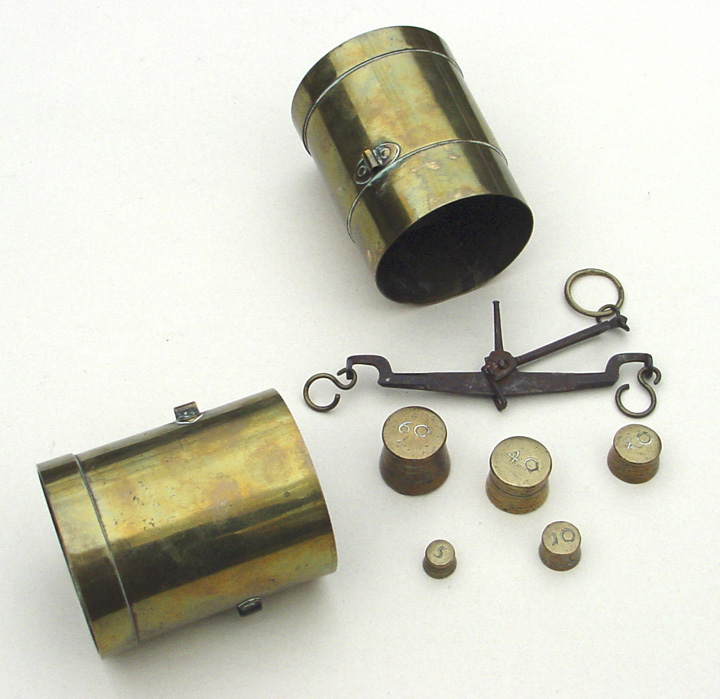
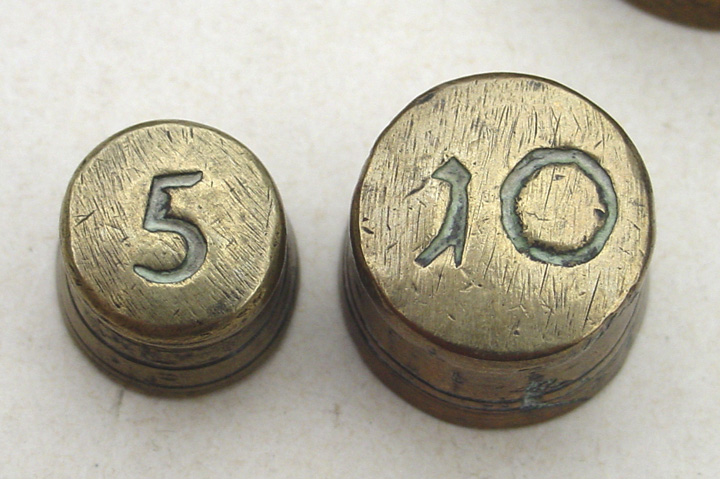
PORTABLE DUTCH CORN SCALE OUTFIT, c. early 19th century. This "Amsterdam corn scale" outfit, when assembled, forms a brass cylinder 3-3/8" in diameter and 7" tall (8.5 x 18 cm). The two halves form the weighing vessels, one for corn and one for weights. The 5-1/2" long cut steel balance beam, with its brass hangers, would be connected to the vessels by chain or cord running through the guides along the sides. The original turned brass weights, of traditional mushroom form, are also present, marked 5, 10, 20, 40, and 60. Condition is fine through-out noting cleaning residue in the crevices. The "Amsterdamse korenschaal" was used to determine the specific gravity of a grain sample, as a measure of its quality. The form was apparently used only in Holland. Examples are uncommon; we find one illustrated in Kisch (Fig. 21). (7414) $950. |
| Combustion Blowpipe | Click on any image for a larger view. Scroll to view more items. |
|
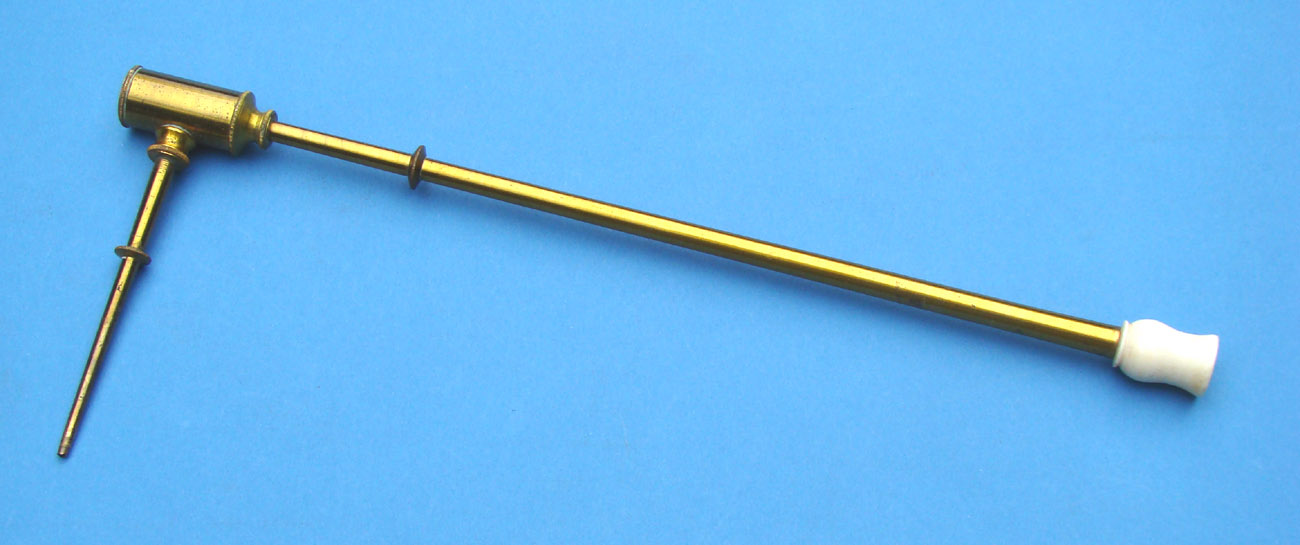
FINE BLOWPIPE, possibly German, 19th century, made of
clear lacquered brass, 10" (25 cm) long, with removable nozzle and
turned bone mouthpiece. Very finely constructed, likely a Lingke manufacture,
the blowpipe is in very fine condition. In use one blows a fine high speed
stream of air into a flame, richly oxygenating the combustion and creating
much higher temperatures capable of melting or vaporizing or oxidizing
or reducing samples, when performing chemical and mineral analysis. (9333)
$250.
|
 |
| Optical Demonstrations | Click on any image for a larger view. Scroll to view more items. |
|
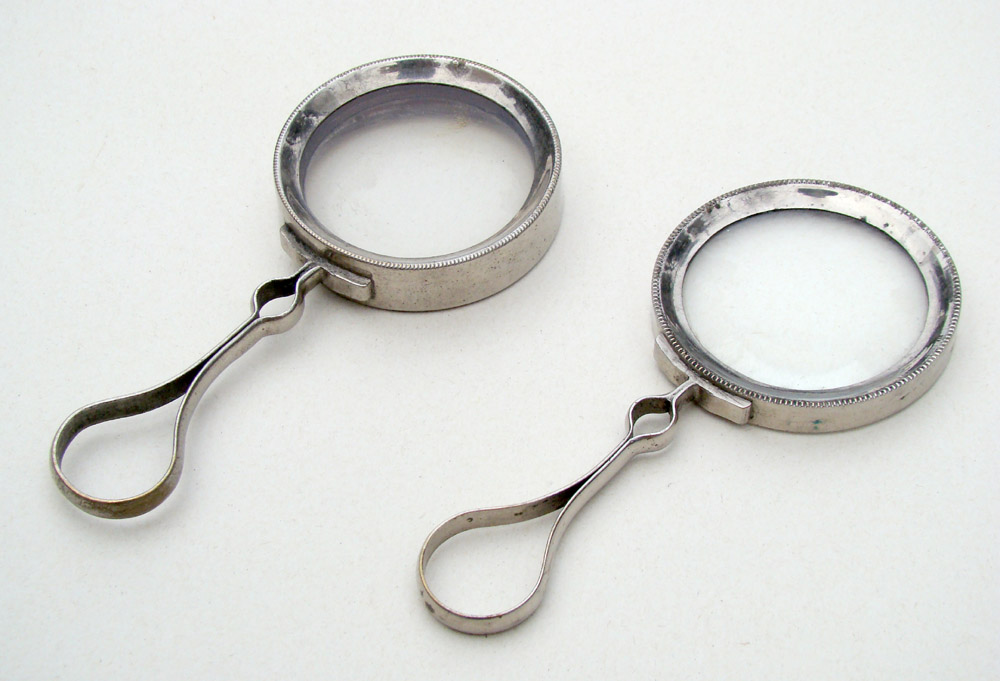
DEMONSTRATION LENS PAIR, POSITIVE AND NEGATIVE, c. second
half 19th century, made of plated brass, 3-3/4" (9.5 cm) tall with
their curviform handles. One lens is double convex (positive) with a focal
length of about 3-1/2"; the other lens double concave. In an exemplary
demonstration, the former will magnify the printed word, the latter diminish
it. An unusual pair, in excellent condition. (9340) $295.
|
|
| French Pocket Thermometer | Click on any image for a larger view. Scroll to view more items. |
|
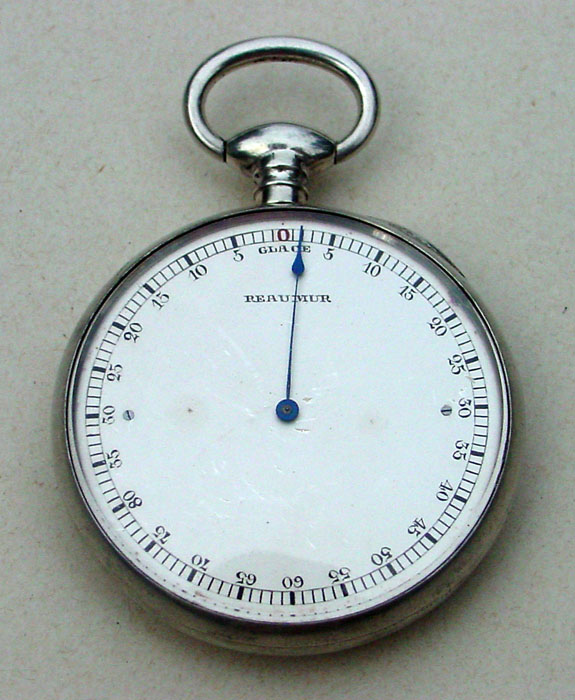
A REAUMUR WATCH-CASE BIMETALLIC THERMOMETER, French, 19th
century. The case is made of bright plated metal, 1-3/4" (44 mm)
in diameter, with glazed front and removable back plate. The dial is delicately
hand-painted with "Reaumur" and a -35° to +80° scale
divided every degree and labeled "Glace" (i.e., "Ice")
at 0°. The mechanism has a long shaped bimetallic spring, amplification
linkage, and geared sector driving the pointer which is preloaded by a
fine hairspring. Condition is fine and functional throughout, noting light
scratches to the dial plate. This handsome pocket thermometer is unusual
in being designed solely for the Reaumur temperature scale, as proposed
by Rene Antoine Ferchault de Reaumur in 1731. He set the freezing point
of water at 0°, and, for the "convenience" of octogesimal
division, the boiling point at 80°. It was generally replaced in the
late 18th century by the Centigrade system. (8279) $1600.
|
 |
|
|
| Certified Chemistry Standards | Click on any image for a larger view. Scroll to view more items. |
 |
 |
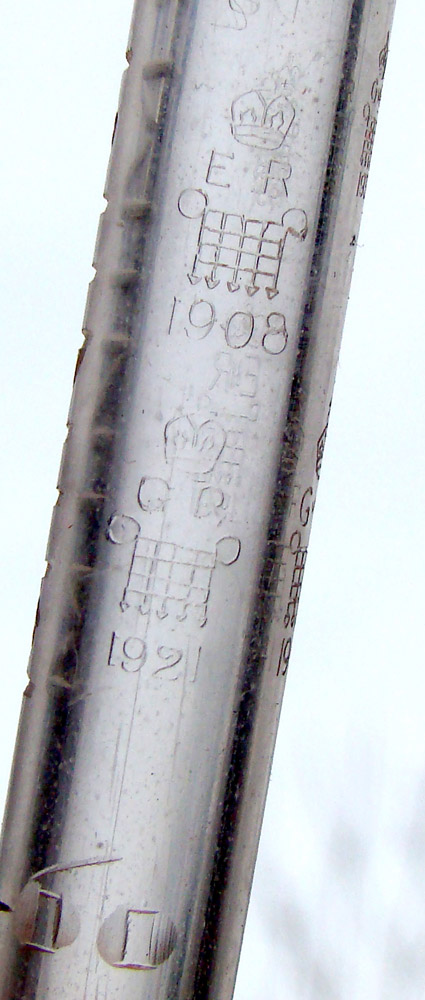 |
CHEMISTRY STANDARD VOLUME MEASURES, English, c. 1900,
comprising a set of five graduated glass pipettes, numbered "2244,"
engraved variously with volumes in minims, grains, drachms and ounces,
each one etched with a sequence of certifications including date and ruling
monarch (e.g., 1908 ER, 1921 GR, 1931 GvR, 1941 GviR, 1951 GviR, 1961
EiiR). The fine fitted mahogany case is 12-1/4" x 3-7/8" x 1/2"
(31 x 10 x 1.3 cm) and bears a brass plaque engraved "County of Renfrew,
DeGrave & Co. Ltd. Makers London." In excellent condition, this is
an unusual set of fine volume standards. (9272) $495.
|
| Unusual Chemical Balance | Click on any image for a larger view. Scroll to view more items. |
| SINGLE ARM BALANCE, Continental, mid-19th century. The finely grained hand-dovetailed walnut(?) case measures 9-1/4" x 5" x 3-3/8" (24 x 12 x 8 cm) , with internal fitted drawer holding the case-mounting balance outfit. There is a turned brass pillar with steel assembly supporting the steel beam with its spherical brass counterweight and adjustable side weight. A double pan hangs from the far end. This unusual balance is in very fine condition, and has an interesting note of provenance within the drawer: "Cette balance, moins les poids, appartient a Mr. Kaeppelin, profess'r." Rodolphe Kaeppelin (1810 - 1891) was science professor at the Lycee de Colmar, and wrote a text Cours de physique (4th edition 1846). Kaeppelin is best known for his innovative "hydrostat" weighing instrument, published 1856. (8415) $950. | 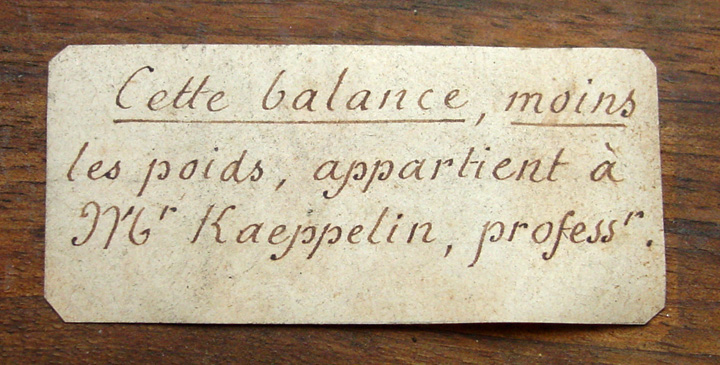  |
| Acoustic Columns | Click on any image for a larger view. Scroll to view more items. |
 |
DEMONSTRATION SOUNDING TUBES, probably English, late 19th
century. These four lacquered brass tubes are mounted on a mahogany base
13-1/4" x 4" (34 x 10 cm), the tallest standing 11-1/8"
above the base. Each has a wood plunger piston which, when withdrawn rapidly,
produces a sound whose frequency depends on the length of the standing
column. Complete and all original, in fine condition. (9282) $975.
|
| Provincial Standard Measure | Click on any image for a larger
view. Scroll to view more items. |
 |
 |
|
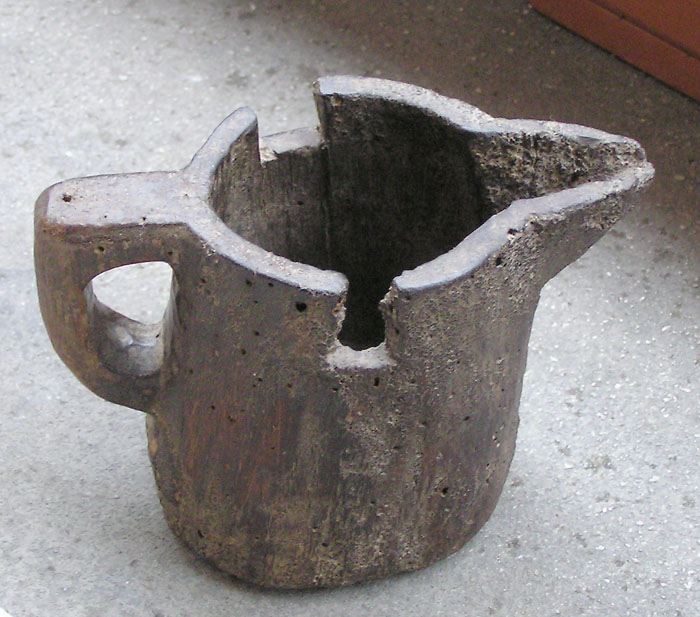
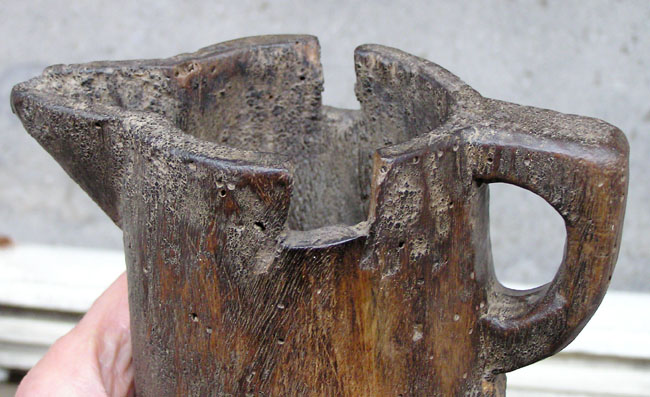
EARLY PORTUGUESE VOLUME MEASURE, probably northern Portugal,
c. early 19th century. Carved from a single block of wood, with handle,
pouring spout, and overflow notches, the vessel measures 4" (10 cm)
tall. Condition is fine, noting old deposits and a few worm holes. This
vessel would have served as a secondary standard measure for liquids;
when filled to the level of the two notches, through which any excess
liquid spills away, it contains approximately 294 milliliters. The Portuguese
system of volume measure for liquids (oil, wine, etc.) was standardized
by King Sebastiao in 1575, and successfully continued in use until the
adoption of the metric system in the 19th century. The principal unit
was the almude, subdivided into twelfths (the canada) and forty-eighths
(the quartilho). There were also half-units of each of these. But the
actual volume of the almude remained very much a local matter; for example,
in Lisbon it was the equivalent of 16.54 liters, but in Porto 25.08 liters
(Doursther, 1840; Noël, 2009). So our vessel falls between the quartilho
of Lisbon (345 ml) and the meio-quartilho of Porto (261 ml); it must represent
one of the innumerable local volumes in use at the time. The construction
is typical of vessels from northern Portugal. For more background on the
subject, and for examples of primary standards, see Weights and Measures
in Portugal (2007). (8369) $950.
|
| Authorised by the French Government | Click on any image for a larger view. Scroll to view more items. |
|
|
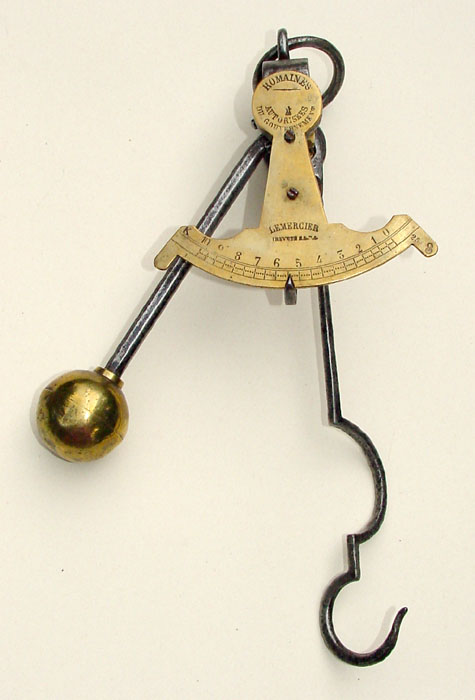
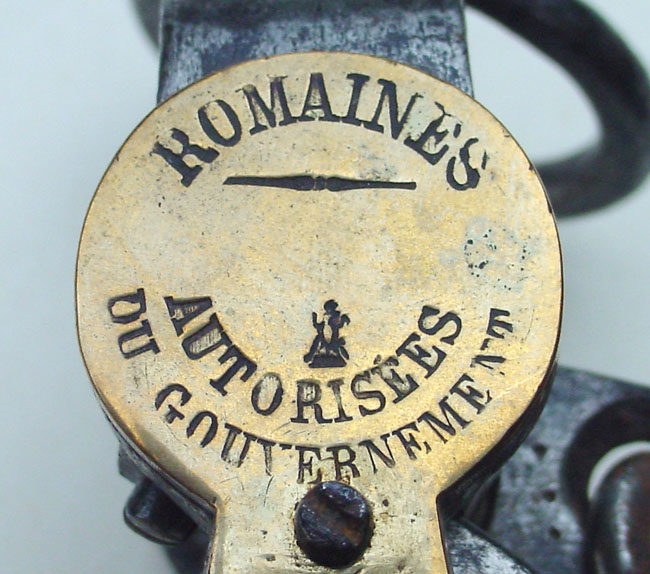
FRENCH HANGING SCALE WITH VERTICAL COUNTERWEIGHT, c. 1870, signed "Romaines, Autorisees du Gouvernement; Lemercier, Brevete S.G.D.G.," and bearing Lemercier's mark, the verification stamp, and the number 254 (possibly for that bureau of control). This balance scale is made of iron and brass, 11" (28 cm) overall (from top of suspension ring to bottom of hook). A single horizontal shaft carries the counterweight arm, pointer, and hook arm, but the latter is suspended at a slight offset from the shaft axis, giving considerable leverage in the linkage. As a load is applied to the hook, the counterweight and pointer incline accordingly, with readout against a scale of 0 - 10 kilograms, subdivided every 100 grams. The hook arm is cleverly shaped to allow passage of the spherical weight. Condition is fine, the metal cleaned long ago. Lemercier, a clockmaker of Tinchebray in the Orne region in France, is credited with this design, and in fact held the legal rights to it, from 1863 until 1898, as granted (and eventually withdrawn) by the French bureau of weights and measures. The present example is the earliest form, datable to 1863 - 1873 (see Pommier, 2005). (8339) $1350. |
 |
 |
| Sphericity Measurement |
Click on any image for a larger view. |
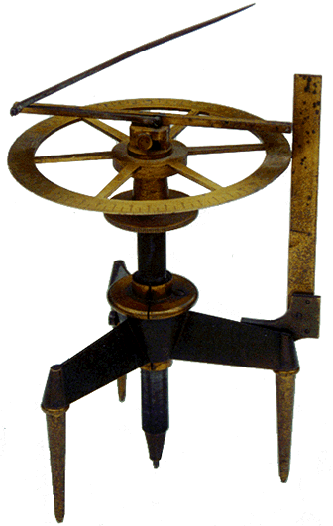 |
PRECISION SPHEREOMETER, French, mid-19th century. Standing 6-1/2" tall, made of brass with a steel lead screw, the spherometer has three tapered legs, central pin on the fine thread precision screw, and "micrometer" readout with vertical scale graduated every half-millimeter, and circular scale (on a six-spoked ring) graduated every 0.001 millimeter (!) The central pin presses against an upper double lever arm with very high amplification factor, so that repeatable positive contact is reliably indicated. The instrument thus measures the central height, and therefore the sphericity, of a surface. Condition is fine noting nicks around the scale edge, and crazing to the original lacquer finish. The most sophisticated early mechanical spherometer we have seen. (6401) $695. |
| Original Prize Medals for Photography | Click on any image for a larger view. Scroll to view more items. |
|
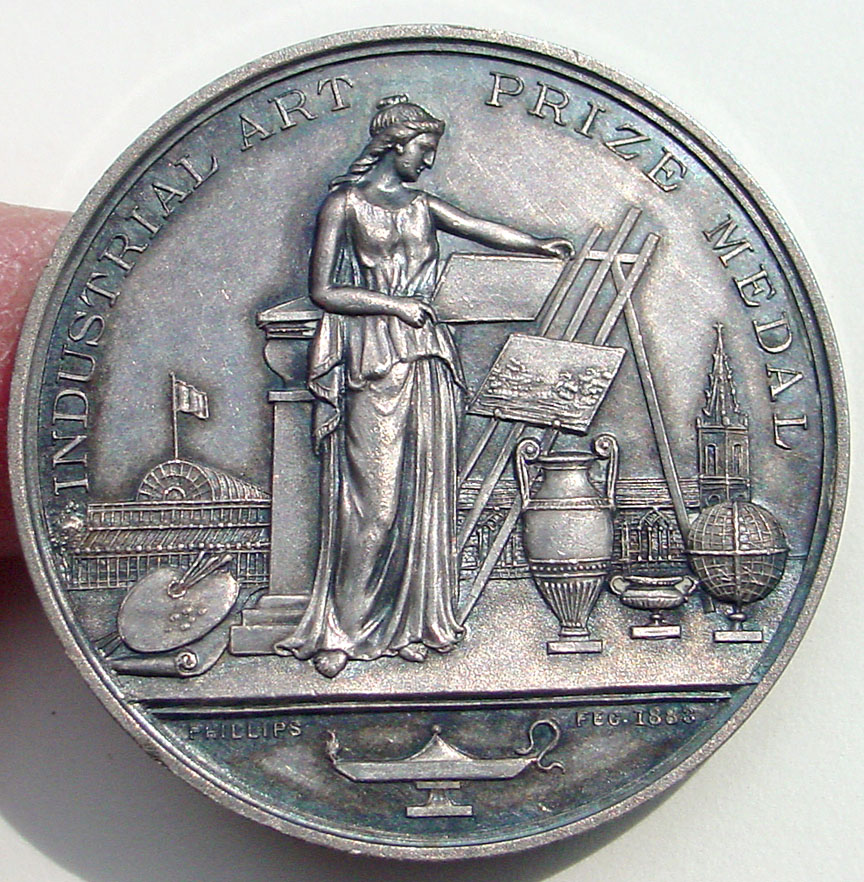
PHOTOGRAPHIC PRIZE MEDALS, English, 1880's. The two medals, which came to us from the same Byrne family source, are described briefly as follows: 1) Silver 1-1/2", O.D., Derby Corp. Art Gallery 1882 VR, Industrial Art Prize Medal. No inscription; wonderfully designed and super-detailed. 2) Bronze 1-3/4", one side with bust of James Watt, Royal Cornwall Polytechnic Society, First Class, edge engraved "Byrne & Co., for portraits on China, 1881." |
 |
 |
The winner's name is engraved around the edge of the latter. The photographers Byrne & Co. are found in 1883 and 1900 directories at 1 Clarence Terrace, in the London Borough of Richmond upon Thames (home to Hampton Court Palace, Ham House, Kew Gardens, etc.) Condition is fine. $400./the pair |
 |
| Early De Luc Hygrometer | Click on any image for a larger view. Scroll to view more items. |
|
|
 |
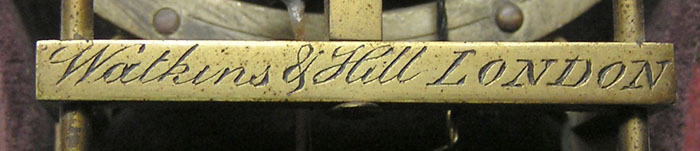
HAIR HYGROMETER, English, c. second quarter 19th century,
signed "Watkins & Hill, London." The open framework is constructed
of clear lacquered brass, 8-3/4" (22 cm) tall overall, with suspension
ring and mounts for the mechanism. It is fitted with a circular scale
of relative humidity divided every unit from 0 to 100, and ends marked
D(ry) and M(oist). An index pointer is driven by central double pulley,
the pulley drawn counter-clockwise by string attached to a tight bundle
of very fine hair, and clockwise by string attached to a long finely wound
preload spring. The hair is secured, at the base of the instrument, to
an adjustable calibration screw. If the air dries out, the hair shrinks,
pulling on the string and rotating the index arm counterclockwise against
the spring tension. Condition is very fine complete with the original
shaped wood case lined in purple cloth and bound in red Morocco leather.
This is a good early example of the hygrometer form designed by Jean-Andre
De Luc but here activated by a fine bundle of hair rather than by a strip
of whalebone. Hair was in fact the province of Horace Benedict de Saussure,
and controversy between the two scientists raged for years in the late
18th century (see Middleton, 1969). (8359) $2850.
|
 |
| Looking around Corners in 1750 | Click on any image for a larger view. Scroll to view more items. |
|
|
 |
 |
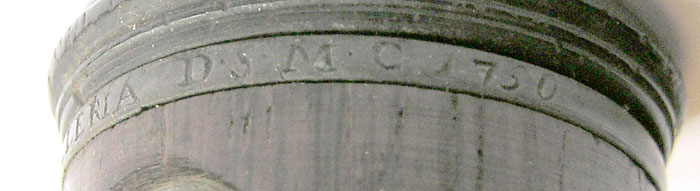
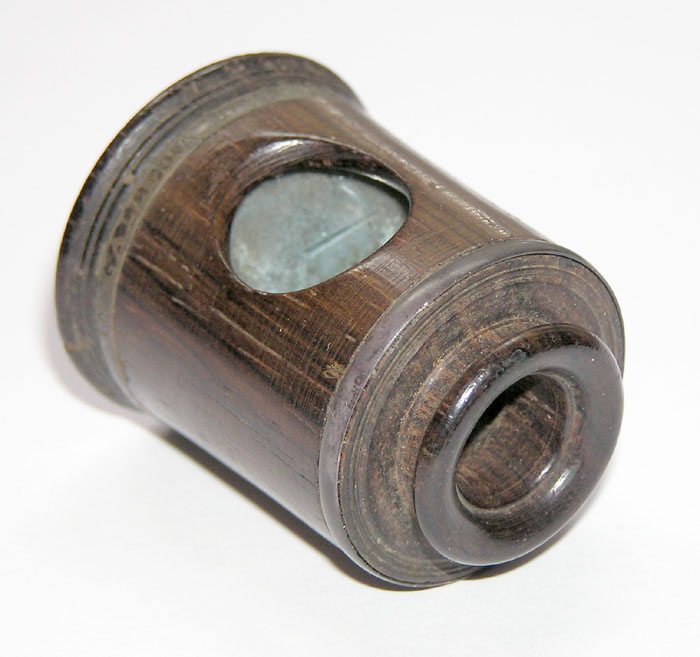
| RARE ITALIAN POLEMOSCOPE, 1750, signed on a silver band, "In Galleria D.S. M.C. 1750." Made of turned (probably tropical) wood, bound in (now quite darkened) silver, this optical instrument measures 1-13/16" (47 mm) tall by 1-7/16" (36 mm) outside diameter. It has viewing port and observation port, with internal oval glass mirror set at 45°. The other end is set with a circular plane glass mirror. Condition is fine except for considerable loss of silvering to the mirrors. In use the polemoscope, or "jealousy glass," permits very discrete viewing at right angles of, for example, patrons at the opera. This unusual example, with its simple second mirror, allows one to also view to the rear, surreptitiously, or to check one's own makeup. We have not identified the maker. The "Galleria" address suggests the shops in the fine arcades of northern Italy, for example in Milan and most notably in Turin, where the Galleria built by the famous architect Amedeo de Castellamonte in 1673 still exists, and even includes an ongoing shop established in 1707 (thanks to Alberto Lualdi for this insight). It is tempting to connect the initials with the workshop of the optical instrument maker Domenico Selva (and his son Lorenzo), quite active in mid-18th century Venice (albeit a city of arcades termed "Procuratie" and not "Galleria"). But perhaps we have here tangible evidence of an unrecorded maker. (8319) $2950. |
| Official Pre-Metric Measure from Upper Austria | Click on any image for a larger view. Scroll to view more items. |
 |
|
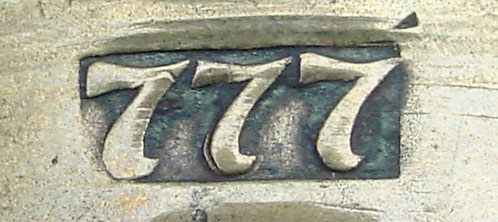
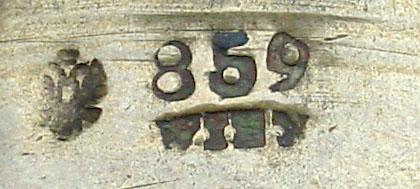
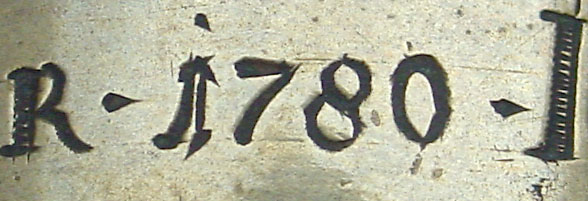
AUSTRIAN OFFICIAL STANDARD MEASURE, 1777, stamped (1)777
and with an elaborate crowned double eagle and with twin cross-hatched
punches, engraved "Iohan Ferdinand Pachner, K=K, Stadrichter, 1780,"
and stamped with a recertification "(1)859, Wien" and a small
double eagle. The cylindrical brass vessel measures 3-1/16" (8 cm)
tall by 2-5/16" (6 cm) base diameter, with shaped base and lip, and
decorative turned rings. Condition is fine. This unusual vessel is an
official standard for liquid measure, with a capacity of 1/4 Seitel, the
Seitel, at about 0.354 liter, being 1/4 of the Mass, the principal pre-metric
volume measure in Austria. It was made in 1777 for the important old town
of Steyr, in Upper Austria, where Johann Pachner served as city judge
from 1772 to 1781, then as mayor from 1782 to 1786. (8399) $3250.
|
 |
 |
 |
 |
| Rare Certification Rule for Standard Measures | Click on any image for a larger view. Scroll to view more items. |
 |
|
 |
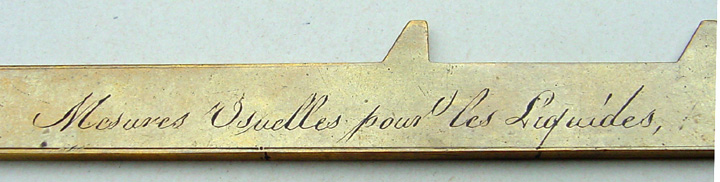 |
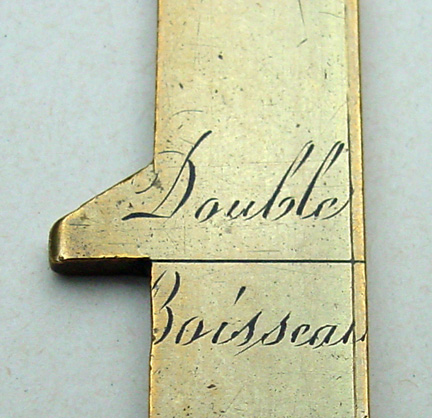
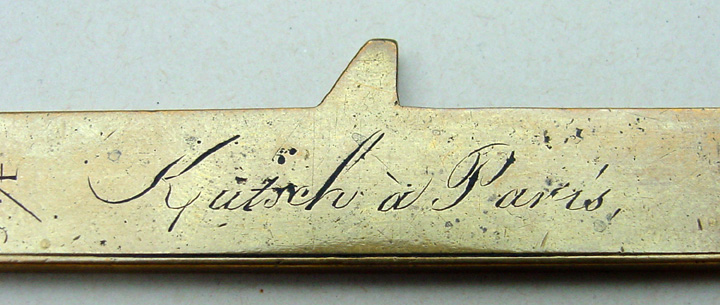
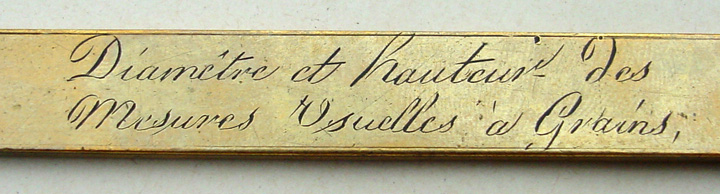
| RARE VOLUMETRIC MEASURE STANDARD RULE, French,
early 19th century, signed "Kutsch a Paris". The 13-3/4"
(35 cm) long brass rule has seven leveling stubs aligned with "Diametre
et hauteur des Mesures Usuelles a Grains" ranging from "1/8 Liter"
to "Double Boisseau." The other side is divided with two scales
(heights and diameters) for "Mesures Usuelles pour les Liquides"
from 1/16 to 1/4 liters. Condition is very fine noting light wear. This
standard rule served to certify the heights and diameters of the cylindrical
measures used to measure out verified quantities of volume. For grain measures,
the cylinders had equal heights and diameters; for liquid measures, the
height was twice the diameter. The revolutionary bodies in late 18th century
France required the best craftsmen to implement this standardization of
weights and measures. Lenoir, Fortin, and Jecker were commissioned. Kutsch
himself was employed by the Commission des Poids et Mesures, according to
Daumas, and was called upon to make measuring comparators. He is listed
in Paris directories from 1803 to 1828, at various addresses, as a mathematical
instrument maker specializing in weights, measures, and balances. We have
had one other standard rule by Kutsch (Tesseract Catalogue 59, Item 47),
and the CNAM in Paris holds a standard meter by him. Rare and significant.
(8335) $2950. |
 |
| The "Kilogram Divided" | Click on any image for a larger view. Scroll to view more items. |
 |
 |
 |
 |
 |
 |
|
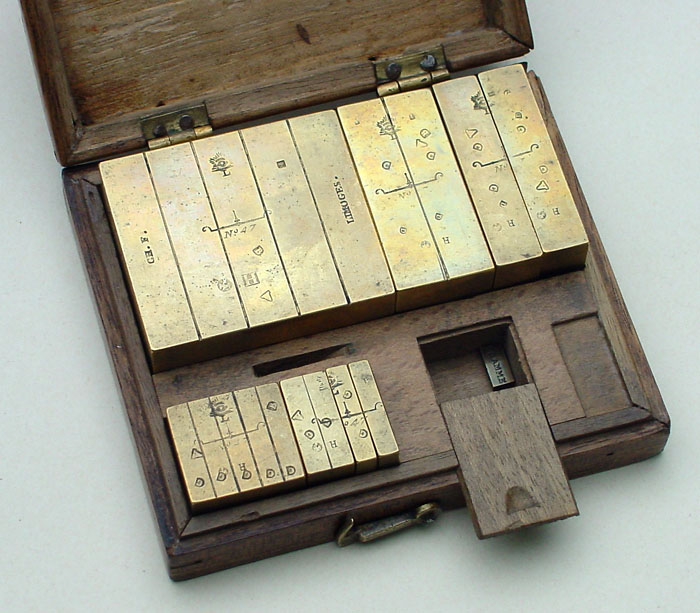
OFFICIAL FRENCH STANDARD WEIGHTS -- THE "PARALLELOPIPED
KILOGRAM", very early 19th century. Contained in its 4" x 4-1/2"
x 1-1/8" (10 x 11 x 3 cm) fitted wood box are the subdivided elements
of a kilogram, specifically brass weights of 500, 200, 100, 50, 20, 10,
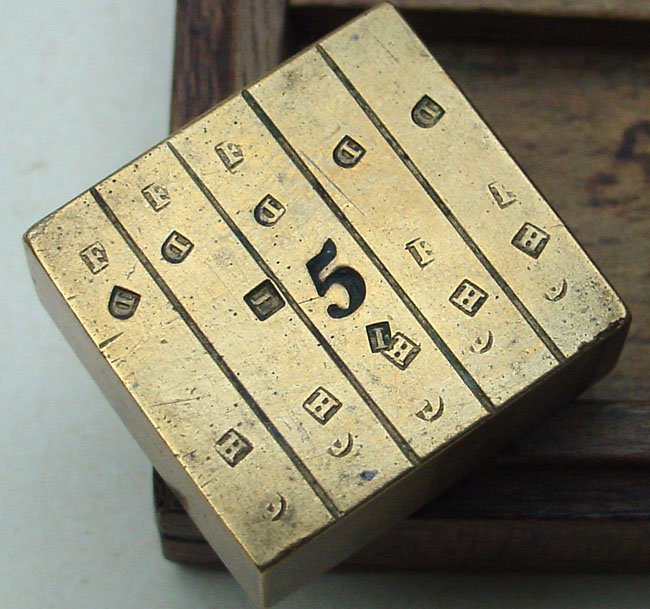
and 1 gram. Each rectangular weight has an adjustment plug, and is marked
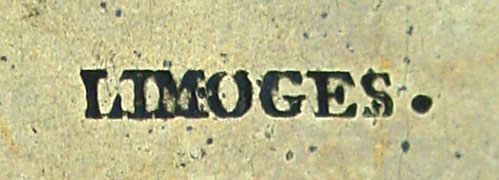
with its weight value, plus a host of standardization marks, including
variously an image of a balance beam, the number 47, the city (Limoges),
the "all-seeing-eye" above an "L," the letter "H,"
a crowned eagle, and letter certifications running continuously (except
no "J") from A through K. Condition is very fine and complete
but for tweezers and a few of the smallest weights (present are 991 out
of the full 1000 grams). The "parallelopiped kilogram" was published
by chemist Claude Antoine Prieur in 1797, in the Annales de Chimie.
He devotes eight pages to their description and advantages, and recommends
those made by Fortin. The weights could be purchased at the Bureau of
Weights and Measures, on rue Dominique in Paris. The present set was made
for official use in the town of Limoges, and bears certifications through
the first quarter of the 18th century. Following Pommier (in recent issues
of Le Systeme metrique), we find that for primary standards the
balance beam mark was used 1801 - 1840, the crowned eagle 1808 - 1812,
and the sequential year letters starting with A for 1802 (or a couple
of years later in some of the provinces). A very rare survival, this is
an important standard set from the early years of the metric system. (8379)
$3800.
|
| Massive Demonstration Outfit | Click on any image for a larger view. Scroll to view more items. |
 |
 |
 |
 |
|
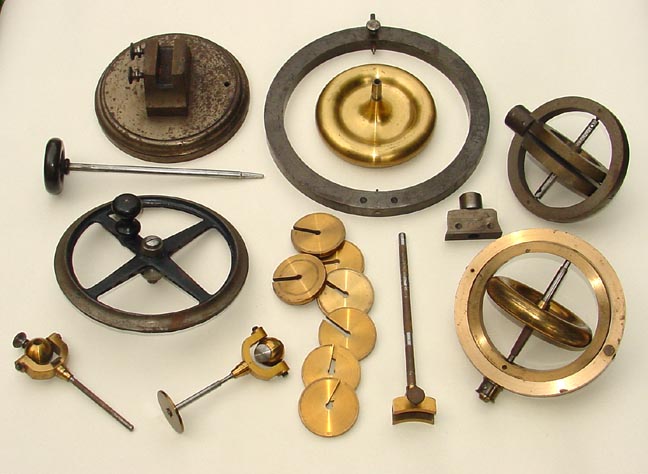
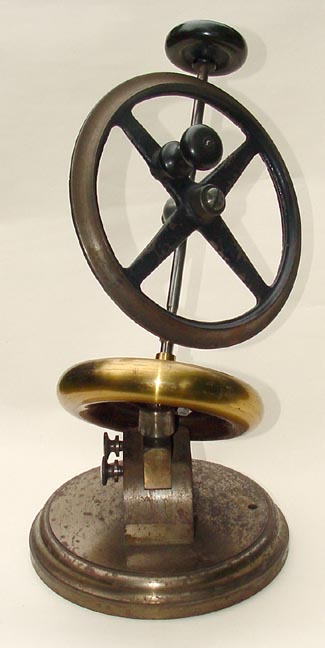
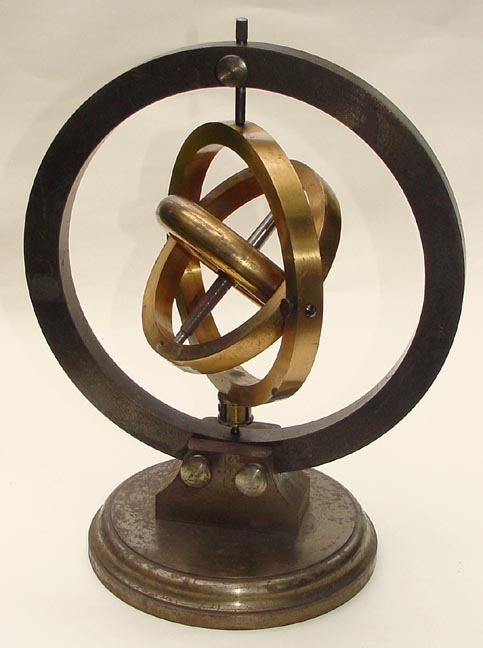
ELABORATE GYROSCOPE COMPENDIUM, probably German, c. 1900.
This massive outfit includes an iron base, iron mounting ring 11-1/8"
(28 cm) in outside diameter, brass rotor, brass rotor in double gimbal
rings, twin rotors in iron ring, speed crank assembly, mounting arms,
and seven stackable brass weights. Total weight of the outfit is approximately
45 pounds. Condition is fine and seemingly complete, noting some mild
surface rust and a couple of little screws lacking at lubrication(?) holes.
Components may be assembled in three basic ways (see photos): (1) iron
base with ring and, on top, the arm mounted with rotors at each end and
weights in the middle; (2) iron base with vertical ring and central rotor;
(3) iron base with mounting block, brass rotor, and spinning wheel with
handle. A remarkable compendium. (8387) $4500. (SOLD)
|
| Astronomy |
| Microscopy |
| Dialling |
| Navigation |
| Demonstration & Experimentation |
| Calculation |
| Medical |
| Specials |
| Books New and Old |
| Tesseract Catalogues |