|
|
| Early X-Ray Localization of Bullets | Click on any image for a larger view. Scroll to view more items. |
 |
|
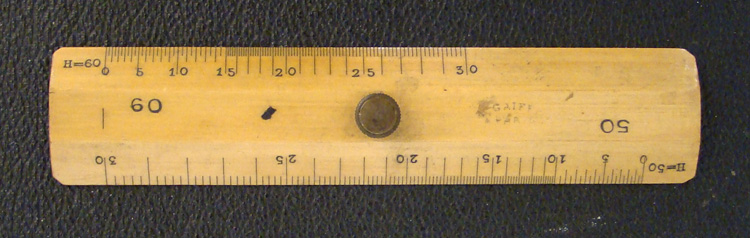
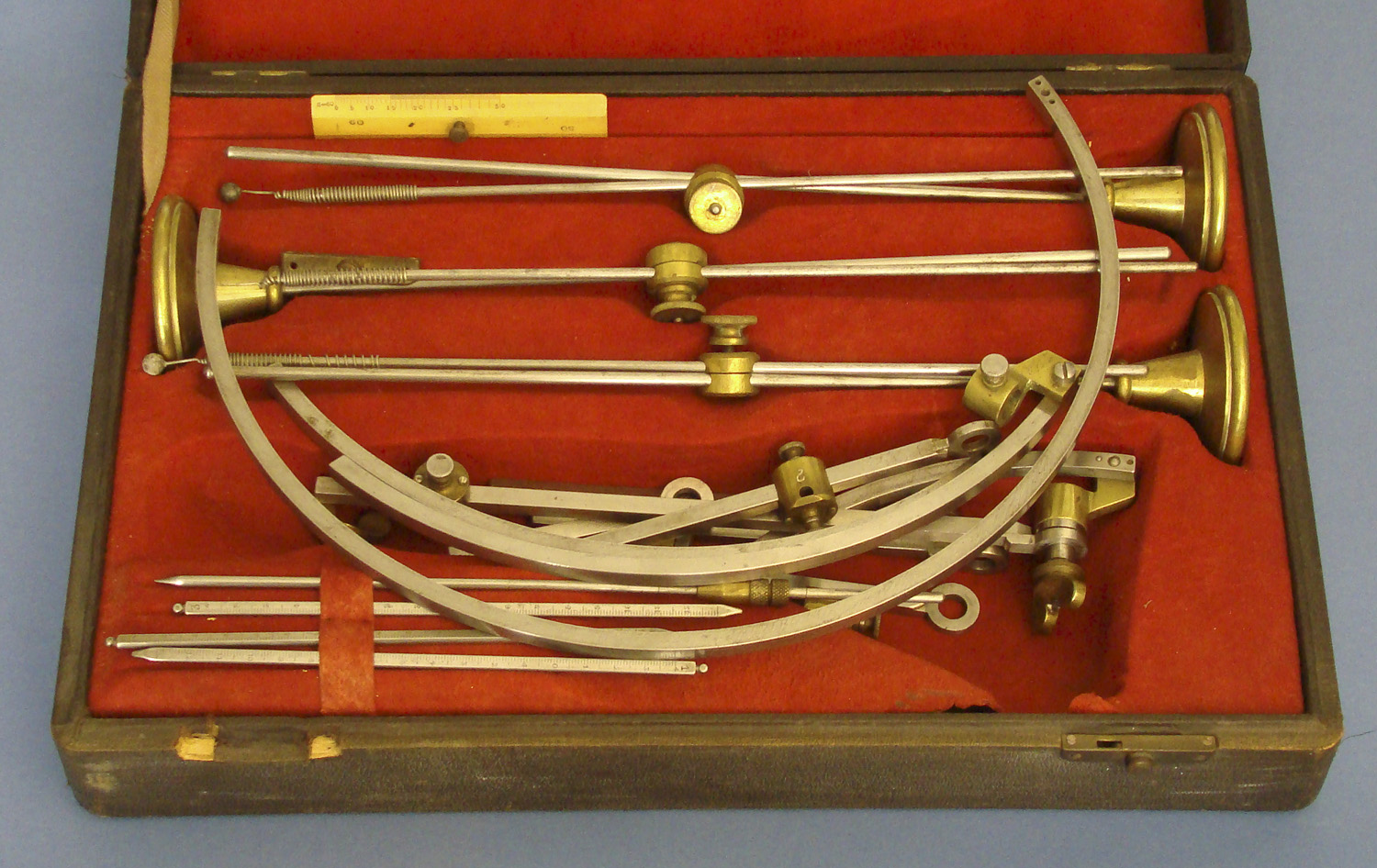
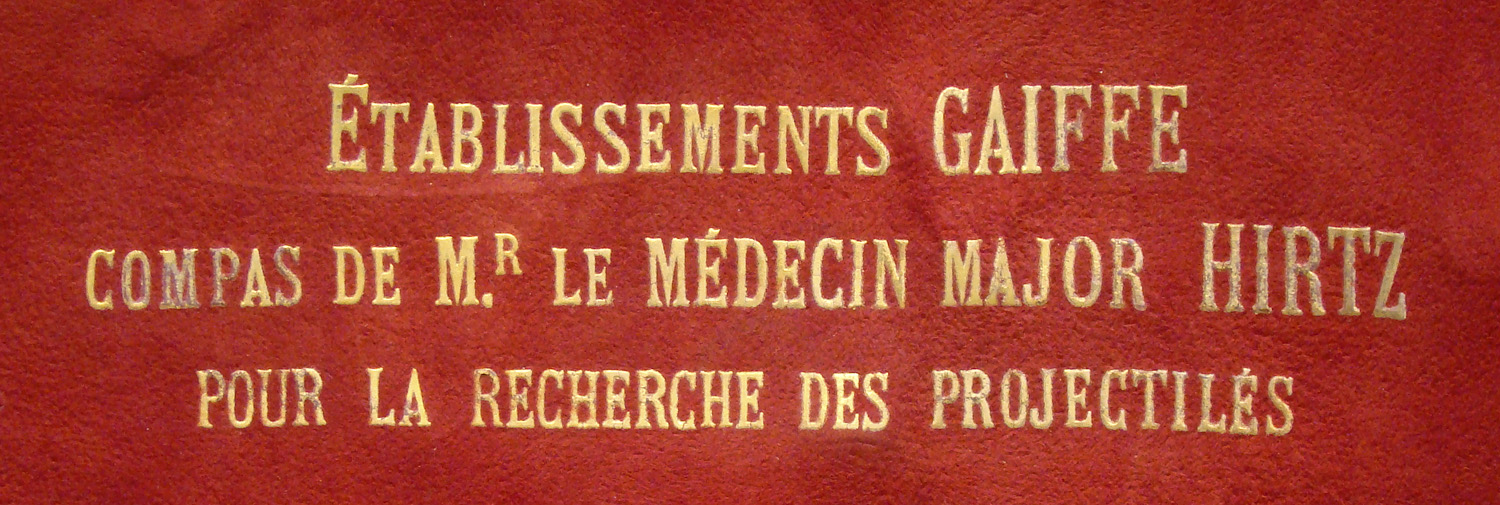
RARE SURGICAL BULLET EXPLORATION SYSTEM OF MAJOR HIRTZ, French, c.1915, contained in the original leatherette covered fitted case 16-1/2" x 11-1/4" x 3-3/4" (42 x 28 x 9 cm), signed in gilt on the red chamois lining "Etablissements Gaiffe, Compas de Mr. le Médicin Major Hirtz pour la recherche des Projectiles." There are numerous devices of polished steel and brass, including three standards with articulated holders for various accessory devices (three straight arms with spring-mounted balls of lead, three flat probes calibrated in millimeters, a straight probe, six straight bars, four arcuate bars, and various connectors). A boxwood rule is signed "Gaiffe a Paris." The outfit assembles to precisely locate internal foreign bodies, used in association with early X-ray equipment. Condition is fine throughout. The inventor of this forerunner of modern stereotaxic instrumentation was Major Eugène-Jules Hirtz (1869-1936), who saw medical service in Algeria and in World War I. He developed the French Army's first physiotherapy service, organized the Army's radiologic services, set up a central service of electro-radiology and a school for X-ray technicians (directed by Madame Curie!), and held, from 1920 to 1928, the chair of radiology-electrology-physiotherapy at the Ecole d'application du Val de Grâce. The maker was the firm A. Gaiffe of Paris, specialists in electro-medical and X-ray apparatus. We note Gaiffe catalogues on record covering the years 1874 to 1911. A remarkable outfit. (10585) $5500. |
 |
|
| Leech Confinement | Click on any image for a larger view. Scroll to view more items. |
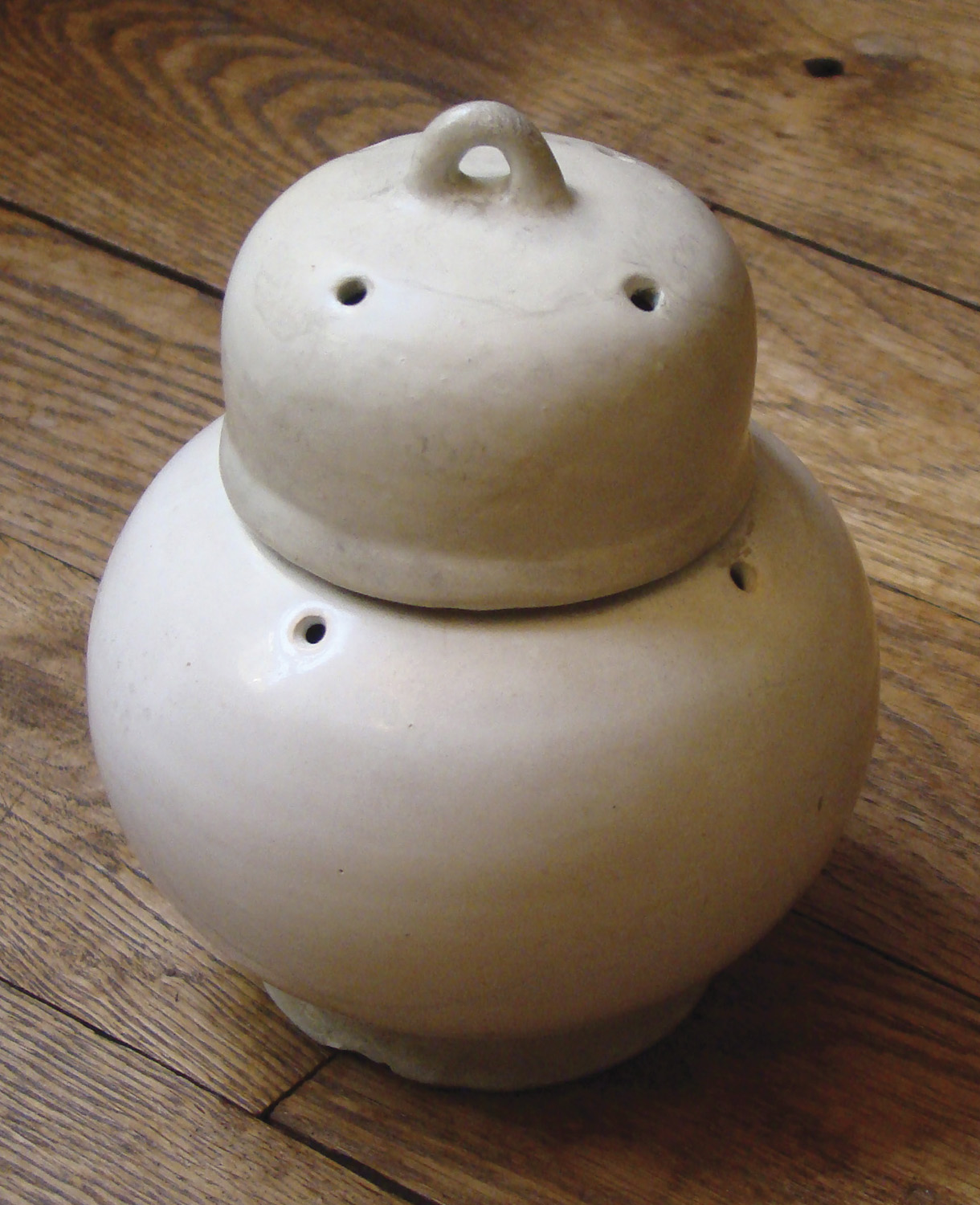 |
CERAMIC LEECH POT, French, 19th century, the glazed creamy-white earthenware or soft-paste ceramic pot standing 5-3/4" (15 cm) tall with its screw-on cover shaped with pendant ring and numbered "17" inside. Body and cover are each pierced with four "breathing" holes. Condition is fine noting typical hairline formation cracks and a couple of chips to the bottom of the base. This is an uncommonly found form of ceramic vessel, designed for everyday use in carrying leeches to or from, for example, the pharmacy. (10401) $550. |
| The Mechanical Pelican | Click on any image for a larger view. Scroll to view more items. |
 |
|
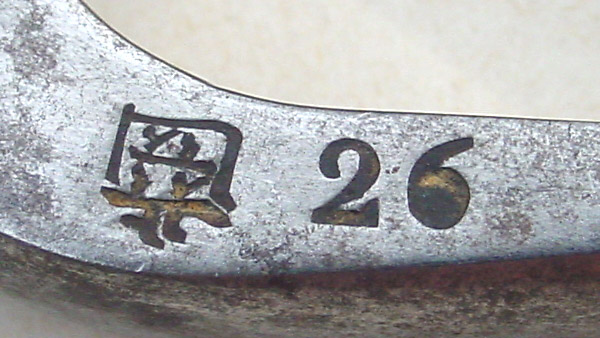
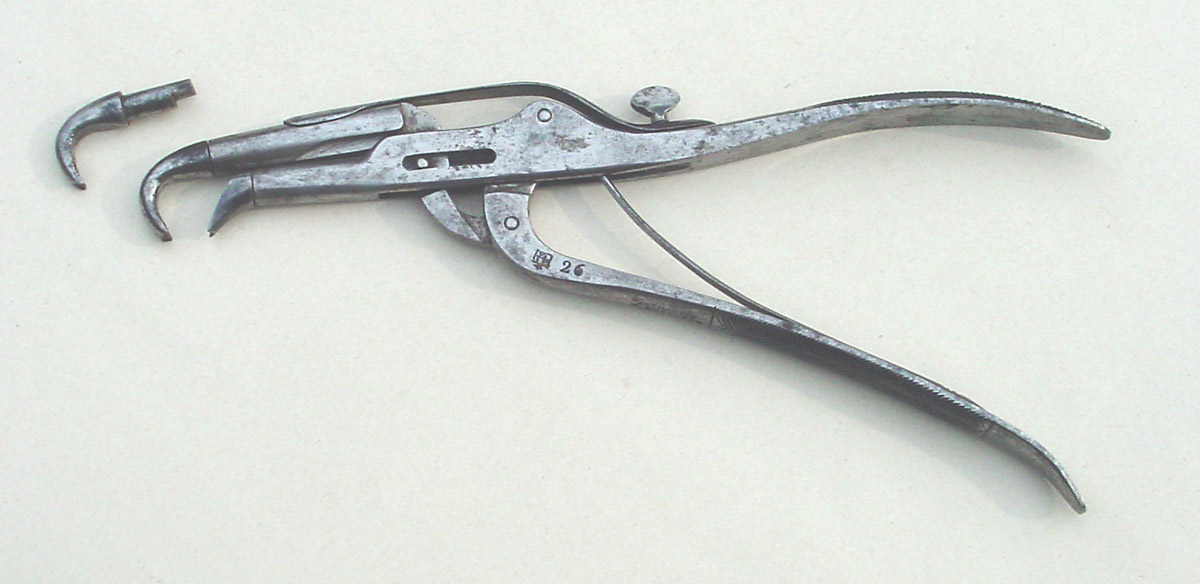
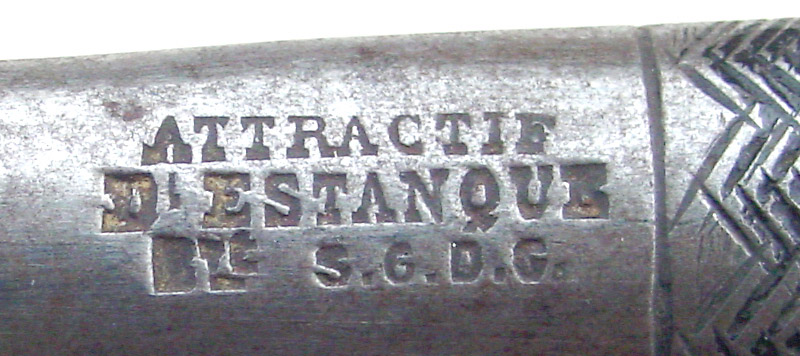
THE "ATTRACTIF DESTANQUES" - A SORT OF DENTAL PELICAN OF MECHANICAL COMPLEXITY, French, c. 1865, stamped "Mathieu a Paris" and "Attractif d'Estanque, B'vt. S.G.D.G.," and stamped with a maker's mark and "26" and internally numbered "5." Finely shaped of steel, the device measures 9-1/4" (23.5 cm) overall, and features a spring-loaded grip activating a mechanical retraction of the upper serrated jaw. It is a nearly parallel motion, guided by linear slots, and brings the jaws together smoothly and securely. An adjustable spring arm controls tension between the jaws - a desirable feature because the tool provides enormous leverage. A swiveling flap allows the three-tyned upper jaw to be quickly replaced by a two-tyned one. Condition is fine noting light staining to the steel. D'Estanque's instrument is of remarkable complexity, and remarkable rarity. It was offered in the Mathieu catalogue, and one is illustrated in Elisabeth Bennion's Antique Dental Instruments (plate 65). She writes: "An extremely complicated type of pelican with two handles was that designed by Eugene d'Estanque and patented by him in 1861. He illustrated it in L'Union Medicale in 1864 and it was made by Charriere and Mathieu with considerable mechanical skill...." (7397) $4950. |
 |
|
| By Cutler to Louis XVI of France | Click on any image for a larger view. Scroll to view more items. |
 |
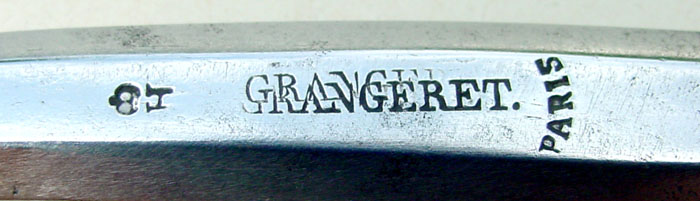 |
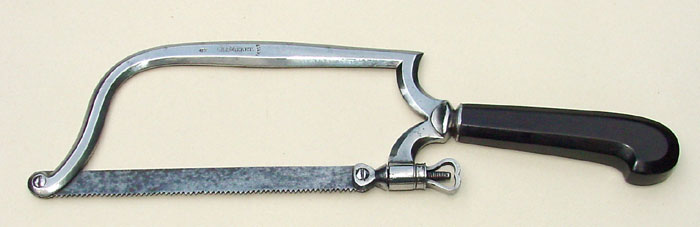
SMALL AMPUTATION SAW BY THE BEST, French, last quarter 18th century, signed "Grangeret, Paris" and with the maker's "crowned-H" stamp. Measuring only 11-1/2" (29 cm) overall, the saw is finely shaped of polished steel, set with a 5" (13 cm) long blade, a "butterfly" blade-tightening nut, and a fine eight-sided pistol grip handle of ebony. Condition is very fine with traces of old stains. The maker was Pierre Grangeret (c. 1731 - 1802), master cutler, recipient of the "crowned-H" mark in 1772, recorded as cutler to Louis XVI. This saw is a good example of Grangeret's superior craftsmanship -- it is comfortable in the hand, with good heft and balance, it is esthetically a pleasure to look at, and it seems eminently functional. It has an unusual diminutive size, clearly designed for younger patients or for finger amputations. (8469) $1350. |
| The Cost of Beauty | Click on any image for a larger view. Scroll to view more items. |
 |
|
|
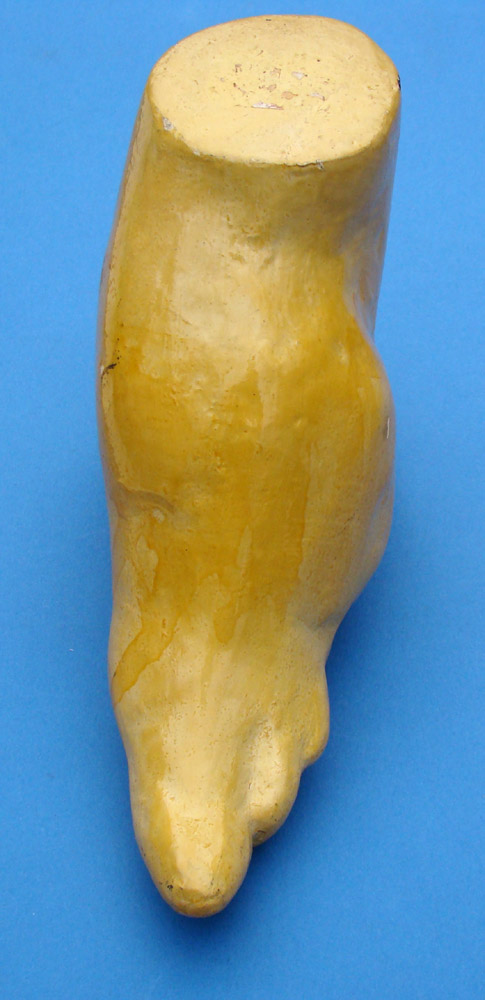
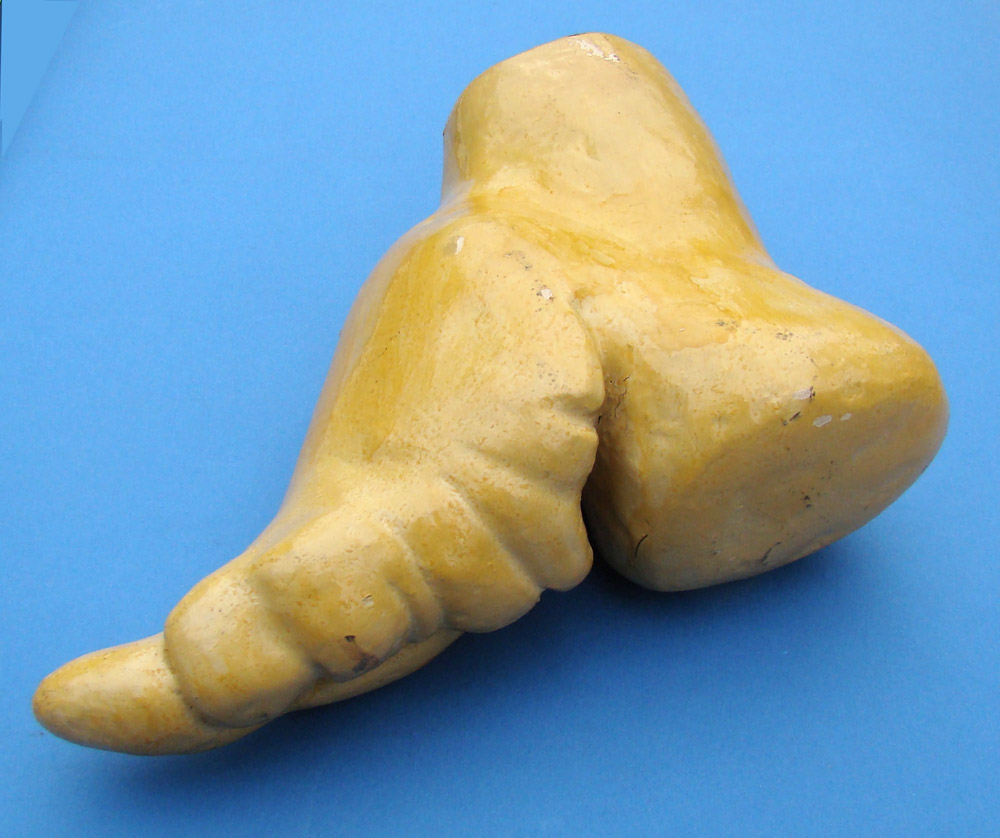
FOOT-BINDING IN CHINA, first half 20th century, this life-size cast (or model) of a foot measuring 6-3/4" (17 cm) long, formed apparently of hard plaster with a heavy shellac coat. It is a left foot, and shows the large toe extending forward, the other toes curled under the foot as grown during years of constant tight binding. Condition is very fine. This particular object was acquired in China, probably in the second quarter of the 20th century, by a Western physician who traveled and worked there. The process of foot binding was practiced in China, especially among the upper classes, from the 10th century onwards until banned in 1912. One estimate is that a grand total of two billion women had had their feet bound. The process was painful, involving breaking the bones of the arches and toes of the young girl's feet, then keeping them tightly wrapped as they developed. The resulting "lotus" shape was considered highly desirable, an object of beauty and the cause of the sexually attractive "Lotus Gait" swaying walk that resulted. (9452) $950. |
| Efficient Bleeding c. 1895 | Click on any image for a larger view. Scroll to view more items. |
 |
 |
|
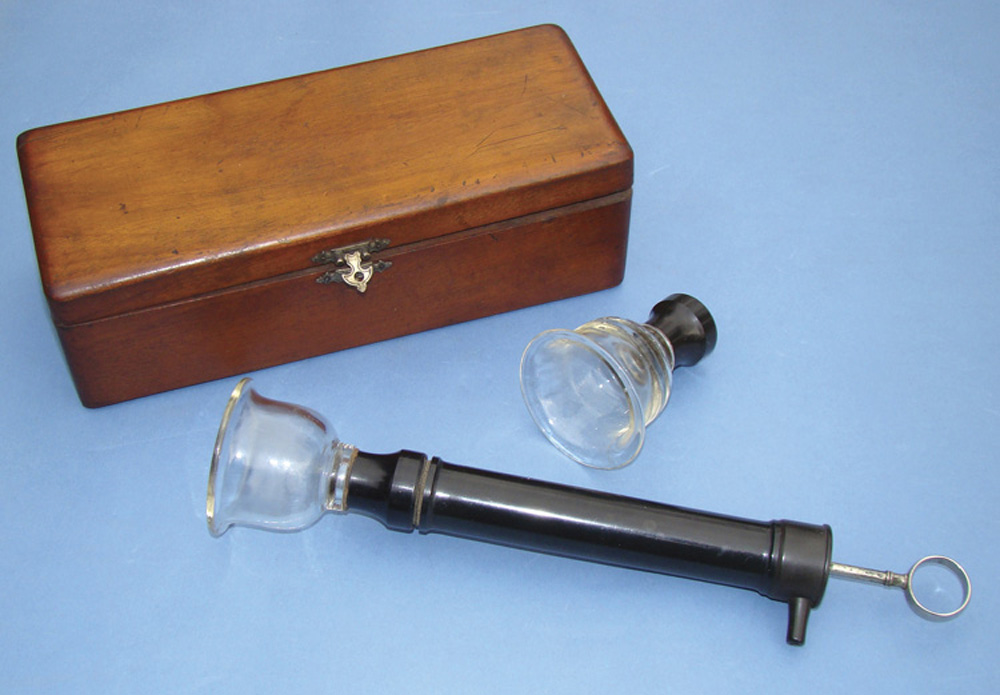
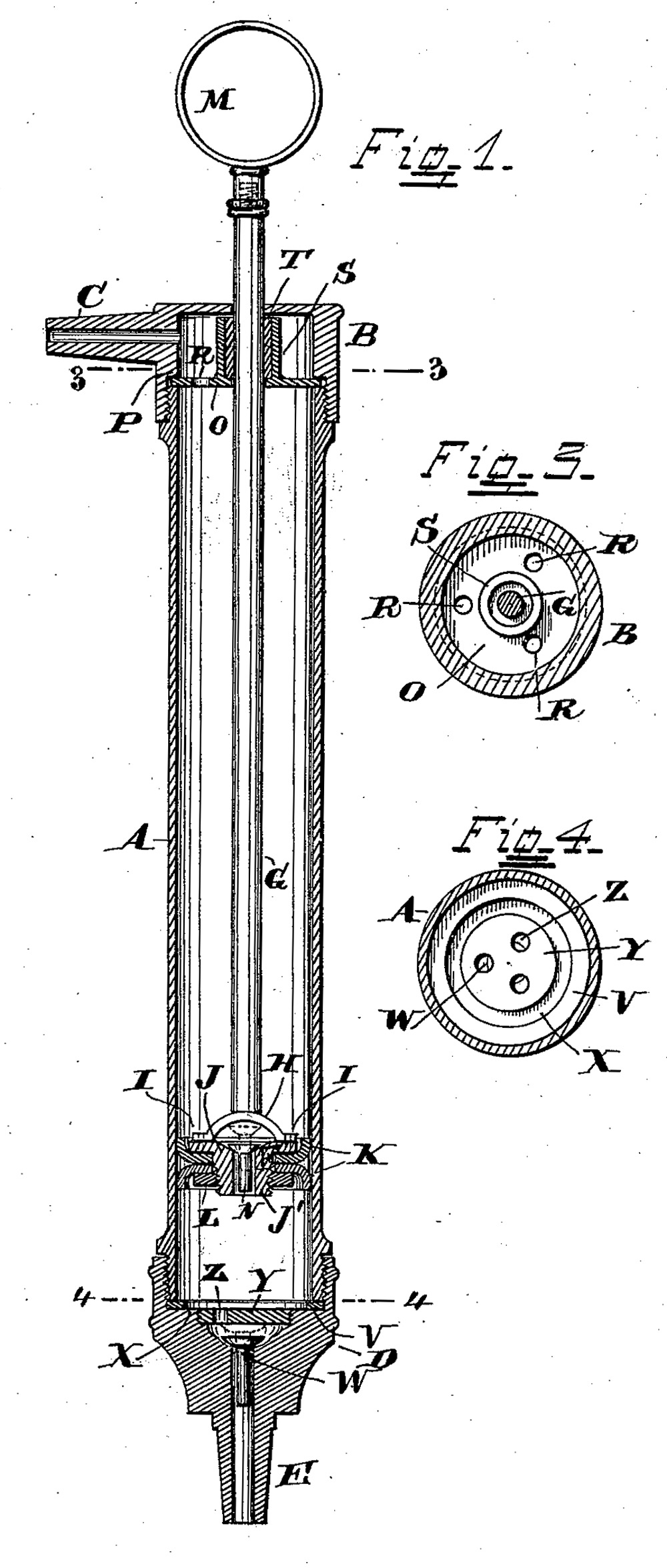
DRS. BLACK'S CANADIAN / AMERICAN CUPPING APPARATUS, c. 1895. The 10" (25 cm) long fitted walnut case contains a gutta percha hand piston pump and two screw-on molded glass bleeding cups with gutta percha fittings. The large printed trade label in the case identifies the inventors as Drs. W.S. & F. Black, and the maker as Wm. B. Stewart of Box 646, Trenton, N.J. Condition is fine but some accessories are lacking. It appears that Fergus Black, resident of Uxbridge in Ontario in Canada, received U.S. Patent 514,900 for this improved air pump. An uncommon phlebotomy device. (10593) $1450. |
| Attractive Home Medicine Chest | Click on any image for a larger view. Scroll to view more items. |
 |
 |
|
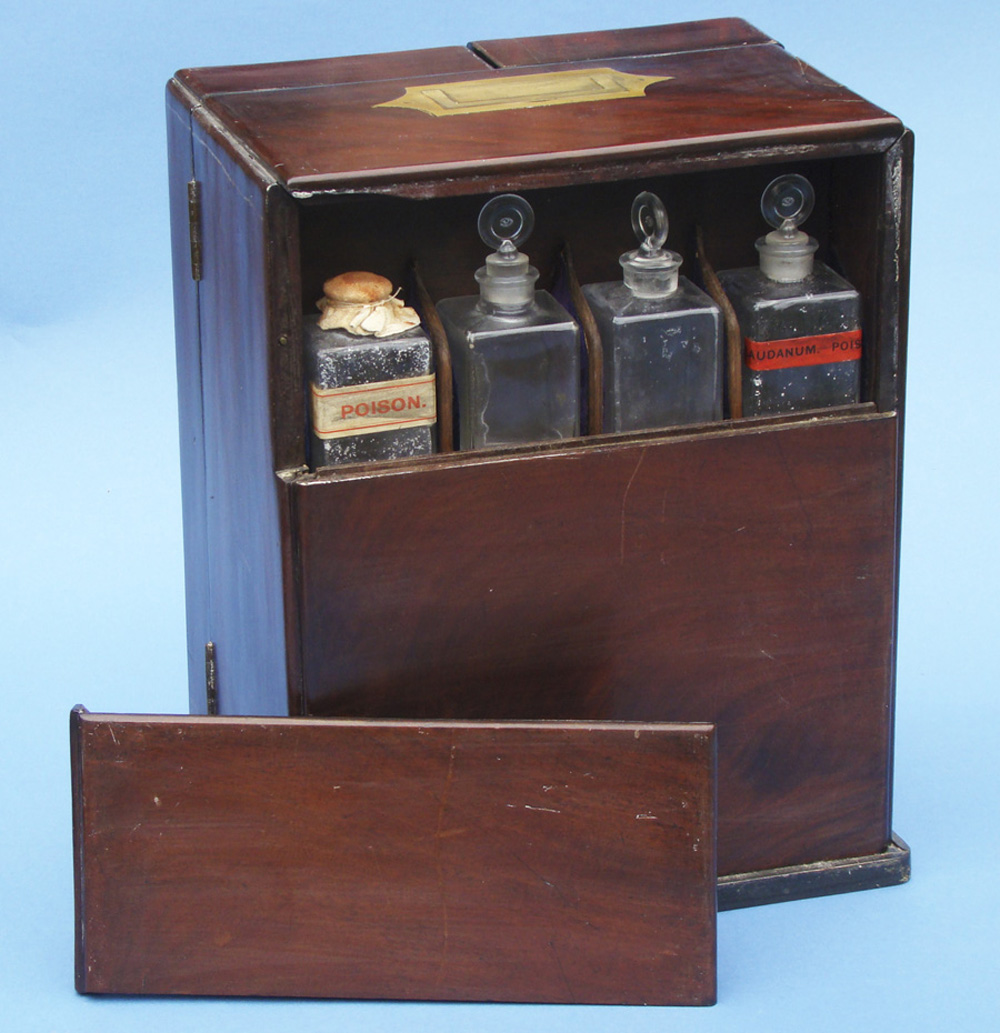
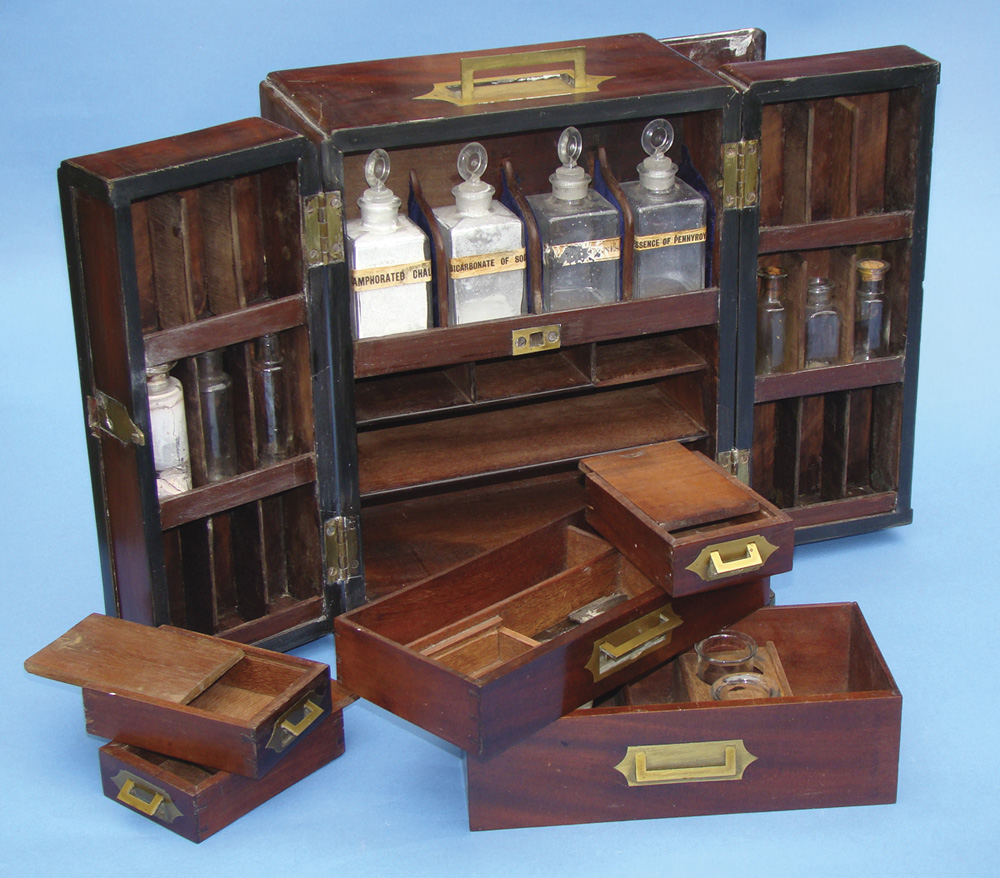
CUPBOARD-STYLE PORTABLE MEDICAL CHEST, English, c. second quarter 19th century. Measuring 12" x 9-5/8" x 7-3/8" (30 x 24 x 19 cm) overall, the chest is made of finely figured mahogany with lovely inlaid brass "campaign" hardware. The two doors open to reveal 22 bottle compartments, two large compartmented drawers (one with interior covered drawer), and three small dovetail-lidded drawers. It is equipped with a few glass bottles, two blown glass measures, porcelain mortar, and original key. To the rear is a large sliding cover revealing four "poison" compartments and their bottles. Condition is good noting some rubbing to the finish. This form of medicine chest was introduced in the early 19th c., and remained popular until late in the century (see Young, 1994, Antique Medicine Chests). A good example. (10603) $2200. |
| Precision Eyeglass Fitting in Louisiana | Click on any image for a larger view. Scroll to view more items. |
 |
 |
 |
|
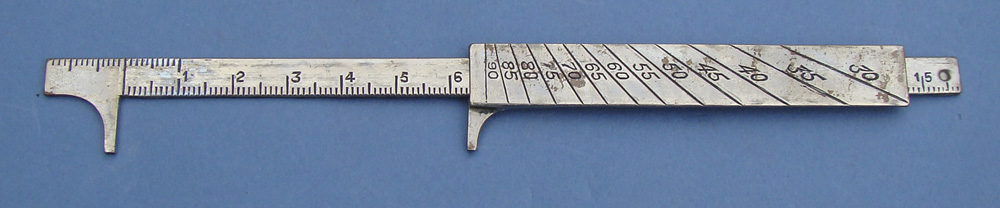
MILLARD'S FACE MEASURE, American, c. 1920, bearing 1903 and 1918 patent dates. Made of plated brass, 6-3/4" (17 cm) long, this is a combination linear rule, caliper and angle measure. Invented by Samuel B. Millard of New Orleans, Louisiana, its serves to measure interpupilary distance, as well as the width of the bridge of the nose, the distance between the back of the ear (or the bridge of the nose) and the eyelashes, the length of the temple, the height of the nose above the corner of eye, and the "crest angle" of the nose bridge. According to Millard, when opticians are fitting glasses, facial measurements "are frequently taken in a haphazard way," but with his invention they "may be taken with absolute accuracy." An uncommon anthropometric device, in very fine condition, complete with photocopies of the patents. (10583) $550. |
| The Grim Reality of War, in Three Dimensions | Click on any image for a larger view. Scroll to view more items. |
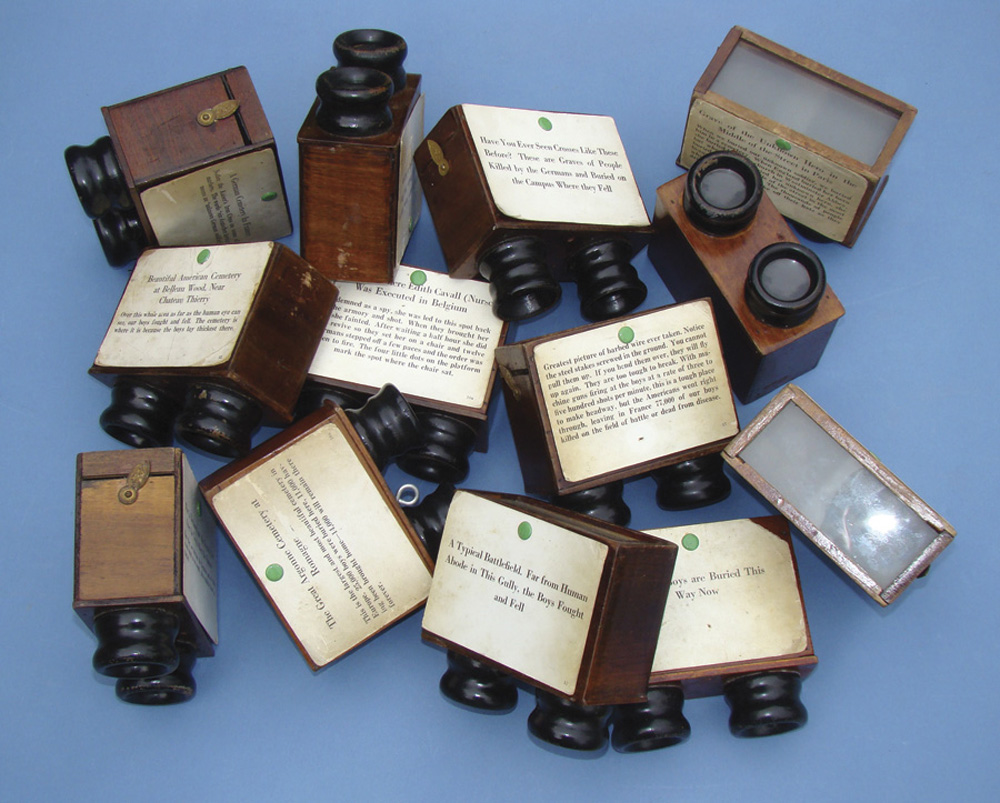 |
|
SET OF THIRTEEN WORLD WAR I STEREO VIEWERS, American, 1919, by Charles T. Buell & Co. Each fixed-focus viewer is 4-1/2" x 4-3/8" x 2" (11 x 11 x 5 cm) overall, with its rectangular varnished wood box, turned and blackened wood eyepiece surrounds, ground glass window, original insertable glass stereo view, brass latch, and printed descriptive card tacked atop. The views show scenes of loss in the trenches and fields of France, cemeteries there, etc. The descriptions are exceedingly patriotic. Condition is generally good, with signs of active use. This unusual set was undoubtedly made for viewing in the classroom or in public displays. Charles T. Buell & Co. is recorded in Newark, Ohio, in the early 20th century, and is listed as U.S. copyright holder of numerous images. By the late 1940's the firm claimed to have been builders of "Walk-Thru Shows," for 23 years, sold with their interchangeable frames, viewing boxes, and scenes, and with themes such as "What our Boys saw in Paris," and "Famous Prisons, Convicts and Torture Chambers of the World." (10573) $975/the set. |
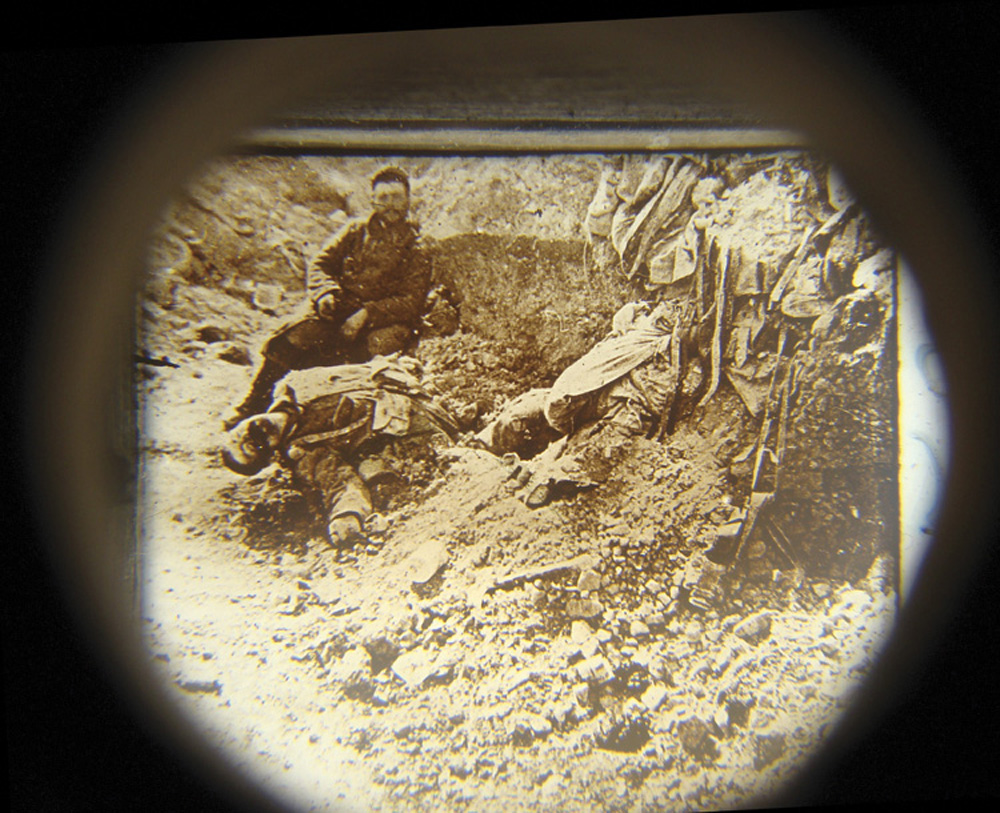 |
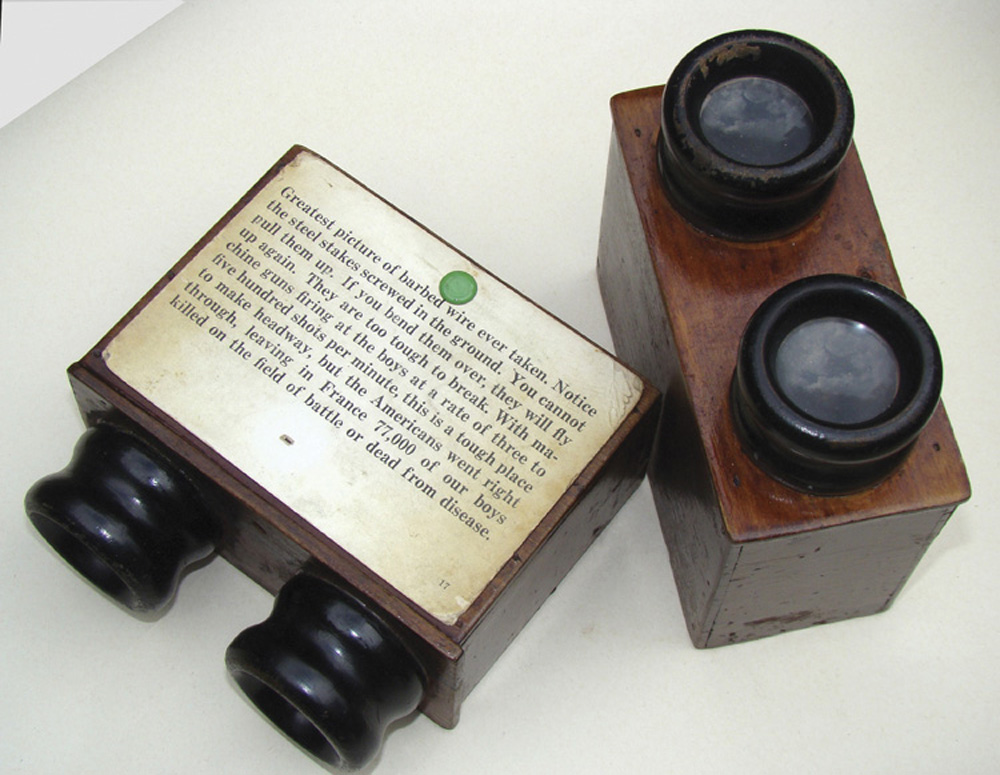 |
| The Eye in Eleven Parts, in Mixed Materials | Click on any image for a larger view. Scroll to view more items. |
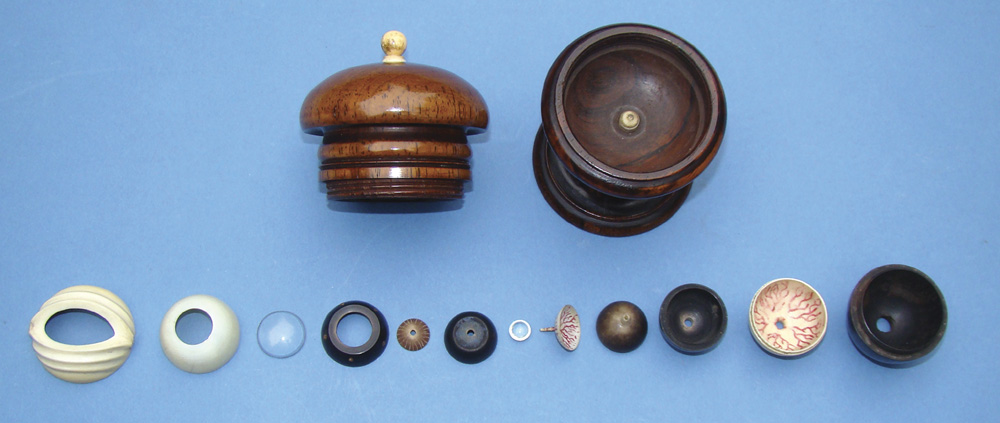 |
 |
 |
|
|
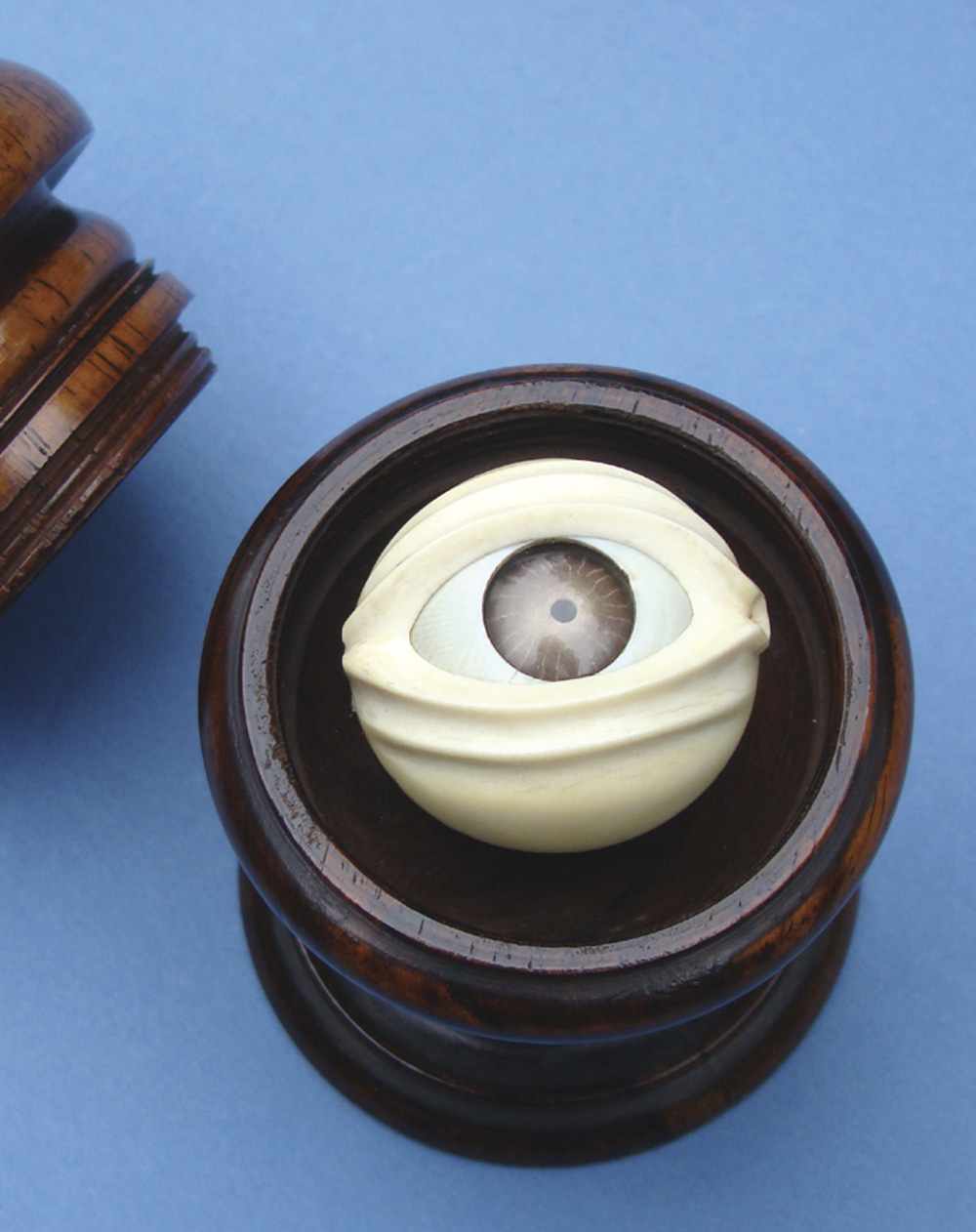
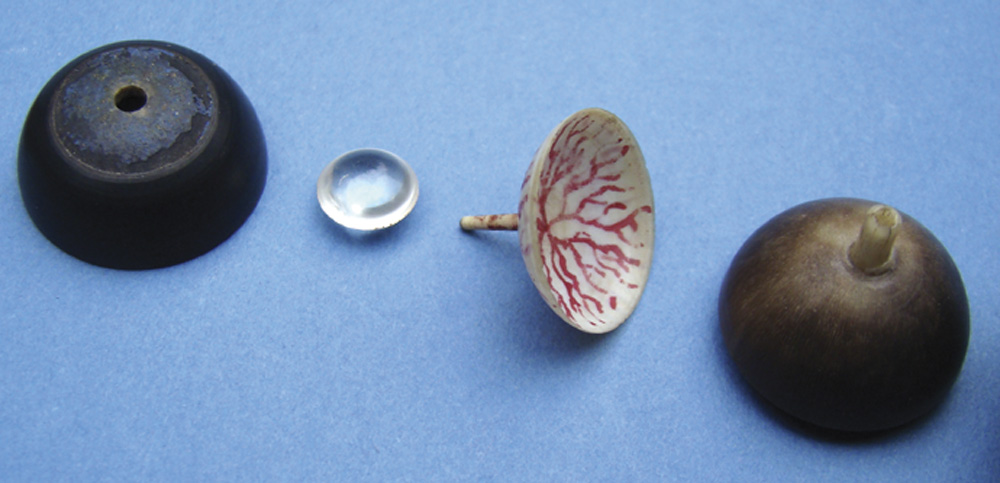
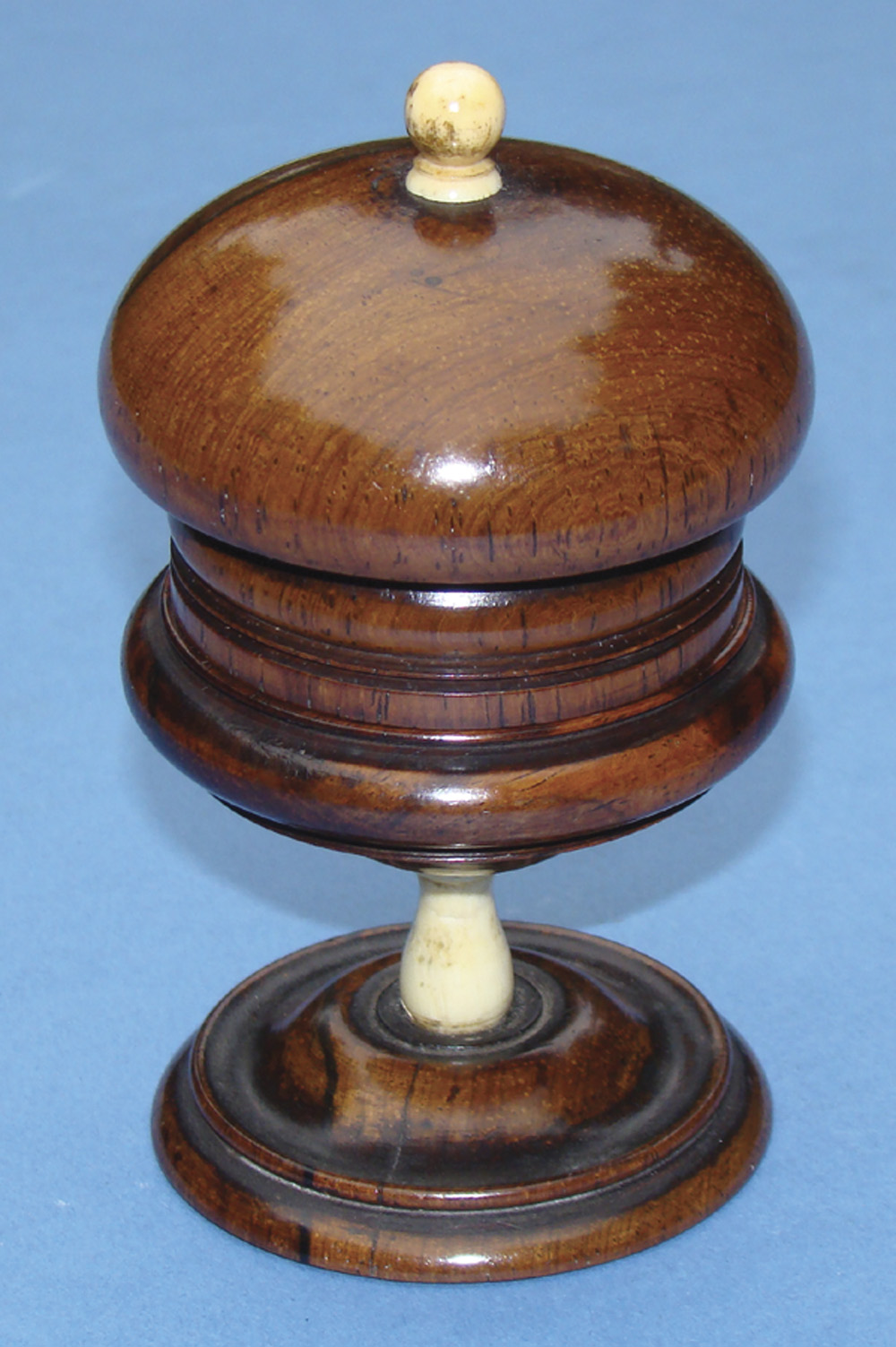
EXQUISITELY CRAFTED ANATOMICAL MODEL OF THE HUMAN EYE, Continental, probably German, c. mid-18th century. Standing 4" (10 cm) overall, the presentation case is made of beautifully grained wood, the lid, body, and base turned and mounted with ivory pillar and knob. The eye itself is made of the most finely crafted ivory, horn, wood, and glass. Some parts are so delicate one hesitates to touch them, yet they are all complete and undamaged, even the paper thin retina, with blood vessels shown appropriately in red. There are eleven elements to the eye, plus the wood cup which supports them in the stand. The eye seems complete (as we understand it) with cornea, iris, lens, scleral coat, choroid coat, retina, and optic nerve. A true "cabinet de curiosités" piece, most rare, in superb condition, it is a spectacular example of a very rare object. We have seen one other of this design in the marketplace in the past 30 years, that a less complete example which we sold in 1984 in our Catalogue F. We note a related form illustrated in Bennion's book (p.289), and two in the Museum for the history of medicine in Zurich. The craftsmanship is comparable to that of the small ivory anatomical models of the human body, also attributable to the tradition of Stephan Zick of Nuremberg. (9378) $18,500. |
| SOCIETY OF RADIOGRAPHERS | Click on any image for a larger view. Scroll to view more items. |
 |
|
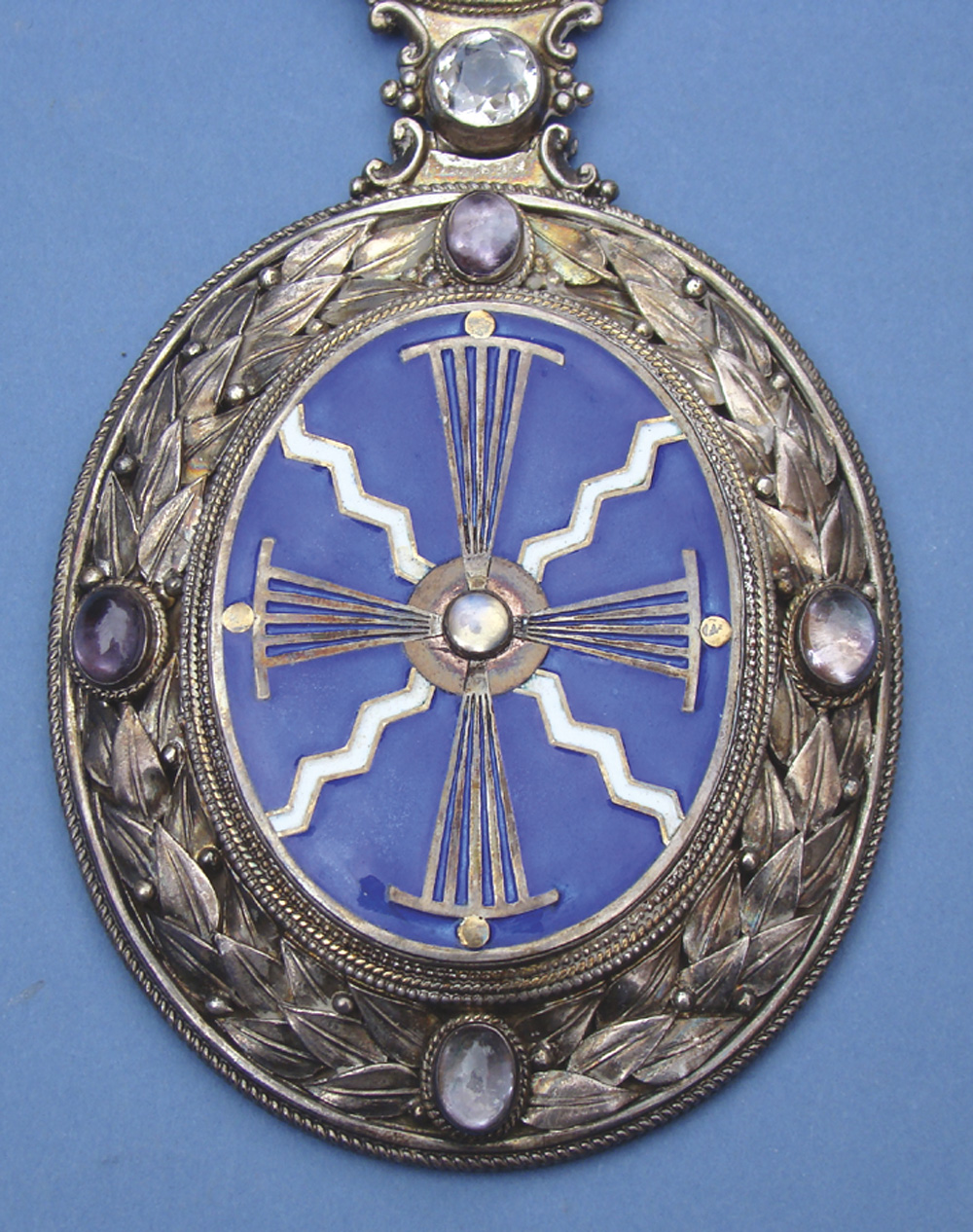
ENAMELED SILVER AND GOLD CHAIN OF OFFICE, English, 1935, engraved on the reverse "Presented by Leo A. Rowden M.B., C.M., February 1935." The 3-1/2" (9 cm) tall large oval pendant has a central blue and white enameled device with central stone and gold and silver inlay, surrounded by a silver wreath set with semi-precious stones. The reverse has a locket, and the pendant is suspended from a 1-1/2" diameter armorial in similar materials. This connects to two 8" long chains with scientists' names (Hauksbee, Faraday, Crookes, Thompson, Roentgen, Hittorf, Nollet, and Guericke) alternating with blue enameled panels, bearing symbolism suggestive of X-rays and their generation. The chains are connected by blue ribbon. This rare survival is complete and in excellent condition throughout. This impressive chain of office is for the Society of Radiographers, founded in 1920, open to those with at least ten years continuous employment in electro-therapeutic or X-ray departments. Examinations were required for admission. In 1921 there were 67 members, but by 1995, there were 13,500, and the Society continues today. We find records of Leo Rowden, the presenter of this chain; he advocated extensive use of X-rays for their ability to gauge internal dimensions with great accuracy: "Every woman should have her pelvic measures, accurately determined by radiography, engraved on the inside of her wedding-ring." (9388) $2950. |
 |
|
| Large Trade Sign, probably Brooklyn, 1920's | Click on any image for a larger view. Scroll to view more items. |
 |
|
DOUBLE SIDED OPTOMETRIST'S TRADE SIGN, American, early 20th century, lettered "Dr. Jerome Hoyt, Optometrist" on both sides in gold on black sand. With its rectangular wooden frame, it measures 43" x 12-1/2" x 1-5/8" (109 x 32 x 4 cm) overall, and is fitted with two large iron eyes for hanging. In good condition throughout, this is a fine example of the kind of trade sign hung along the streets of late 19th / early 20th century American cities. The optometrist was undoubtedly the Dr. Hoyt recorded in Brooklyn in the second quarter 20th century. Notably he was in charge of the optometry division of the United Hebrew Bikur Cholim Welfare Association in Brooklyn, and served as a member of the executive board of directors of the Brooklyn Optometric Society. (9379) $850. |
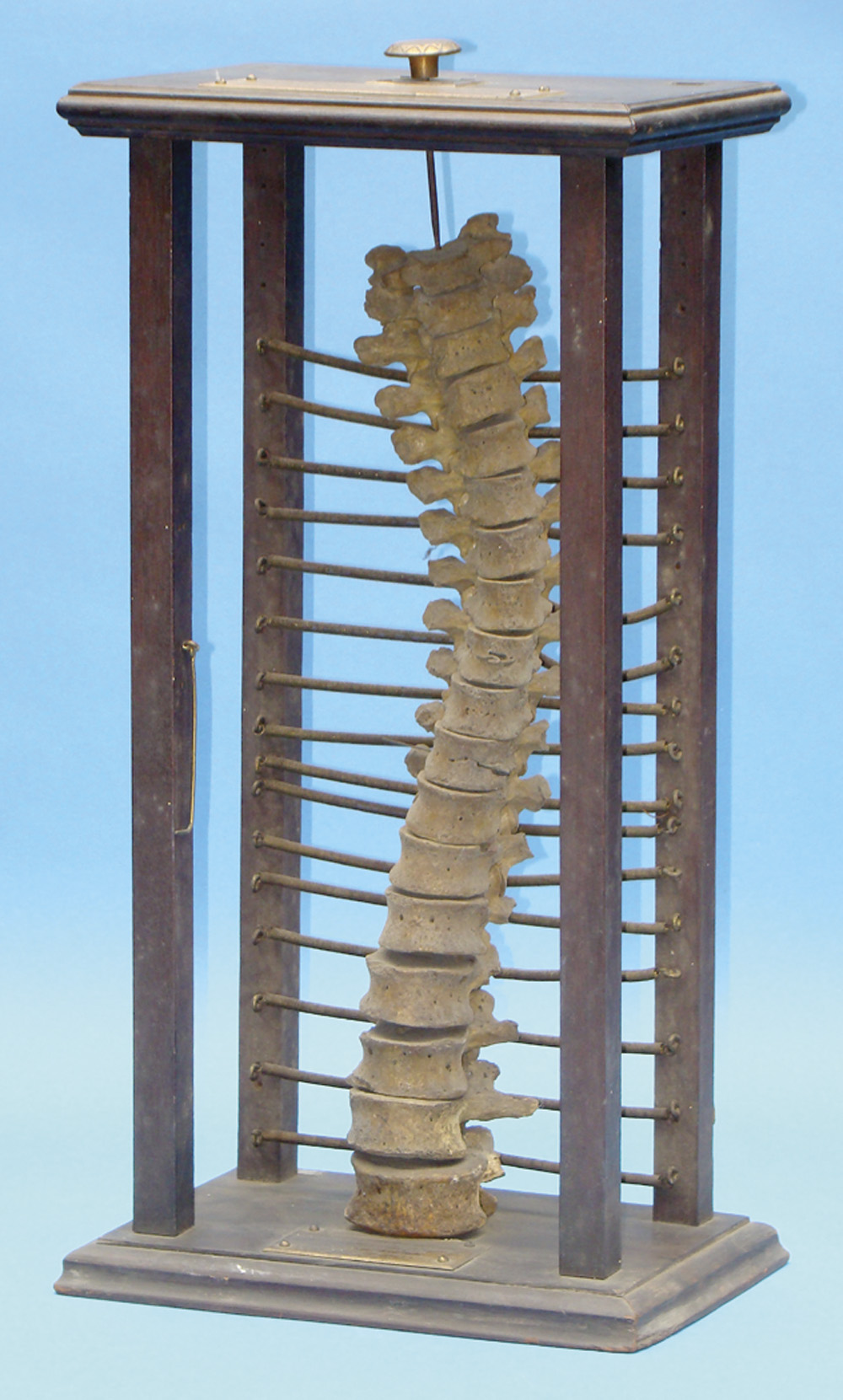
| The Human Spine in Motion | Click on any image for a larger view. Scroll to view more items. |
 |
|
 |
|
| "Glad Tidings for all Men & Women" | Click on any image for a larger view. Scroll to view more items. |
 |
 |
|
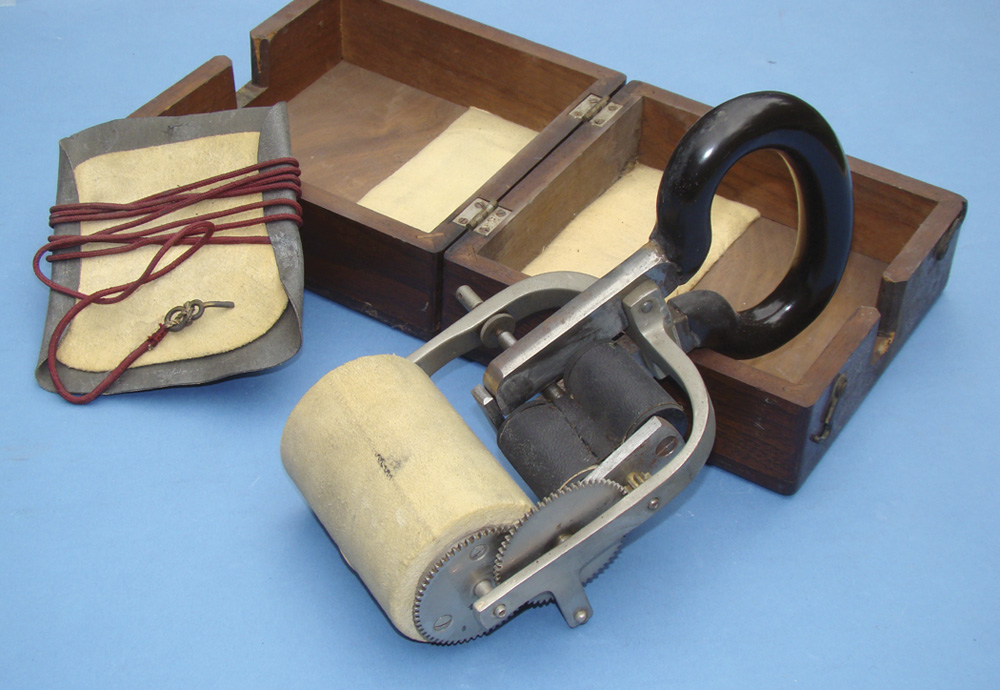
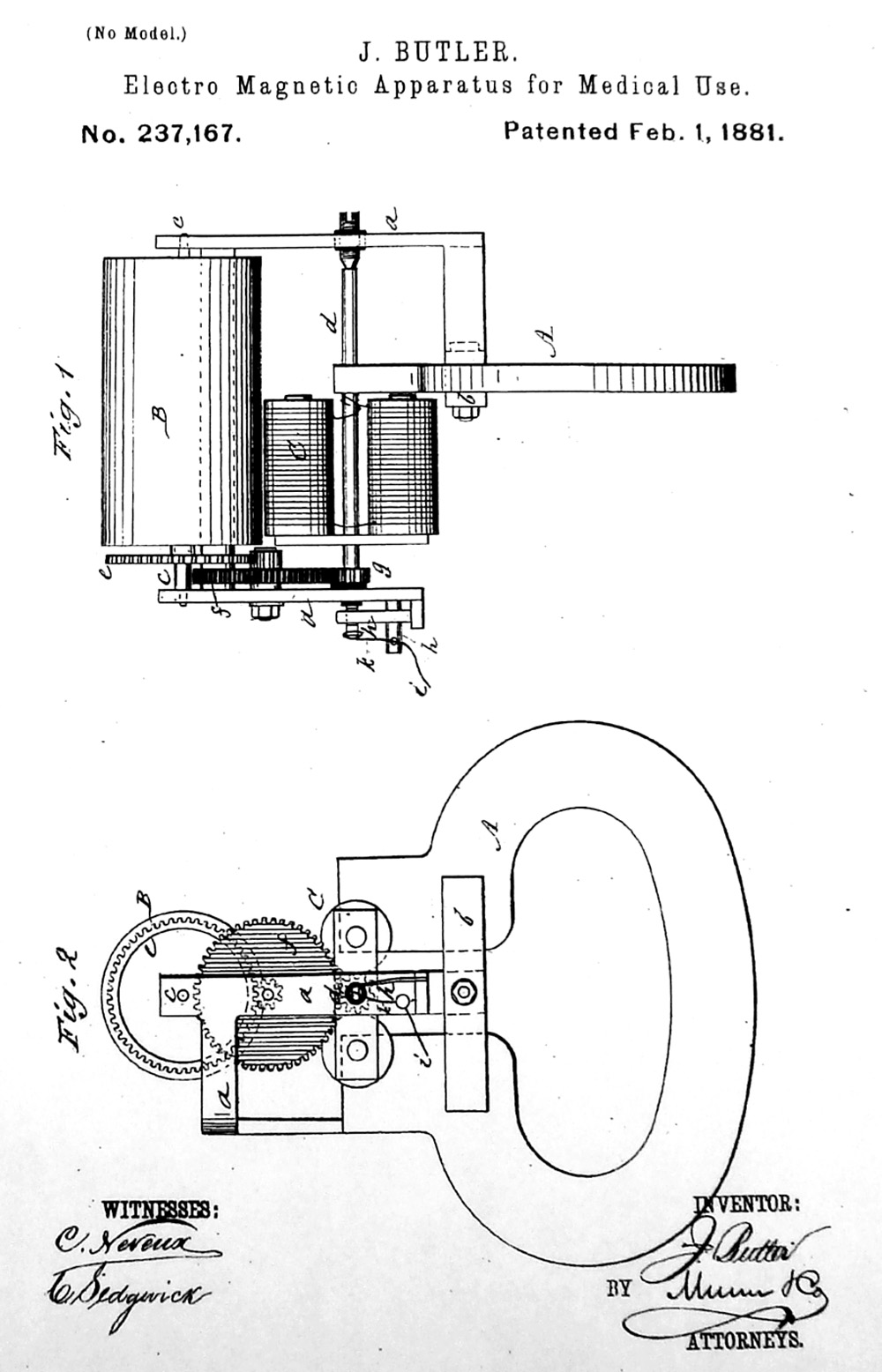
DR. JOHN BUTLER'S ELECTRO-MASSAGER, American, c. 1885, stamped "Pat¹d. Feb 1, 81." Measuring 8-5/8" (22 cm) in overall length, this hand powered device combines physical massage with the benefits of electro-therapy. Constructed of plated brass and iron, it has a chamois-covered cylindrical massage roller which drives, through approximately 23:1 gearing, an electromagnet's double coil against a permanent magnet. The handle, coated in hard rubber, is in fact the large permanent magnet. The roller, when moistened, is one electrode in contact with the skin; the other is a flexible pad with chamois lining and electric wire connection. The whole is in fine condition, complete with the original carrying case. Dr. Butler's innovative combined massager/stimulator was advertised as "The Greatest Medical Discovery Ever Known," bringing "Glad Tidings for all Men & Women." Apparently manufactured by the Dynamo-Electric Mfg. Co., at 907 Broadway, New York City, it did have the advantage of no messy liquid battery. Butler was granted U.S. Patent 237,167; we include a photocopy with his unusual device. (9409) $1650. |
| "The Adjuster" -- an 1843 American Invention | Click on any image for a larger view. Scroll to view more items. |
 |
|
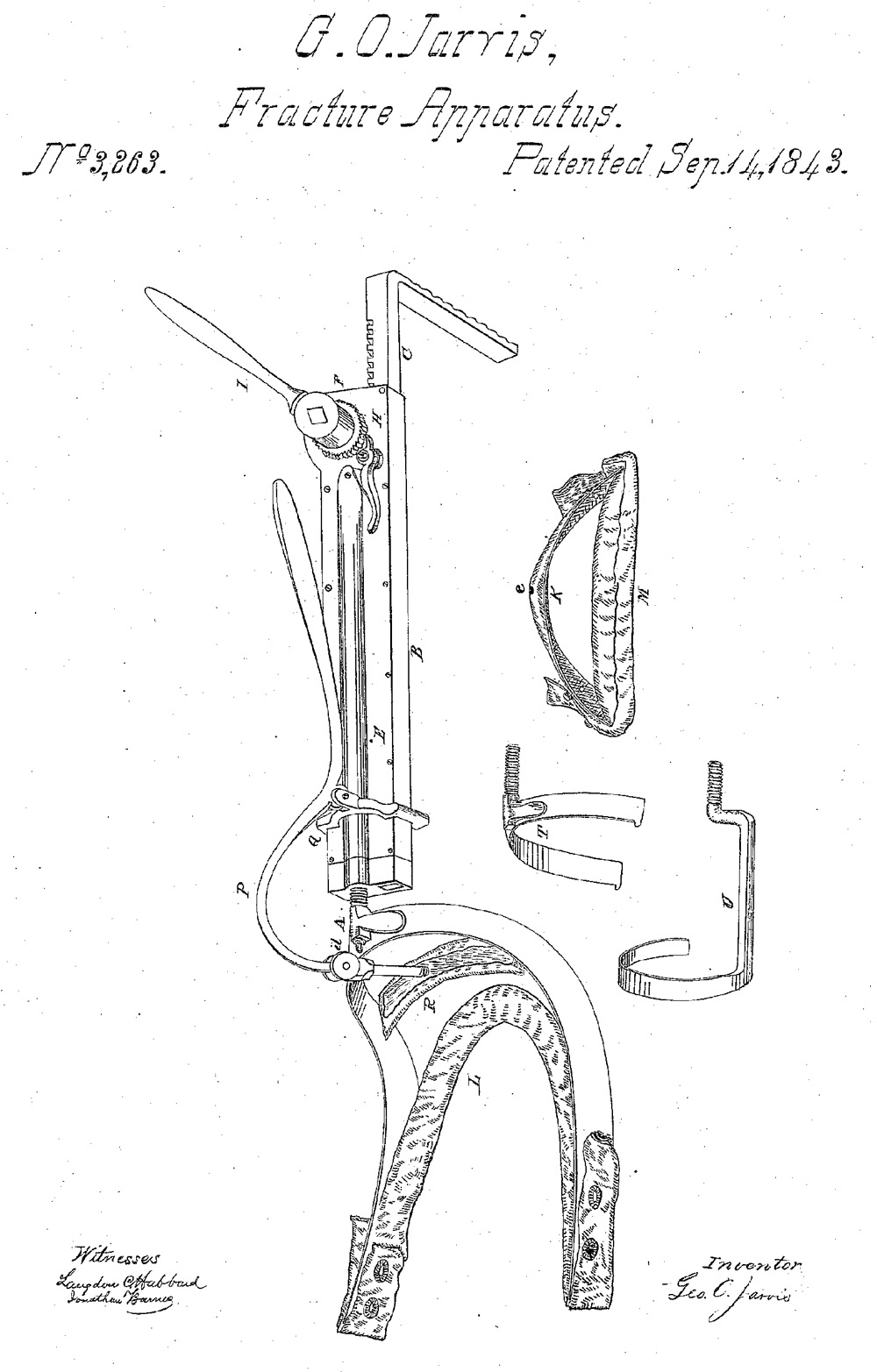
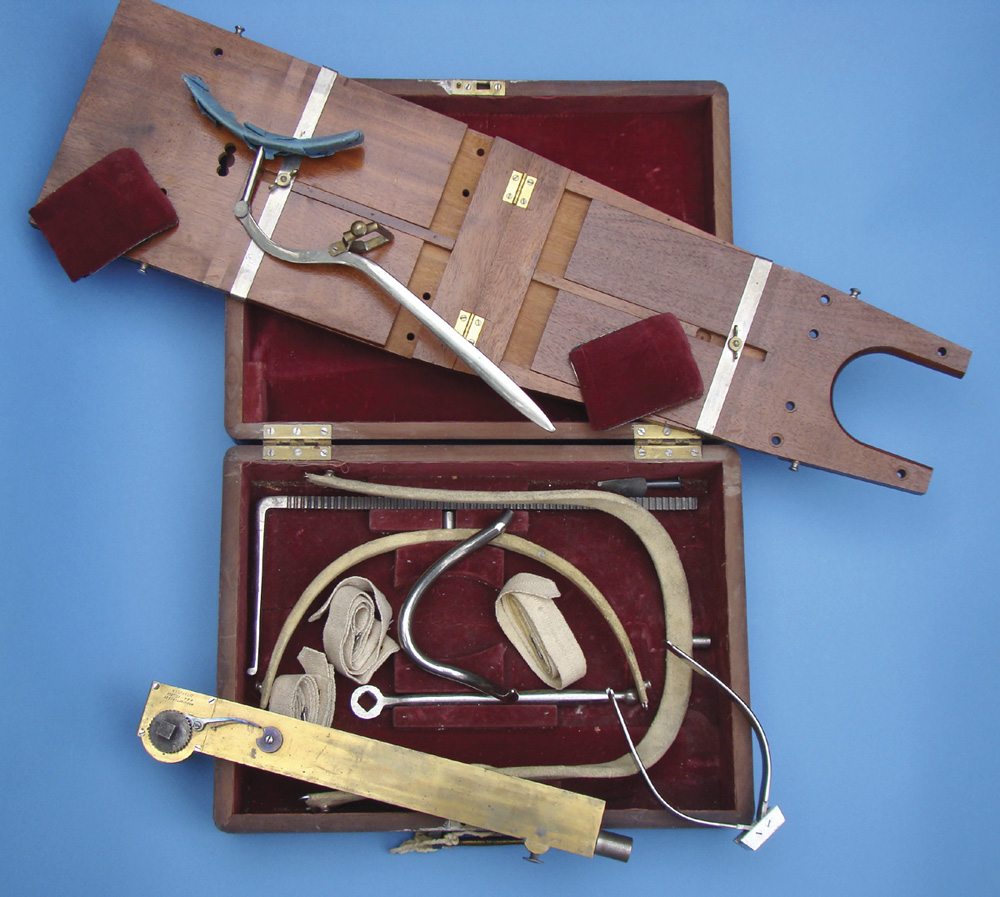
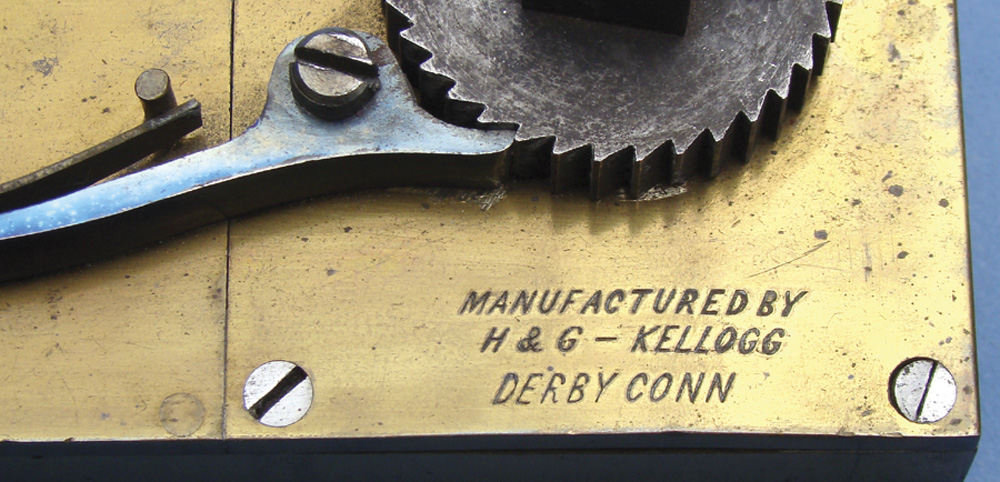
EARLY AMERICAN ORTHOPEDIC OUTFIT FOR REDUCING DISLOCATIONS AND FRACTURES, c. 1845, signed "Manufactured by H. & G. Kellogg, Derby, Conn." Contained in the 15" (38 cm) wide walnut carrying case is a complete traction outfit, with folding doubly-expandable wood splint, various supports and clamps in polished steel some with chamois leather bindings, canvas straps, and the fine 13-3/4" long (minimum) ratcheting mechanism in lacquered brass and steel. It is all of high quality craftsmanship and in fine condition throughout. Patented 14 September 1843, by Dr. Jarvis of Portland, Connecticut, this elaborate invention was an early American patent (#3263). Jarvis claimed to "have invented a new and useful machine or instrument for the purpose of producing the extension, counter-extension, and transverse or lateral motion necessary to reduce fractures and dislocations of bones and of maintaining a just coadaption of the fractured ends of bones during the process of reunion....I denominate the said machine 'the adjuster.'" A rare American orthopedic contraption, complete with a photocopy of the patent. (9408) $4500. |
 |
|
| Complex Anthropometry | Click on any image for a larger view. Scroll to view more items. |
 |
 |
|
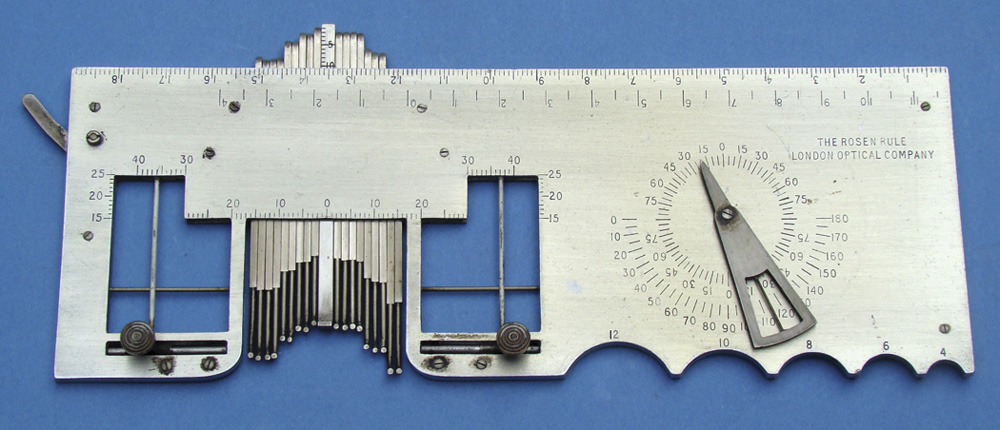
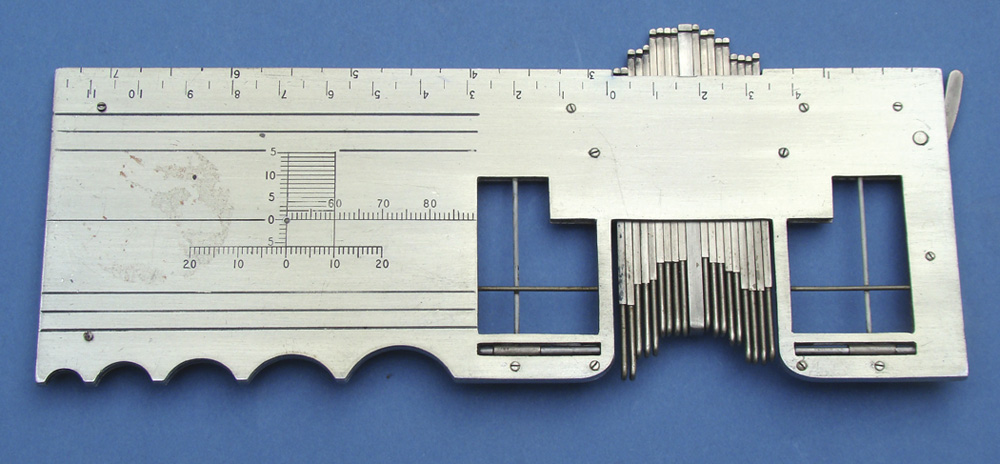
"THE ROSEN RULE" FOR OPTICIANS, English, c. early 20th century, signed "London Optical Company," the 7-1/2" (19 cm) long two-sided aluminum rule with a complex array of scales and devices for quantitative fitting of eyeglasses. Nineteen sliding, clampable rods conform to the shape of the nose, and adjustable targets align with the centers of the pupils; a rotating index provides degree conversions, plus there are quantized arcs, linear scales, etc. This unusual rule is in very fine condition. It is sufficiently rare that we have found no other trace of one. (9429) $650. |
| Straightforward Removals | Click on any image for a larger view. Scroll to view more items. |
 |
|
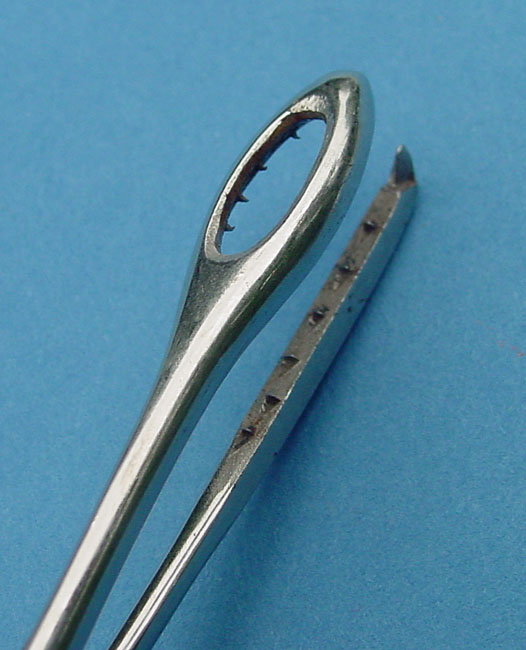
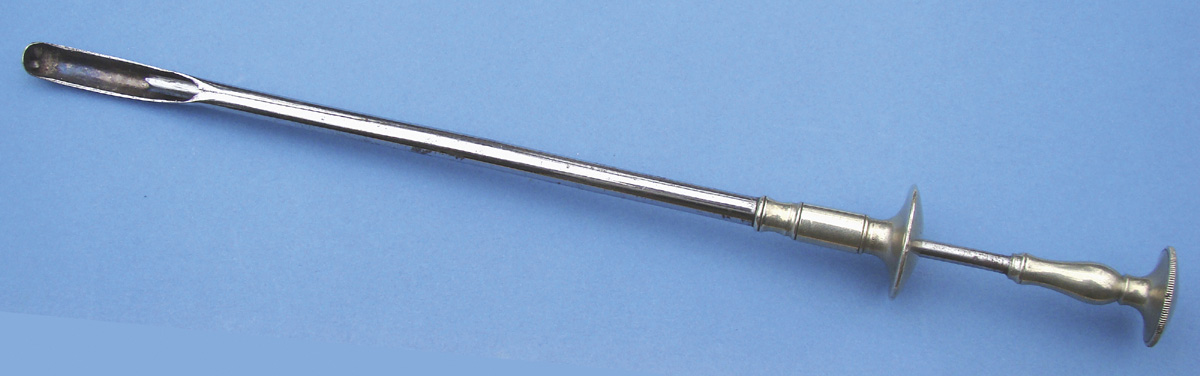
BULLET EXTRACTOR, English, c. third quarter 19th century, unsigned but attributable to Coxeter of London. Measuring 9-1/2" (24 cm) overall (closed), the extractor has a polished steel probe / scoop, with opposable toothed shaft for securing the bullet. Using the finger pulls made of a fine alloy, one withdraws the shaft, inserts the probe into the wound until the bullet is touched and then surrounded by the spiked scoop, and finally squeezes the spiked shaft closed against the bullet and withdraws the instrument. Condition is fine noting a little rust spotting. We have had one other example of this form, that one by Coxeter "Inventor & Maker" (Tesseract Cat 28, Item 63). Longmore illustrates and describes the instrument in his book "Gunshot Injuries," and explains that it was much used during the Crimean War of the 1850's. (9456) $850. |
| Handsome American Eye-Testing Instrument | Click on any image for a larger view. Scroll to view more items. |
 |
|
|
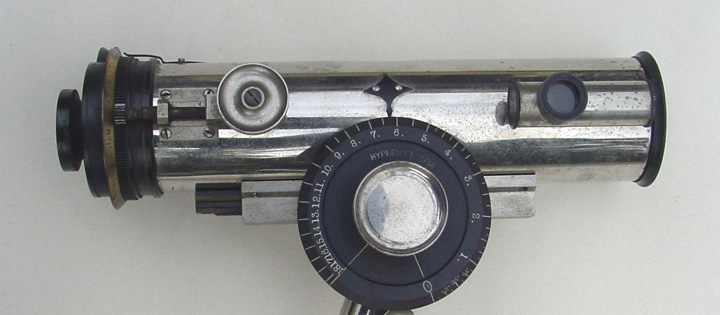
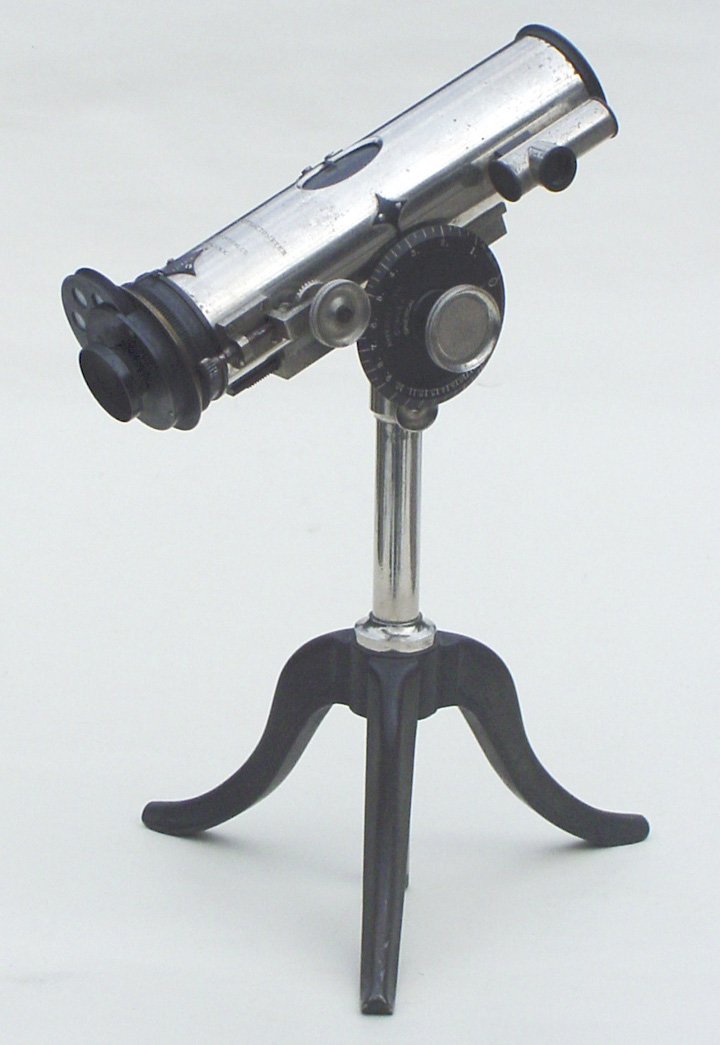
DE ZENG'S REFRACTOMETER, American, late 19th century, signed on the main tube "De Zeng's Refractometer, Cataract Optical Co., Buffalo, N.Y." This rare and complex eye-testing device has a particularly graceful design, standing 12-1/2" (32 cm) overall (extending to 20-1/2" (52 cm) by drawtube) on the cast iron tripod base. It is constructed of both plated and blackened brass, and nickel silver, and incorporates internal racked lens tube with calibrated Myopia/Hypermetropia thumbwheel, twin wheels of corrective lenses on a rotatable assembly driven by conical pinion and ring gear, and external sight, the whole instrument on tiltable mount. Condition is very fine. An unusual form of ophthalmic device, not listed in the standard references. (7494) $2400. |
| From the Luer Firm's Exhibition Collection | Click on any image for a larger view. Scroll to view more items. |
 |
|
|
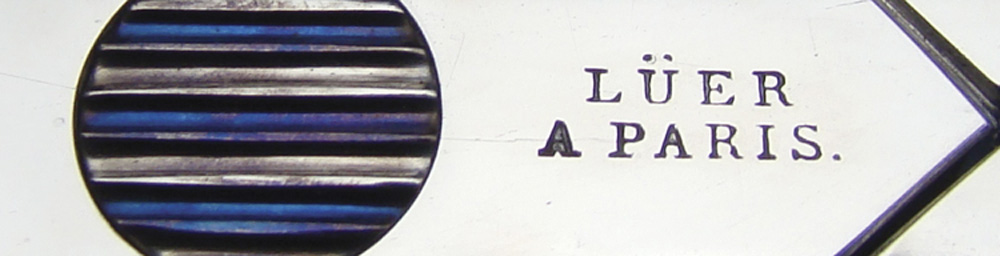
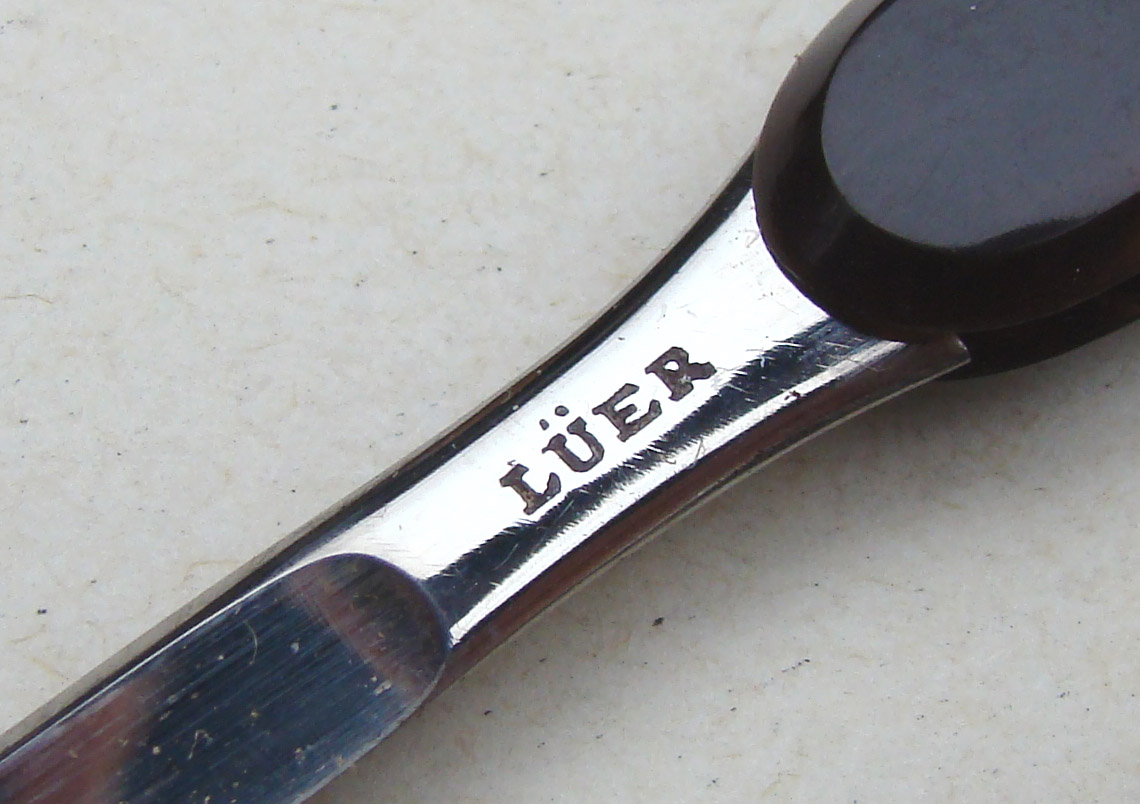
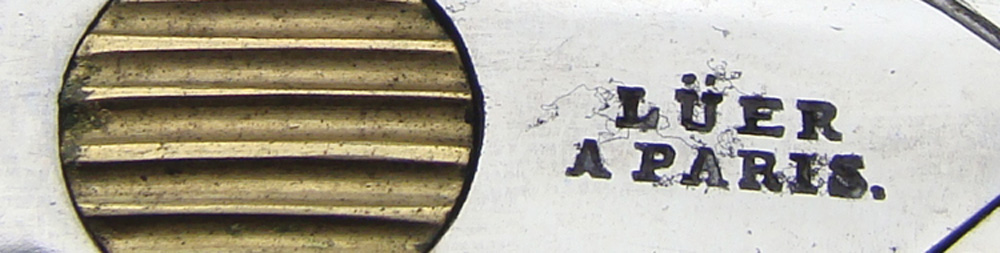
SET OF EXHIBITION QUALITY ORTHOPEDIC SURGICAL TOOLS, French, third quarter 19th century, all nine pieces signed "Lüer" or "Lüer à Paris." Lengths range from 6" to 8-1/2" (15 - 22 cm), and both quality and condition are remarkable. There are four snips in polished steel with beautifully feather-ridged locking handles and with springs and fittings of blued and gilt steel. The snips are spring loaded, with automatic locking hinge activated by the same spring; the sharp curved blades mate exactly. In addition there are four polished steel knives or scalpels, with handles of laminated ivory and steel, as well as a slim ivory-handled saw. Condition throughout is superb, as new. There is no case, as with most of the Lüer exhibition items, which may have been originally displayed on panels. These instruments came to us by descent from the original collection of exhibition pieces made and held by the Lüer firm, being their finest productions, shown at the great national and international exhibitions of the 19th century. We have been fortunate to have handled several of their exhibition items. all of which present as substantial, beautiful, sculptural objects. We note the luxation device for dislocated fingers (Tesseract Catalogue 82 Item 38), the bullet extractor (82/39,), and their exhibition tourniquet (84/38). (10422) $3200./the set |
 |
|
| Electricity to Cure Everything | Click on any image for a larger view. Scroll to view more items. |
 |
|
|
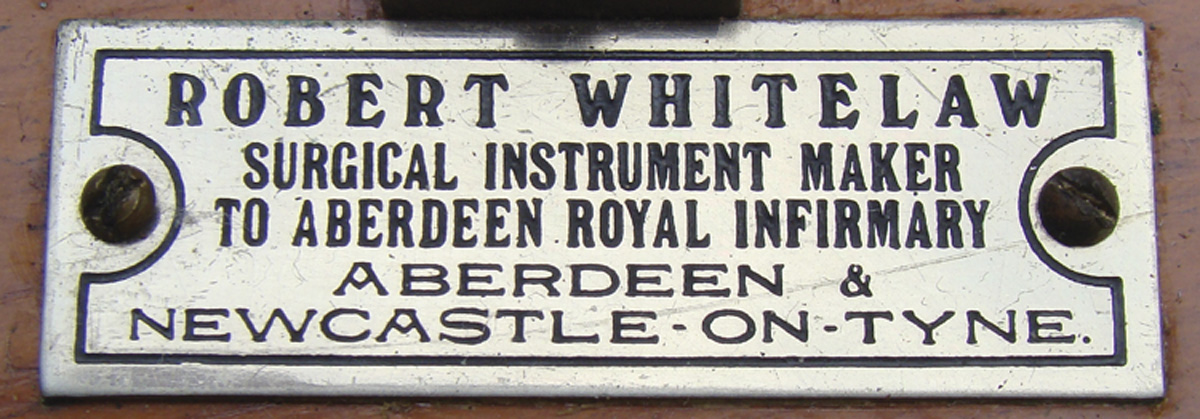
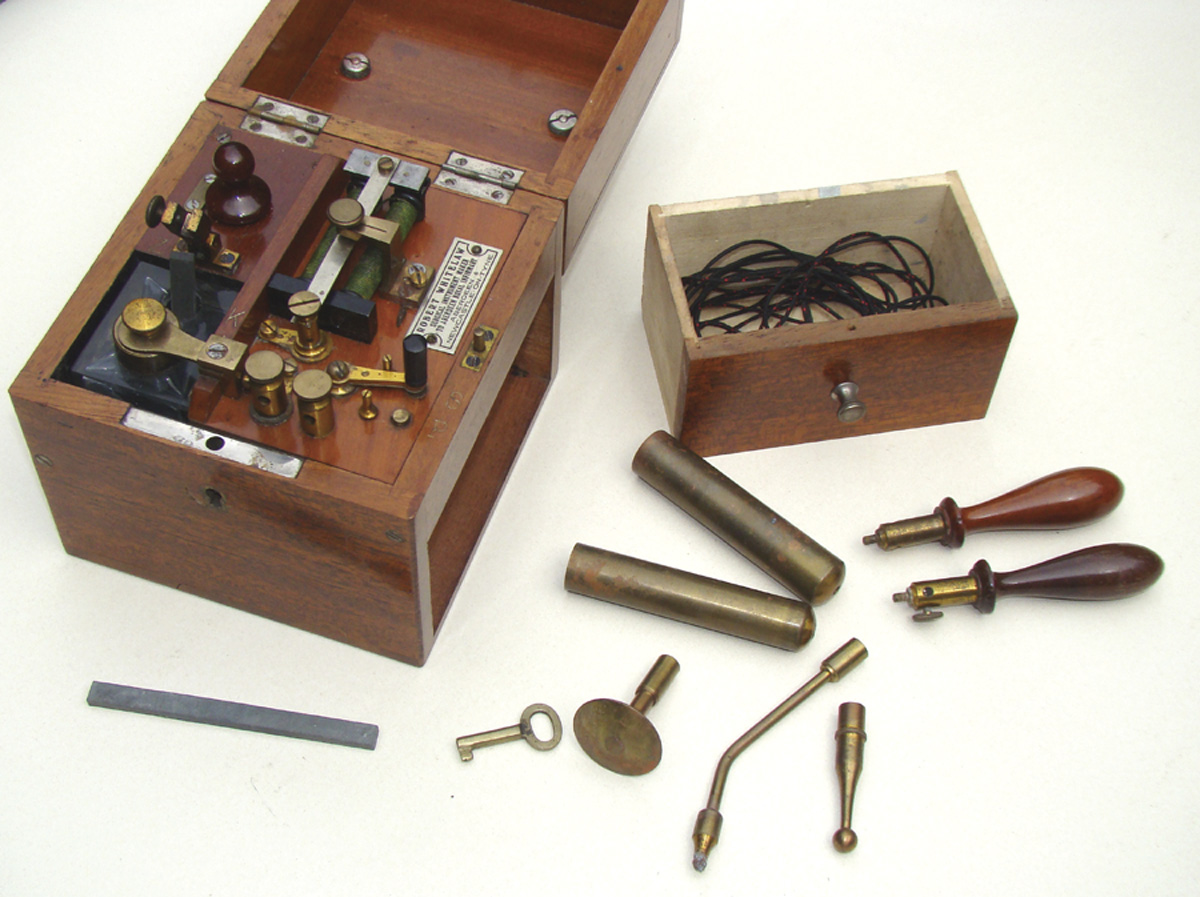
FINE PORTABLE ELECTRO-MEDICAL OUTFIT, Scottish, c. early 20th century, signed on a plaque "Robert Whitelaw, Surgical Instrument Maker to Aberdeen Royal Infirmary, Aberdeen & Newcastle-on-Tyne." The outfit is housed in a cubical case of beautifully grained mahogany, 5" (13 cm) on a side, with plated carrying handle and self-latching side drawer. This compact device incorporates a rectangular molded and cut glass carbon / zinc voltaic cell, adjustable coil, vibrator, switch, and lacquered brass fittings and terminals. Accessories include connection wires, mahogany-handled applicators with choice of five shaped brass electrodes, spare carbon rod, and case key. Condition is fine. (9466) $595. |
| The Bleeding Arts | Click on any image for a larger view. Scroll to view more items. |
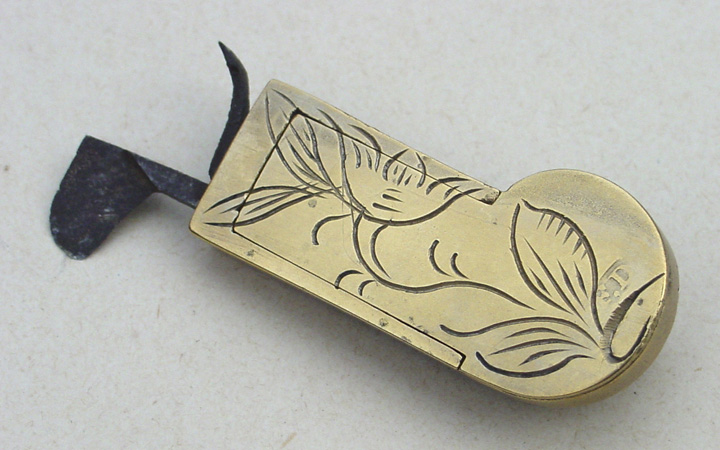 |
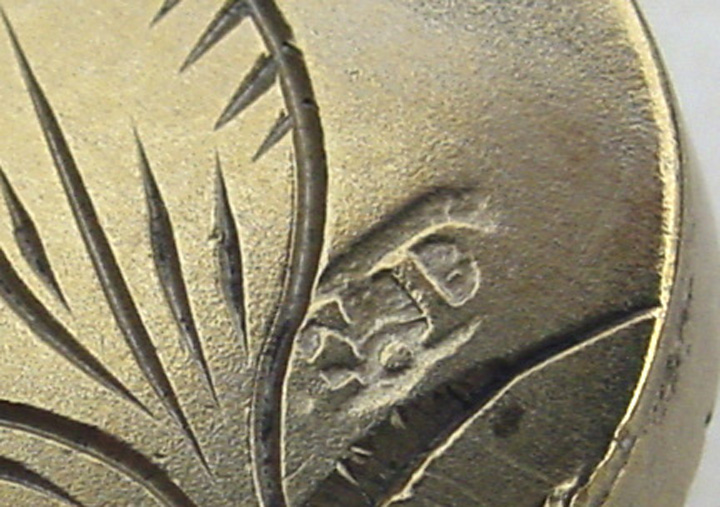
FLORAL DECORATED SPRING FLEAM, c. early 19th century, stamped "F.D." outside and engraved "XV" inside. This attractively decorated bleeding device is made of brass with shaped steel blade, spiral cocking spring, and spring-loaded trigger release. Measuring 2-1/4" (5.7 cm) overall, it is in fine functional condition, noting some surface oxidation to the steel. (7544) $750. |
 |
|
| Phlebotomy Outfit c. 1870, in as-new Condition | Click on any image for a larger view. Scroll to view more items. |
 |
|
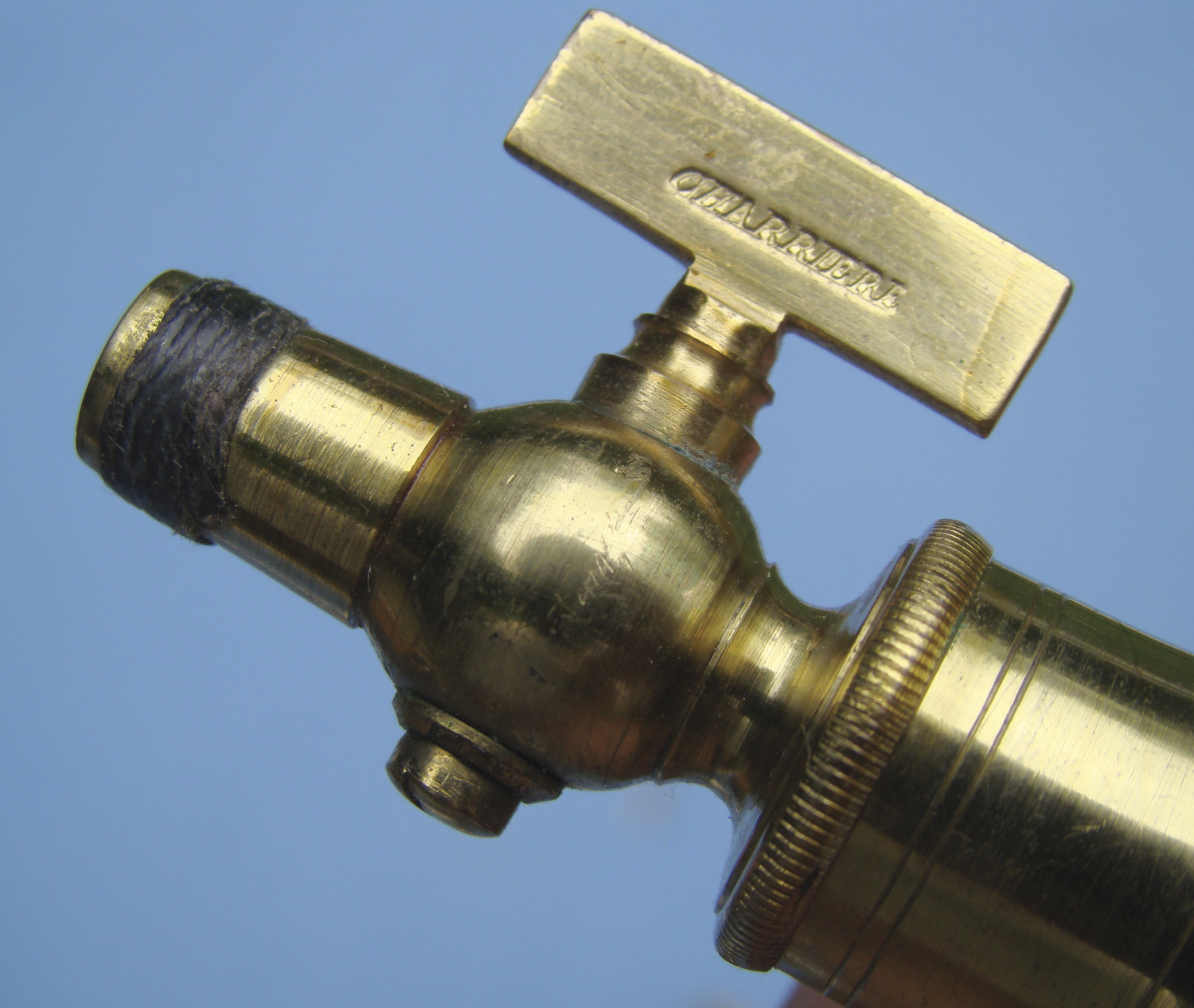
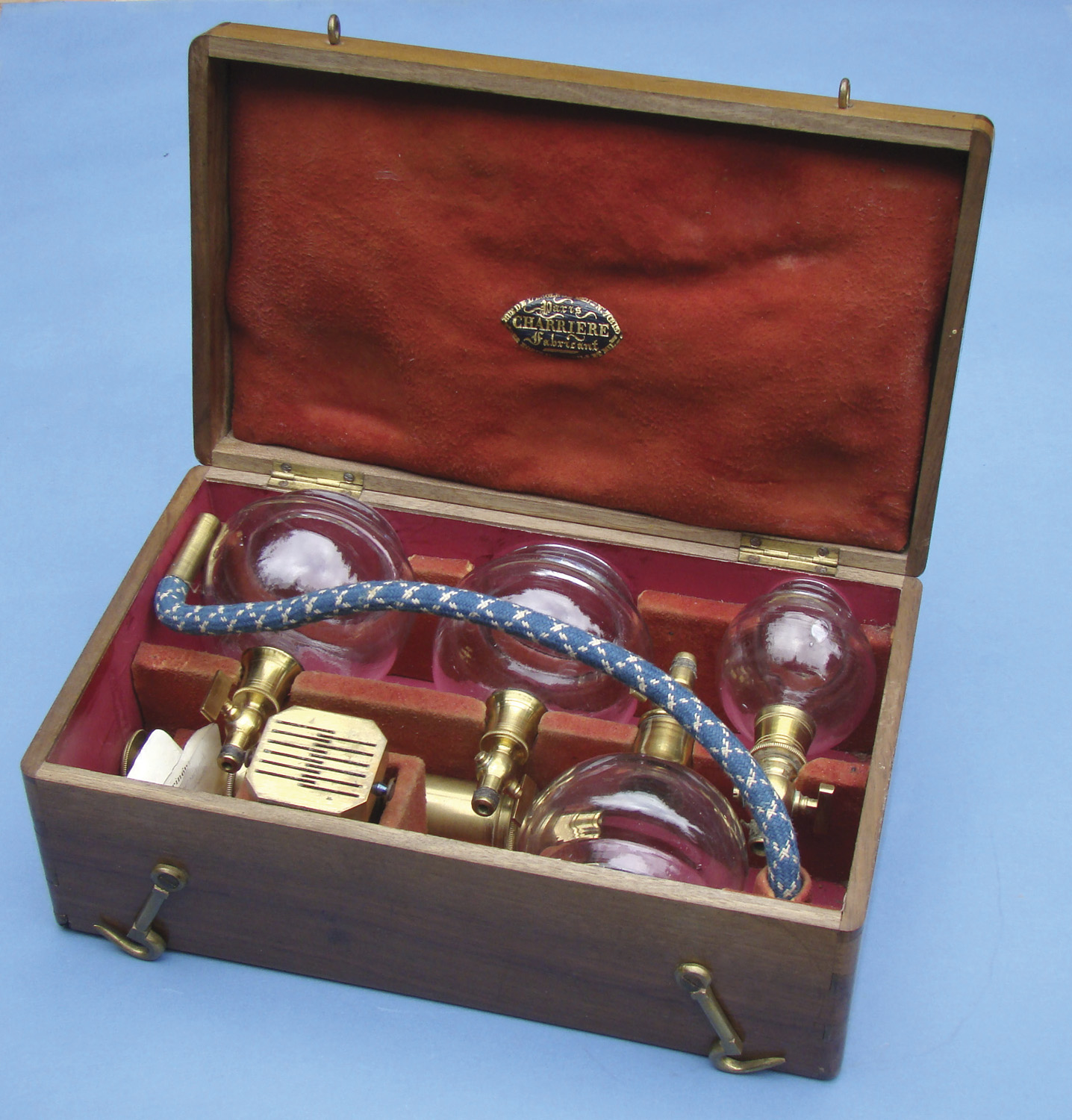
EXCEPTIONAL BLEEDING SET, French, c. third quarter 19th century, by the famous Charrière of Paris. The original trade label describes Charrière, at 7 bis rue de l'Ecole de Médecine, as designated "Maker to the Civil and Military Hospitals." The set contains 12-bladed scarificator with lacquered brass body, syringe, four blown glass bleeding cups each with syringe fitting and stopcock, and flexible cloth-bound extension hose mounting between syringe and cup. Included is even the little printed instruction sheet for maintenance and lubrication of the syringe, with its improved "Piston à double parachutes," apparently double seals to enable the strongest suction of the piston. The cups have different sizes and shapes, one even oval. We find very similar devices illustrated in a Charrière 1867 catalogue. All is contained in the original fitted case, 10-1/2" x 6-1/4" x 4-1/4" (27 x 16 x 11 cm) of finely figured French walnut (?). Condition-wise this is the best cupping set we have seen on the market, complete, with no replacements and in perfect almost new condition. (10391) $3500. |
 |
|
| Manual Nursing | Click on any image for a larger view. Scroll to view more items. |
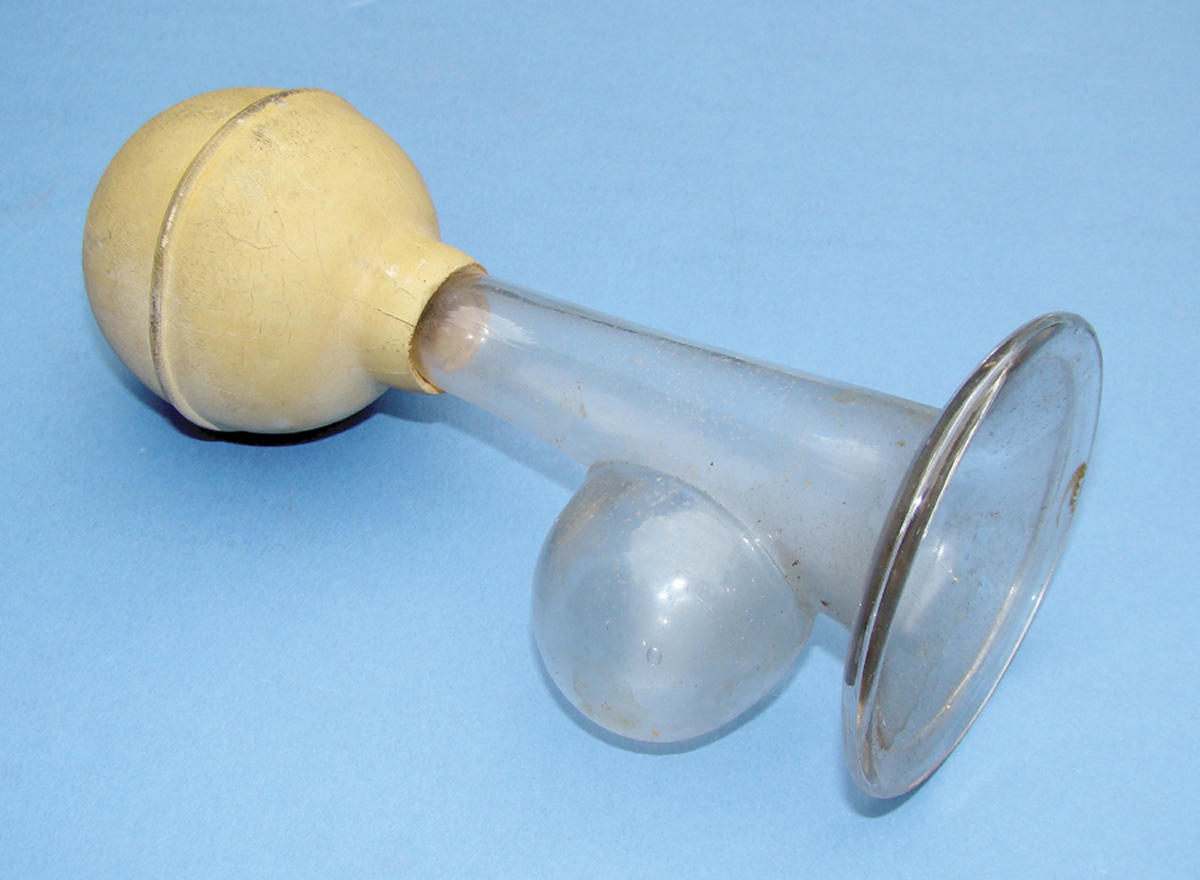 |
MANUAL BREAST PUMP, American or English, c. second quarter 20th century, measuring 5-3/4" (15 cm) overall. The hand-blown glass body has a flared conical shape, with bulbous reservoir to one side, and is fitted with a now-quite-hard rubber bulb. Designed expressly to stimulate milk production, and to collect breast milk for bottle feeding, the pump is in fine condition. (9476) $95. |
| 23 Exhibition Instruments of Minor Surgery | Click on any image for a larger view. Scroll to view more items. |
 |
|
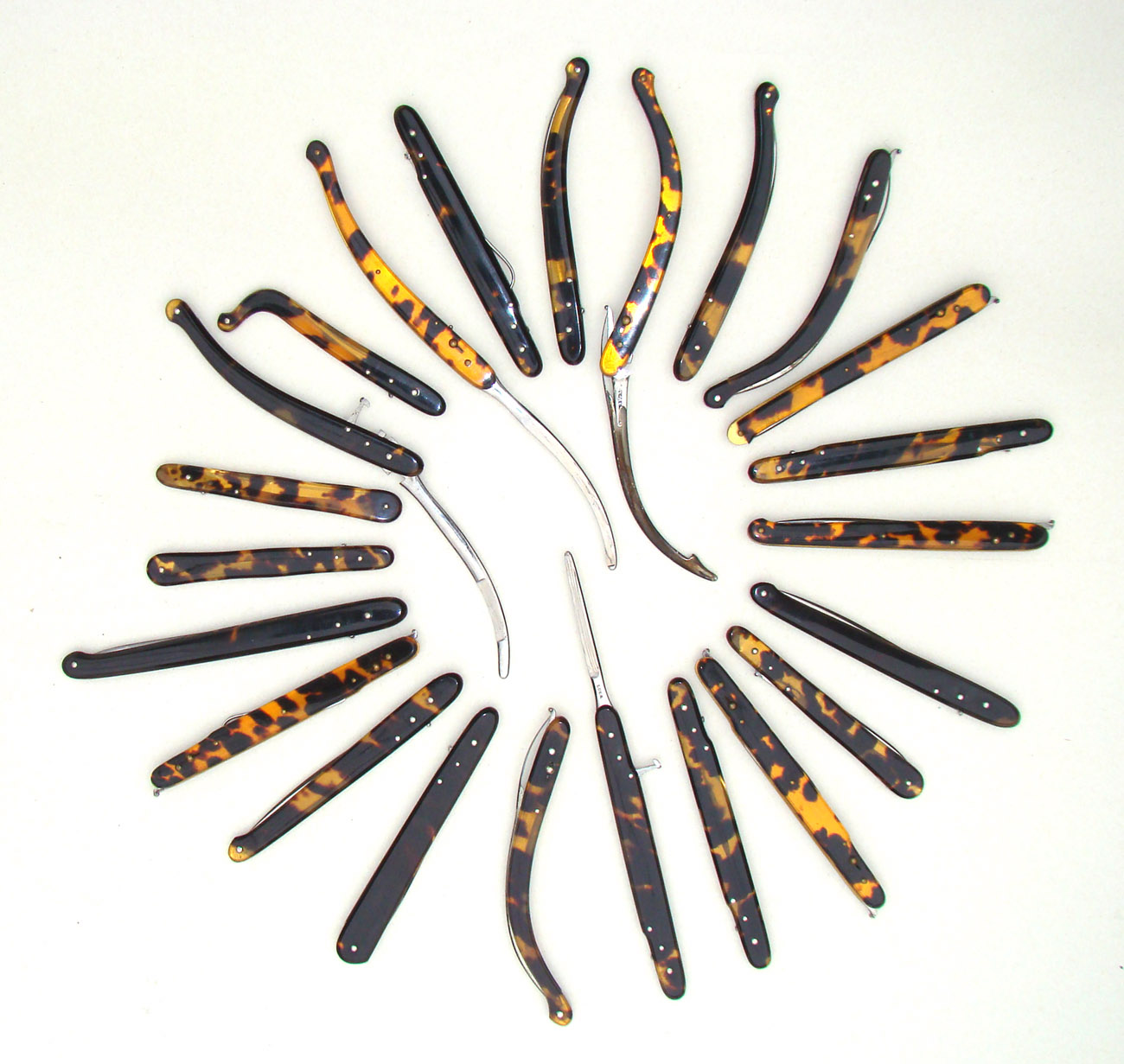
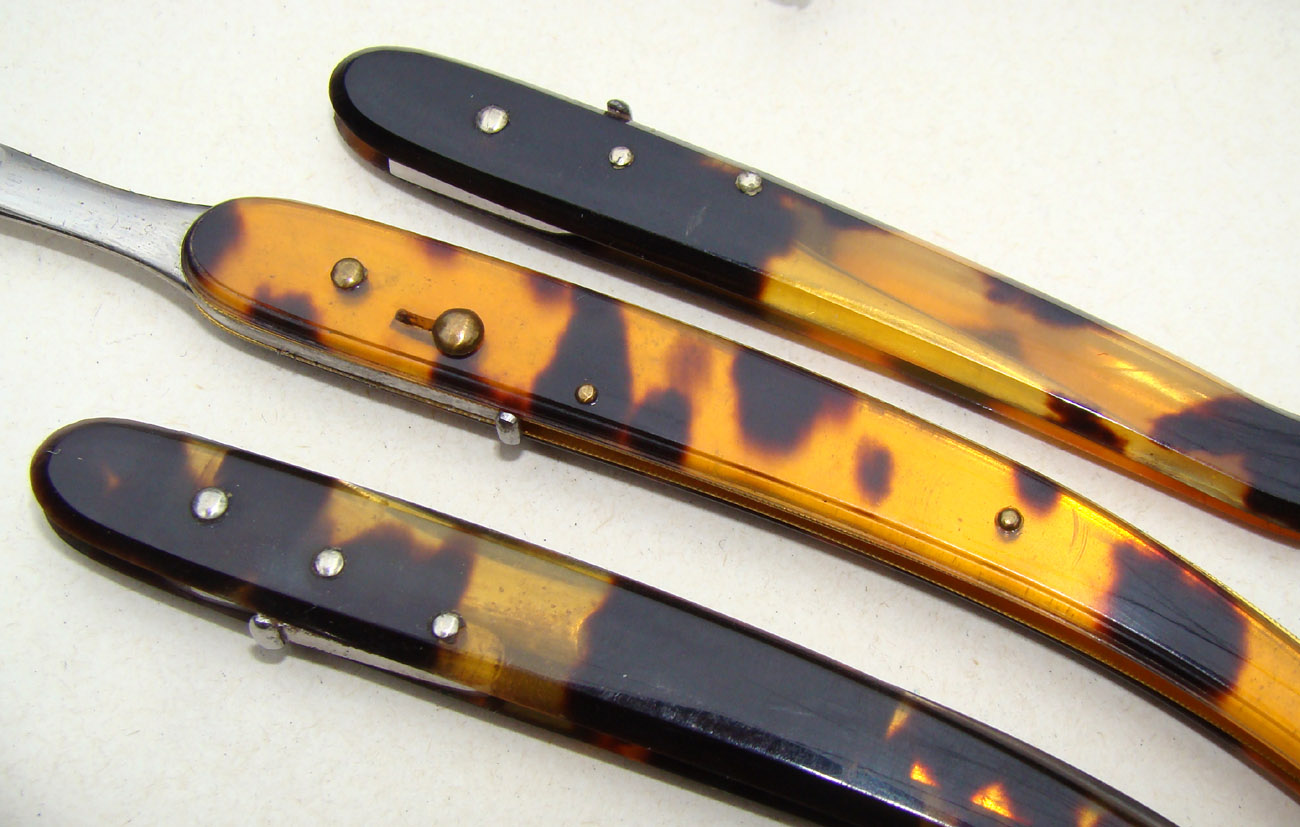
FULL RANGE OF FOLDING BISTOURIES, SCALPELS, LANCETS, AND KNIVES, French, c. third quarter 19th century, all signed "Luer," a uniform set of 23 instruments showing the wide variety produced by this famous Parisian firm. Ranging from 3" to 4-1/4" (7.5 - 11 cm) long (closed), they are constructed with exquisitely patterned tortoiseshell bodies housing polished steel blades with locking / latching mechanisms. Some have gilt brass linings beneath the tortoiseshell. There are single and double ones, exhibiting all manner of blades curved and straight, long and short, sharp and blunt pointed, even hatchet shaped. Several blades have removable silver sheaths, spring-loaded to function as a bistoury cache. There are various locking mechanisms, sliding, latching, and hinged. All are in excellent as new, unused condition, noting only two small chips to the tortoiseshell. The instruments came to us via descent from the original collection of exhibition pieces made and held by the Luer firm, being their finest productions, shown at the great national and international exhibitions of the 19th century. An exceptional set. (9485) $5500./ the set. |
 |
|
| American Sounding | Click on any image for a larger view. Scroll to view more items. |
 |
|
|
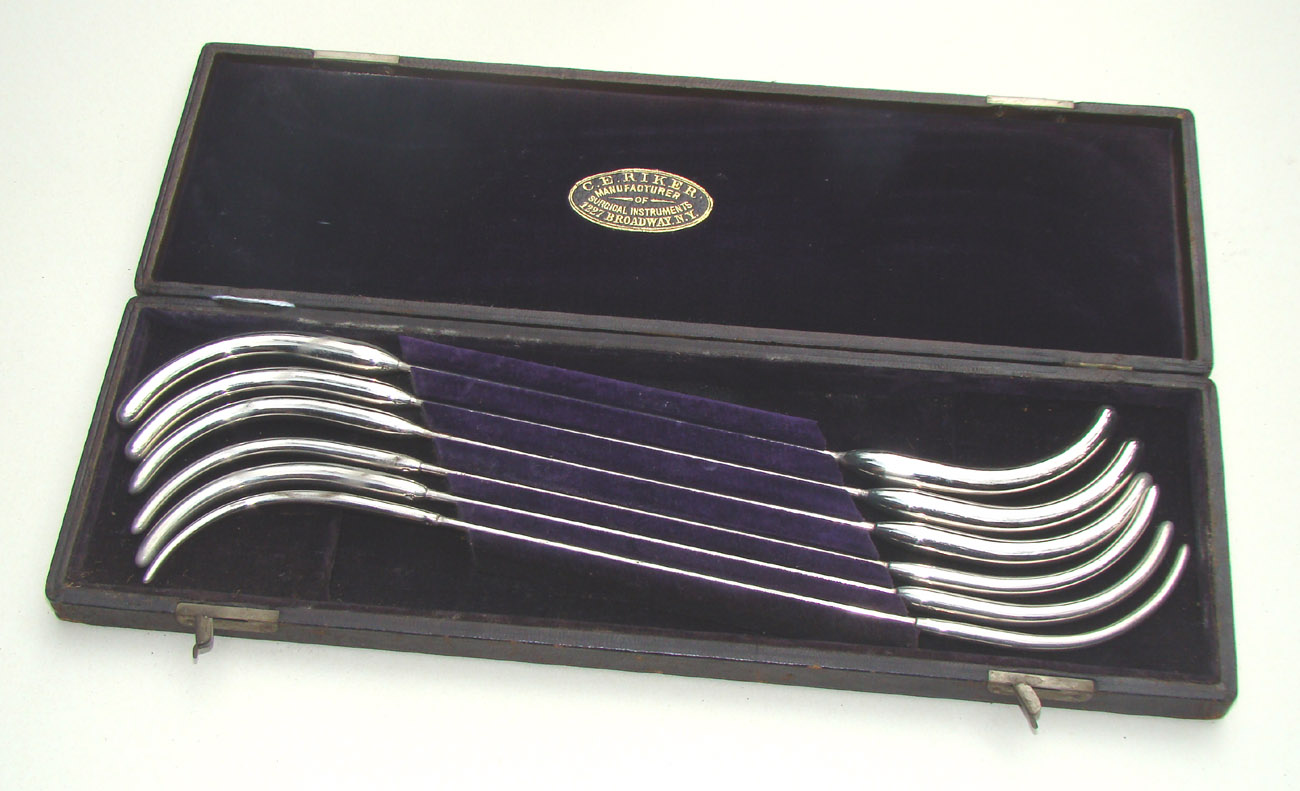
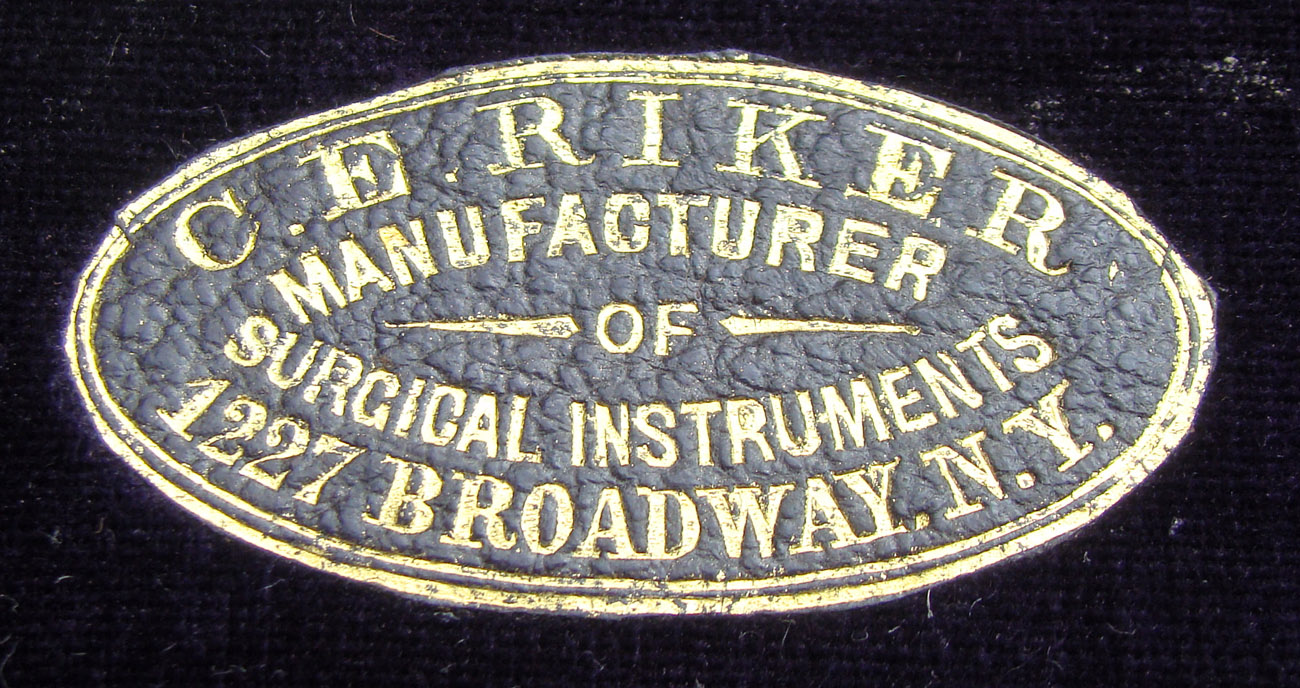
FOWLER'S CURVED URETHRAL SOUNDS, American, c. 1885, signed on the case label "C.E. Riker, 1227 Broadway, N.Y." This is a complete set of six double-ended finely-polished metal sounds in graduated sizes, all contained in the original 12-3/8" (31 cm) long leather bound wood case. Condition is very fine, the case exterior a bit rough. An identical set is listed in a late 19th century Sharp and Smith catalogue, as "Dr. Fowler's set of sounds" having "the regular Van Buren curve and taper." They are designed for dilating the male urethral canal, for locating strictures, and for sounding the presence of stones. Charles E. Riker is listed at this NY address from 1880 until 1894 (see Edmonson). (9373) $595. |
| Quality Dental Care | Click on any image for a larger view. Scroll to view more items. |
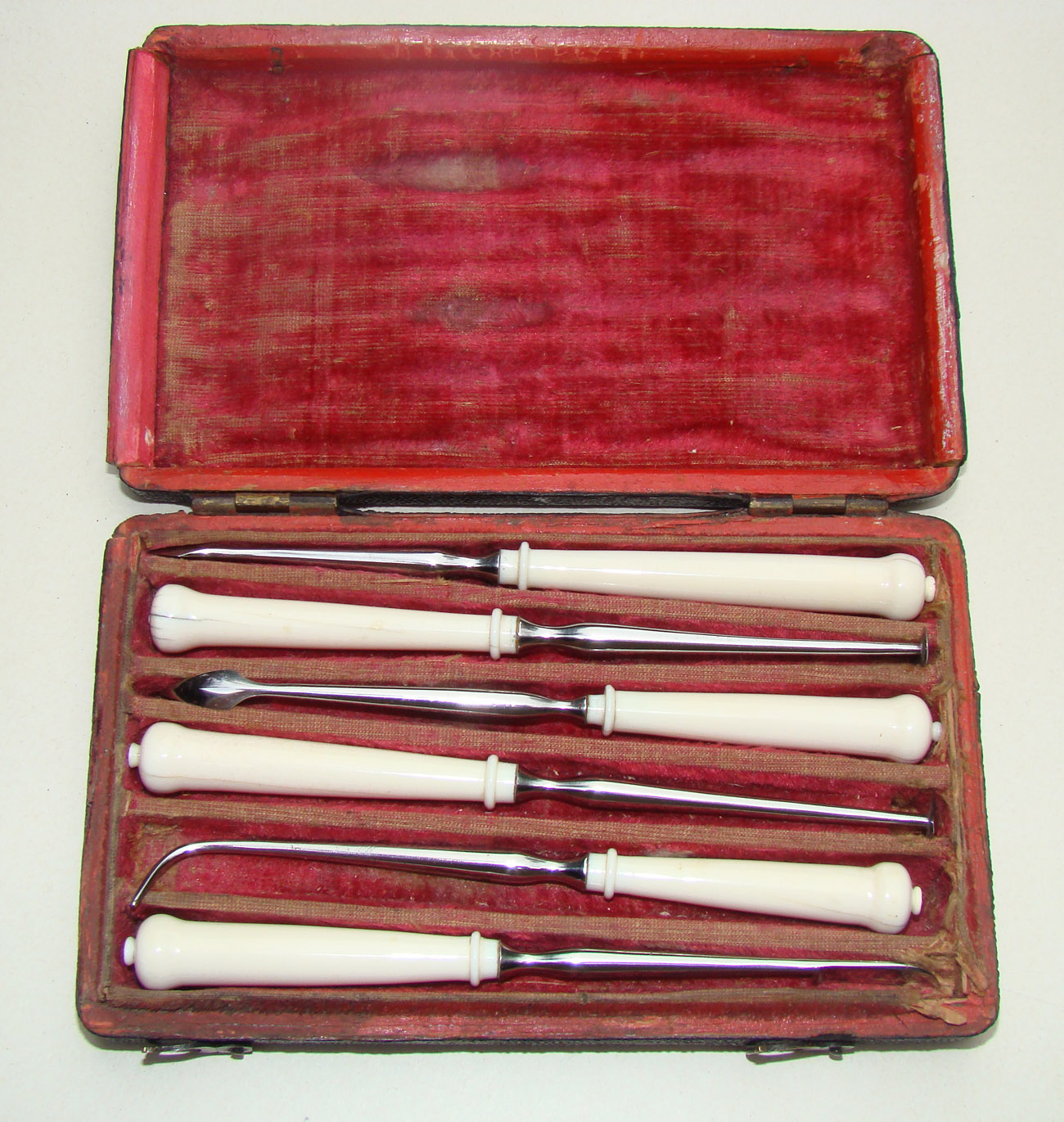
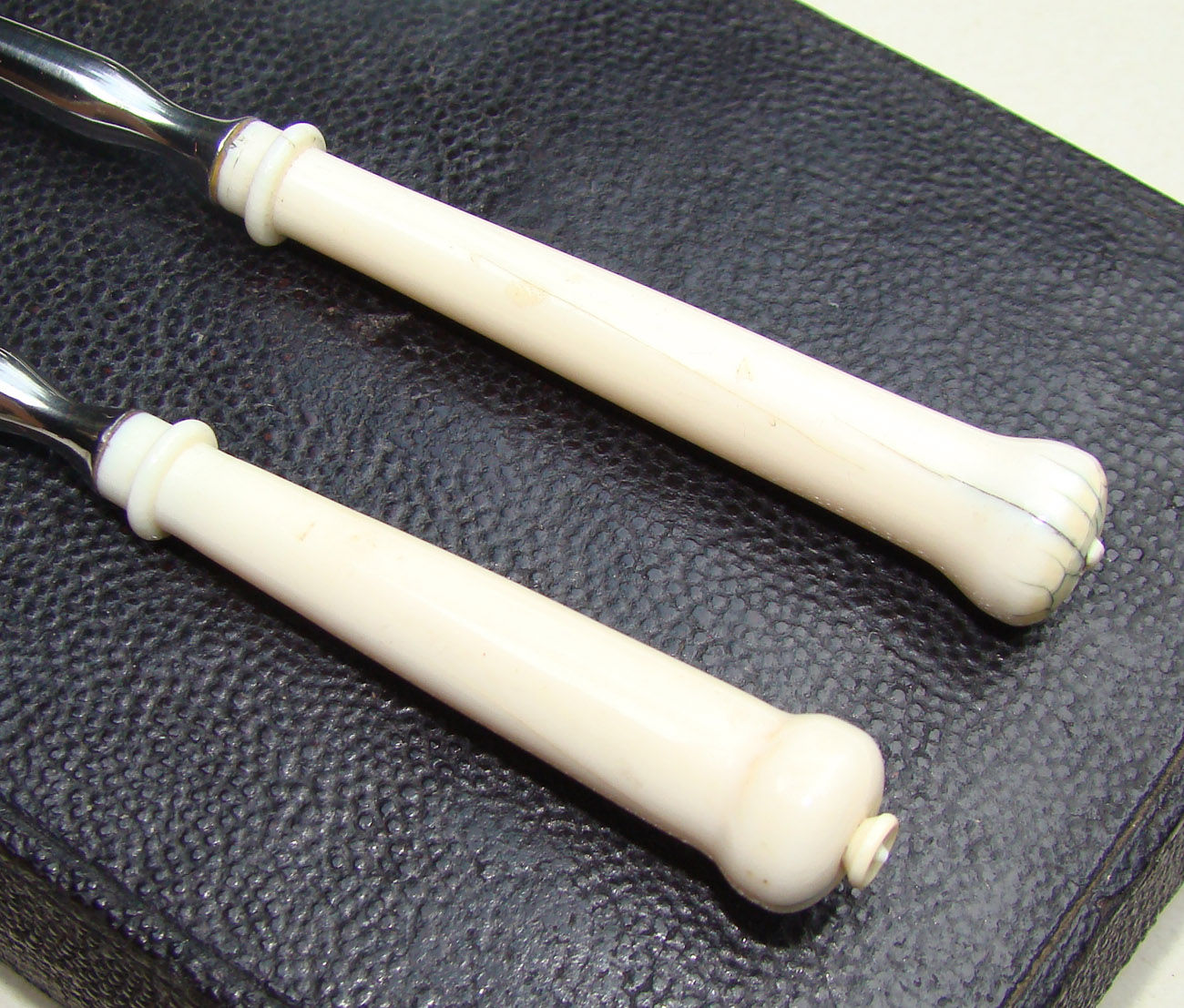
| PRISTINE POCKET DENTAL TOOL SET, probably English, c. first half 19th century. The 3" x 5" (8 x 13 cm) fitted carrying case is bound in fine dark fishskin and lined in red velvet. It contains the original complete set of six dental tools -- knife, lancet, plugger, and three scalers of quite different shapes -- all in polished steel with fine turned ivory handles. Condition is excellent noting hairline cracks to the ivory. An especially fine example of portable dental kit. (9415) $1150. |
 |
|
| Handsome Electro-Therapy Outfit | Click on any image for a larger view. Scroll to view more items. |
 |
|
|
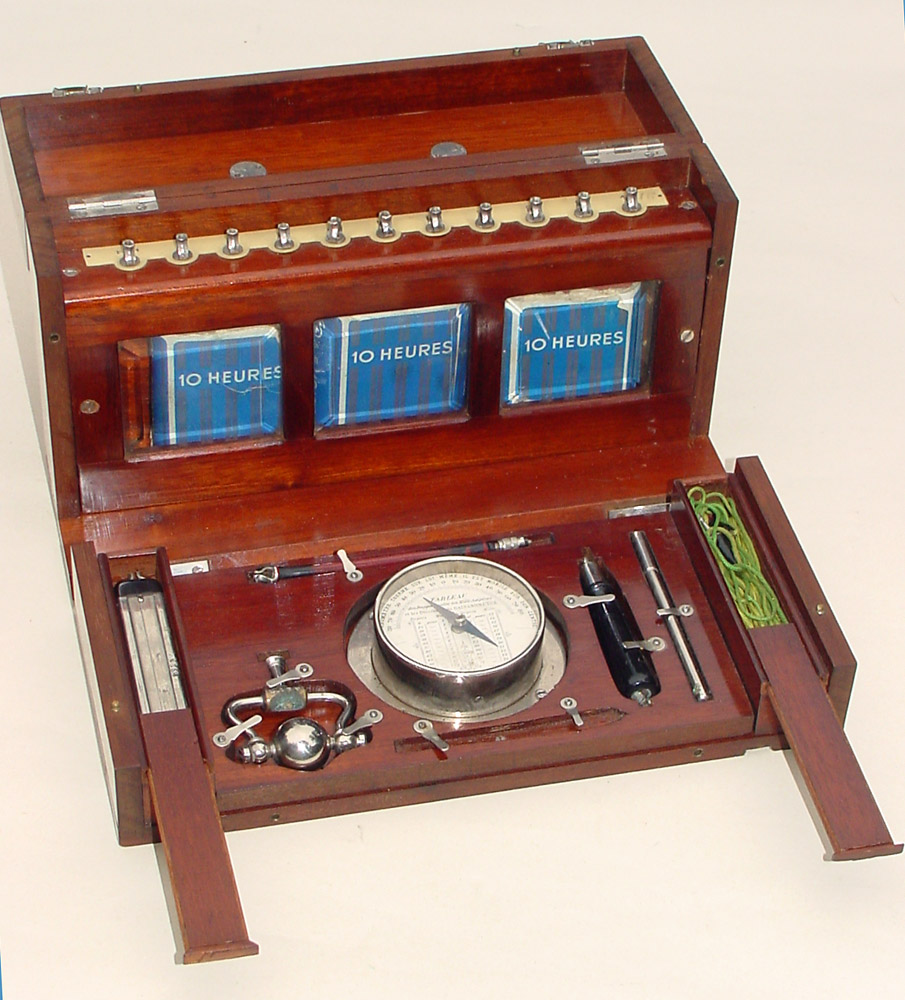
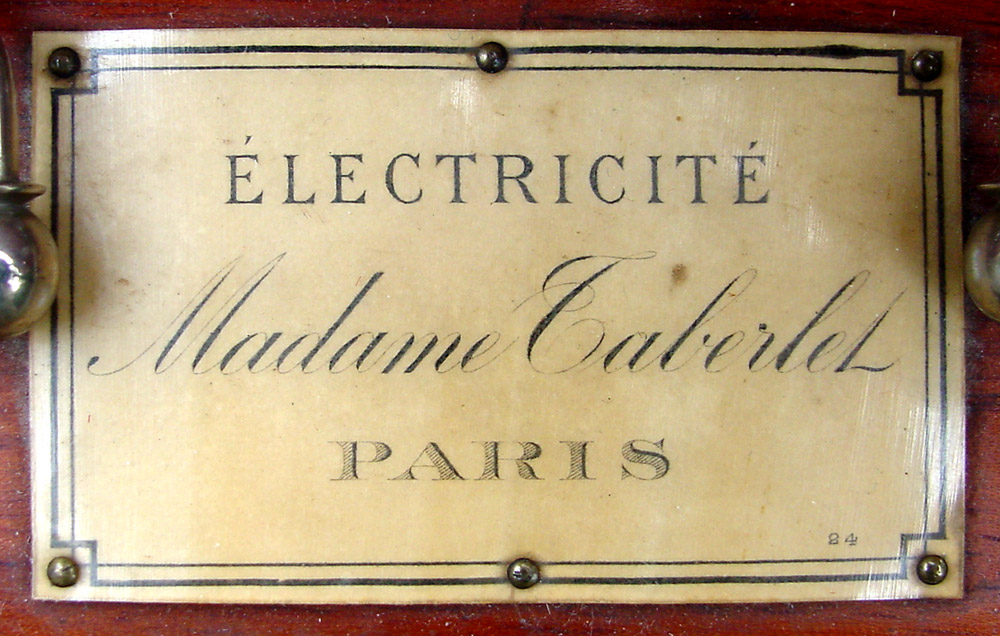
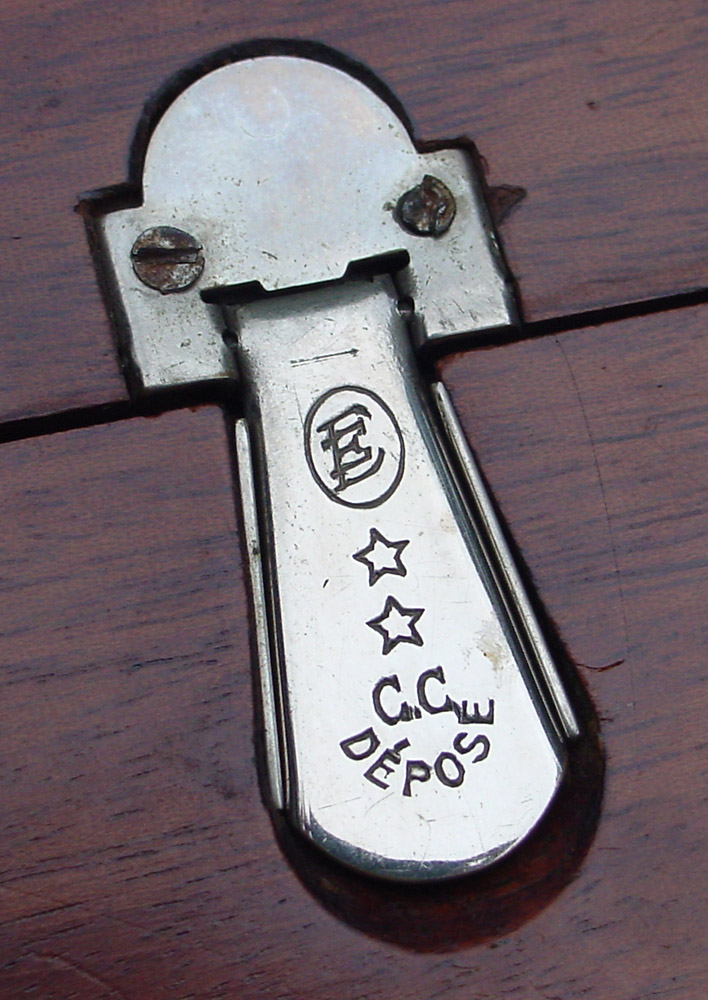
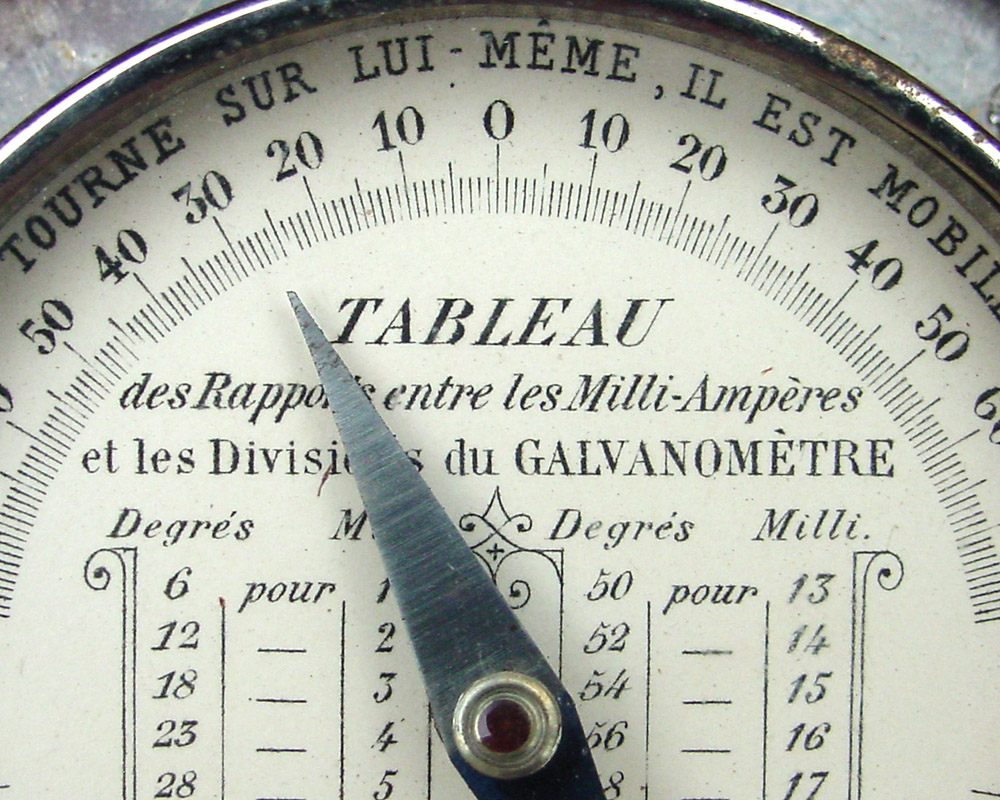
ELABORATE ELECTRO-MEDICAL SET, French, c. 1900, signed on the box "Electricite, Madame Taberlet, Paris," on the galvanometer face "Charles Chardin, Paris," and numbered "B127." The 11" x 6-1/4" x 3-3/8" (28 x 16 x 9 cm) fine wood box opens out to reveal three batteries behind glazed windows, 11 connecting posts (labeled "+," and 1 to 10), a magnetic compass galvanometer with conversion table between degrees and milliamperes, and fitted compartments for the connecting wires, hand grips, conducting roller ball, and electric needles. Condition is very fine noting one small accessory lacking. A handsome, elaborate, and rather unusual electromedical outfit. (7466) $1150. |
 |
|
| Personal Dosage Measurement | Click on any image for a larger view. Scroll to view more items. |
 |
 |
|
|
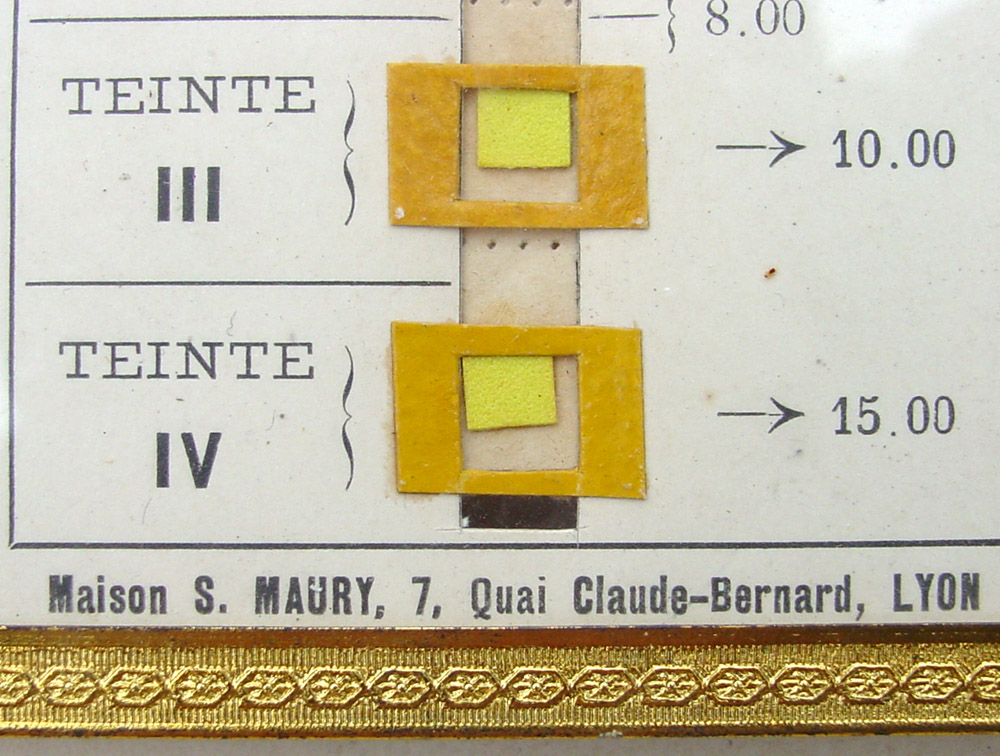
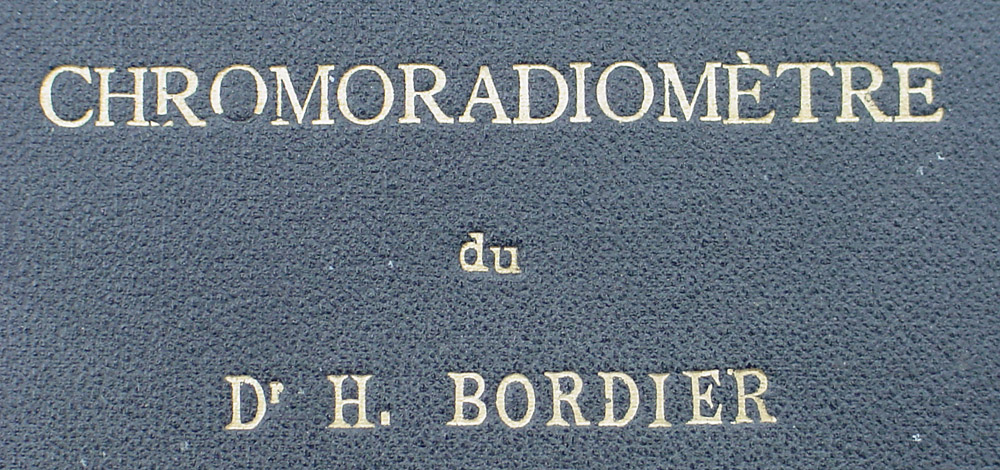
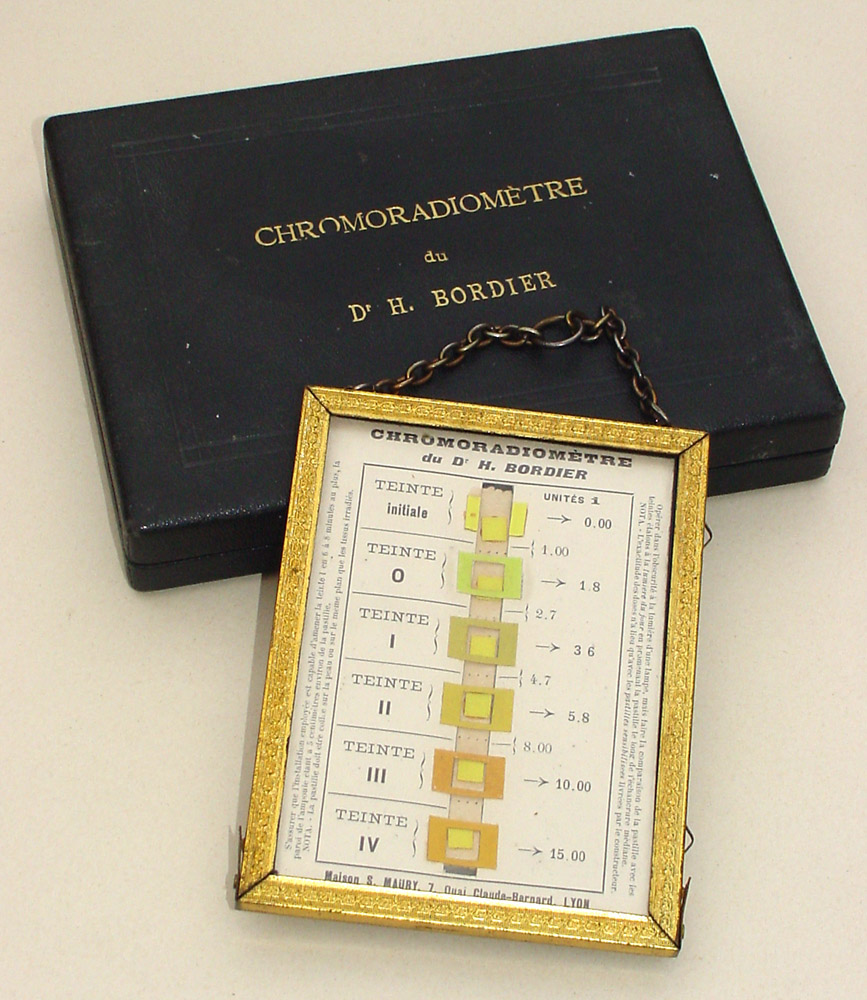
THE CHROMORADIOMETRE OF DR. H. BORDIER, French, c. 1910, contained in the original 6-5/8" x 5-1/8" (17 x 13 cm) fitted case lined in red silk and red velvet. The device was made by "Maison S. Maury, 7 Quai Claude-Bernard, Lyon," and consists of a printed card in a glazed gilt metal frame with suspension chain. Six colored paper windows are pasted along a central slot in the card, and a considerable supply of small comparison test disks are included. Condition is very fine and all original. In use one glues a disk to the patient's skin or other tissue, irradiates with x-rays, and compares the disk's color with the standards along the slot, as a measure of dosage. The disks are made of barium platinocyanide, which changes color progressively from green to dark yellow-orange as a result of irradiation. An early attempt to quantize radiation dosage, this was apparently the first commercial dosimeter. (9430) $1150. |
| Finely-Articulated Medical Lamp | Click on any image for a larger view. Scroll to view more items. |
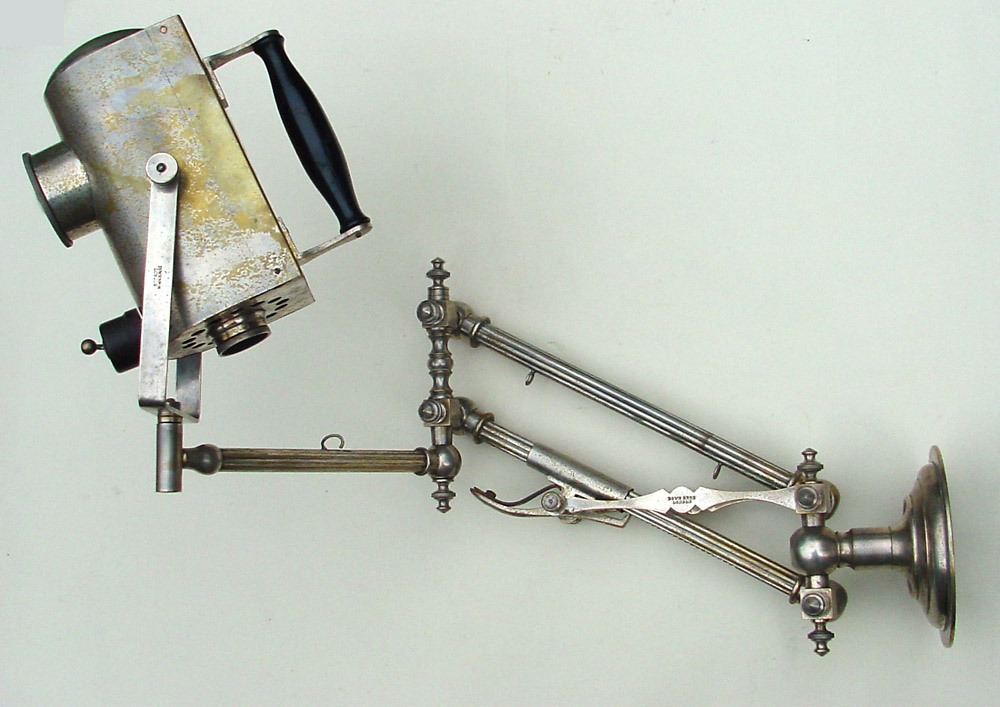 |
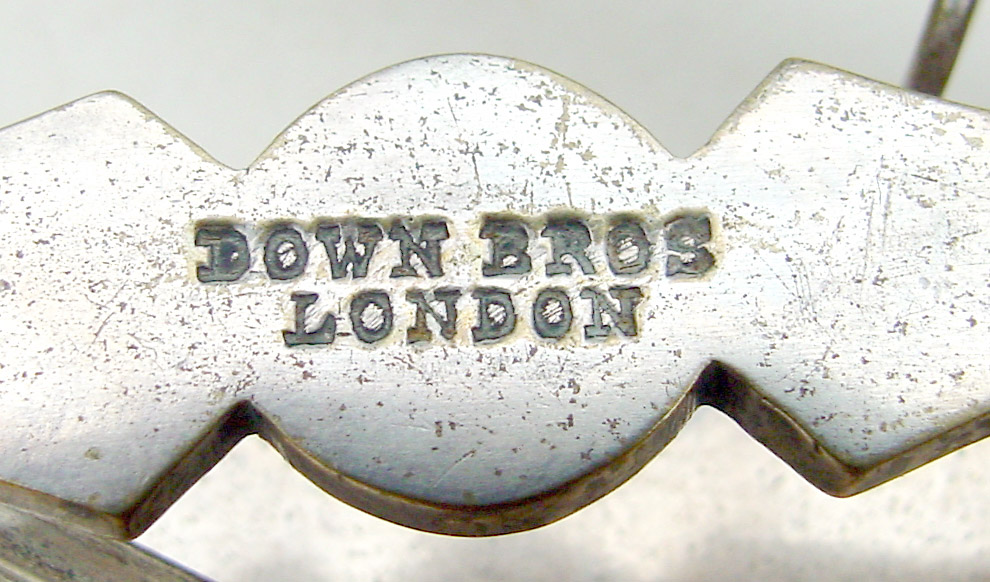
| EARLY ELECTRICAL EXAMINATION LAMP ON ARTICULATED ARMS, English, c.1925, signed in three places "Down Bros., London." This wall-mounting lamp extends from 14" to a maximum length of 27" (35 -69 cm), and is constructed of solid brass with a silver wash. Parallel-motion arms allow it to be raised or lowered, and locked in position by a spring loaded finger with rachet stops. It further swivels against the wall mount, and the always-horizontal lamp arm swivels at its mount. There are turned finials throughout in a sort of Eastlake design. The lamp head itself has a wood handle, swivels up and down, and is fitted with electric light socket, metal reflector, glass condensing lens (for throat examination), and switch with thermoplastic housing. Condition is very fine noting wear to the thin finish. A rarely found and quite handsome example of early electrical examination lamp. (7516) $2750. |
 |
|
| French Ophthalmic Scotometer | Click on any image for a larger view. Scroll to view more items. |
 |
 |
|
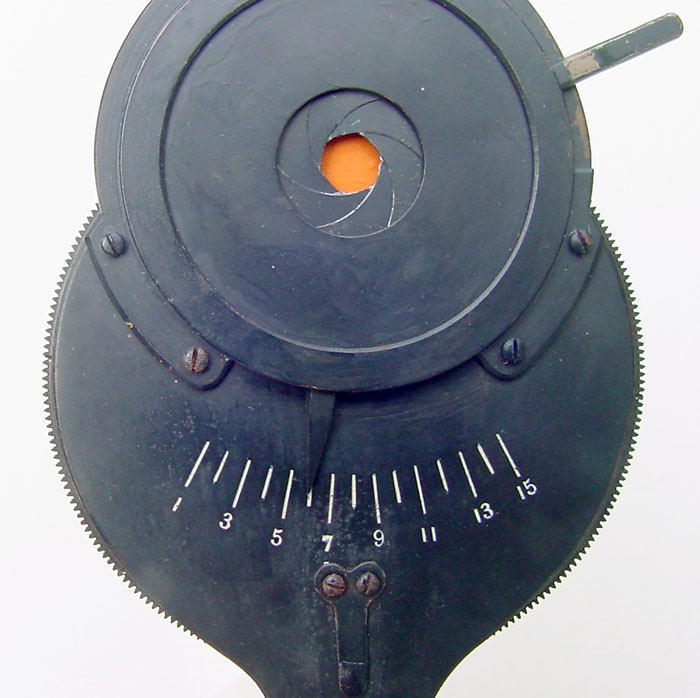
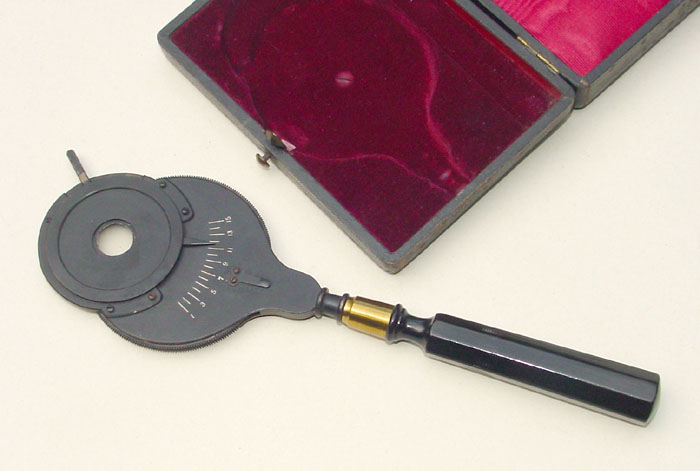
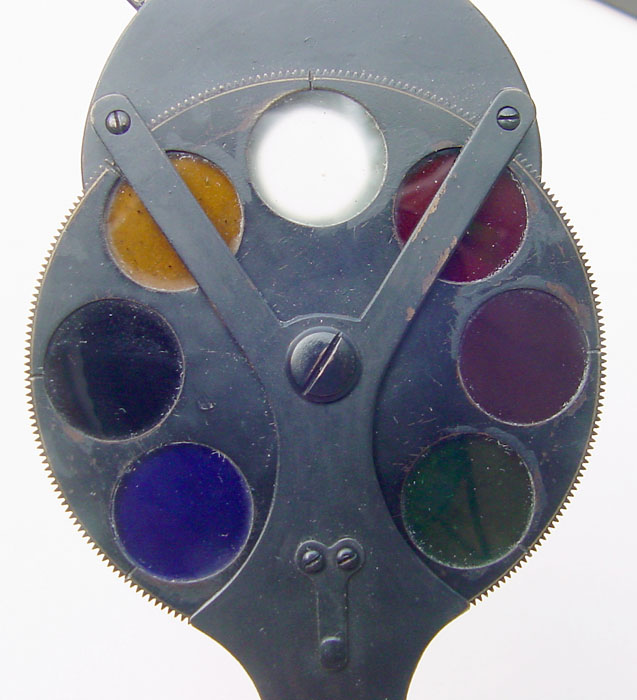
| THE SCOTOMETER OF ANTONELLI, French, c. 1900, in its original 4-3/4" x 3-1/2" x1-1/4" wood case covered in black fabric. The blackened brass instrument, with wood handle, measures 8-1/4" (21 cm) overall. It features a sighting hole with leaf diaphragm adjustable against a 1(1)15 mm scale, a large rotating wheel of eight colored glass filters (for use by daylight), and a superimposed wheel of eight opaque colored targets (for use by artificial light). In very fine functional condition throughout, the "scotometer" measures the perception of colors in the central vision field, enabling early diagnosis of certain optic nerve diseases. The inventor of the present instrument was Dr. Alberto Antonelli, well-published ophthalmologist in Paris. We are aware of one other example, in a private collection, and we find the device listed in a 1909 catalogue of Maison Luer, 104 blvd. St. Germain, Paris. A less elegant instrument, termed "Snellen's scotometer," is held in the Utrecht University Museum (see Eye and Instruments, p. 195). Most rare. (8419) $2250. |
| Finding the Cylindrical Axis of Eyeglass Lens | Click on any image for a larger view. Scroll to view more items. |
|
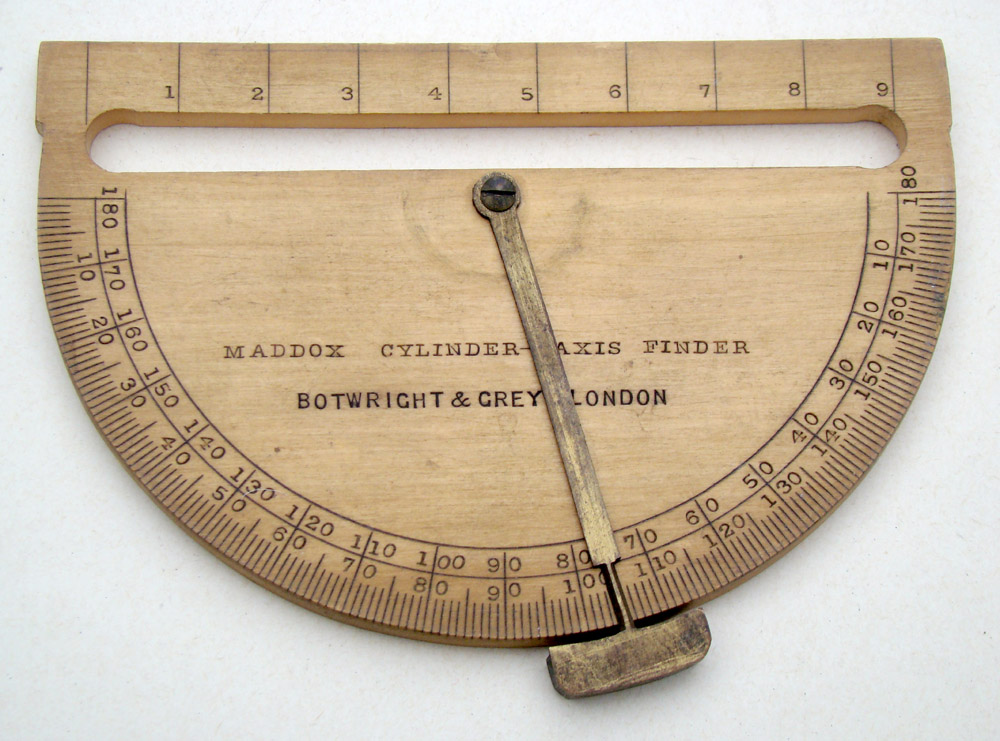
THE MADDOX AXIS-FINDER, FOR ASTIGMATIC EYEGLASS LENSES, English, c. 1900, signed "Maddox Cylinder-Axis Finder, Botwright & Grey, London." This 4" (10 cm) wide boxwood plate is fitted with a brass index arm reading against a 0(1)180 degree scale. A straight slot is bordered by a 0(1)9 linear scale plus edge groove. Condition is very fine. In use one places the frame of eyeglasses along the groove, and tilts the whole assembly to the right or left while viewing a distant vertical straight line through the eyeglass lens. The angle (measured on the inclinometer scale) at which distortion of the line disappears, gives the cylinder axis of the astigmatic lens. The inventor was the famous Dr. Ernest E. Maddox, an ingenious ophthalmologist with an international reputation. Botwright and Grey may have been the sole makers of this device, which was advertised by the Geneva Optical Co. of Geneva, New York. A later version is found in early 20th century John Weiss & Son London catalogues. (9372) $295. |
| 19th Century Bullet Removal | Click on any image for a larger view. Scroll to view more items. |
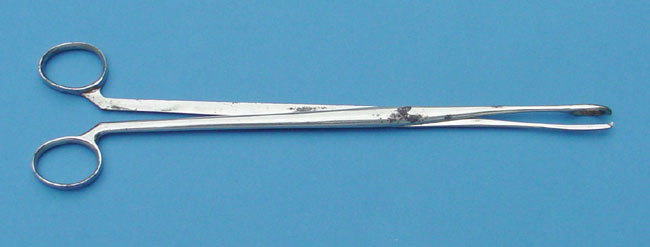
| GROSS' BULLET FORCEPS, American, late 19th century, signed "Tiemann & Co.," 9-3/8" (24 cm) long, of polished steel. These slim forceps terminate in a sharply toothed open cup and a toothed finger for securely gripping a lead ball (whether round or conical), or a steel covered bullet. But when closed, they present a blunt end, for delicate probing. Condition is very fine noting minor rust spotting. Dr. Samuel Gross was a prolific inventor, represented by no less than 17 instruments in the 1889 Tiemann catalogue. In 1859 he had authored the exhaustive two-volume work A System of Surgery - Pathological, Diagnostic, Therapeutic, and Operative, complete with over 2300 pages and over 900 engraved illustrations. (8368) $695. |
 |
|
| Eye Coordination Training | Click on any image for a larger view. Scroll to view more items. |
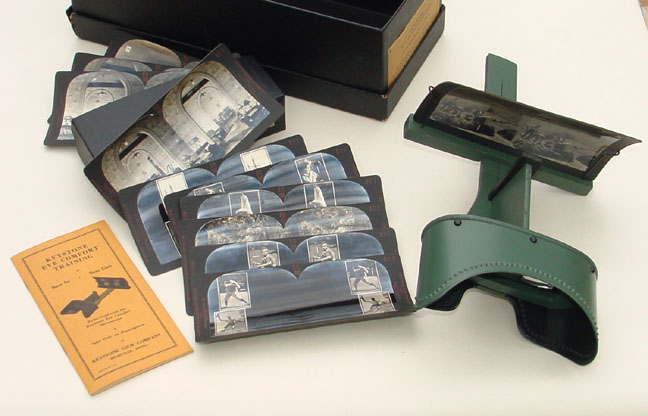
| THE KEYSTONE EYE COMFORT STEREOSCOPE OUTFIT, American, c. 1937, by the Keystone View Co., Meadville, Penn. The handheld stereoscope itself is constructed of wood and metal, colored green with black trim, and has card carrier sliding along a distance scale. The set is complete with the original 12 stereograms mounted with silver photographic prints, the instruction manual, and the cardboard box. Condition is near mint throughout. The stereograms range progressively in difficulty of eye task, each explained in detail on the reverse. The outfit, "Sold Only on Prescription," is designed to "smooth and ease the co-ordinating action of two eyes and bring relief to many whose difficulties arise from inability to read, sew, or work comfortably." (8352) $395. |
 |
|
| "Electricity is Life" | Click on any image for a larger view. Scroll to view more items. |
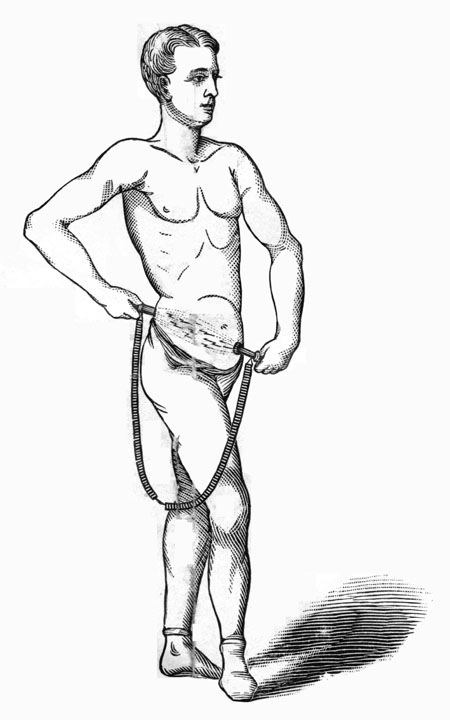
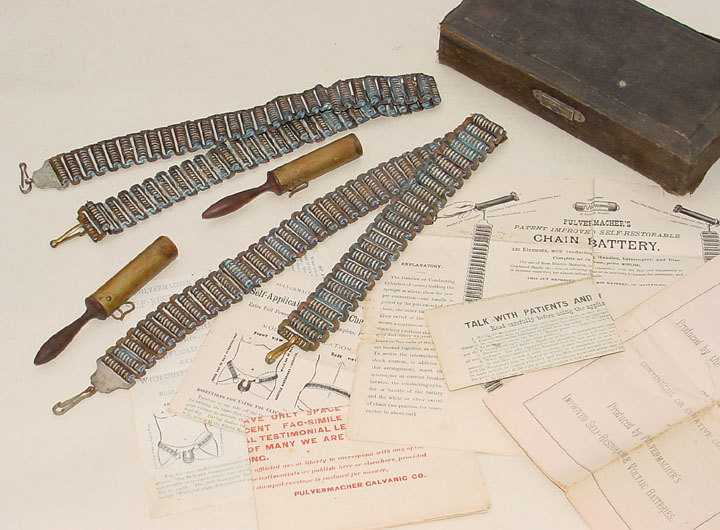
| PULVERMACHER'S "PATENT IMPROVED SELF-RESTORABLE CHAIN BATTERY," American, c. 1885, signed on the terminals "Pulvermacher Galvanic Co." and "Electricity is Life." The 8-3/4" x 4-1/2" x 1-3/4" (22 x 11 x 4 cm) fitted wood case contains the two 27" (69 cm) long branches of this electromedical chain battery, each with 60 articulated brass links containing zinc cylinders insulated with twine. Two wood-handled brass tubes can be attached to the ends, and loaded with, for example, sponge balls as applicators. To activate the belt it would be dipped in vinegar. Condition is good noting darkening of the brass, the case fair. And most important, the outfit includes considerable documentation, with printed instructions, illustrations, and testimonials.(7449) $695. | |
 |
|
| Surgical Grasping | Click on any image for a larger view. Scroll to view more items. |
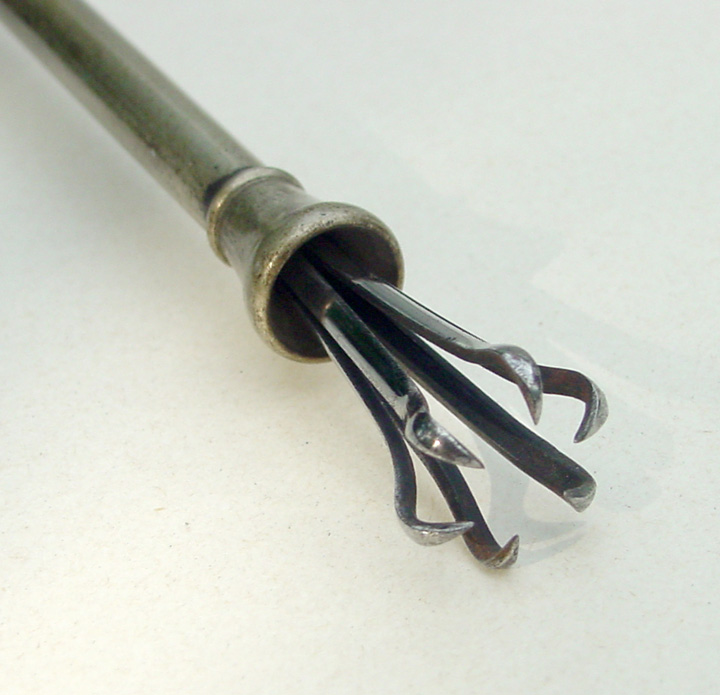
| THE CONVERGENT GRASPING-HOOK OF CHASSAIGNAC, French, c. 1875, made with polished steel fingers, "maillechort" metal guidetube and ferrule, and shaped ebony handle, with overall length of 11-1/8" (28.5 cm). It has internal snares, opened and closed by sliding its outer guide tube. Condition is fine and functional throughout, noting a hairline crack in the handle. Charles Marie Edouard Chassaignac (1805 - 1879) was surgeon in Paris; various instruments (notably his "ecraseur"), surgical operations, and anatomical parts bear his name. His "erigne" offered here was used to grasp and elevate the area to be treated or excised, especially recommended for ligature of hemorrhoids and removal of tumors. (8475) $975. | |
 |
|
| Patented Reflective Trade Sign | Click on any image for a larger view. Scroll to view more items. |
|
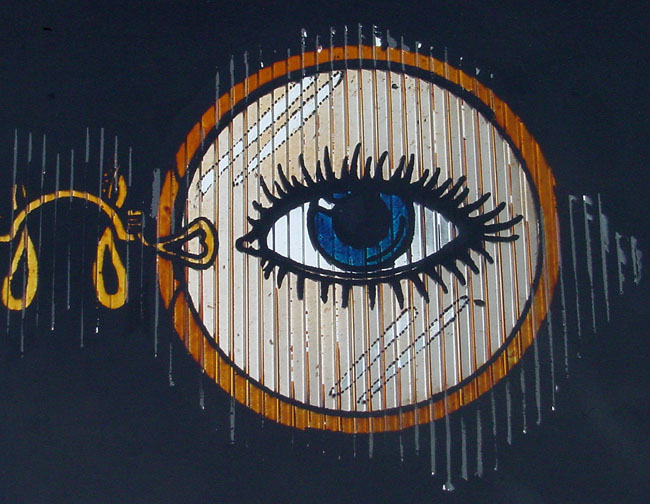
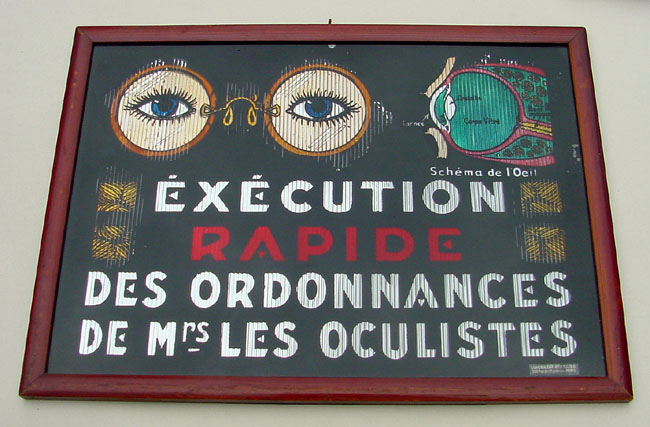
DRAMATIC OPTOMETRIST'S SIGN, French, c. early 20th c., the red grain-painted wood frame measuring 10-3/4" x 14-3/4" (27 x 37 cm), the glass panel backed with reflective material and reverse-painted or -printed in color, showing fitted eyeglasses, a cross-section of the eye, and the message "Execution Rapide des Ordonnances de M'rs. les Oculistes". It is signed in the corner, for the patented process "Luicolor B'te. S.G.D.G., 339 rue des Pyrenees, Paris." To the reverse is a hinged card support, as though to stand the sign in a window display. The reflective striations of the background give the sign a dramatic quality as one walks by. Condition is fine throughout. (8378) $1950. |
 |
|
| "Open Wide" | Click on any image for a larger view. Scroll to view more items. |
 |
|
|
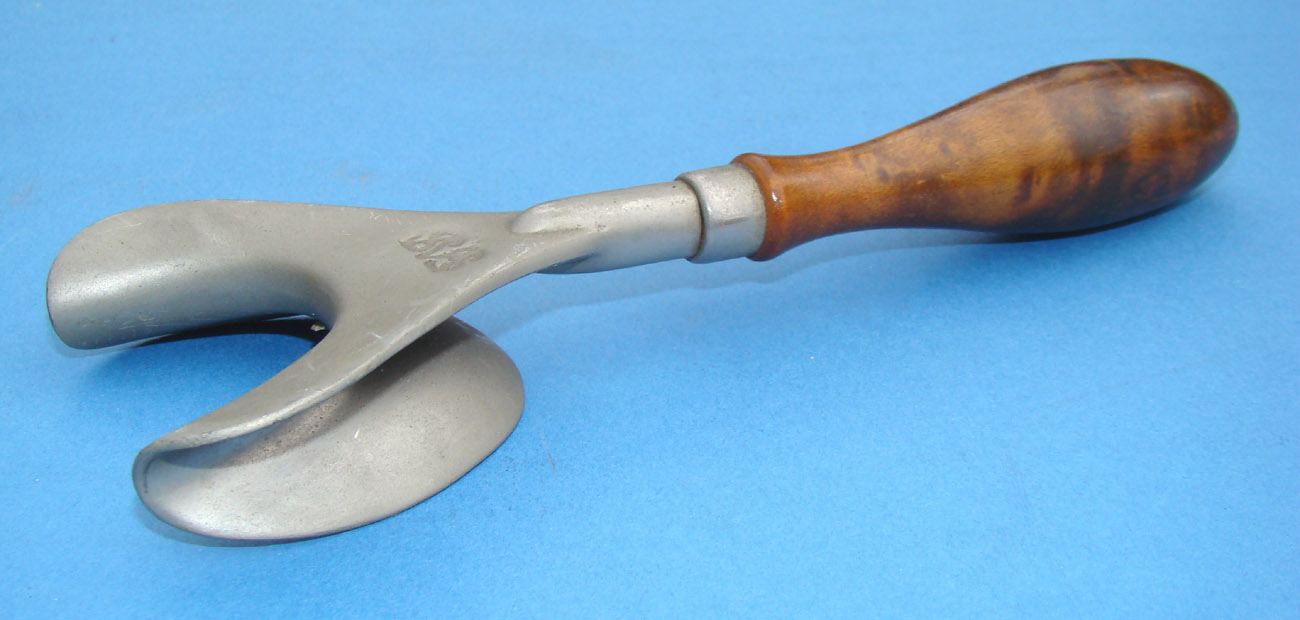
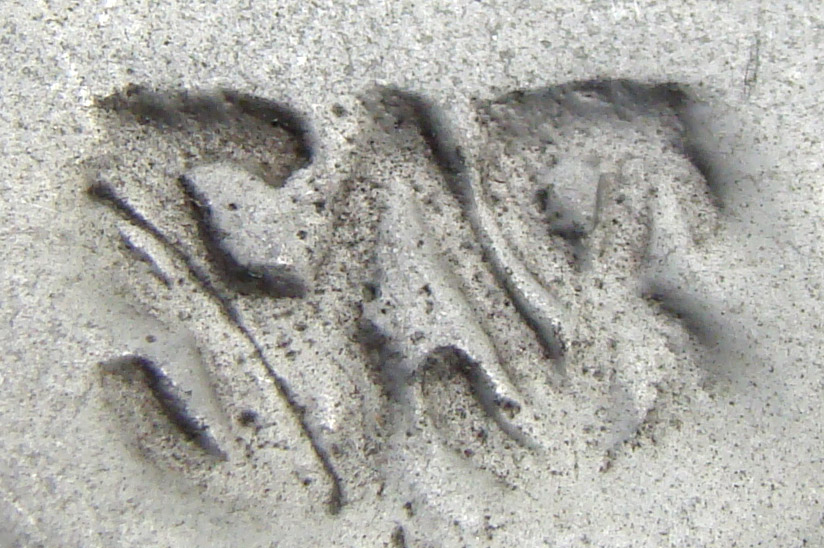
CHEEK RETRACTOR, American, c. 1900, bearing the "SWS" logo of the S.S. White Dental Mfg. Co. of Philadelphia. Measuring 5-1/2" (14 cm) overall, this dental device has a very smoothly recurved pulling surface, and a lovely grained turned wood handle. Unusual, and in excellent condition. (9445) $220. |
| French Dental Operating Set | Click on any image for a larger view. Scroll to view more items. |
|
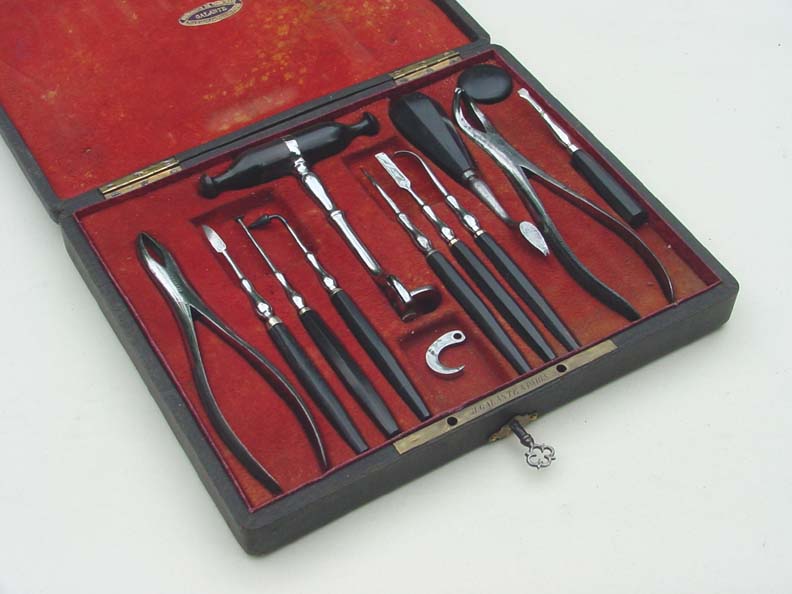
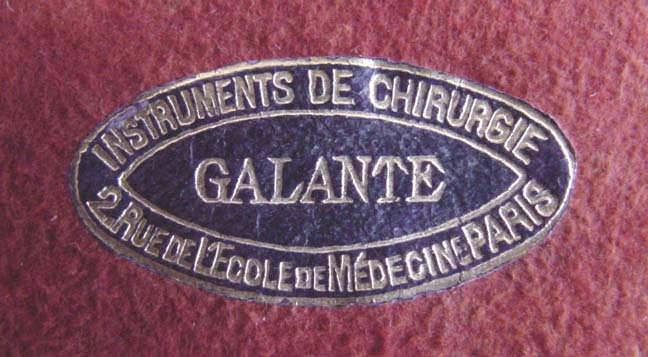
UNCOMMON DENTAL SET, French, c. 1875, signed in the case "H. Galante a Paris" and "Galante, Instruments de Chirurgie, 2 rue de l'Ecole de Medecine, Paris," and on the major instruments (toothkey and two forceps) "Galante." This fine set comprises eleven tools, plus a small turned ebony box and an auxiliary tooth key claw of larger size. The eight-sided tapered wood handles are ebony; the lovely tooth key handle is turned horn. The full set is contained in its original 8" x 10" x 1-5/8" (20 x 25 x 4 cm) wood case covered in black fabric and lined with red chamois, complete with original key. The set is complete and all original, with the possible exception of the elevator. Condition is very fine throughout. The maker was Henri Galante, established in Paris in 1851. Catalogues are known from 1853 to 1885 (see Davis and Dreyfuss), and the firm had representatives in London and in Naples. A rare example of a cased French dental operating set. (7439) $2950. |
 |
|
| Ways of Hearing | Click on any image for a larger view. Scroll to view more items. |
 |
|
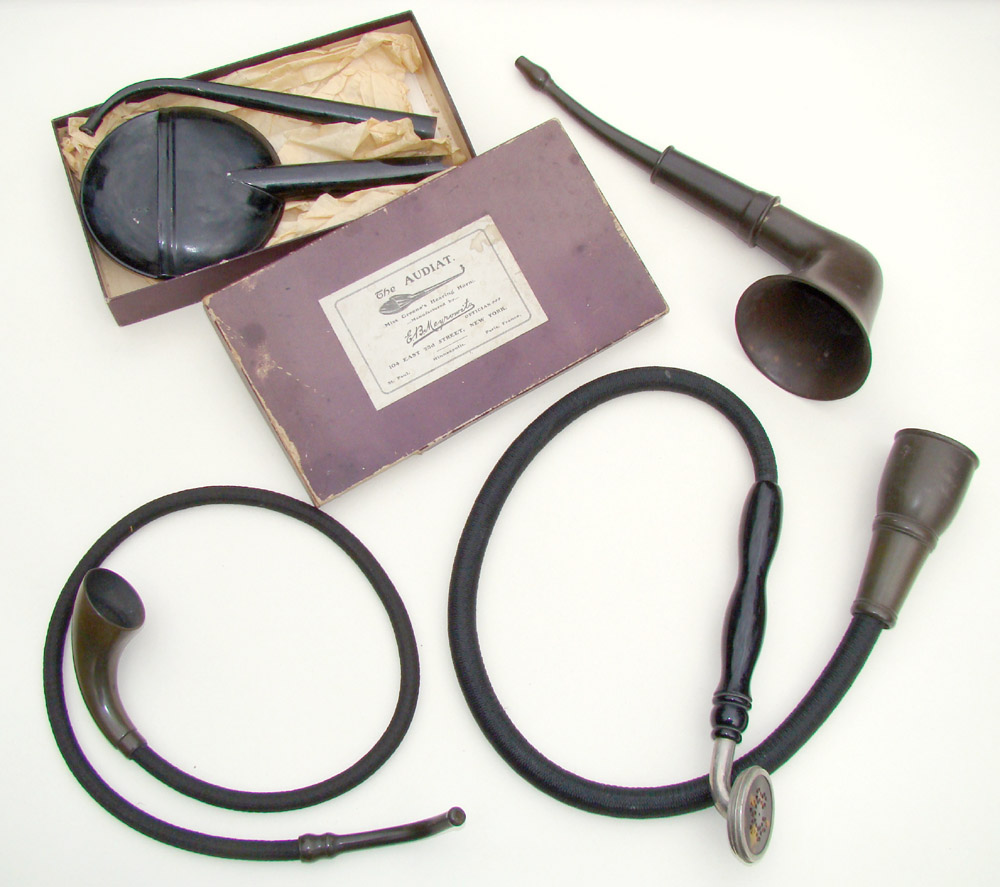
EAR TRUMPETS AND SPEAKING TUBES (clockwise from upper
left)
|
|
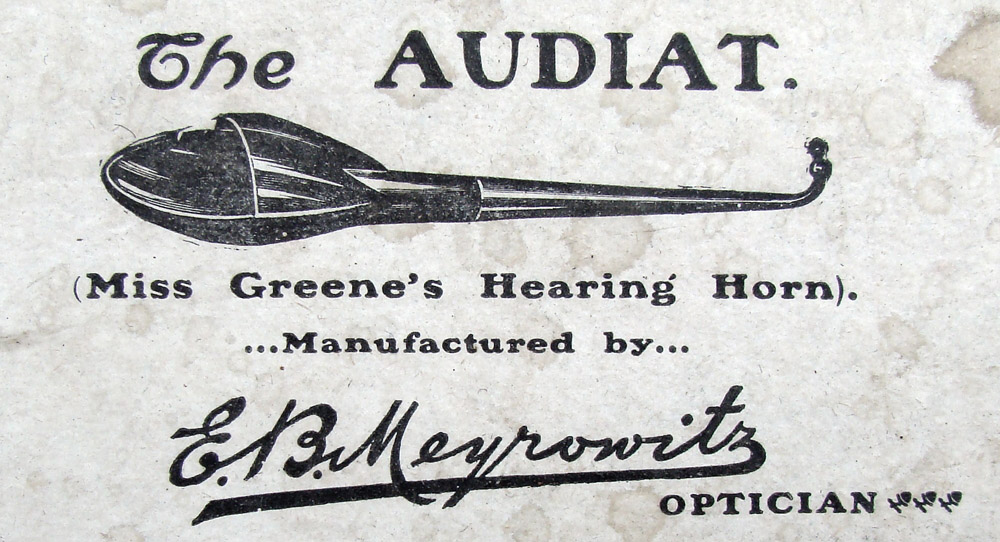
"MISS GREENE'S HEARING HORN," American, c. 1900,
by E.B. Meyrowitz, Optician, 104 East 23d Street, New York, so signed
on the original box label. Constructed of black japanned "tin"
(steel, actually), the "Audiat" assembles in two parts to a
length of 18-1/2" (47 cm). It is a banjo-style ear trumpet, which
collects considerable sound with its 5-1/4" diameter bowl. Condition
is fine noting minor losses to the finish, and some to the rubber ear
protector. (9392) $595.
|
|
|
COLLAPSIBLE EAR TRUMPET IN GUTTA PERCHA, English or American, second half 19th century, opening to 15" (38 cm) with the bell screwed into the central section and the ear tube withdrawn fully. In fine condition, unusual entirely in hard rubber. (9402) $450. LONG SPEAKING TUBE WITH DIAPHRAGM, English, c. 1900, stamped " 'Ardente,' 309 Oxford St. W." Measuring 41-1/2" (105 cm) long, this instrument has flexible tube bound in black fabric, hard rubber speaking bell, and earpiece with large ebonized wood handle, nickel-plated assembly, and imitation tortoiseshell aperture, all in very fine condition. Unlike the ear trumpet and later hearing aid, which amplify all ambient sounds, the speaking tube was designed to selectively amplify a speaker's voice, one end being held by the speaker himself. (9412) $500. COMPACT SPEAKING TUBE, English or American, late 19th century, 37" (94 cm) long, with narrow fabric-bound flexible tube, curved hard rubber mouthpiece, and curved hard-rubber ear insert, in very fine condition throughout. (9422) $395. |
| From the Charriere Museum Collection | Click on any image for a larger view. Scroll to view more items. |
 |
 |
|
 |
|
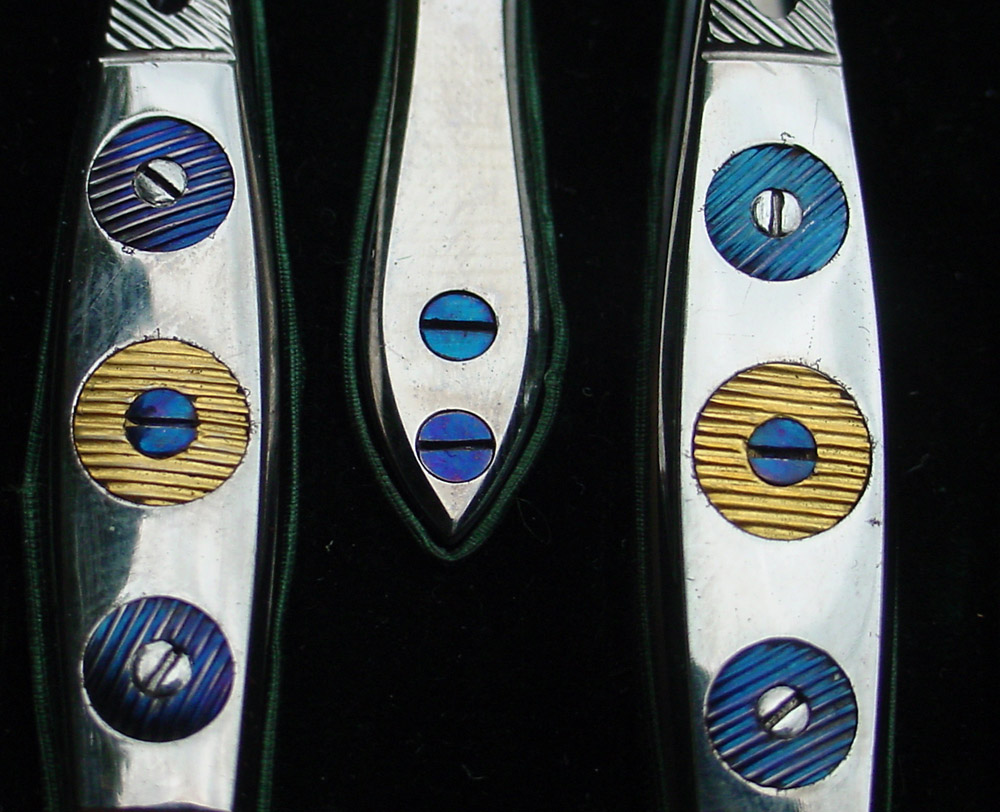
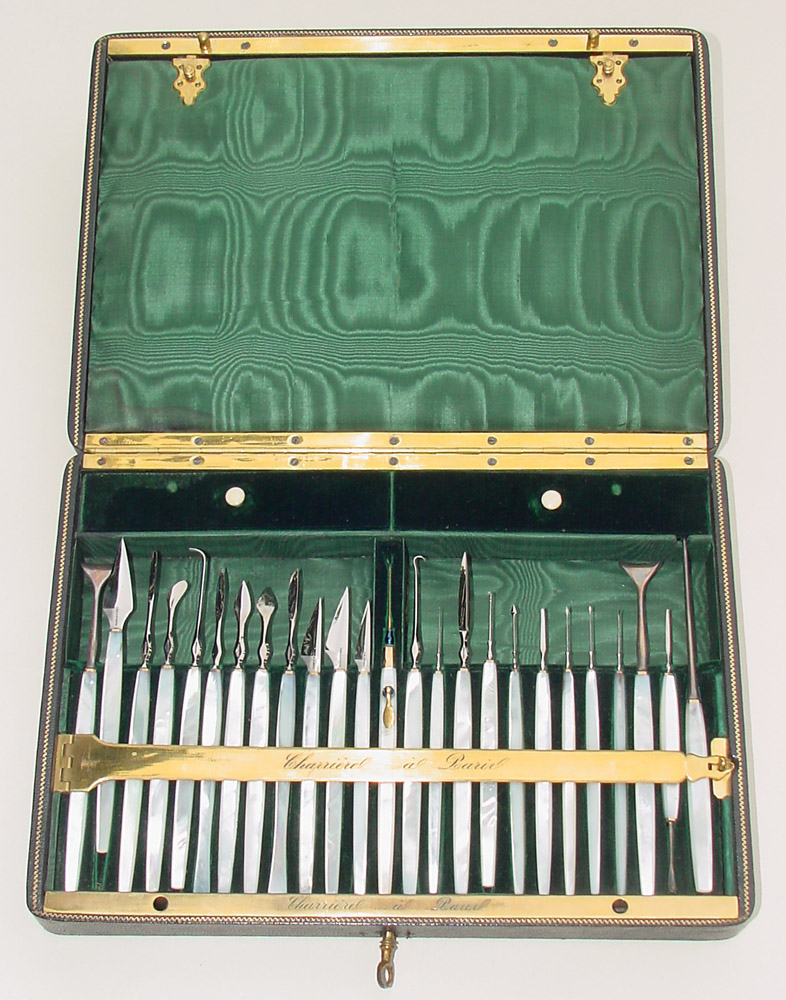
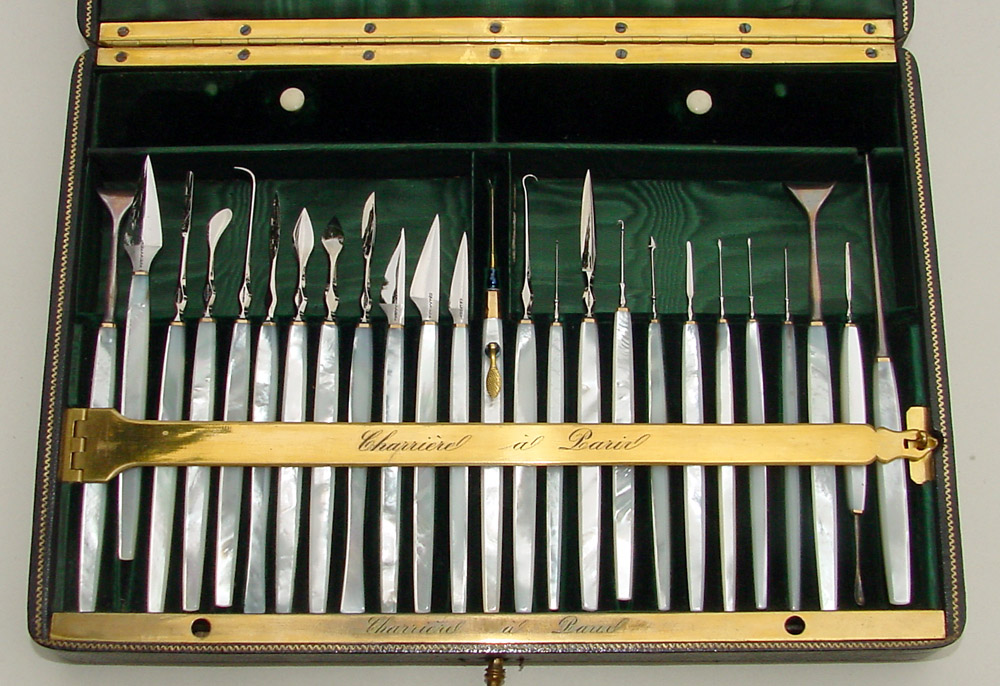
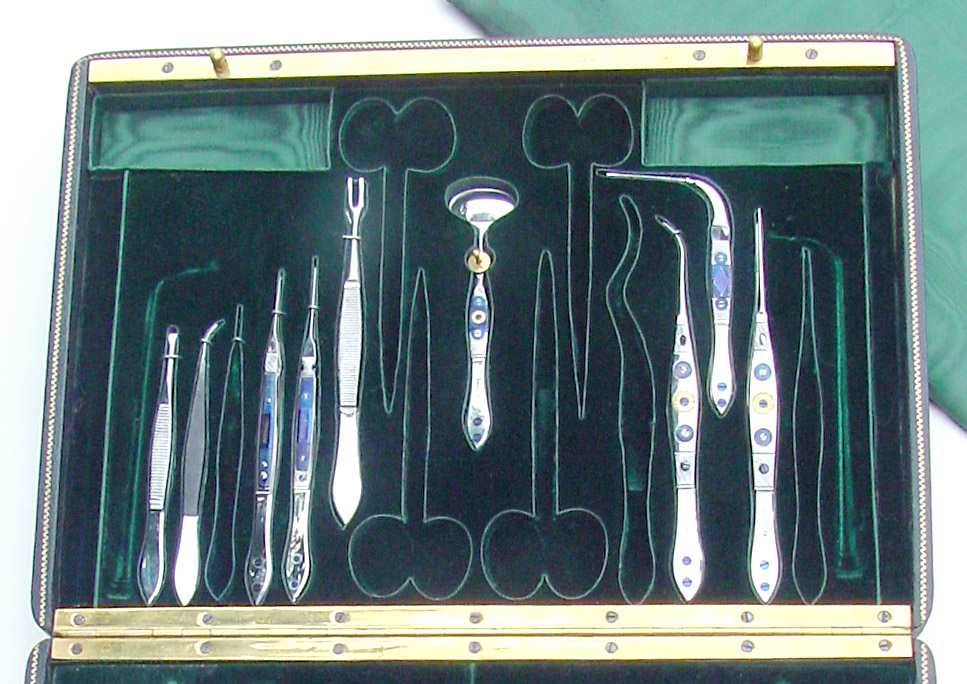
SPECTACULAR EXHIBITION OPHTHALMIC SURGERY SET, French, c. 1860, boldly signed twice on the box and minutely on many of the instruments "Charriere a Paris." The black leather covered wood case measures 11" x 8" x 2" (28 x 20 x 5 cm), the edges with gilt bands. The interior is lined in luxurious green watered silk and green velvet, with gilt brass straps and hinges, and ivory knobs. The lower level is complete with 25 ophthalmic surgical tools with iridescent mother-of-pearl handles, gold or gilt ferrules, and polished steel blades, hooks, probes, etc., all different. Notable is the precision thumb-activated pincers (the serretelle of Dr. Desmarres, for operating on secondary cataracts) with its contrasting blued steel and gilt fittings. The lid is only half full, with nine original ophthalmic tweezers, forceps, clamps, etc., all exquisite in polished steel with gilt and blued fittings. All is original, and the condition is excellent noting only that the lid is very slightly warped. The unused near-mint exhibition state of this set is attested to by the presence of various original retaining clips and the bold signed retaining strap, holding pieces in place. This set figured in the pedagogic museum of Maison Charriere, where the finest examples of their creations were deposited. This "historic collection" was a place where the showcases would be opened to young surgeons and their students, who could inspect and manipulate the rarest and the latest developments in their field. It had been proposed by Frederic Charriere as early as 1844; to translate from his notice of 1851, "(it) will present the methodical classification of my historic collection of old and modern instruments forming the complete arsenal of instrumental surgery assembled at great cost and classed by order of operations. This collection will be permanently housed under glass in a special room open to students and foreigners." Charrière even discussed having two formal instructive seances weekly (see Drulhon, Frederic Charriere, Fabricant d'Instruments de Chirurgie, 2008.) One of the most beautiful ophthalmic surgical sets we have seen and in the finest condition. (9382) $14,500. |
 |
|
| Removing the Big Ones | Click on any image for a larger view. Scroll to view more items. |

|
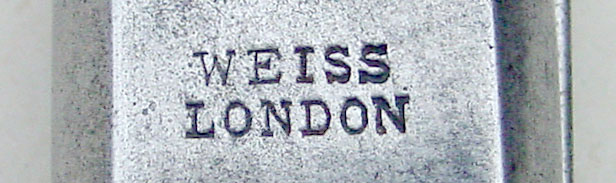
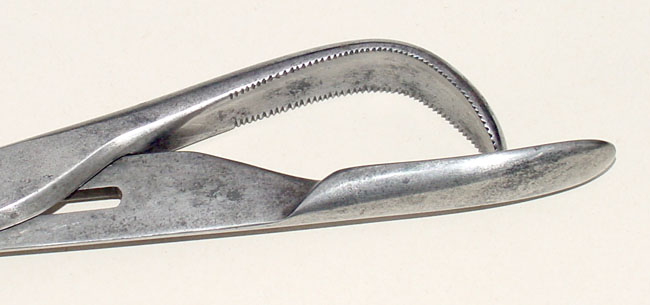
| LE CAT'S FORCEPS FOR
EXTRACTION OF LARGE BLADDER STONES, English, mid-19th century, signed twice
"Weiss, London." Measuring 11" (28 cm) long overall (minimum),
these lithotomy forceps are made of grey steel with a shaped ebony handle.
The ingenious linkage permits one to set the maximum opening by long screw,
and to independently set and lock the forward opening, the "overbite"
of the jaws. Both jaws are smoothly convex on the outside, and concave on
the inside, the smaller relatively flat and smooth-edged, the other curved
to a right angle and with sharply serrated teeth. It is possible to grip
stones of a wide variety of shapes and sizes. This unusual form is in fine
condition throughout. It is a variant of the forceps introduced by Claude
Nicholas le Cat (1700 - 1768), surgeon of Rouen, professor of anatomy and
surgery, medical author and inventor. Bennion (p. 87) illustrates two examples
of large Le Cat stone extractors with the long screw adjustment, but with
simple scissor hinge. Very large bladder stones were encountered at times;
Le Cat writes of a calculus weighing over three pounds! (8408) $2400.
|
 |
|
| Astronomy |
| Microscopy |
| Dialling |
| Navigation |
| Demonstration & Experimentation |
| Calculation |
| Medical |
| Specials |
| Books New and Old |
| Tesseract Catalogues |