
|
|
| The Polygonal Sky | Click on any image for a larger view. Scroll to view more items. |
 |
|
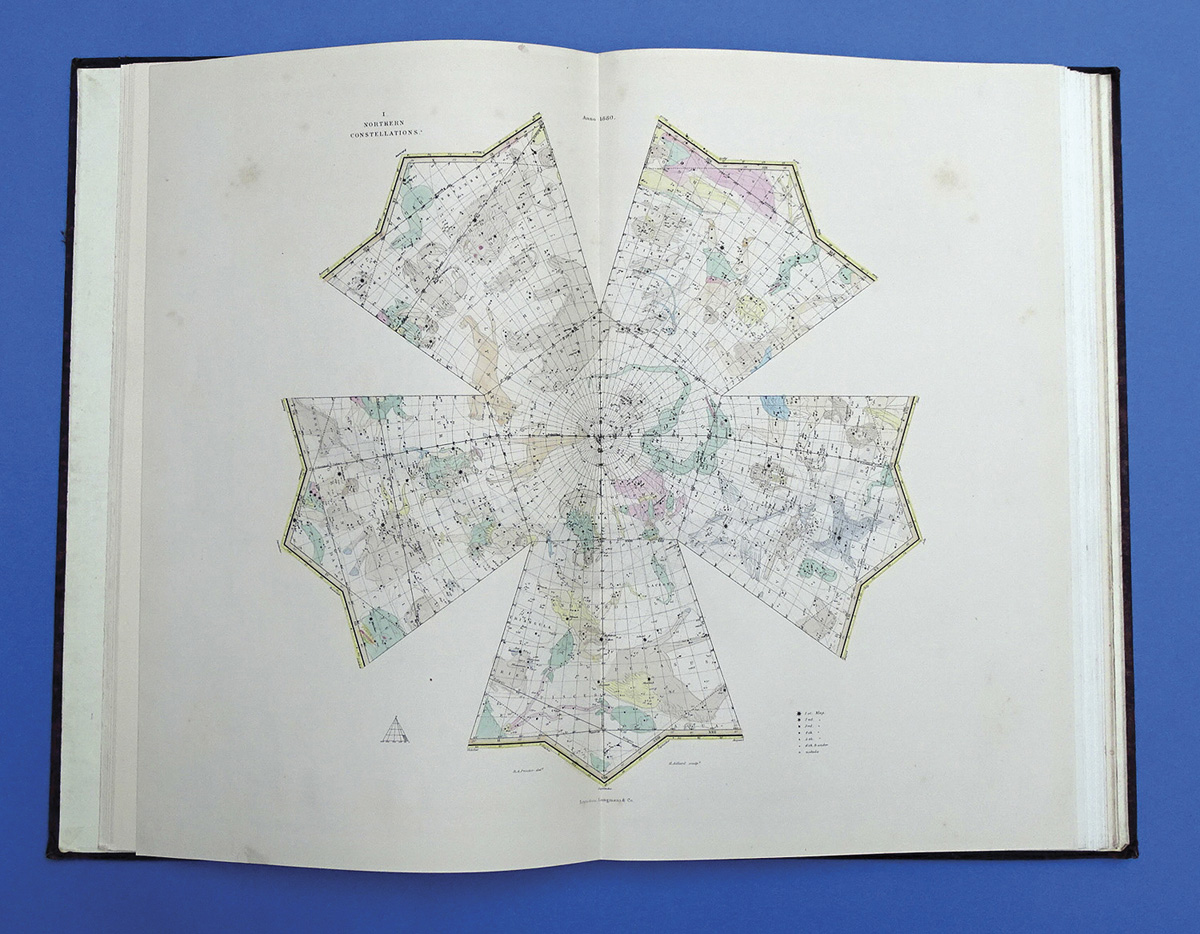
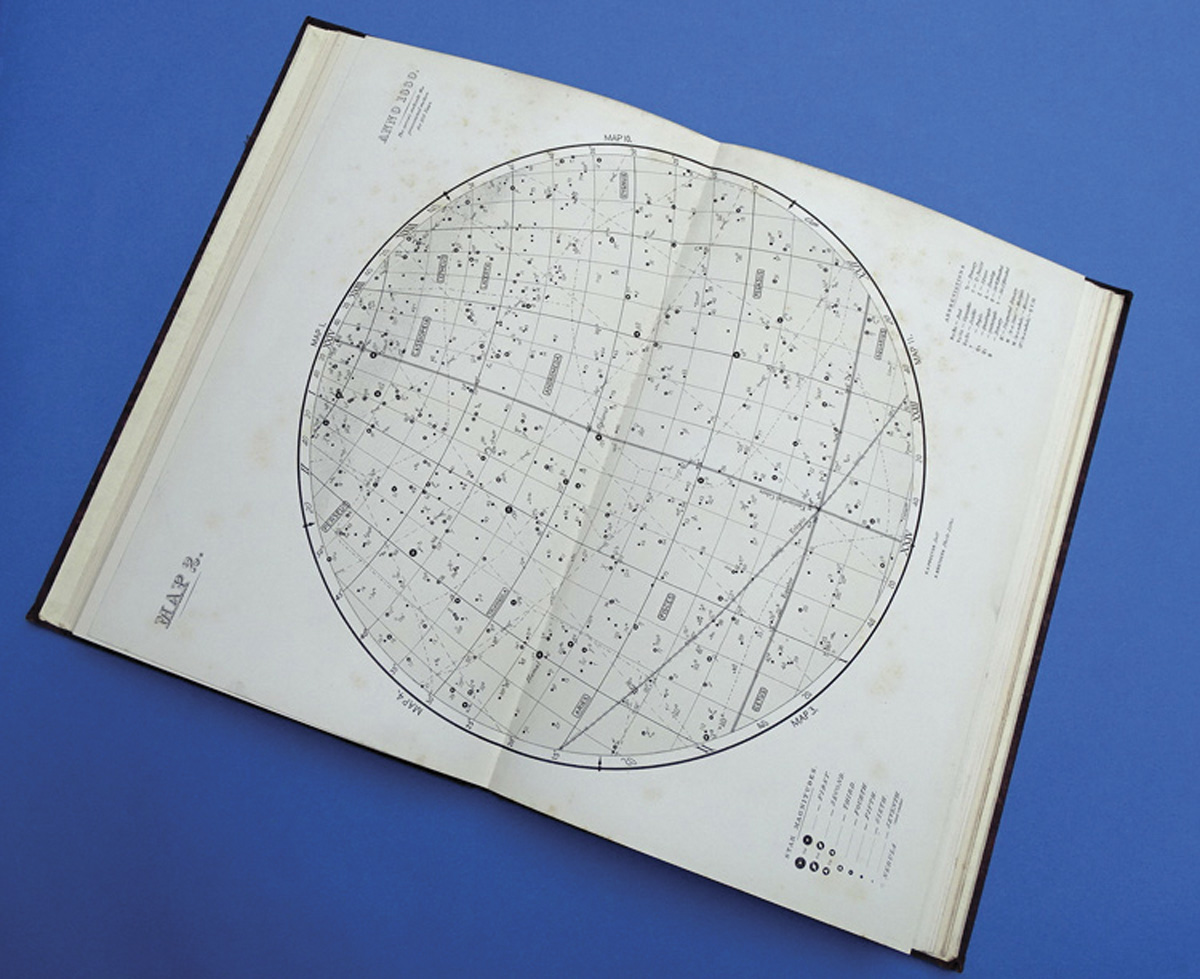
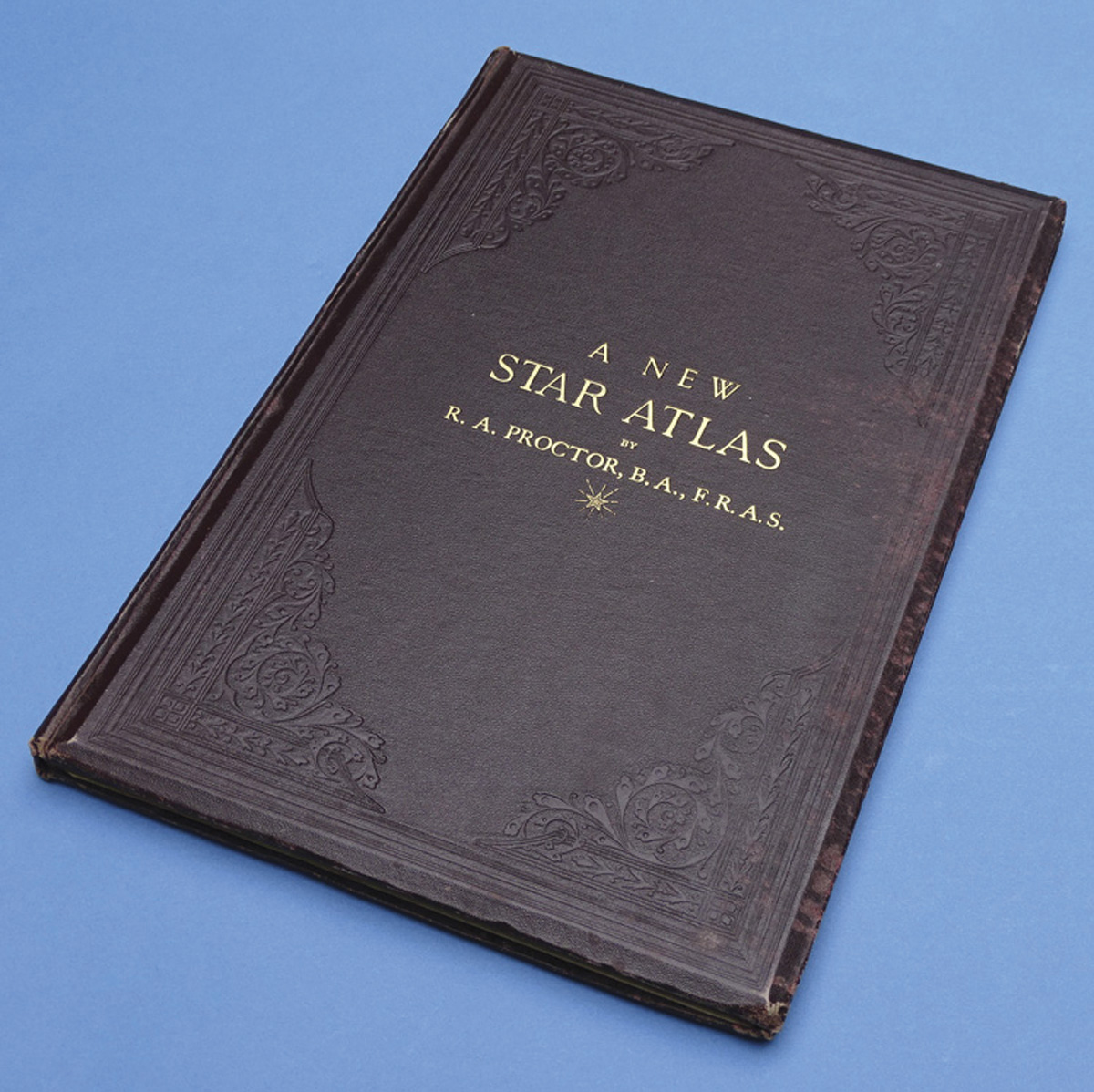
PROCTOR'S "NEW STAR ATLAS," English, 1870, the large 10" x 14-3/4" (25 x 37 cm) volume with cloth-bound covers, stamped with foliate designs in the spandrels and gilt-stamped with the title. With 27 text pages, 12 double-page circular charts, and two double-page "index" plates, the atlas presents "All the stars visible to the naked eye, and fifteen hundred objects of interest,... without appreciable distortion, on an adequate scale, and within a convenient volume." Most interesting are the two index plates which present the entire sky in trapezoidal and pentagonal segments and with the classical constellation figures delineated and colored. Condition is fine noting minor foxing and slight wear to the cover's edges. A fine atlas, by the famous astronomer Richard Proctor, here in the 1870 first edition. (10046) $350. |
 |
 |
| The Elegance of Master Jesse | Click on any image for a larger view. Scroll to view more items. |
 |
|
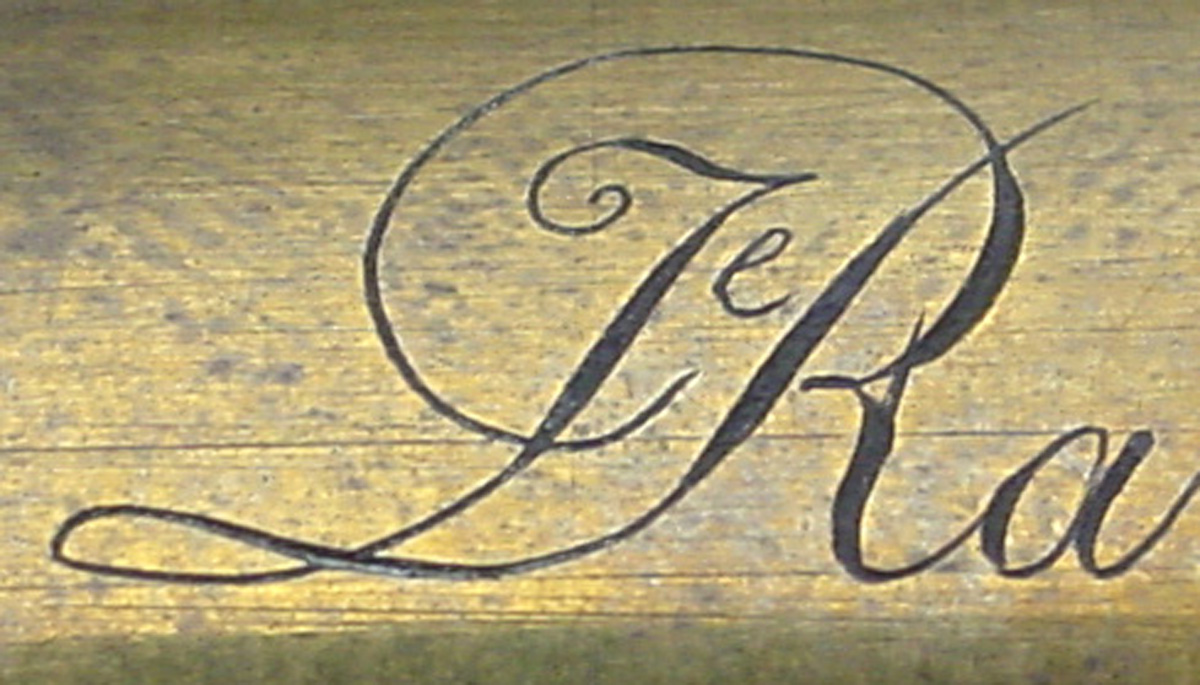
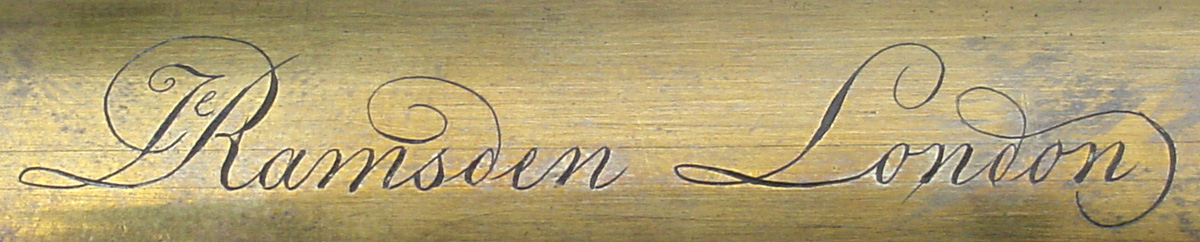
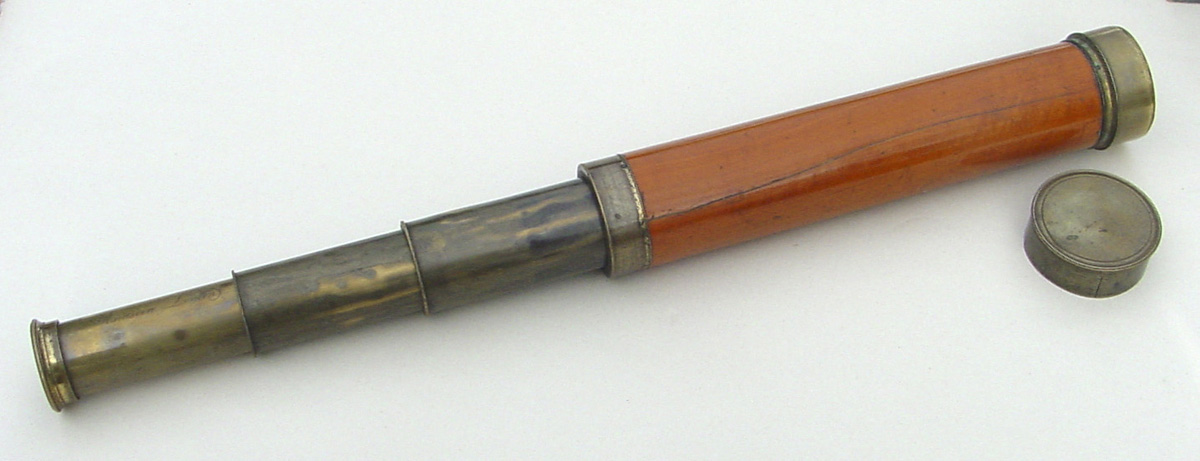
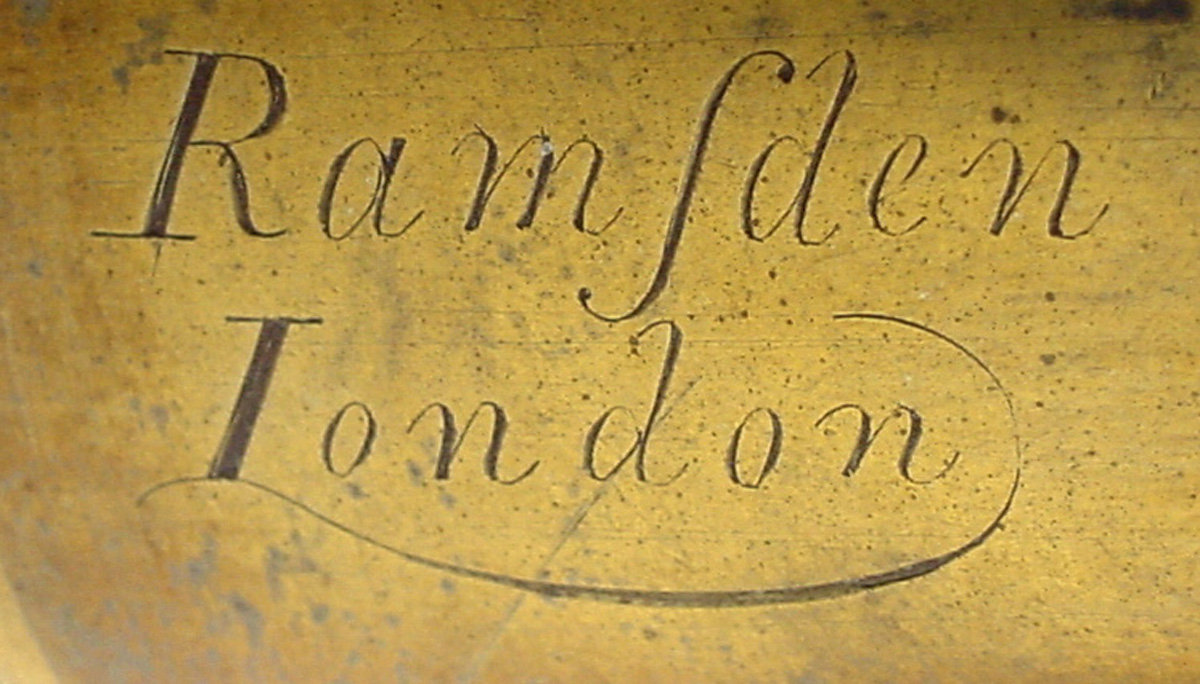
"JE. RAMSDEN" THREE-DRAW TELESCOPE, exquisitely script engraved "Je Ramsden, London," with exceptional flourishes to some letters. Opening from 9-3/8" to 28-3/4" (24 to 73 cm), the telescope has main tube bound in beautifully grained orangish wood, three brass drawtubes, 1-5/8" diameter triplet achromatic objective, four-element erecting eyepiece system (in an interesting variant of the Huygens erecting system, the two inner lenses here being biconvex; PC/CC/CC/CP), dust cap and dust slide. Condition is fine throughout noting a couple of age cracks to the wood and a number of quite small dents to the drawtubes. This is a good example of a quality instrument by the "master," with his beautiful and quite unusual first-name signature. (8076) $1650. |
 |
 |
|
We are pleased to be able to offer several telescopes by the English master, Jesse Ramsden, and by his workshop and apprentices. While studying them we discovered quite a variety of optical arrangements of the lenses in the erect-image eyepiece systems. It was a period of rapid evolution in the improvement of image quality and the correction of aberrations. John Dollond (senior) received his patent for the achromatic doublet objective in 1758, and his son Peter made the first triplet objectives about 1763 (see King, 1955). Meanwhile there was experimentation and evolution in the design of the eyepiece systems, ranging from the sequences of 1, 2, 3, 4, or 5 biconvex lenses, to the systems using Huygens or Ramsden couplets of plano-convex lenses, etc. We have inspected these eyepiece systems and tried to describe them succinctly (as in the collation of a book); proceeding from the objective end to the eye end, we label each lens surface in sequence with P for plano (flat) and C for convex (bulging outward). Thus the eyetube of our major seven-foot long telescope has five ³CC¹s² in a row. A simple two-element Huygens eyepiece would be CP/CP and a similar one, but to a design introduced by Ramsden about 1787, would be PC/CP. |
| A Ramsden Masterpiece, c. 1770 | Click on any image for a larger view. Scroll to view more items. |
 |
 |
|
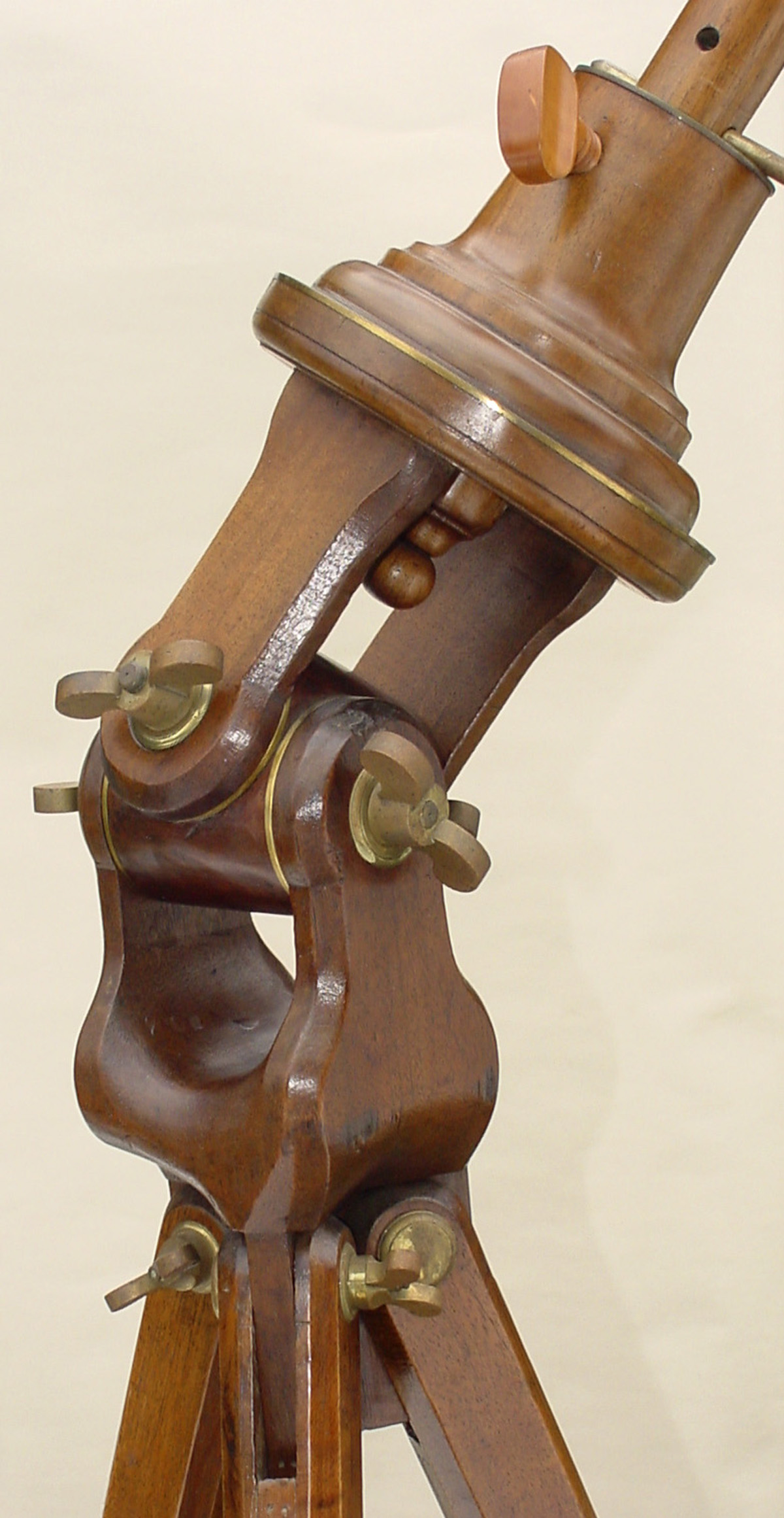
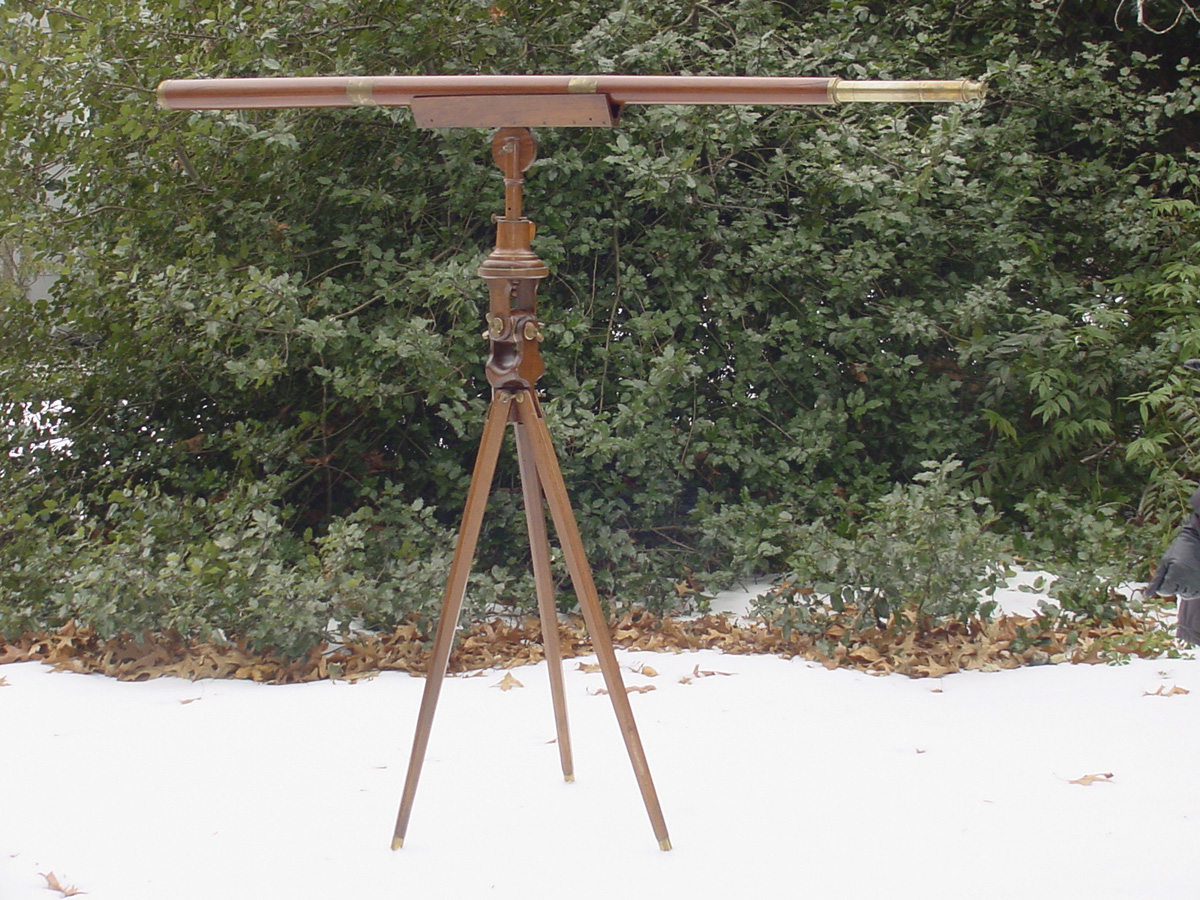
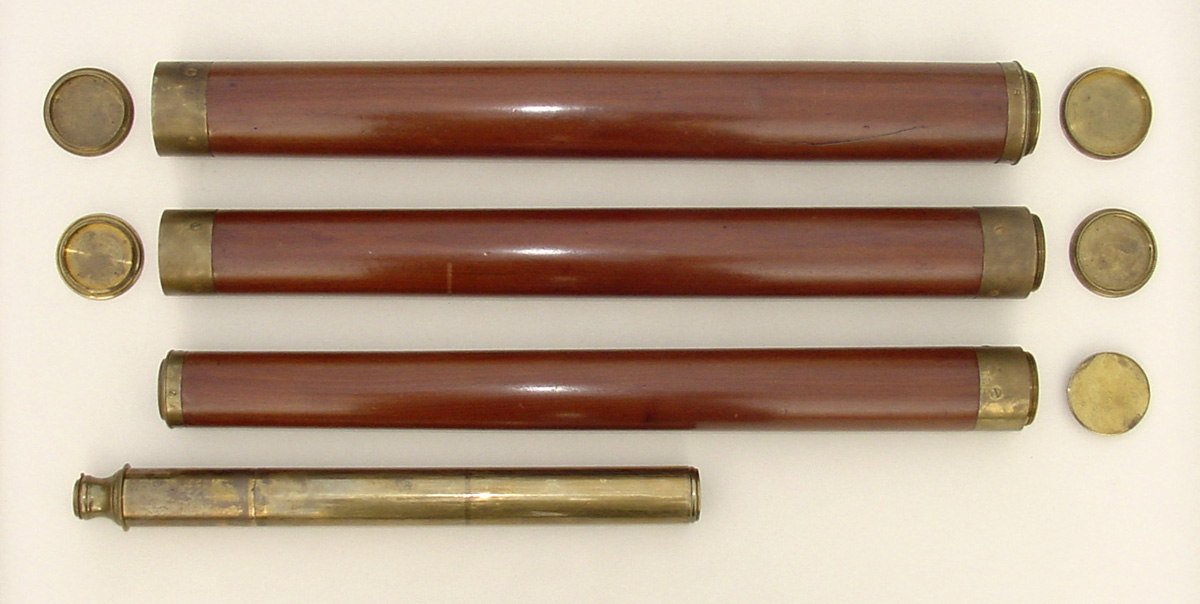
EXTRAORDINARY LONG GLASS BY RAMSDEN WITH UNIVERSAL MOUNT, c. 1770. This spectacular telescope assembles from three brass-bound, tapered mahogany tubes, plus a single brass drawtube, to form a smoothly tapered long glass with a remarkable extended length of 7" 3" (2.2 meters). The brass fittings are very sturdy, and all three tubes have threaded dust caps for the ends. The slightly greenish objective is an achromatic doublet with a 2" clear aperture. The 17-1/2" long drawtube is segmented, with bulbous end, and contains a system of five biconvex lenses, this an optical arrangement designed to improve the field of view (CC/CC/CC/CC/CC). Thus the telescope dates after the 1758 introduction of the achromatic objective, and before the movement, by 1780, to the four-lens Huygenian eyepiece, to multiple brass drawtubes, and to the flared eyecup assembly (see King, and Cheetham). The telescope produces erect images of high quality and magnification. Condition is very fine noting some oxidation to the brass. The handsome tripod is professionally made of walnut(?) with brass fittings throughout, including numerous decoratively shaped sturdy brass clampnuts. The eight-sided legs are 44" long, clamping to a double yoke which supports the universal mount. The main yoke block is a complex, beautiful shape, hand carved from a single block of wood! The twin yokes may be clamped for use as altazimuth mount, equatorial mount, or any other combination. The telescope itself is held down by straps (not present) in a wood trough 21" long, adjustable about the two axes. A pin provides further settings for telescope height, above the ground, 72" maximum. Both telescope and tripod are rare, beautiful examples of high quality. (8086) $29,500. |
 |
 |
|
JESSE RAMSDEN "In person he was above the middle size, slender but extremely well made, and to a late period of life possessed of great activity. His countenance was a faithful index of his mind, full of intelligence and sweetness. His forehead was open and high, with a very projecting and expressive brow. His eyes were dark hazel, sparkling with animation but without the least fierceness. His nose aquiline and very handsome. His mouth rather large, but in speaking it had an expression of cheerfulness and a smile the playful benevolence of which will not easily be forgotten by his friends. His tone of voice was singularly musical and attractive, and his whole manner had a character of frankness and good humour which he well knew to be irresistible." (L. Dutens, in Aikin, 1813; McConnell p. 20). |
| Seventeeth Century Map of the Heavens | Click on any image for a larger view. Scroll to view more items. |
 |
 |
|
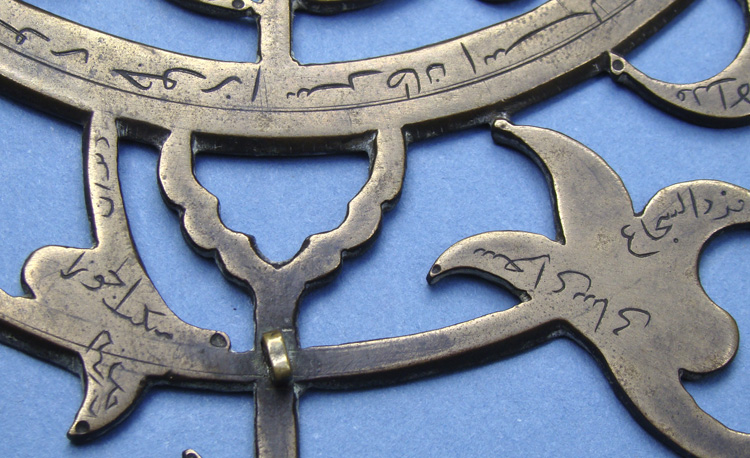
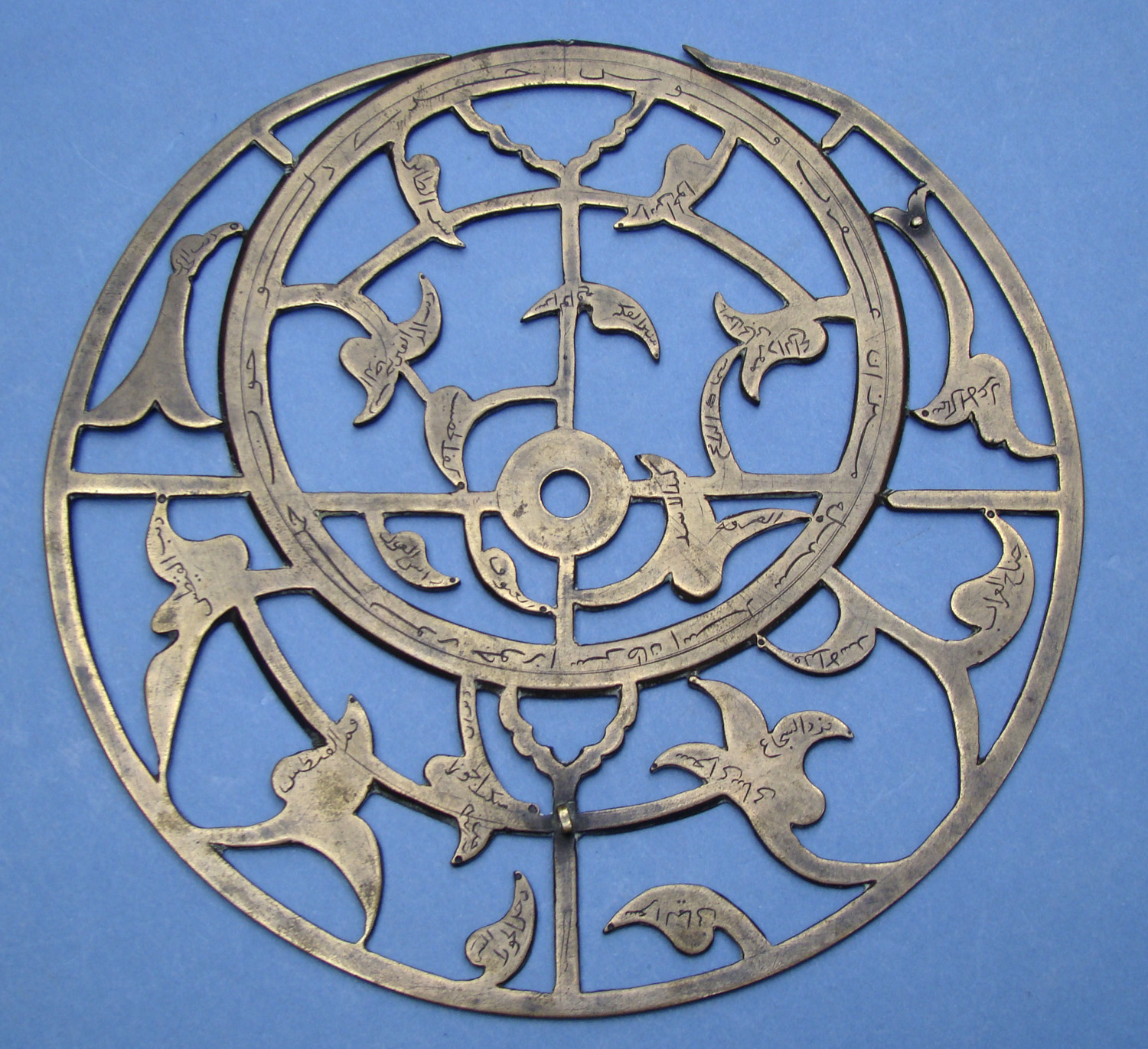
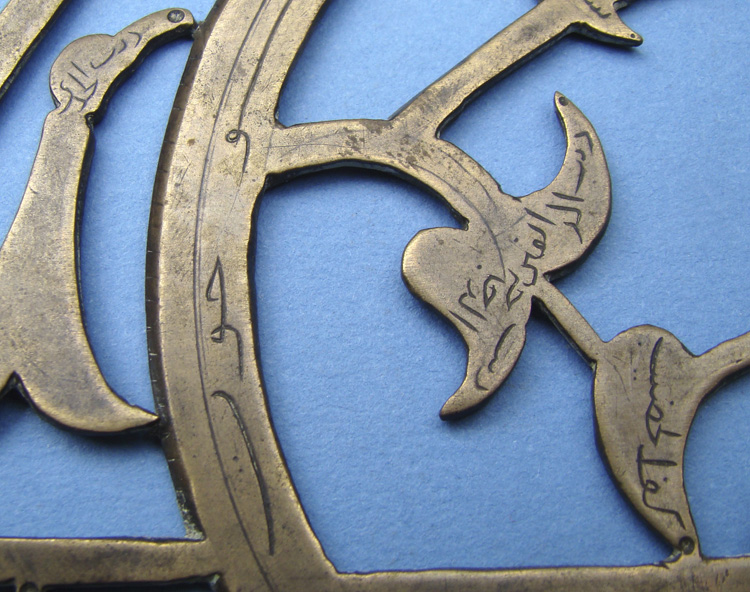
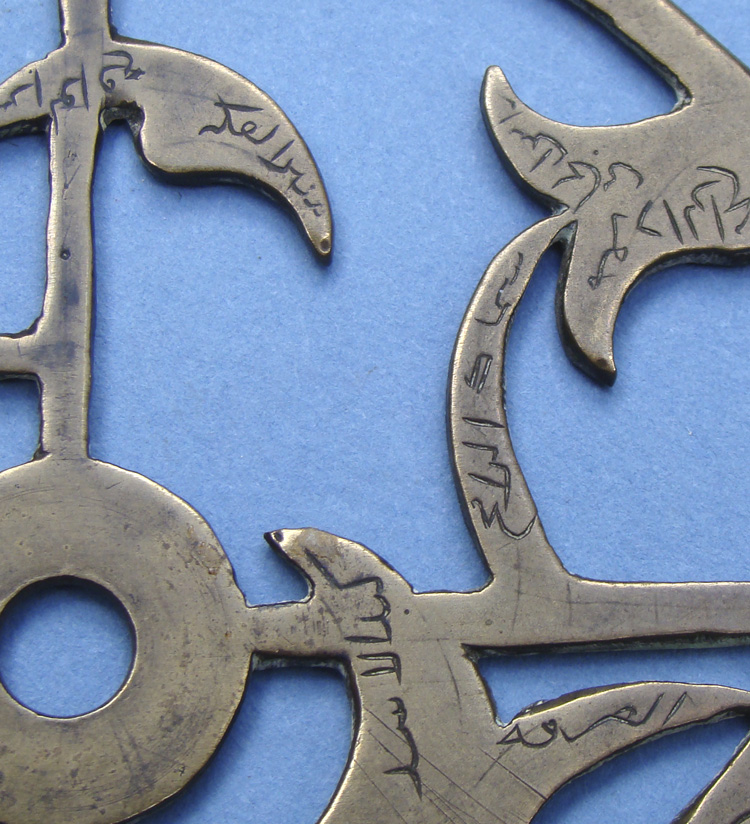
ELEGANT ASTROLABE RETE WITH FLORAL DESIGN, Indo-Persian, c.17th century, of pierced and hand-engraved brass, 6" (15 cm) in diameter. Engraved in Arabic script, the rete, with its map of the heavens and celestial coordinate system, has a circular ecliptic band labeled with the twelve Zodiacal houses and subdivided on the beveled edge for every two days. Arcs of the equator are included inside the upper half of the ecliptic, and outside the lower half. A horizontal bar is counter-changed at the equinoxes and at the center, and a vertical bar is interrupted by two fine multi-lobed bifurcated decorative frames. There are 26 labeled star pointers on elegant floral supporters, most with small incised points at their tips, to indicate the precise star positions. Condition is very fine, noting light wear and slight bending of the tips of the circumferential ring. Included is a star list, giving transcriptions of all the star names plus their equivalent modern constellation locations. This decorated rete is in the Indian tradition, possibly from Lahore. It is notably similar to the rete on a large Indo-Persian astrolabe, illustrated and described by S.R. Sarma in his on-line A Descriptive Catalogue of Indian Astronomical Instruments, 2016, item B015. The present rete is B016 in Sarma¹s comprehensive catalogue. A fine early example. (10065) $2950. |
 |
 |
| By a Maker of Rock-Crystal Lenses | Click on any image for a larger view. Scroll to view more items. |
 |
 |
|
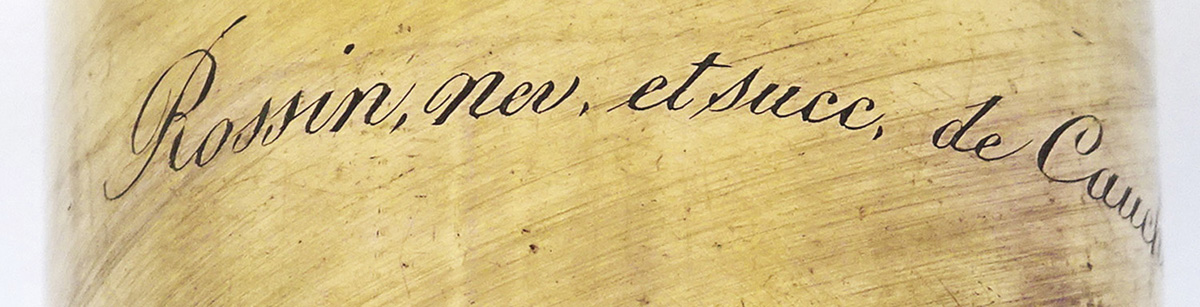
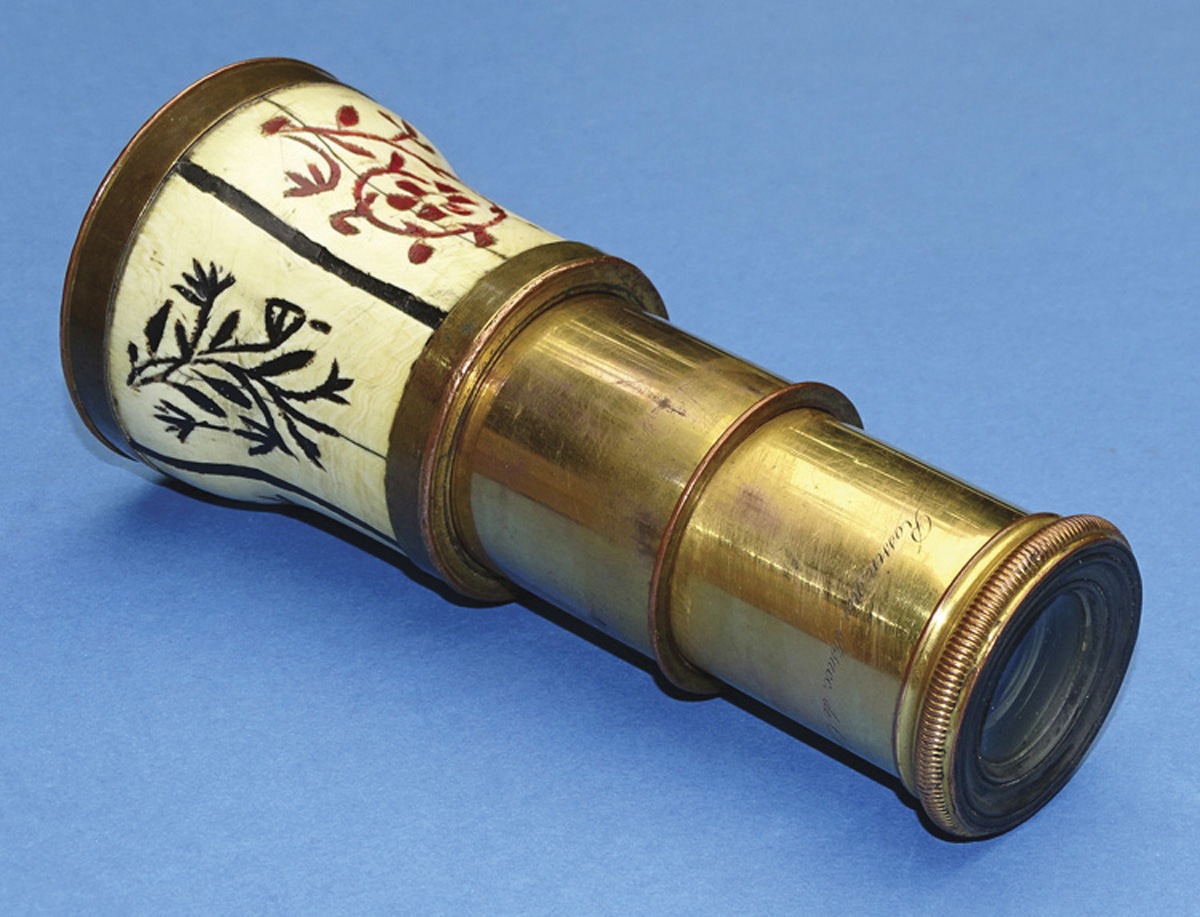
UNUSUAL LARGE POCKET TELESCOPE WITH HELICAL FOCUS, French, late 1830's, signed "Rossin, nev. et succ. de Chauchoix." Opening from 3-1/2" to 6-3/4" (9 - 17 cm), this large "monocular" is made of gilt brass with two drawtubes, the bell-shaped main tube bound in four floral-filled panels alternating red and brown. The singlet objective is a full 2-1/4" in diameter, and with the thick bi-concave eye lens gives bright erect images. Focusing is by helical thread to the first drawtube. Condition is fine noting hairline cracks to the panels. Rossin was Cauchoix's nephew, working with him and taking over the workshop in 1836. Robert Aglaé Cauchoix (1776 - 1845) became famous as lens maker, producing lenses of rock crystal, publishing on them in 1828. His achromatic telescope received a gold medal, and he supplied telescopes to Cambridge Observatory. Rossin himself is known for a lorgnette with crystal lenses (see Marcelin). (10056) $1450. |
| The Earth viewed from above the North and South Atlantic | Click on any image for a larger view. Scroll to view more items. |
 |
|
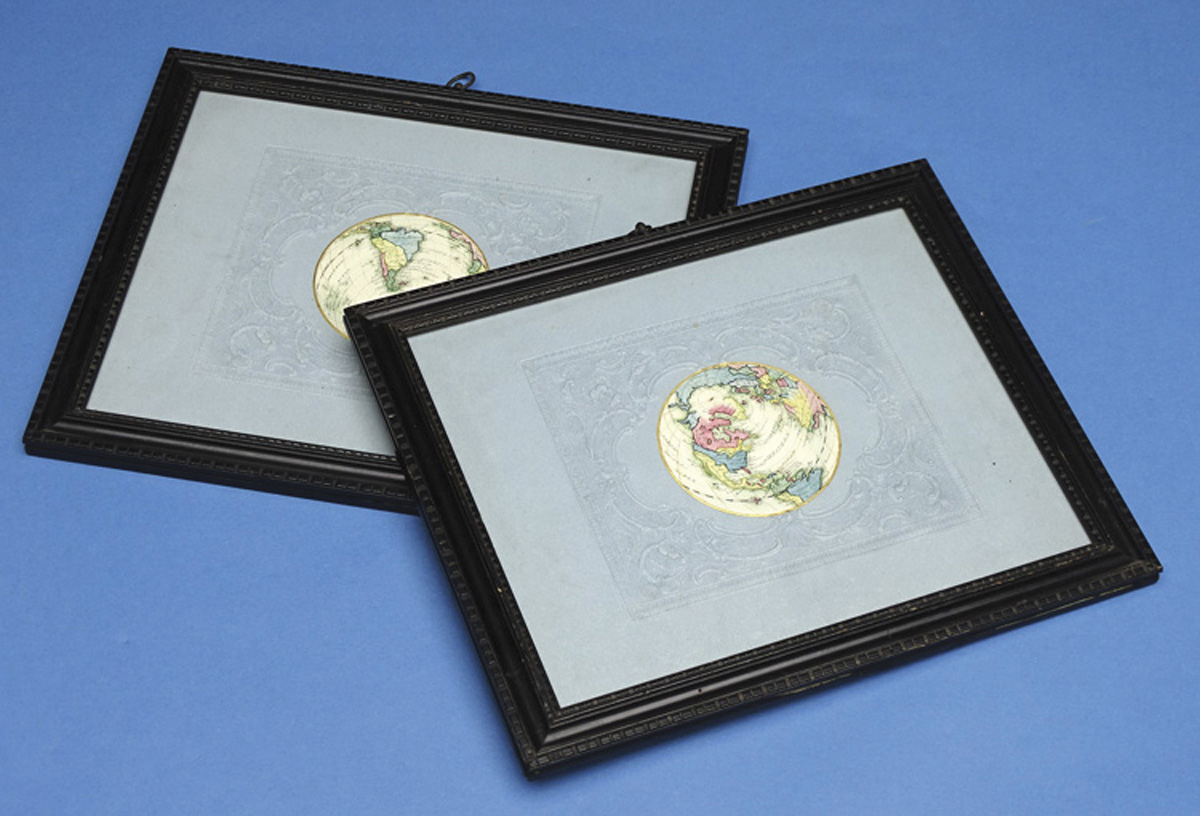
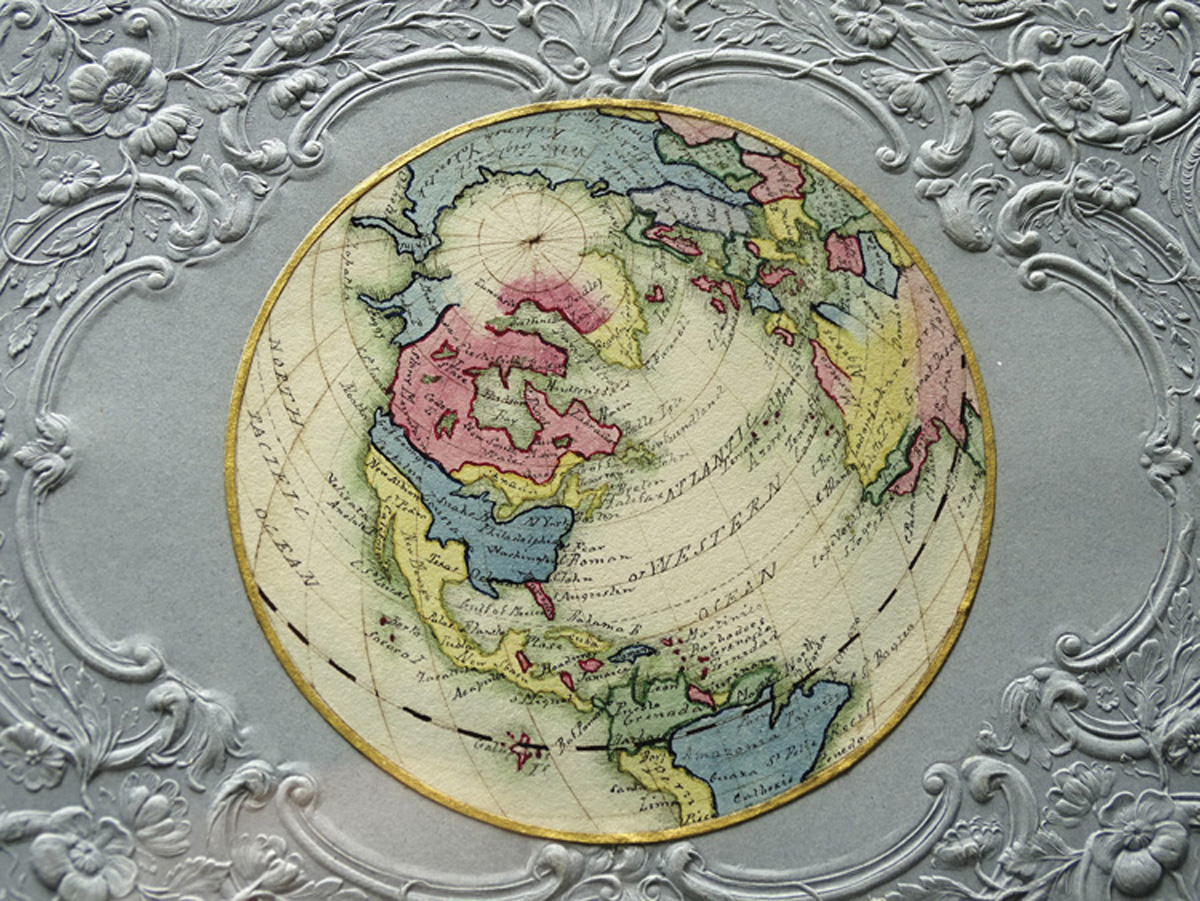
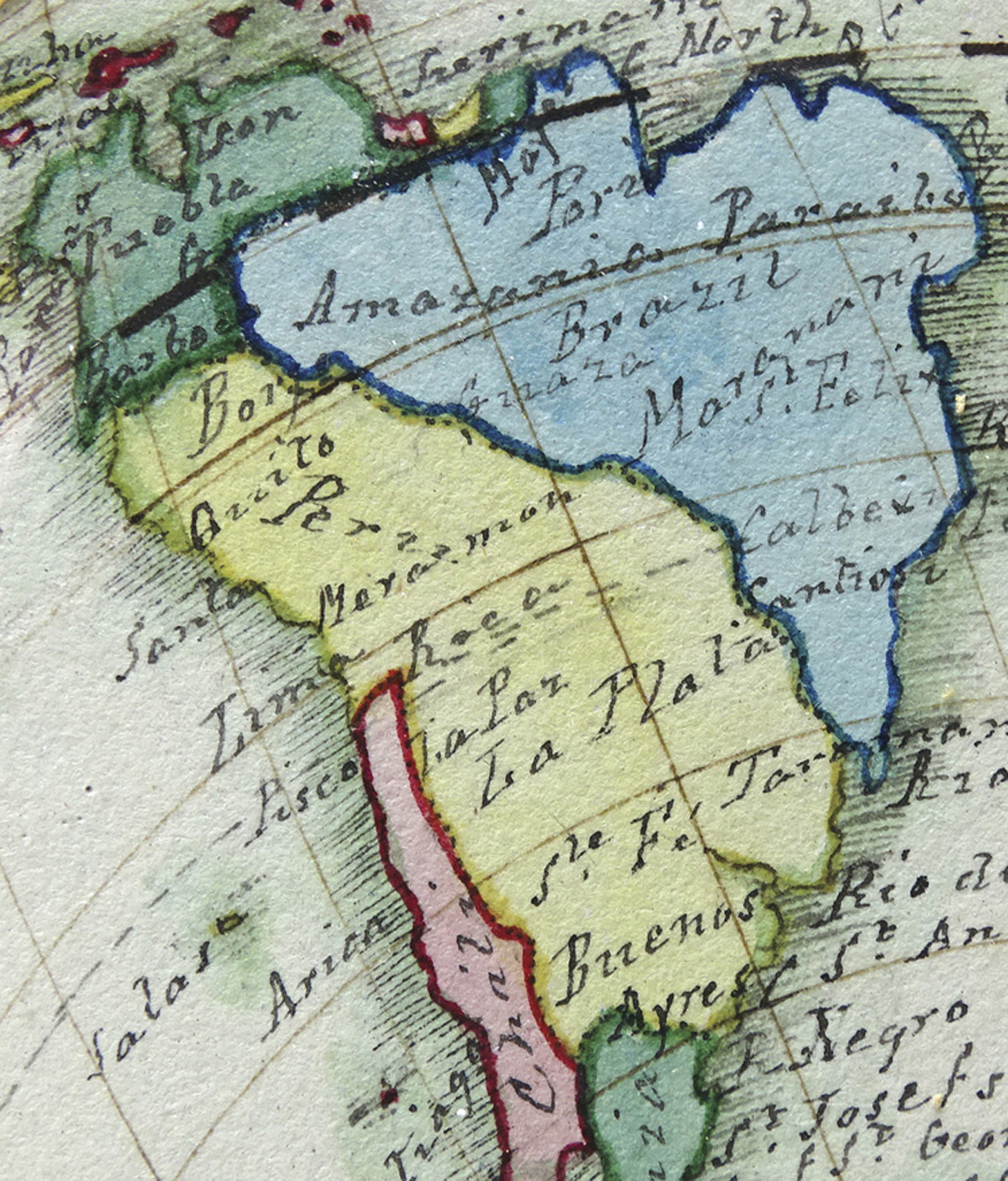
FINE PAIR OF VICTORIAN PLANISPHERES, English, c. mid-19th century, the 3-1/2" (9 cm) diameter disks inked very finely in manuscript, with full hand-coloring to the land. They are mounted to fine pressed paper mats showing beautiful floral patterns, backed by wood panels, and set behind ripply glass in ebony frames with geometric ridging, each frame 10-3/4" x 13" (27 x 33 cm) overall. Condition is excellent throughout. The projections of the earth are centered in the North and South Atlantic Ocean, and thus cover from circumpolar regions to beyond the equator, especially in the Western Hemisphere. A most attractive pair. (10076) $1750. |
 |
 |
| The Dollonds' Remarkable Split-Image Telescope | Click on any image for a larger view. Scroll to view more items. |
 |
 |
|
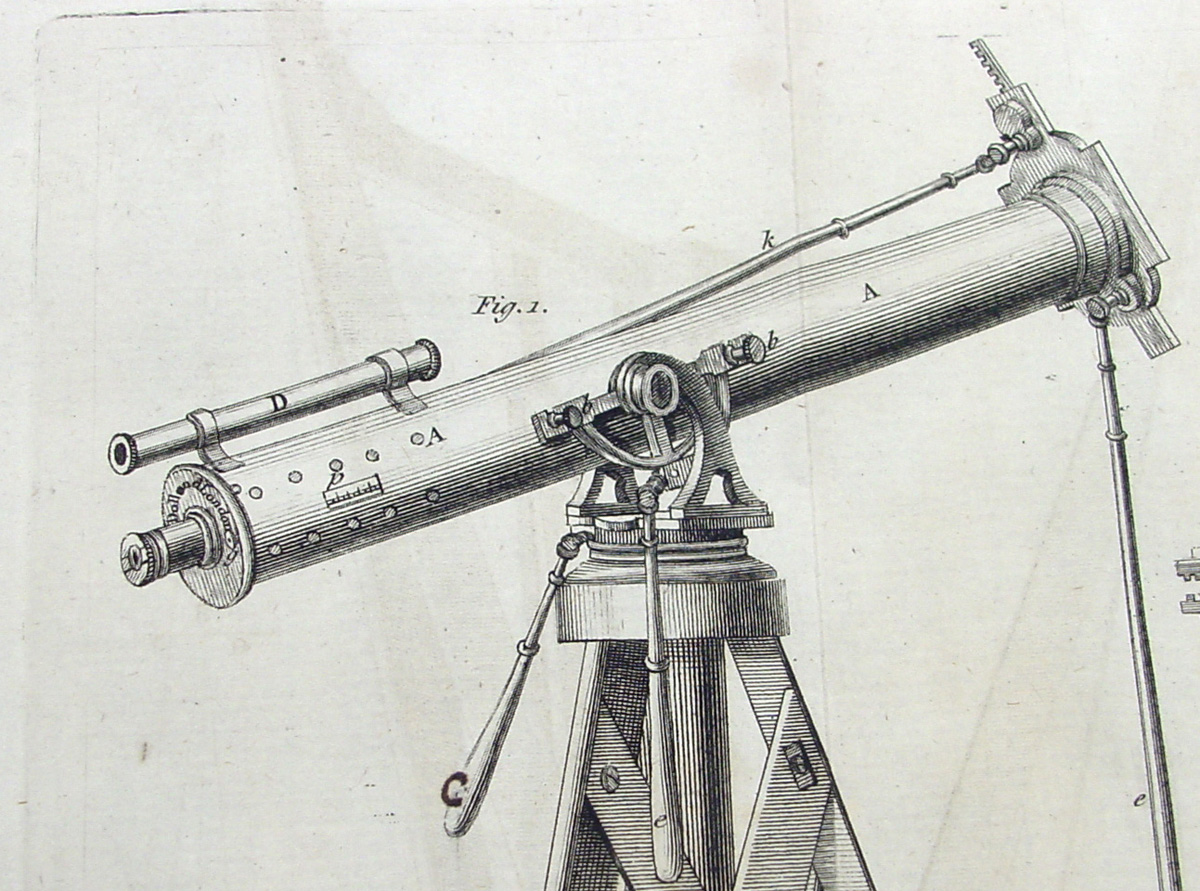
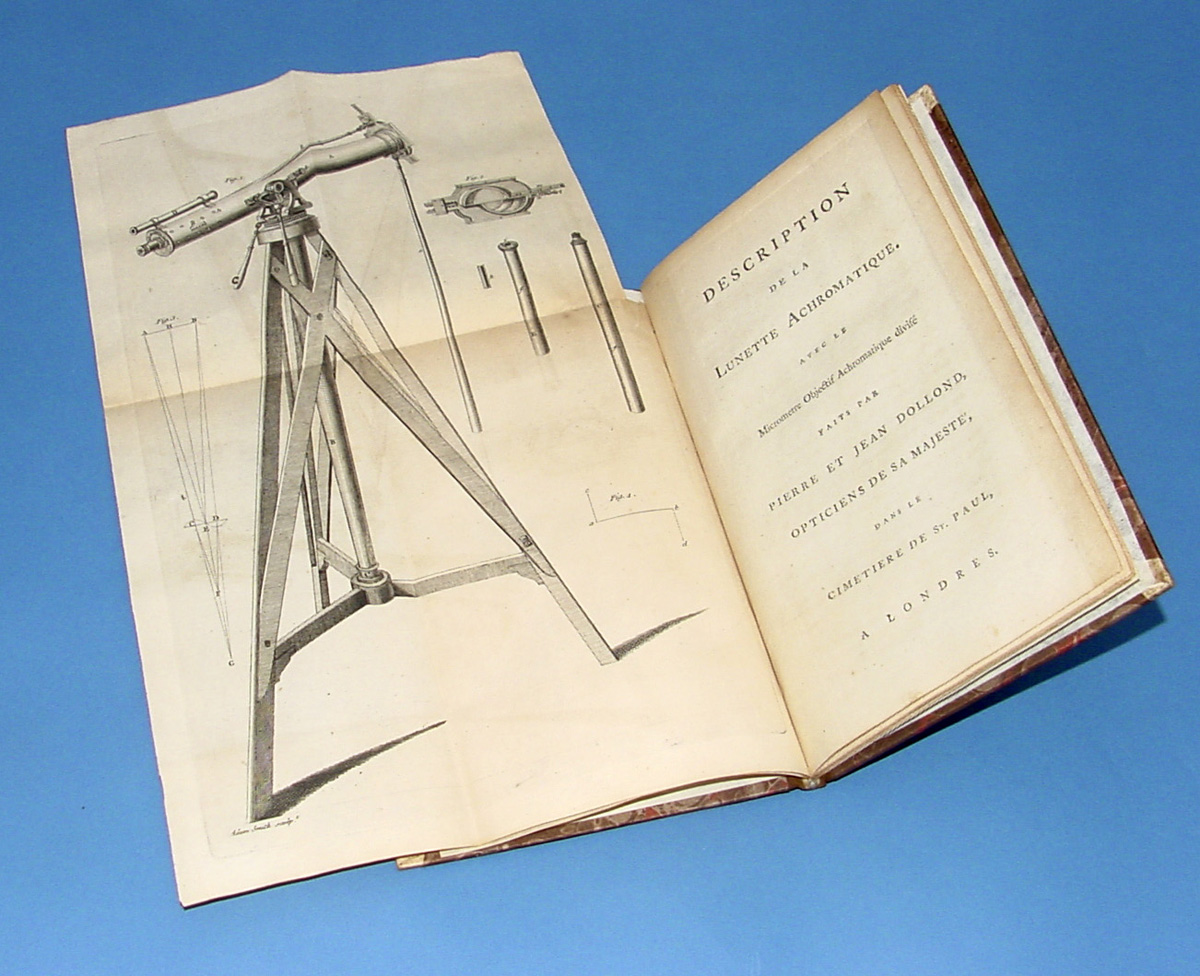
"DESCRIPTION DE LA LUNETTE ACHROMATIQUE, AVEC LE MICROMETRE OBJECTIF ACHROMATIQUE DIVISE, FAITS PAR PIERRE ET JEAN DOLLOND, OPTICIENS DE SA MAJESTE, DANS LE CIMITIERE DE ST. PAUL, A LONDRES," English, c. 1775, being a rare example of the separately published 20 page booklet describing Peter and John (II) Dollond's refractor with its micrometric split-objective, that being a triplet achromat of 3-1/2 feet focal length. The large fold-out plate shows the instrument with its fine stand, long control rods, extra eyepieces, and complex mount for the split objective. Condition is very fine, with a sympathetic 20th century binding measuring 5-1/4" x 8-1/4" (13 x 21 cm). Several typographic errors in the text show old hand corrections. The use of French here is not surprising. There was much cross-Channel activity at the time, and we find various of the Dollonds¹ booklets, instruction sheets, etc. offered in both languages. It was John Dollond senior who, in 1754, proposed his divided-glass micrometer to the Royal Society. His achromatic objective lens was now two half-lenses, mounted one above the other and with sideways offset adjusted by calibrated fine screw motion. One saw two offset images in the eyepiece, and could directly measure the diameters of planets, sun, or moon, just by bringing their opposite limbs into contact. (see King, 1955). A rare publication of which we find very few copies in libraries. (8256) $3950. |
| The Dollonds' Remarkable Split-Image Telescope | Click on any image for a larger view. Scroll to view more items. |
|
FRAGMENTARY DESCRIPTION OF THE 30" LONG ACHROMATIC REFRACTOR, English, c. 1810. Measuring approximately 6" x 8" (15 x 20 cm), this is a portion of a single printed sheet describing the instrument made by Peter and George Dollond (and thus dating after John II's death in 1804, and before Peter's in 1820). Printed in London, it describes, in French, the 2" objective of convex crown glass and concave flint glass, the terrestrial and celestial eyepieces with magnifications of 50 and 80 times respectively, the colored glass to protect the eye when observing sunspots, etc. Condition is rough and torn, but it is the complete French text portion of the (typically) bilingual Dollond broadside. (not illustrated, afd) (8266) $95. |
| Antique Japanese Telescope with Provenance | Click on any image for a larger view. Scroll to view more items. |
 |
 |
|
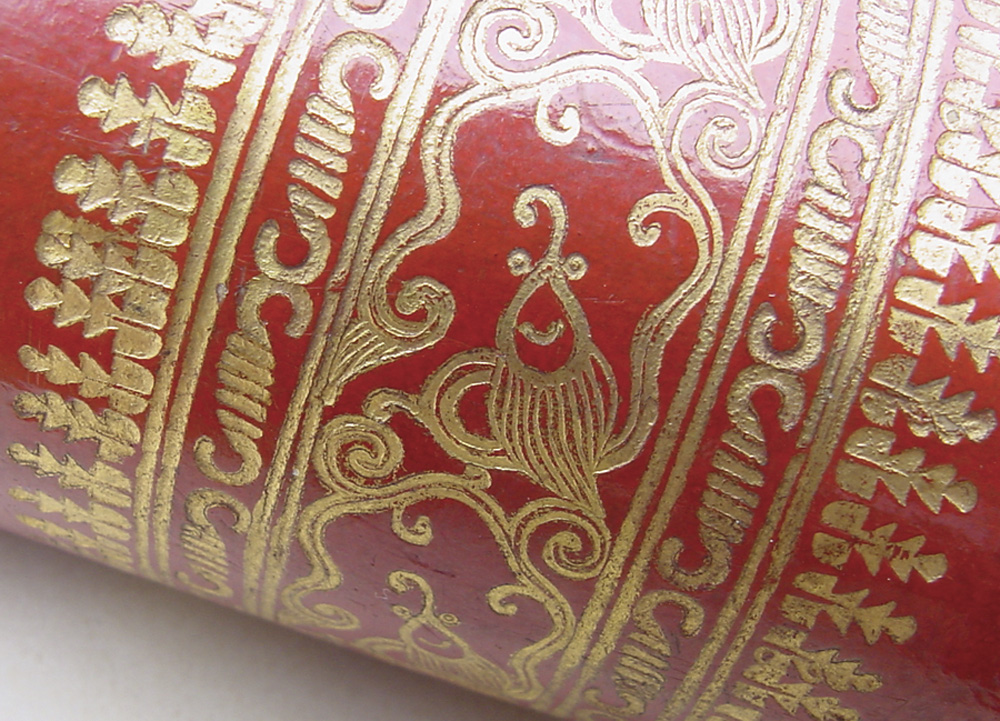
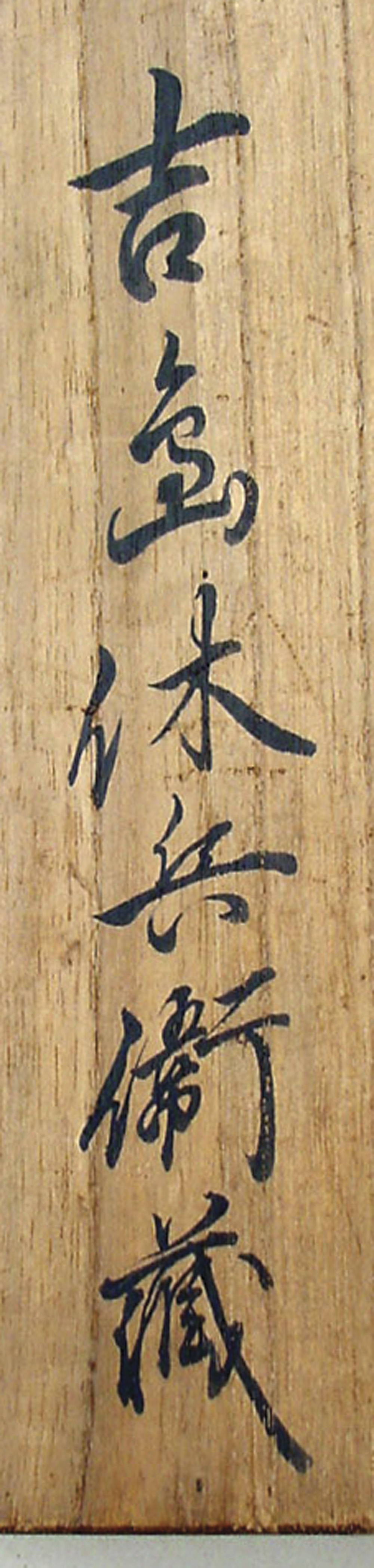
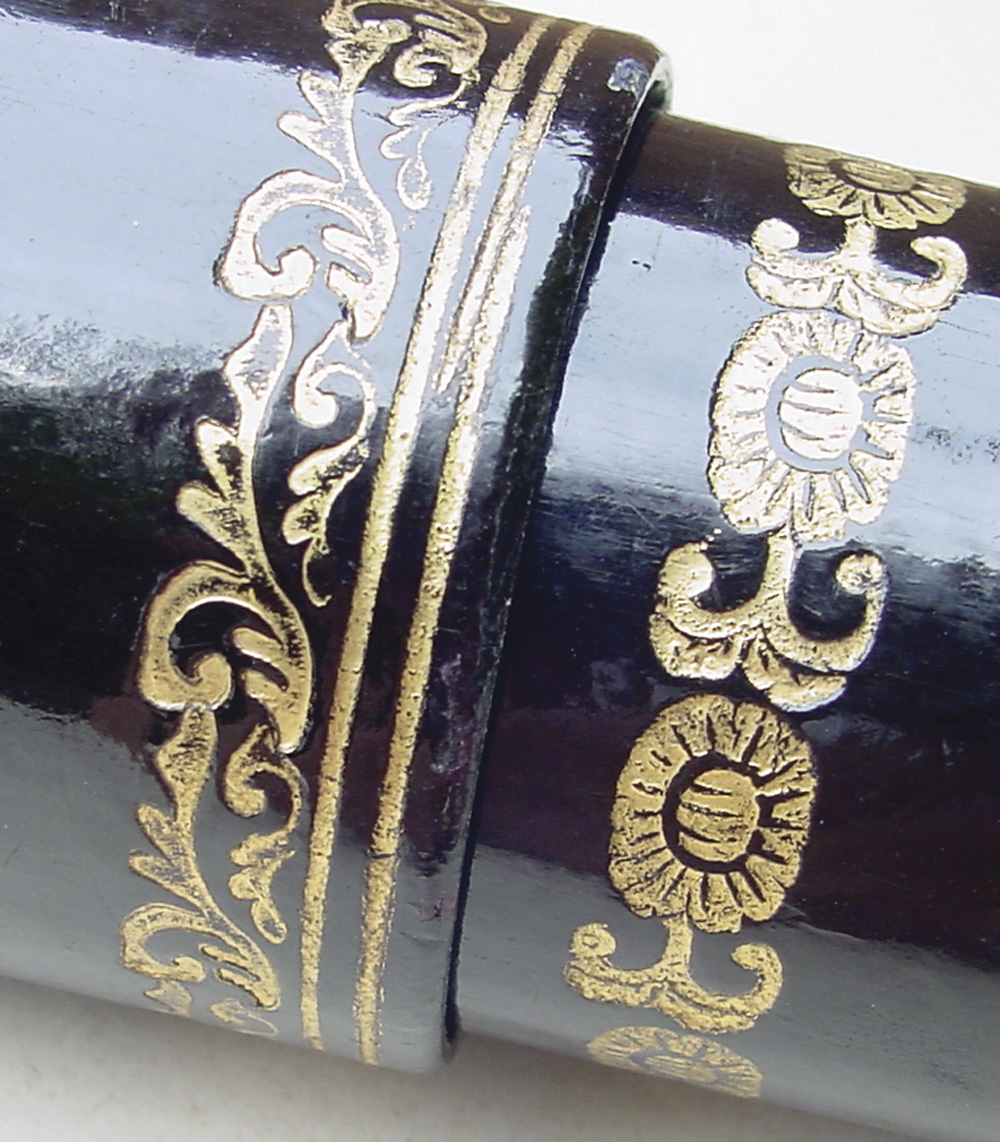
JAPANESE LACQUERED TELESCOPE, c. mid-19th century, the rolled card and wood tubes heavily lacquered in black and rust, with gilt stamped decoration. It opens from 14" to 38" (36 to 97 cm) on three drawtubes, the tubes slightly tapered for rigidity when fully open. The eye surround is turned horn, and the optics consist of a two-element eyepiece system plus a singlet objective mounted between card disks and set behind a brass aperture which stops down the 2" wide main tube to a tiny 7/16". The outfit is complete with lacquered end caps and its softwood (probably camphor wood) box with lid, all in very fine condition noting some internal lacquer loss on the smallest drawtube. There are inscriptions throughout, all in Japanese kanji. The number "16" appears on the eyetube, the objective cell, and both endcaps, and is probably the batch serial number (to match up the correct hand-made parts during construction of several instruments at once). The case ends and lid are marked "telescope," and the owner's name appears twice "owned by Mr. Kyubei Yoshijima." Within the box is a large marked sheet of rice paper, probably 19th century but possibly unrelated to the telescope. A splendid example of a beautiful early Japanese telescope. (9018) $5800. |
 |
 |
| Early Wooden Telescopes, in Unusual Sizes | Click on any image for a larger view. Scroll to view more items. |
 |
 |
|
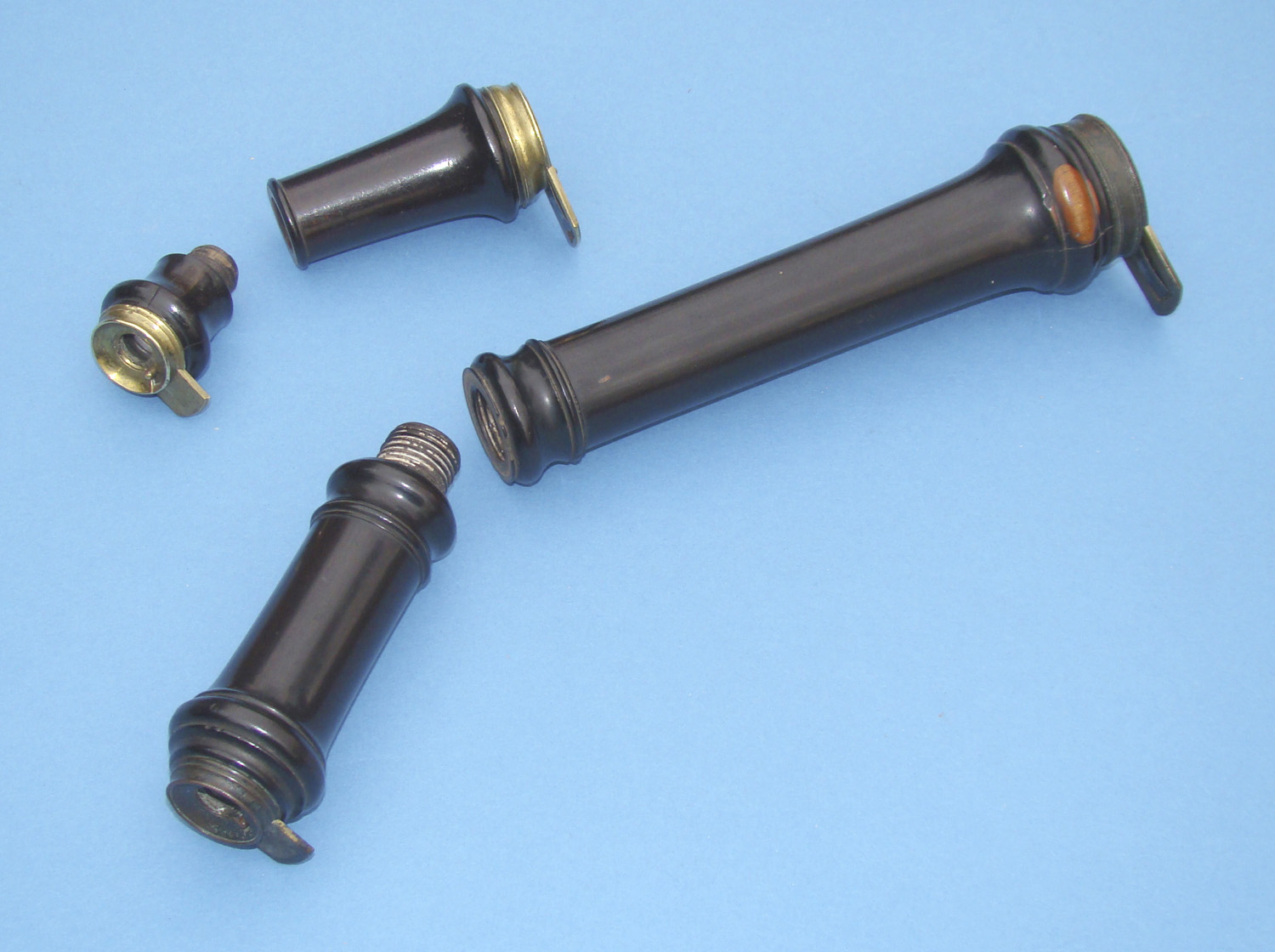
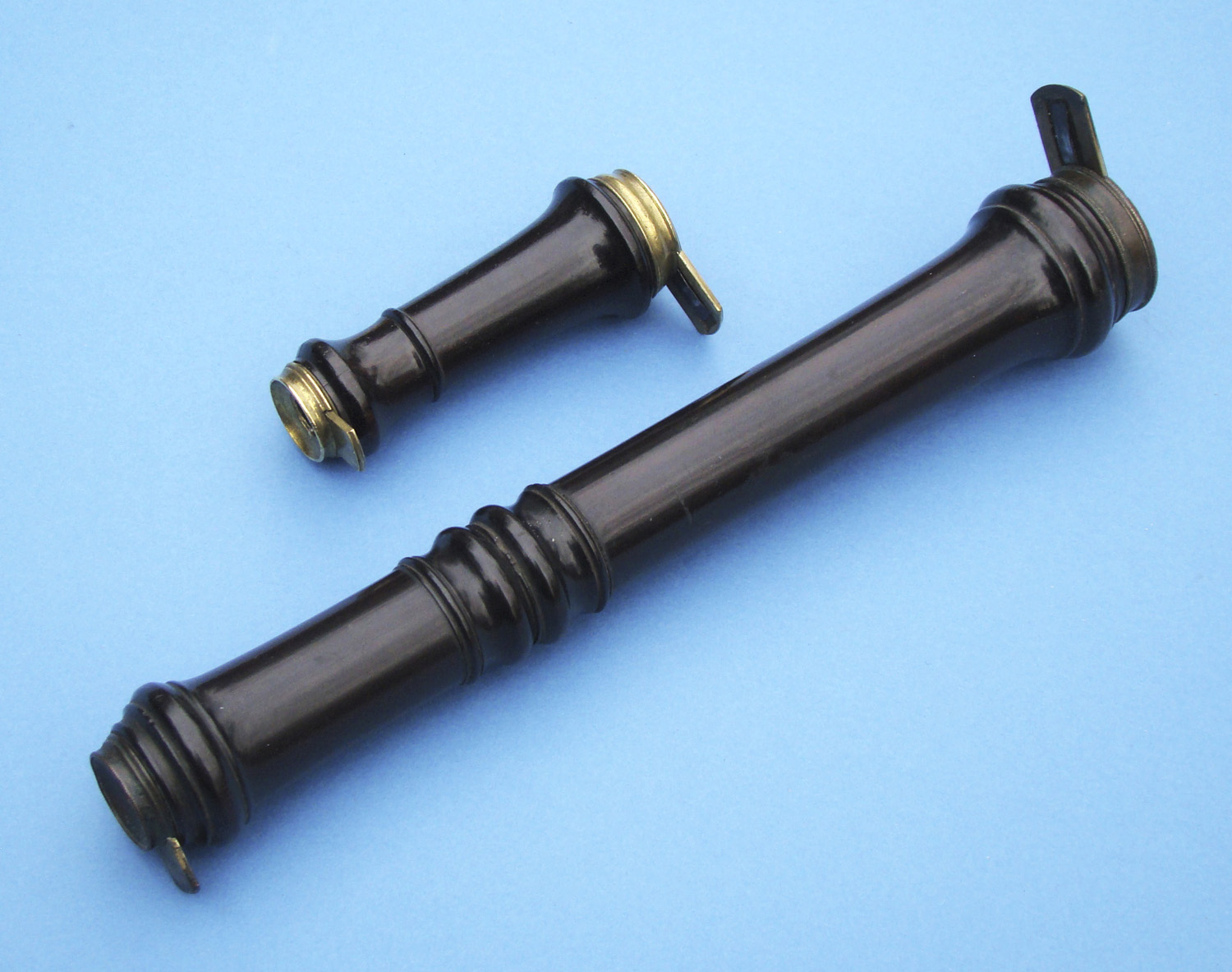
SMALL POCKET TELESCOPE, English, early to mid-18th century. SOLD IMPRESSIVELY LARGE EXAMPLE OF THE LIGNUM TELESCOPE, English, c. early to mid-18th century, measuring 9" (23 cm) overall of beautiful lignum vitae with brass end caps with dust slides (the brass now dark brown). The telescope separates in the middle for focusing. The eye lens is plano-concave with ground periphery, and gives fine erect images, small but of moderate magnification. Condition is excellent. Over the years we have had several English pocket telescopes of lignum, in various sizes, but never one this large and handsome. They were never signed apparently, but we do find "Little Perspectives" advertised (see e.g., John Yarwell¹s 1683 card reproduced in Crawforth, Annals of Science 42, p.540). (10055) $3500. |
| Ramsden's Premises as Focal point for Scientists of the Day | Click on any image for a larger view. Scroll to view more items. |
 |
|
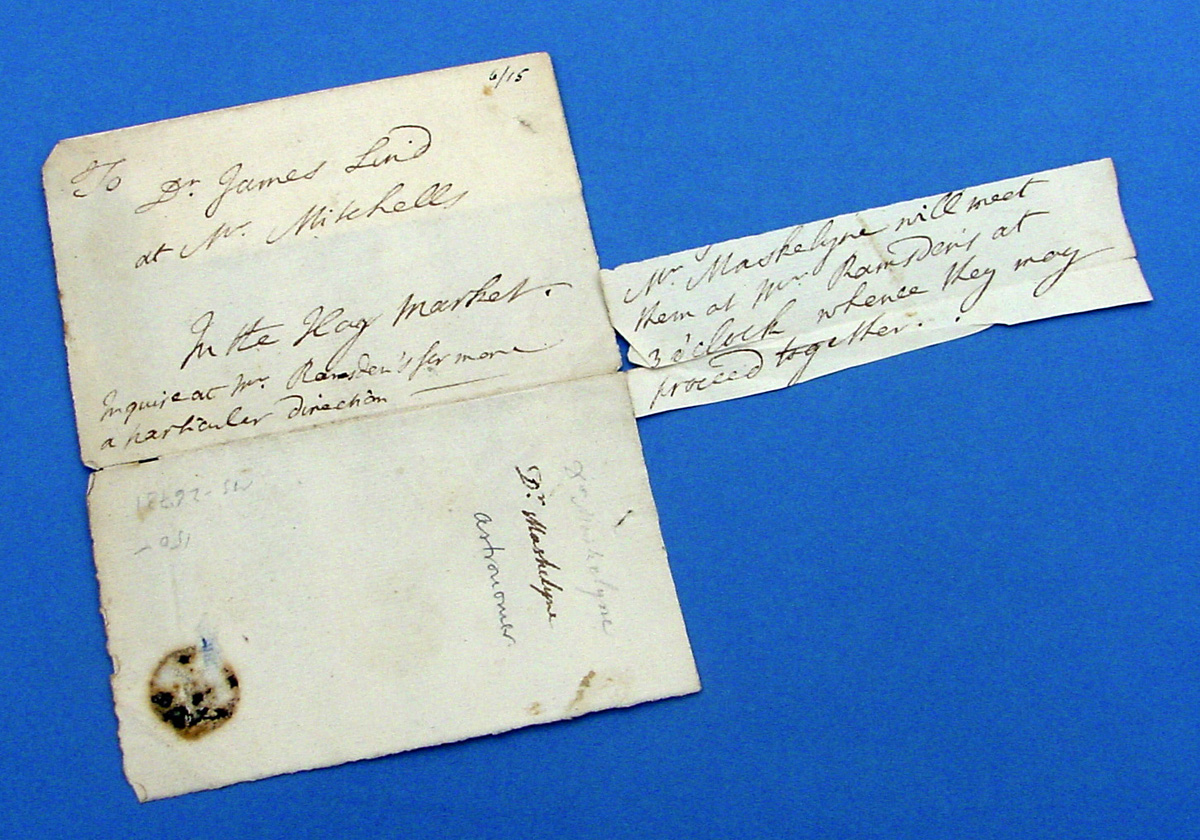
RAMSDEN'S AS MEETING POINT -- A MANUSCRIPT FRAGMENT, English, second half 18th century, the small note addressed to Dr. James Lind, at Mr. Mitchell's in the Hay Market "Inquire at Mr. Ramsden's for more a particular direction." The incomplete contents reads "Mr. Maskelyne will meet them at Mr. Ramsden's at 3 o'clock whence they may proceed together." Condition is fair, with traces of sealing wax. James Lind (1736 - 1812) was a physician (to the Royal Household) deeply involved in London scientific circles. McConnell (2007) finds him variously accompanying Sir Joseph Banks on an expedition to Iceland, receiving a letter from Roy expressing exasperation at Ramsden's continuing delays in completing the great geodetic theodolite, and designing a barometer which Ramsden constructed. Nevil Maskelyne (1732 - 1811) was of course the famous Astronomer Royal, who figures in many of Ramsden's activities. (8166) $550. |
| Pyefinch's Innovation vs. Dollond's Patent | Click on any image for a larger view. Scroll to view more items. |
 |
 |
 |
 |
|
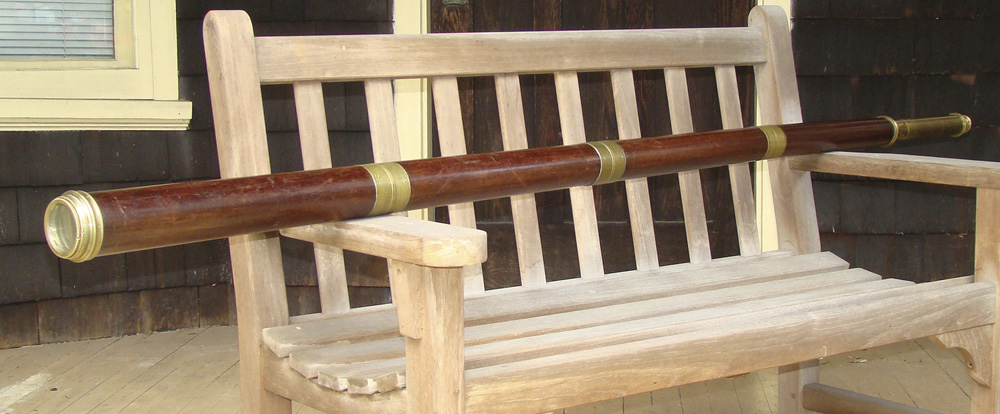
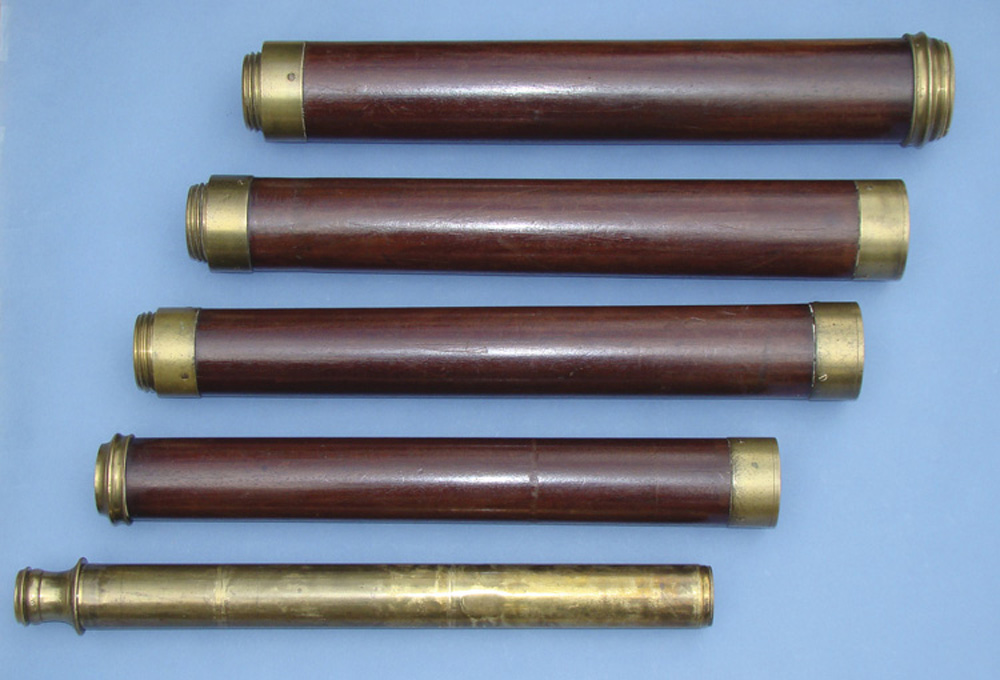
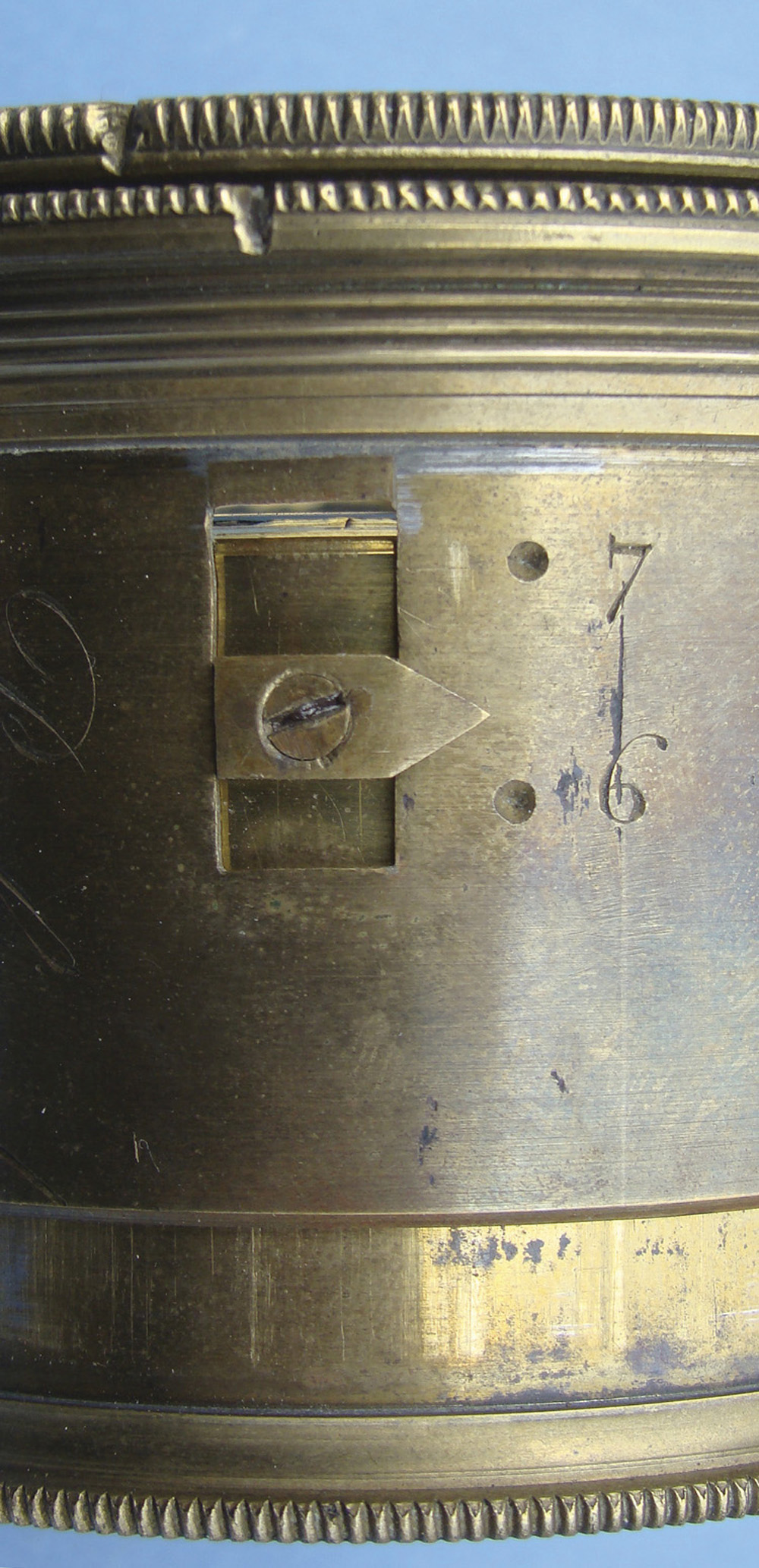
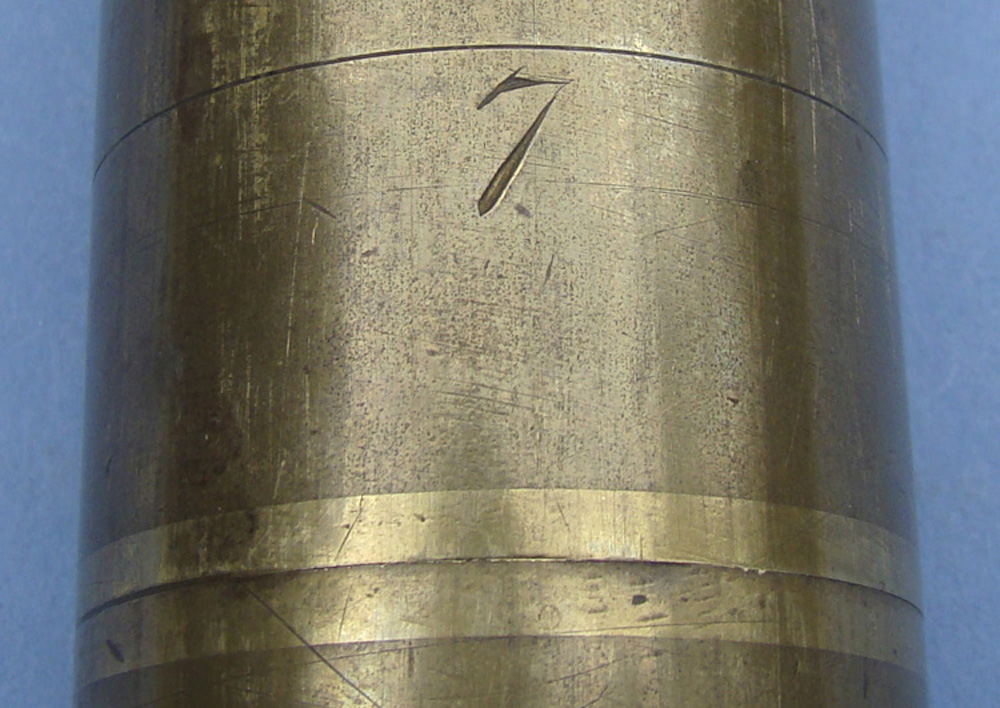
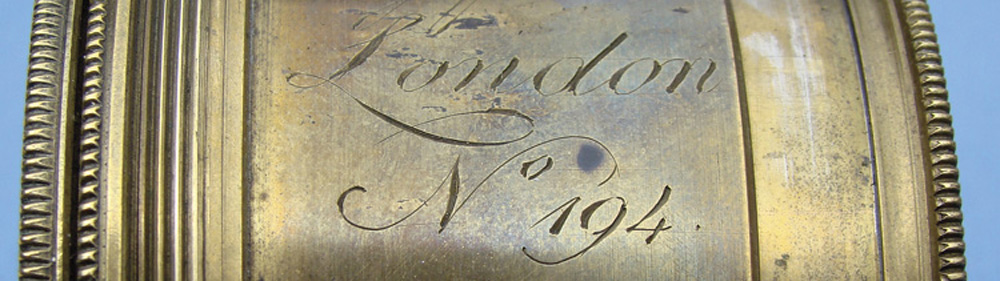
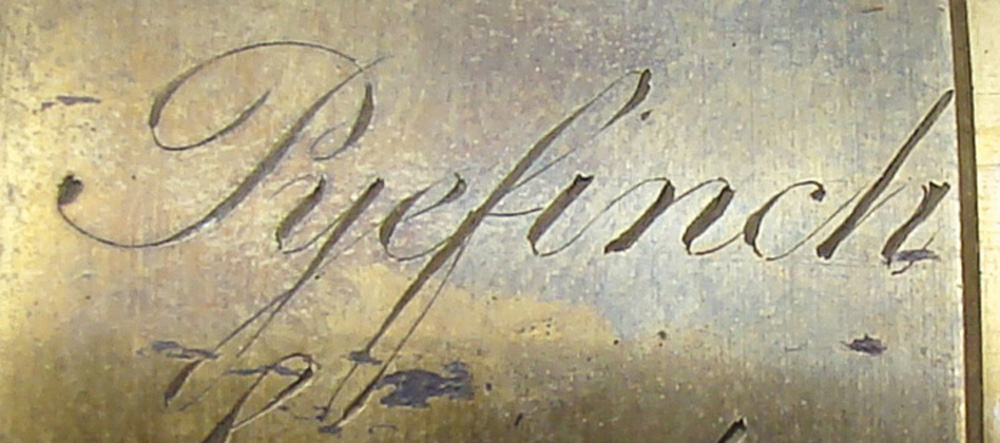
IMPORTANT DESIGN IN A LARGE ACHROMATIC TELESCOPE, English, c. 1770, signed on the objective cell "Pyefinch, London, No. 194." The telescope has a tapered mahogany barrel with substantial brass fittings, constructed in four screw-together sections and one brass drawtube. Overall length varies from 6'3" to 7'4" (1.90 - 2.24 m). The slightly grey-green objective is 2" in diameter, with two elements in notched mounts to assure they are kept in the optimum rotary alignment. The elements have adjustable separation; at position marked "7" they are in near contact, at "6" they have a 3/8" air gap between them. The drawtube contains a four-element eyepiece system with dust slide, and is scored "7" and "6" for two different focal positions 3-7/16" apart, "7" being the longer focal length. The combination gives good erect images of high magnification. Condition is generally fine, the wood with some wear and hairline cracks, the brass with minor dents. The maker was Henry Pyefinch, apprenticed to Francis Watkins in 1753, made free in the Spectaclemakers Company in 1763, working until his death in 1790. He was a fine craftsman and innovator, noting the lovely telescope in Tesseract Catalogue 79 (Item 3), as well as his co-patenting of a novel instrument, the "Aerostathmion." The present instrument is an extremely rare example of an achromatic telescope with variable separation of the objective elements. Various 18th century makers had utilized crown / flint glass combinations to minimize chromatic aberrations in the image, but it was John Dollond who, in 1758, and with the assistance and financial support of his co-partner in this effort, the maker Francis Watkins, obtained letters patent for the achromatic lens. John died three years later, his son Peter becoming proprietor of the business. It is impossible to well summarize here the fascinating history of court challenges to the patent, but a recent book gives the remarkable story in depth (B. Gee, Francis Watkins and the Dollond Telescope Patent Controversy, 2014). Despite rulings upholding Dollond's monopoly, achromatic telescopes were being produced by various London makers. By 1764, Pyefinch left Watkins' employ, and actually formed a trading agreement with Dollond. But within four years the two were exchanging actions and counter-actions. The innovative Pyefinch found an escape from Dollond's monopoly, and in 1770 received his own patent for "refracting telescopes with object glasses therein, composed of two or more different glasses or mediums separate and distinct from each other, and so placed in the tube as that, by altering the distance of the one from the other, the glasses will have greater or lesser magnifying powers without destroying the effect arising from the different refractive qualitys of the several mediums...." Only one other example is known of Pyefinch's freedom from the grip of the Dollond patent (see http://dioptrice.com/telescopes/258). (10023) $24,000. |
 |
 |
| Triplet Lenses Throughout | Click on any image for a larger view. Scroll to view more items. |
 |
 |
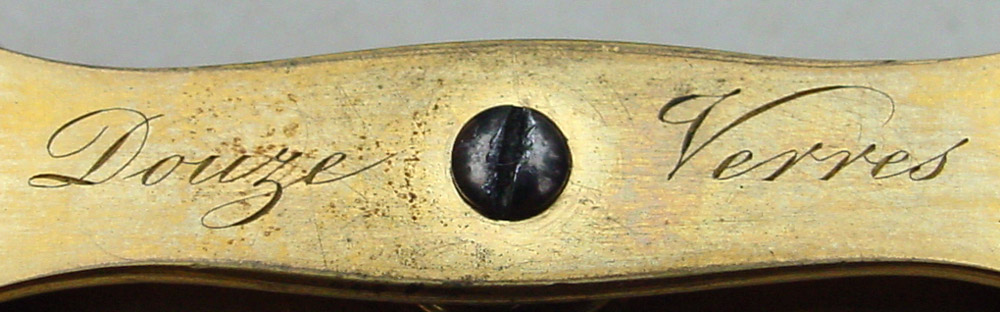
| REMARKABLE COMPACT ALL-TRIPLE-LENS BINOCULARS, French, c. 1875, engraved "Douze Verres" (for "Twelve Lenses") and signed in the case "Gregoire Opticien, Quai St. Antoine, 14." Measuring 3-7/8" (10 cm) overall and 1-1/8" (3 cm) thick (closed), they are constructed of gilt brass and tortoiseshell, with a central knurled ivory focusing knob. Each objective lens, and each eyepiece, is itself a triplet, a sophisticated design to minimize aberrations and permit a compact, short-focal-length instrument. The apparent maker was Gregoire of Lyon, working throughout the third quarter 19th century. The firm had been founded in 1790, owned by Pierre Biette in the 1830's, and by H. Peter in the late 19th century. A fine device, in superb condition, with the original carrying case. (9030) $1350. |
| The Achromat | Click on any image for a larger view. Scroll to view more items. |
 |
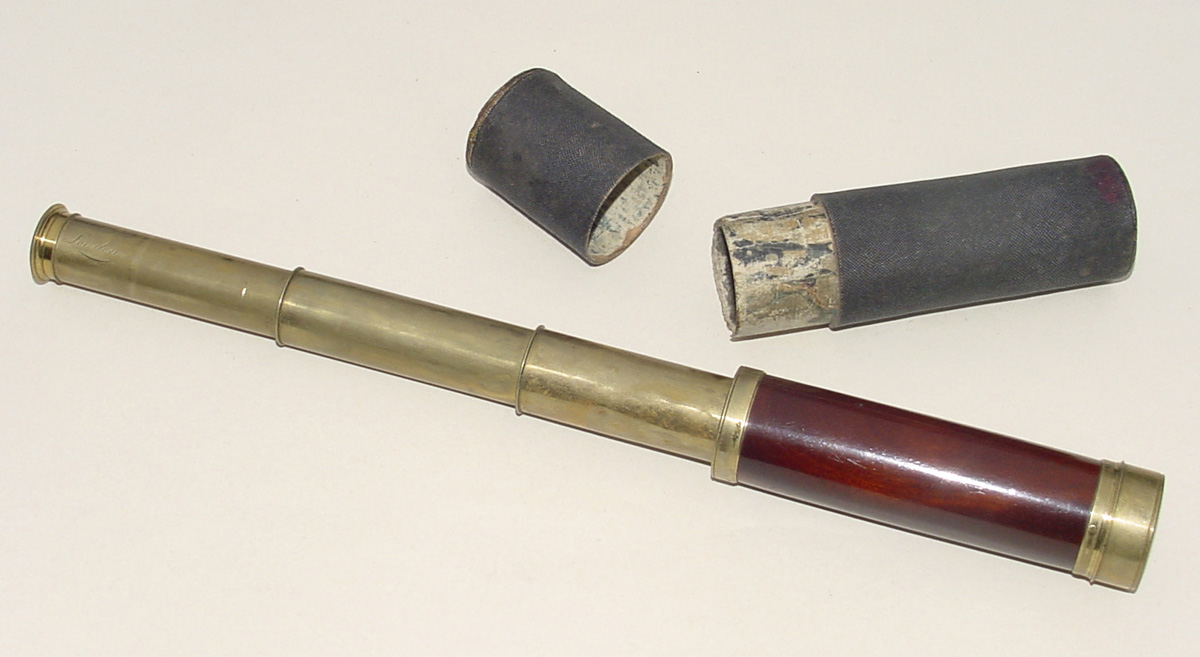 |
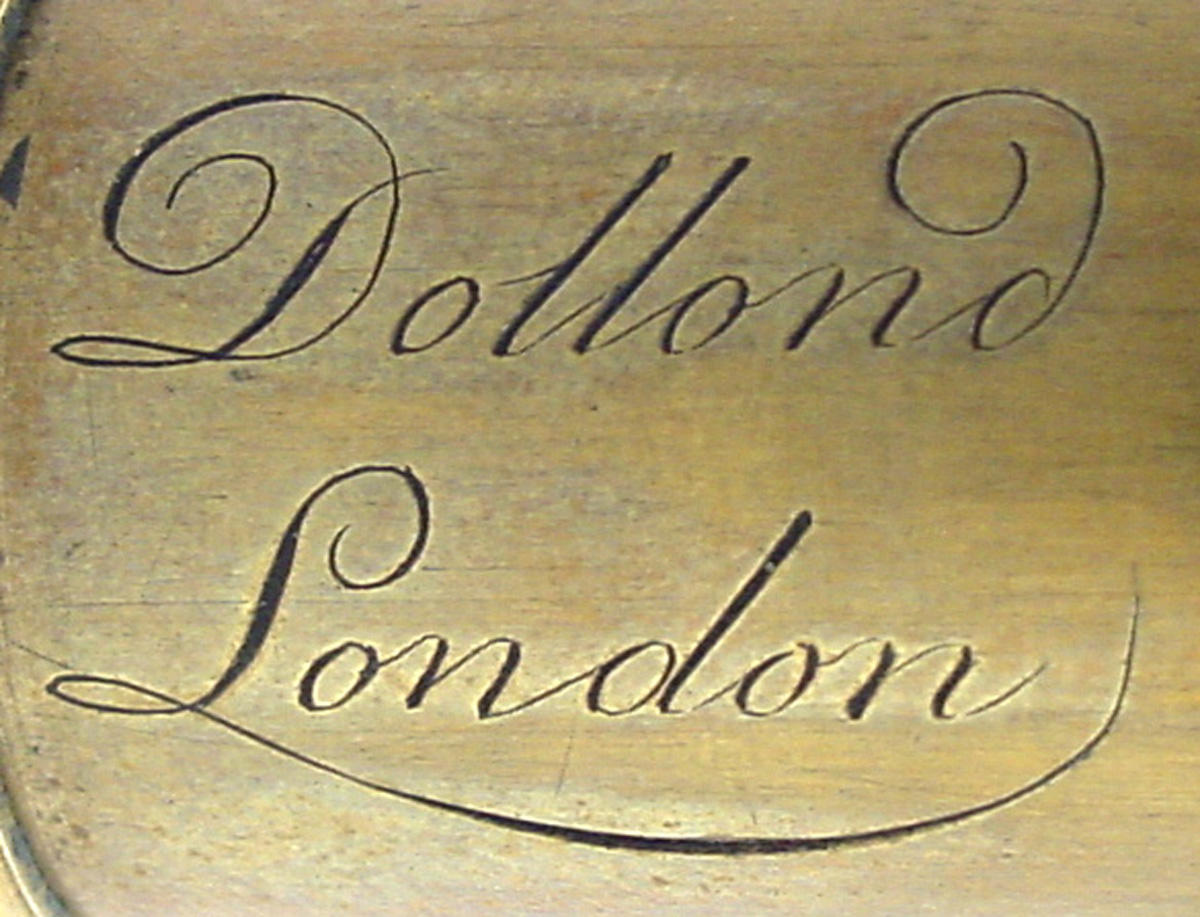
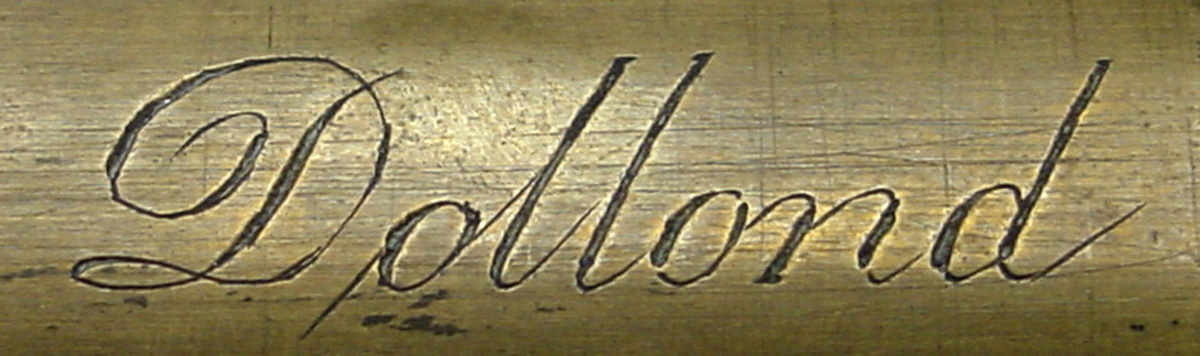
| DOLLOND'S ACHROMATIC POCKET TELESCOPE BY DOLLOND, English, c. 1800, finely signed "Dollond, London." Opening with three brass drawtubes from 5" to 13-1/2" (13 - 34 cm), this fine pocket telescope has a main tube bound in beautiful crotch mahogany, a greenish triplet objective, and a segmented eyetube with a three-element (of a probable four) erecting eyepiece system (X/CC/CP/CC). It is fine condition, functioning well, with erect images of good magnification but of limited angular size, and is equipped with eye shutter and lens cap. The original wood carrying case is lined with watered paper and bound in black fine grained fishskin, in very fine condition. (8276) $750. |
| From Bolton Hall | Click on any image for a larger view. Scroll to view more items. |
 |
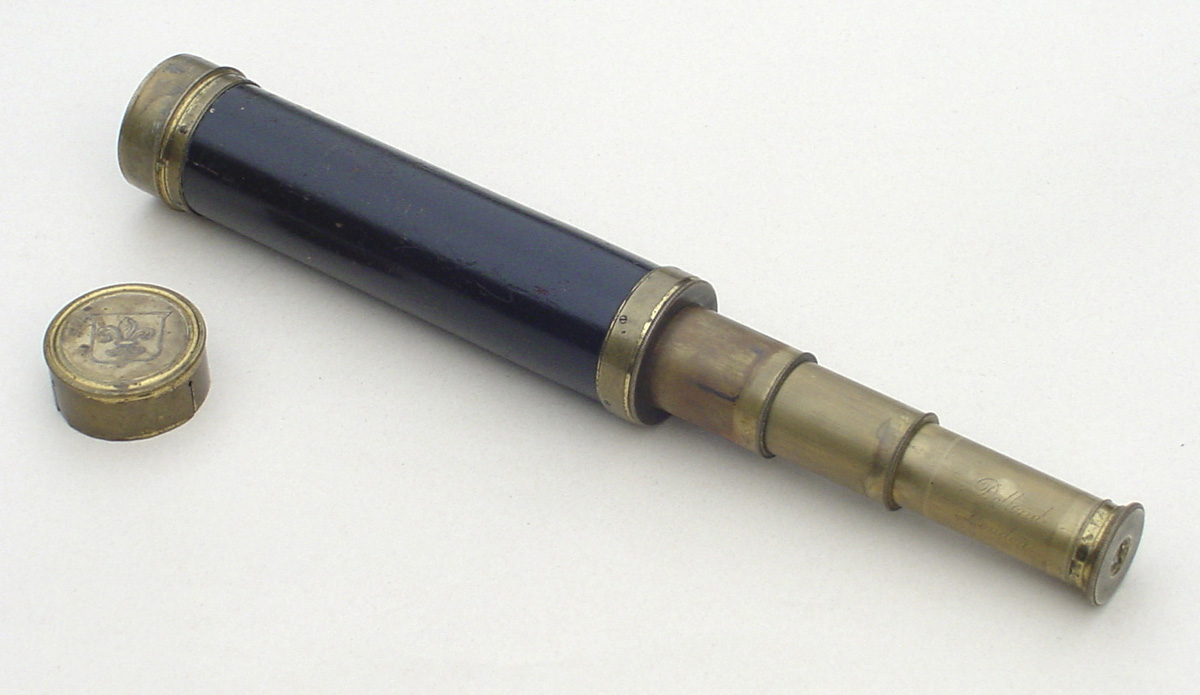 |
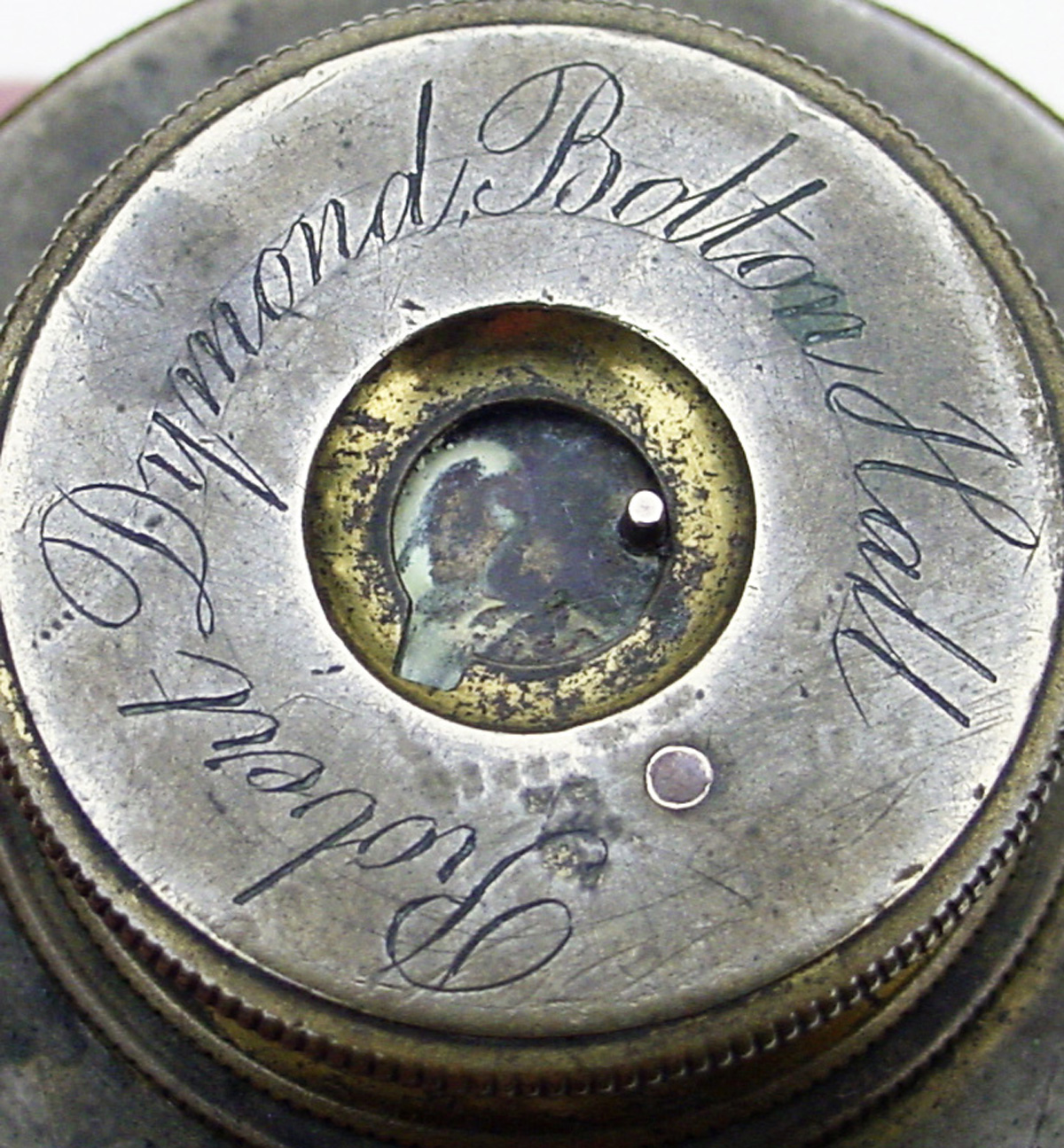
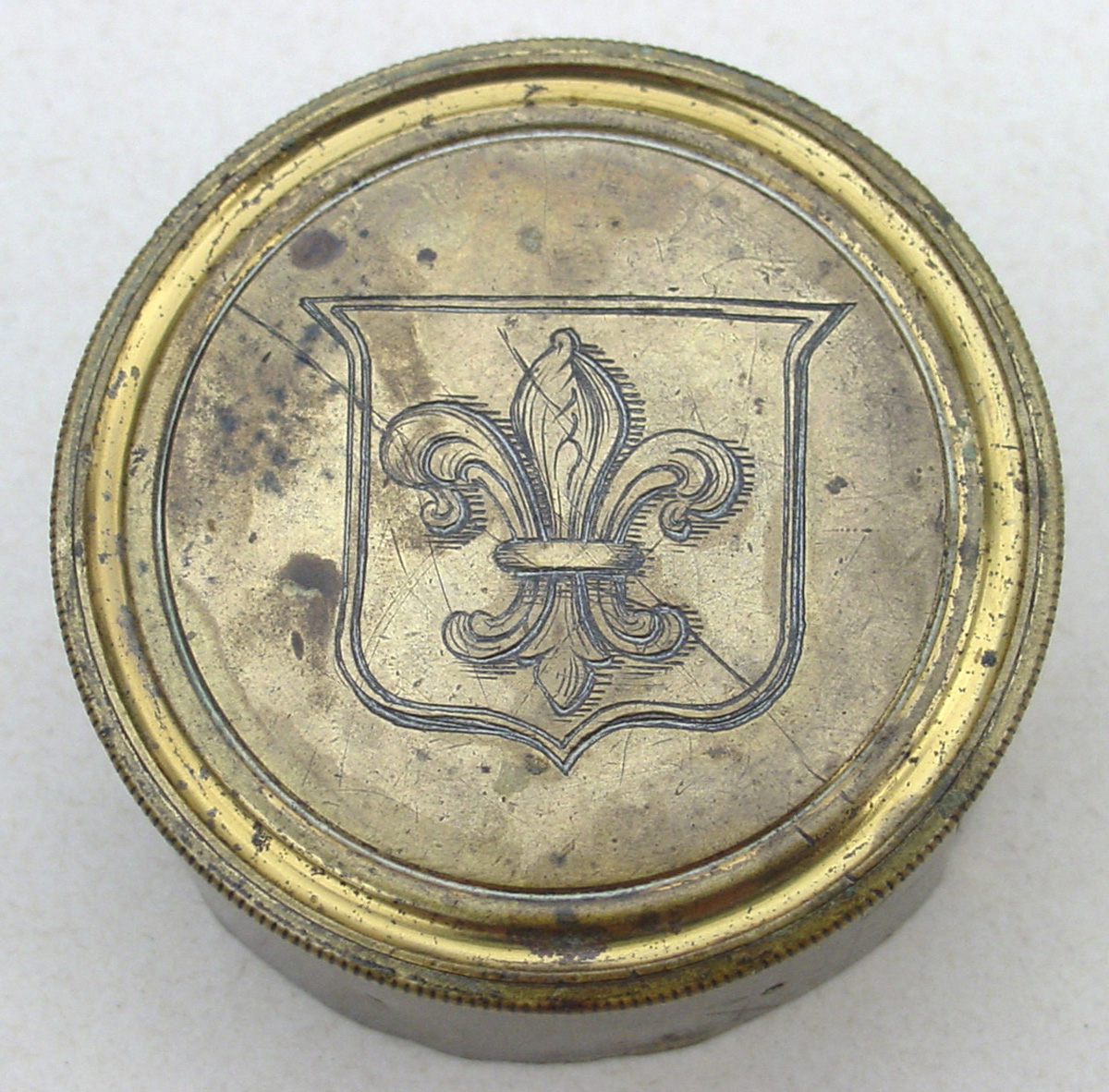
| A SPYGLASS WITH PROVENANCE, English, early 19th century, signed on the drawtube "Dollond, London," on the eye surround "Robert Dymond, Bolton Hall," and engraved on the dust cap with a heraldic fleur-de-lys. Made of brass with black enameled wood main tube, and opening from 7" to 19-3/4" (18 - 50 cm) by three drawtubes, the telescope is in fine condition and gives good images with its triplet achromatic objective and erecting eyepiece system in a segmented drawtube (PC/CC/CC/CC). The census records show one Robert Dymond born in Bolton in 1800, and by 1851 this Dr. Dymond living in Bolton Hall with his family and numerous servants. (8286) $1100. |
 |
 |
| "Little further improvement was made in the construction of the refracting telescope, till we come down to the time of Dollond and Ramsden,... when both parts of this instrument were brought nearly at the same time to almost a state of perfection. While Dollond was occupied in exterminating the prismatic colours from the compound object-glass, by means of a concave lens of flint glass interposed between two convex lenses of crown glass, Ramsden, his brother-in-law, succeeded in diminishing the aberrations both in the terrestrial and celestial eye-pieces; so that an union of the two improvements has rendered the achromatic refracting telescope as perfect as the materials of which it is composed will admit. It is a matter of much regret that large discs of flint-glass of uniform texture, of good colour, and free from veins, are extremely difficult to be acquired...." (Pearson, 1829) |
| Ramsden's Enterprise Continued | Click on any image for a larger view. Scroll to view more items. |
 |
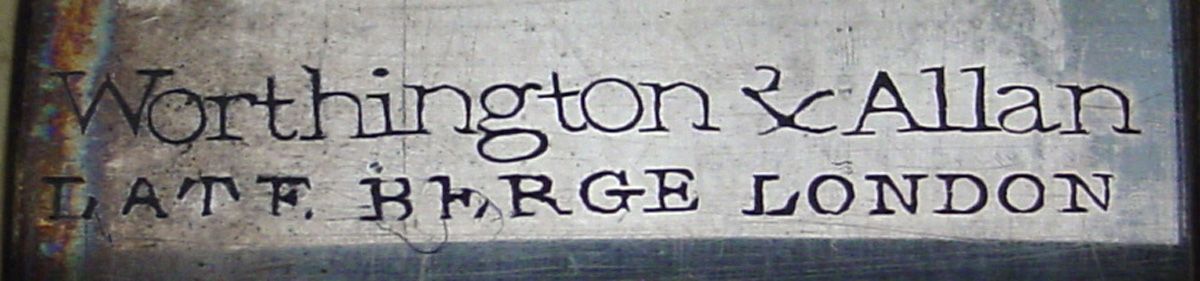 |
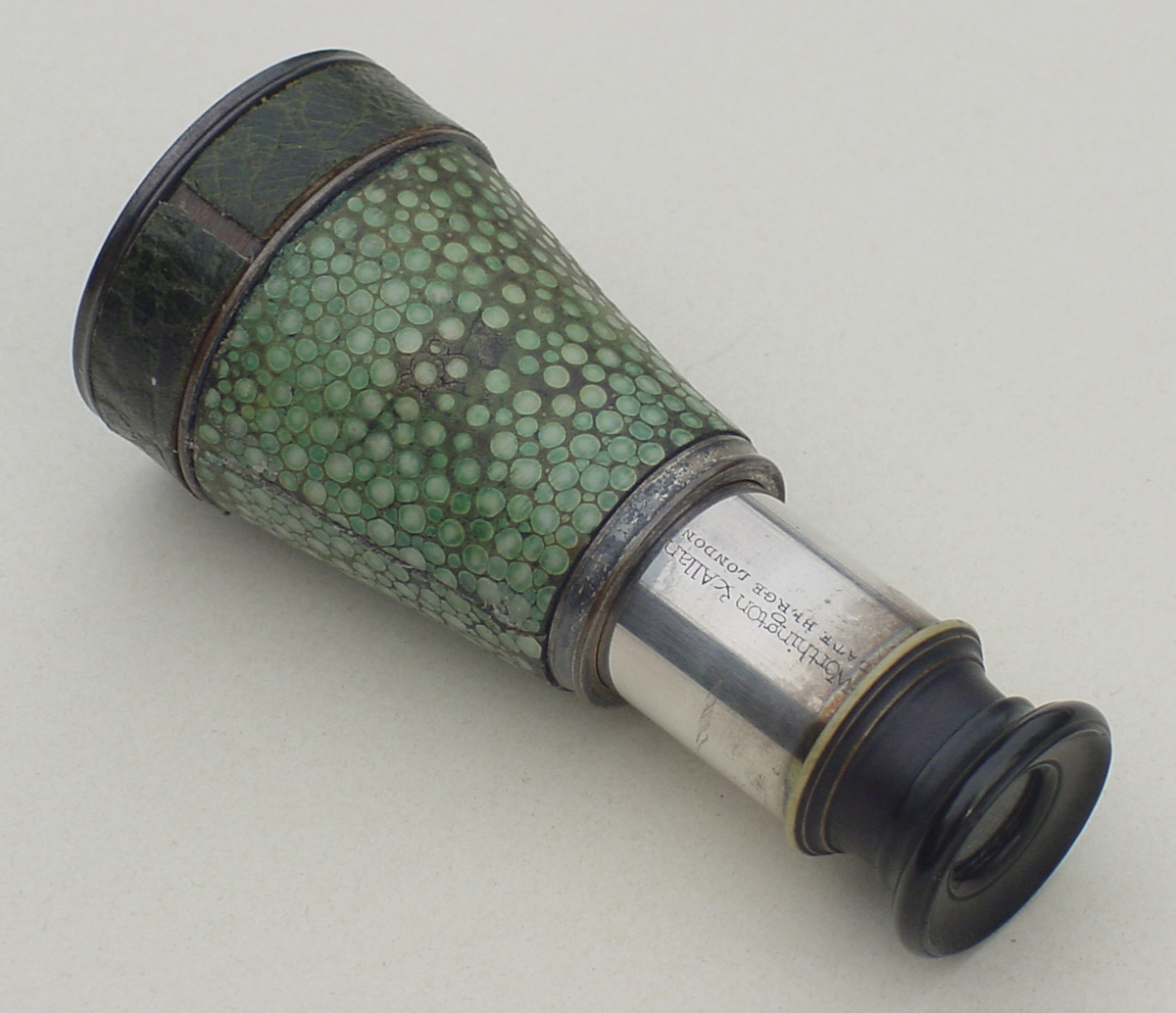
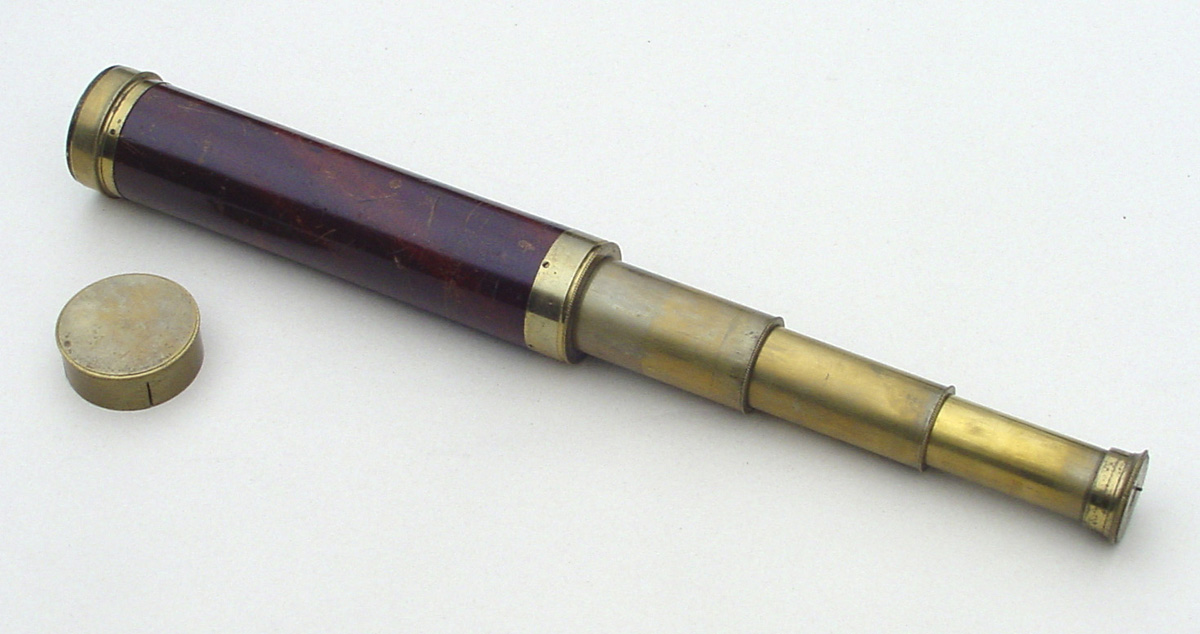
| CONICAL MONOCULAR WITH INDISPUTABLE EVIDENCE OF THE SUCCESSION, English, c. 1820, finely stamped in individual block letters "Worthington & Allan, Late Berge, London." This 3-1/4" (8 cm ) long (closed) monocular is constructed with an interesting variety of materials, the 1-3/8" diameter achromatic doublet set in a silvered (now darkened with oxidation) brass cell bound in green leather, the conical main tube of silvered brass bound in green rayskin, the drawtube of silver over brass, and the eyelens mount of dark stained ivory. The Galilean optical system provides clear bright images of low magnification. Condition is good, the tube coverings a bit rough. This is the first example we have seen of the "Late Berge...² signature, and as such is an important document in its own right. (8486) $1200. |
| Iridescent Elegance in "ye King's Royal Patent" | Click on any image for a larger view. Scroll to view more items. |
 |
 |
|
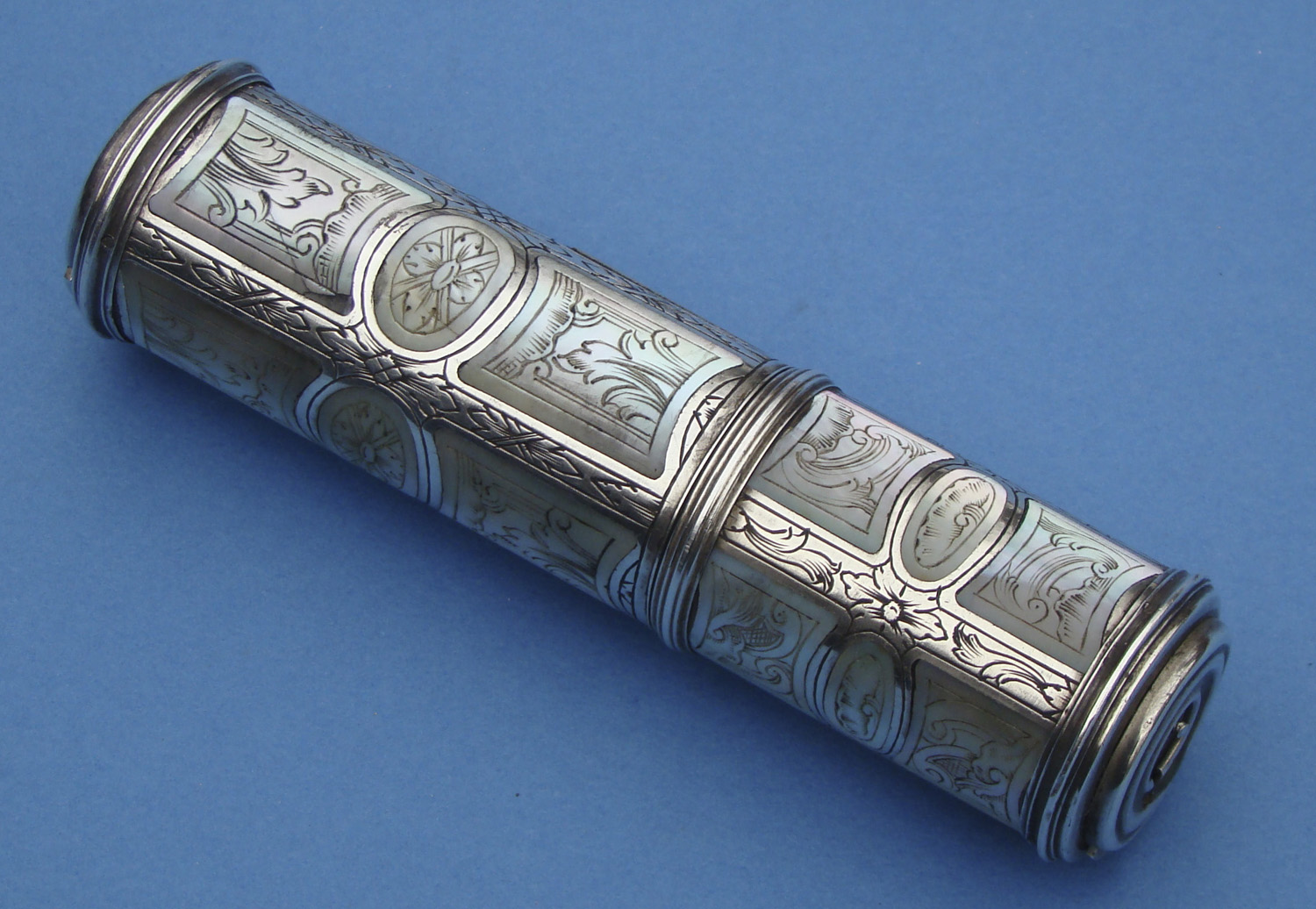
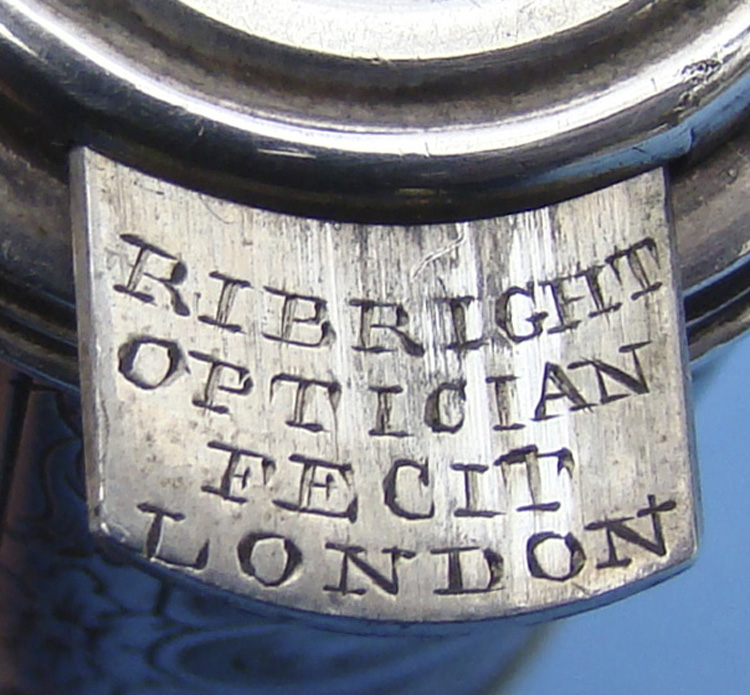
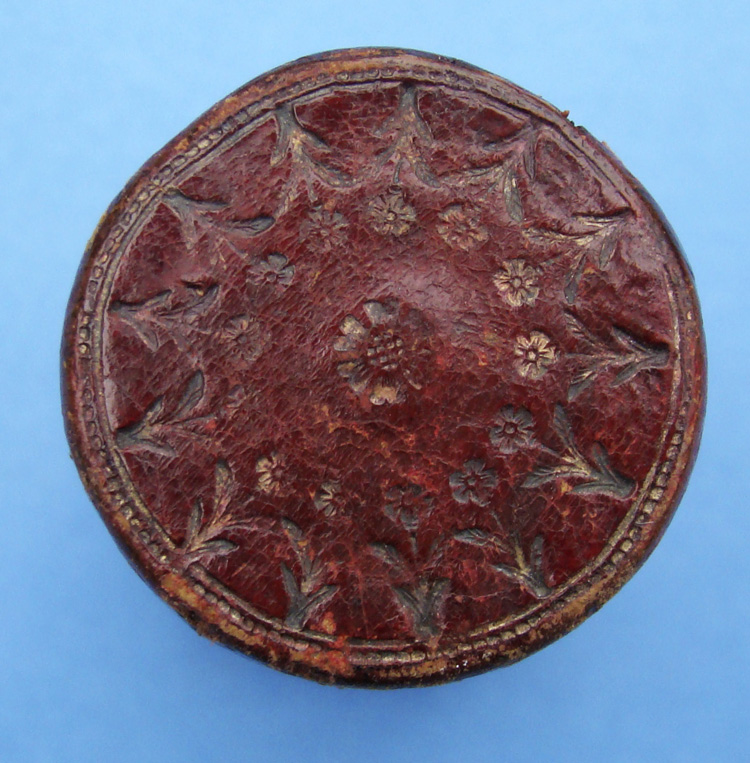
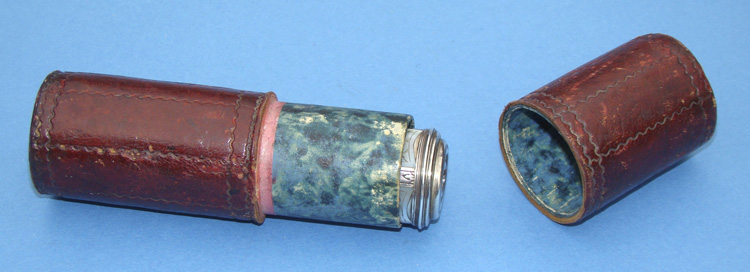
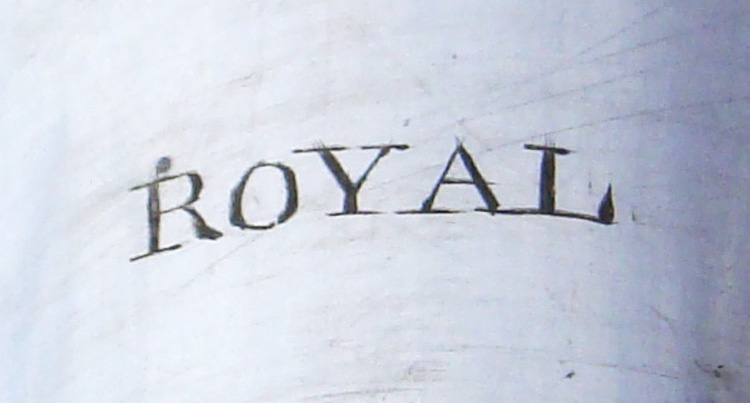
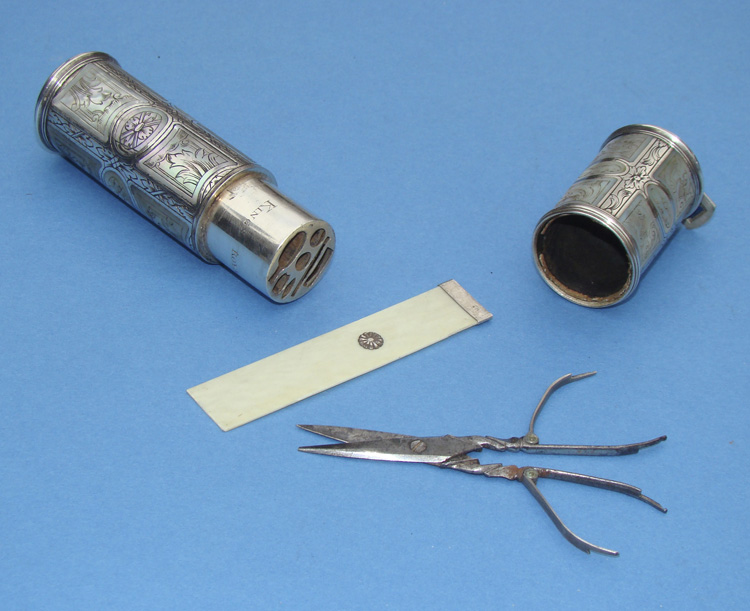
EXQUISITE MONOCULAR OF THE HIGHEST QUALITY, English, mid-18th century, signed "Ribright Optician Fecit London" and "By ye King's Royal Patent," and numbered "557." Of cylindrical shape, 4-1/8" (10.5 cm) long (closed), the instrument is made of silver, beautifully hand engraved with patterns of foliage, and inset with 24 hand engraved shaped lozenges of iridescent greenish mother-of-pearl. The ends are set with lenses (stopped down to 5/16" diameter and equipped with dust slides) forming a Galilean monocular system giving magnification of several times. The eye assembly withdraws for focusing and access to the interior. Midway along the tube, where the bundle of light rays is smallest, there is an internal fitting with six slots for various mathematical and domestic tools. Only two remain, both with silver handles and showing a bit of wear: a notepad for use with pencil, and a folding scissors. Condition of the monocular is excellent, complete with its case bound in decoratively stamped leather and lined in colored paper. This system of compendium concealed within a telescope was patented (and produced) by Thomas Ribright in 1749, as "Making small perspective-glasses with mathematical and other instruments and twees in the same case...." All Ribright-form monoculars are rare, especially signed ones (see, e.g., the unsigned one in Tesseract Catalogue 90, Item 1). Some are more elegant and highly crafted than others, this the finest we have had. (10075) $6500. |
 |
 |
 |
 |
| Crafted by Semitecolo of Venice, Italy | Click on any image for a larger
view. Scroll to view more items. |
|
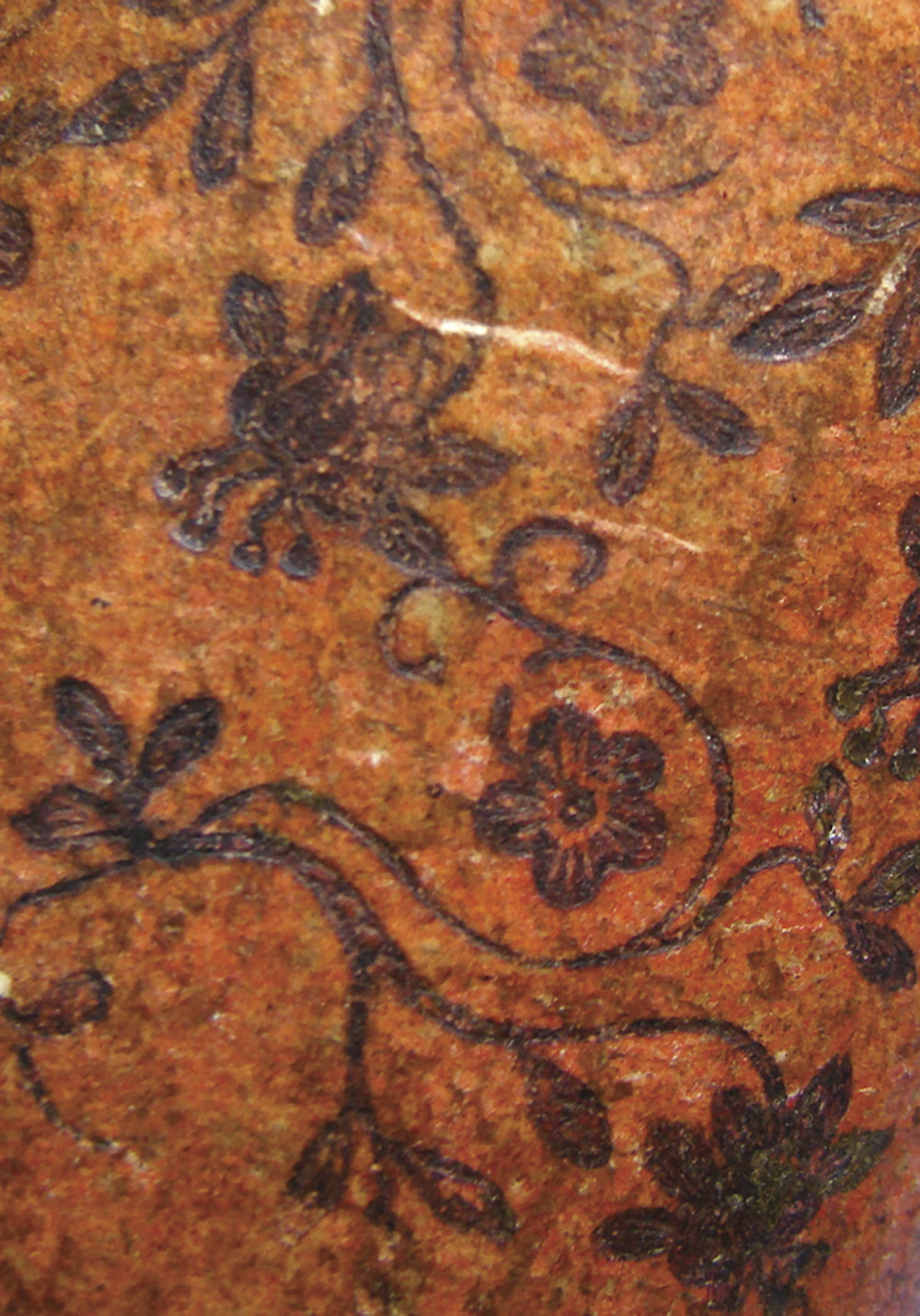
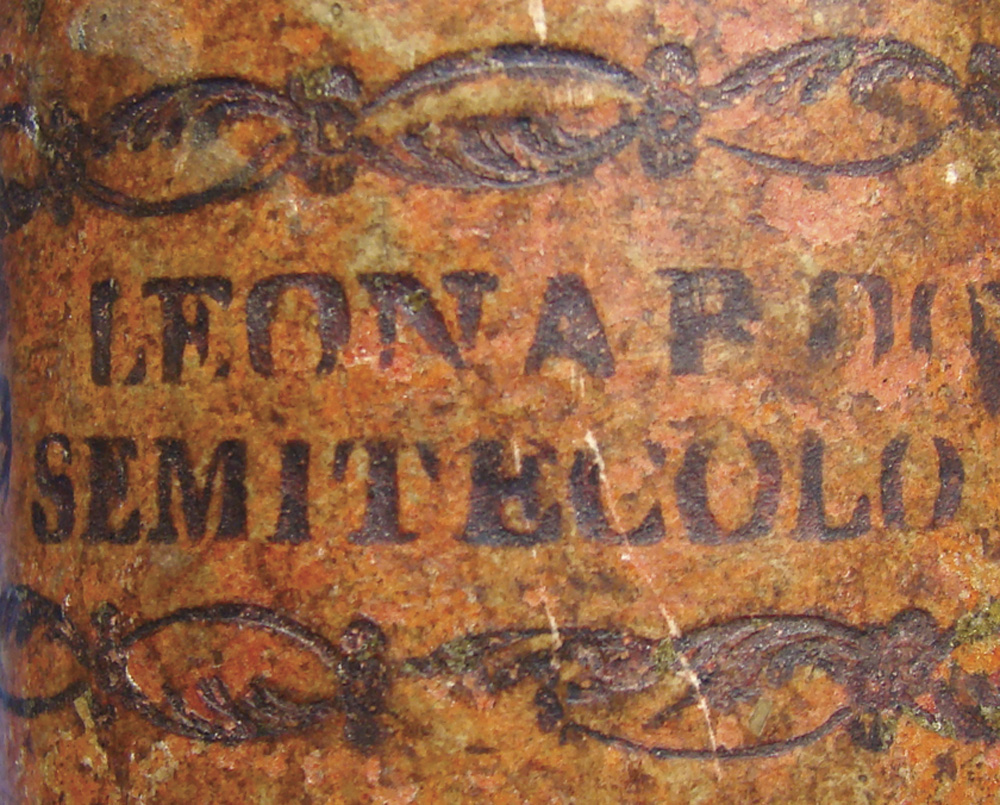
GOOD VENETIAN TELESCOPE, Italian, c. 1800, signed "Leonardo Semitecolo." Opening from 12" to 33-1/2" (30 - 85 cm) by three draw tubes, the telescope is constructed of heavy card tubes bound in fine multi-colored paper, with turned fittings of multi-toned horn. The main tube is stamped with charming floral patterns. The singlet objective and three-element Schyrle eyepiece system give good erect images. Condition is fine with light wear, lacking dust covers. Lens making got an early start in Venice, and by the late 18th century the city hosted numbers of telescope and microscope makers. It seems that every visitor on a Grand Tour of Europe must have returned home with a handheld spyglass. Here we have a fine attractive example, complete with all original optics, and by the best known maker of the day. (9058) $1950. |
 |
 |
 |
| "Designed by a lady" -- Stars of the British Empire! | Click on any image for a larger view. Scroll to view more items. |
 |
 |
 |
 |
|
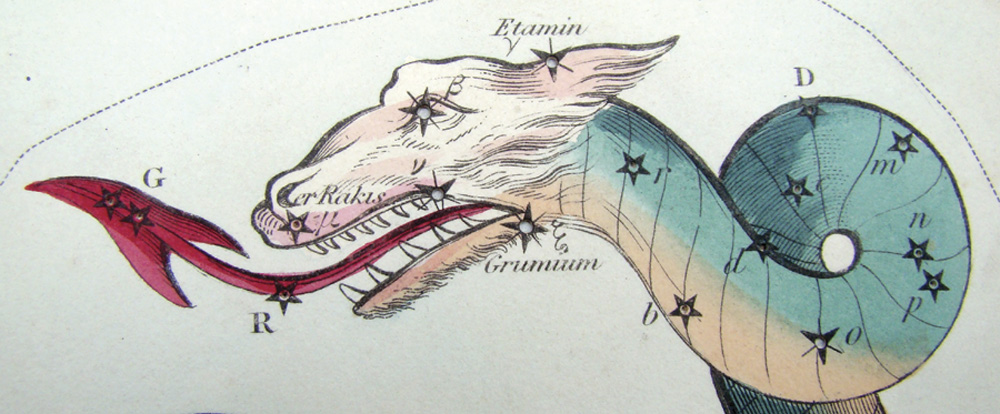
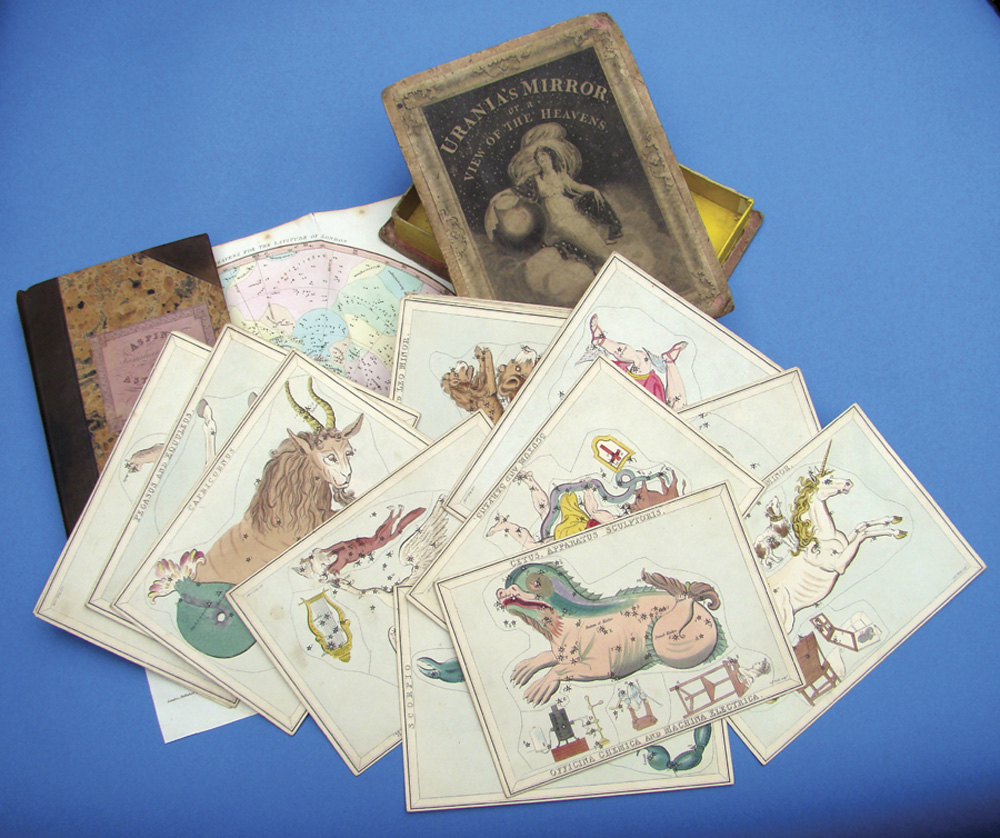
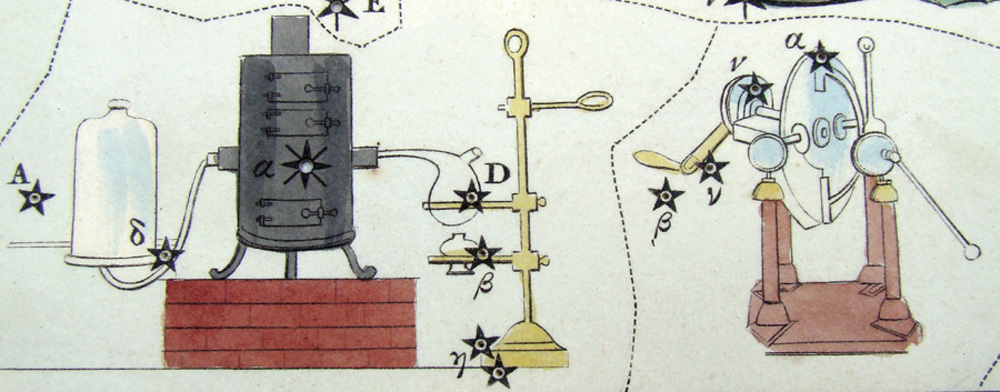
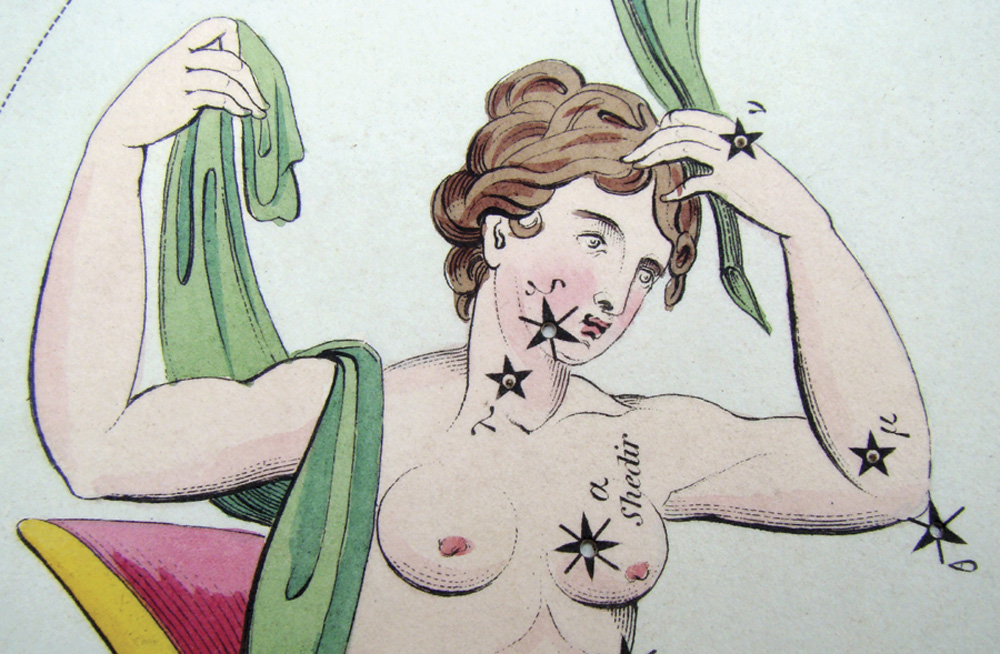
COMPLETE SET OF "URANIA¹S MIRROR" ASTRONOMICAL CARDS AND BOOK, English, 1825, published by Samuel Leigh of 18 Strand, London. This is a complete set of 32 hand-colored cards, each 5-1/2" x 7-3/4" (14 x 20 cm), printed with constellation figures, the brighter stars identified and pierced with holes and the cards backed with tissue paper, making visible the star patterns when held to a light. The cards are delicately colored, and contained in the original cardboard box. Some of the more unusual technology-related constellations are included, e.g., Machina Electrica, Officina Chemica, and Antlia Pneumatica. This rare early set of astronomical cards is complete, with bright colors, in fine condition noting light soiling and one card never colored. Some of the backing tissues bear old manuscript poems. The box, with its original title plate, is in fair condition. This outfit is complete with Jehoshaphat Aspin's 200-page Familiar Treatise on Astronomy to accompany Urania¹s Mirror. This book, published by Leigh in 1825, includes four fold-out plates, and is in good condition, noting a bit of foxing and corner staining. It has a very fine later half-leather binding. Aspin refers to Urania¹s Mirror as "consisting of thirty-two cards, on which are represented all the constellations visible in the British empire, on a plan perfectly original, designed by a Lady." A good example of a most attractive but now hard-to-find astronomical set. (9078) (SOLD) |
| Gilt-Stamped Japanese "Pocket" Telescope | Click on any image for a larger view. Scroll to view more items. |
 |
|
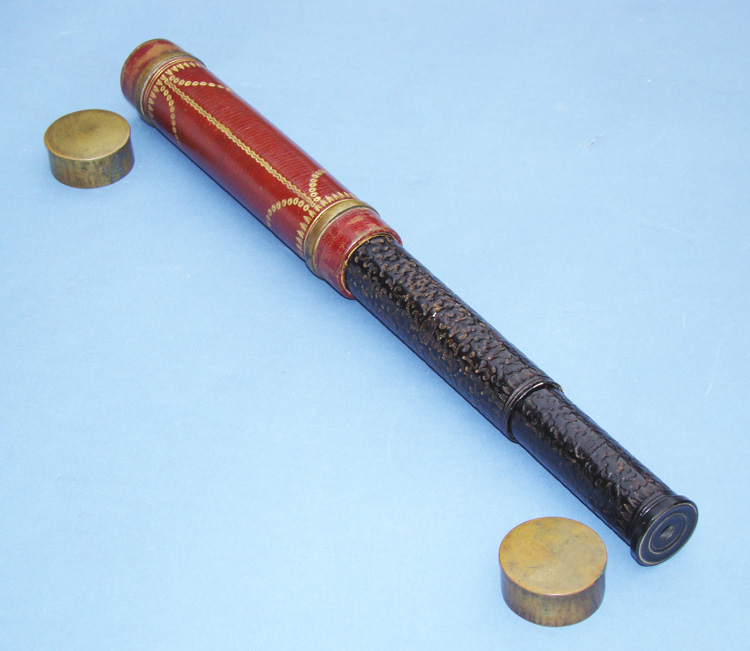
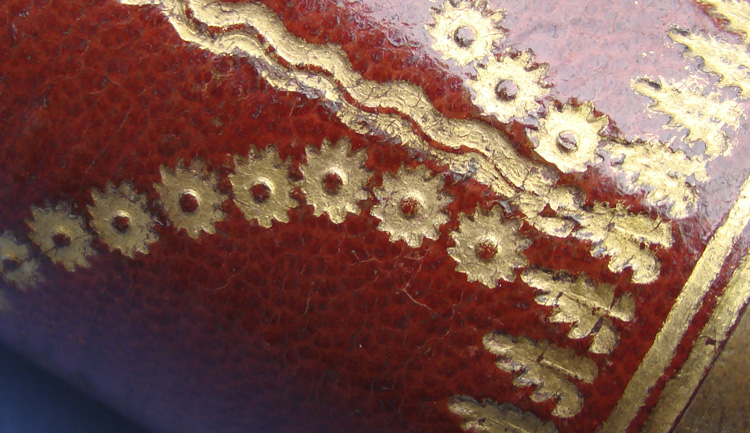
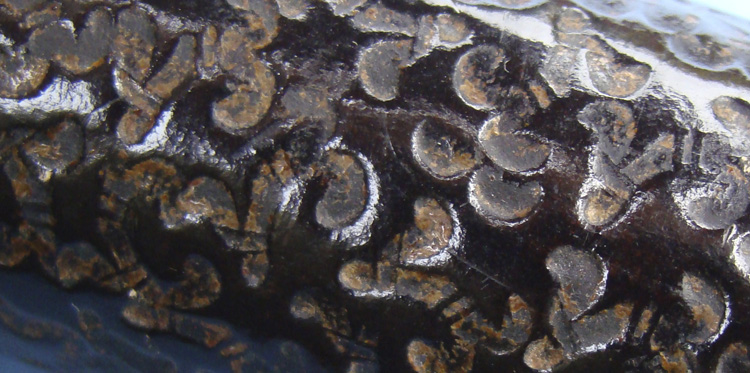
JAPANESE POCKET TELESCOPE, c. 19th century, measuring 6-7/8" (17.5 cm) long closed, with its brass dust caps. The main tube is bound in red leather, gilt stamped, and the telescope opens to 16" (41 cm) on its two intensely-patterned black and lightly gilt-stamped drawtubes. The latter are tapered for a very snug stable fit when drawn open, and are removable only by removing the objective and withdrawing them through that opening. The eye surround is turned horn, the singlet objective surround brass, stopped down to a miniscule 6mm for acuity. Condition is very fine noting tiny losses to the binding. We have had larger Japanese telescopes, one bound in fully patterned leather (Tesseract Catalogue 102 Item 6), the other lacquered and patterned (98/1), but this is the first truly "pocket" form we have seen. (10095) $2200. |
 |
 |
| Rare Surviving Evidence of Ramsden's Workmen | Click on any image for a larger view. Scroll to view more items. |
|
McConnell has so far identified eleven British apprentices to Ramsden, of whom Thomas Jones is certainly the most well-known. Additionally Matthew Berge may have served such an apprenticeship, and certainly worked many years for Ramsden, and succeeded him in business. And William Cary advertised on invoices and trade cards that he was a former Ramsden apprentice. There were foreign apprentices and workmen as well, and some British workmen (including James Allan and John Stancliffe) who went on to set up successful instrument manufactories on their own. Little is known of most of Ramsden's workmen (who numbered as many as 50 at a time), but we have been fortunate to acquire several signed instruments as tangible evidence of their craft. The interesting signatures show clearly that experience in Ramsden's workshop was a strong selling point for a young craftsman working in the early 19th century. |
 |
 |
 |
|
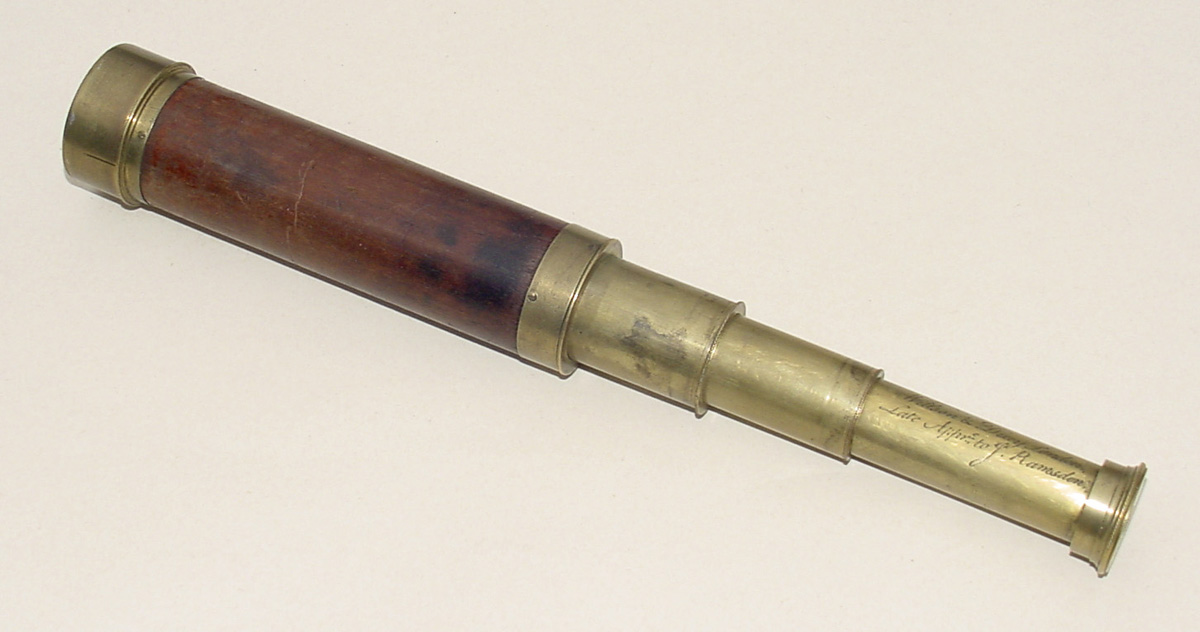
THREE DRAW POCKET TELESCOPE BY FORMER APPRENTICES, English, c. 1805, well engraved "Willson & Dixey, London, Late App'¹e. to J. Ramsden." This small instrument, extending from 5-1/4" to 15" (13 - 38 cm), is brass with mahogany bound main tube, equipped with a greenish triplet objective, a four-element erect-image eyepiece system (PC/CC/CP/CC), lens cap and dust slide. Condition is fine. Clifton lists George Willson, and Dixey, working in partnership in Piccadilly 1802 - 1809. Willson was known in business as "optical turner" since 1798. And one Edward Dixey was apprenticed to Ramsden on 4 September 1787 for seven years (McConnell p.61). We note the particularly interesting form of signature: "Late Apprentice to J. Ramsden...." (8376) $2250. |
| One-Time Apprentices to the Master | Click on any image for a larger view. Scroll to view more items. |
 |
 |
 |
|
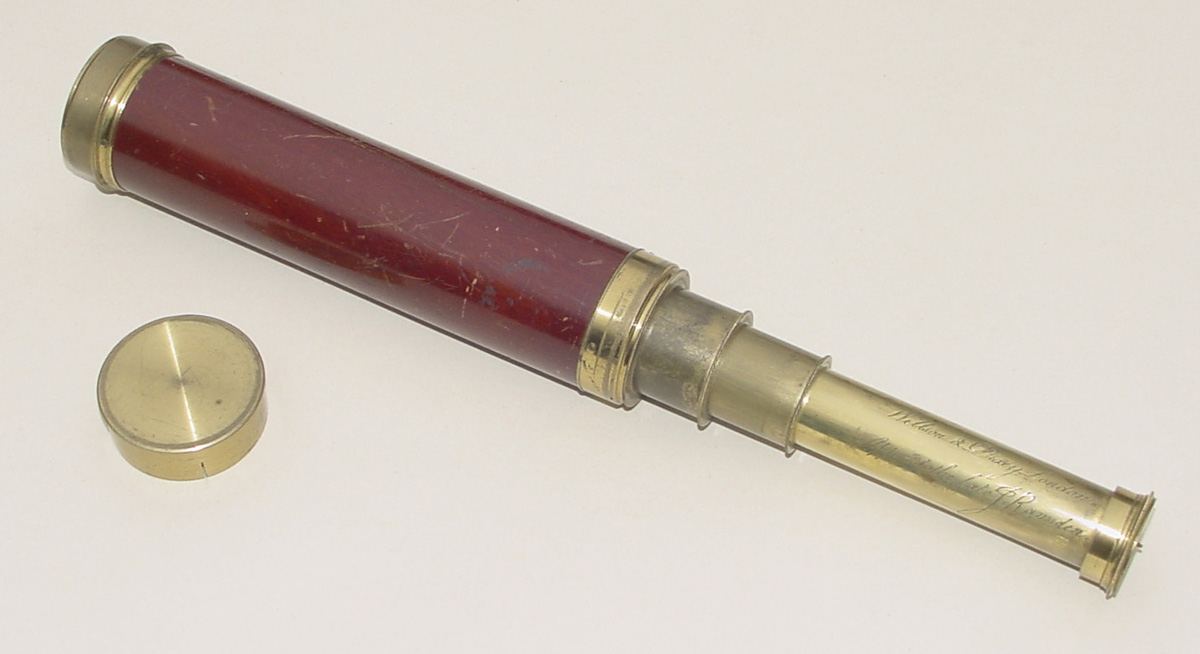
FINE HAND TELESCOPE BY WILLSON AND DIXEY, English, c. 1805, signed "Willson & Dixey, London, Appr'e. to the late J. Ramsden." The telescope has a fine brass-bound mahogany main tube, and three brass draws, opening from 7-1/2" to 22" (19 - 56 cm). It is mounted with a 1-1/4" greenish triplet objective and a somewhat different four element erecting optical system employing a Huygenian couplet (CC/CC/CP/CP). Condition is fine complete with dust cap and shutter, the lacquered areas of the brass retaining much of their original finish. We note on this telescope, and on the preceding one, that the milling on the brass fittings is straight, i.e., perpendicular to the flat surfaces. And notable is the variant form of signature "Apprentice to the late J. Ramsden..." and its possible implication. (8386) $2750. |
| A Rare Survival | Click on any image for a larger view. Scroll to view more items. |
|
The ordinary workmen, who file, turn and plane &c, receive from 18 to 21 shillings per week of six days. They work for 12 hours daily, from 6 in the morning to 8:30 in the evening. They have one hour from 1 to 2 for lunch, 1/2 hour in the morning for breakfast, and after twelve hours he gives them another 1/2 hour to drink tea." (Ljungberg of Kiel reporting on Ramsden's workshop practices in his visit to London in 1787-8; McConnell p.67) |
 |
 |
 |
|
THREE-DRAW TELESCOPE BY MACKNEIL, English, very early 19th century, beautifully signed in script "Mackneil, London, Apprentice of the late Mr. Ramsden." With a 1-3/8" diameter greenish triplet achromat, a four element erect-image eye system (CC/CC/CC/CC), a finely grained mahogany main tube, and three brass drawtubes opening from 7-1/2" to 22-1/2" (19 - 57 cm), this is a relatively standard form. But as usual it differs in all the little details, from the use here of four biconvex lenses, to the milling on the brass edges, which is angled and finely finished, to the exquisite engraving, to the form of reference: "Apprentice of the late...." Condition is fine, with lens cover and dust slide. McConnell, in the Inland Revenue Apprenticeship Tax registers, finds that Jonathan Mackneil, on 1 Feb. 1786, was indentured to Ramsden for seven years. And Clifton shows him trading in London c. 1799 to 1809. (8396) $2950. |
| Miniature Telescope with Galilean Optical Design | Click on any image for a larger view. Scroll to view more items. |
 |
 |
|
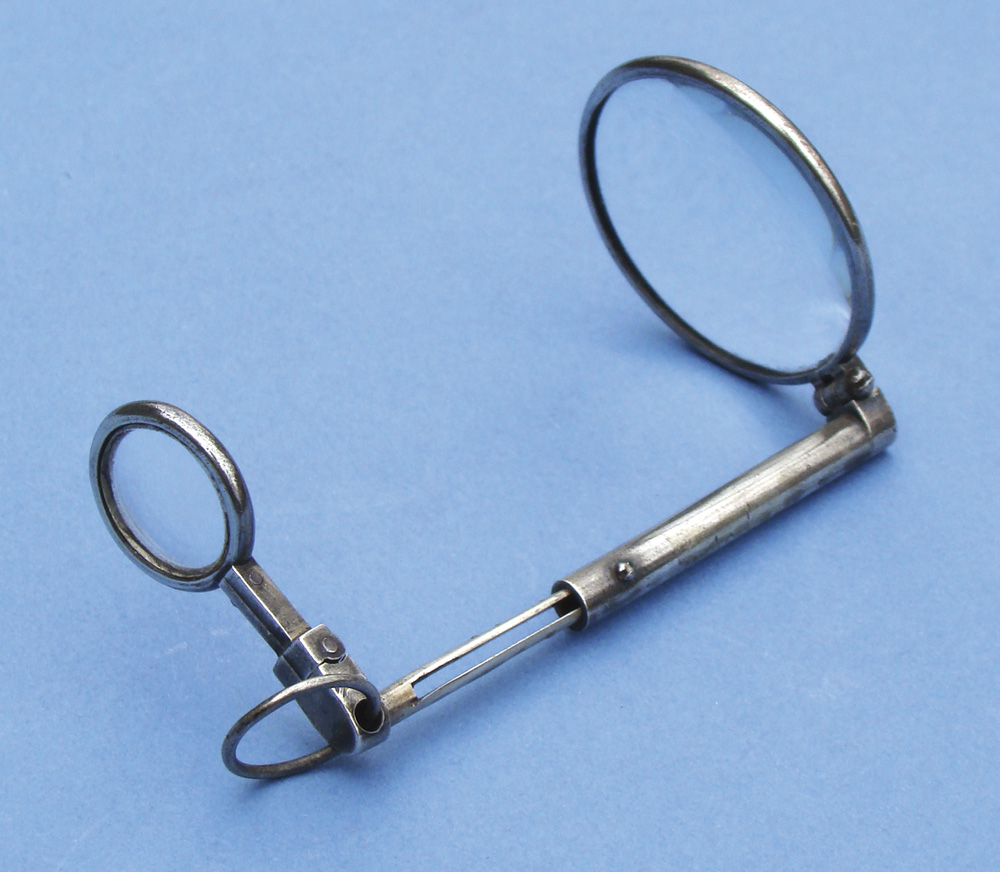
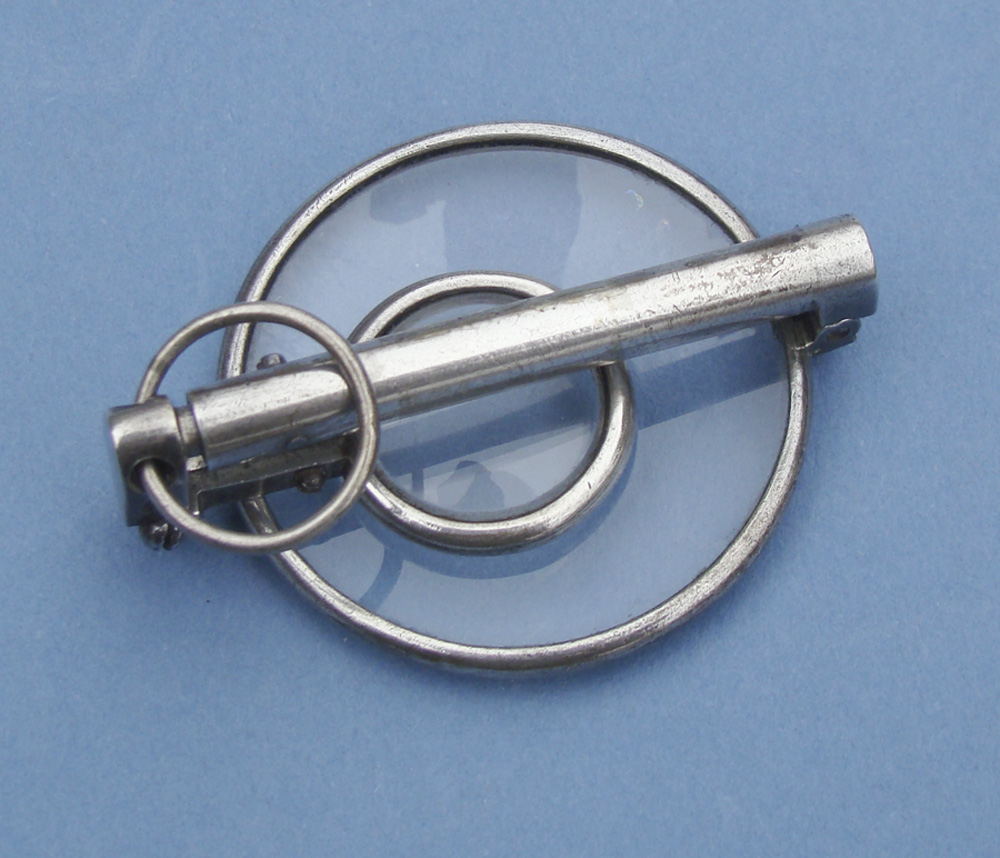
POCKET OPEN-AIR MONOCULAR IN SILVER, French, c. 1825, with several poinçon hallmarks. Mounted with pendant ring, the device folds to a very compact 1-5/8" x 1-1/4" x 1/2" (4 x 3 x 1.3 cm), and opens with hinged lenses on sliding support arm. It is a traditional "Galilean" optical design giving upright images of low magnification. In fine condition, it is an unusual form of miniature telescope. The French poinçon mark of the "tête de lièvre" (the head of a hare), which is applied twice here, firmly dates it to 1819 - 1838. (9079) $1450. |
| Elegance in Sheffield Silver and Red Enamel | Click on any image for a larger view. Scroll to view more items. |
 |
 |
|
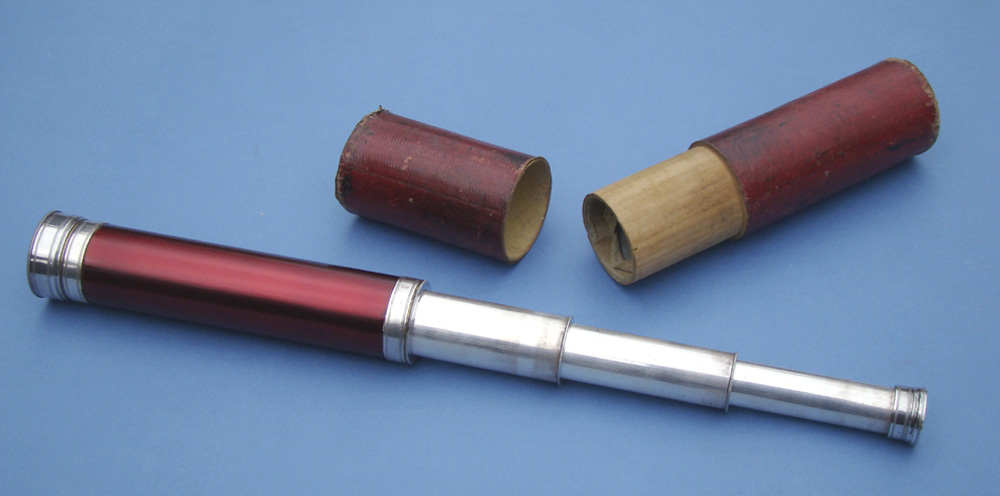
A LUXURIOUS SPYGLASS, English, c. late 18th century, signed "Gilbert, London." Opening from 6-5/8" to 19" (17 to 48 cm) on three drawtubes, the telescope is fashioned from Sheffield silver, with a matte red enameled main tube. The two lenses of the achromatic objective are notched and keyed in to maintain their best rotational alignment as determined by the maker, and the erecting eyepiece system has four elements, giving fine images. The telescope is in excellent condition, complete with its original red Morocco leather bound wood case in fair condition. The Gilberts were a virtual dynasty of mathematical and optical instrument makers, active individually and in various partnerships from the early 18th century to the mid-19th (see Clifton). The present spyglass is a very fine example of a type popular in the last decade of the 18th century, constructed especially by the Gilberts (and see Tesseract Catalogue 85 Item 2 for more details). (9068) $1350. |
| Art and Science, by Biasio Burlini | Click on any image for a larger
view. Scroll to view more items. |
 |
 |
|
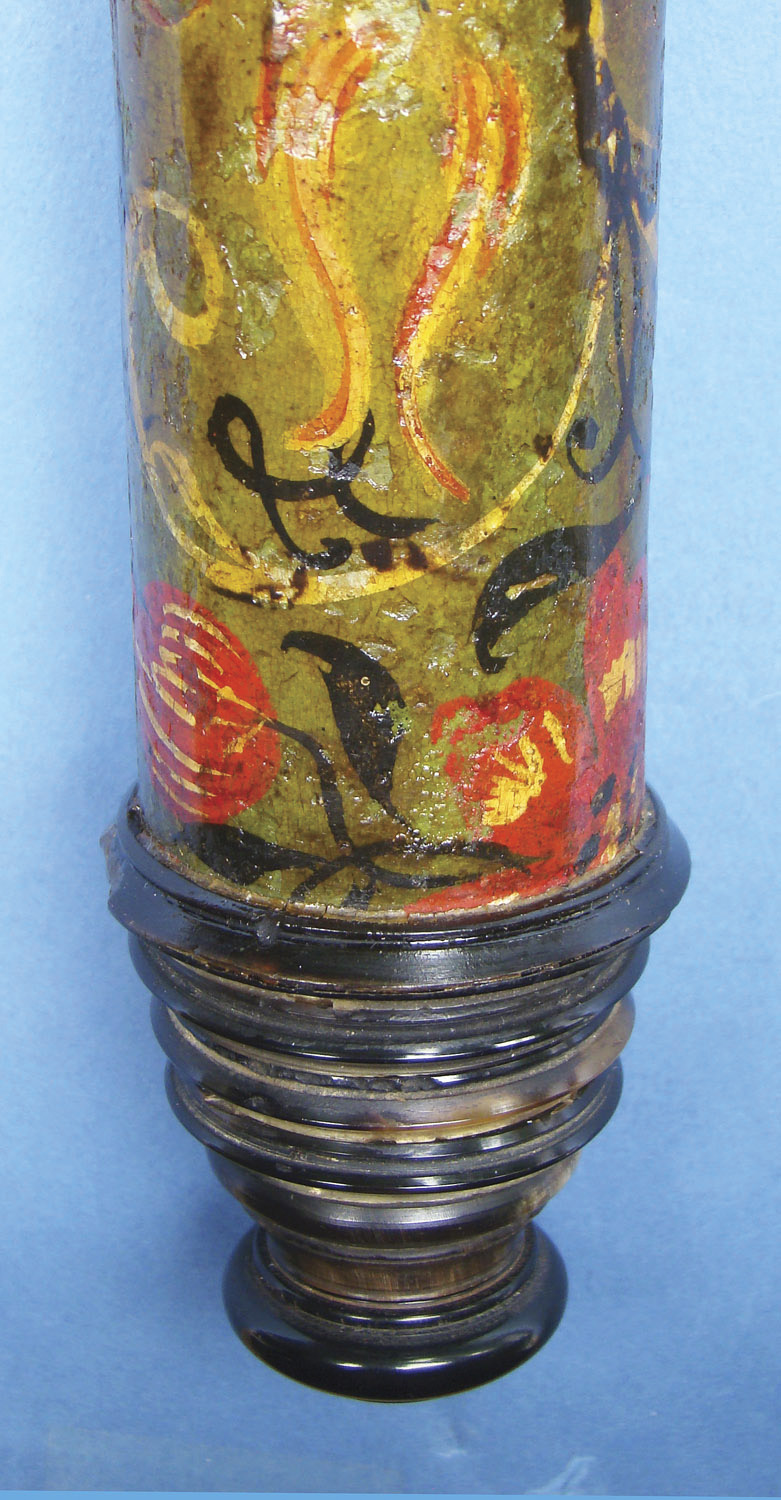
FINE VENETIAN TELESCOPE, Italian, c. second quarter 18th century, engraved on the objective lens "Biasio Burlini, Venezia." The telescope opens from 11-1/8" to 36" (28 - 91 cm) with four card drawtubes bound in green vellum. The main tube is bound in vellum painted with wonderful swirling colorful floral designs, and protected with a typical high-gloss clear lacquer finish. Lens mounts, tube rings, and end caps are all finely turned of horn. With internal erecting system, the telescope gives very fine erect images of quality. Condition is very fine throughout, noting only some losses to the clear lacquer. Professor Biasio Burlini (1709 - 1771) was active in Venice in the mid-18th century. His workshop, with the "Archimedes" trade sign, was described in period literature, and several of his telescopes exist in museums. Lualdi has recently studied Burlini¹s records in the Italian archives, and inventoried surviving microscopes and telescopes. A significant instrument with its signed objective lens, we note a similar one in the Louwman collection (published as his item 67). (10011) $5800. |
 |
| Ingenious Binoculars with Folding Rack-Works | Click on any image for a larger view. Scroll to view more items. |
 |
 |
|
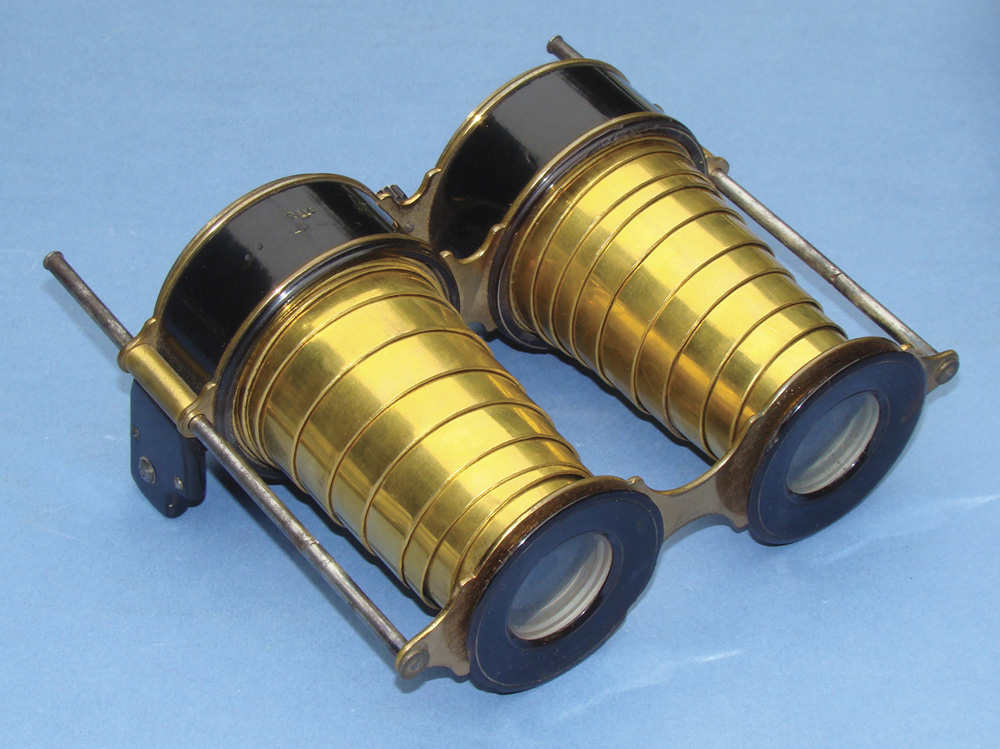
EXCEPTIONAL COILED-TUBE BINOCULARS, French, c. 1880. These ingenious binoculars are constructed with two gilt-brass main plates supporting not only the 2" (5 cm) diameter objective lens cells, but also the complex assembly of axle with twin pinion gears engaging the long folding rack-works which drive a thick plate carrying the eyelenses, meanwhile extending the helical coils to form opaque tubes to exclude off-axis light. Materials include gilt brass, steel, horn, and tortoiseshell. Condition is very fine noting a little nibbling to the organics and a little chipping to the enamel. This attractive and ingenious device extends from a compact 1-1/2" thick to 5" fully open (4 to 13 cm), and is complete with its original somewhat worn shaped case bound in blackened leather and lined in pink silk. (10012) $1950. |
| A Simple Honest Astrolabe from Northern India | Click on any image for a larger
view. Scroll to view more items. |
 |
 |
 |
|
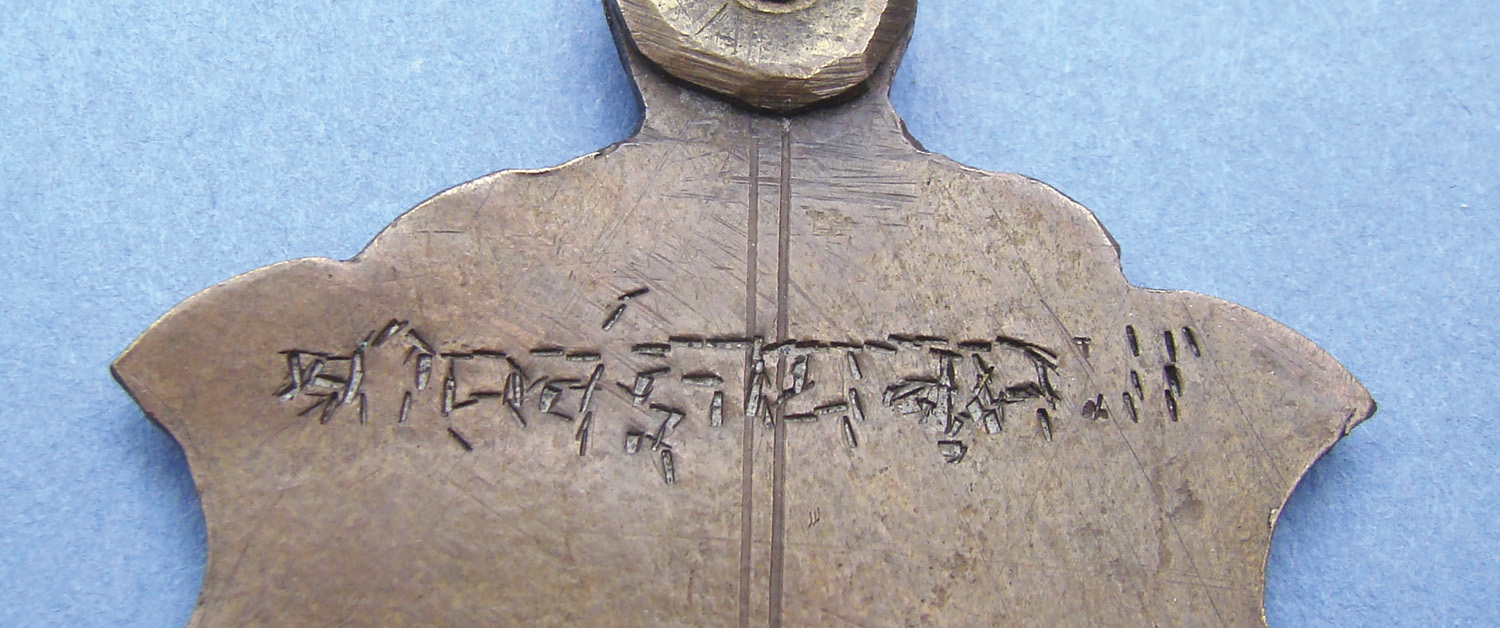
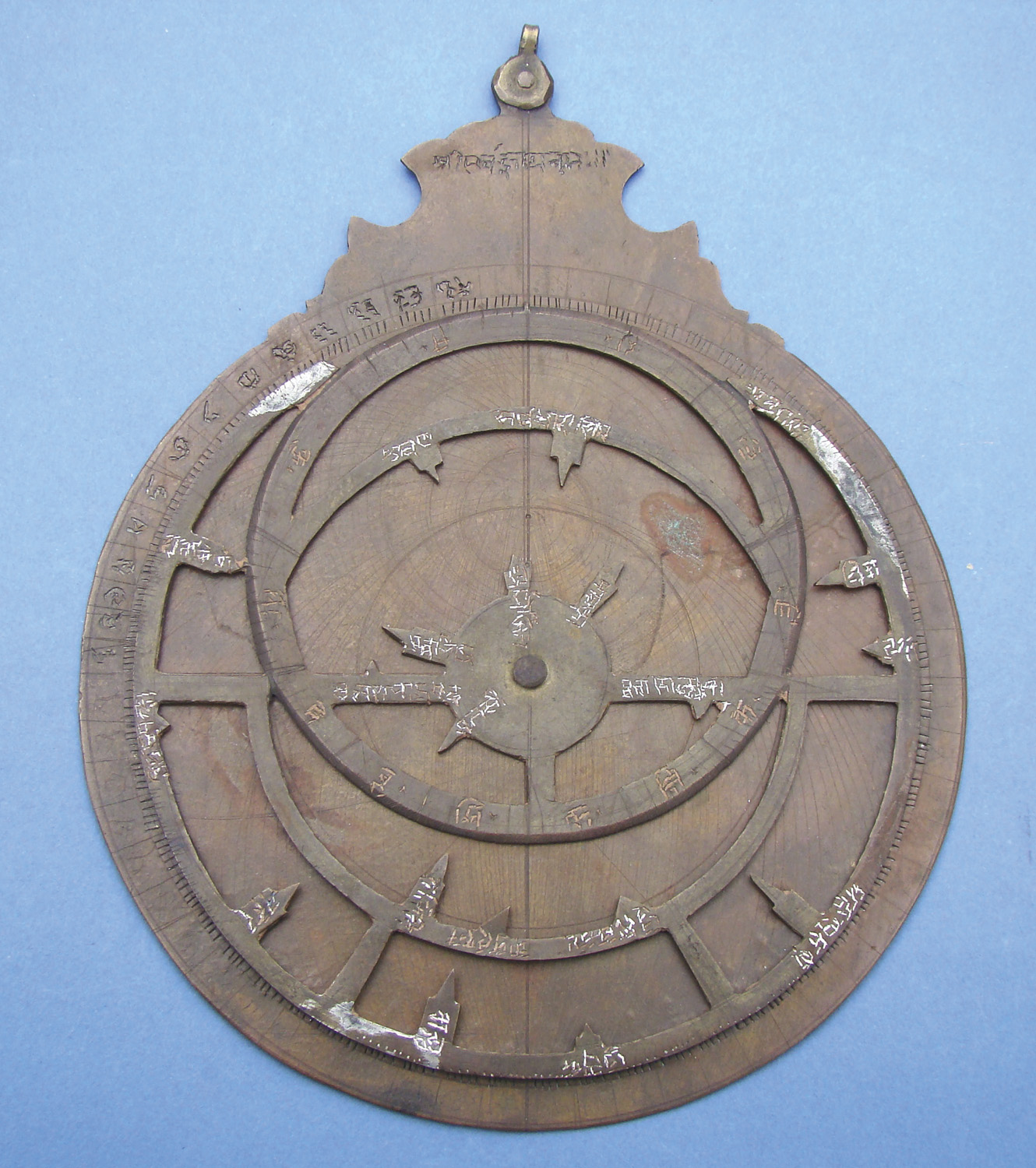
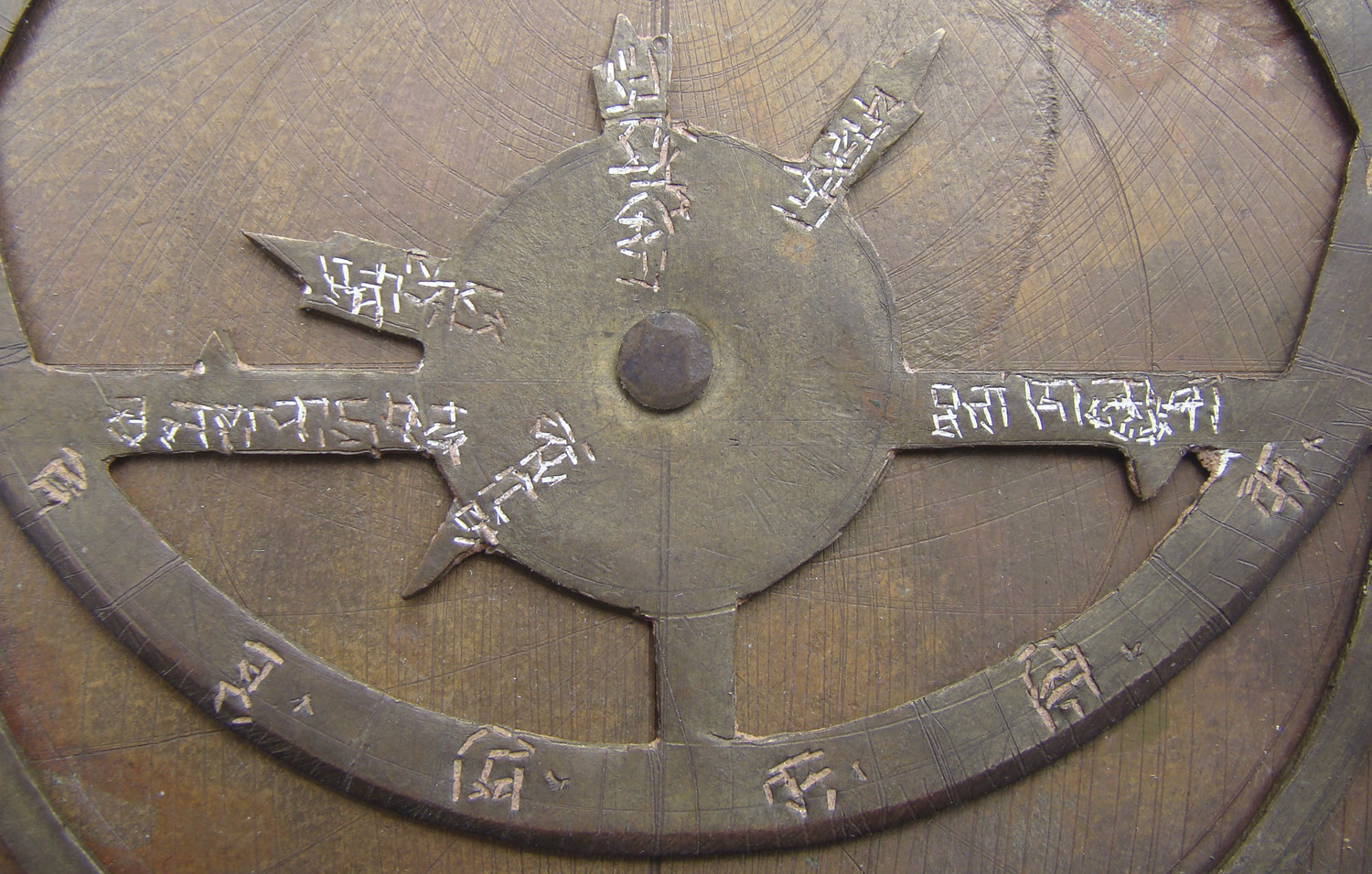
PRIMITIVE BRASS HINDU ASTROLABE, Indian, probably 19th century. Measuring 5" (13 cm) in diameter, the astrolabe is made of sheet brass, hand cut and engraved in Sanskrit. The rete has 20 named star pointers, all of the early dagger form. The ecliptic circle is divided into 12 named houses, and the equatorial circle and tropic of Capricorn are present. The combined plate / mater, designed for a single latitude, bears a Sanskrit inscription on the throne, and is divided, rather crudely, every degree, with 15 divisions of six degrees each, in each quadrant. The throne has a scalloped crown shape, as known on some astrolabes made in Jodhpur in the third quarter 19th century. The inscription is difficult to decipher, but seems to translate as "Salutation to the glorious Omniscient One" (Sarma, personal communication.) The reverse is scratch divided with a sine/cosine grid, and a labeled shadow square. The alidade is lacking; the suspension ring is present. The workmanship is quite crude but the design is honest and the condition is fine, noting the brass now quite darkened. The maker of this astrolabe was certainly not an accomplished craftsman; his "engraved" letters and numerals were basically all punched out with a single narrow tool, almost as punches with a screwdriver blade. Yet the design appears astronomically correct. It was traditional for an astronomer to design the astrolabe, and for a metalworker to execute it. This is often acknowledged in the inscription (see for example Tesseract Catalogue 91 item 2). We can speculate that in this case the astronomer, with little craft training, executed the instrument himself. (10021) $3800. |
| Fine Early Example of Reflecting Telescope | Click on any image for a larger view. Scroll to view more items. |
 |
 |
|
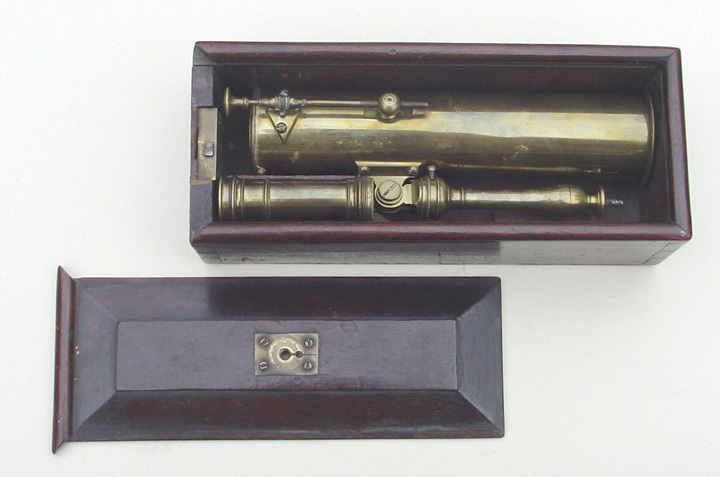
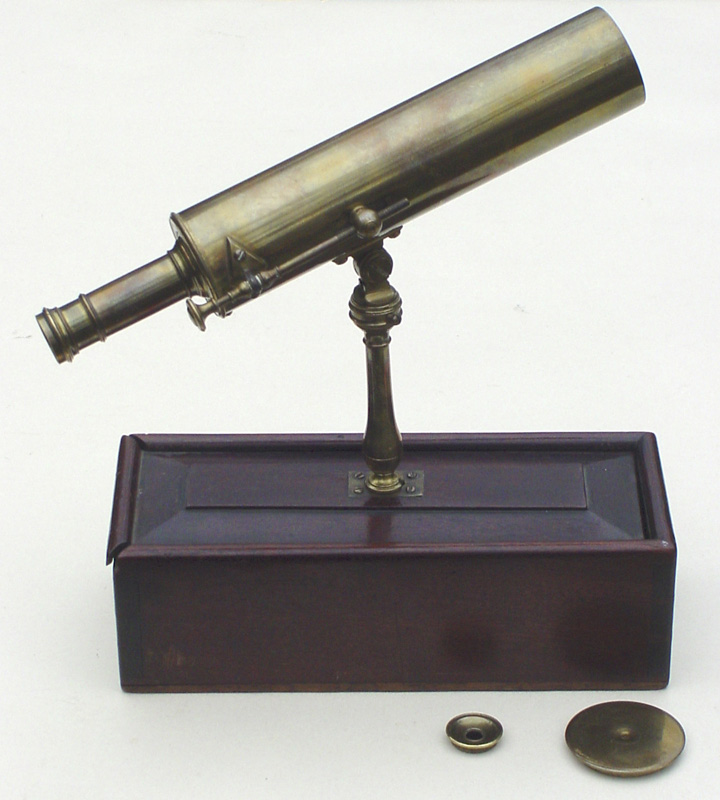
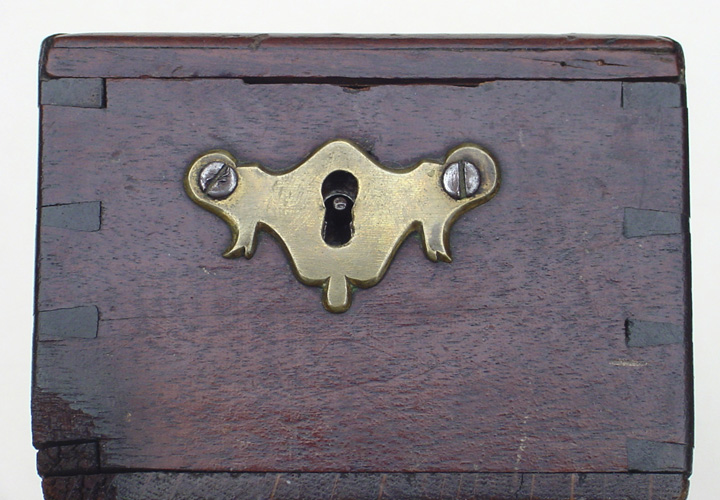
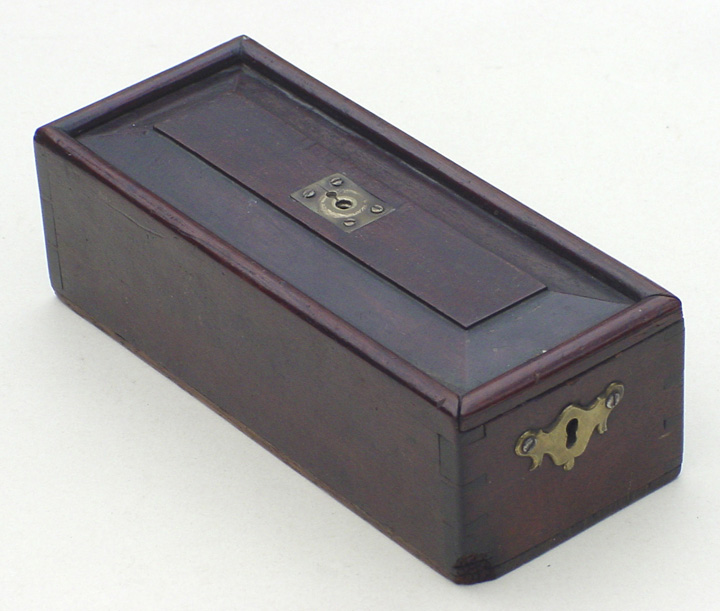
DIMINUTIVE EARLY CASE-MOUNTED GREGORIAN TELESCOPE, probably English, c. second quarter 18th century. The 8-5/8" x 3-1/2" x 2-3/4" (22 x 9 x 7 cm) mahogany or rosewood case has oak bottom and beveled slide-off lid, plus inset brass mounting plate and beautiful brass escutcheon. The brass telescope assembly mounts to the lid, by tapered steel screw and turned brass pillar to altazimuth mount. The main tube is 7-1/4" long and 1-5/8" in diameter, fitted with spring-loaded speculum metal primary mirror, speculum secondary mirror on adjustable mount driven by external focusing rod, erecting eyepiece assembly with two lens elements and two apertures, screw-on red solar filter, and turned end cap. The system gives remarkably fine images, even in daylight when the Gregorian design suffers from off-axis light. Condition is fine noting some darkening to the brass, a couple of replaced mounting screws, and old repair to the lock. Various details point to an early date -- the use of oak as a secondary wood, the escutcheon form, telescope design details, the diminutive size, the case-top mounting, etc. We have seen an even smaller case-mounted Gregorian by Edward Scarlett, and note James Short's frequent use of this design. (7044) $4500. |
 |
 |
| Unusual Paper-on-Wood Quadrant, c. 17th century | Click on any image for a larger view. Scroll to view more items. |
 |
 |
|
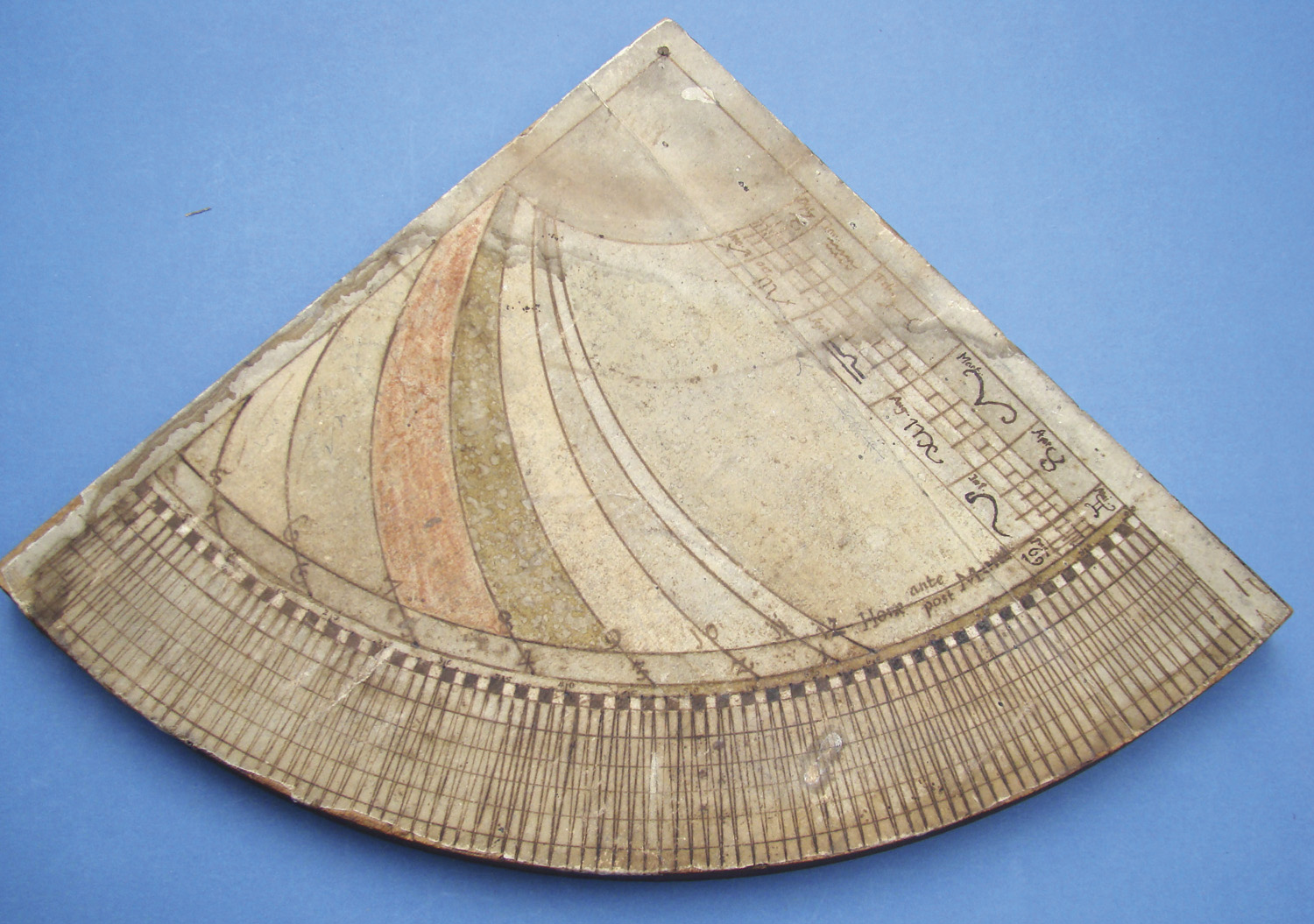
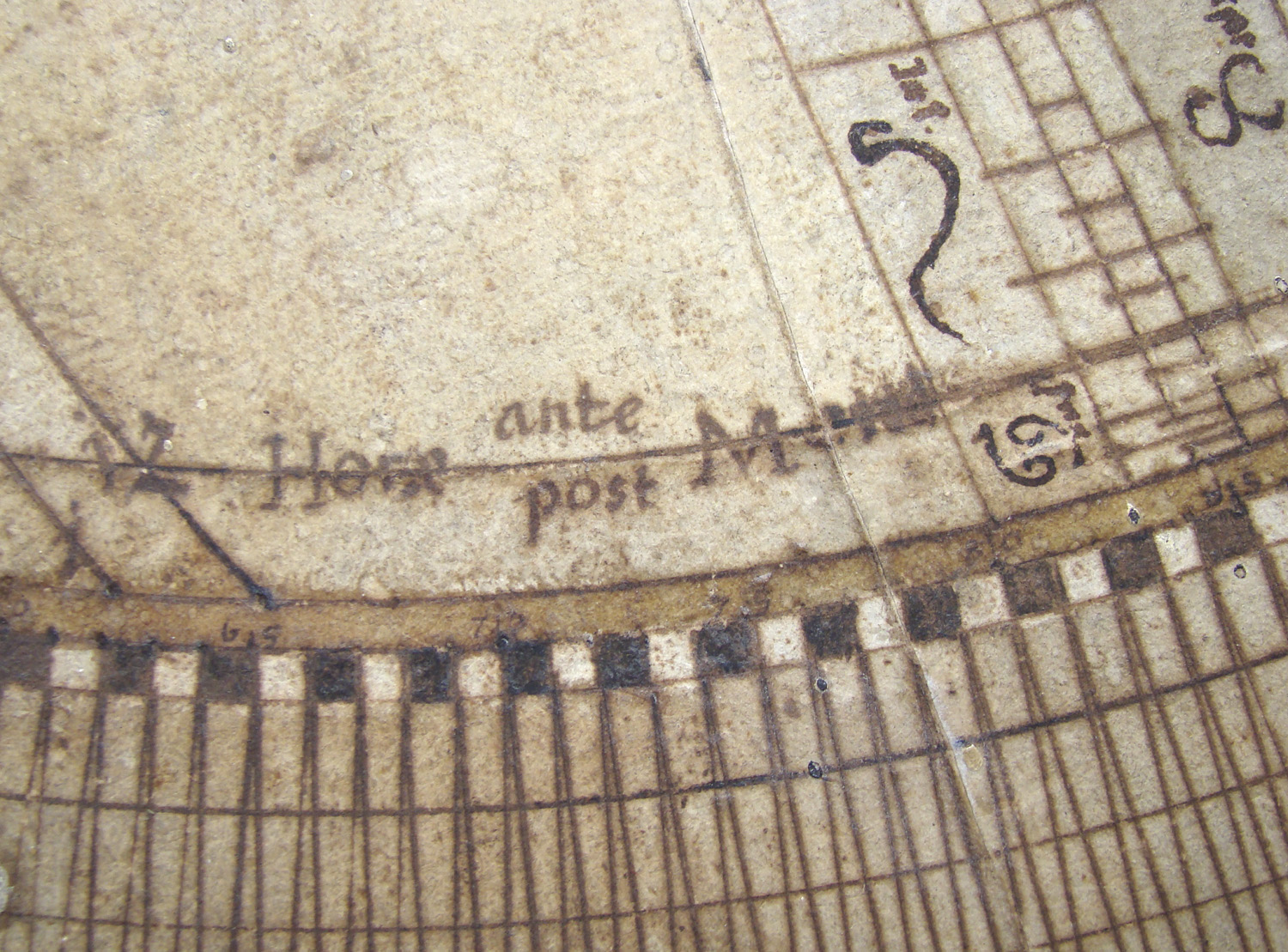
MANUSCRIPT HORARY QUADRANT, probably German, c. 17th century. This thick (3/4"; 1.9 cm) wood quadrant is 8-3/8" (21 cm) in radius, mounted on one side with a paper sheet laid out in ink with partial hand coloring. The other side has an incomplete attempt to draw the same inked design directly on the wood. A plugged hole at the apex would anchor a string with plumb bob. Two edge holes might permit auxiliary sights, although one can of course sight directly along the broad edge. The layout presents a degree quadrant, the scale running counter-clockwise from 0° to 90°, highlighted every degree with alternating dark and light squares, numbered every five degrees, and with a broad band of transversal lines giving interpolation points every ten arcminutes. Within this is a large band of curved hour lines running from 4 am to 12 noon and back again to 8 pm, the number sequences labeled in Latin respectively "ante" and "post-Meridie." Along the right edge is a Zodiacal / calendrical scale divided every five days. Condition is good noting water damage especially around the apex and along one edge. This is a form of the early horary quadrant, known from Medieval times (see, e.g., Cowham, 2014, p. 12; Tesseract Catalogue 78, Item 14). It is laid out for a latitude of approximately 46°. To find the time with this altitude dial, one simply positions a bead along a plumb line such that the bead sits at the correct date / Zodiacal position on the scale, then aligns the quadrant edge with the sun, meanwhile letting the plumb line hang freely and noting the correct time under the bead. We suggest a central European, probably German, origin of the quadrant based on the numeral shapes ("1" as"j," "2" as "z"), the spelling "Mai," and the latitude consistent with regions just south of southern Germany Similar manuscript instruments are quite uncommon, although some fine ones have survived, noting the 15th century planetary instruments in Frankfurt am Main (see Glaseman), and the lunar computer in Tesseract Catalogue 98 (item 4). (10051) $4800. |
| Fine Astrolabe signed for Astronomer and Maker | Click on any image for a larger view. Scroll to view more items. |
 |
 |
|
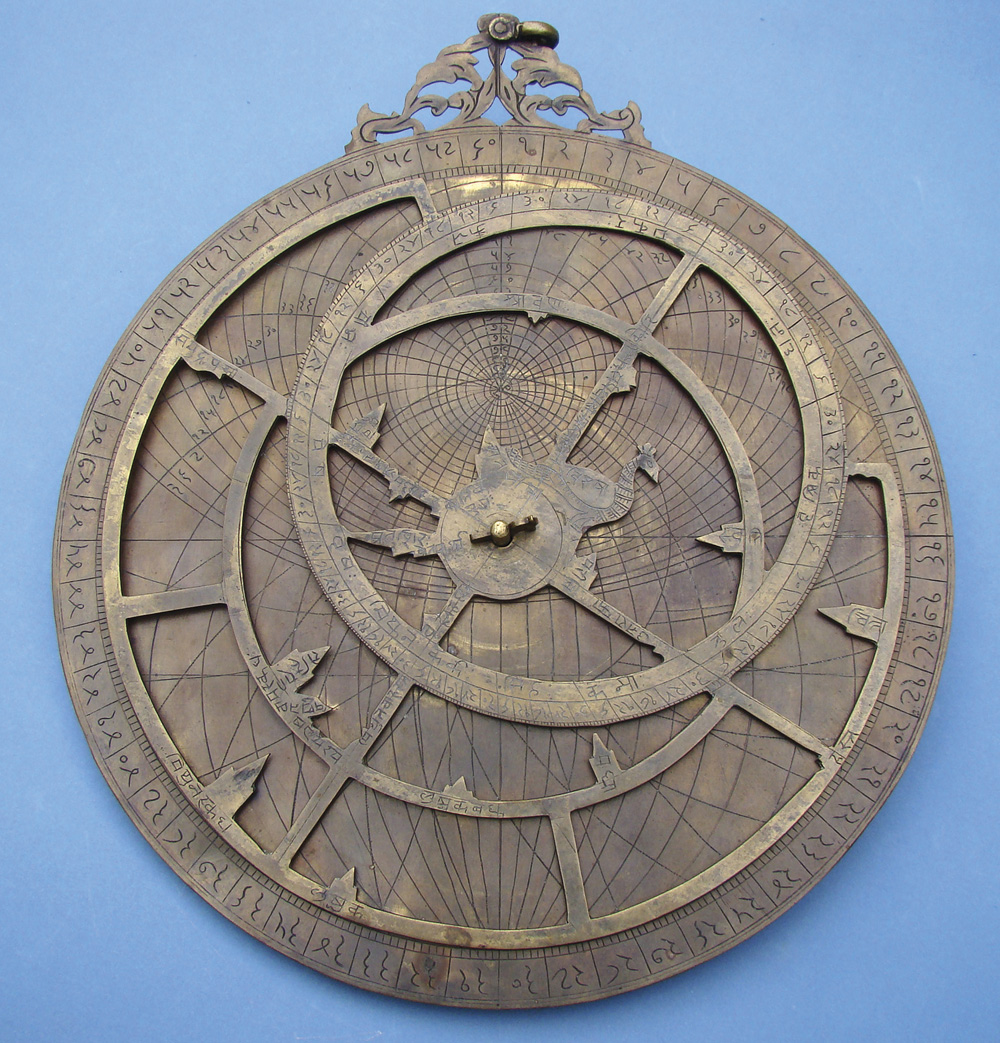
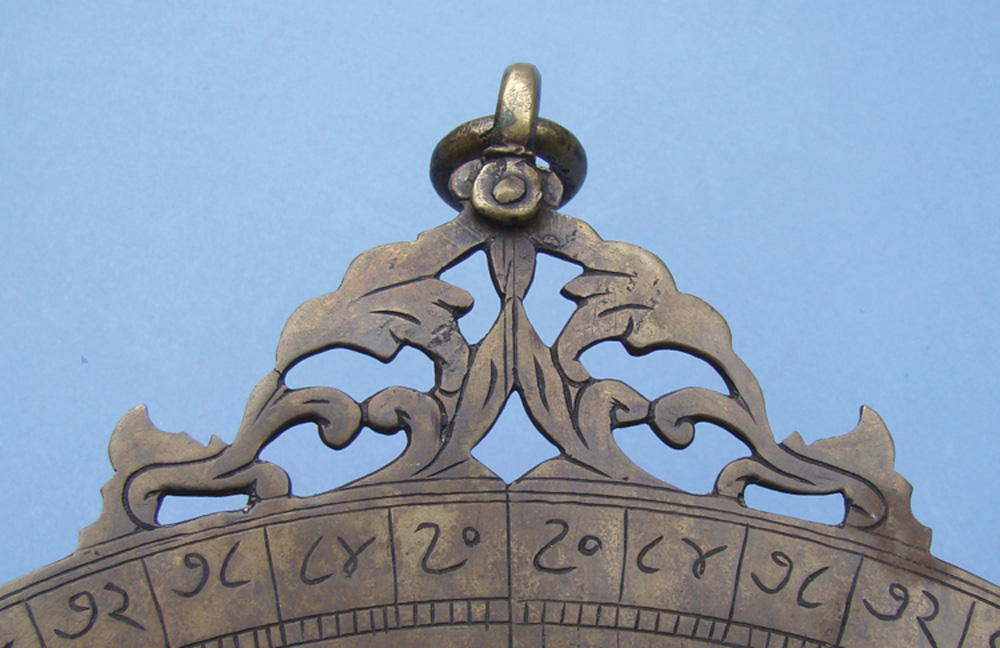
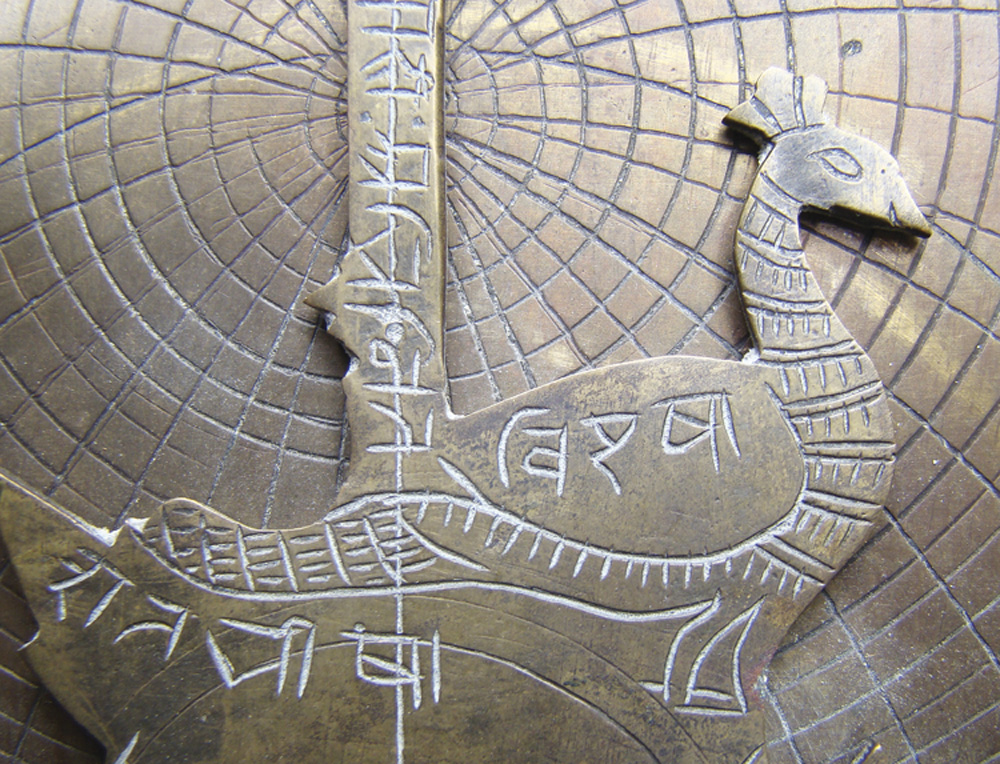
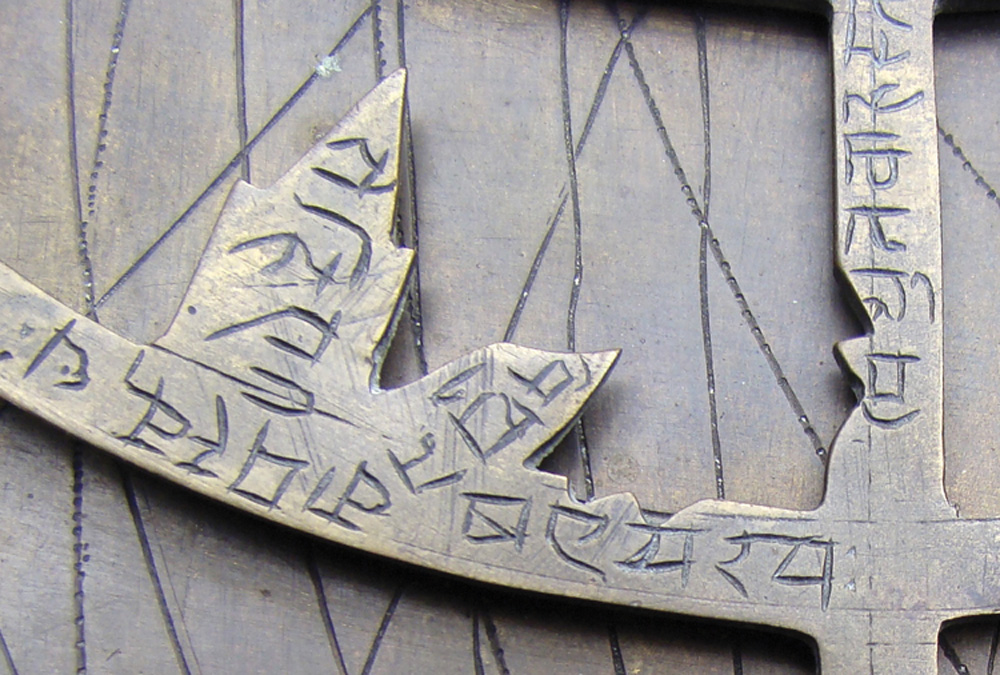
ELEGANT BRASS ASTROLABE, signed for the astronomer who designed it and for the craftsman who made it, Indian, c. mid-19th century. The main plate measures 10-3/4" (27.4 cm) in overall diameter, hand-engraved on the front with the coordinate system for a user at latitude approximately 28 degrees north. The astrolabe was likely crafted in Rajasthan, possibly in the important city of Bikaner at latitude 28.01 degrees. Around the projection is a circumferential scale divided every degree and labeled every six degrees. The integral "throne" is nicely pierced and engraved in foliate patterns, and mounted with suspension swivel; the rounded edges in the throne give it an almost three-dimensional shape. The openwork rete, which presents a map of the heavens, rotates on the main plate, and is designed with 27 different mostly dagger-shaped star pointers, all labeled with the appropriate star names. The pointer for Alpha Coronae Borealis (Alphecca) however, is formed as a large peacock perched on the rete¹s central disk, and finely modeled with raised neck and with feather decoration. The reverse is engraved with a sine/cosine grid, and with a double shadow square labeled on the left "shadows of a gnomon of 12 digits," and on the right "shadows of a gnomon of 7 digits." Below this the inscription reads "Latitude 28.16 [degrees]" and "Midday equinoctial shadow 6.30 [digits]." And finally comes: "This plate was made by Sutradhara Suryamalla according to the instructions of Kasturicandra." Sutradhara means architect, here used in the sense of craftsman or artisan; the maker's last name means literally "sun-wrestler." Two other astrolabes by Suryamalla are known, also made under the instruction of the astronomer named Kasturicandra, and bearing the same distinctive peacock motif. (Sarma, personal communication). The back of the astrolabe is mounted with the sighting tube/alidade, which has a nicely shaped center and a beveled edge divided both sides of the center (with equally spaced divisions, approximately 54 on one side of the shaped center, 58 on the other, and thus approximately two millimeters per division). All is held together by a central pin secured by a charming little stylized-horse-shaped "horse." Condition is very fine throughout, the brass with a uniform brown patina. A fine example of an authentic functioning astrolabe, signed for both the maker and designer. (10042) $22,500. |
 |
 |
 |
 |
| Beautiful Construction by an Uncommon Maker | Click on any image for a larger view. Scroll to view more items. |
 |
 |
|
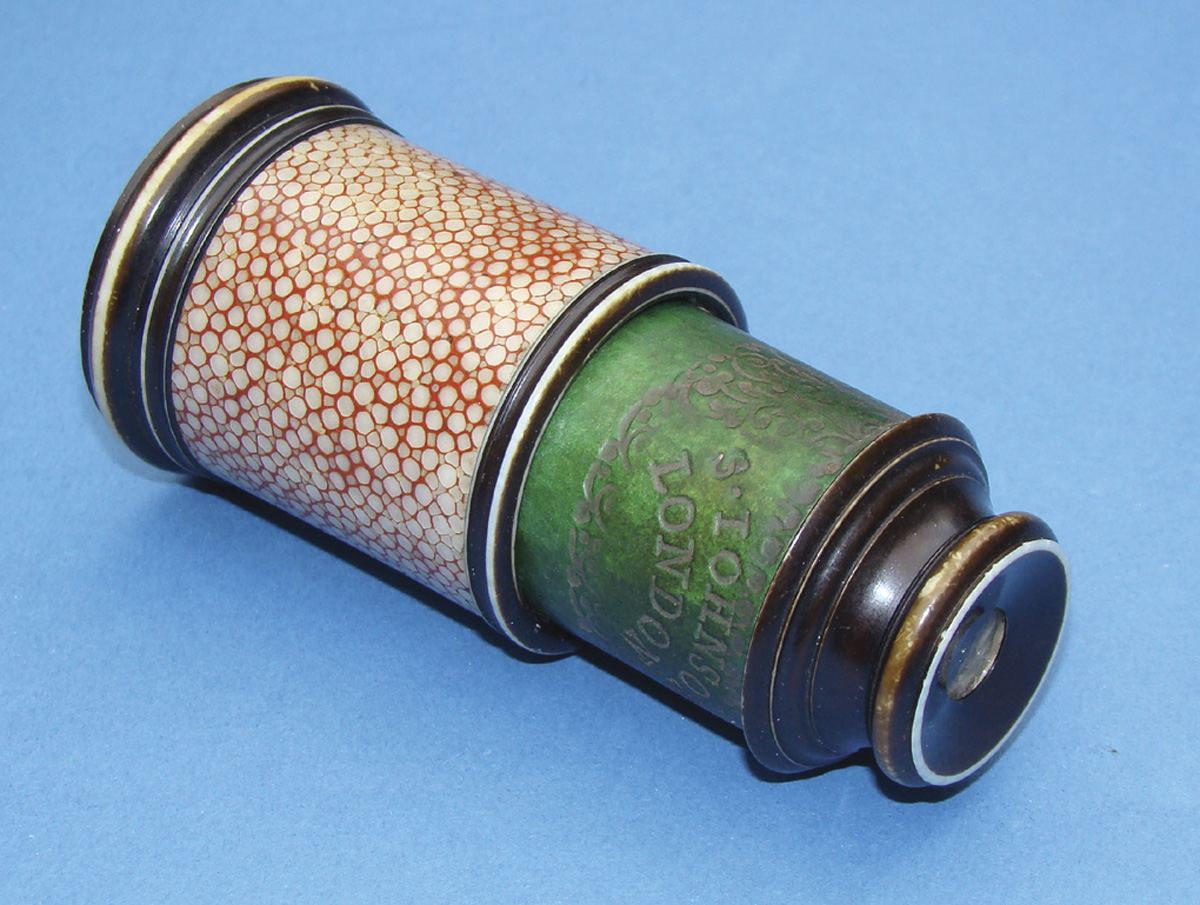
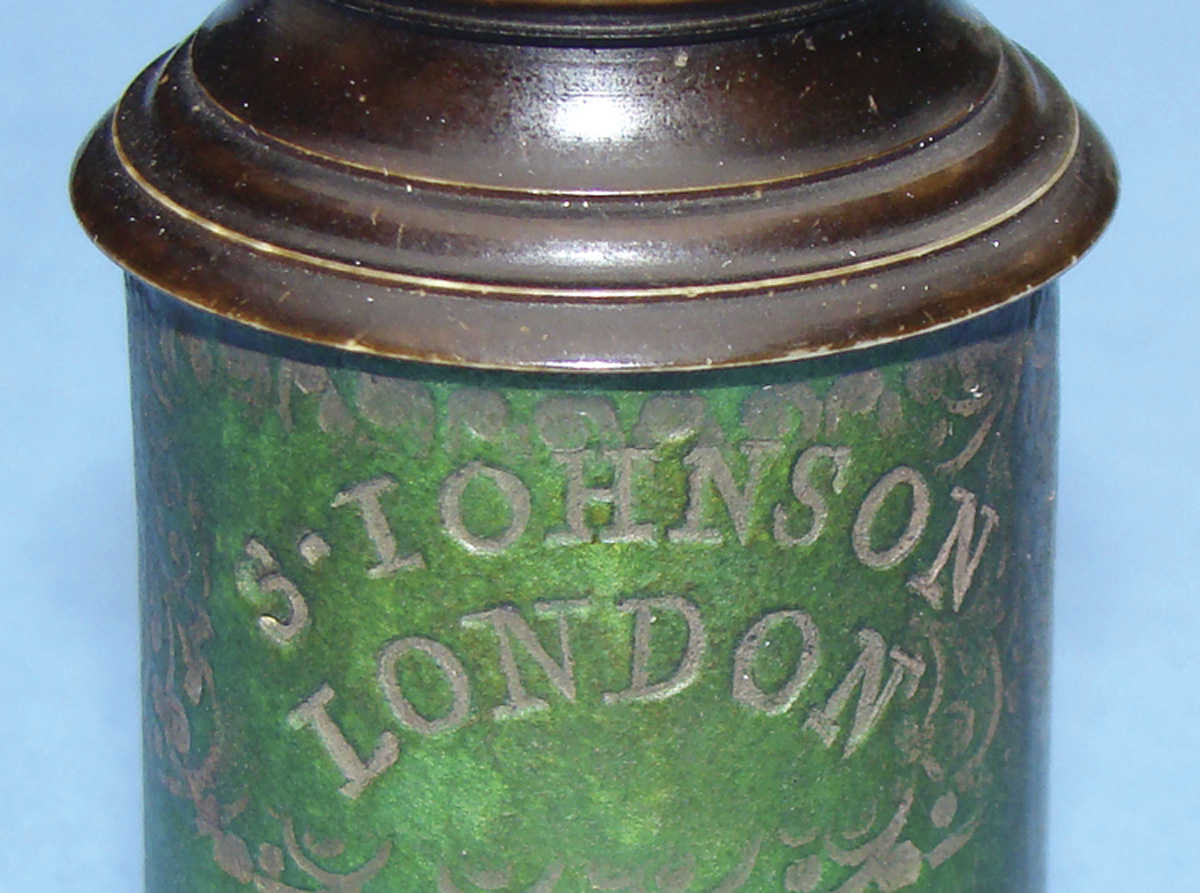
HANDSOME ENGLISH MONOCULAR BY AN UNCOMMON MAKER, third quarter 18th century, signed (stamped) on the drawtube "S. Iohnson, London." Measuring only 2-3/8" (6 cm) long closed, this little telescope is constructed in a wonderful combination of materials typical of 18th century fashion, with wood main tube bound in red-stained ray skin, card drawtube bound in green-stained vellum with stamped decoration, dark-stained ivory mounts, and internal diaphragm of wood. Condition is very fine, noting some (rather attractive) wear to the stain on the edges of the ivory mounts. The maker would have been Samuel Johnson, apprenticed to the famous optical instrument maker James Mann in 1738, made free in the Spectacle Makers guild in 1745, and working under the wonderful trade sign of "Sir Isaac Newton & Two Pair of Golden Spectacles" (see Clifton). (9036) $1950. |
| Handheld Reflecting Telescope, in Fishskin Case | Click on any image for a larger view. Scroll to view more items. |
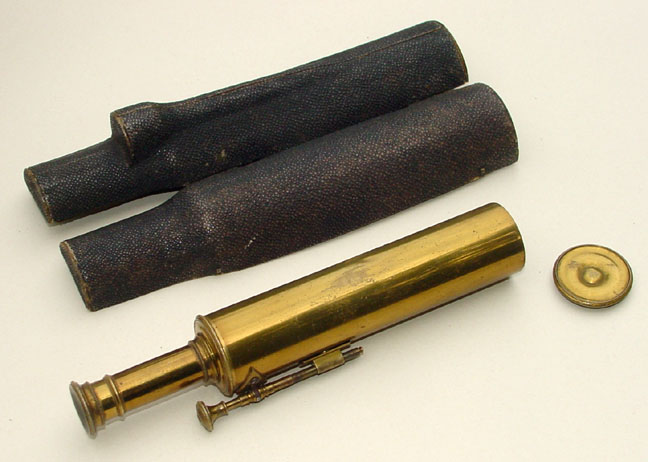 |
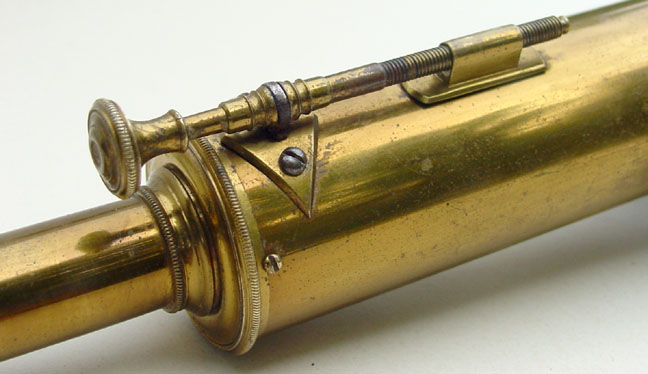
| MINIATURE GREGORIAN TELESCOPE, English, c. third quarter 18th century. Measuring 7-1/4" (18 cm) overall, complete with turned brass end cap, the instrument has bright speculum metal mirrors, two-element erecting eyepiece system, and external screw focussing to the secondary mirror. Craftsmanship is excellent, and it gives superb images even in daytime. The telescope is contained in its wonderful original shaped case of wood lined with green velvet and covered in black fishskin. Condition is very fine throughout, noting a bit of rubbing to the original lacquer finish on the brass, and loss of one small semicircular end to the case. The miniature Gregorian telescope is known in very few examples; we have had one by Stedman of London (Tesseract Catalogue 52 Item 7), and one unsigned (Catalogue 40 Item 6). A splendid example. (8013) $4950. |
 |
| Eighteenth Century "Calendarium Perpetuum" | Click on any image for a larger view. Scroll to view more items. |
 |
 |
|
GERMAN PERPETUAL CALENDAR, 18th century, made of gilt and silvered brass, 1-7/8" (4.7 cm) in diameter. On one side the rotatable "Calendarium Perpetuum" shows the days of the week (in German, and marked with their planetary signs) against days of the month, and has floral patterns hand-engraved in the open spaces. The other side gives, in seven readout windows defined by its rotatable disk, month of the year with its number of days, tabulation of the important saints' and feast days in the month, sun¹s Zodiacal position, length of day, length of night, time of sun rise, and time of sunset. There is further floral engraving, as well as inclusion of a seated person amongst the vines. The Zodiacal signs are identified by amusing little hand engravings. A good example in very fine condition. (7037) $2400. |
| Early English Quadrant | Click on any image for a larger view. Scroll to view more items. |
 |
 |
 |
|
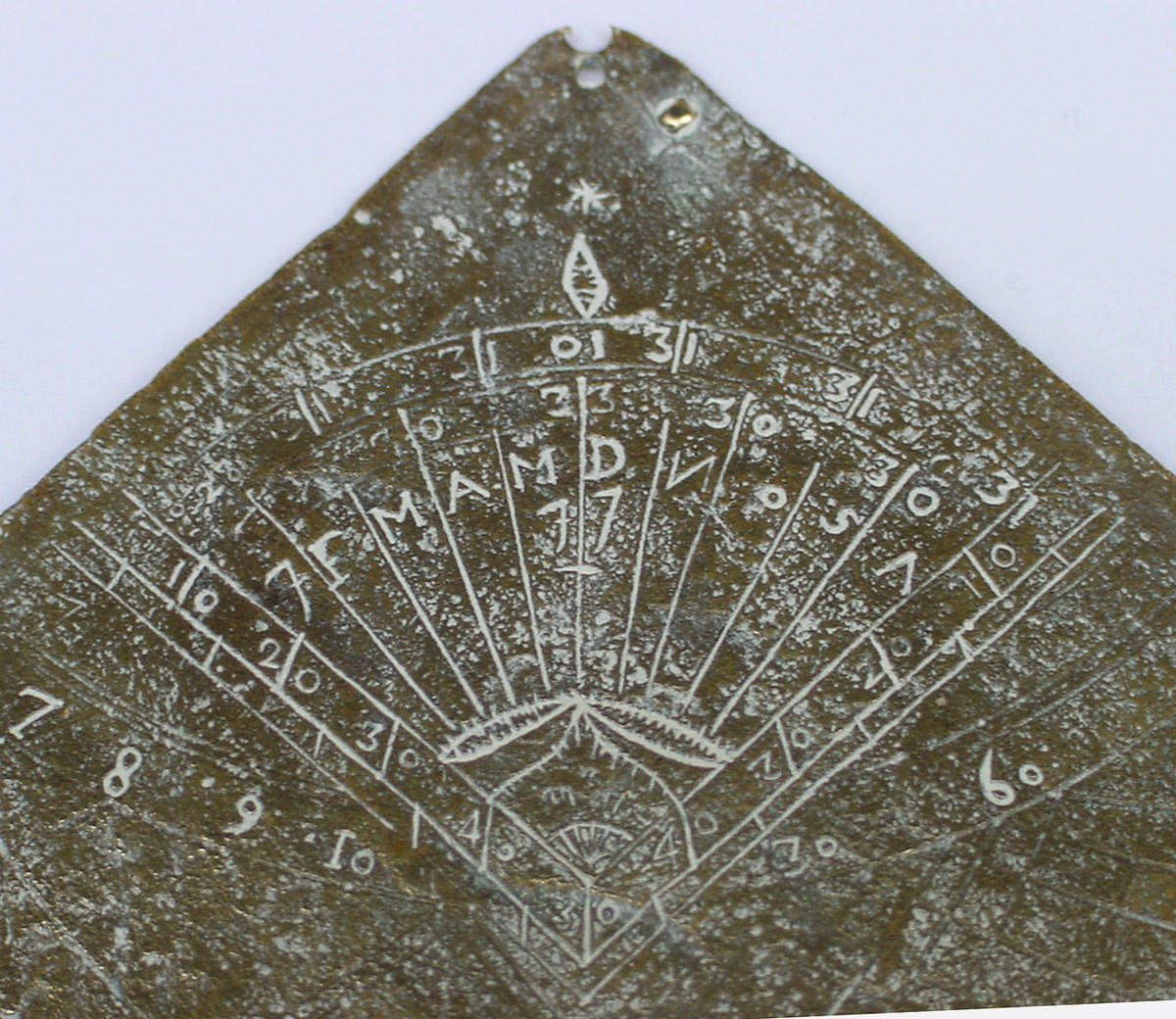
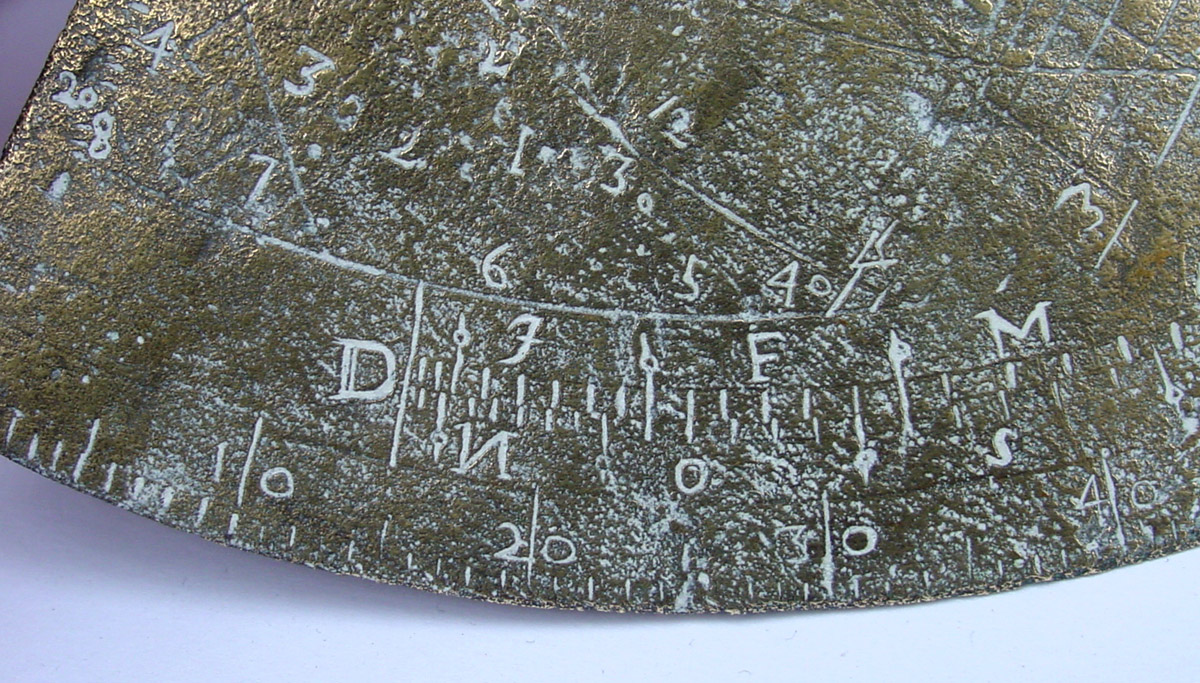
FASCINATING EARLY QUADRANT, English, mid-17th century. This very thin brass quadrant is 3-3/4" (9.5 cm) in radius, hand engraved on one side, with practice engraving of several numerals and letters on the reverse. There is a circumferential quadrant scale divided every degree, for use in measuring the angular altitude of sun, moon, stars, mountains, buildings, etc., by sighting along the edge and reading against a little plumb line which would be suspended from the apex. Next is a calendrical scale, laid out for a vernal equinox of approximately 11 March (consistent with the Julian calendar), and for a latitude of 52° (close to that of London). The sky grid of arcuate hour and azimuth lines is crossed by the ecliptic, and is consistent with Edmund Gunter¹s design of 1623. There is an edge scale of solar declination, and in the corner a fascinating shadow square, each leg divided every 5 from 0 to 50. Within the square is a scale hitherto unknown to us on surviving quadrants. The 90° angle is divided radially into ten equal segments labeled "J, F, M, A, M, D, N, O, S, A," and with "J, J" on the center line. And concentric arcs indeed carry variously the numbers 28, 30, and 31, which all align, rather primitively, with the letters, giving an aide-mémoire for the number of days in each month. The apex of the square has hand-engraved decoration of a very distinctive style found on some 17th and early 18th century English instruments: compare with that on a plane table rule (Tesseract Catalogue 76, Item 30) and that on a boxwood compendium attributed to Sutton (Wynter and Turner, p. 132). Condition is fair noting much old pitting to the brass, and only remnants of the little pinhole sights remaining. The instrument was reputedly purchased in Wales many decades ago, and probably suffered outdoor weathering a very long time before. Nevertheless it is a fascinating early quadrant. (7077) $4500. |
| Ringard's Oval Lenses | Click on any image for a larger view. Scroll to view more items. |
 |
 |
 |
|
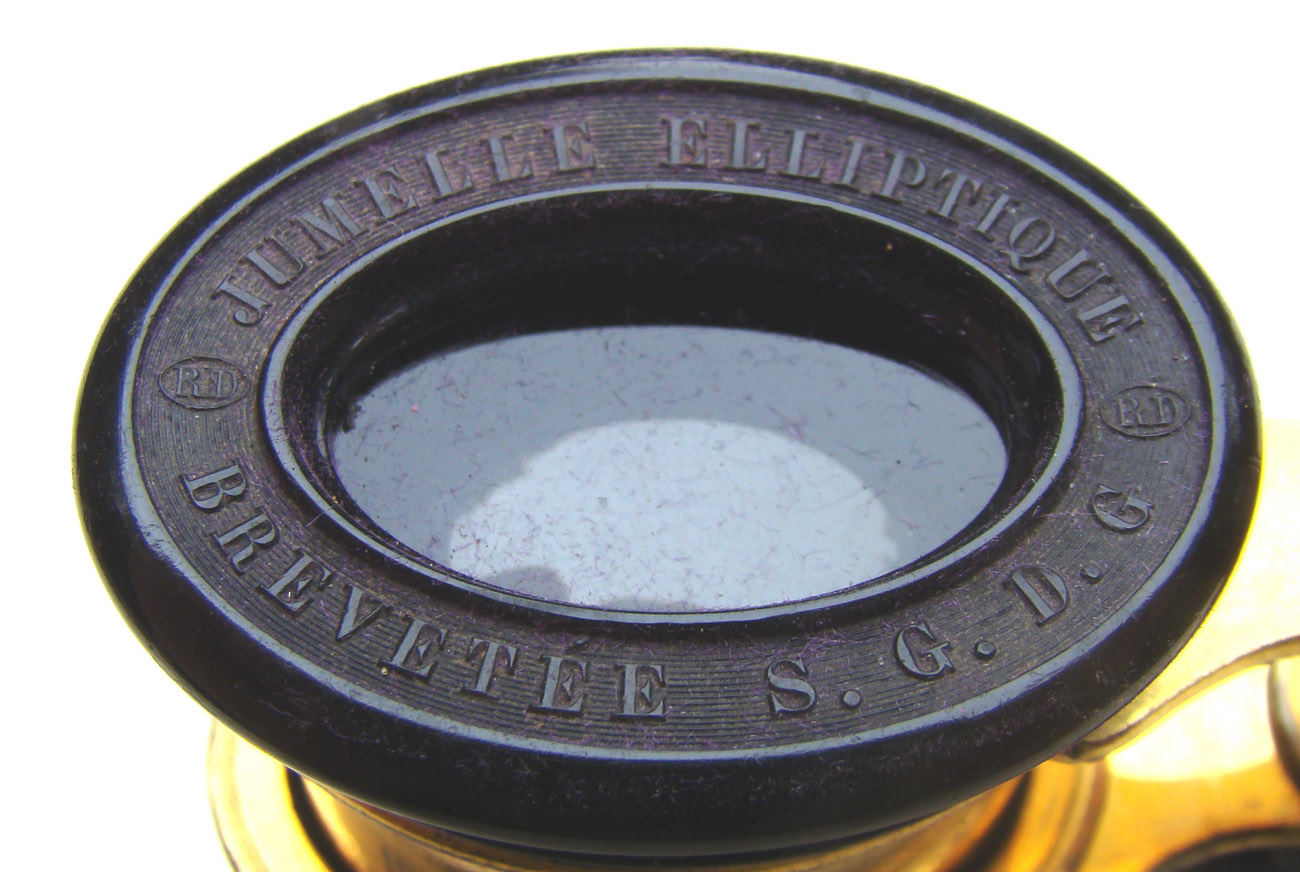
ELLIPTICAL LENS BINOCULARS, French, mid-19th century, signed in the eye mounts "Jumelle Elliptique, Brevetée S.G. D.G., Ringard Opticien, R. S't. Martin, 199, Paris," and with the maker¹s "RD" mark. Measuring 4-3/4" (12 cm) wide, and made of beautiful contrasting black enameled and gilt brass, with lens mounts and central focusing knob of hard rubber or wood, the binoculars have highly elliptical tubes fitted with singlet eye and objective lenses. Their unusual elliptical form provides the user with a field of view much wider horizontally than vertically, in a quite compact instrument. Condition is very fine noting some small chips to the mounts. The original leather case is rather rough, but has interesting fouled anchor motifs on the brass clasp. M. Ringard, Parisian optician, crafted these rather remarkable binoculars. His techniques of cutting and centering the oval lenses is specially treated in an 1848 paper in the Bulletin de la Société d¹Encouragement pour l¹Industrie Nationale. (9043) $850. |
| Binoculars with a Handle | Click on any image for a larger view. Scroll to view more items. |
 |
 |
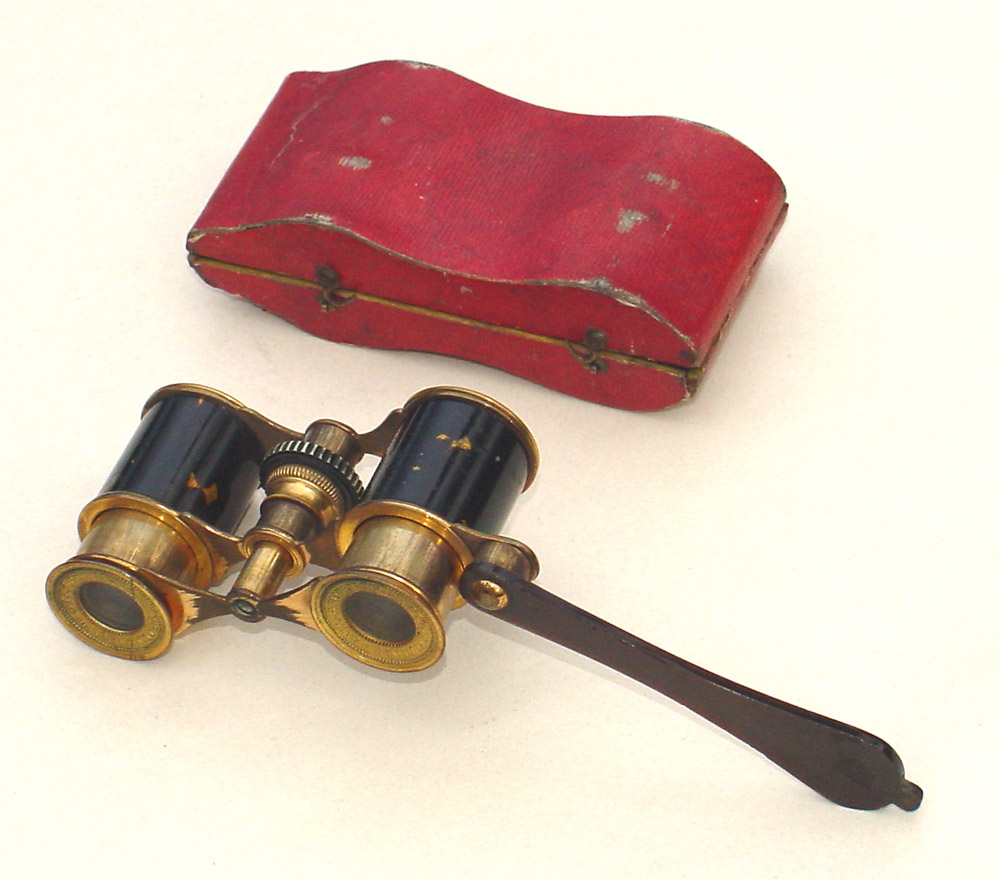
| ELEGANT OPERA GLASSES, French, mid-19th century, signed twice ³Bianchi, rue du Coq St. Honoré No. 11 à Paris.² Measuring 4-1/2² (11 cm) wide overall, the binoculars are constructed of gilt-lacquered brass, with simulated tortoiseshell enameled main tubes, central geared focus with ivory thumbscrew, and swing away horn handle. In fine functional condition, they are complete with the shaped wood case covered in simulated red Morocco leather and lined with silk. (7036) $650. |
| For Your Walking Stick or Cane | Click on any image for a larger view. Scroll to view more items. |
 |
|
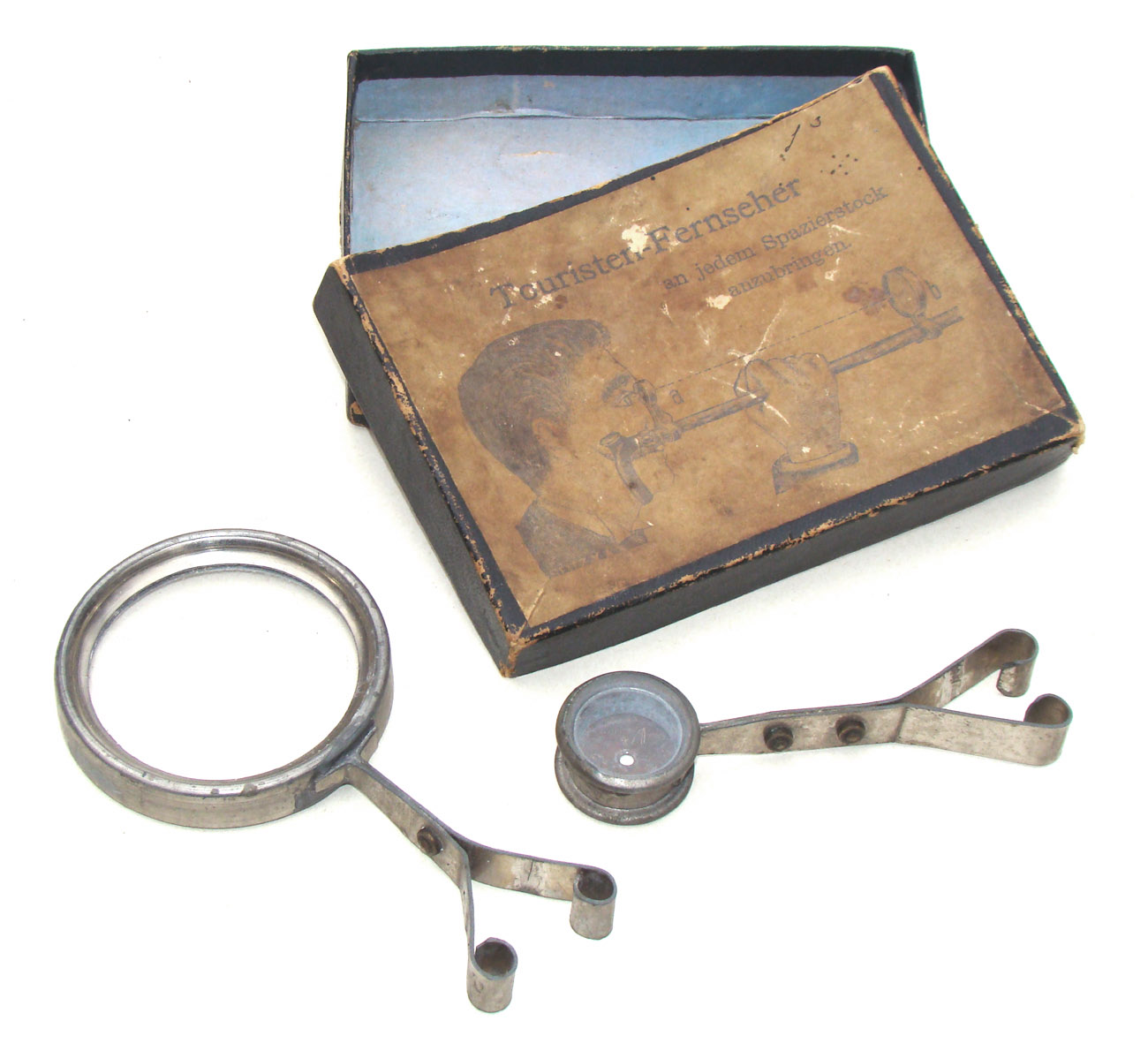
THE "TOURISTEN-FERNSEHER," A CANE-MOUNTING OPEN-AIR TELESCOPE, German, c. 1900, comprising two quite portable lenses set in tin mounts, contained in the original 3-1/2" x 5" (9 x 13 cm) card box with instructions. Each lens holder is designed to clamp onto one¹s walking-stick, thus forming an impressive Galilean telescope with a 2" diameter objective and focal length of approximately 20". It functions well, and is in good condition, the box rough. (Featured in "Wondrous Devices" exhibition, Hudson River Museum, 2018) (9035) $495. |
| High Precision Time Setting | Click on any image for a larger view. Scroll to view more items. |
|
|
|
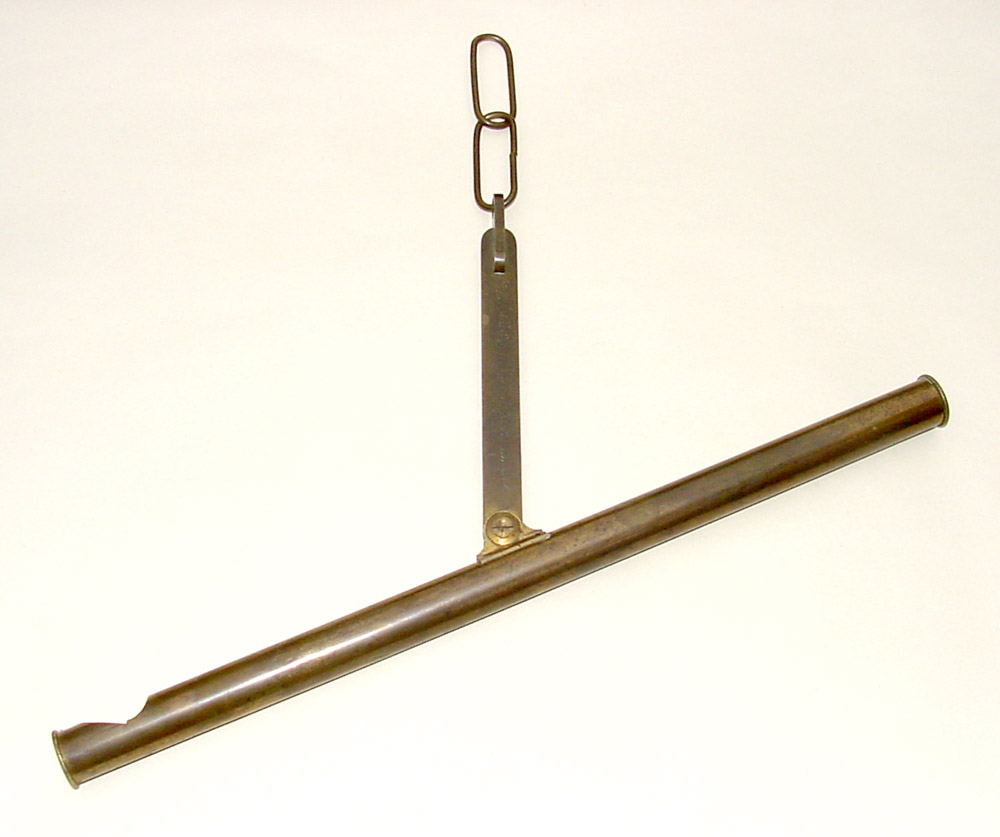
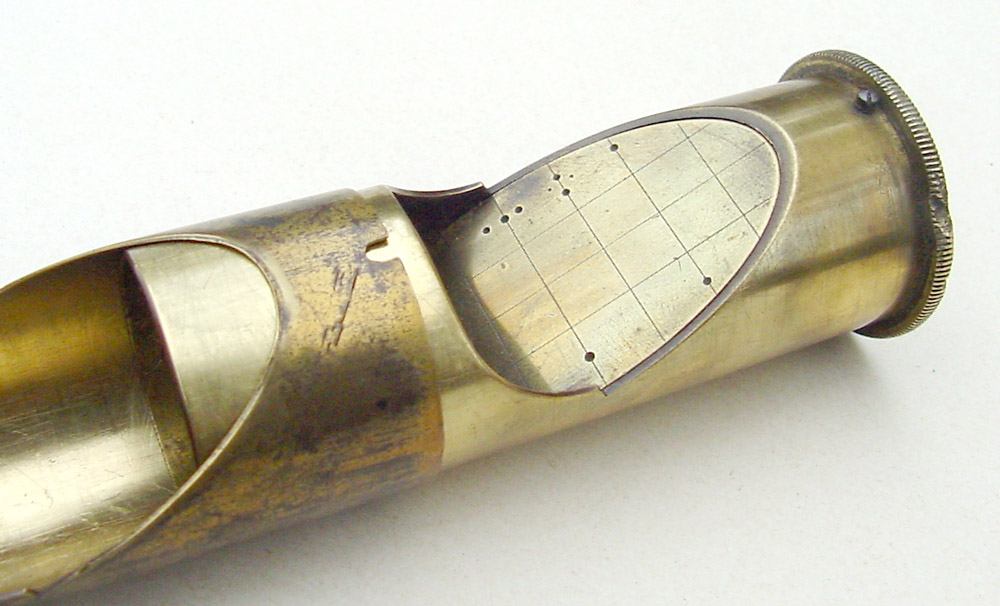
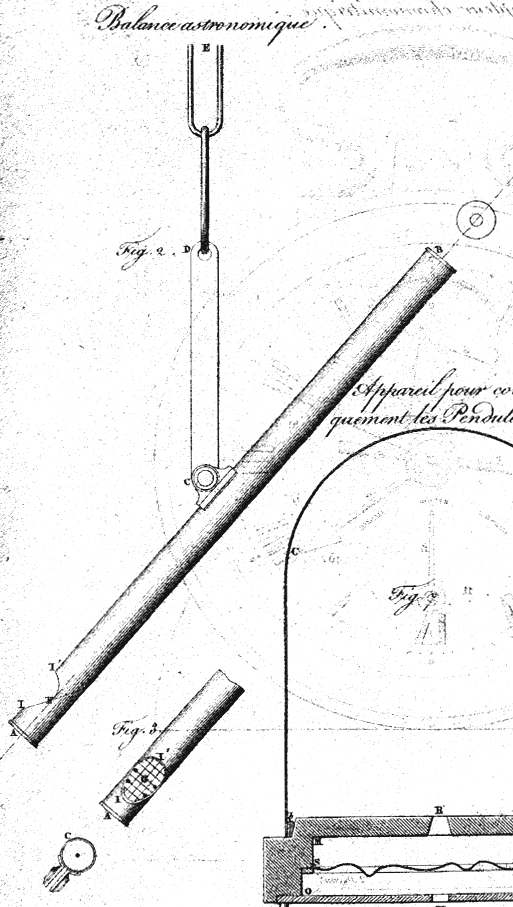
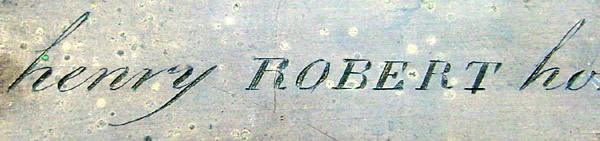
HENRI ROBERT'S ASTRONOMICAL BALANCE, French, c. 1835, signed "henry ROBERT, horloger a Paris. invenit." The "balance" is constructed with a 20" (51 cm) long lacquered brass tube fitted to a flat brass suspension bar and two large brass chain links. When suspended, the whole can rotate about the zenith direction, and the tube can pivot in its vertical plane. The tube itself is fitted with a tiny lens and pinhole at one end, and a removable target at the other. The target is inscribed with a grid of lines identified by dot patterns, and is inclined to the optical axis, and visible through a cut in the side of the tube. Condition is fine and complete, retaining about half the original lacquer finish. Henri Robert (1795 - 1874) was a clock-and-watch maker and prolific inventor. He worked with Breguet, establishing his own business in 1832, and became "Clockmaker to the Marine" as well as "Clockmaker to the Queen." This is his astronomical balance, by which one can determine the error in a watch or clock with high precision, simply by observing the sun (see Archives des Découvertes et des Inventions Nouvelles...pendant l¹année 1833). One suspends the balance in sunlight sometime before noon, aligns it with the sun, and, using the watch or clock in question, notes the exact times that the spot of sunlight crosses the lines on the target (as the sun ascends in elevation as it approaches the maximum at noon). One again notes the exact times that the same lines are crossed after noon. An average of the times should be 12:00:00 noon -- if not, one resets the watch by the difference. The maker / inventor offered the apparatus in two sizes, this one the larger and more accurate, giving time corrections to five seconds. This is a remarkable survival, complete even with the original suspension chain links. We are aware of only one other example of Robert's invention, that in the smaller version (Orologi e strumenti della Collezione Beltrame, 1996). (Featured in "Wondrous Devices" exhibition, Hudson River Museum, 2018) (9040) $5500. |
 |
 |
 |
| Astronomical Quadrant with Rackwork Motions | Click on any image for a larger view. Scroll to view more items. |
 |
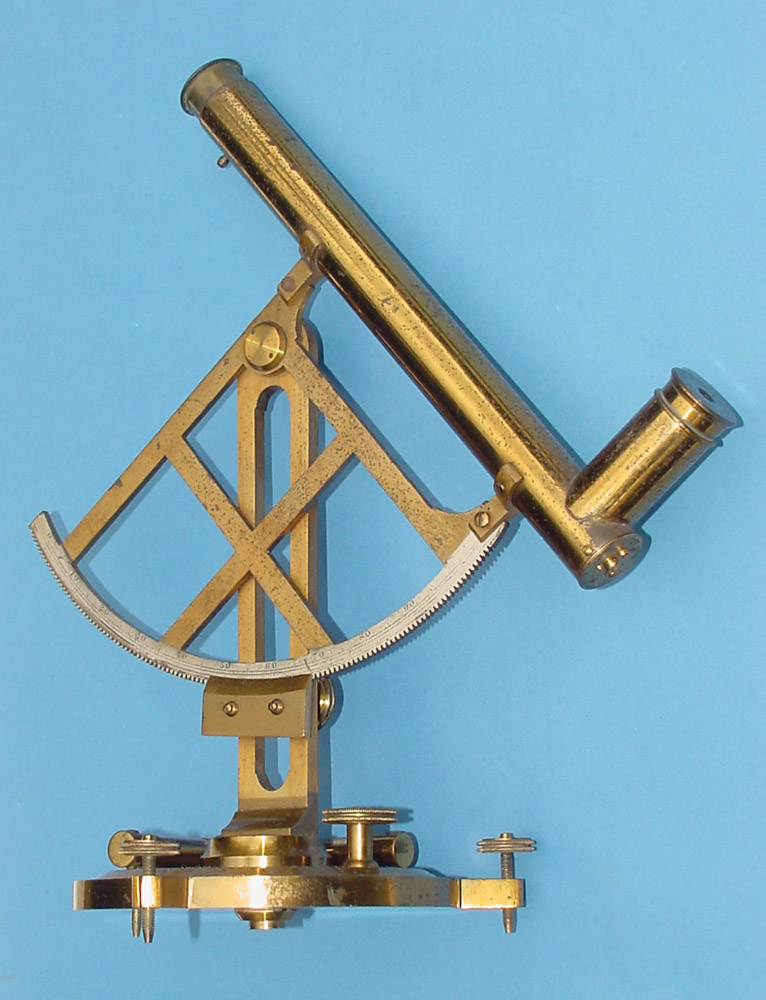 |
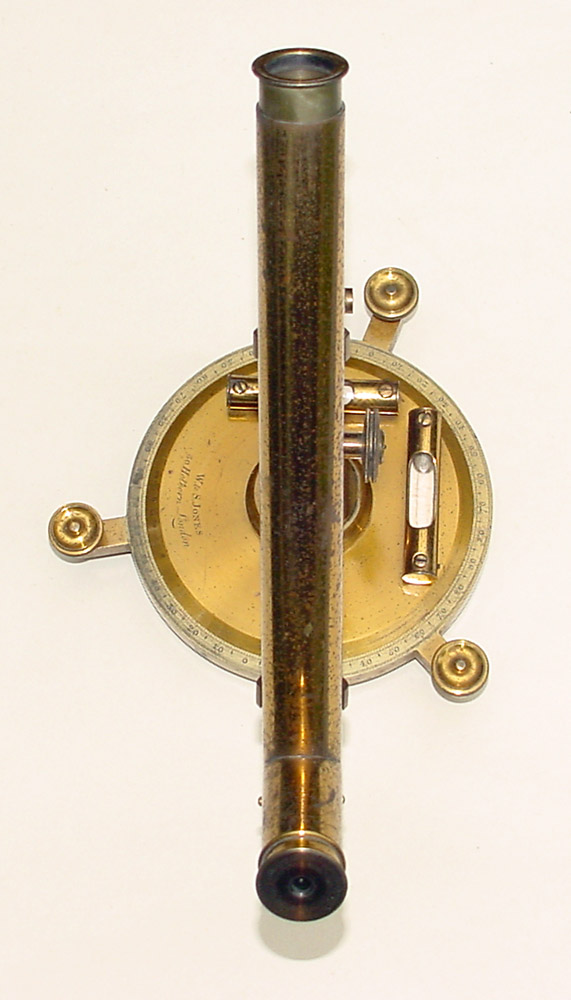
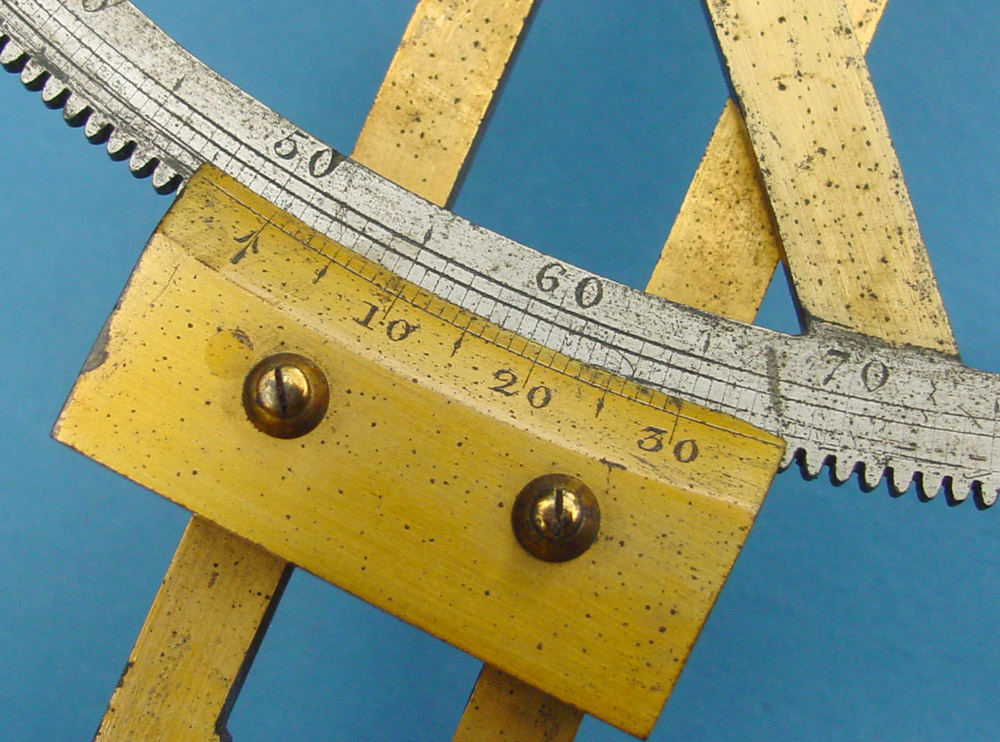
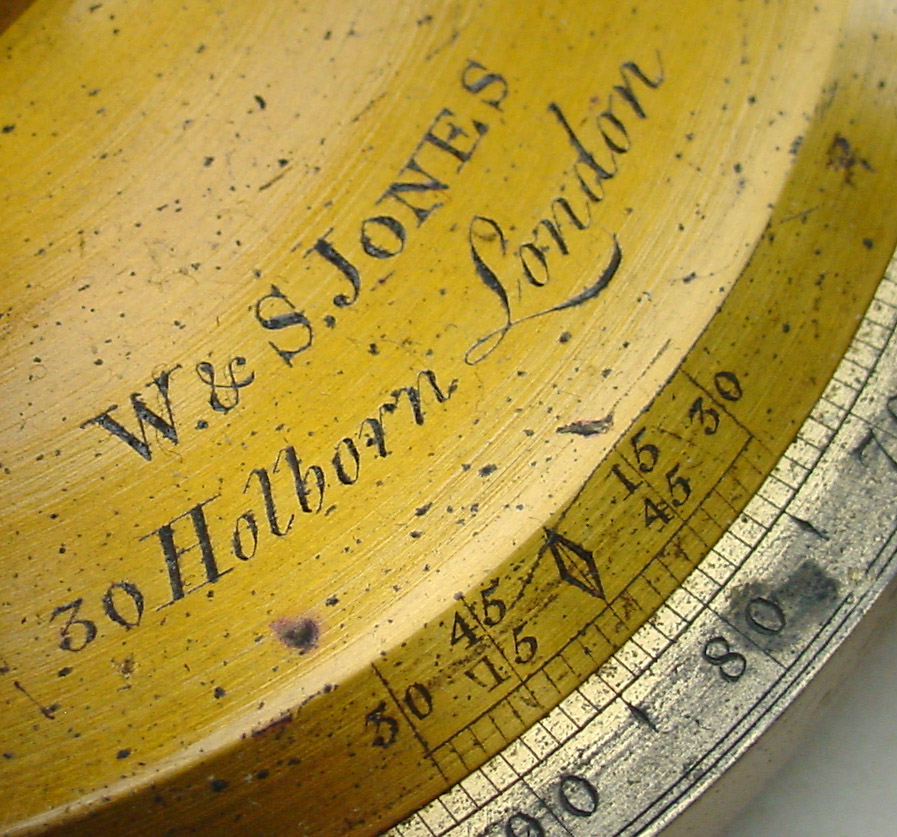
| JONES' IMPROVED ASTRONOMICAL QUADRANT, English, early 19th century, signed "W. & S. Jones, 30 Holborn, London." This handsome lacquered brass instrument stands 10" (25 cm) tall on its tabletop base with three leveling screws. The base has a circumferential degree scale, and is centered by a rotating disk which carries the instrument on central pillar, and which is fitted with crossed spirit levels, internal pinion and ring gears, and one-arcminute vernier. Atop the openwork pillar is mounted the 4-1/4" (11 cm) radius openwork quadrant with 0° - 90° scale, one-arcminute vernier, and pinion with external rack. Thus the instrument functions as a geared altazimuth theodolite. It is aligned not with sight vanes but with a right angle telescope with sliding focus to both the objective and eyepiece, fitted with solar filter. Condition is very fine, complete, and functional; the brass is spotted but retains most of its original clear lacquer finish. This is a very rare example of Jones' improved astronomical quadrant. In his Lectures of Natural and Experimental Philosophy George Adams (and subsequently William Jones) devotes six pages to the construction and use of the simple astronomical quadrant. But in a footnote, Jones describes this improved version: "By the addition of a small telescope, with a reflecting eye-piece, vernier scales to the arc and circle, rack-work and pinion to the arc AB, and circle EF, &c. I have rendered this small instrument useful for observing angles up to the zenith, and with more ease and accuracy for angles in general." The first example we have seen. (Featured in "Wondrous Devices" exhibition, Hudson River Museum, 2018) (9011) $9800. |
 |
 |
| Aluminum from the Columbian Exhibition | Click on any image for a larger view. Scroll to view more items. |
 |
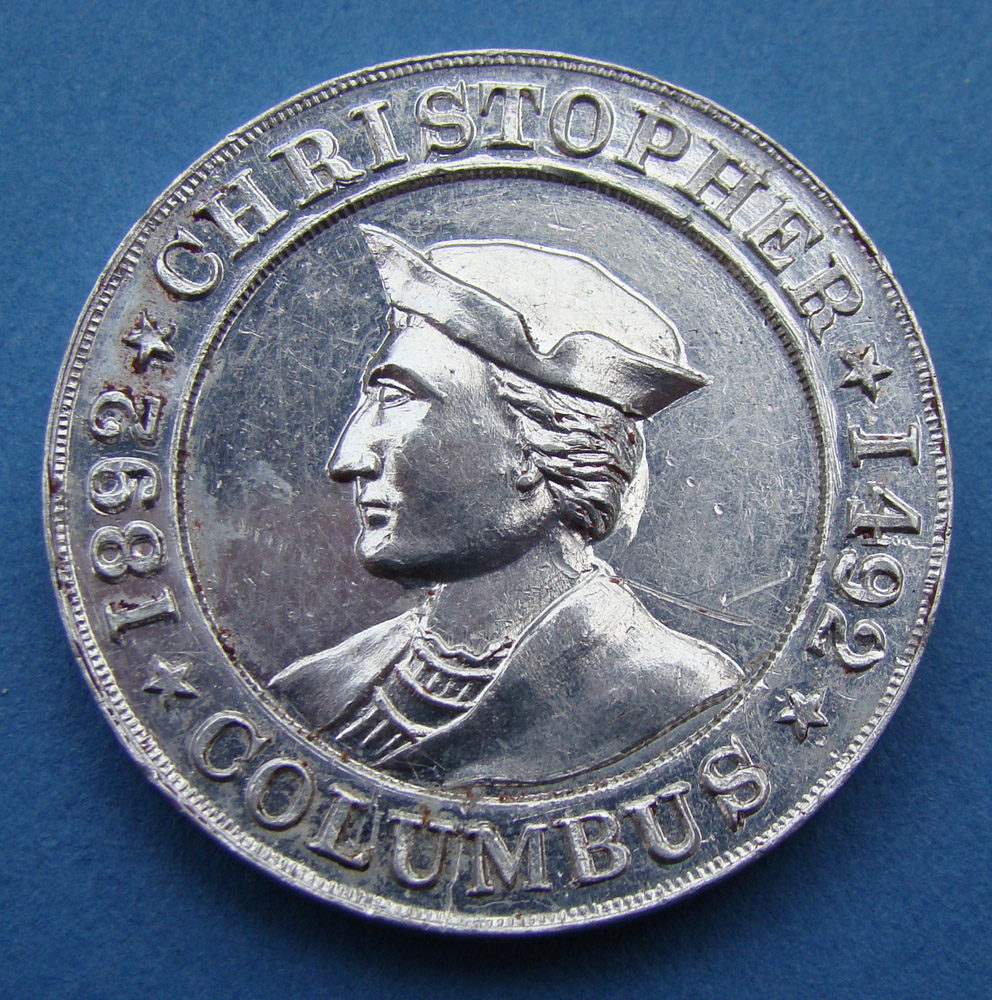 |
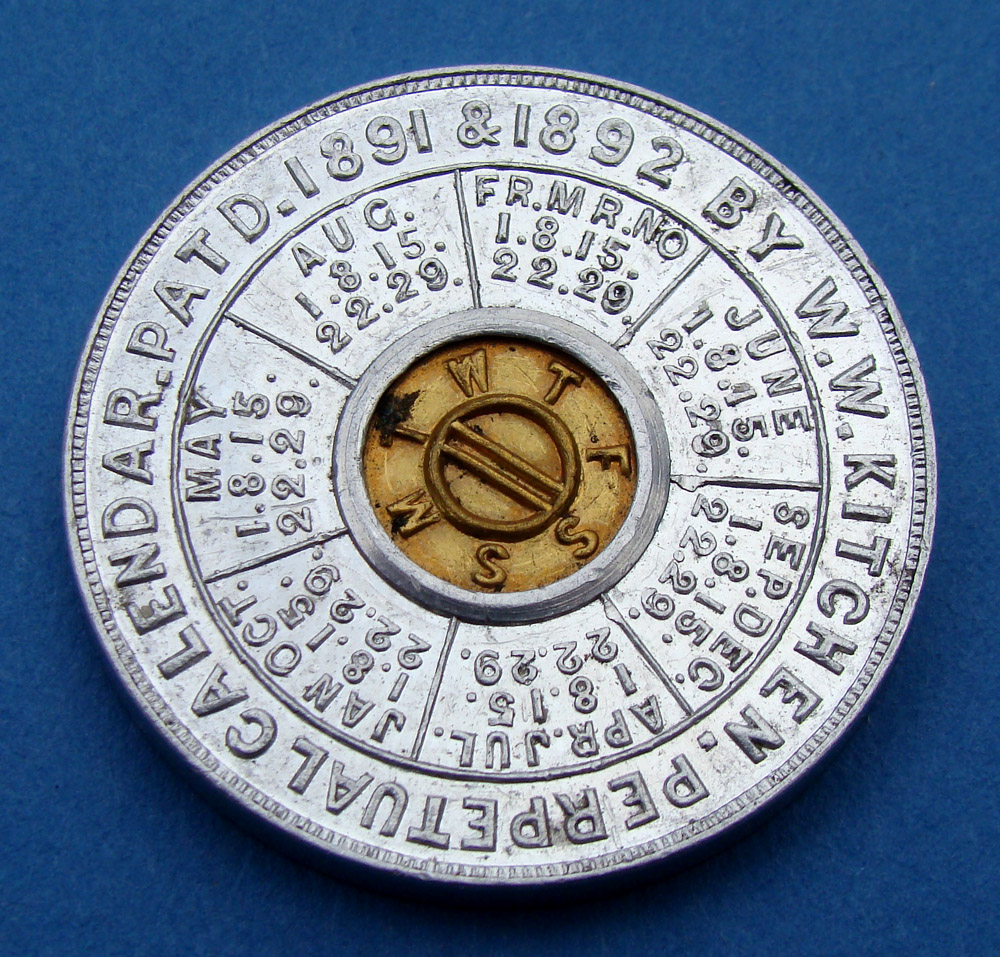
| PERPETUAL CALENDAR MADE FOR THE COLUMBIAN EXHIBITION, American, 1892, signed "Perpetual Calendar, Patd. 1891 & 1892 by W.W. Kitchen." Made of aluminum, 1-3/16" (3 cm) in diameter, the disk bears on one side a raised profile of Christopher Columbus, and on the other a calendar marking every seventh day of each month. At the center is inset a brass volvelle with the days of the week. Setting this volvelle once per year allows direct readout of the day of the week for every date. This is a fine example of the perpetual calendar patented by William Whitney Kitchen, of Rockford, Illinois, on 1 December 1891. It was available at the 1893 World¹s Columbian Exposition held in Chicago to celebrate the quatercentenary of Columbus' 1492 voyage to the New World. (9052) $450. |
| Lunar / Solar Calendar Disk | Click on any image for a larger view. Scroll to view more items. |
 |
| PERPETUAL CALENDAR / LUNAR CALENDAR, English, 19th century, made of brass 1-1/2" (3.7 cm) in diameter. One side has a rotating disk marked "Day of the Month For Ever," with a smiling sunface and a ring of month dates. This reads against a fixed ring of weekdays. The other side has a volvelle marked "Moon's Age, Phases, and Southings," with circular scales of twice-12 hours, date of the lunar month, and weekdays. An eccentric circle indicates fullness of the moon. In fine condition, this is an uncommon form of lunar / solar calendar. We note a variant version, undoubtedly by the same maker, marked as a tidal calendar "High Water and Moon¹s Age" (Tesseract Catalogue 38, item 58). (Featured in "Wondrous Devices" exhibition, Hudson River Museum, 2018) (8088) $750. |
| Innovative Telescope in Silver Plate | Click on any image for a larger view. Scroll to view more items. |
 |
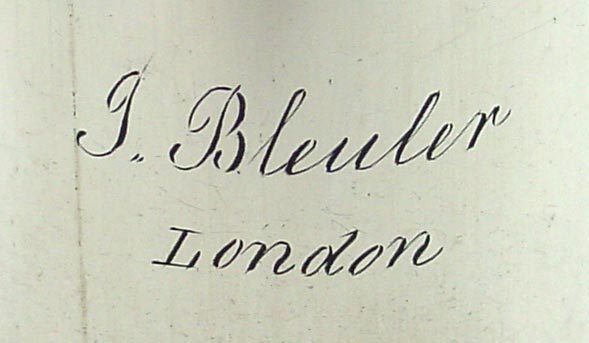
| SPLENDID MINIATURE TELESCOPE WITH COMBINABLE EYE LENSES AND SOLAR CAP, English, c. last quarter 18th century, signed "J. Bleuler, London." Constructed with tubes and fittings of Sheffield silver plated copper and brass, this little telescope opens from 2-3/4" to 6" (7 - 15 cm) with three drawtubes. The main tube is finished with black enamel over copper. Giving erect images, the optics are a greenish triplet achromatic objective, two swiveling eyelenses useable singly or in combination, and a slip-on solar filter / dust cap. It is signed on the largest drawtube, and numbered 1, 2, 3 on the smallest. Condition is very fine noting a few scratches to the enamel. It is complete with the original cylindrical wood carrying case bound in red Morocco leather. The innovative maker of this unusual telescope was John Bleuler (1757 - 1829) of Ludgate Hill, apprenticed to Shuttleworth, made free in the Spectaclemakers Company in 1779. (8028) $2200. |
 |
 |
| Carl Zeiss circa 1930 | Click on any image for a larger view. Scroll to view more items. |
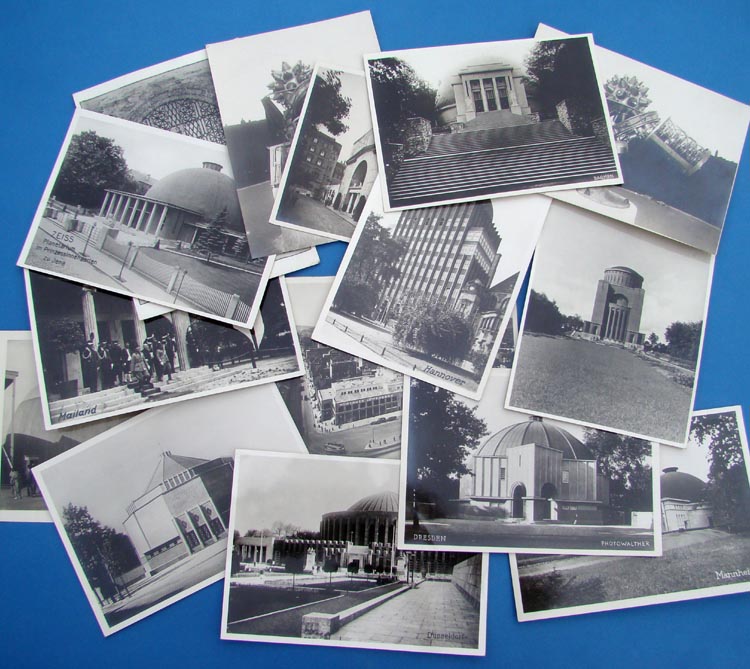 |
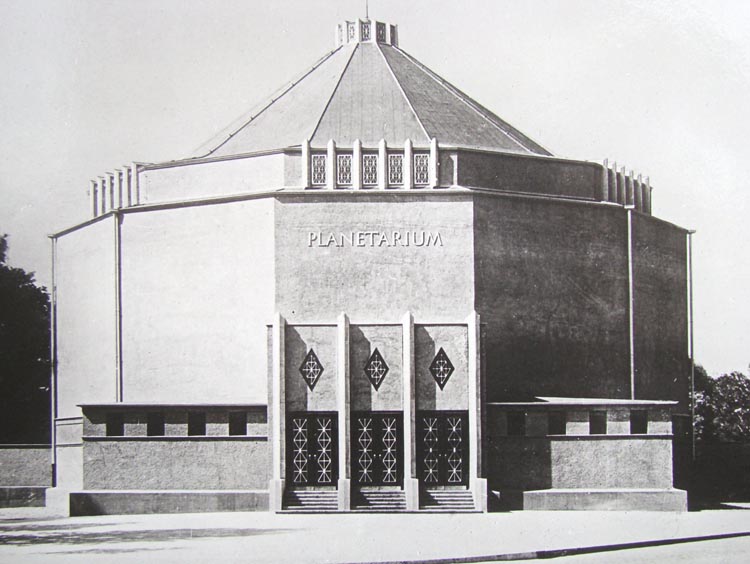
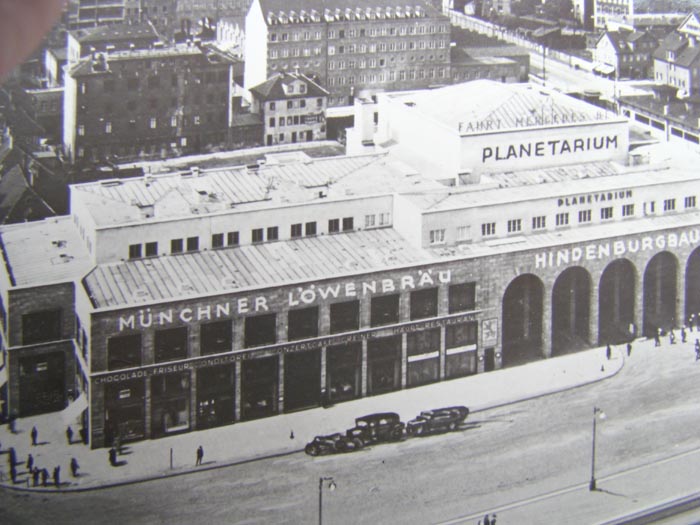
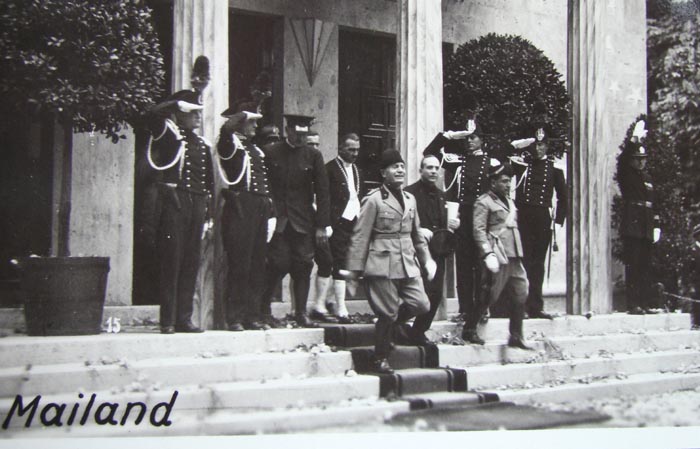
| OFFICIAL CARL ZEISS PLANETARIUM PHOTOGRAPHS, German, c. 1930, the 14 original silver print photographs measuring 5" x 7" (13 x 18 cm), and variously bearing "Carl Zeiss, Jena" stamps, code number stamps, and/or applied printed descriptions. Depicted are planetaria, equipment, and activities. Most sites are in Germany; there are dramatic views of the powerful modernist architecture of the Weimar Republic applied to planetarium buildings. One unforgettable image shows Mussolini departing the Mailand (Milan) "Ulrico Hoepli" planetarium at its dedication on 20 May 1930. (8038) $1150. |
 |
 |
 |
| Four-Eyepiece Telescope by Plossl | Click on any image for a larger view. Scroll to view more items. |
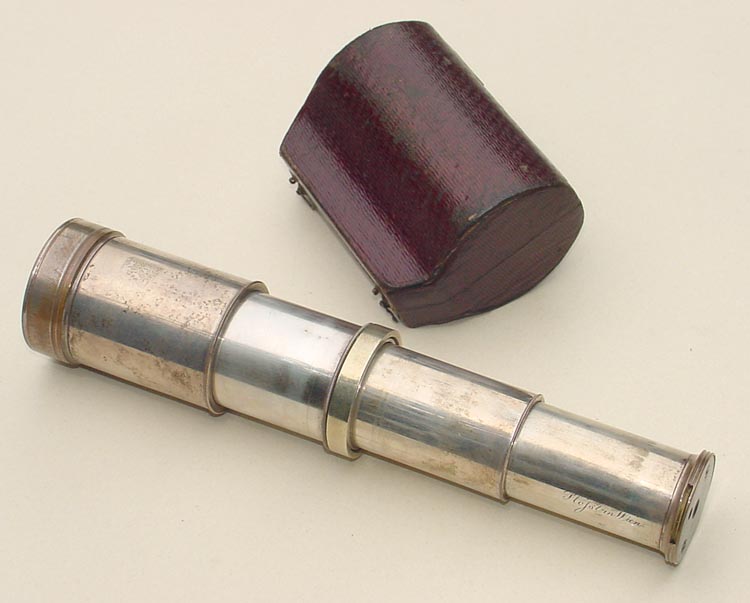 |
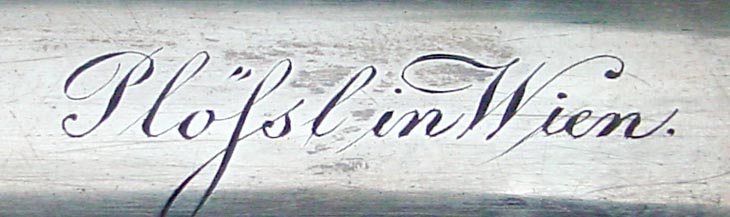
QUADRUPLE-EYEPIECE THREE-DRAW MONOCULAR, Austrian, early 19th century, signed "Plofsl in Wien." Opening from 3-1/4" to 8-1/4" (8 - 21 cm) and constructed of silver plated brass and copper, this small telescope is fitted with a cemented doublet achromatic objective, and a wheel of four selectable eye lenses. The tubes are rolled and soldered, not drawn. It offers upright images of high magnification but with a small field of view. Condition is fine noting negligible dents and a tiny edge chip to the lens. There is no handle or mount. The original shaped wood case is lined in purple silk and bound in red Morocco leather. Georg Simon Plossl (1794 - 1868) trained with the Voigtlander optical firm in Vienna, founding his own workshop in 1823. By 1845 he employed no less than 36 workers, and was famous for the quality of his microscopes and telescopes. (8078) $1900. |
 |
| Prague-Centered Projection with Celestial Volvelle | Click on any image for a larger view. Scroll to view more items. |
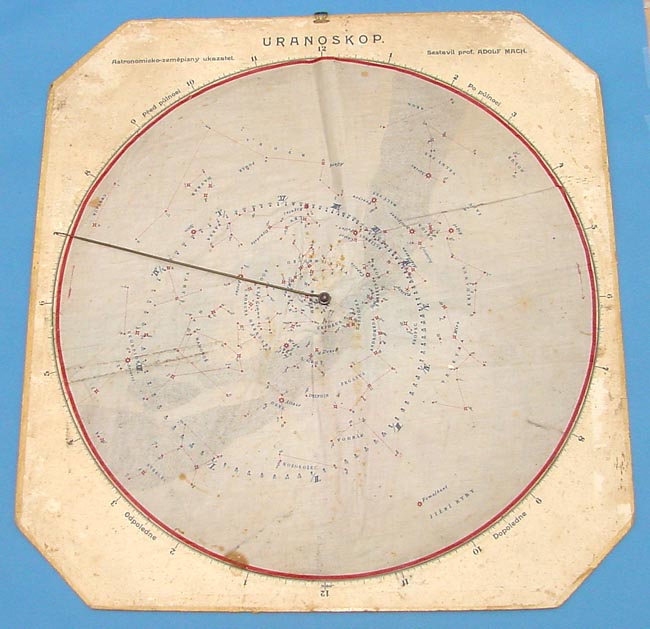 |
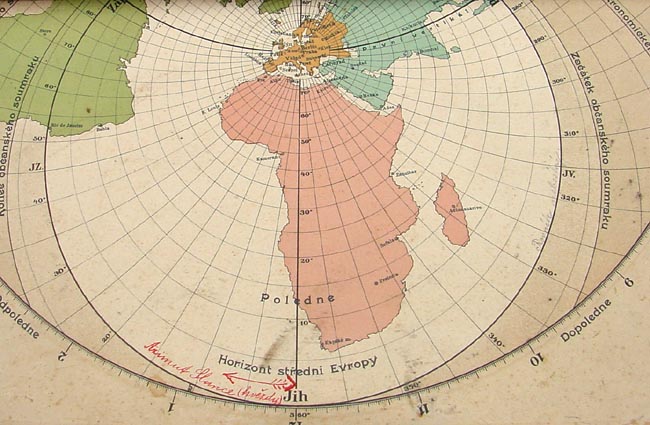
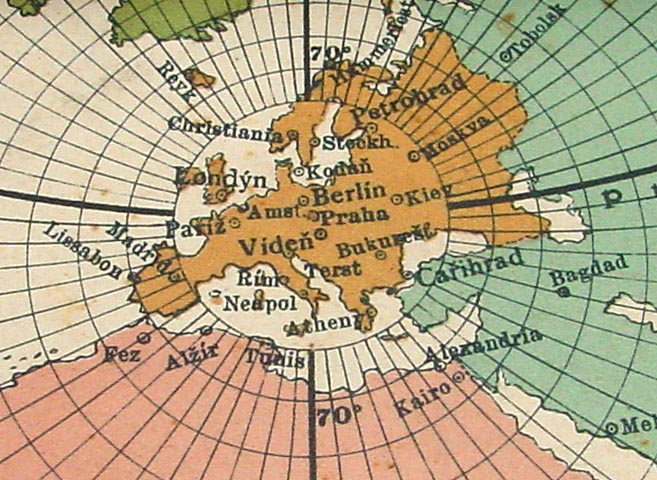
| THE URANOSCOPE OF PROFESSOR ADOLF MACH, Czech, c. early 20th century, signed "Uranoskop. Astronomicko-zemepisny ukazatel. Sestavil prof. Adolf Mach." Constructed on heavy card, 18-5/8" x 19-3/4" (47 x 50 cm), this unusual planisphere has a rotating volvelle of the heavens printed on starched linen, and a rotating brass index pointer, with readout against an outer hour scale divided every minute. Underneath the volvelle is a fixed map of the earth, printed in colors, utilizing a most remarkable projection centered on Prague. Condition is good with general light soiling and wear, and wrinkling to the linen. (8048) $950. |
 |
 |
| Astronomy |
| Microscopy |
| Dialling |
| Navigation |
| Demonstration & Experimentation |
| Calculation |
| Medical |
| Specials |
| Books New and Old |
| Tesseract Catalogues |