|
|
| Optical Maker to Napoleon as "Dictator" | Click on any image for a larger view. Scroll to view more items. |
 |
 |

|
|
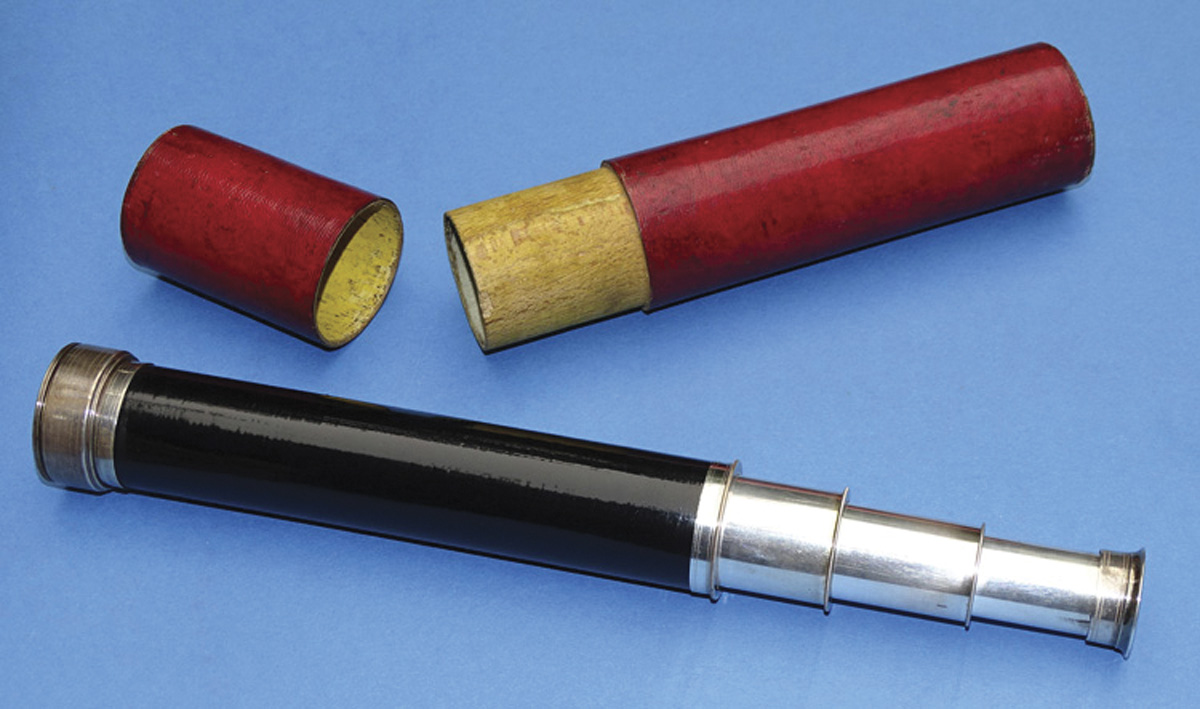
FINE SILVERED SPYGLASS, French, 1799-1804, beautifully engraved by the maker "Lerebours, Opticien du P'er Consul, Place du Pont=Neuf à Paris." Opening from 8" to 22-3/4" (20 - 58 cm), the telescope is made of silvered copper and brass, with black enameled main tube, and features achromatic doublet objective, three drawtubes, and erecting eyepiece system. As with some of the finest telescopes, the drawtubes have engraved fiducial arrows which, when aligned, assure the preferred rotational positioning of eyepiece and objective (see for example Tesseract Catalogue 86 Item 12, a fine Ramsden telescope offered in our "Ramsden" issue). Condition is very fine throughout, the black enamel refinished. It is complete with the cylindrical wood carrying tube bound in red Morocco leather. Noël-Jean Lerebours (1761-1840) was a prolific maker of high quality optical and geometrical instruments. He was admitted to the "corporation des fabricants d'instruments" in 1789, and went on to construct fine telescopes for the Observatoire de Paris. But the present telescope has added importance, documenting that Lerebours was appointed optical maker to Napoléon himself, during the few short years between the end of the Directorate (1799) and the start of the Napoleonic Empire (1804). It was the Consulate period, begun with Napoléon's first rise to real political power, becoming First Consul ("Premier Consul") in an authoritarian republican government, essentially a military dictatorship. In 1802 the Constitution was amended making him First Consul for Life, and just two years later the first French Empire was established, with Napoléon as "Emperor." A rare survival by this maker to the First Consul himself! (10216) $2400. |
| Matthew Berge Takes Over | Click on any image for a larger view. Scroll to view more items. |
|
"Berge, [Banks] explained, had been Ramsden's first pupil and had worked with him for a long time. Everything which Ramsden did, Berge could do to the same standards." (McConnell p.260) "The only difference, albeit considerable, between Berge and his master, is that the first lacked the creative genius of the second." (Joseph Banks, reported by Castelcicala de De Medici, 1808; McConnell p.255) |
 |
|
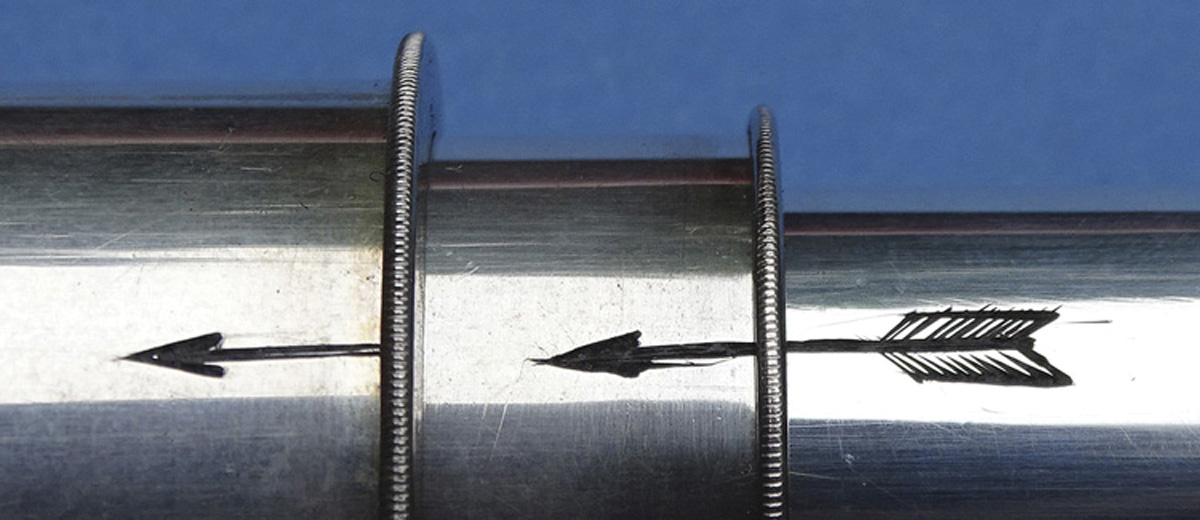
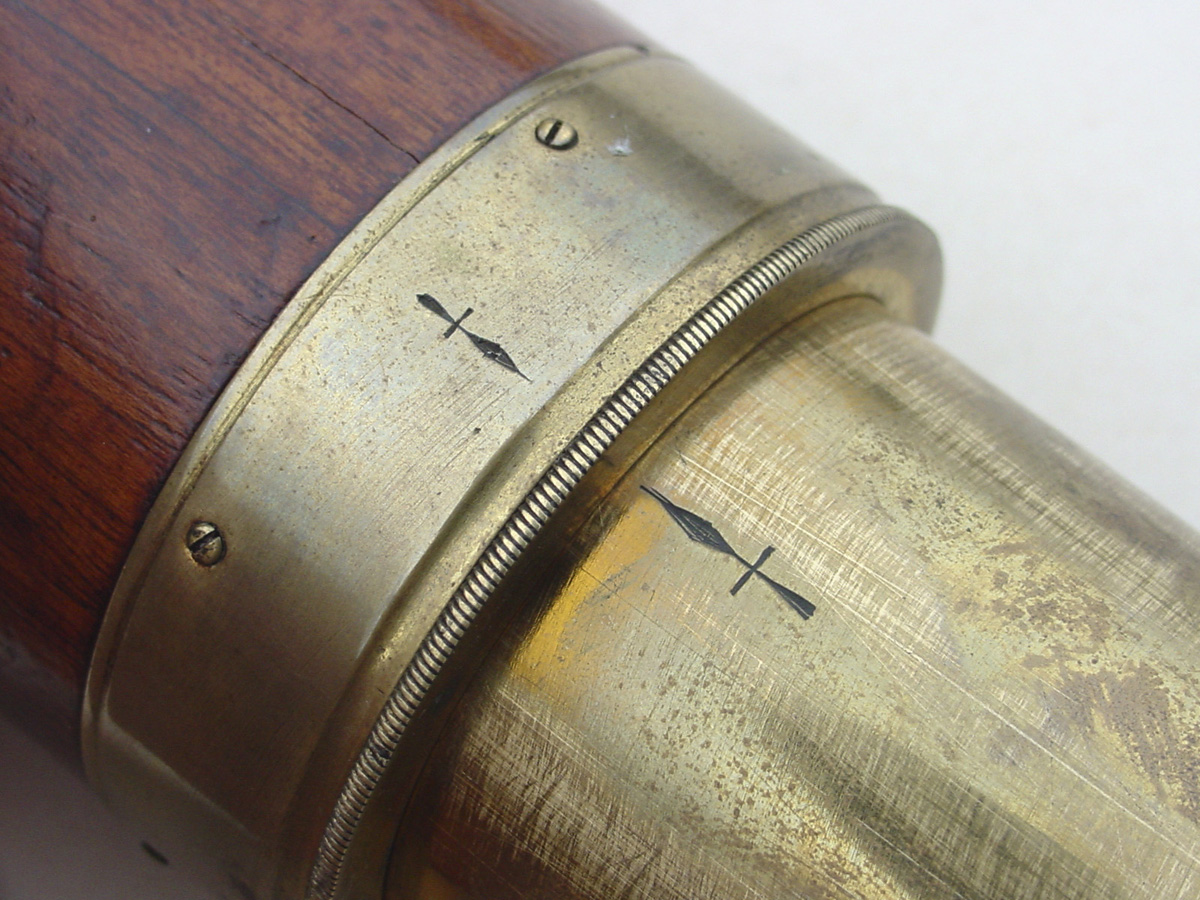
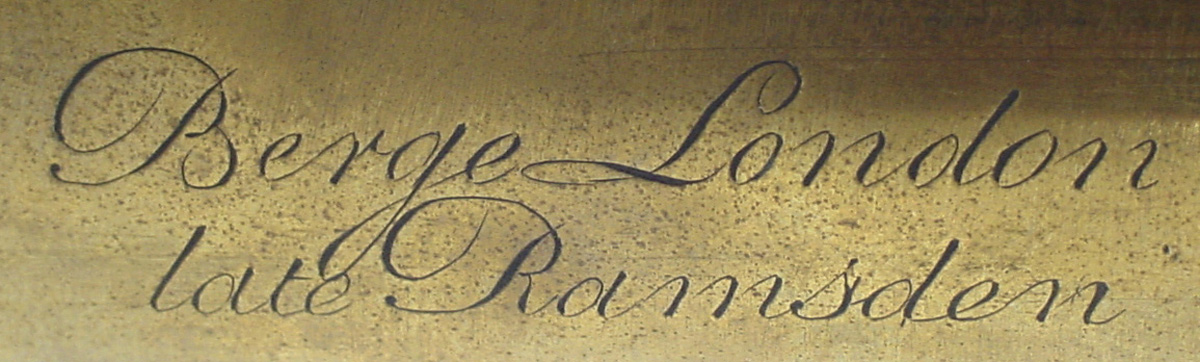
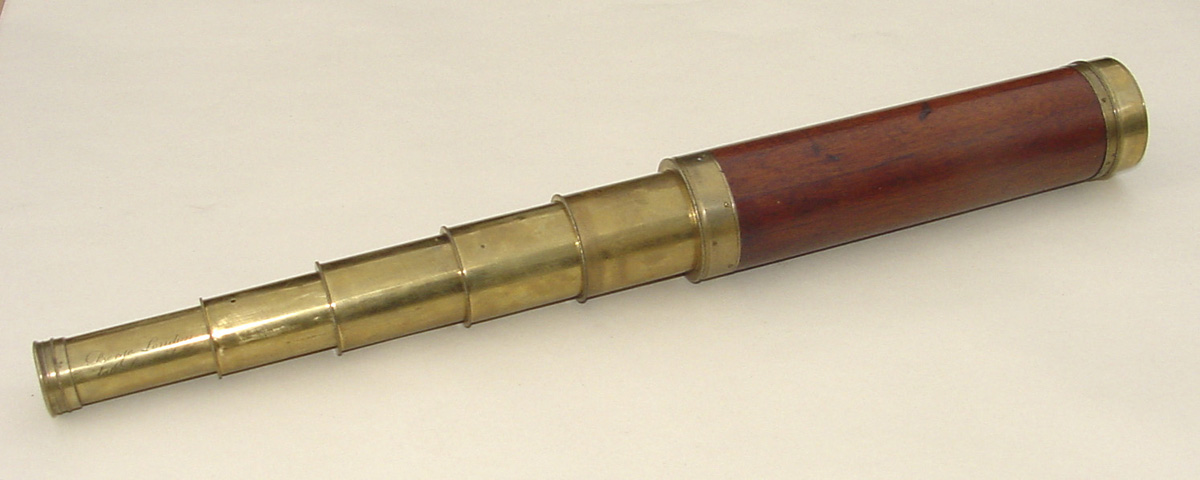
METER-LONG FIVE DRAW TELESCOPE, English, early 19th century, well signed with Berge's succession signature "Berge London, late Ramsden." Opening from 10-1/8" to 39-1/2" (26 -100 cm), the telescope has a greenish achromatic objective (doublet? remounted?) with a large 2" clear aperture. The eye system has four elements (?/CC/CC/CP), the first element either replaced or remounted. Images are erect and tolerable, but show aberrations. The main tube and the next four drawtubes are each engraved with bold fiducial arrows; the tubes can be rotated so that all arrows are in alignment, and aligned with "breathing holes" in the tubes. These holes allow rapid entrance and exit of air, as the close-fitting tubes are quickly withdrawn or collapsed. But the system of arrows, which we have also noted on some fine multi-draw telescopes by Ramsden, Gilbert, etc., remains mysterious. (8476) $850. |
 |
|
| Tide Prediction, and a 14-ton Camera | Click on any image for a larger view. Scroll to view more items. |
 |
|
|
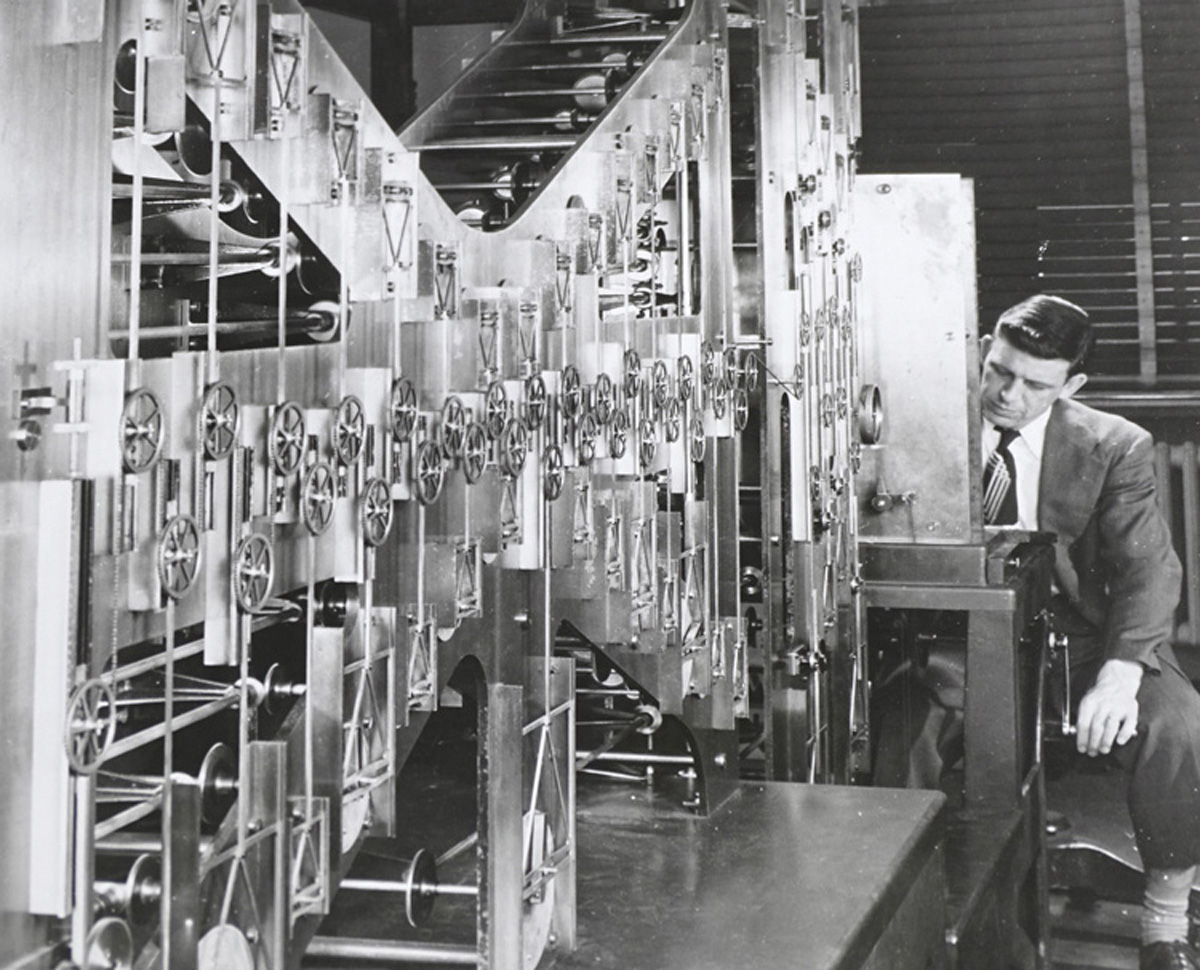
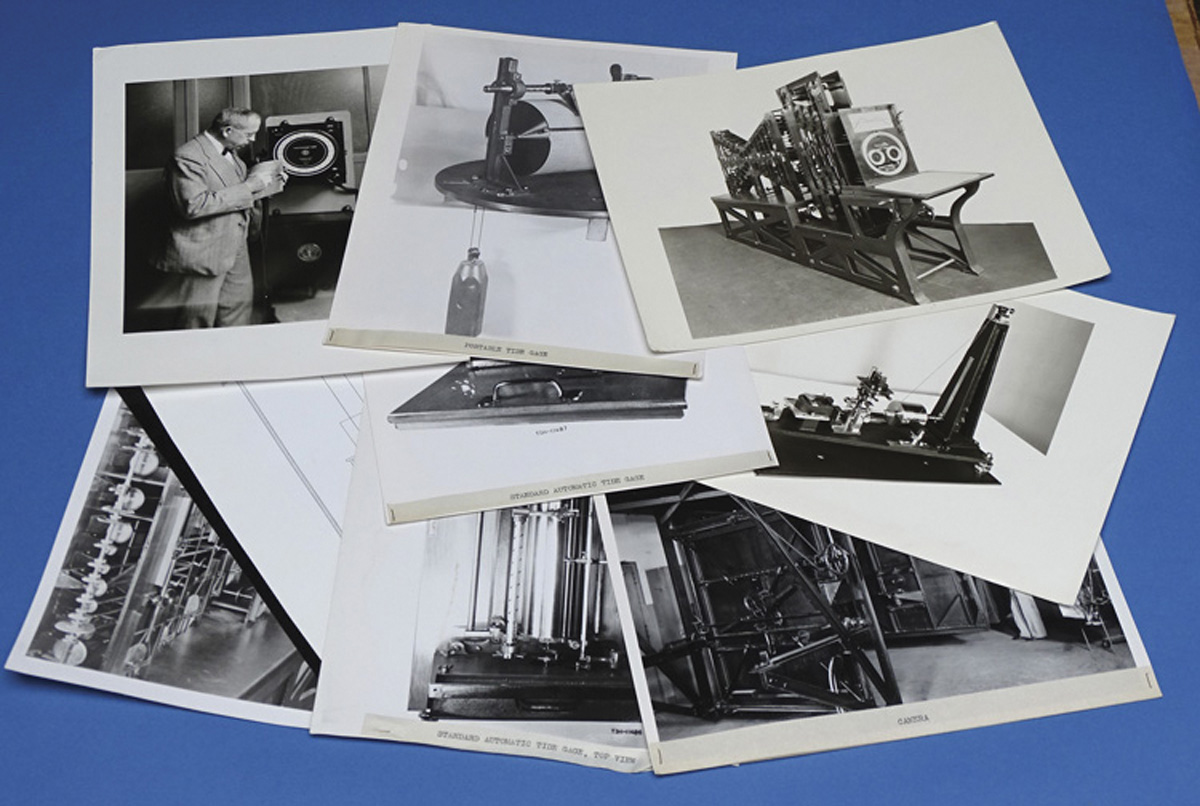
TIDE GAUGES, ETC. -- NINE ORIGINAL SILVER PRINTS, American, c. 1930's, the 8" x 10" (20 x 25 cm) prints coming from the U.S. Coast and Geodetic Survey (several so stamped). All have numeric identification on the reverse, and some have attached labels. Included are photos of a Dorsey Fathometer (with Dr. Dorsey himself), a portable tide gauge, a McComb-Romberg tilt compensation seismometer, the 50" precision copying camera (weighing 14 tons!), and an extremely complex analogue tide computer (The Tide Predicting Machine No. 2, here illustrated). Condition is generally fine throughout. A remarkable photo archive. (10206) $500. |
| High Precision Analogue Readout | Click on any image for a larger view. Scroll to view more items. |
 |
 |
|
|
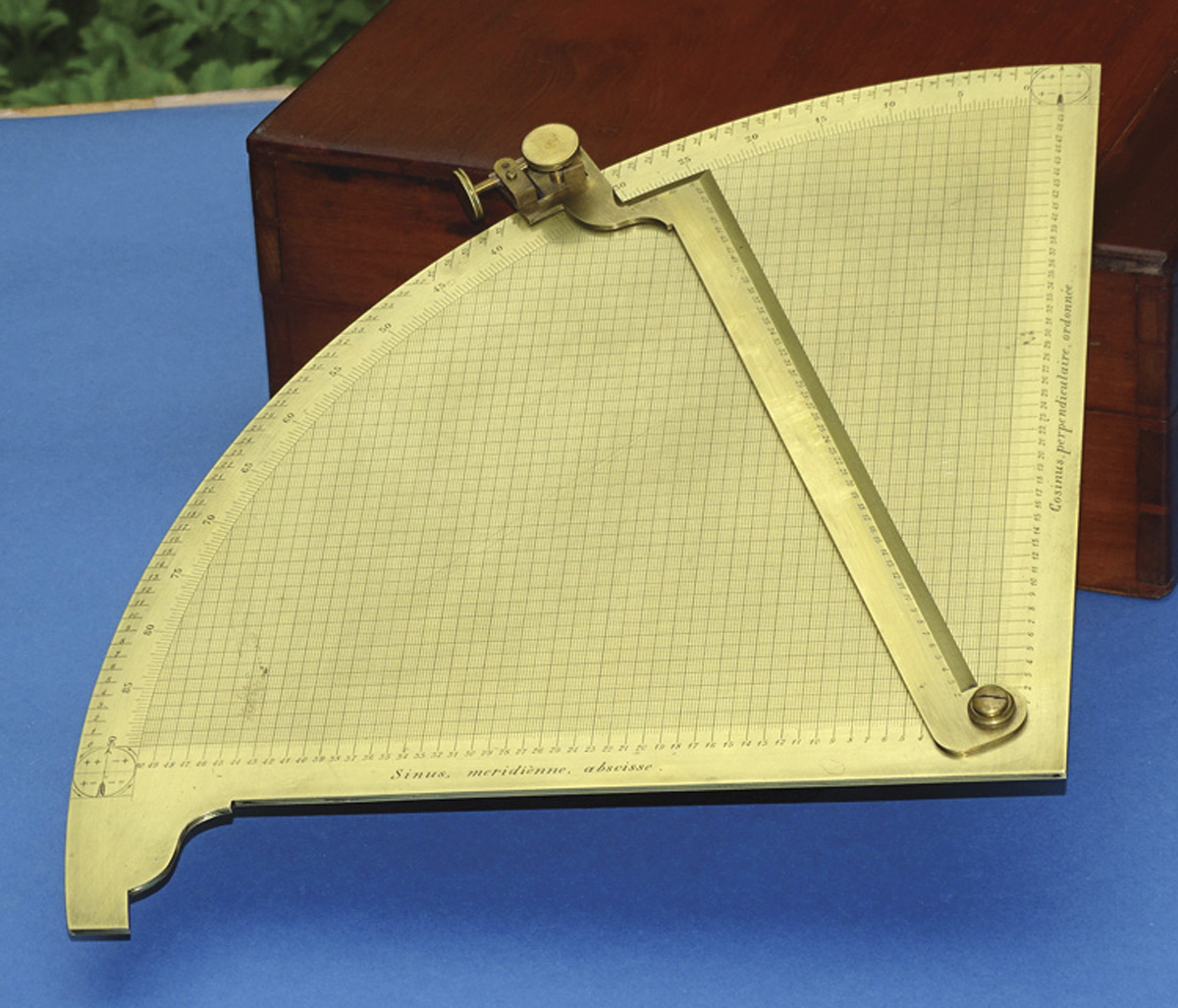
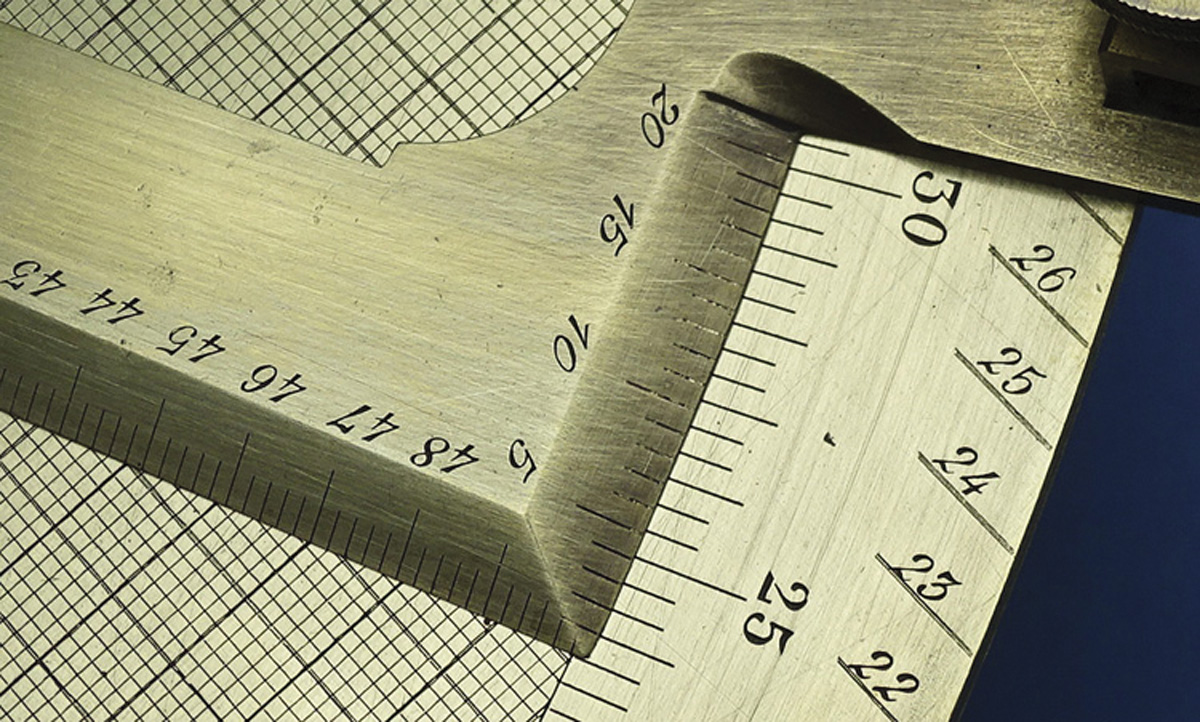
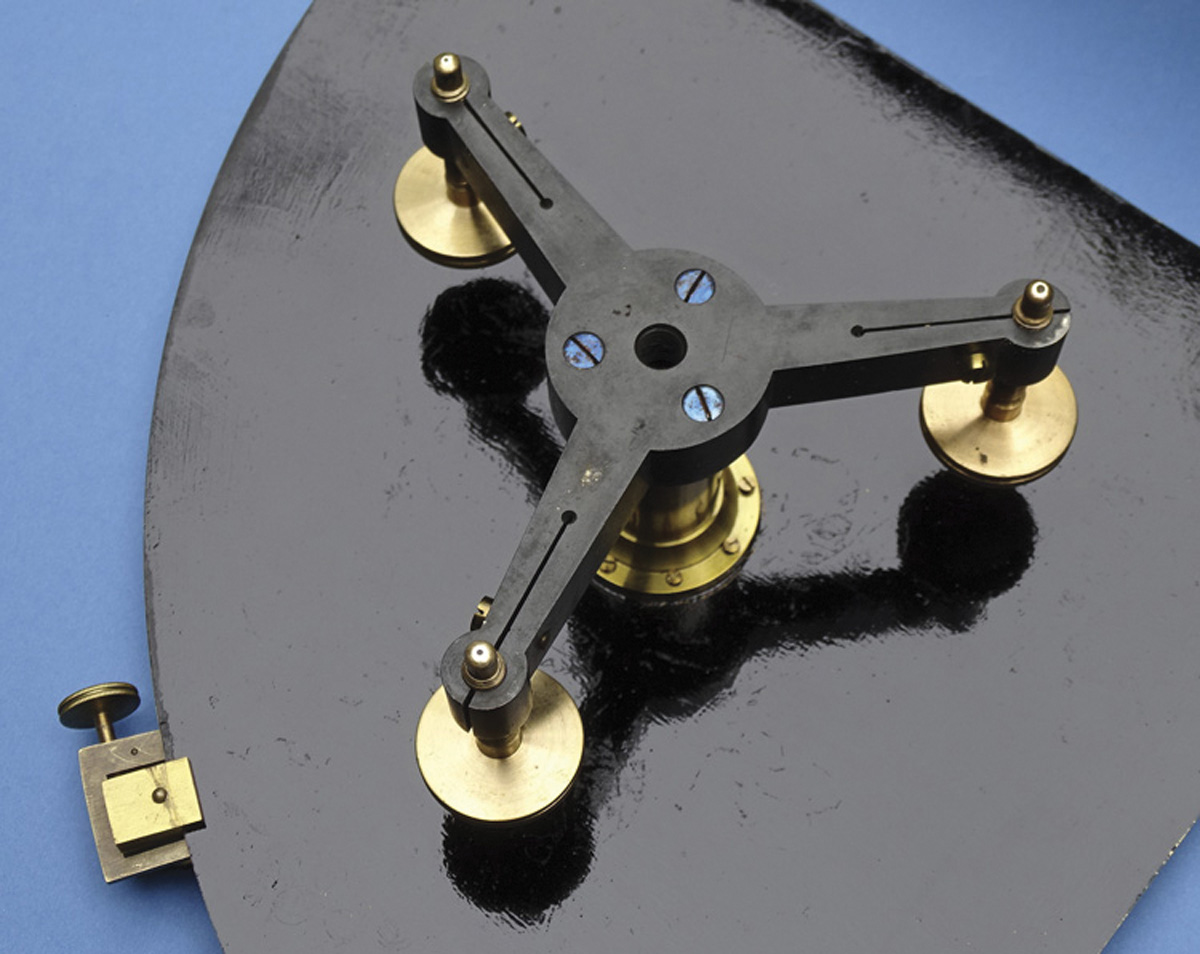
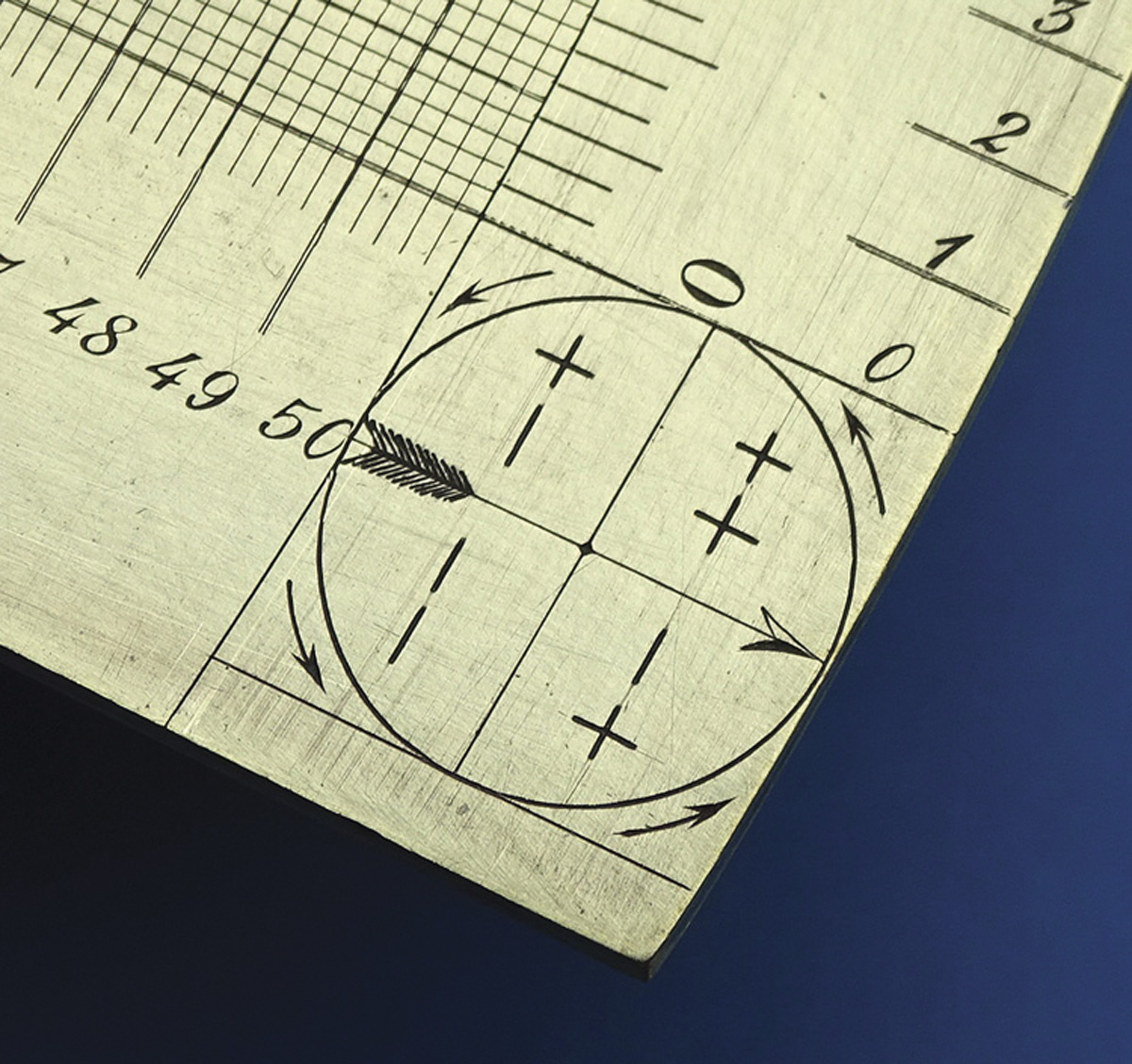
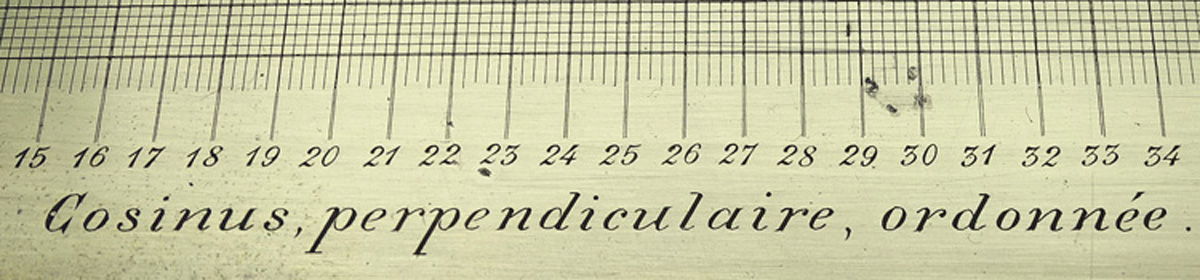
LARGE SINE/COSINE CALCULATING QUADRANT, French, c. late 19th century. A 12-1/2" x 14" x 5" (32 x 36 x 13 cm) mahogany case, with brass handle and key, holds this impressive brass quadrant mounted on 3-1/4" (8 cm) tall bright-lacquered and chemically-darkened three-screw leveling stand. The quadrant itself has a 9-3/4" (25 cm) radius from vertex to scale divided counter-clockwise every 20 arcminutes from 0° to 90·. An index arm has clamp and slow motion tangent-screw, with one-arcminute vernier. Within the quadrant is a linea" grid of orthogonal lines ruled every one-fifth unit from 0 to 50. One axis is labeled "Sinus, meridiènne, abscisse," the other "Cosinus, perpendiculaire, ordonnée." A similar linear scale runs the length of the index arm. And the arc repeats the axial units where the lines are long, to simplify visual alignment. Finally, the two corners bear curious identical circles with straight and rotary arrows, and ± indications. Condition is very fine throughout, apparently little used. All manner of right triangles and trigonometric functions can be solved with this finely executed quadrant. Construction is similar to that of various French navigational instruments, and it was probably designed for use in the chart room by the navigator. The first example we have seen. (10226) $4800. |
 |
|
| By an Exceptional Craftsman | Click on any image for a larger view. Scroll to view more items. |
 |
|
|
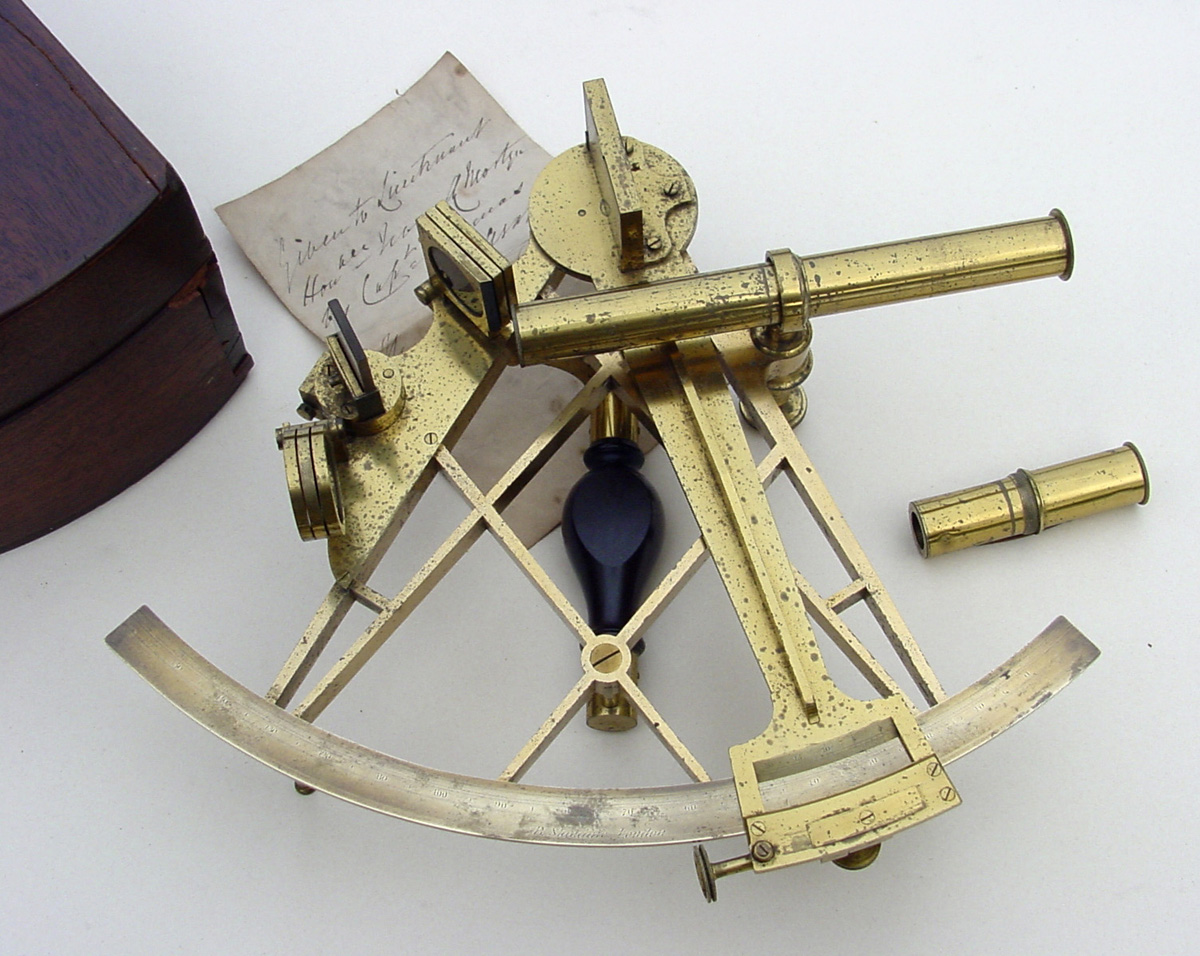
SUPERB LATTICE FRAME SEXTANT, English, c.1815, signed "B. Stancliffe, London." The lacquered brass sextant is 9-3/4" (25 cm) tall, with adjustable index and horizon mirrors, three index and three horizon filters, index arm clamp and long tangent screw, thumb screw motion to telescope, three turned brass feet, and hardwood handle. The lattice struts taper in thickness from front to back, in the fine tradition of Jesse Ramsden. The scale is divided, on the brass, every 20 arcminutes from -2° to +152°, with brass vernier divided to 20 arcseconds. Accessories include a long telescope with achromatic objective, a short sighting tube, and the original keystone shaped mahogany case (signed "Capt. Fox"), plus an 1862 presentation note from a captain to a lieutenant. Condition is fine throughout, noting general spotting to the original clear lacquer finish on the brass, one small construction screw lacking, and dents to the sighting tube. John Stancliffe had worked for Ramsden, and established his own business in Little Marylebone St., London, in 1779, continuing until 1812. By 1788 he had completed his own dividing engine, and produced brass sextants of exquisite workmanship. His nephew and apprentice, and eventual successor, Benjamin, followed in his footsteps, listed from 1816 (see Clifton). It is not clear whether he spent all his working years in London, or perhaps had a relative by the same name, but a Benjamin Stancliffe emigrated to the United States c. 1816 after working for Troughton (see Warner: Rittenhouse 3, 110; Miller: Rittenhouse 11, 1). Two superb brass lattice frame sextants are known by "B. Stancliffe, Maker, Philad'a.," quite similar to the present example but with inlaid silver scales and with scale magnifiers. A rare Stancliffe instrument, superbly crafted. (8406) $4950. |
| For Night work and Day work | Click on any image for a larger view. Scroll to view more items. |
 |
|
|
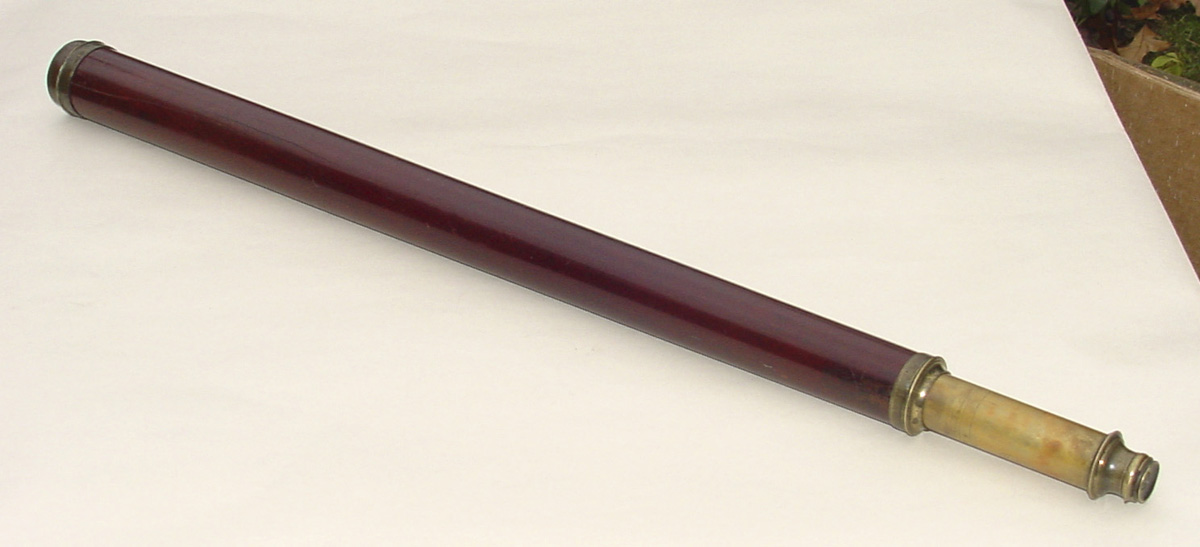
INTERESTING HAND-HELD SINGLE-DRAW TELESCOPE BY GEORGE ADAMS, English, second half 18th century, beautifully engraved "G. Adams, London." Opening from 26" - 32" (66 - 81 cm), the telescope has a tapered mahogany barrel with brass fittings, and single draw tube with bulbous eye fitting and dust slide. The objective is apparently a triplet, with 1-3/8" clear aperture. The eyetube has four lens elements giving an erected image convenient for terrestrial viewing; it is constructed with a "Huygenian" assembly, i.e., with the two elements nearest the eye (the Huygens couple) being plano-convex with the flat sides facing the eye (see Cheetham 1997 for a clear explanation). Quite unusually, the eyetube is ringed and labeled "N" and "D," presumably indicating the focus positions for night use (focused at essentially infinity for observing distant lights or astronomical objects) and for day use (ships, coastal landmarks). Condition is fine and functional, although with a central crack in the small eye lens. A rare example by George Adams (either senior or junior, it being difficult to distinguish between the works of the two).(8056) $1950. |
| Apparently an Unrecorded Form | Click on any image for a larger view. Scroll to view more items. |
 |
|
|
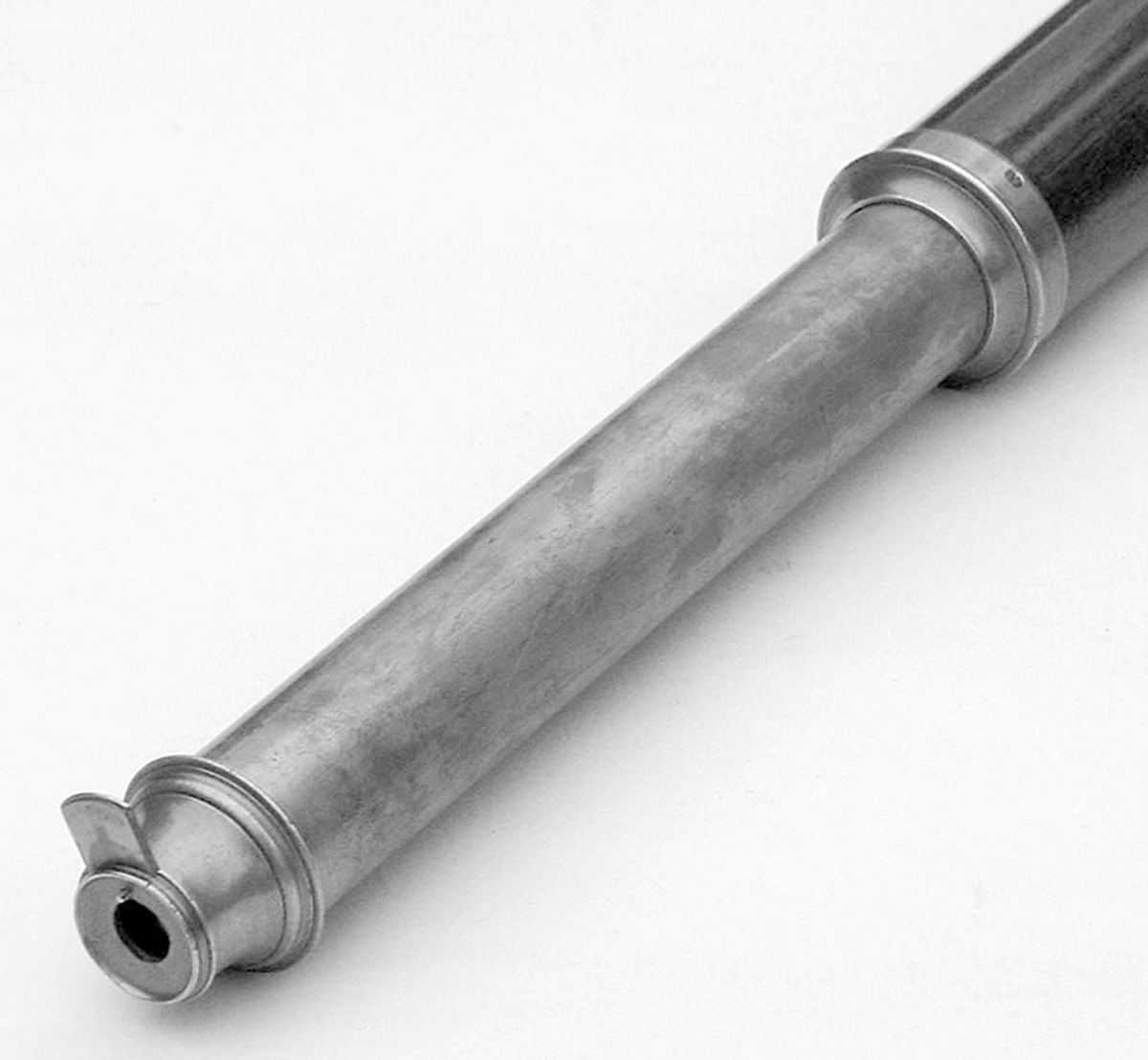
BEAUTIFUL EXAMPLE OF THE "IMPROVED SEA TELESCOPE," English, c. 1795, signed on the single brass draw tube "Improv'd Sea Telefcope; Gilbert, Wright, & Hooke; London." Opening from 51" to 60" (130 - 152 cm), the telescope has a large round tapered mahogany main tube, a 2-1/2" (stopped down to 2-3/8") achromatic doublet objective, and a four-element erecting optical system in a non-segmented drawtube (CC/CC/CC/CP). Condition is very fine noting a couple of scratches to the outer objective lens. The optics give fine images. William Gilbert, Gabriel Wright, and Benjamin Hooke were apparently in partnership together only from 1794 to 1801. The "Improved Sea Telescope" seems unrecorded in the standard literature (and would make a good subject for research in period documents, with subsequent publication on the varied developments of the sea telescope!) Tesseract had a smaller example in 1986 (Catalogue 12, that instrument signed "Gilbert & Co.") We do note that Gabriel Wright received three patents (in 1779, 1791, and 1796), primarily relating to navigational compasses. (8596) $4500. |
| Comfort in the Sailor's Bunk | Click on any image for a larger view. Scroll to view more items. |
 |
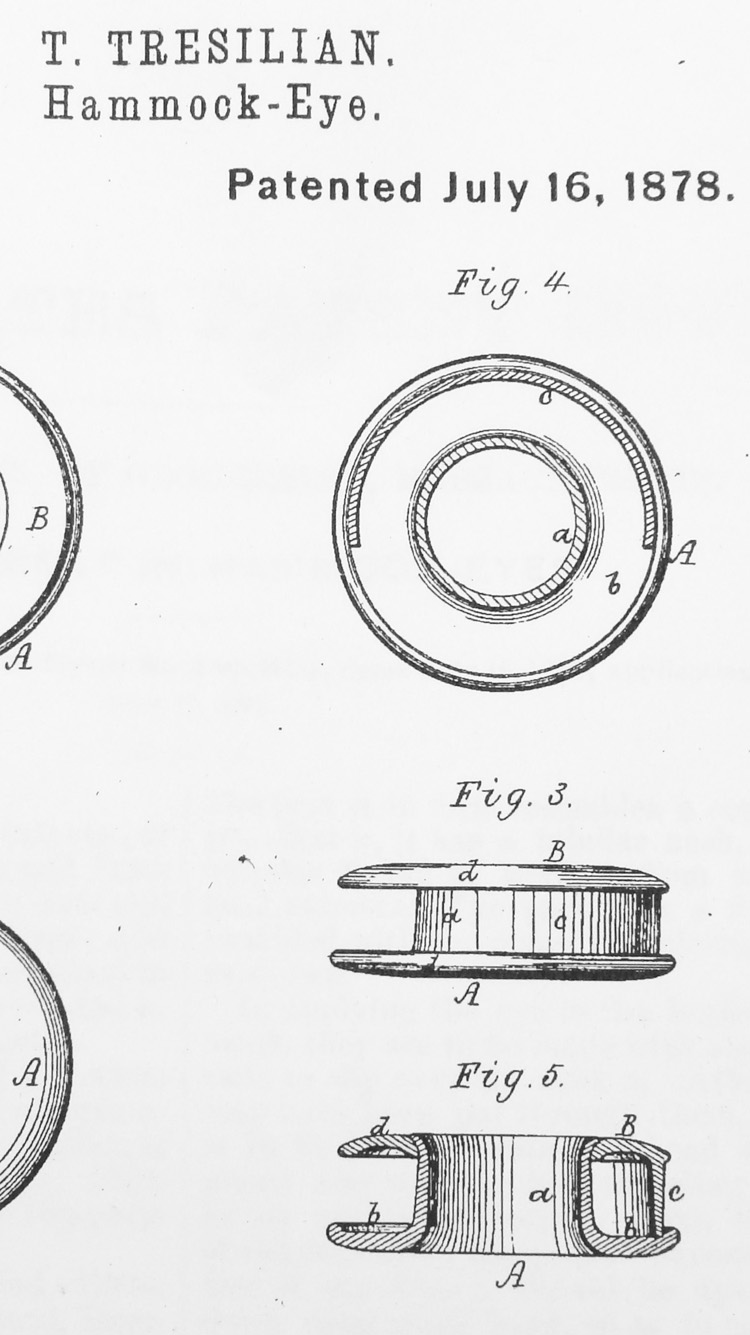 |
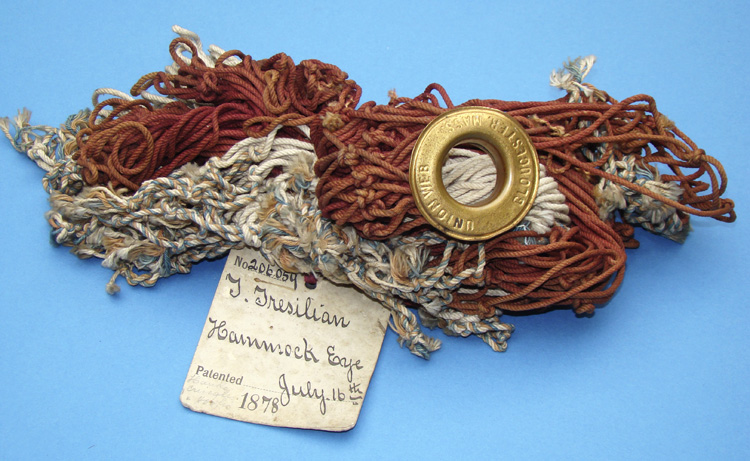
"IMPROVEMENT IN HAMMOCK-EYES" -- SECURE SUPPORT FOR THE SLEEPING SAILOR, American, 1878, signed on the 2" (5 cm) diameter brass fitting "Union Web, Gloucester, Mass." The two-part fitting is designed to partially encompass a braid of hammock strings. for secure mounting at each end. The fitting is complete with a considerable quantity of the red and white strings, plus the original patent office tags. Condition is good noting some wear. This is the original example submitted by Thomas Tresilian of the sea-faring town of Gloucester, for which he received patent 206,059, on 16 July 1878. Tresilian apparently frequented the sea; a publication of collections by fishing vessels, made for the U.S. Fish Commission, records him taking in a "great bush-coral" from George's Bank. A unique American invention. (10225) $695. |
| Large Eighteenth Century Octant | Click on any image for a larger view. Scroll to view more items. |
 |
|
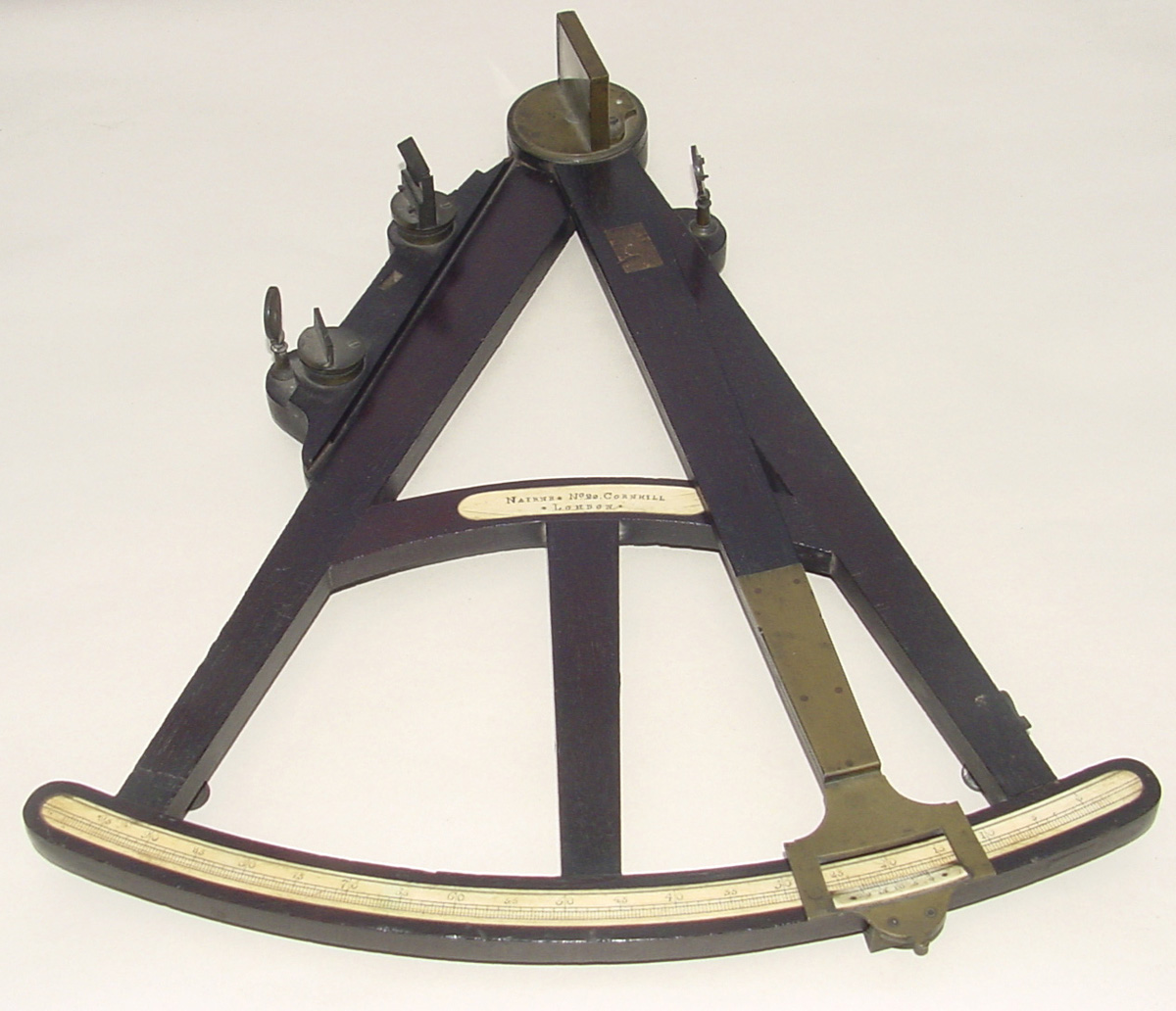
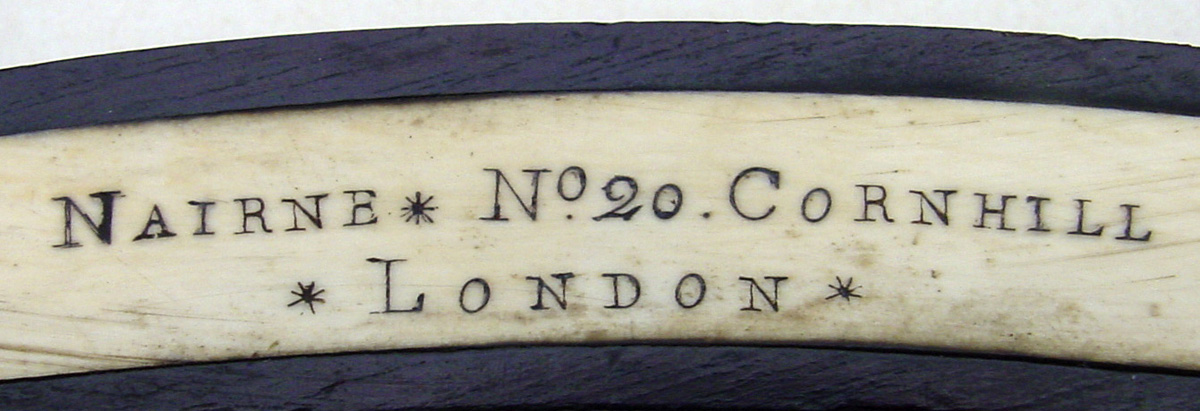
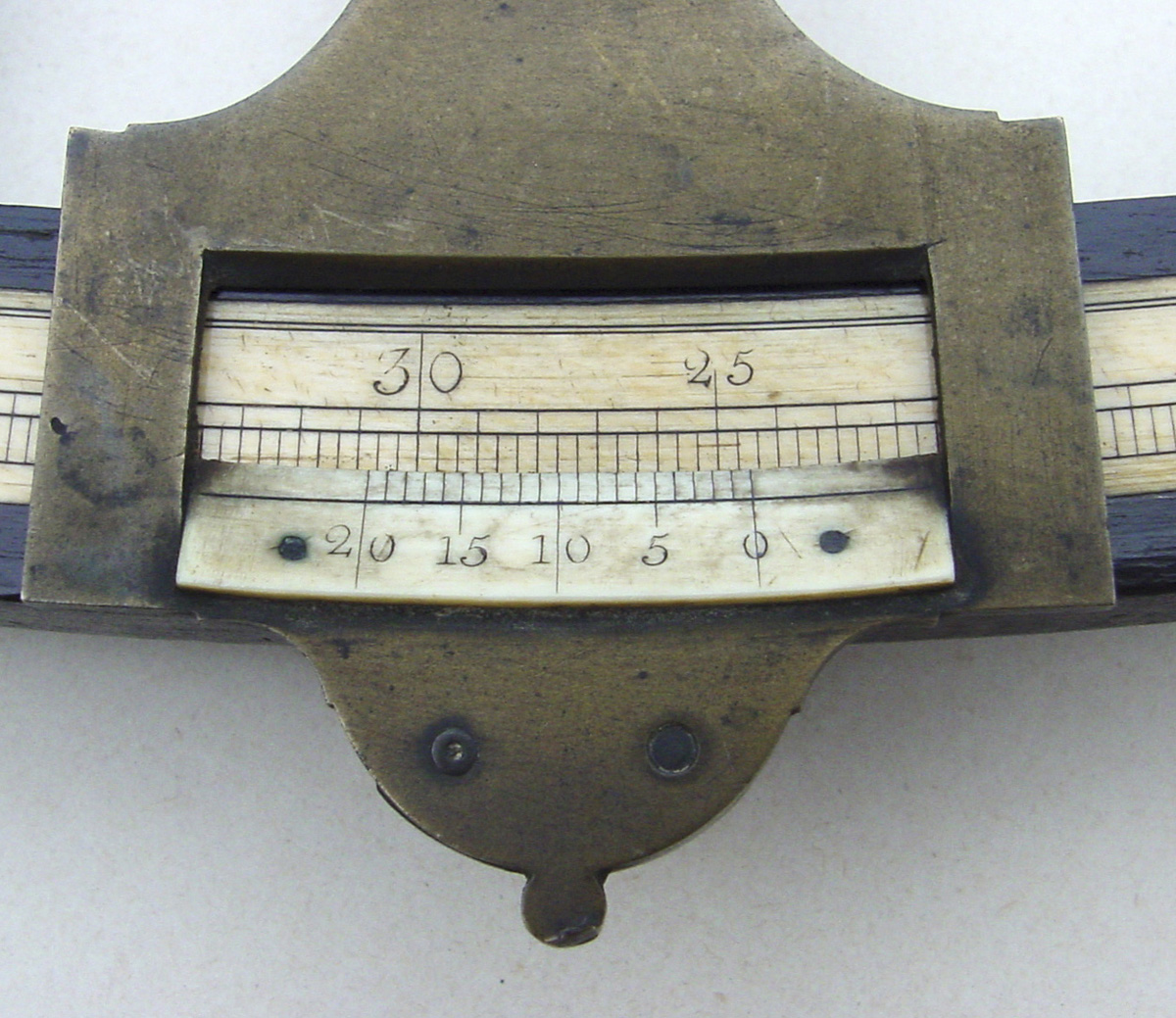
OCTANT BY NAIRNE, English, c. 1770, signed "Nairne, No. 20 Cornhill, London." Made of rosewood or dense mahogany, the octant is 18" (46 cm) overall with a scale radius of 15-3/4". It is a curved T-brace design, and has wooden index arm terminated by brass and bearing the vernier and spring plate, the brass beautifully laminated over the wood. The main scale, on a single piece of inset ivory, is divided every 20 arcminutes, and read with an ivory vernier (zero to the right) with division to one-arcminute. There are two mirrors and two peepsights, the fore-sight peep itself double with pivoting shutter. Condition is good but incomplete; lacking are the filter set, the backsight mirror, one foot, three thumbscrews on the reverse, ivory notepad and pencil, and a fragment of wood at the filter hole. The maker was Edward Nairne, working on his own from 1749 (following his apprenticeship to Matthew Loft) until 1774 (when he entered into partnership with Thomas Blunt). He is listed in Cornhill for his entire career, but with the address numbered from c. 1770. A finely crafted octant by this important maker. (8046) $2950. |
 |
|
| High English Quality | Click on any image for a larger view. Scroll to view more items. |
 |
|
|
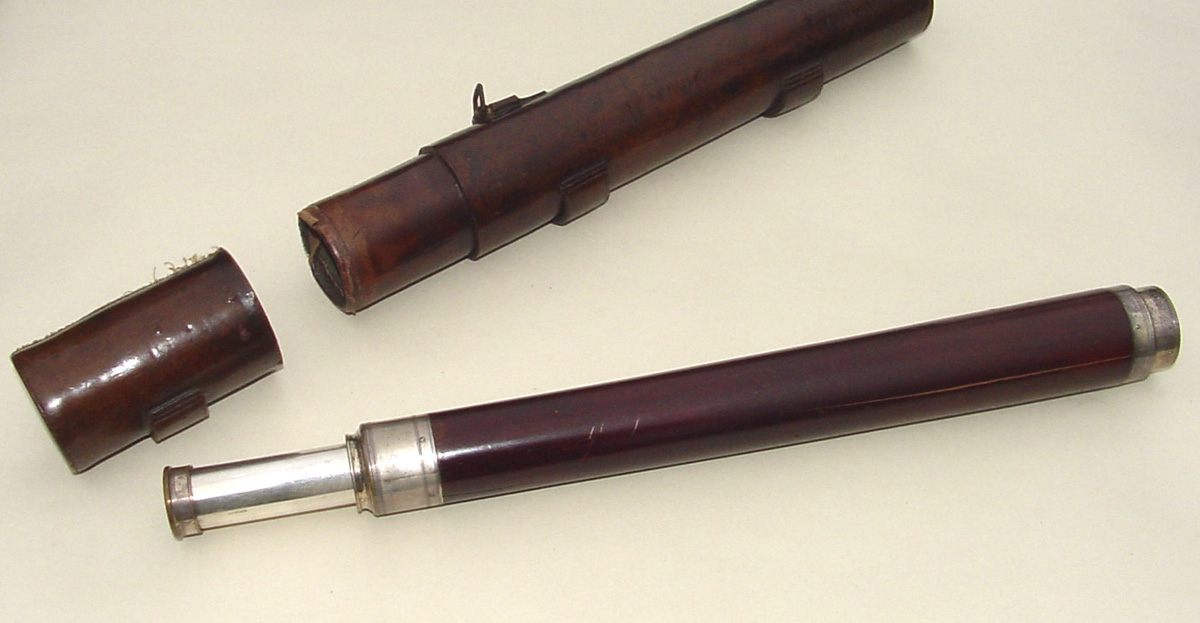
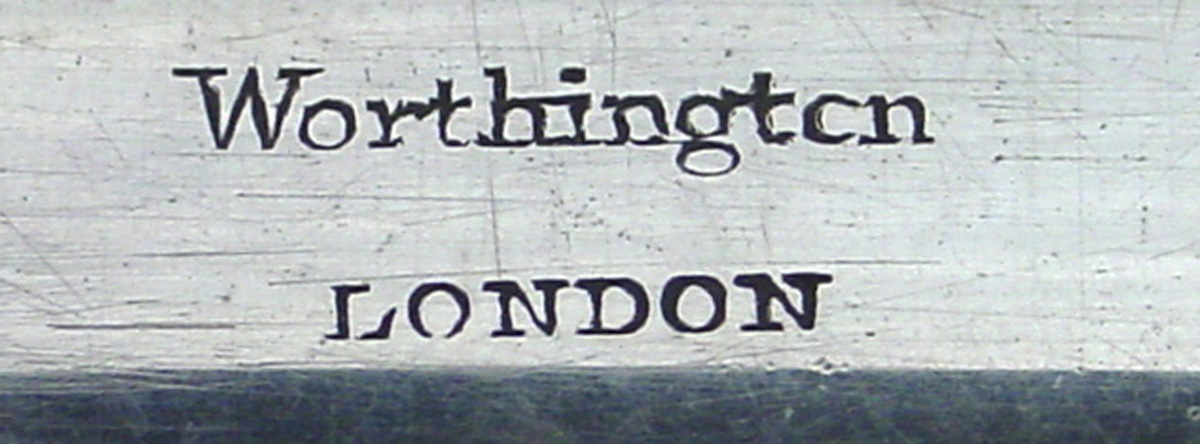
AN ELEGANT SPYGLASS, English, c. 1835, signed "Worthington, London." Opening from 16-3/8" to 21-1/4" (42 - 54 cm) by single draw, the telescope has a tapered red-stained wood main tube, tubing of silver over copper, mountings of silver over brass with reeded decoration, greenish triplet achromatic objective lens, erecting optics (CC/CC/CC/CP), and eye shutter. Condition is very fine noting a few nicks and age crack to the wood, complete with the original rugged hard leather carrying case. It is clear that even after the departure of Allan, Worthington was producing instruments of quality. But optically and mechanically this telescope resembles fine examples from the late 18th century. It represents the end of a long tradition and the end of the Ramsden succession. (8506) $1800. |
| Ingenious Belgian Invention | Click on any image for a larger view. Scroll to view more items. |
 |
|
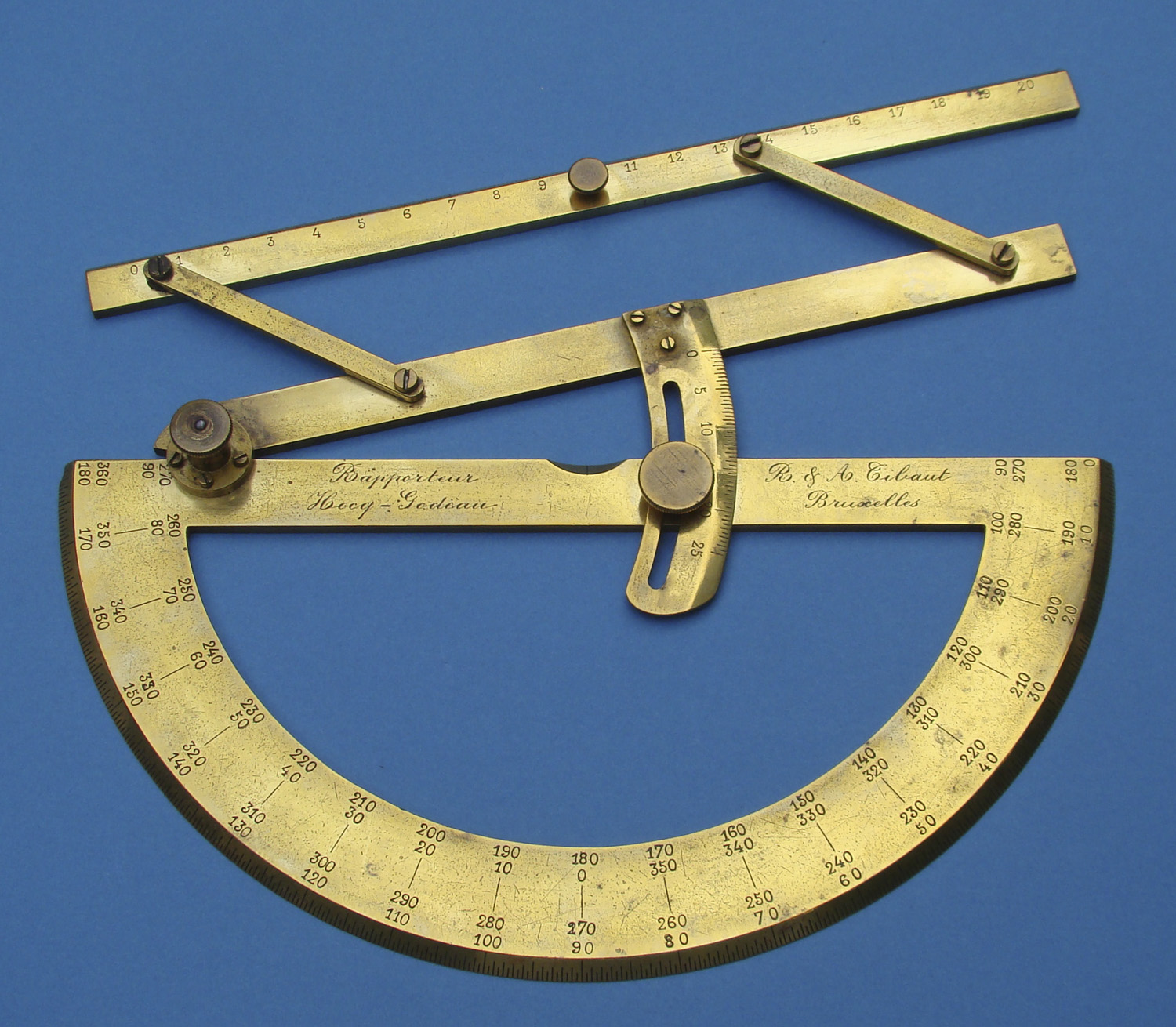
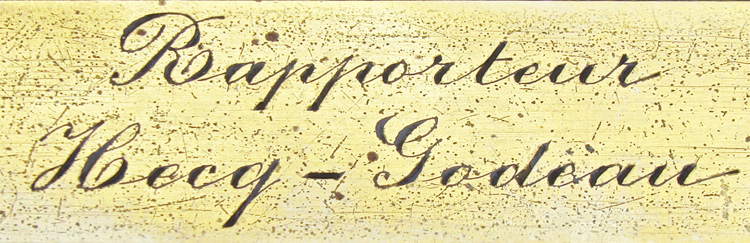
REMARKABLE COMBINATION PLOTTING TOOL -- A SEMI-CIRCULAR PROTRACTOR WITH INCLINING PARALLEL RULE, Belgian, c. 1900, signed for the inventor "Rapporteur Hecq-Godeau" and for the maker "R. & A. Tibaut, Bruxelles." Made of thick brass, 8-5/8" (22 cm) across, the protractor has a beveled edge divided every half degree and labeled 0-180, 180-0, 270-90, and 90-270. Hinged to this, and with two clamp screws, is a parallel rule with beveled edge divided every millimeter from 0 to 20 centimeters, and with guiding arc divided every half degree from 0° to 25°. Condition is fine throughout noting only some bending to the arc. Ingenious and extremely rare. (10215) $1800. |
 |
|
| Converting Water Tank Studies to Oceanic Behavior | Click on any image for a larger view. Scroll to view more items. |
 |

|
 |
|
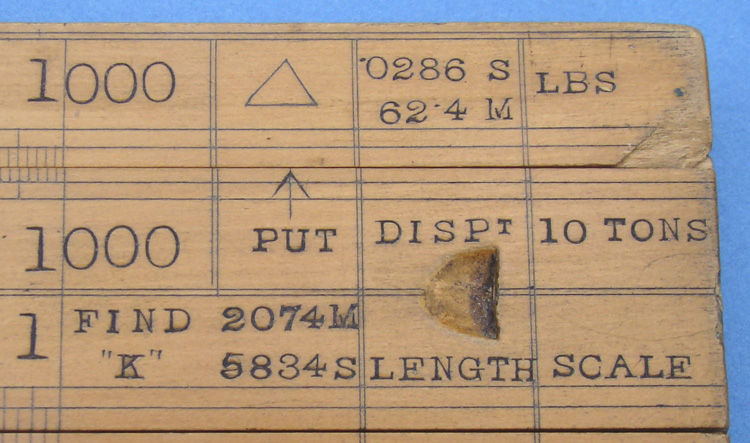
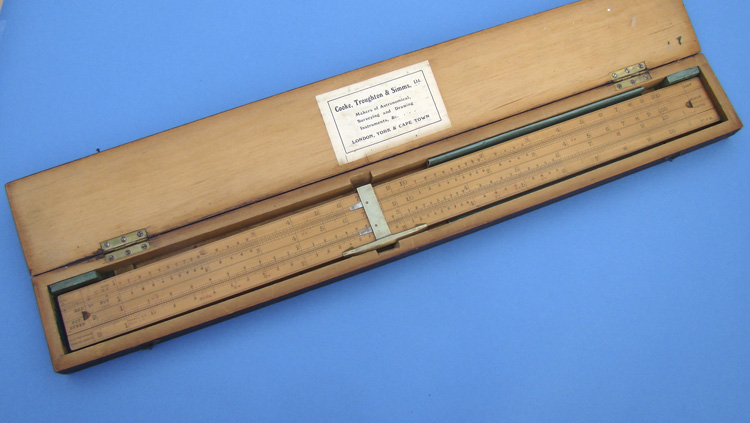
THE RARE ³FROUDE² SLIDE RULE FOR SHIP MODEL STUDIES, English, c. 1890, signed "Froud's slide rule" and for the maker "Stanley, Great Turnstile, Holborn, London." Made of lovely boxwood, 24" (61 cm) long, the rule is fully divided with scales on both sides, and on both sliders, and with numerous equations and constants on the edges. There is a fine metal cursor with twin index points on each side. The rule is in excellent condition, complete with the original stained pine case (with Cooke, Troughton & Simms vendor's label) and instruction booklet. The many mysterious scales and equations on the rule relate to the challenge of scaling the actions of a ship model, in a water tank, up to the real ship in the real ocean. In the instructional example, a 425 foot long vessel is scaled down by 31:1, requiring a realistic model almost 14 feet long. Calculation then involved the relative displacements, corrections for density of fresh versus salt water, finding the wetted surface of the model, also the speed at which the model must be run to "correspond" to a given speed of the ship, of velocity and resistance in standard units, surface friction corrections, effective horse power determination, etc. R.E. Froude himself was a British naval engineer, prolific author and subject of books and articles. (10205) $1950. |
| Elegant Sheffield Silver and Crotch Mahogany | Click on any image for a larger view. Scroll to view more items. |
 |
|
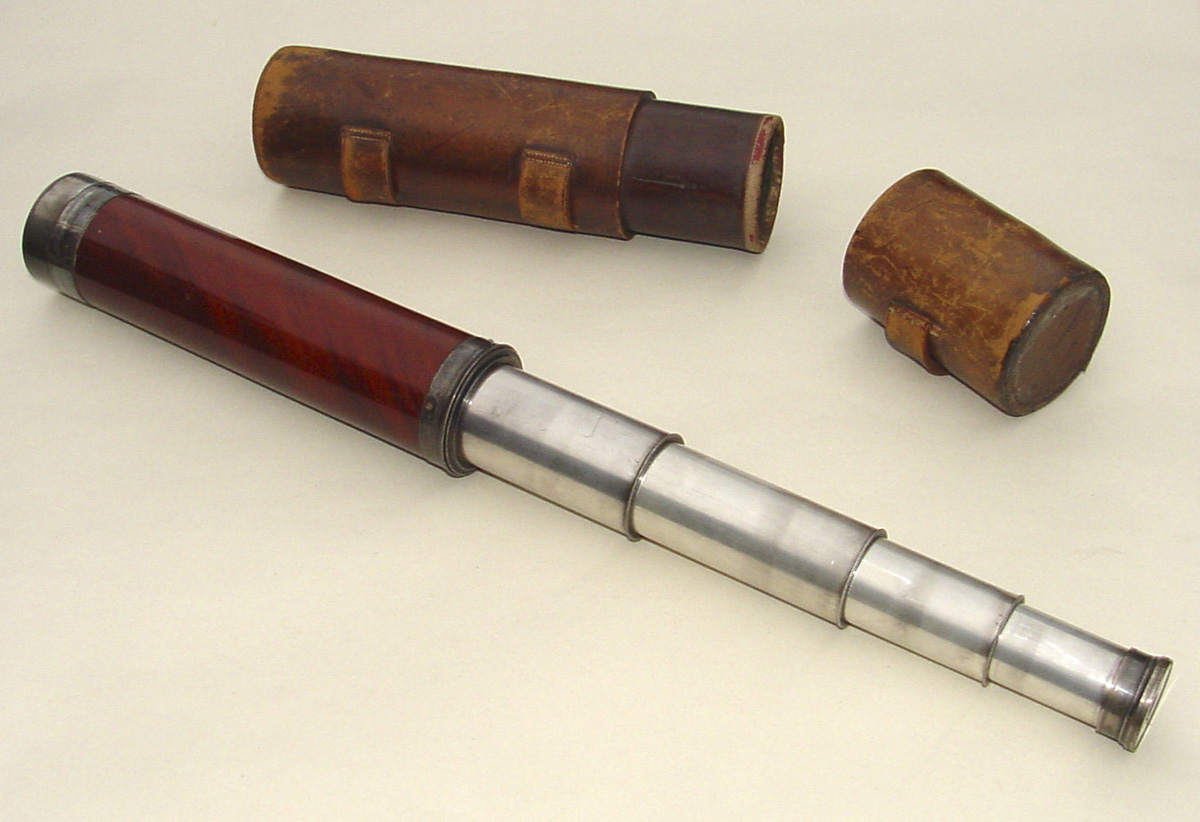
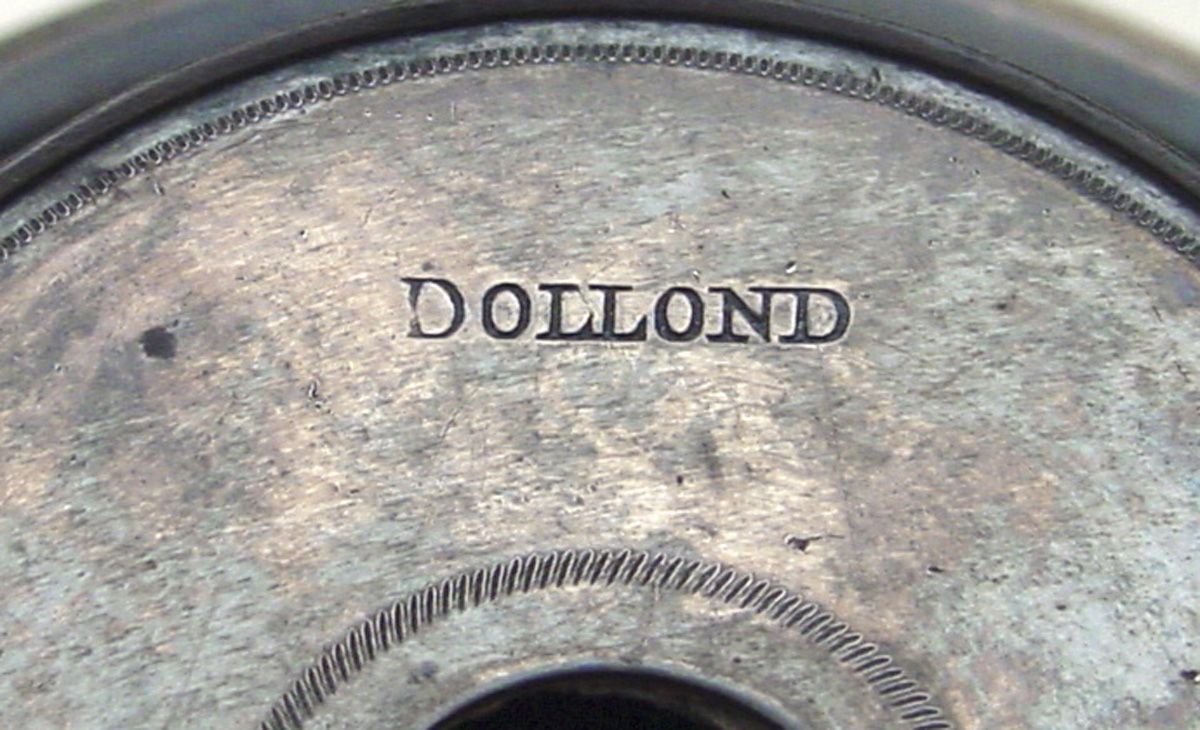
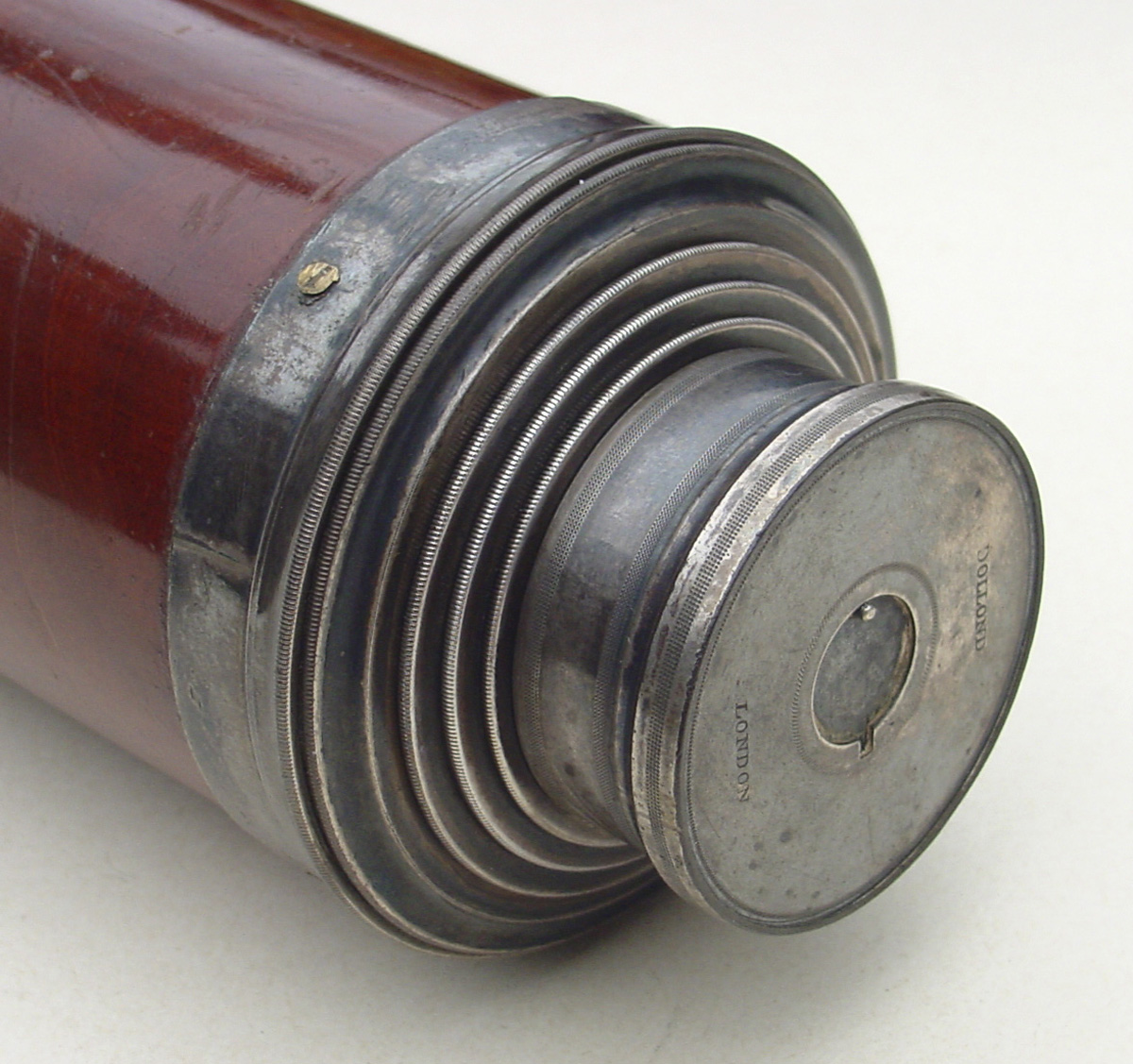
LARGE AND ELEGANT DOLLOND TELESCOPE, English, c.1790, stamped "Dollond, London." This large handheld telescope has a 2" diameter greenish triplet achromatic objective, main tube of finely grained crotch mahogany, four drawtubes and fittings of Sheffield silver over copper, erecting eyepiece system (CC/CC/CP/CC), and eye shutter. It opens from 11-1/4" to 42" (29 - 107 cm), and gives splendid images. Condition is very fine, noting small edge chips to one lens element (not affecting the optics). A large and most elegant instrument, complete with the original leather carrying case. (8296) $2500. |
 |
|
|
"Achromatic Telescopes, so constructed as to be used at sea in the Night, and also in Foggy Weather. These Telescopes are generally preferred to those of the old construction on account of the Object being shewn erect." (George Dollond catalogue, c. 1830) |
| Ramsden's Diminutive Form, by his Brothers-in Law | Click on any image for a larger view. Scroll to view more items. |
 |
|
|
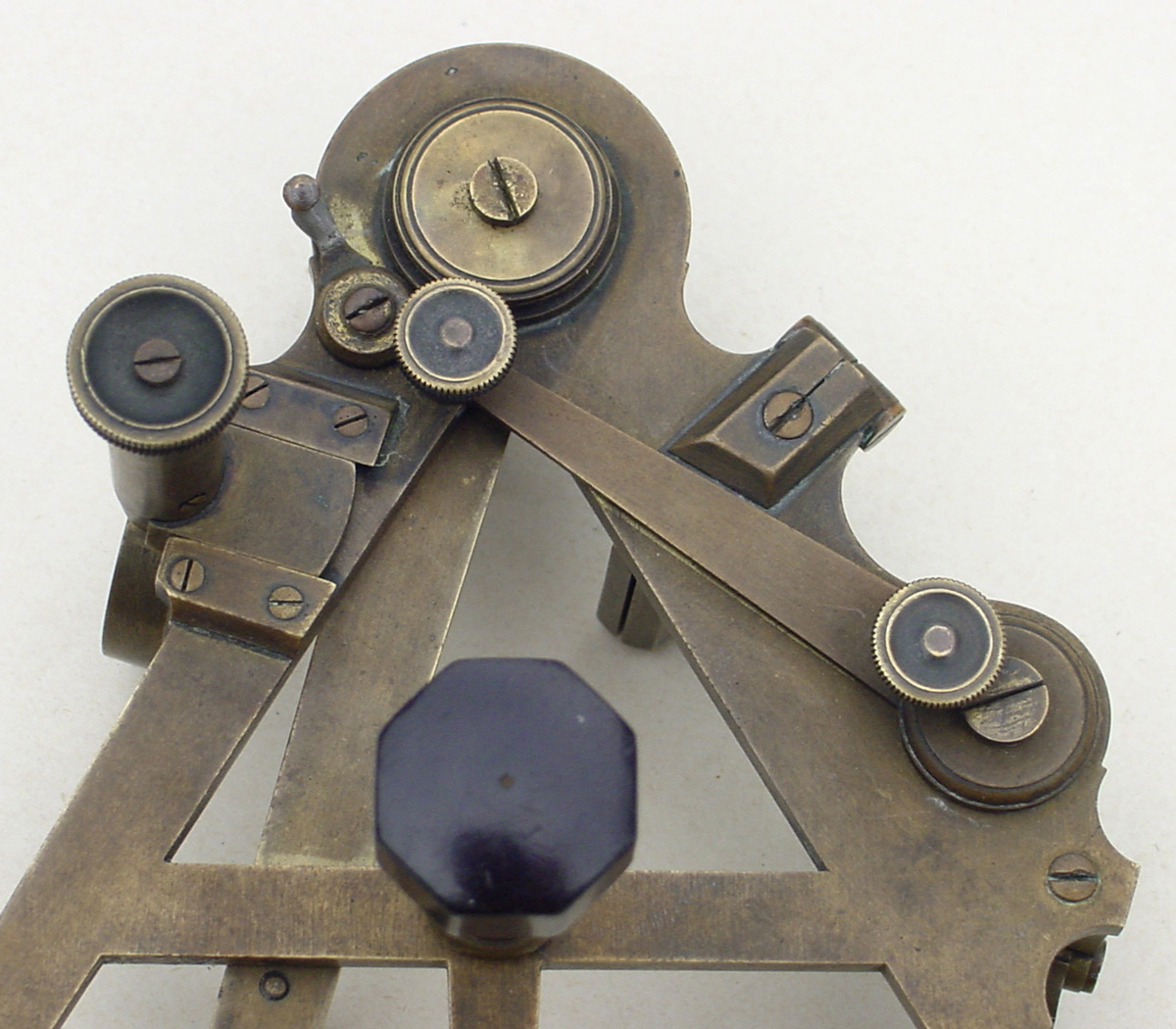
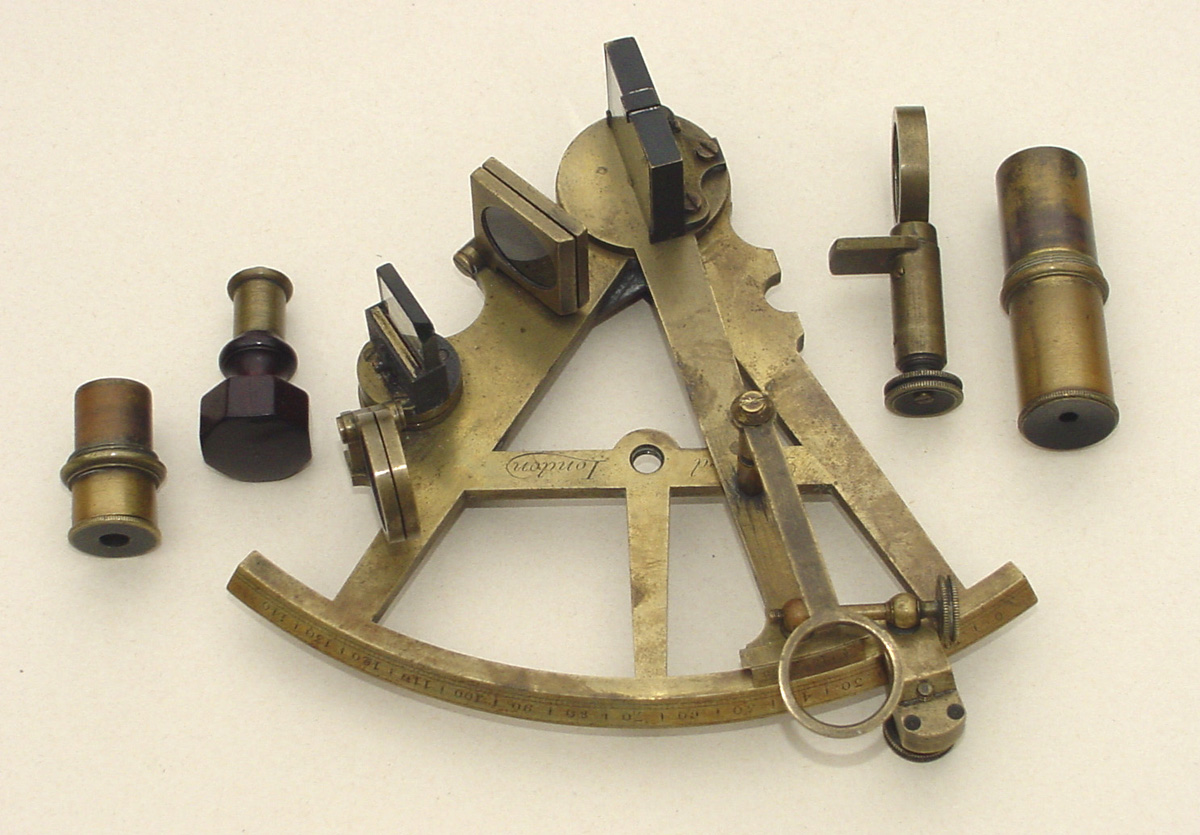
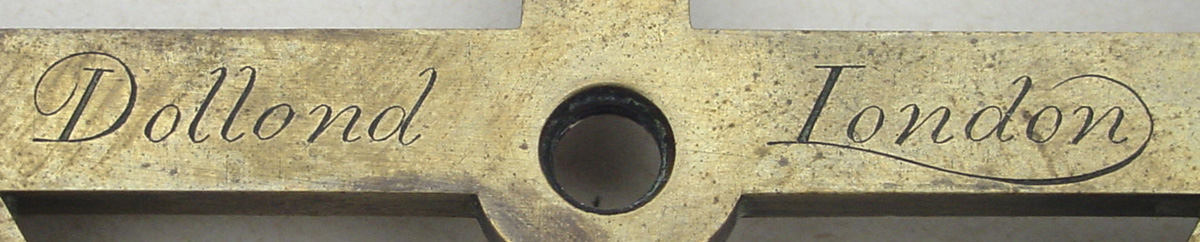
EARLY MINIATURE SEXTANT, English, c. 1780, signed on the crossbar "Dollond, London." This fine example of a miniature all-brass sextant measures 5-1/8" (13 cm) overall, with a scale radius of 4". The scale is divided directly on the canted (and therefore conical) brass limb, every half-degree, to 144°; calibrations are read from "above" rather than from "below" as usual. The index arm has one-arcminute vernier, offset clamp with fine tangent screw, and scale magnifier which is a true two-element "Ramsden eyepiece." Notable are the two pairs of interposable red filters, for horizon and index mirror views; the dovetail slide and thumbscrew motion to the sighting tube; the fine octagonal wood handle; and especially the early "Ramsden" form of tilt adjustment to the horizon mirror via long lever with twin clamp screws, the control knob near the eye. Condition is fine except for considerable browning and spotting to the brass, and a couple of tiny chips to the mirrors. The square mahogany case appears to be an old replacement; it bears the trade label of George Lee & Son of Portsea. A fine example of this diminutive form. (8346) $4950. |
 |

|
|
"I am turned Longitude mad, and I have got a most novel Sextant made by my friend Ramsden which altho' only Six Inches Radius.." (Dr. Lind, 1765, in a letter to James Watt; Taylor II, p. 237) |
| 66 Guns and 2 Angels, carved in Coquilla Nut | Click on any image for a larger view. Scroll to view more items. |
 |

|
 |
|
|
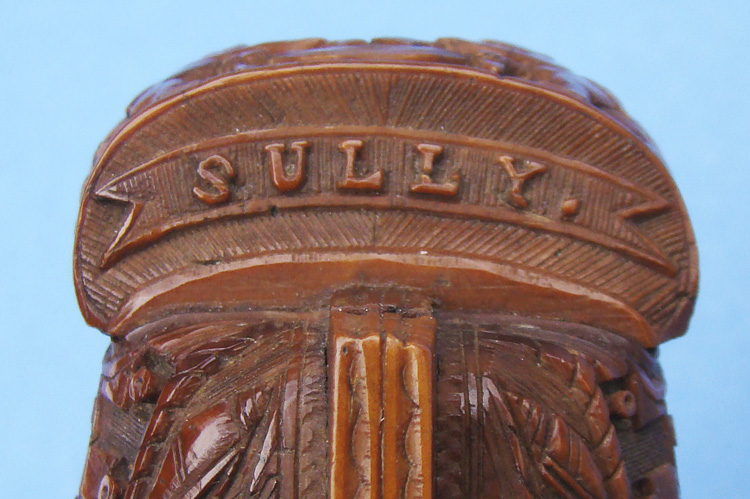
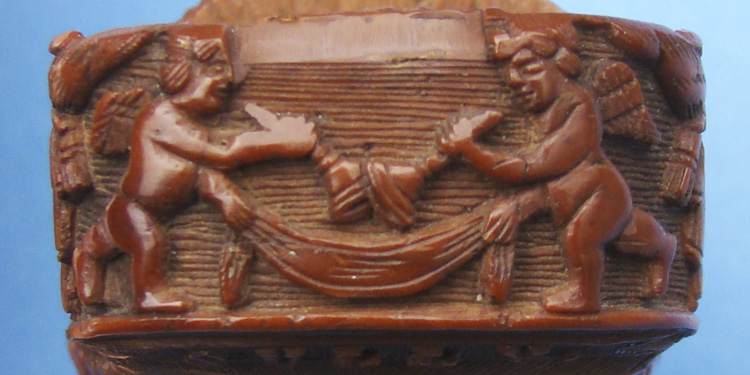
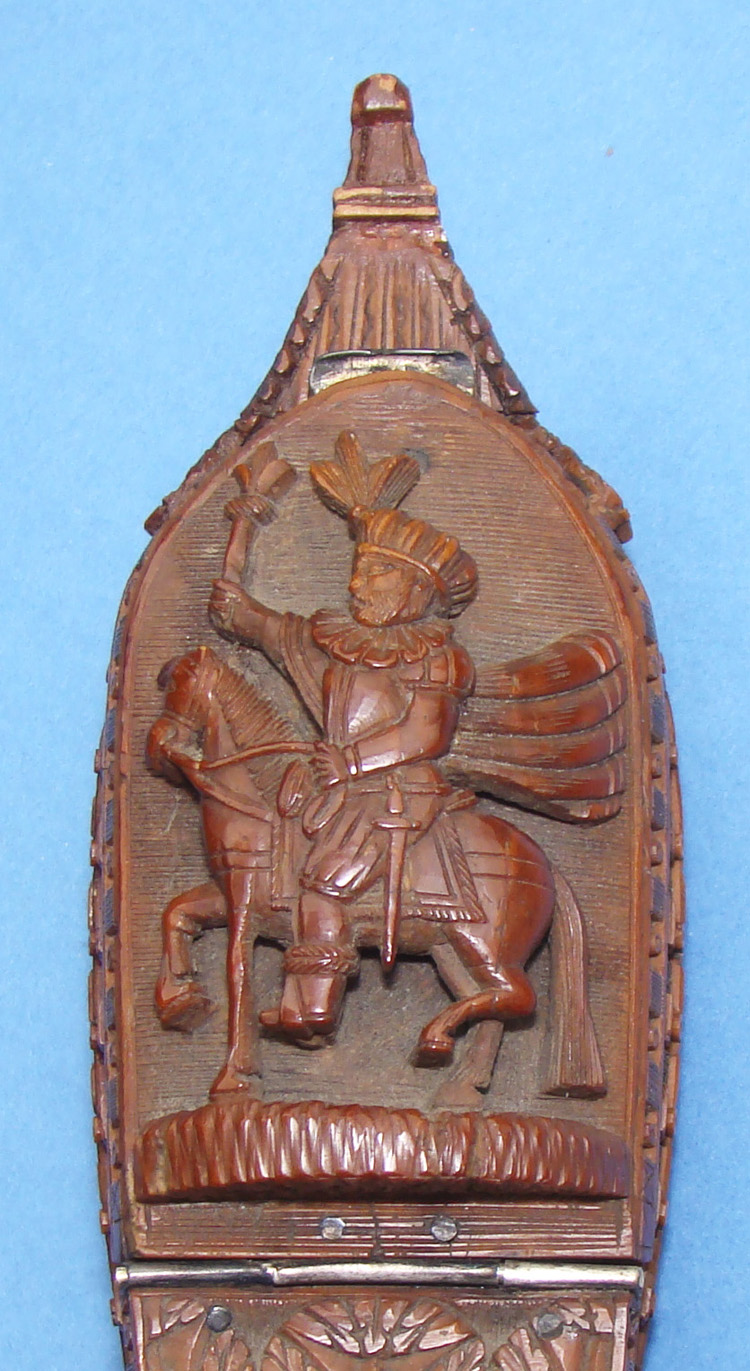
FINELY CARVED SHIP MODEL, French, c. early 19th century, hand-carved entirely of coquilla nuts, measuring 4-1/2" (11.5 cm) overall. The ship is hollowed out, and fitted with a hinged lid to form a tobacco box. The lid is deeply carved with a magnificent leader on horseback, with full regalia. The stern is carved with two angels blowing trumpets and the name of the vessel, "Sully." The ship carries a total of 66 guns arranged in three layers. Condition is excellent. The coquilla nut is the fruit of the Brazilian palm tree and was carved by French prisoners of war held (often on moored hulks) during the Napoleonic wars. Over 100,000 such prisoners were brought to Britain between 1793 and 1815. The Duc de Sully (1560-1641) was a distinguished soldier, an important statesman in the French monarchy, serving as Henri IV's right-hand man and chief minister for 22 years. (10185) $1950. |
| Important Connecticut Invention by Captain Townshend | Click on any image for a larger
view. Scroll to view more items. |
 |
|
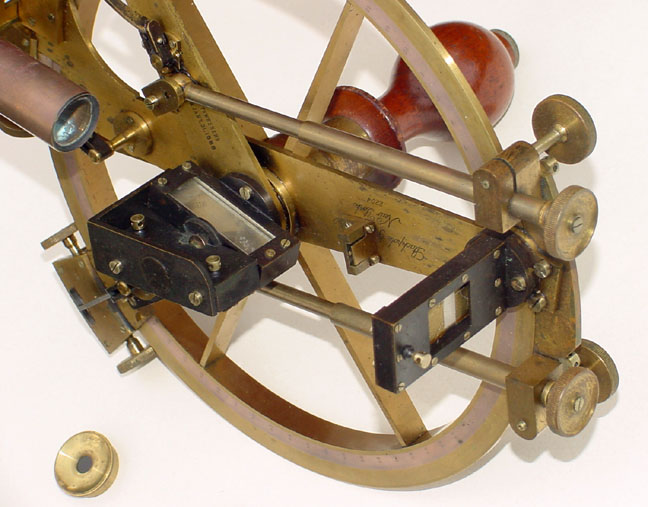
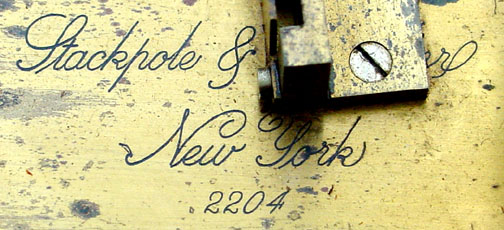
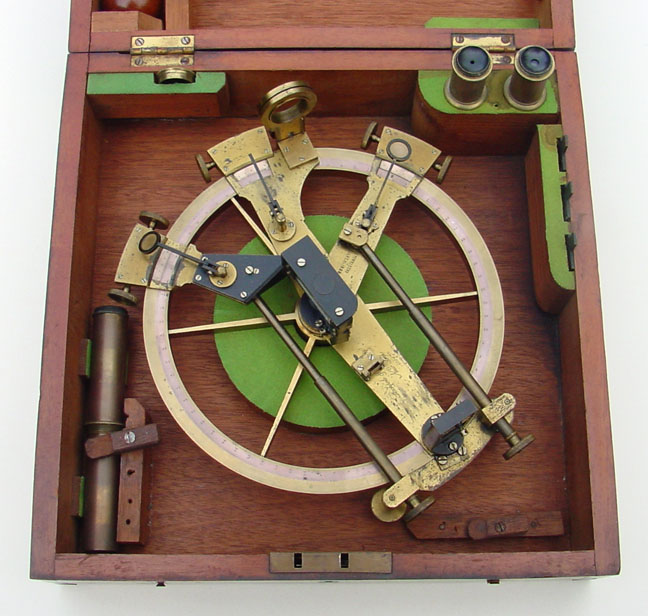
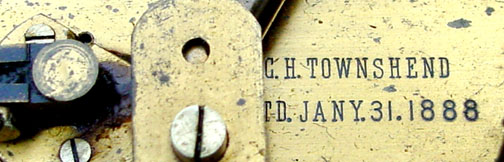
TOWNSHEND'S DOUBLE REFLECTING CIRCLE -- AN EXCEPTIONAL AMERICAN NAVIGATIONAL INSTRUMENT, c.1890, signed "Townshend, Patd. Jan 31, 1888," and "Stackpole & Brother, New York, 2204." The instrument is made of brass, with 8" (20 cm) diameter six-spoked main circle inset with silver scale divided every ten seconds of arc and labeled with double degrees 0 - 180 (on two sides), and 0 - 720 full circle. Two mirrors are mounted independently at the center of rotation, each with vernier (divided every ten arcseconds thus reading to 20 seconds in double degrees) arm and magnifier. Each mirror arm can be adjusted manually by long control rod, or driven in fine motion by clamp and tangent screw. One views through the adjustable telescope to the fixed mirror (with one clear and two silvered areas itself mounted tied to the telescope on long arm with clamp, tangent screw, vernier, and magnifier), then to the adjustable mirrors and to the targets. Thus one can sight three objects and measure two angular separations simultaneously (as two bright stars from the moon, for the lunar longitude method, or three coastal landmarks, for triangulation in coastal navigation). It is equipped with mahogany handle, two interchangeable achromatic telescopes, one sighting tube, screw-on solar filter, three insertable rectangular filters, and the original fitted mahogany case. Condition is very fine noting a little spotting to the original lacquer finish. Captain Townshend (1833 - 1904) was a resident of New Haven, Ct, and recommended his device for sighting sun, moon, and fixed stars, etc. Very few examples of his double reflecting circle have survived -- we can locate only those at Mystic Seaport and in the New Haven Colony Historical Society, one in a private collection, and the one offered in Tesseract Catalogue 50, Item 26. An important find. (8152) $14,500. |
|
|
|
|
| An Ebony Sextant, on Ramsden's Engine | Click on any image for a larger view. Scroll to view more items. |
 |
|
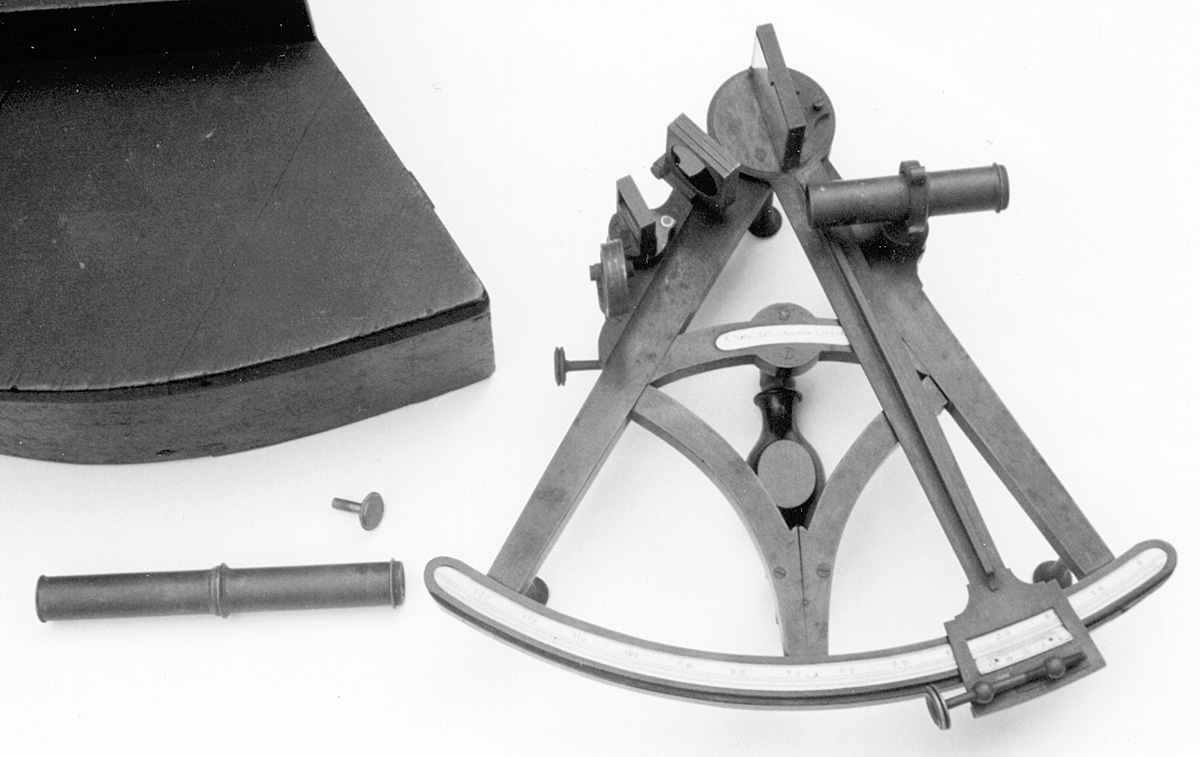
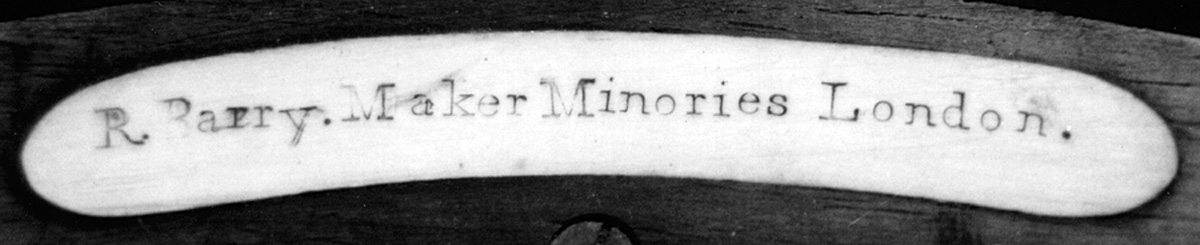
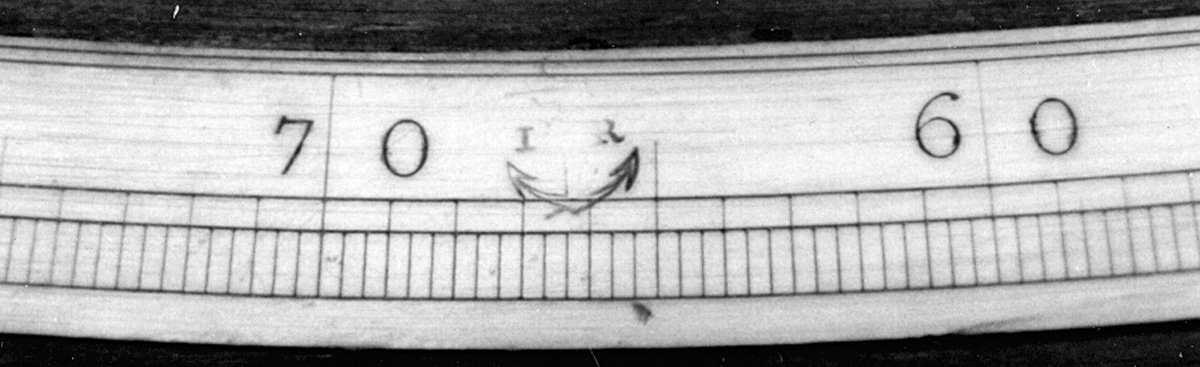
EBONY SEXTANT DIVIDED ON THE RAMSDEN ENGINE, English, c.1800, signed "R. Barry, Maker, Minories, London," and the scale with a fouled anchor "IR" stamp. The sextant features a very graceful ebony framework and measures 11-3/4" (30 cm) in overall height. The instrument seems complete and all original, except lacking a swing-away pinhole sight. It is equipped with reinforced all-brass index arm with clamp and tangent screw, telescope mount with thumbscrew height adjustment, telescope, auxiliary sighting tube, two mirrors, six colored filters, and lignum vitae handle. The horizon mirror has independent thumb-screw adjustments for rotation and tilt. The fine inset ivory scale is divided every third of a degree from -2° to 137°, and the right-zero ivory vernier reads to 30 arcseconds. The three long brass legs are distinctive with their unusual spreading feet. Condition is fine, the brass browned throughout. It is complete with the original stepped keystone-shaped case with early green paint, plus a 1944 U.S. Coast Guard authorization letter for one George L. Allen "to take celestial observations on the waterfront in Cape Ann vicinity." According to Clifton, Richard Barry flourished as chart seller and instrument maker, from 1800 to 1811. Thus Ramsden (1735 - 1800) or his successor Matthew Berge (c. 1752 - 1819) would have divided this ivory scale on the Ramsden engine, as discussed by Stimson. (8226) $3750. |
 |
|
|
"...representing that he had invented an instrument for dividing sextants etc., the construction of which is such as leaves no dependence on the workman, as a boy can use it with the same exactness as the most experienced hand; and in the most speedy manner. And expressing the wish that the said instrument which has cost him £250 and another which he is constructing to divide streight lines may be the property of the Board on their paying him for them and giving him such a priority to him as, in their opinion, he may deserve. And the said Mr Ramsden, having been called in and discoursed with upon the subject, the professors who were present were desired to go to his house (taking with them Mr Bird if he was inclinable to go) in order to see a quadrant divided by the above instrument, and to report their opinion of it to the Board. (Ramsden, 1774, in a memorial to the Board of Longitude; McConnell p.43) ³Bird examined a sextant divided on the engine and reported that the graduations over the whole 120° were accurate to one two-thousandth part of an inch -- a remarkable accuracy in comparison with previous methods of scale division. ...the Board awarded Ramsden the sum of £300 for his invention,...purchased the engine for £315,...subject to certain conditions. He was...to divide all sextants and octants brought to him by other craftsmen, at the rate of 3 shillings for each octant and 6 shillings for each brass sextant, with nonius divisions to a half-minute.² (McConnell p.43) |
| Less than a Hand-Full | Click on any image for a larger view. Scroll to view more items. |
 |
|
 |
|
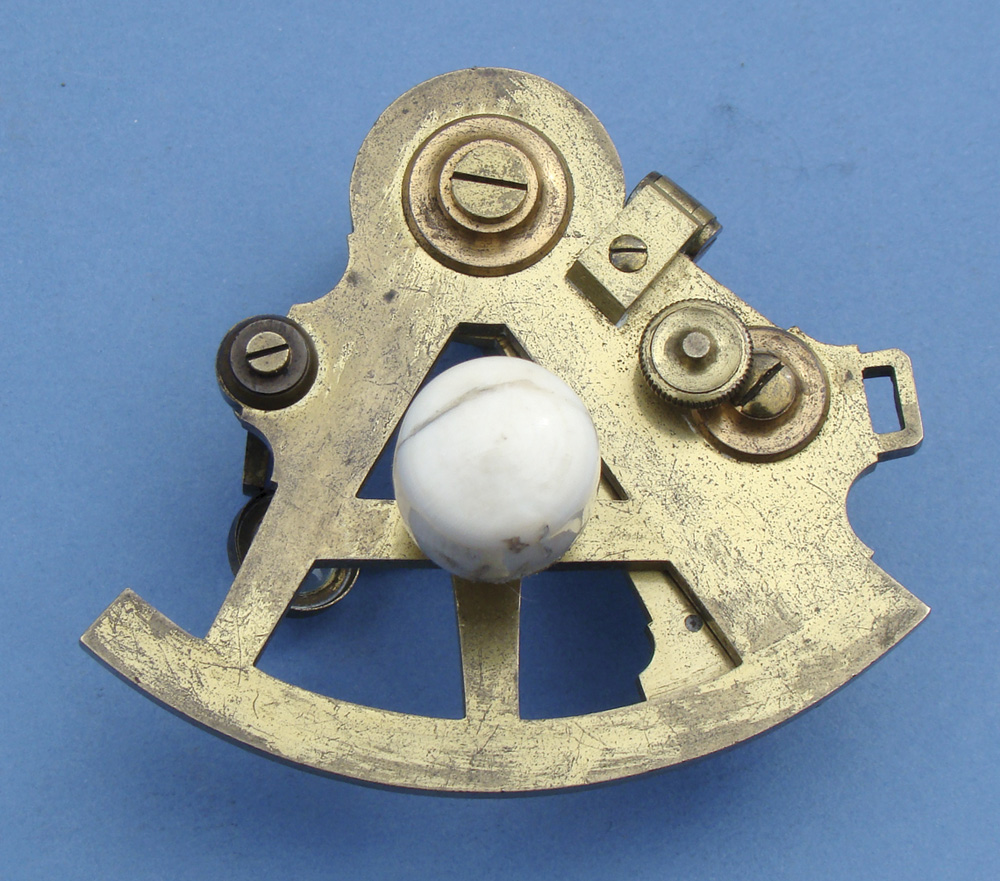
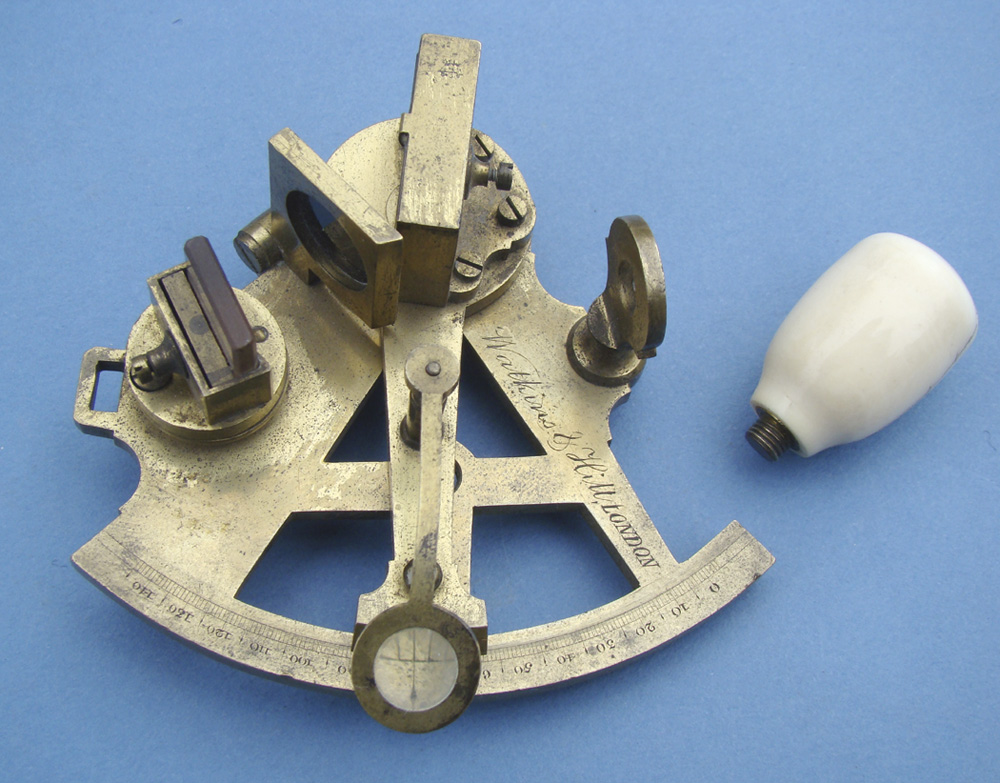
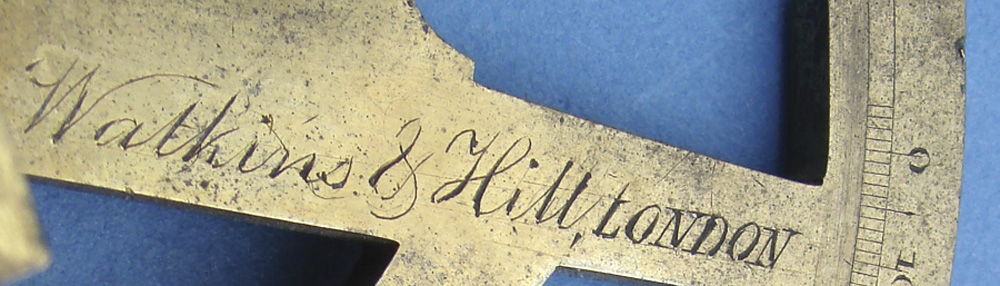
SUB-MINIATURE FULLY-FUNCTIONAL SEXTANT, English, c. second quarter 19th century, beautifully signed "Watkins & Hill, London." With a scale radius of only 2" (5 cm) and an overall height of 2-5/8", the sextant can be essentially concealed within one's hand. Despite the size it is fully functional and operational with the human grip and human eye. It is equipped with peepsight, twin mirrors, swing-away red index filter, and turned ivory handle. The index mirror alignment is adjustable by four screws to its mount, the horizon mirror by a mounting screw and a thumbscrew beneath. There is a slot probably for an auxiliary horizon filter, not present. The scale is divided directly on the brass, every degree from -4° to +145°, and is numbered every 10° upside down (for convenient readout when held in the right hand). The index arm has a three-arcminute vernier divided on the canted brass end, an adjustable scale magnifier, and a little push knob. Condition is very fine throughout, with no noticeable wear. We note that the handle has a hairline age crack, and that much of the original lacquer remains. This is a splendid example of an eminently portable functional sub-miniature of the classic form of navigational sextant. The partnership of Francis Watkins and William Hill was in business from c. 1819 to 1856, as optical, philosophical, and mathematical instrument makers. They produced the full range of such instruments, and of very high quality craftsmanship. (9179) $4500. |
| In the Palm of your Hand | Click on any image for a larger view. Scroll to view more items. |
 |
|
|
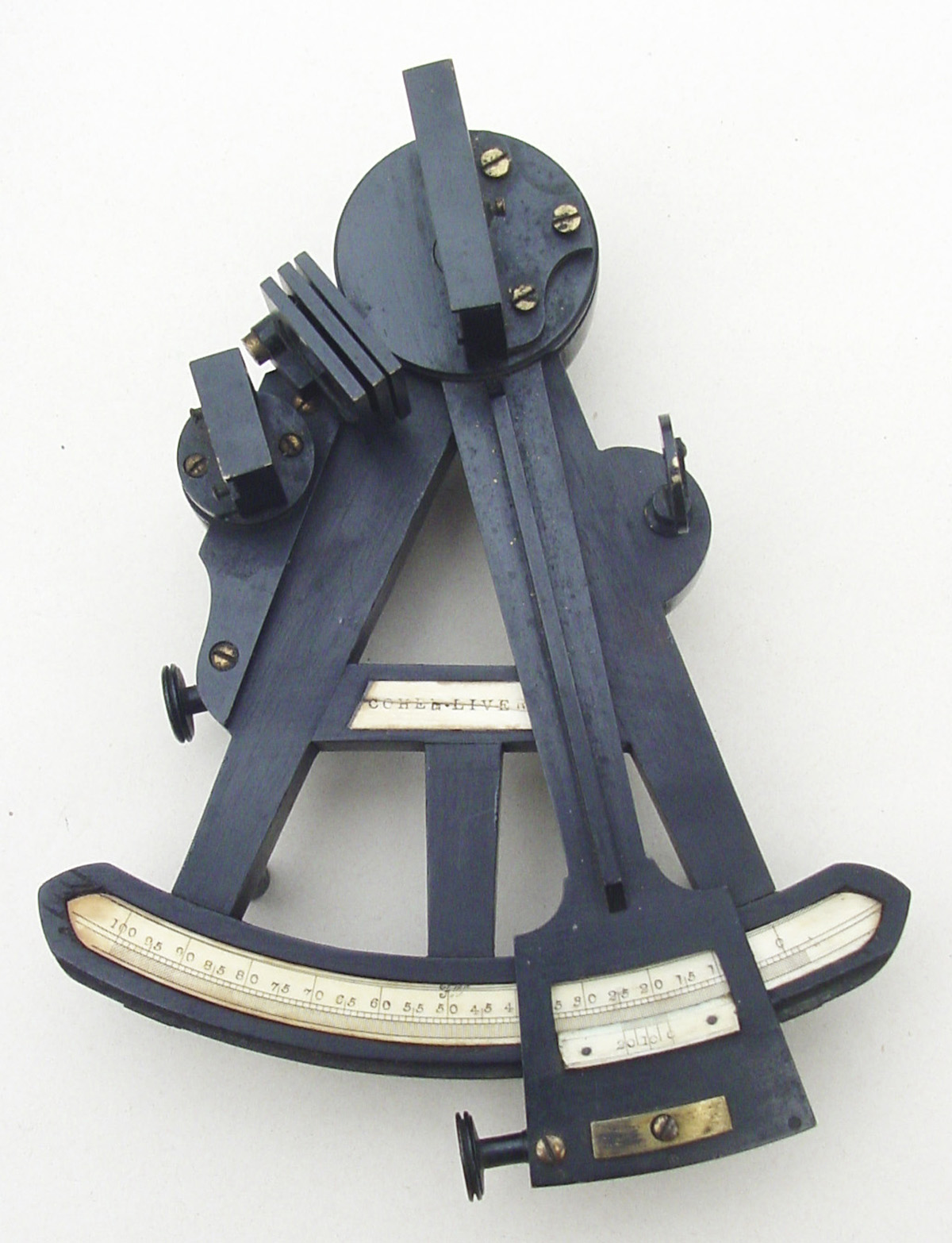
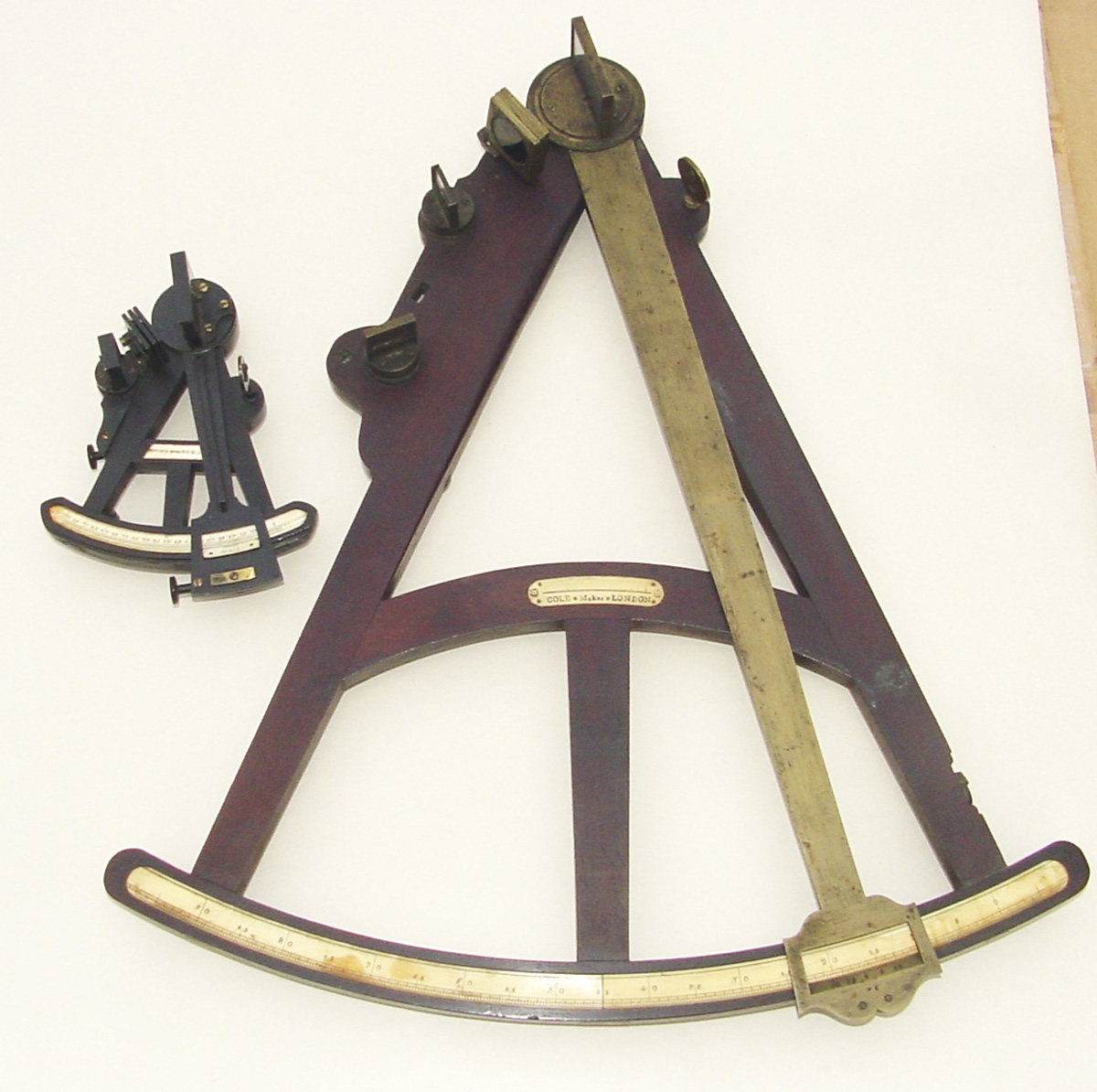
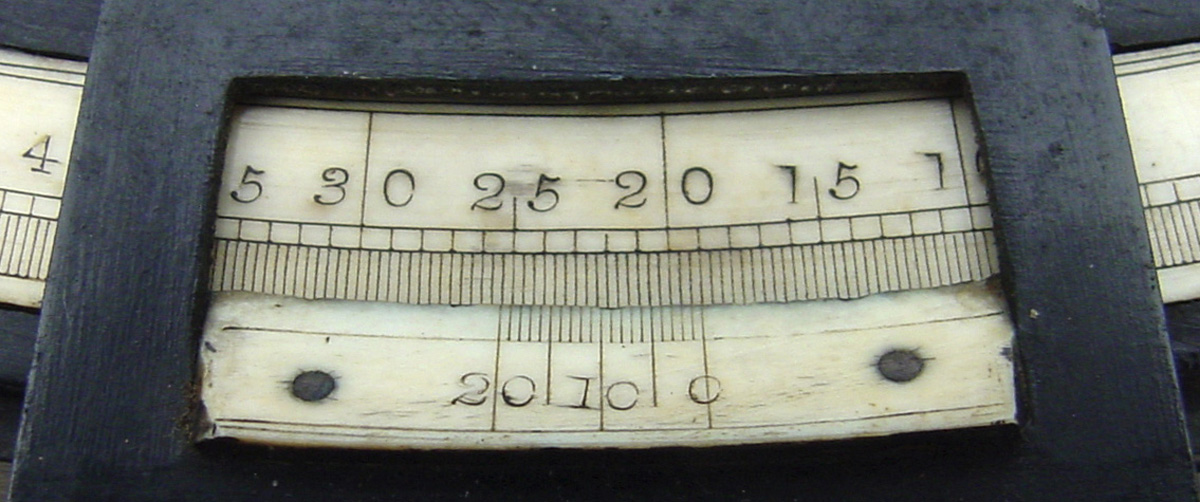
RARE DIMINUTIVE EBONY OCTANT, English, mid-19th century, signed on the ivory nameplate "Cohen, Liverpool," and stamped near the center of the ivory scale with a script "FW." This remarkable hand-sized octant measures 6-3/8" (16 cm) in overall height, with a scale radius of 4-3/4" (12 cm). Construction is like that of a standard octant but reduced, with a tapered A-frame of ebony, blackened brass index arm with clamp and tangent screw slow motion, index mirror, three swing-away index filters, horizon mirror with tangent screw fine adjustment for zero position, twin peep sight with swinging cover, and three turned brass legs. There is an ivory "notepad" plaque, ivory scale divided every 20 arcminutes, and ivory vernier reading to one arcminute. Condition is excellent noting a couple of small age cracks. The original keystone mahogany case is good. We note one similar diminutive octant signed "Adams London" in the collection of the Swedish Academy of Sciences (illustrated in Pipping). The present maker was apparently Morice Cohen, listed in Gore's Directories as an optician working 1848 - 1849 at 59 Pitt St., Liverpool (see Morrison-Low, 2007). The initials "FW" refer to the scale divider, a tradition begun by Jesse Ramsden when he, from time to time, used his newly invented dividing engine to divide scales for other makers. Stimson has studied this history, and presents a tabulation of known marks (in De Clercq, 1985). "FW" is recorded no less than six times, and most interestingly, four of these are on specific Liverpool octants (by Brokovski c. 1840, by Christian, and by B. Wood c. 1860). But "FW" and his dividing engine have yet to be identified! A splendid example. (8236) $6500. |
 |
|
| U.S. Navy Distance-Ranging in WWII | Click on any image for a larger view. Scroll to view more items. |
 |
|
|
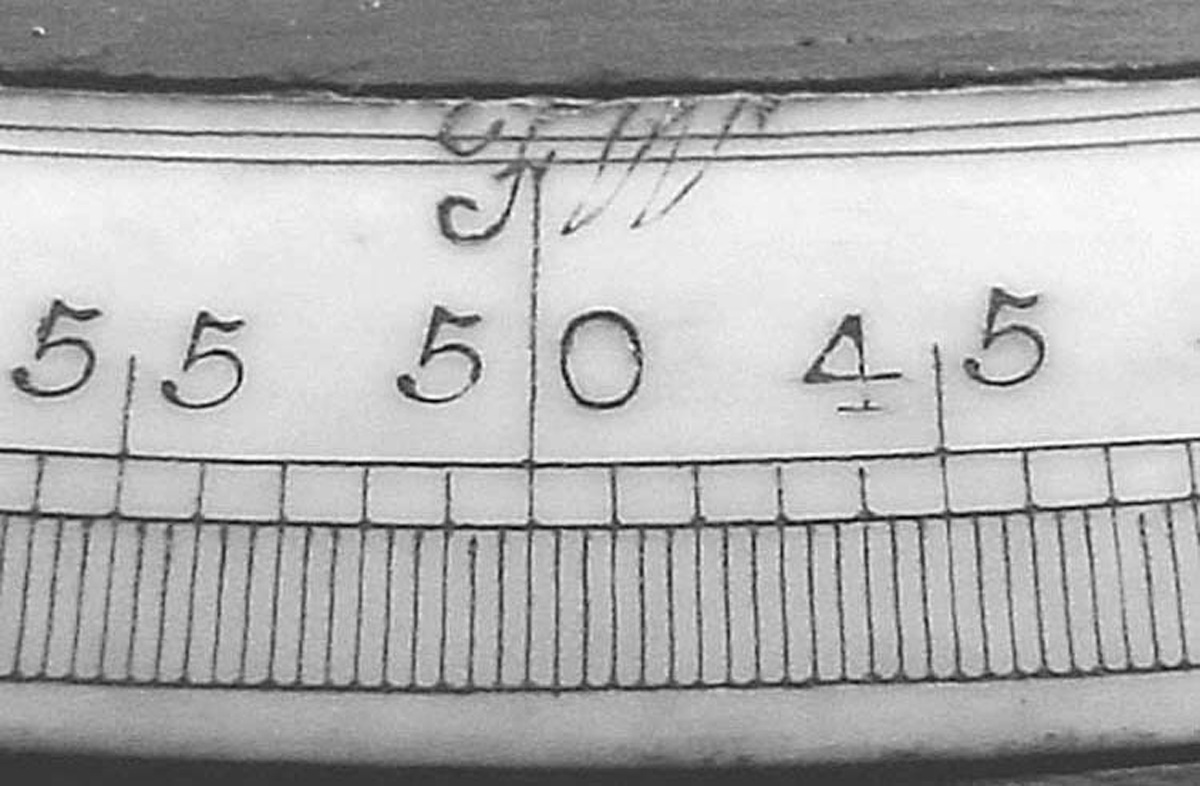
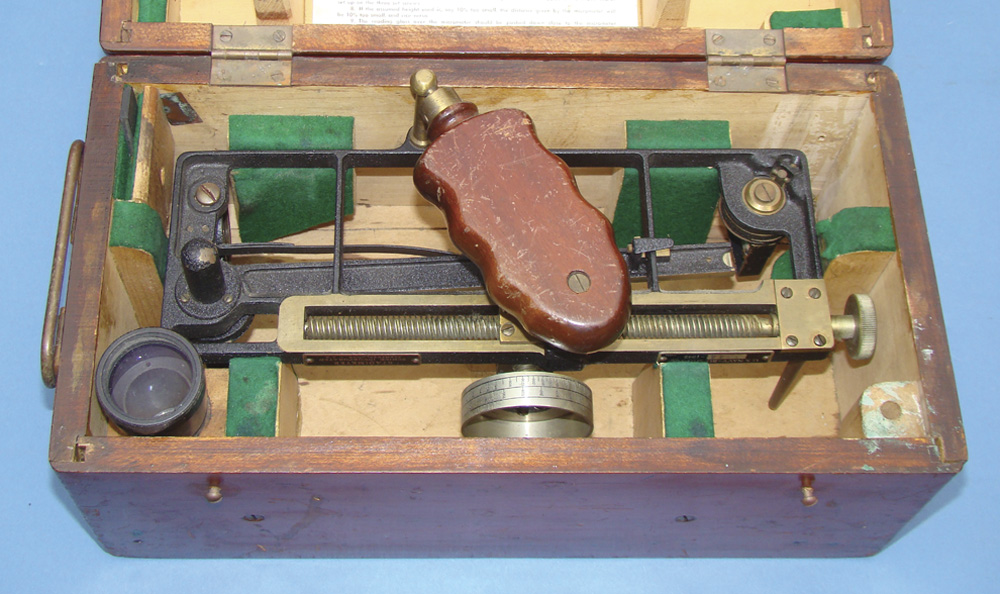
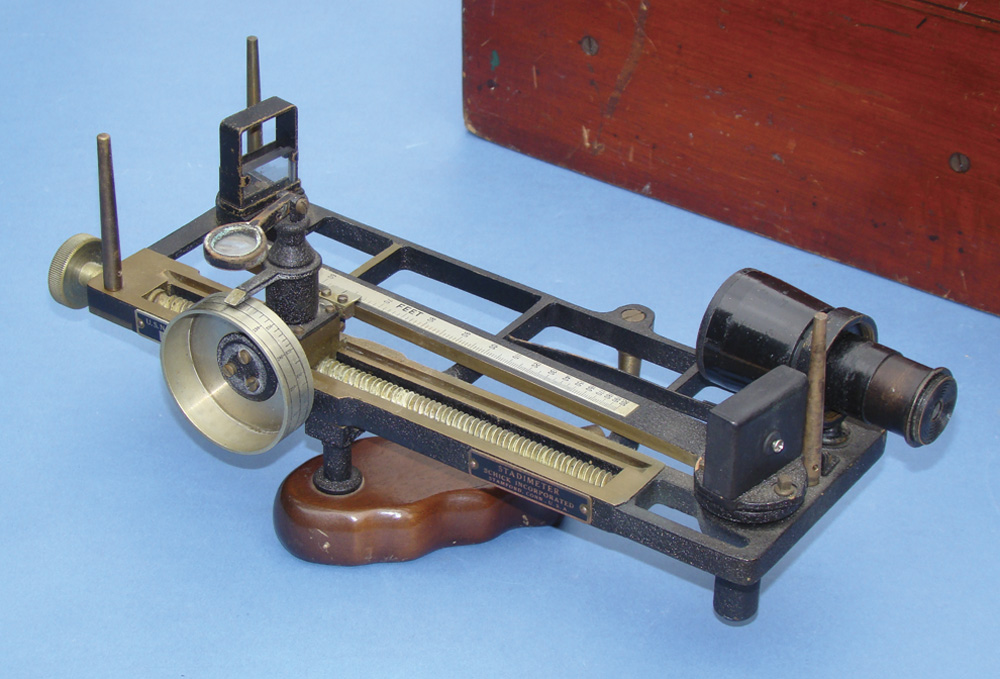
U.S. NAVY TELESCOPIC STADIMETER, American, c. 1942, signed on plaques "Schick, Inc., Stamford, Conn." and "U.S. Navy-Bu. Ships, #2244 - 1942," and "Repaired by Boston Naval Shipyard." This elaborate distance measuring device, 10-3/4" (27 cm) overall, is made of brass with black crinkle, clear lacquer, and plated finishes, with a shaped mahogany handle. It works something like a sextant but limited to small angular separations, and with readout directly in distance rather than in angle. One sets the size of a known object (ship height or length, e.g.) on one scale (from 50 to 200 feet), and turns a calibrated micrometer knob until coincident images give the distance away in yards (from 200 to infinity). It is a rather sophisticated form of distance ranger, in fine condition, equipped with three legs, twin mirrors, spare mirror, scale magnifier, large-light-gathering-power telescope, and original fitted mahogany case. This is a very good example of the innovative form developed in the 1890¹s by Lieutenant Bradley Allen Fiske. (9178) $495. |
| Combination of Nature's and Man's Inventiveness | Click on any image for a larger view. Scroll to view more items. |
|
There is a common received opinion that if the lodestone be rubbed over with garlick or onions that it will obstruct the virtue thereof; or if a knife being touched upon the lodestone and afterwards cut an onion or garlick it will immediately lose its virtue. This conceit hath also been countenanced by the Ancients, but if you are pleased to make a trial you will find it to be but a mere fallacy. It is also false that the diamond doth hinder the virtue of it while it is near it. (John Seller, Practical Navigation, 1694) |
 |
|
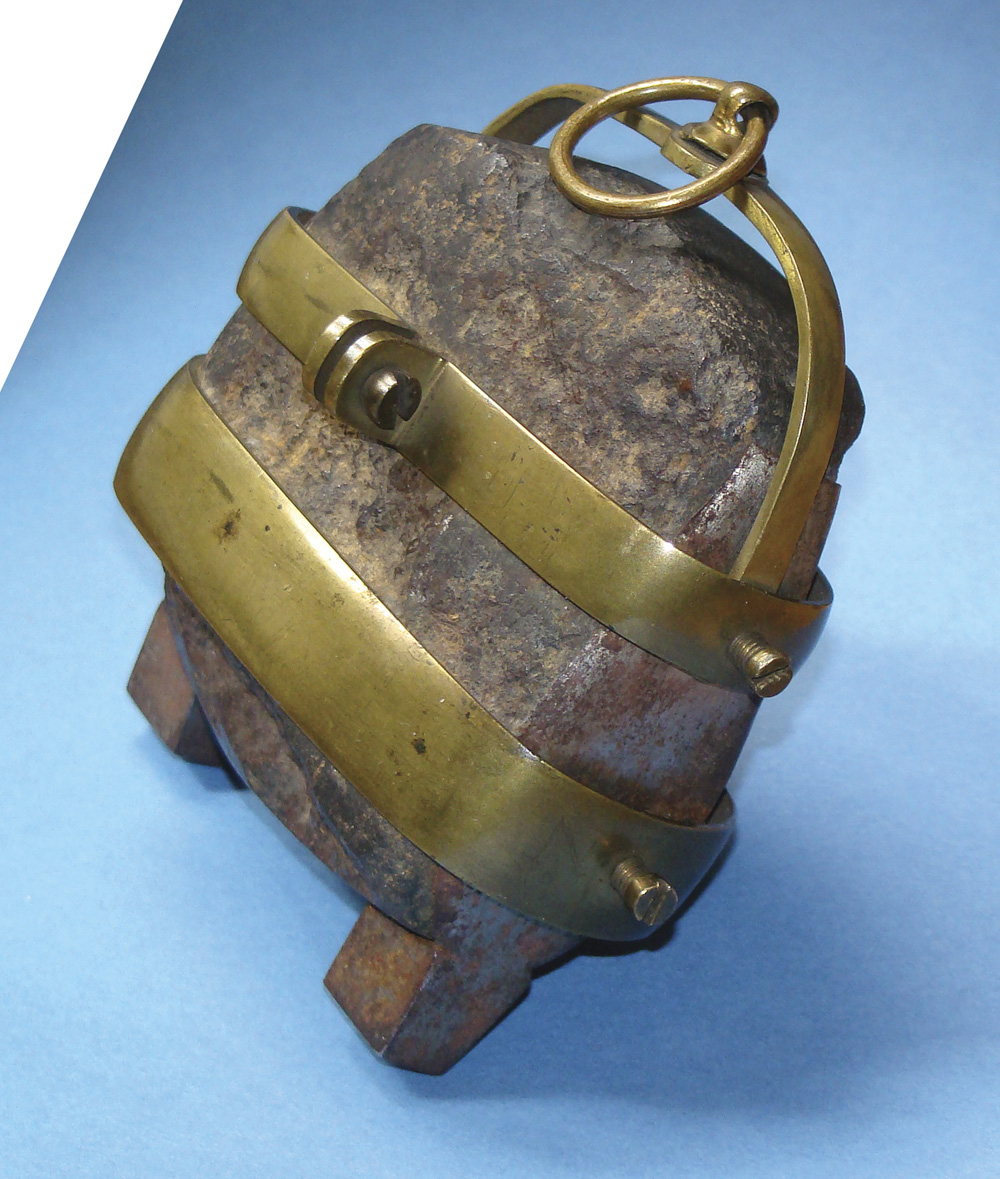
FINE BRASS-BOUND LODESTONE, c. late 17th century, measuring 4-1/4" (11 cm) tall including suspension ring, the ends scratch-labeled "N" and "S." This dramatic lodestone has a naturally magnetic irregular "chunk" of magnetite, clearly visible within the two horizontal brass straps which conform to the shape of the stone. Mounted to the upper strap is a U-shaped strap with suspension ring, acting as a sort of "gimbal" mounting permitting the stone to swivel in two directions and thus find its own vertical. There are iron pole pieces, again well-shaped to conform to the natural shape of the stone, in order to concentrate the field strength. Condition is very fine, noting a bit of oxidation to the iron. It retains a low degree of magnetization. This is a handsome lodestone, "powerful" in making very visible the combination of nature's and man¹s inventiveness. Rarely is the naturally shaped stone so apparent within the metal casing. It may be compared with an encapsulated example (Tesseract Catalogue 100 Item 77), and with a large partially hand-shaped one (97/30). (10203) $6500. |
| By the Innovative "Pupil of Ramsden" | Click on any image for a larger view. Scroll to view more items. |
 |
 |
|
 |
|
|
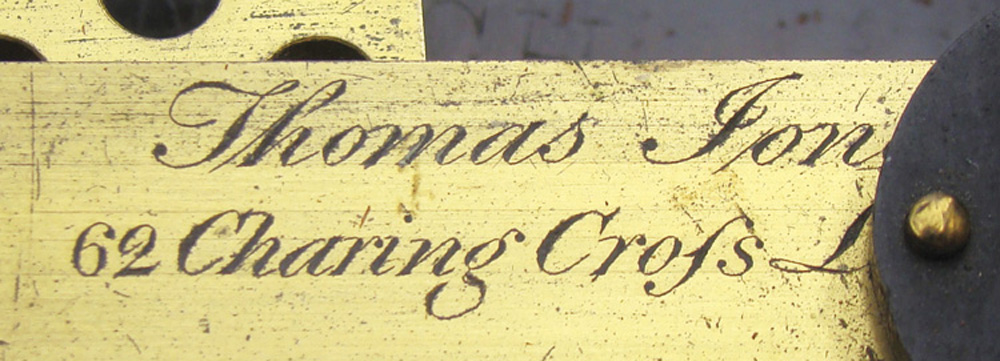
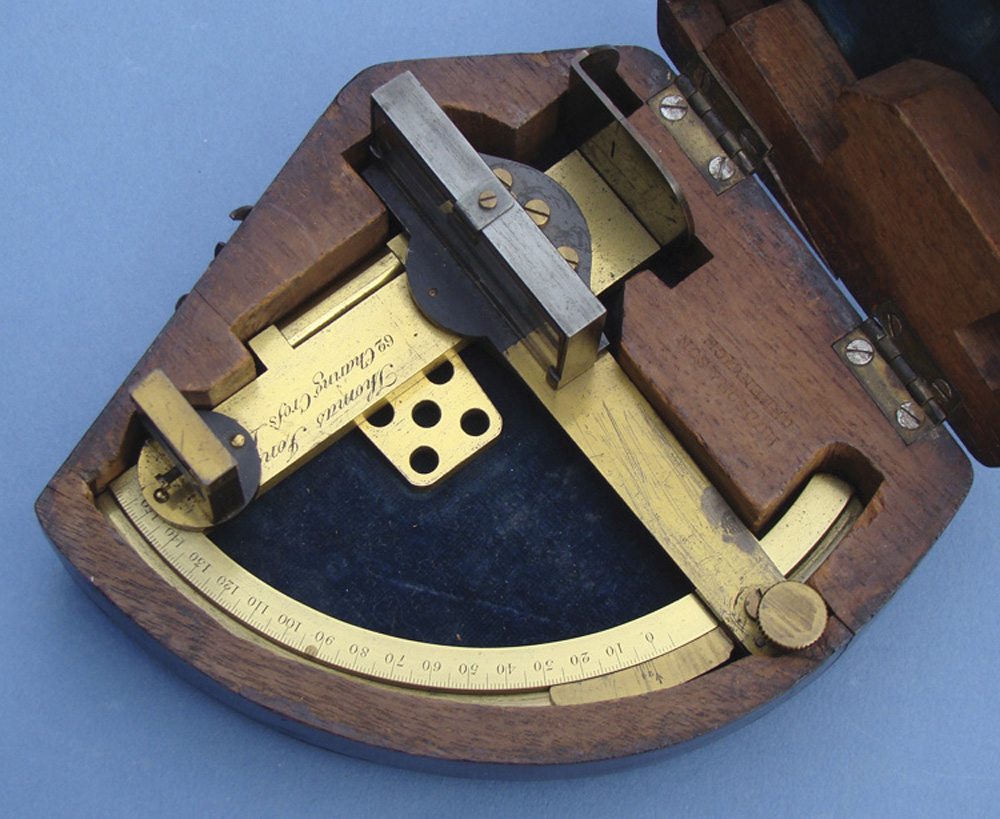
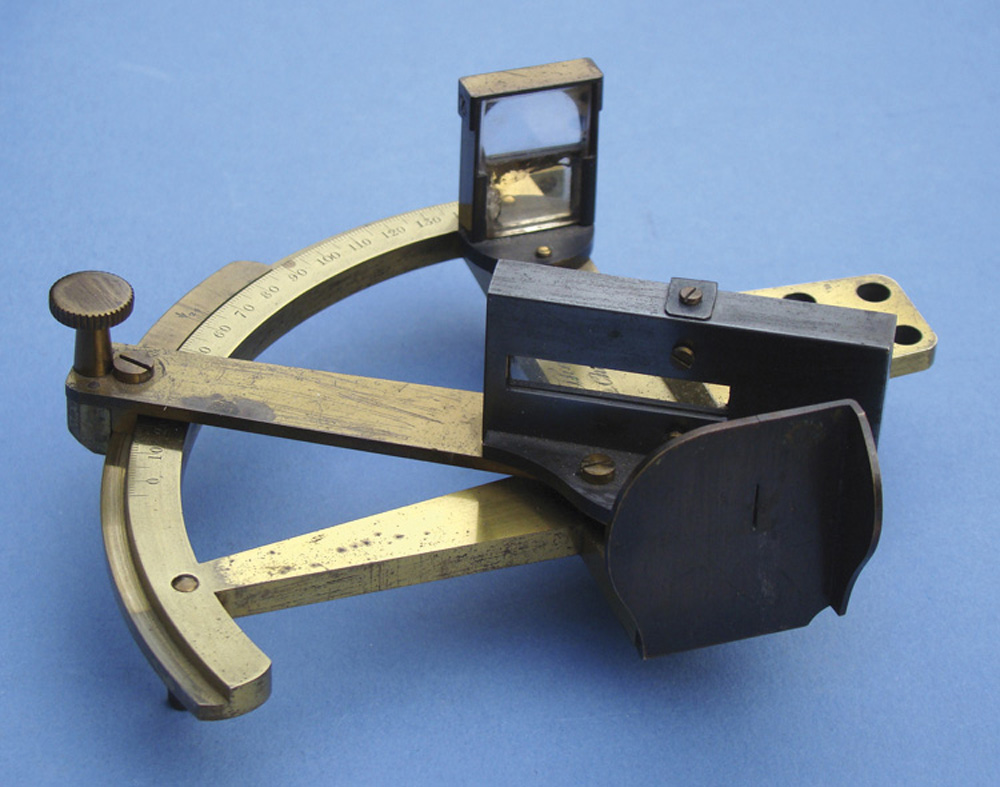
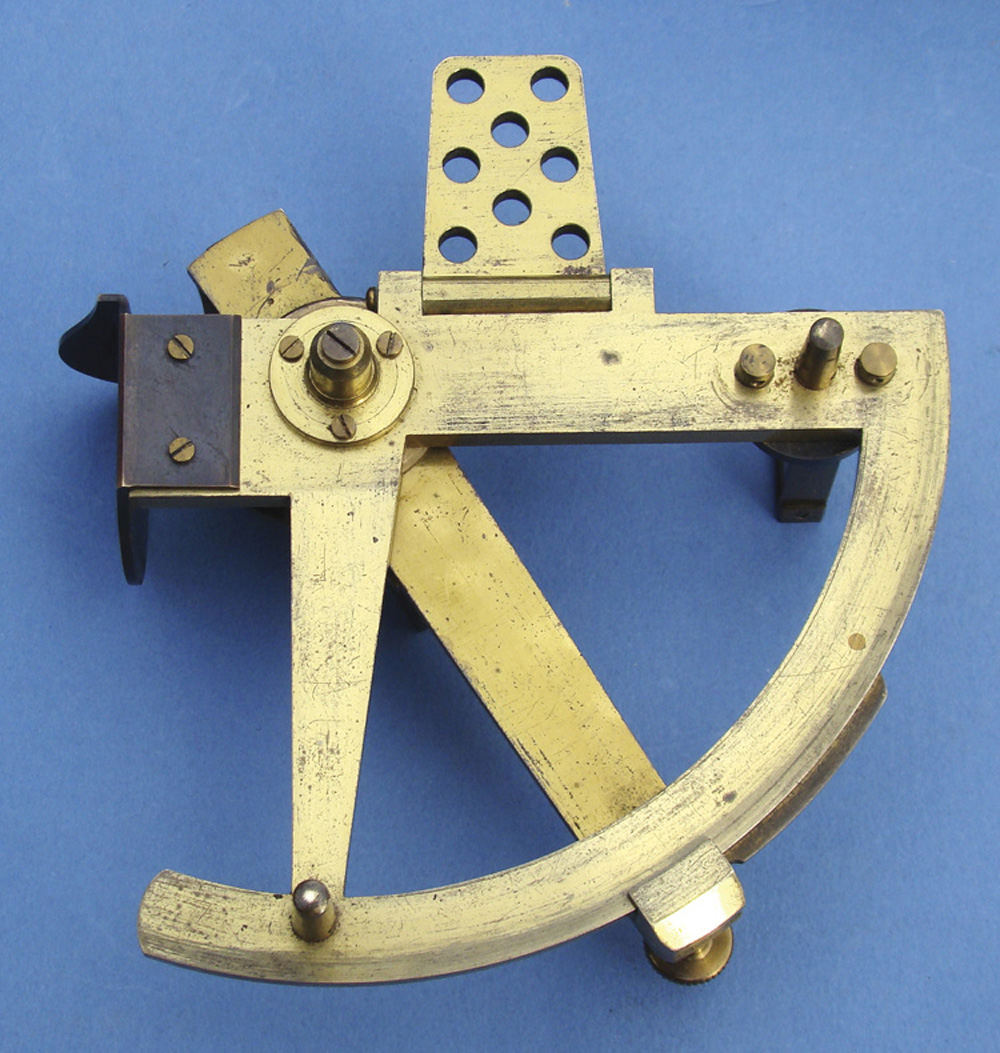
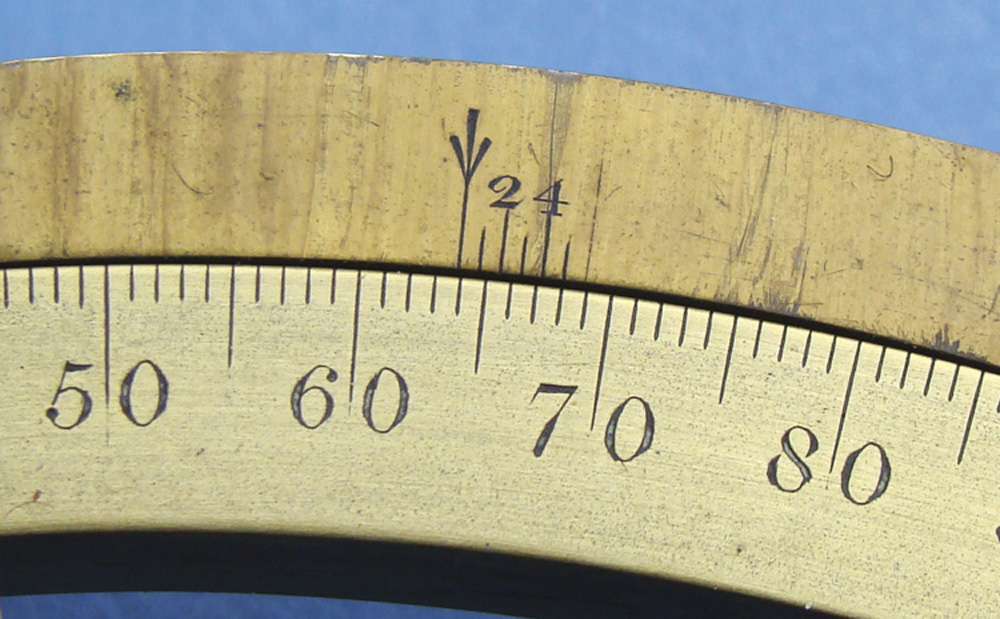
REMARKABLE IN-LINE DOUBLE-REFLECTING MINIATURE QUINTANT, English, c. 1830, beautifully signed "Thomas Jones, 62 Charing Cross, London," and stamped twice on the case "Hudson & Son, Greenwich." This diminutive sextant is constructed of clear lacquered and chemically darkened brass, 4-1/4" (11 cm) overall with a scale radius of just under 3". It is shaped as a quarter-circle, with scale useable from -5° to 148° (and thus covering the 2 x 72° = 144° necessary for a quintant). The rotating index arm carries vernier reading to one-tenth degree, clamp-screw, and quite large mirror silvered but for a clear glass rectangular window within. To one side is a slit sighting vane, to the other a half-silvered "horizon" mirror. The frame is fitted with three legs and a hinged brass handle (which is pierced, probably to save weight). Condition is very fine with its fitted wood case. In use one sees straight ahead through the unsilvered portions of the two mirrors, and sees simultaneously the doubly-reflected image of the target. It is an ingenious layout, "surprisingly easy to use and makes a very good visual presentation of the sight" (p. 131 in Taking the Stars by Ifland, who illustrates a similar but unsigned example). It can be compared with the extraordinary in-line instrument of Amado Laguna (Tesseract Catalogue 101 Item 22) and with the equally ingenious (and rare) single mirror altitude quadrant of Thomas Jones (94/22). This well-known maker, who advertised as "Pupil of Ramsden," had the present address from 1816 to 1850. The later retailer Hudson & Son is recorded in Greenwich in the late 19th century. (10193) $4500. |
| Among the Earliest Surviving Octants | Click on any image for a larger view. Scroll to view more items. |
 |
|
 |
|
|
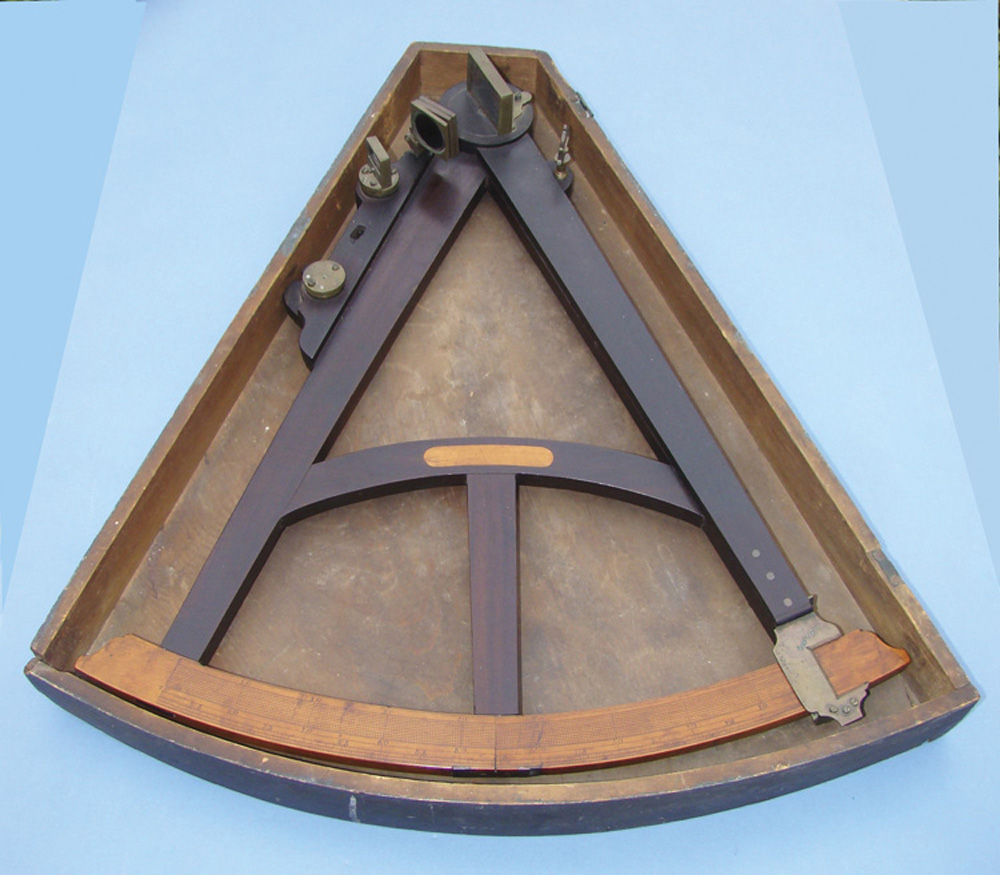
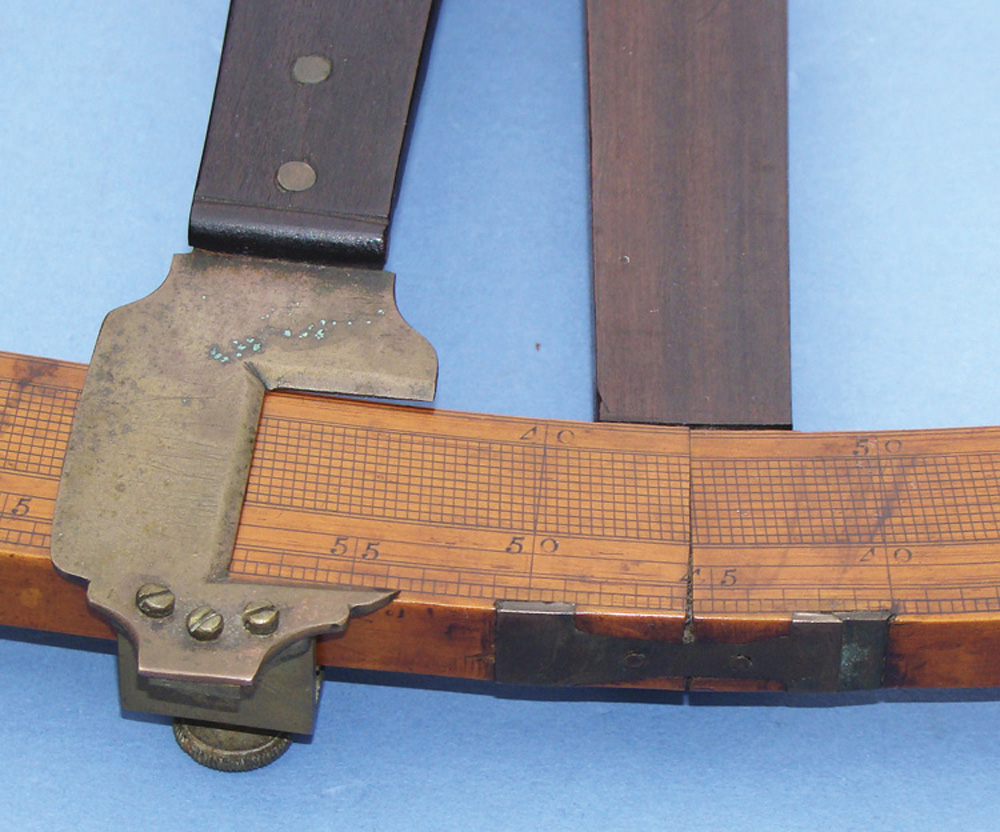
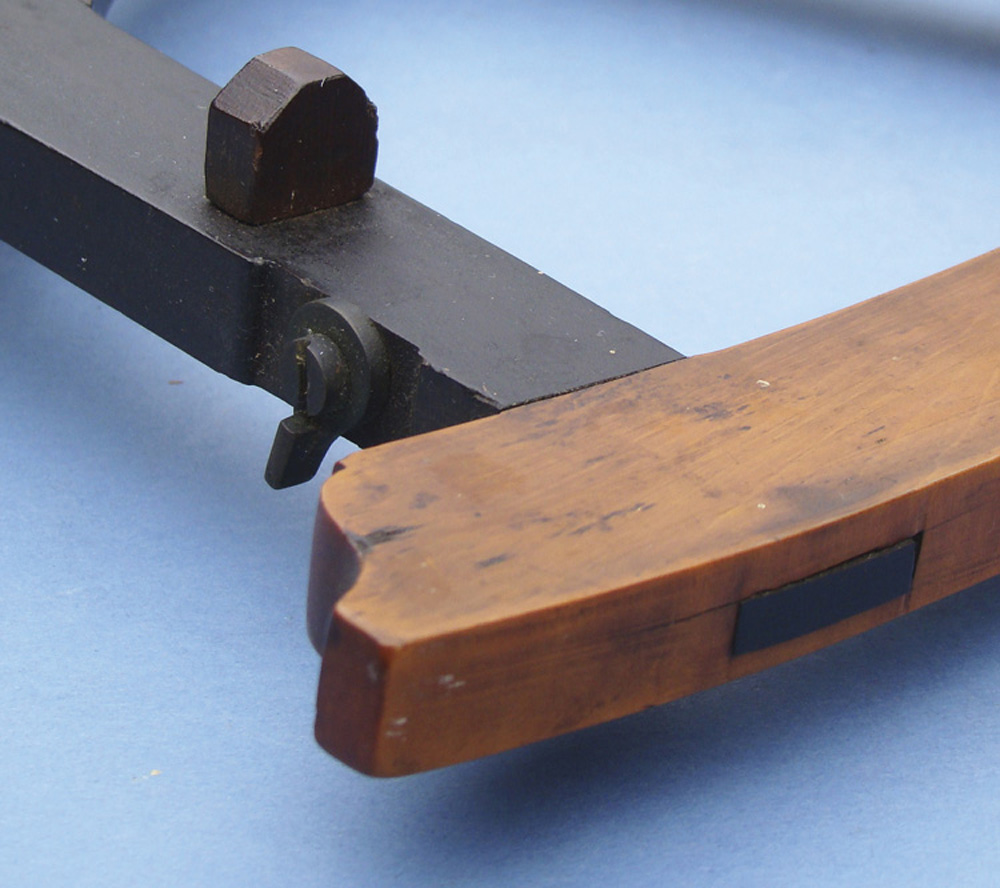
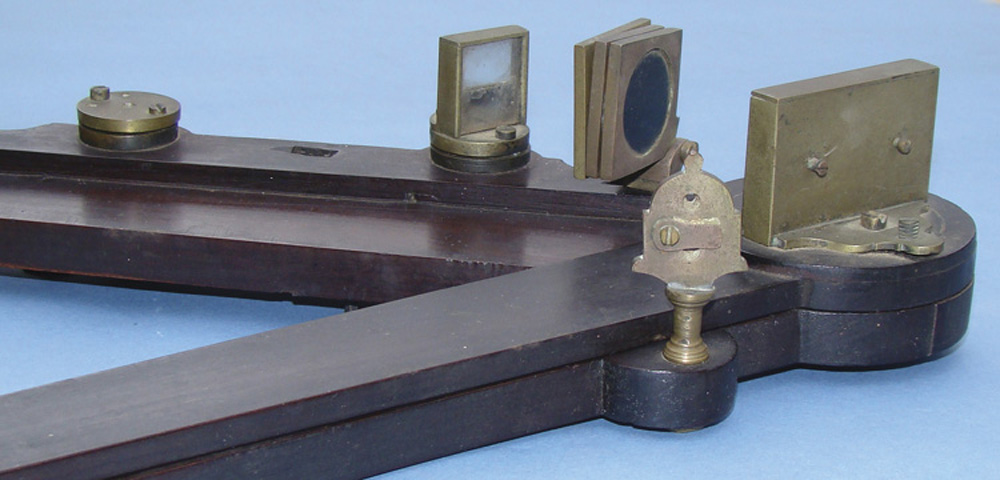
LARGE EARLY OCTANT WITH SOLID BOXWOOD SCALE ARM, American or English, c.1750-1760. Framed in mahogany (or rosewood), with boxwood scale arm 1/2" thick, the octant measures 20" (51 cm) overall. It is equipped with wooden index arm ending in brass "line of faith" reading against transversal scale, and inset blank name plate of boxwood. There are two mirrors, set of three filters (one cracked) interchangeable between horizon and index positions, double peep with pivoting cover, and remains of the backsight assembly. On the reverse are fine brass assemblies for adjustment of horizon and backsight mirror mounts, plus pegged wood feet, this a very early form. The shaped boxwood scale arm (reminiscent of that of a backstaff) is spliced in the center, divided 0° to 90° by thirds, with transversal scale reading to two arcminutes, and zenith distance scale running in reverse. Condition of the instrument is generally fine, noting some chips to the wood frame, and one replaced screw. Included is the lower half of the shaped case. Construction and layout are very similar to two octants in the Peabody Museum Collection (M1034 and M9270), one of those signed in 1755 by John Dupee (b.1729), important early American instrument maker of Boston. The present octant may well be one one of the very earliest surviving American examples (see D. Warner's inventory in Rittenhouse 3, pp. 89-112). Alternatively, we find similarities to early period English octants, in particular with inclusion of the zenith distance scale found so often on Benjamin Cole's instruments (and see that by John Gilbert, Item 24 in Tesseract Catalogue 61). (10213) $6500. |
| Direct Plotting of Heading, corrected for Magnetic Deviation | Click on any image for a larger view. Scroll to view more items. |
 |
|
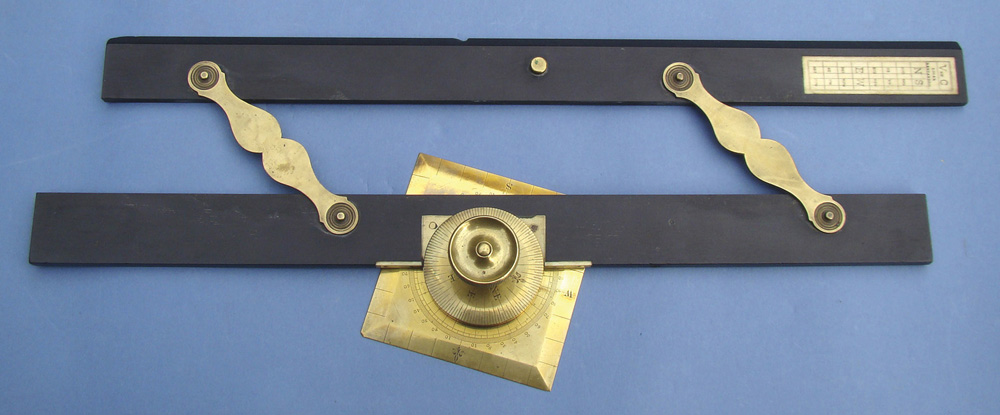
COMPASS PLOTTING RULE WITH MAGNETIC DEVIATION, English, c. early 19th century, the 15-1/4" (39 cm) long ebony parallel rule with twin brass linkages for parallel motion, rotatable brass compass rose divided to 128ths and readable against an inset ivory line-of-faith, rotatable and clampable brass square with linear edge divisions and central 4 x 90° scale similarly readable, plus inset bone or ivory notepad marked "V(ariation) of C(ompass), Local Deviation" and with fields for 16 principal compass directions. Condition is very fine noting one small edge nick. This is a versatile rule permitting direct migration of any compass heading complete with correction for magnetic deviation. We are struck by the variety of designs for parallel rules used in navigation and drafting (cf. the lifting right angle one Tesseract Catalogue 94 Item 40, etc.) It would make for an interesting collection and study. (10163) $1350. |
 |

|
| For the Captain's Leisure, c. 1790 | Click on any image for a larger view. Scroll to view more items. |
 |
|
 |
|
|
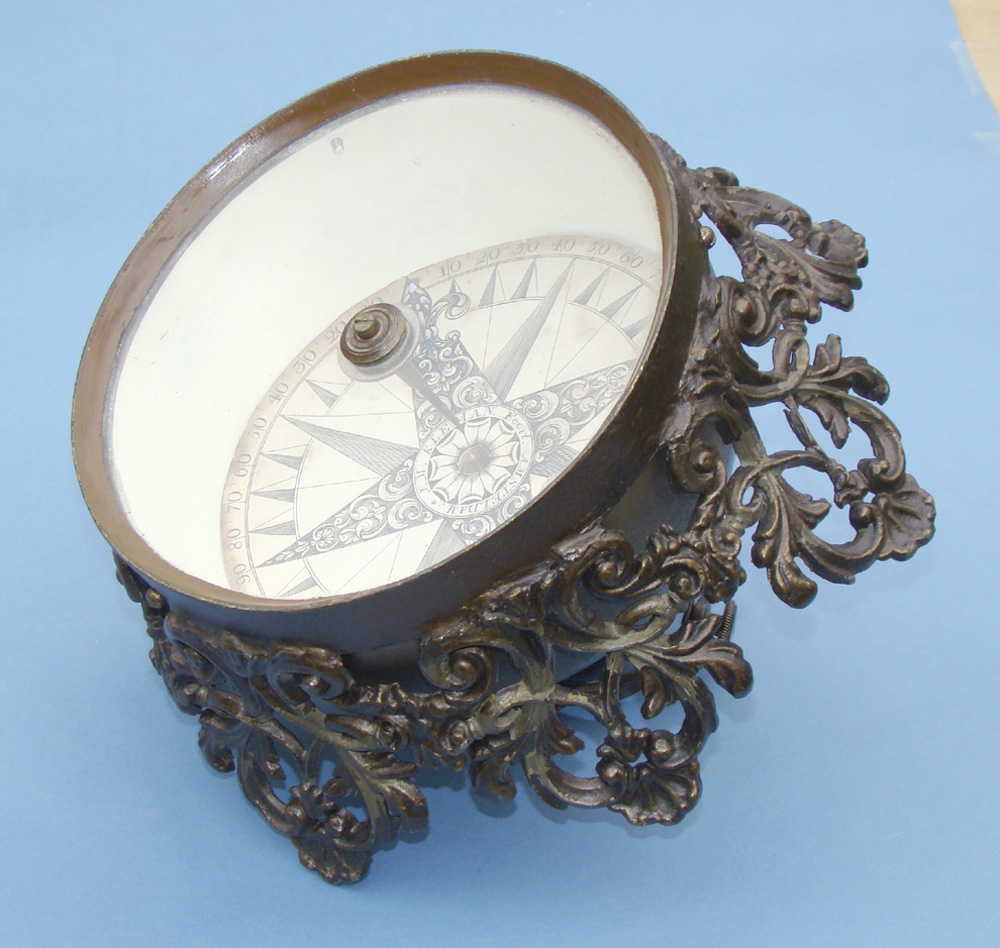
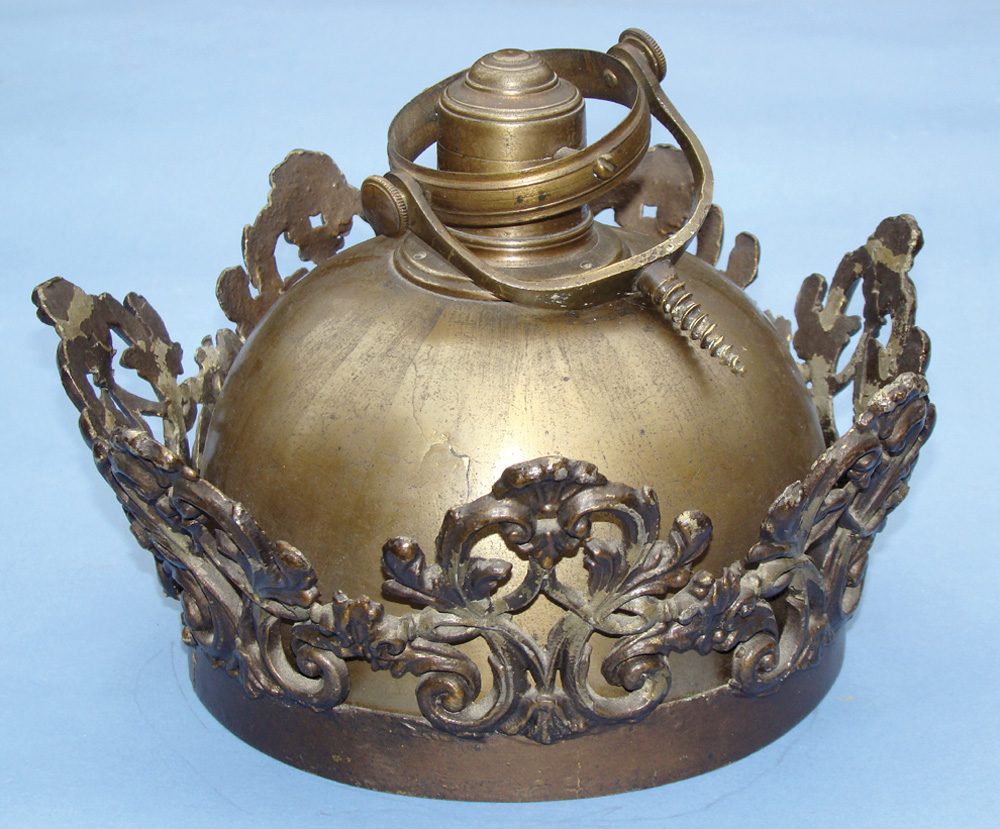
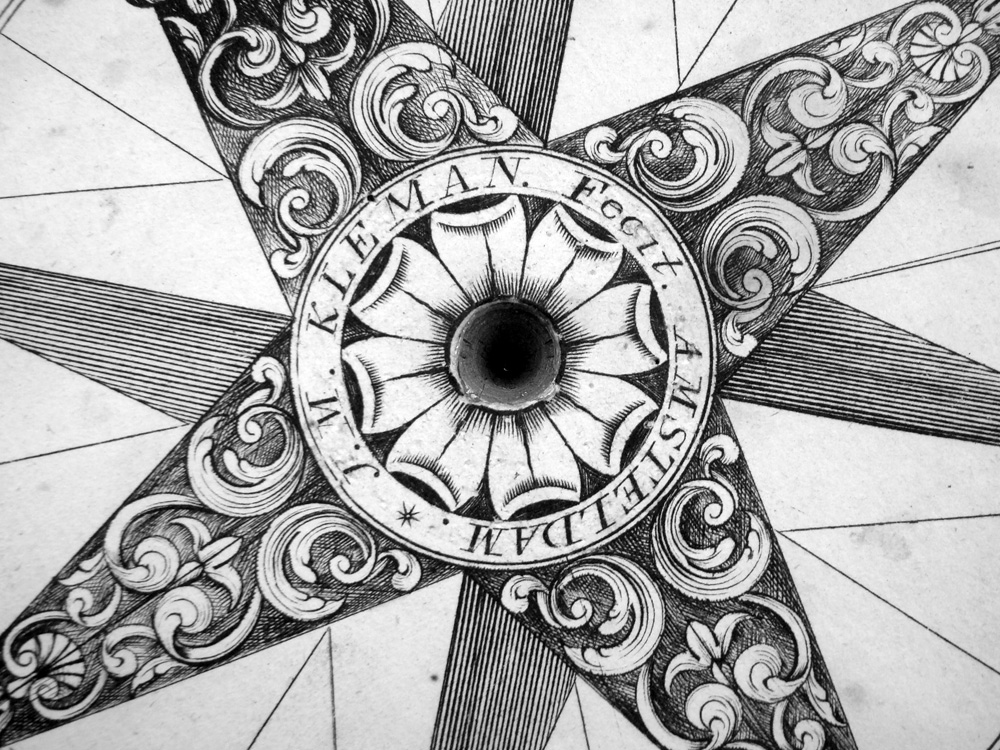
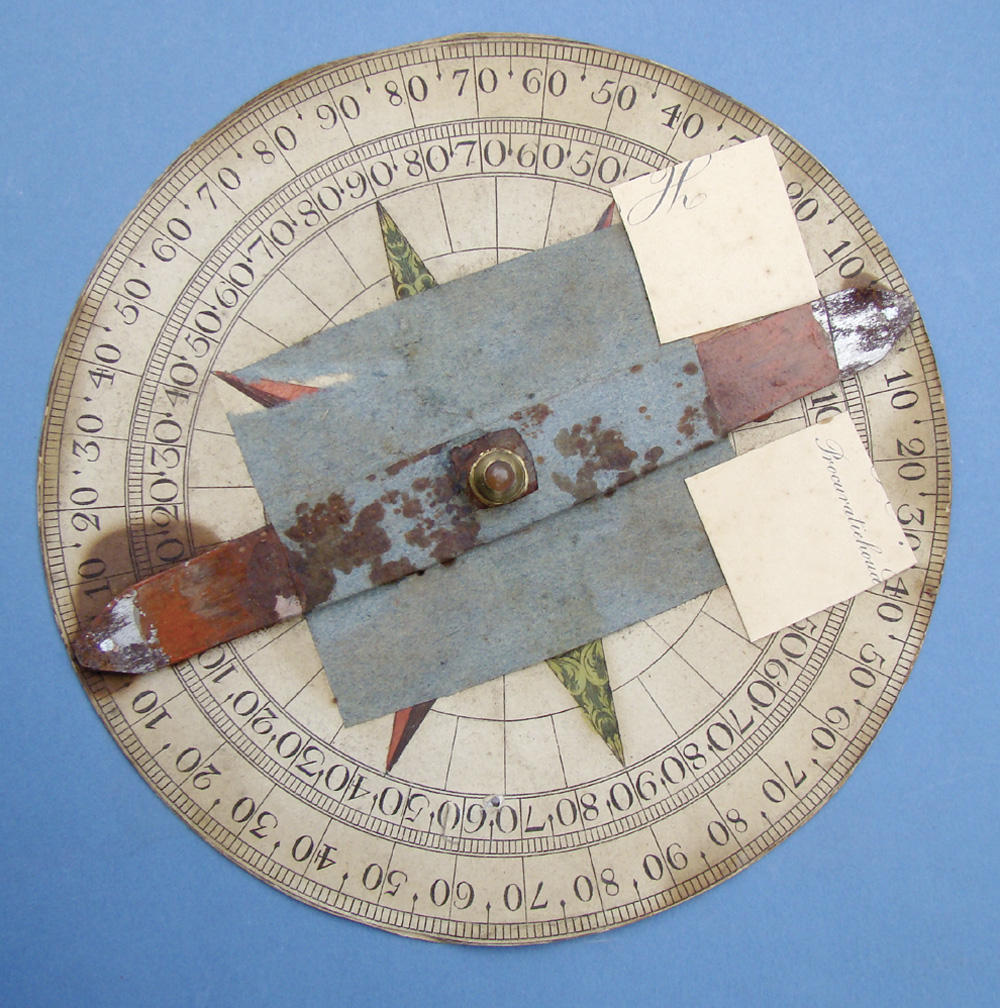
A CROWN OF A CAPTAIN¹S COMPASS -- A DUTCH TELL-TALE UPSIDE-DOWN COMPASS, c. 1790, signed on the printed card "J.M. Kleman Fecit, Amsteldam." The 6-5/8" (17 cm) diameter glazed compass bowl would be suspended upside down over the Captain's bunk. The pivot is set in the glass, and the approximately hemispherical brass bowl is set with a crown-like floral (bronzed-metal?) casting, and with a gimbaled suspension mounting and large integral wood screw. The compass dry card is printed with a fine 32-point rose with floral decoration leading to a fleur-de-lys north point. The card is laid over a rigid mica sheet for stability, and backed with an identical but hand colored card. The flat bar needle is attached by pins at the ends, and by glued paper splints. Sections of card glued near one end probably serve to balance the needle. The conical brass hub is set with an agate pivot. Condition is fine throughout noting some old apparent repairs to the rather soft decorative casting. The assembly is rather heavy (perhaps to dampen its motion?) weighing 4.7 pounds in total. The maker, Jan Marten Kleman (1758 - 1845) formed a major instrument making firm in 18th century Amsterdam, earning the title "Royal Instrument Maker." He specialized in nautical instruments (e.g., the rare pleinschaal navigation rule, our Tesseract Catalogue 94 Item 32), but also provided standard measures, etc. The present instrument is unusual for the signature of him alone, presumably not yet into partnership with his son as "J.M. Kleman & Zoon", starting 1809 -- see ter Kuile and Mörzer Bruyns, 1999, Amsterdamse kompasmakers ca 1580 - ca 1850. Also notable is the earlier "Amsteldam" spelling, coming from the city¹s origin at a dike at the mouth of the river Amstel. Other crowned tell-tale compasses exist, coming from Northern European countries. We note Danish and Swedish examples, and Schück (1915) illustrates German ones from Altona, Rensburg, and Berlin. Some are topped with a cross, and some have a lower glass bowl rather than glass plate. Here we have a very rare Dutch example. (9169) $9800. |
| Early Aluminum, for Function and Beauty | Click on any image for a larger view. Scroll to view more items. |
 |
|
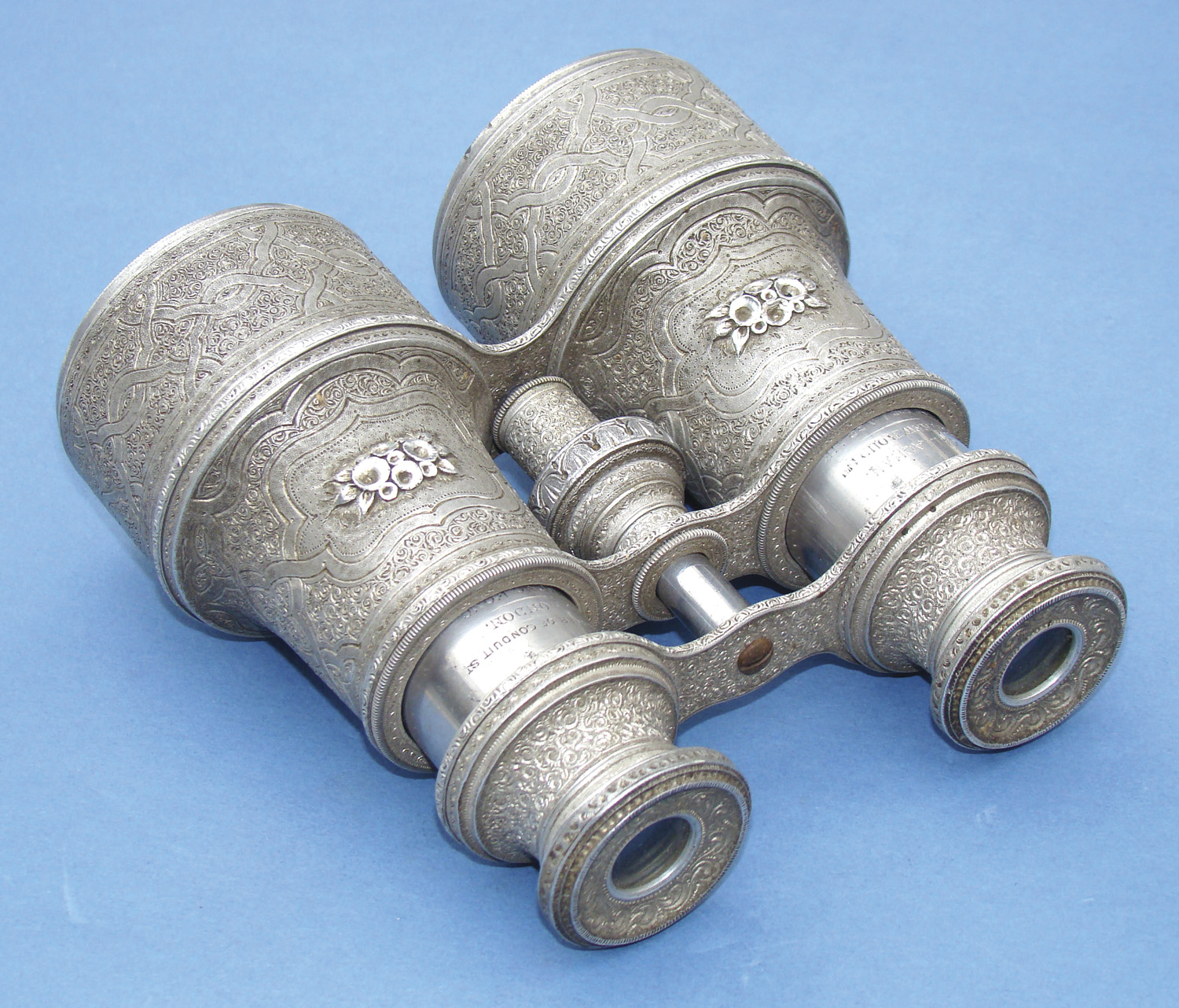
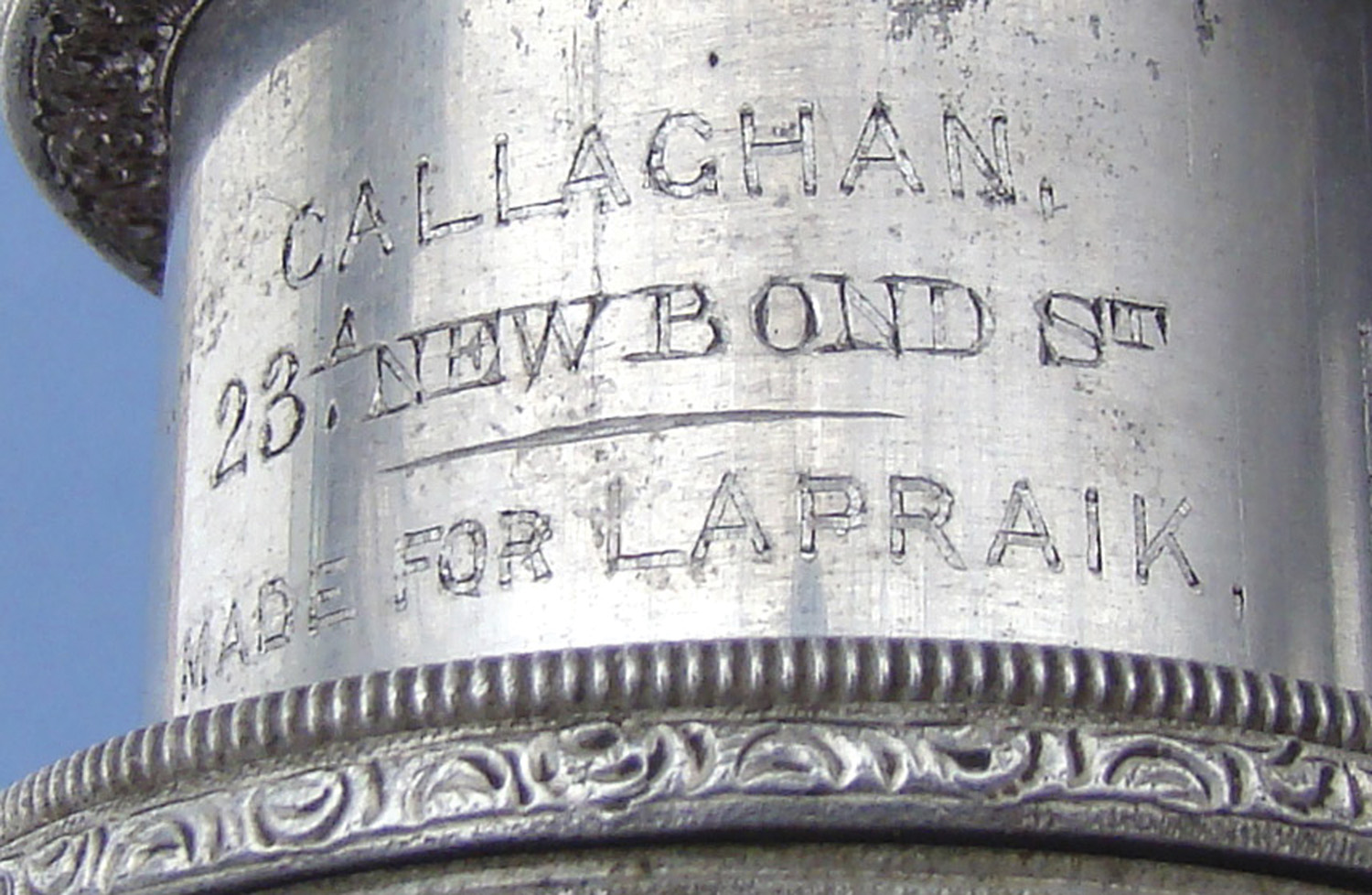
THE ULTIMATE IN DECORATION ON ALUMINUM -- ENGLISH BINOCULARS FOR THE CHINESE MARKET, c. 1870, signed "Callaghan, 23A New Bond St., corner of Conduit St., London; Made for Lapraik, Hongkong." Measuring 4" (10 cm) long (closed), the binoculars extend to 5-1/2" by geared center focus and sliding sunshades. Every square millimeter seems covered with abundant floral and geometric decoration. Condition is very fine and functional, giving excellent images. The maker was the optician William Callaghan (probably the elder, his son of the same name taking over the firm in 1875). In 1866, Callaghan was advertising "The New Derby Race Glass," as well as "Opera, Race, and Field Glasses made by Voigtländer," and further "The New Aluminum Race Glasses, though of the largest size, weigh but a few ounces. Patronized by H.R.H. the Prince of Wales, the Duke of Edinburgh, the Duke of Cambridge, and the elite of the Jockey Club." The inscription explains that this pair was made expressly for the Lapraik firm. Their watch and chronometer business was founded in Hong Kong c. 1845, by the Scotsman Douglas Lapraik (1818 - 1869), and evolved into a group of enterprises including mercantile, steamboat running, banking, dock properties, etc. A successor firm now has 220,000 employees! Metallic aluminum was first isolated in 1825, and was not available in significant quantities until the last decade of the century. Here we have a splendid early example, with the epitome of decorative craftsmanship. (10191) $1200. |
 |
|
| Navigating in the Slave Trade? | Click on any image for a larger view. Scroll to view more items. |
 |
|
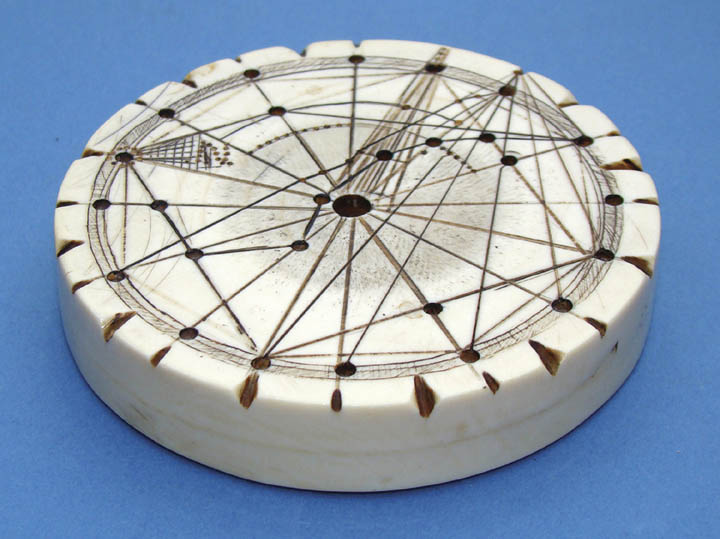
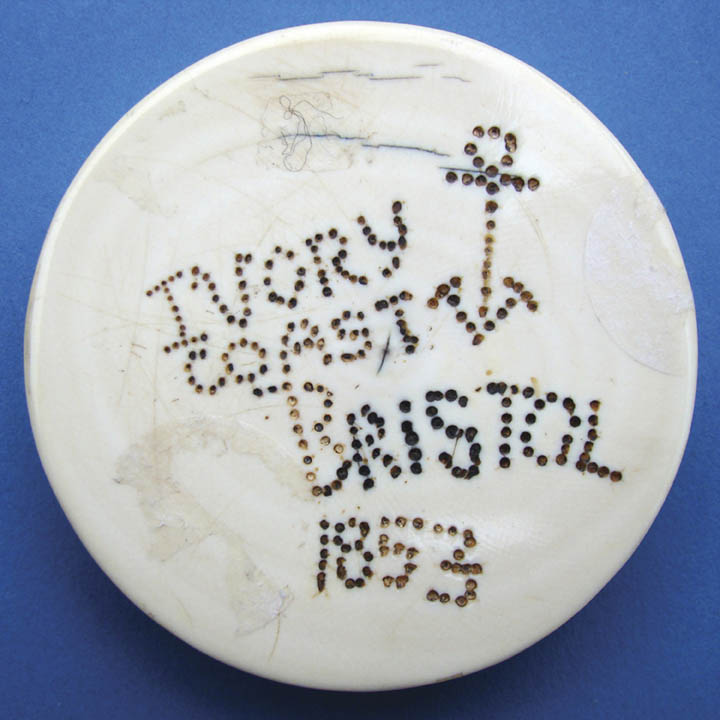
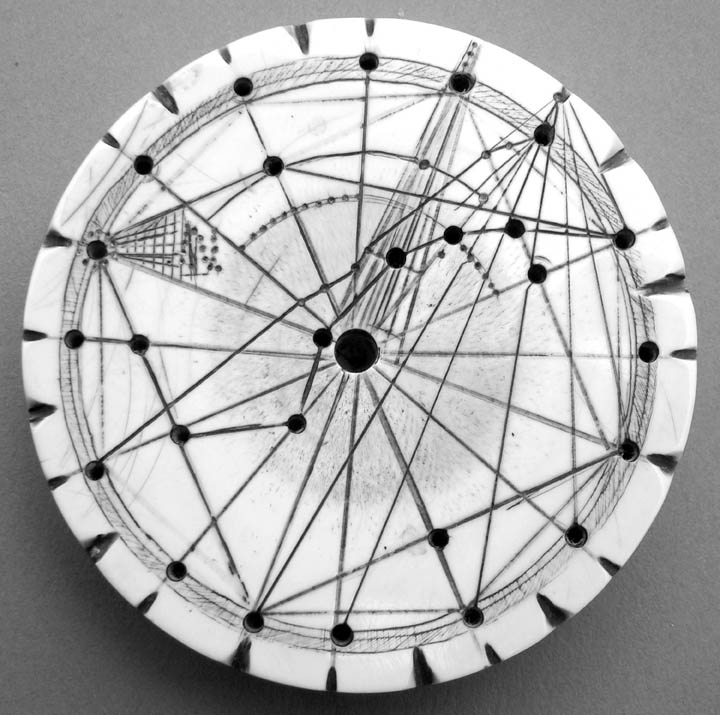
REMARKABLE POCKET DISK -- A TRAVERSE BOARD?, NOCTURNAL?, SAILOR¹S AIDE MEMOIRE?, English, 1853, inscribed "Ivory Coast, Bristol, 1853," and with an anchor design. The substantial hard disk is 3" (75 mm) in diameter and 9/16² (14 mm) thick. The 360° circumference is divided by 24 notches, more-or-less every 15° or every hour of the day. There is an outer circle of 16 holes, presumably for pegs, and thus forming a 16-point compass rose. This circle is somewhat wide and highlighted with scrimshawed hachuring; it is further inscribed with an octagon and a square. Three packets of approximately eight lines radiate from points on the edge and on the circle (two of these seemingly from North and East points), and there are two subdivided circular arcs centered on the large central hole. Finally there are two irregular paths which cross the disk, one being a sequence of drilled holes, possibly for use with marker pegs but notably in the shape of the Big Dipper, and with its two end "pointer" stars aligned with the North point. Condition is excellent. Provenance: Harriet Wynter. This may be a unique sort of pocket traverse board, also unique in being designed for a specific oceanic route. Bristol had the second largest English port, after London, and was a major center for trade in the Atlantic. Bristol-fitted ships became very important for the slave trade, carrying, through the 18th century, an estimated 500,000 Africans from West Africa to the Caribbean and the Americas. This was part of the "triangular trade," the ships bearing manufactured goods (including brass wares, glassware, gun powder) to Africa on the "outward passage," then slaves on the westward "middle passage," finally raw materials (sugar, tobacco, etc.) from the New World back to England on the "return passage." Perhaps the present rather mysterious device records the requisite ship's course for the outward passage from Bristol. Rare and important. (9354) $9500. |
 |
|
| The Complex Calculating Panel of Cmdr. Messum | Click on any image for a larger view. Scroll to view more items. |
 |
|
|
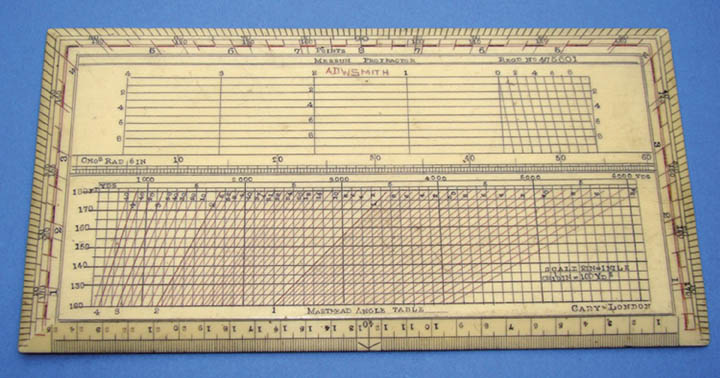
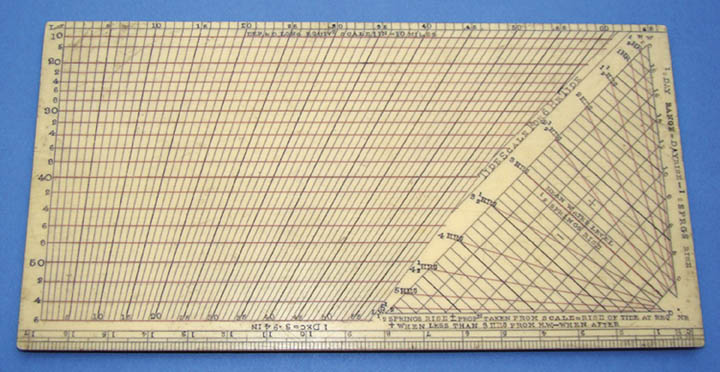
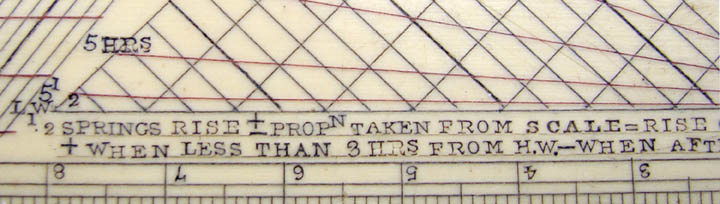
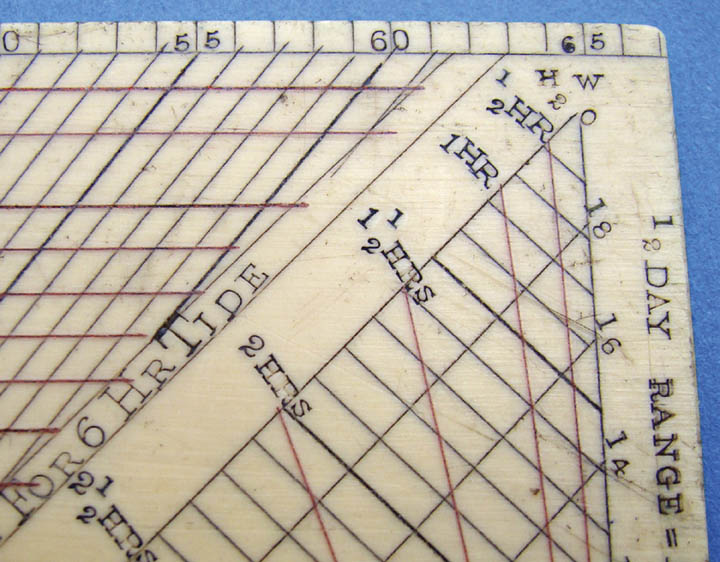
THE MESSUM NAUTICAL PROTRACTOR, English, c.1910, signed "Cary, London, Regd. No. 475601." Made of thermoplastic or heavy celluloid, 7" overall, the protractor is engraved on both sides with numerous scales in black and red. Included are a "Masthead Angle Table" and a "Tide Scale For 6 Hr. Tide." The inventor was apparently Cmdr. Stuart V.S.C. Messum, author of Hydrographic Surveying in 1910. Messum does discuss various scales and designs of protractors, as well as the practicality of surveying by measuring the angular height of the top of a ship's mast above water line. He also devotes many pages to tidal calculations. A rare mathematical instrument, with complex calibrations, in fine condition. (9394) $495. |
 |
|
| Magnetizing Compass Needles, Anywhere Anytime | Click on any image for a larger view. Scroll to view more items. |
 |
 |
|
|
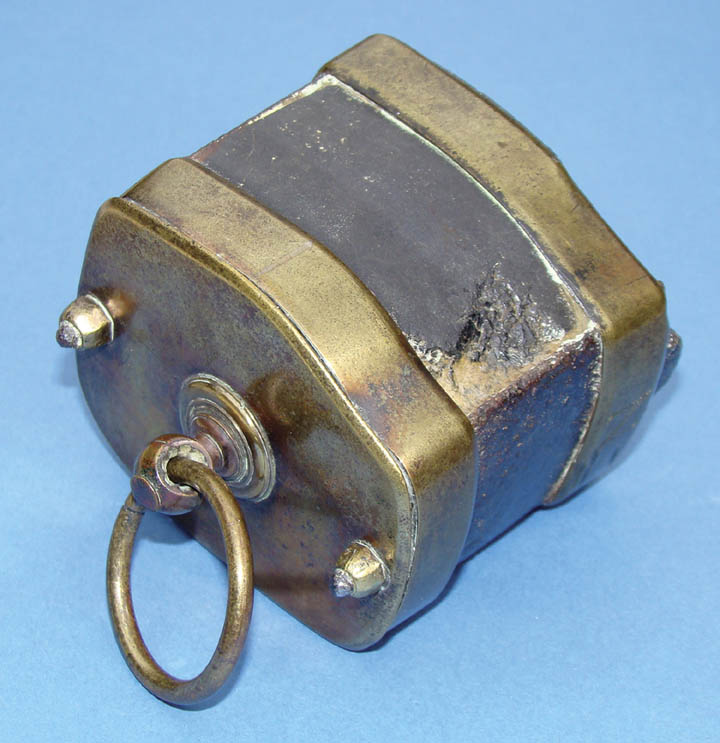
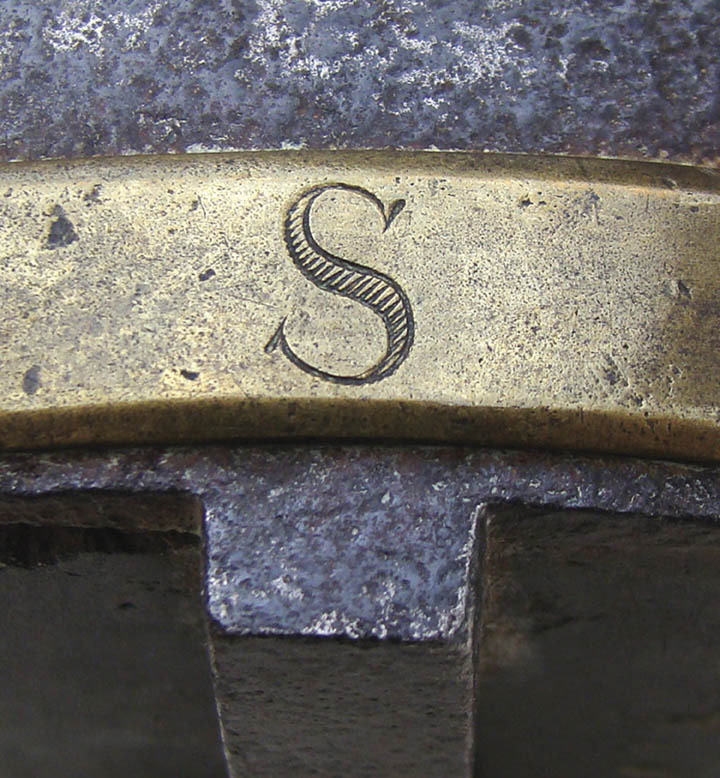
FINELY BOUND IRREGULAR LODESTONE, engraved "N" and "S" at the two poles. Measuring 2-1/4" x 2-3/4" x 2" (6 x 7 x 5 cm) overall, the brass is beautifully shaped to accommodate the natural form of the stone. It features large iron plates to concentrate the force, and a swiveling brass suspension ring. Constructed with a type of naturally magnetic magnetite stone, it dates 17th / 18th century, in very fine condition, retaining noticeable magnetism. Such mounting and assembly was often done in Western Europe, the stone itself coming from Eastern Europe or Russia. The lodestone was of course essential for the early navigator, to apply and then restore as necessary the magnetism of his compass needle, without which he would be literally lost. (9014) $6500. |
| For Distance Ranging of Tall Ships, etc. | Click on any image for a larger view. Scroll to view more items. |
 |
|
|
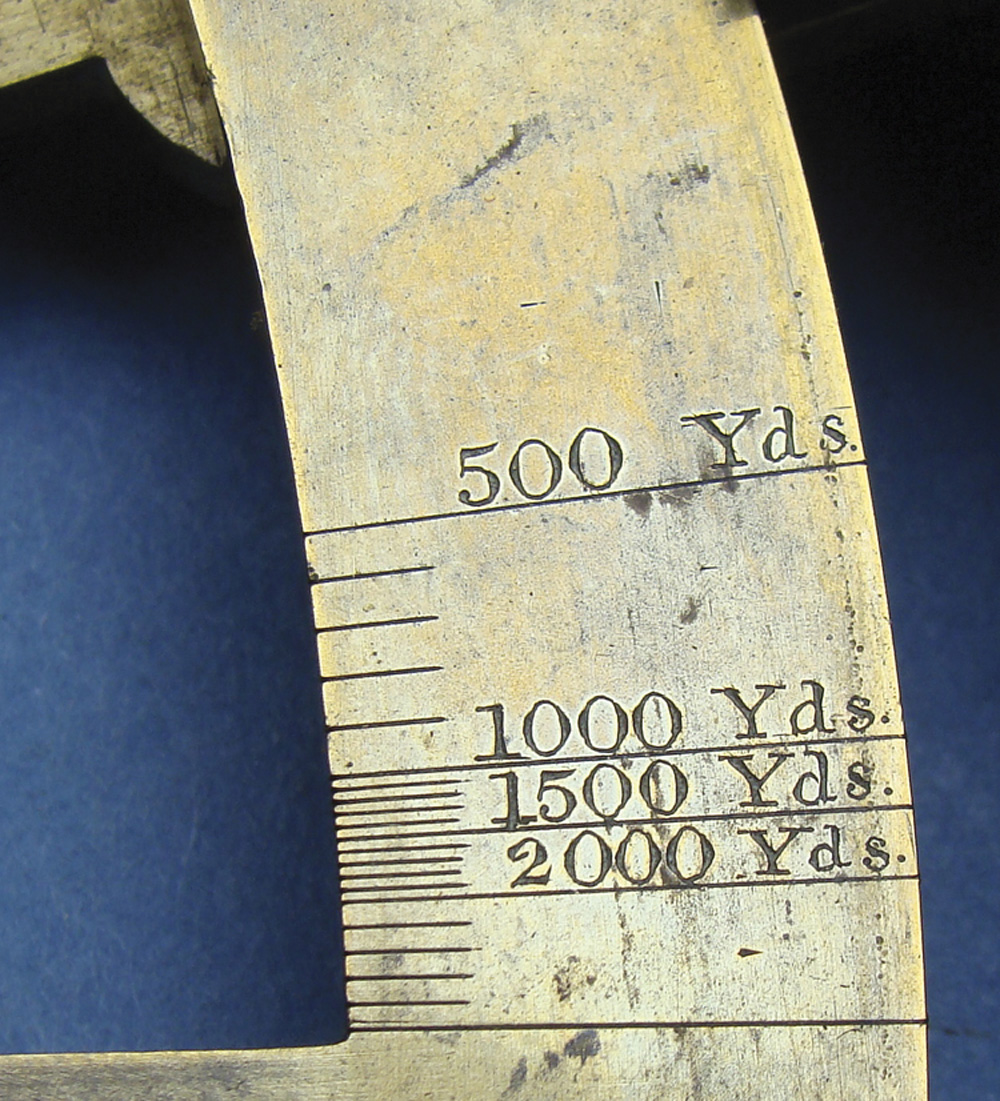
SIGHTING QUADRANT, English, c. early 19th century. This all-brass instrument stands 6-1/4" (16 cm) tall, with cross-hair equipped sighting tube moving in altitude over the 0(1)90 degree quadrant, and swinging freely in azimuth on the short pillar mount. Sighting horizontally the scale reads 0°; vertically, 90°. Thus we have a straightforward astronomical quadrant measuring angular altitudes of celestial bodies as well as topographic features, buildings, etc. But a small scale, with index pointer, on the reverse tells a further story, and speaks of probable maritime use. Covering altitudes of less than 8°, this scale is divided from 500 yards to 2000 yards and beyond. The 500 yard mark corresponds to about 7.°25, which is the angular height of an object about 190 feet tall, at that distance. Few things on land have such a typical height but it is a reasonable estimate for the mast heights of the tallest sailing ships. For example, we find in 1830 the 1300 ton merchant ship had a main mast of 179 feet. Contained in a somewhat stained simple pine box, this unusual instrument is in very fine condition. (10192) $1350. |
| Foot-long 18th-century Rule in Mixed-Materials | Click on any image for a larger view. Scroll to view more items. |
 |
|
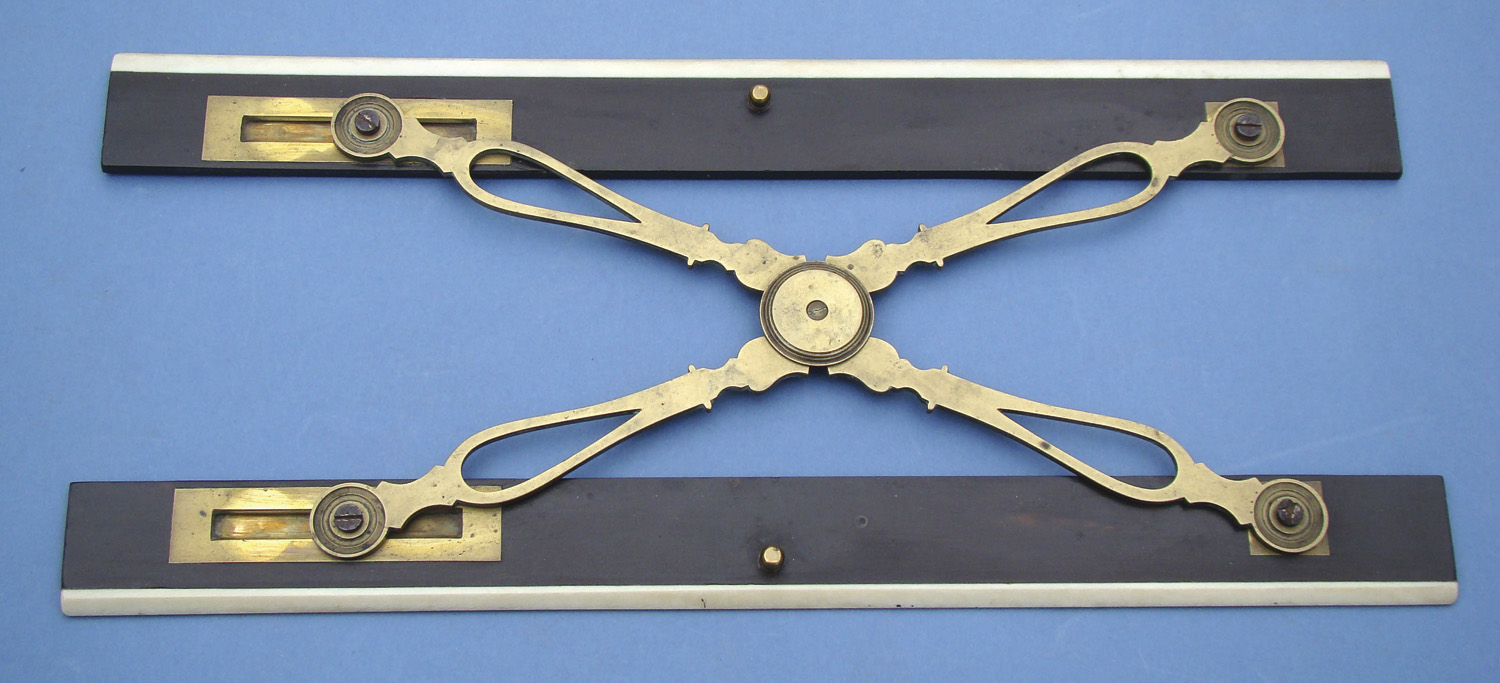
LARGE ELEGANT SCISSOR-HINGE PARALLEL RULE, English, 18th century. This lovely mixed-material rule is constructed of a dense tropical wood, finely shaped and pierced brass linkage, and ivory edge rails, one beveled down and one elevated. It is a full 12" (30 cm) long, and expands to 6-1/2" (16.5 cm) high using the two brass knobs. There is no right or left shift thanks to the scissor linkage with two ends riding in slots. Condition is fine noting light wear. The size is remarkable for this form, most 18th century scissor rules being approximately 6" long. We have had one other large one by Thomas Wright, c. 1735 (Tesseract Catalogue 87 item 28), plus an all-brass one by Jeremiah Watkins c. 1800 (Tesseract Catalogue 96 item 16). (10211) $2950. |
| For pre-correction of Compass Error | Click on any image for a larger view. Scroll to view more items. |
 |
|
|
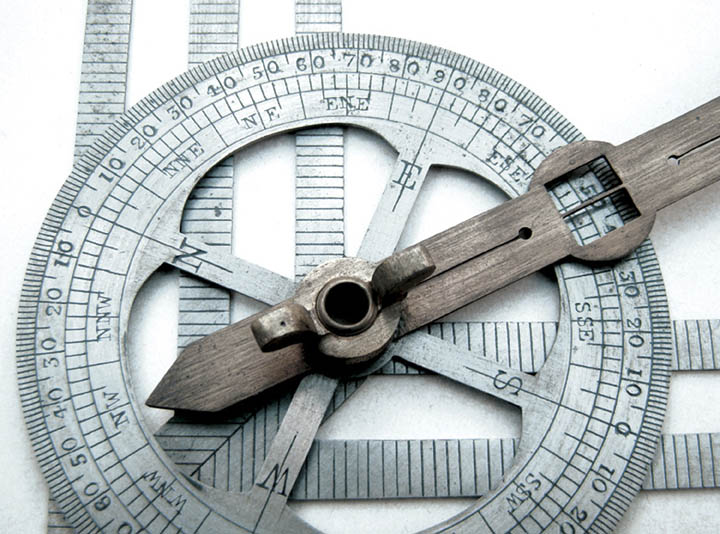
JENKIN'S "PATENT MAGNETIC COMPASS BEARING PROTRACTOR AND COMPASS COURSE FINDER," English, late 19th century, unsigned. Made of plated brass with an 11-1/2" (29 cm) long clampable brass index arm, this multipurpose navigational charting instrument has a divided square and calibrated clampable circle with compass headings and degree scale. We have seen an original instructional sheet and testimonials, indicating that the principal advantage of this instrument to the navigator is the ability to apply the compass error (variation and deviation combined) to "any Bearings he may wish to take before they are actually taken, and this entirely does away with the chance of applying the Error the wrong way, a not uncommon mistake." A most uncommon instrument, very fine, with the original mahogany box. (9384) $650. |
| American Manufacture for American Navigation! | Click on any image for a larger view. Scroll to view more items. |
 |
 |
|
|
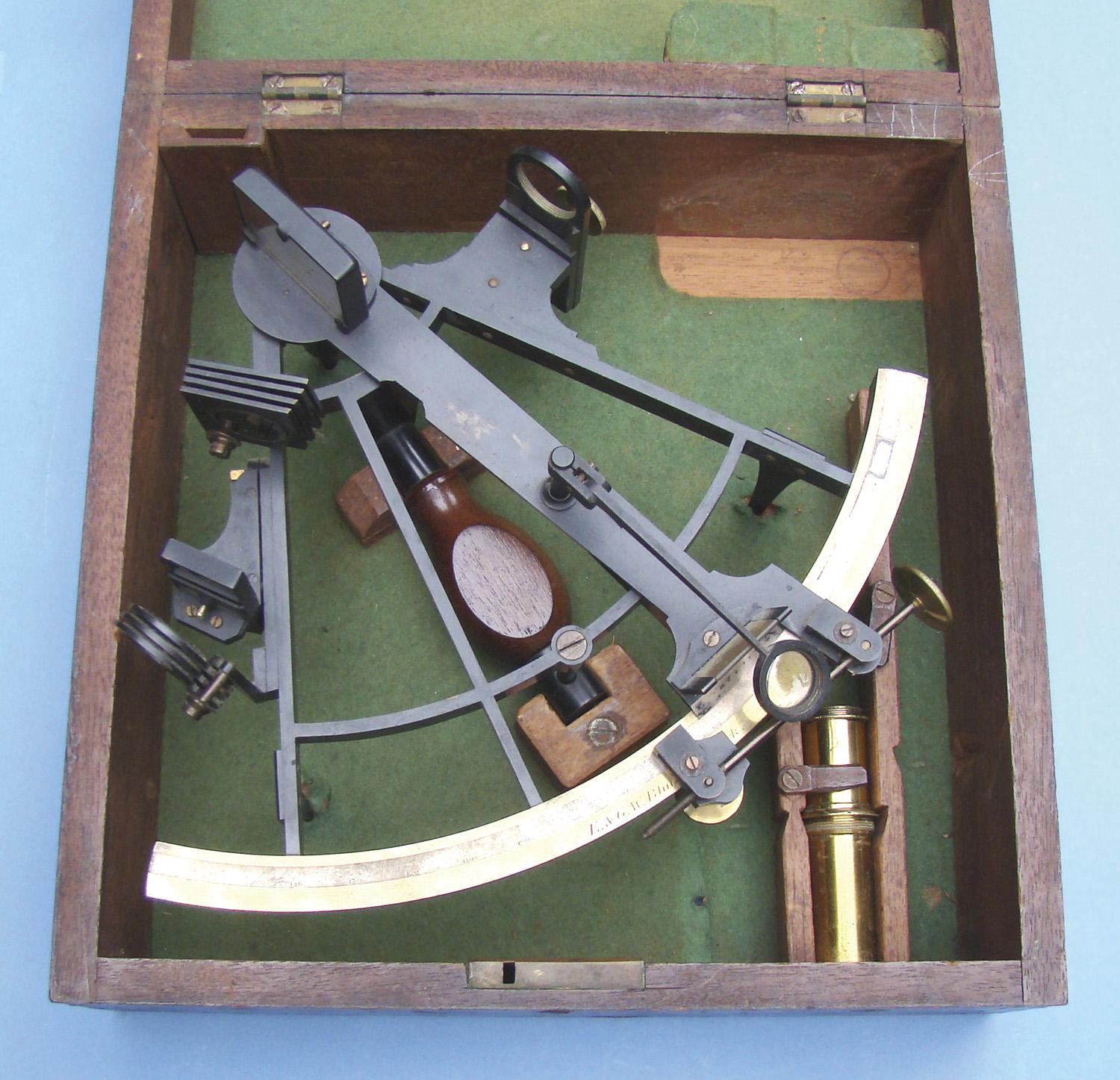
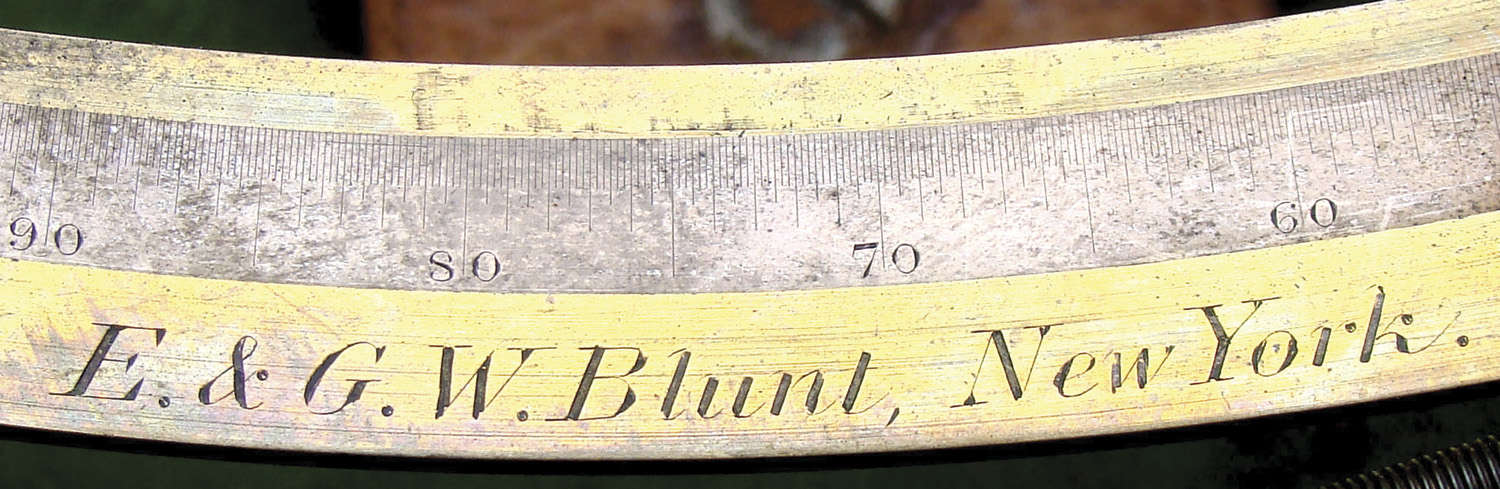
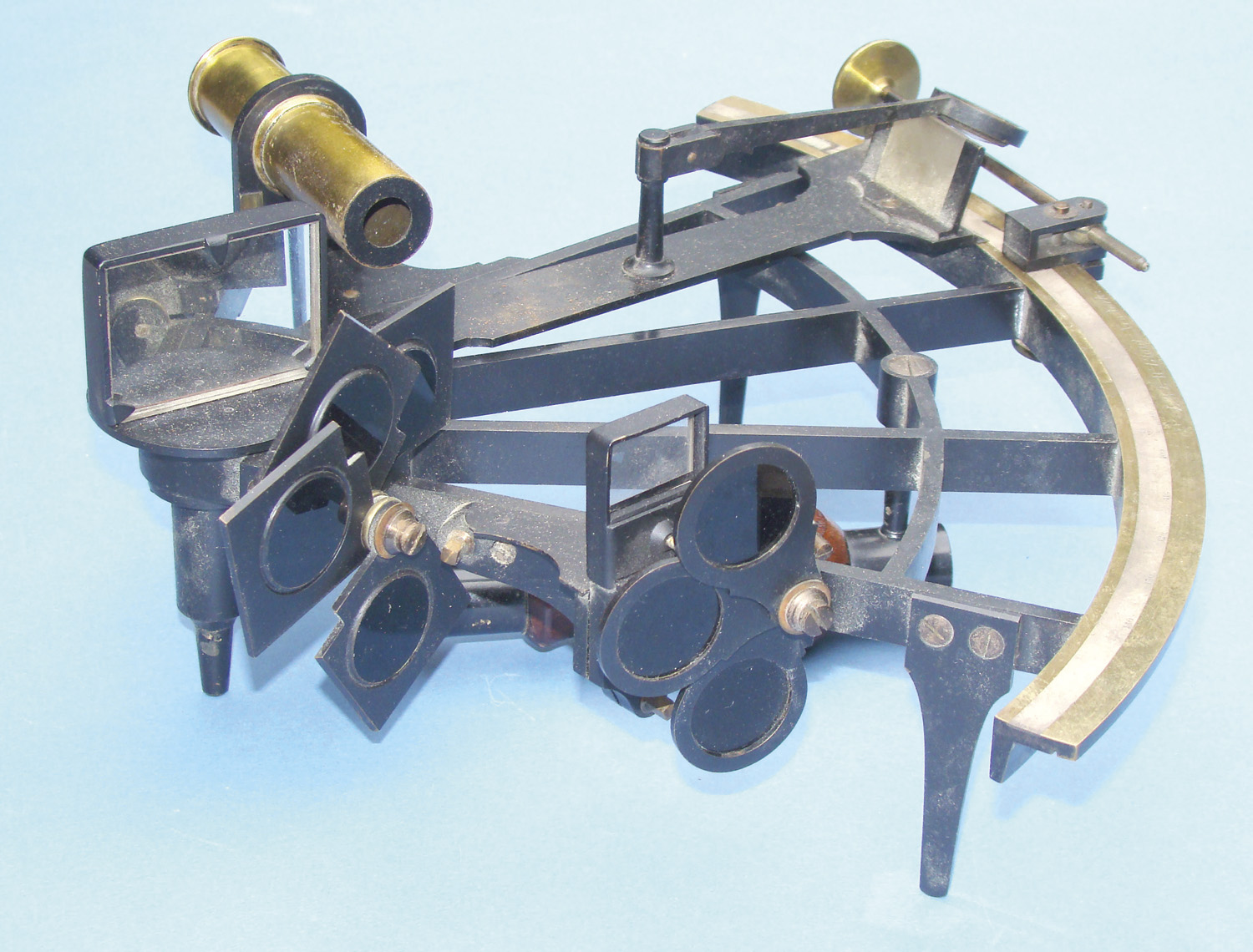
GOOD AMERICAN SEXTANT OUTFIT, c, 1850, signed on the arc "E. & G.W. Blunt, New York." With its sturdy 1/2" thick lattice frame, the sextant measures 11" (28 cm) across at its widest point, and has a 9-1/4" (23 cm) long index arm. Constructed of blackened brass, it is fitted with shaped mahogany handle, three shaped brass legs, two mirrors, seven swing-away filters, index arm clamp and long tangent screw, scale diffuser, swing-away scale magnifier, and adjustable telescope mount. The inlaid silver scale is divided every 10 arcminutes, with silver vernier reading to ten arcseconds(!) The outfit includes lacquered brass sighting tube and square mahogany carrying case, but no other accessories. Condition is very fine. Edmund and George Blunt were in partnership in New York 1824 - 1866, as foremost American suppliers of navigation instruments, designing their own dividing engine, publishing a nautical almanac, etc. They advertised that "American ships may be navigated by American made instruments," in particular with their own sextants and quadrants. Two other Blunt brass sextants are recorded in Warner's inventory (Rittenhouse 3, 86-112), both in museum collections. She found a total of only 12 surviving American brass sextants, all makers included! (10201) $2500. |
| 17th century Charting with Style | Click on any image for a larger view. Scroll to view more items. |
 |

|
|
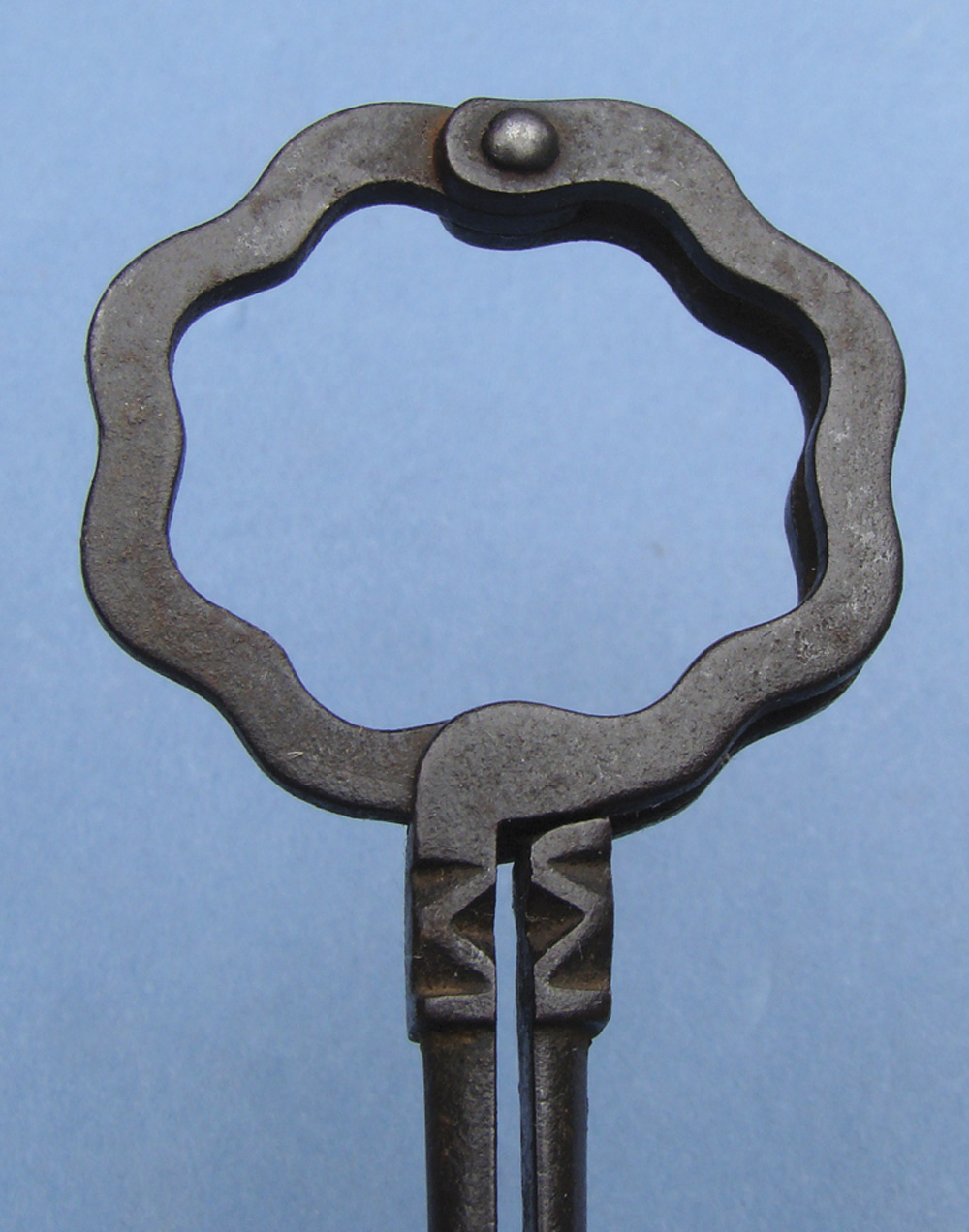
FINELY SHAPED SINGLE-HANDED CHART DIVIDERS, European, c. 17th century. Made of two pieces of iron, hand wrought and filed, decoratively cut and riveted together, these early navigator's dividers measure 7-1/2" (19 cm) overall. They are most attractive, with thin legs topped by zig-zag cut decoration, and extraordinary waviform head. Condition is fine noting overall light oxidation. A very special early example. (10202) $950. |
| For Locating and Maintaining Ship Position, c.1865 | Click on any image for a larger view. Scroll to view more items. |
 |
 |
|
|
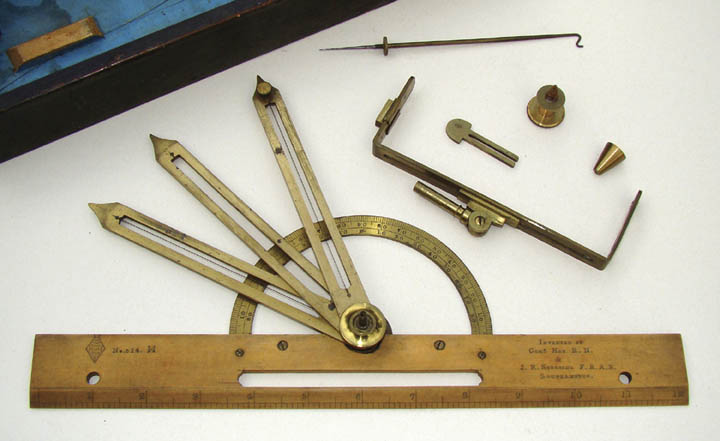
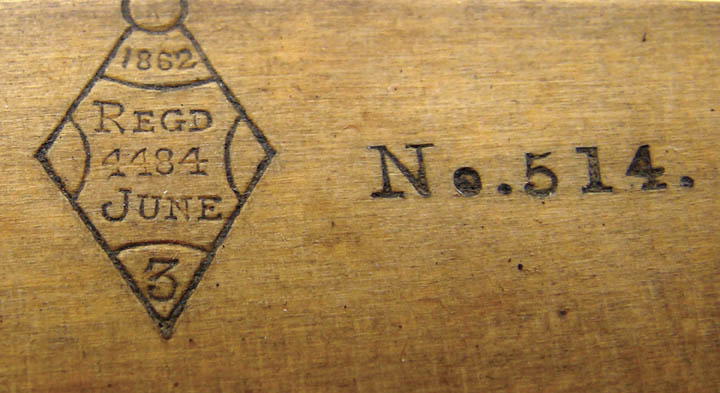
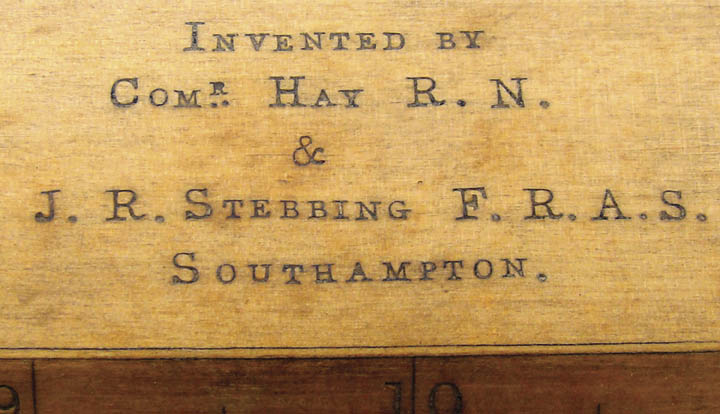
THE HAY / STEBBING DIRECT SIGHTING STATION POINTER OUTFIT, English, c.1865, signed "Invented by Com'r. Hay R.N. & J.R. Stebbing F.R.A.S. Southampton, No. 514" and with an 1862 registration mark. This multipurpose instrument is constructed of brass and boxwood, 12-1/2" (32 cm) overall. An adjustable sight vane is mounted above three pointer arms, on a semicircular protractor and 12" rule. Accessories include a centerpoint / plumb support interchangeable with the sight vane, a hold-down screw, and a curious brass cone and brass bar. It is an unusual navigation outfit in fine condition in the original wood case. One of the inventors was presumably Joseph Rankin Stebbing, optician and instrument maker of 47 High St., and mayor of Southampton in 1867. (9084) $1950. |
| Upside-Down Compass from 1763 | Click on any image for a larger view. Scroll to view more items. |
 |
 |
|
|
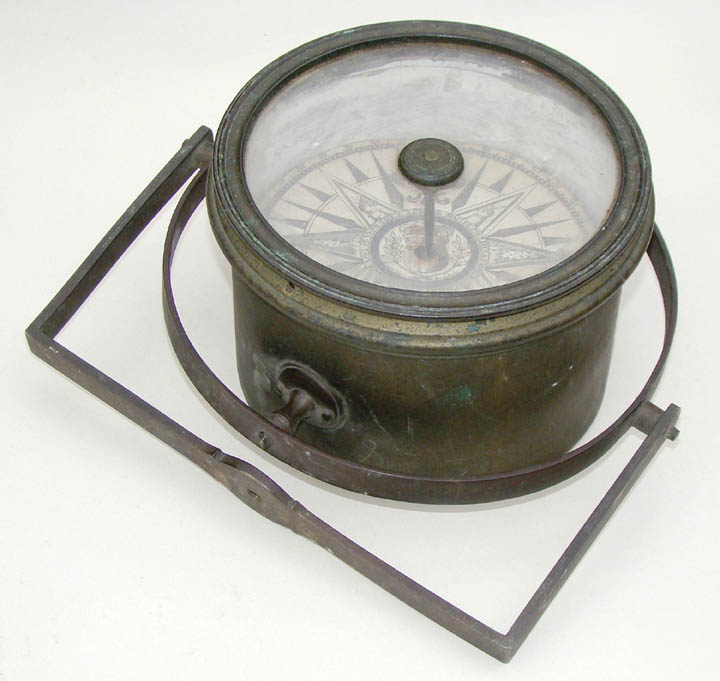
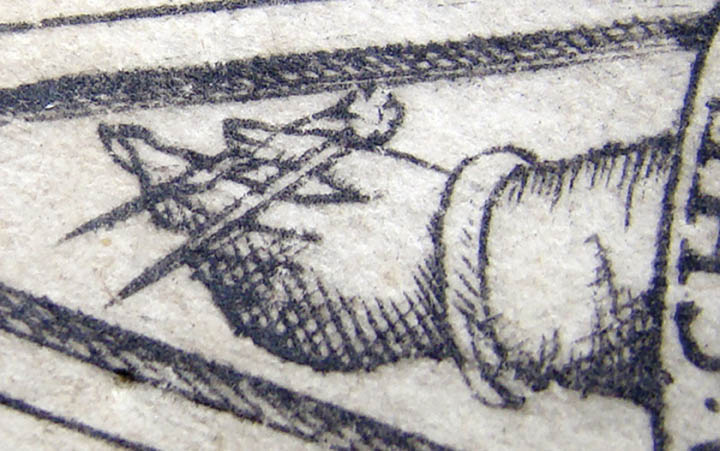
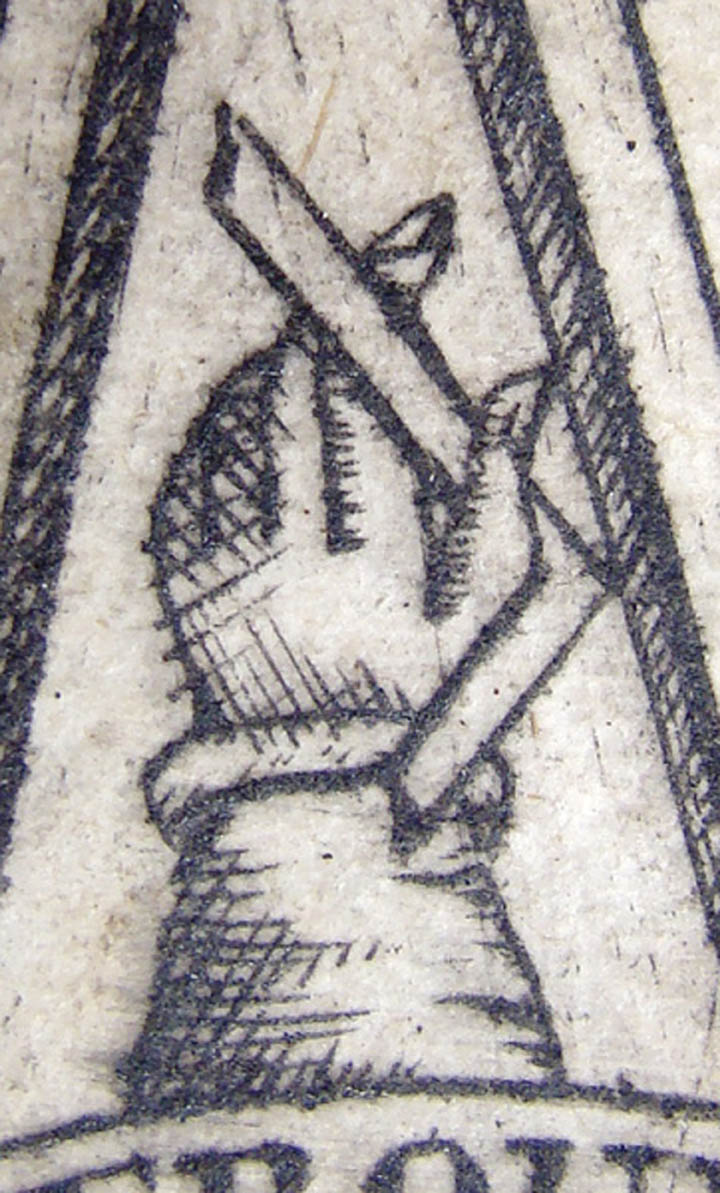
EIGHTEENTH CENTURY TELL-TALE COMPASS, French, c. 1763, signed on the marvelous floating compass card "Se vend chez J. Perre Maître Poulieur & Faiseur de Compas à Dunkerque 1763" ("For sale by J. Perre, Master Pulley-Maker and Compass-Maker in Dunkirk, 1763") and "Gravé par Brochery." The 5" (12.5 cm ) diameter printed card is pinned to a bar-shaped needle, and held secure with red sealing wax. Additional wax was applied to the rear to level the card. There is printed a circumferential degree scale, plus a 32-point rose with a sort of floral cross to the East, and large fleur-de-lys North. Principal directionals depict three faces blowing the E, W, and S winds, separated by four charming vignettes of hands holding chart dividers, square, rule, and writing instruments. A brass pivot cap is centered on a heraldic device topped by a crown which is designed like that of the French King, surmounted by one fleur-de-lys and showing five others around the sides. The card floats within a 6" (15 cm) diameter cylindrical brass bowl with white-painted interior and glazed lid with long pivot stem. The bowl hangs in gimbals with shaped support arm, and is designed to be mounted upside-down where it can be read by the skipper while in his bed or at the chart table. Condition is fine, the brass uniformly dark with age, the card with light stains. This is a good example of ³tell-tale² compass, used below deck to assure the correct route was followed. The compass card is very special, being dated, doubly signed, and bearing these fine vignettes. Marcelin records J. Perre's name on a tell-tale compass rose in the Maritime Museum in Dunkirk. (9044) $3800. |
 |

|
| Charting Angles without Mathematics | Click on any image for a larger view. Scroll to view more items. |
 |
 |
|
|
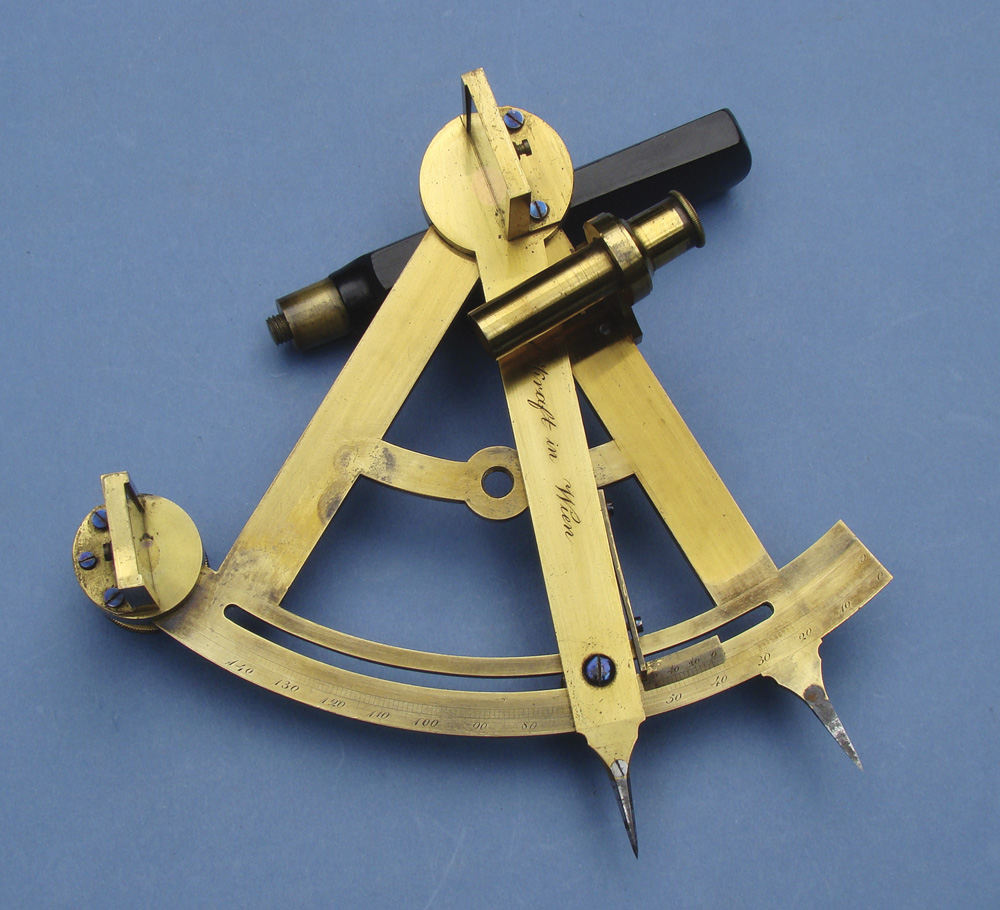
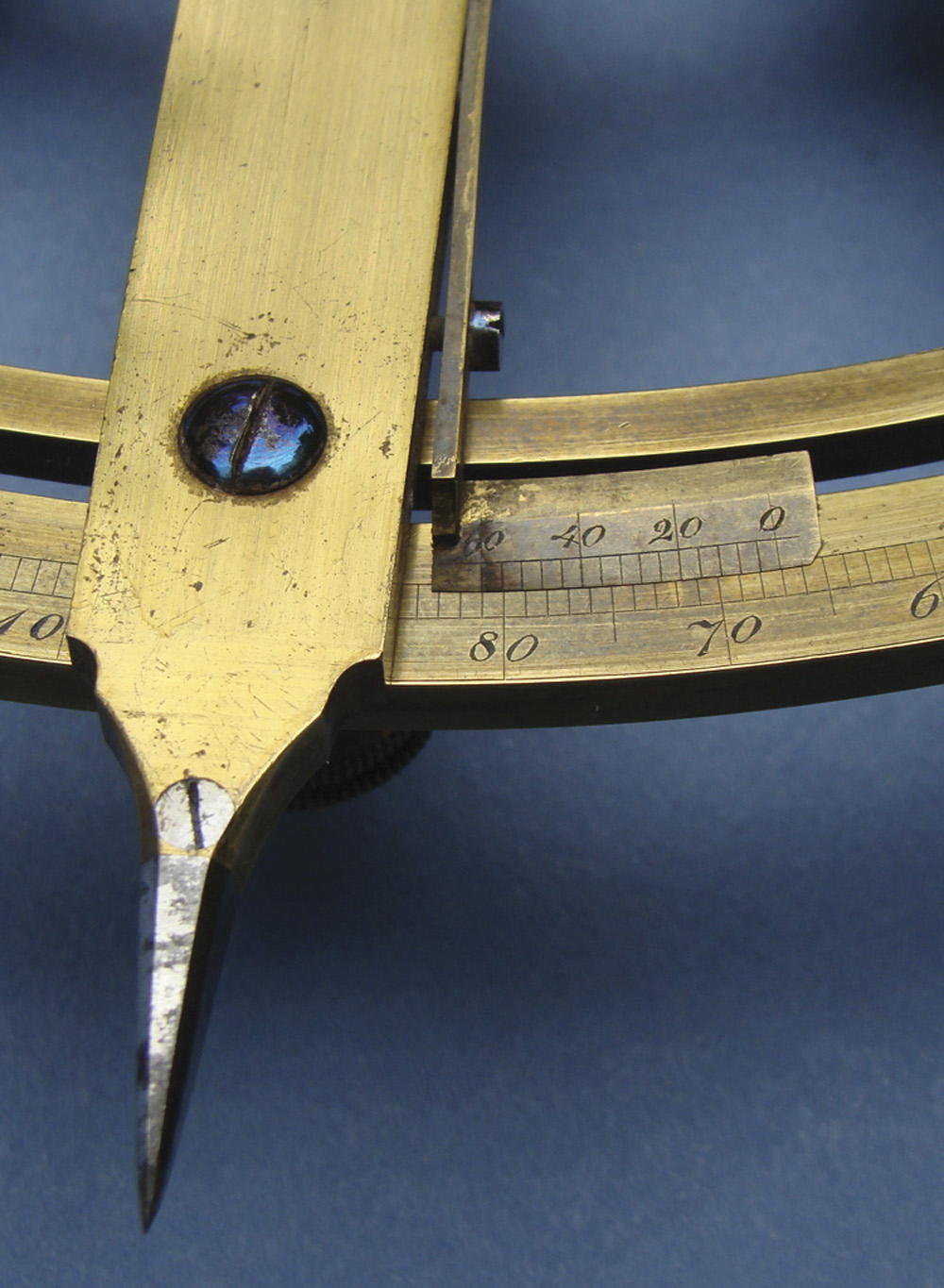
EXCEPTIONAL DIRECT-PLOTTING SEXTANT, Austrian, c.1840, signed "C.E. Kraft in Wien." This lovely sextant measures 5-3/4" tall and 6" (15 cm) wide overall, of clear lacquered brass with blued steel screws and shaped wood handle. It is fitted with clampable index arm and mirror, half-silvered horizon mirror rotatable by thumbscrew below, and sighting tube. The angular scale is divided directly on the brass, every degree from 0 to 140 (but useable only to 122° making this a true sextant); readout is against a spring-loaded screw-adjustable vernier on the index arm, divided every four arcminutes. This fine little sextant has an added direct-plotting feature, with a fixed shaped steel tip on the body corresponding to the 0° position, and a similar tip on the index arm. Condition is excellent, near new throughout. With this instrument any angular separation can be immediately plotted as a distance on chart paper. The conversion is in fact quite simple; at 45° the points are exactly 5 cm apart, and at 90°, 10 cm. We have seen a few other sextants with this feature, noting a similar one by Kraft but with a different vernier geometry (Bennett, 1987, The Divided Circle, Fig. 99), one by Lenoir of Paris, and one by Brander and Höschel (Kern, 2010, vol. 3, item 143). The quality of workmanship and finish is like that of Pister and Martins in Berlin (see Tesseract Catalogue 94 Item 25). Carol Eduard Kraft established his instrument workshop in Vienna in 1823, and is listed in directories through mid-century. He followed in the fine traditions of craftsmanship of Voigtländer and of Starke. (10222) $3500. |
| "Mariner's" Quadrant | Click on any image for a larger view. Scroll to view more items. |
 |
|
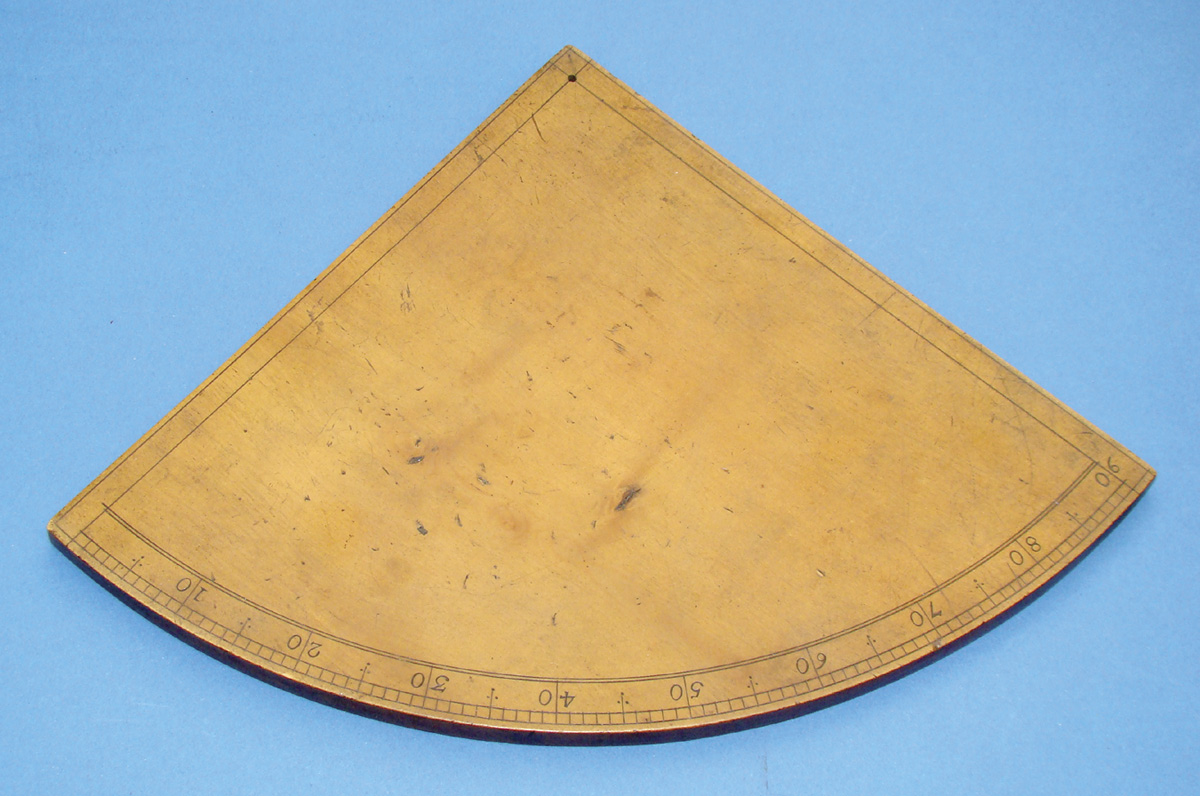
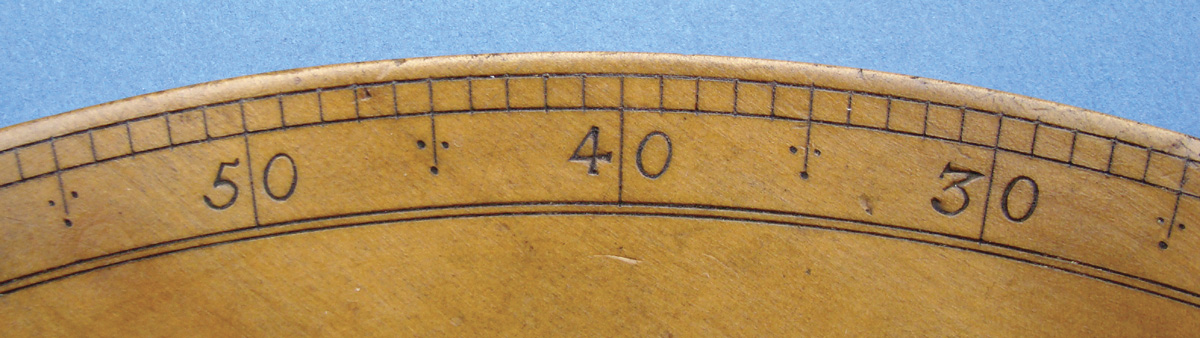
THE PLAIN QUADRANT, English, mid-18th century, made of finely-grained boxwood in the form of a quarter circle, 6" (15 cm) in radius and 9/32" (7mm) thick. The borders are ruled, and the arc is divided every degree from 0 to 90, with calibrations every 10° and intermediate 5° positions marked with triple-dot patterns. The quarter circle's center is pierced with a hole for supporting a string and plumb bob (not present). Condition is very fine throughout. Sometimes referred to as a "mariner's" or "plain" quadrant, this form is useful for simple measurement of solar or stellar altitudes. The angular altitude of the pole star, or the midday sun, leads directly to one's latitude. The plain quadrant also can serve for simple inclination measurements, e.g., in construction, surveying, gunnery, etc. (9176) $1950. |
 |
| Rare Dutch Navigation Rule, by the Klemans | Click on any image for a larger view. Scroll to view more items. |
 |
|
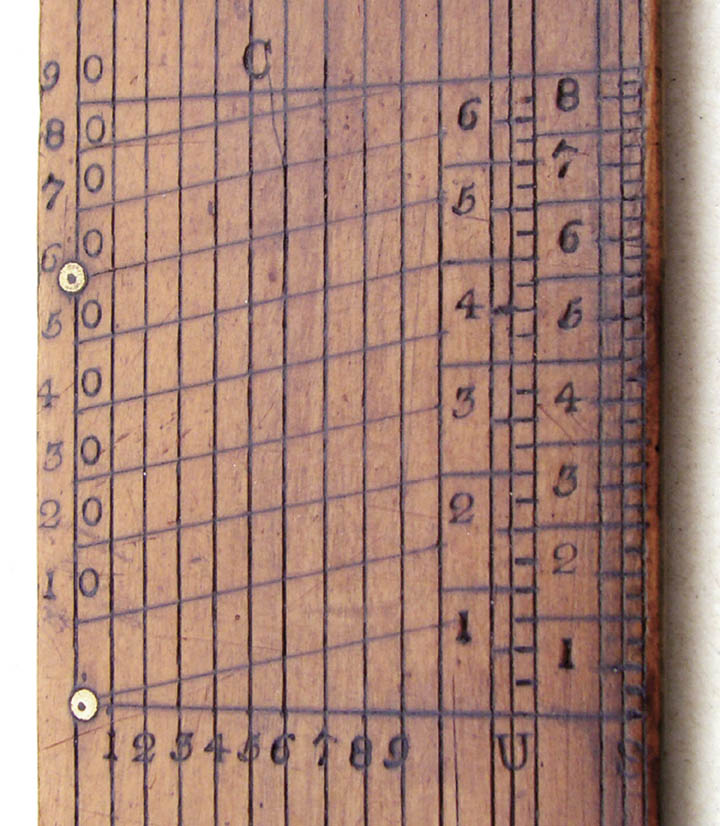
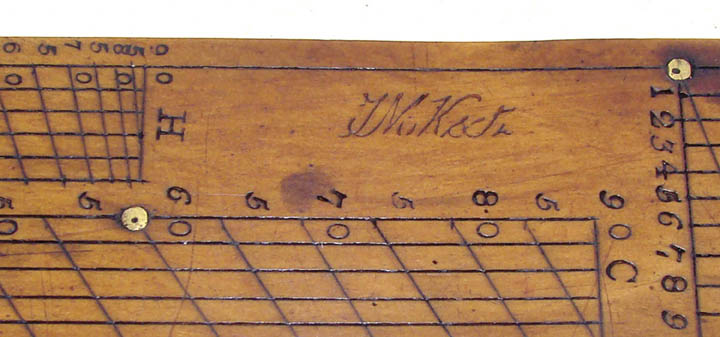
DUTCH PLEINSCHAAL NAVIGATION RULE, first half 19th century, signed "JMK & Zn" (for J.M. Kleman and Son), made of fine boxwood 13-1/2" (34 cm) long. The rule is hand divided and punched with numerous scales, and has six little inset brass studs for use with dividers. One side has a straightforward linear scale of equal parts, running from 0 to 9 in units of approximately 2.2 cm, and with single and double transversal interpolation grids at each end. The other side has three groupings (for three chart scales) of gridded nonlinear scales of Sines and Chords ("H" and "C" in Dutch). Each grid is cut by transversals, and runs 0°-90° vertically, and 0°-10° horizontally. Thus one can pick off immediately with dividers the Sine (or Chord) value for any integral number of degrees. Alongside each grid are vertical axes of hours ("U," running 0-6 and based on 24 hours as 360°) and of compass points or rhumbs ("S," running 0-8 based on a 32-point compass rose). Condition is fine with minor nicks and stains, and a beautiful warm patina. This is a form of the Plain-Scale or Plane-Scale, important for navigation and required equipment on Dutch East India Company ships. Its existence, design and use has been clarified recently by Otto Van Poelje (see Journal of the Oughtred Society, 2004), who finds only a handful have survived. In a 2011 paper Van Poelje treats, in detail, a rule sensibly identical to the present example, and by the same maker, the well-known instrument making firm of J.M. Kleman and Son, active under this name from 1809 - 1859. (9324) $3950. |
 |
|
| Miniature Navigation Outfit, with its Own Horizon | Click on any image for a larger view. Scroll to view more items. |
 |
 |
|
|
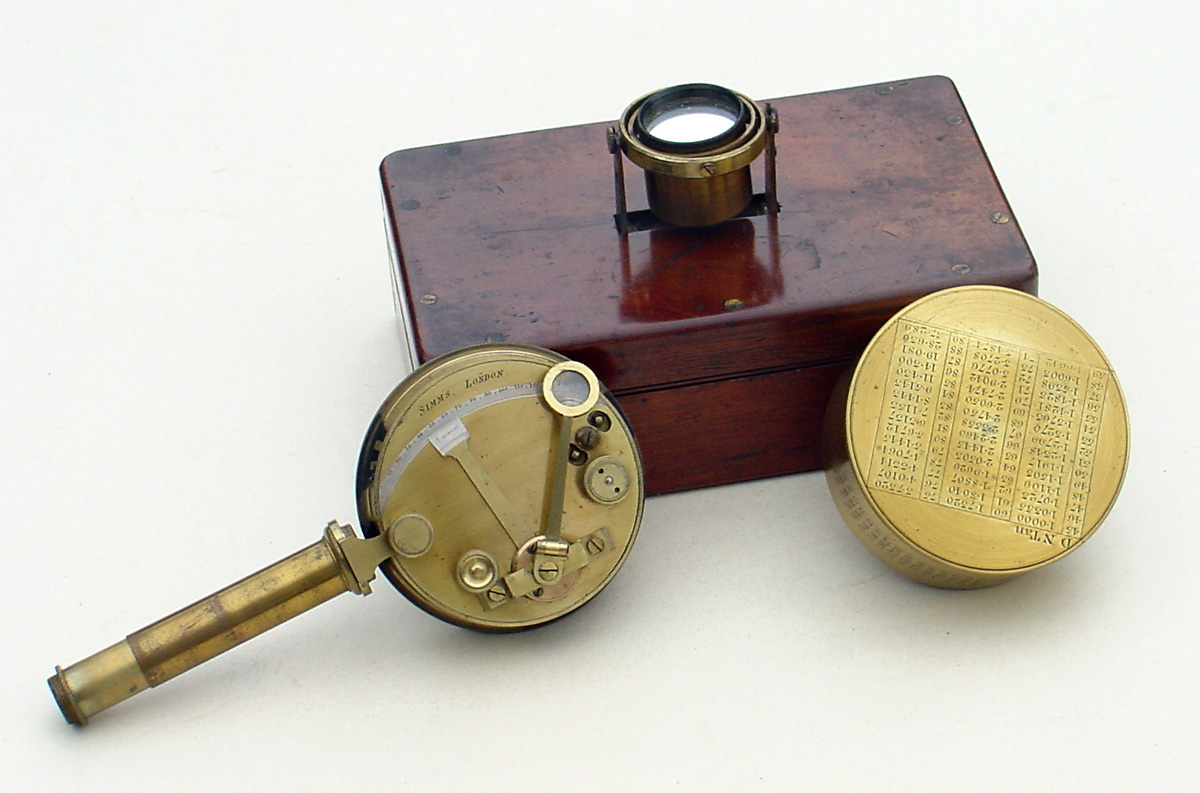
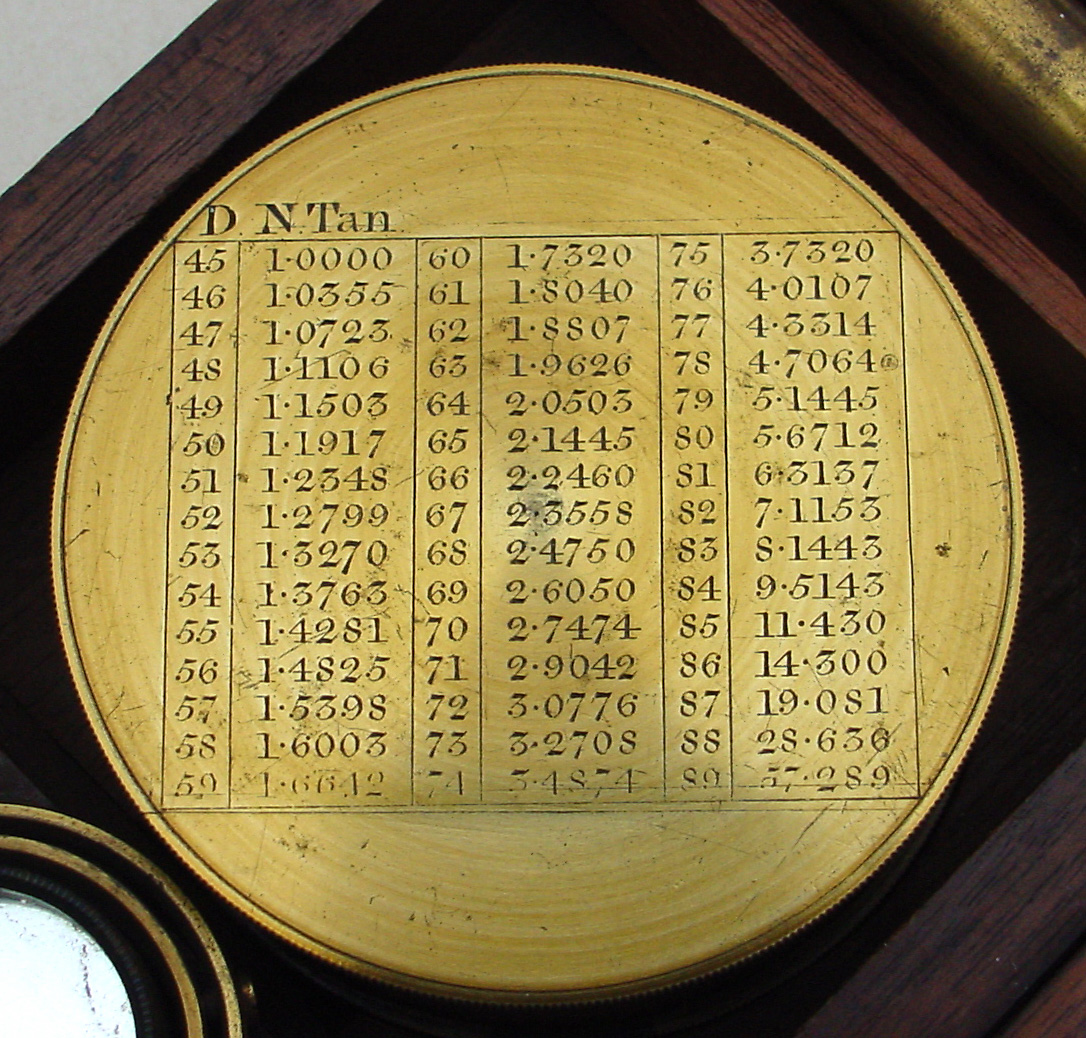
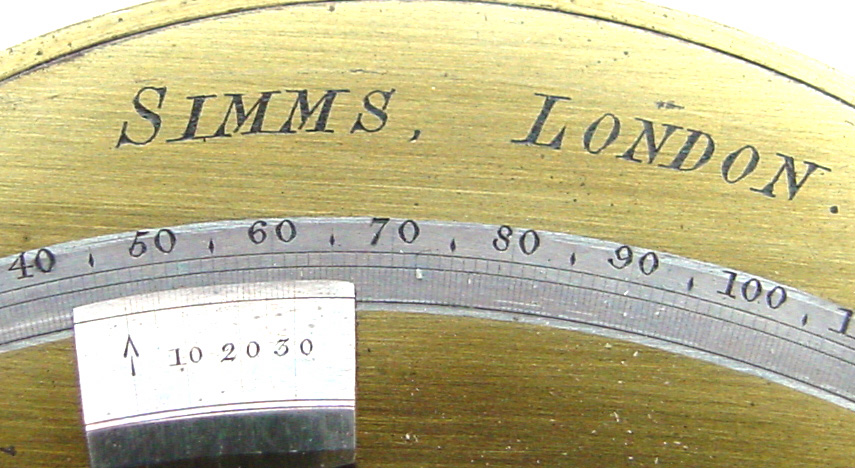
BOX SEXTANT OUTFIT WITH GIMBALLED ARTIFICIAL HORIZON MIRROR, English, c.1820, signed "Simms, London." The 2-3/4" (7 cm) diameter brass sextant is complete with inlaid silver scale and one-arcminute vernier, scale magnifier, geared index arm, mirror adjusting tool, peepsight, single draw telescope, two swing-away filters, and screw-on handle/cover. The cover is engraved with tables of tangents and arctangents. The original fitted mahogany case contains a weighted plane mirror in double gimbal rings, which sets up on folding supports in the case top. This is a novel approach to providing a perfectly horizontal reflecting surface; in use one measures the angular distance from a star, the sun, or even a coastal landmark, to its reflection in the mirror. Half this will be the altitude of the object, determined without reference to the horizon itself, which may be obscured by haze, etc. Condition is very fine throughout. This is one of the few known instruments produced by a member of the Simms family of nautical and mathematical instrument makers. Made prior to William (II)¹s partnership with Edward Troughton beginning in 1826, it is the only example of this unusual design we have come across. (8220) $4500. |
 |
|
| A Good Gimballed Sighting Compass, late 18th c. | Click on any image for a larger view. Scroll to view more items. |
 |

|
|
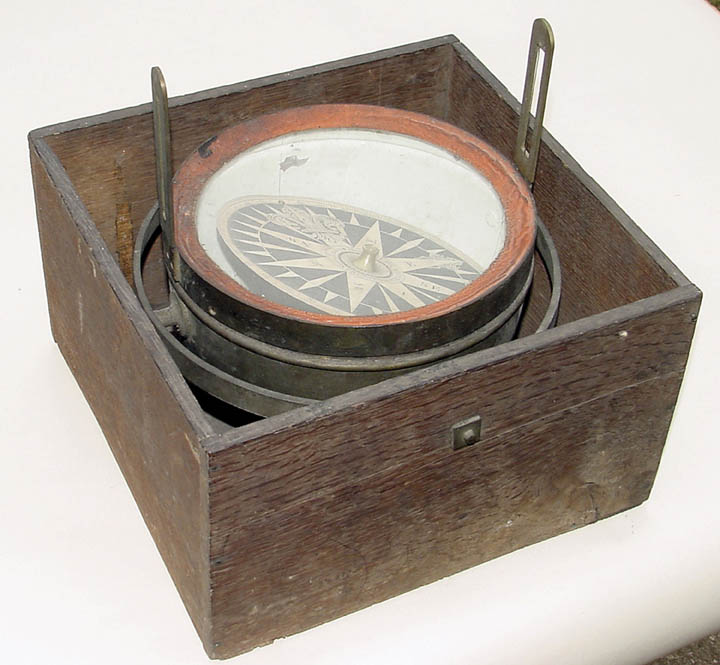
ENGLISH AZIMUTH COMPASS, late 18th century, signed "Bradford" on the elegant fleur-de-lys north point, and "Made by I. Bradford, Wapping Old Stairs, London" around the center of the floating dry card. The large gimbaled compass bowl is made of brass 7-1/4" (18 cm) in diameter, weighted with lead and mounted in its apparently original 10² (25 cm) square wood box. Brass sight vanes, 3-1/2" tall, dovetail into place on opposite sides of the glazed bowl lid. The dry card is printed with a fine 32-point rose with decorative North and East points, and a circumferential degree scale. It is mounted with a long bar needle and brass hub, held together with red sealing wax as usual (some of the wax impressed with the maker¹s fingerprints!). The card is laminated, for stiffness, probably with mica, and with an underneath card which had been printed with an announcement, now partly readable and mysterious.... Condition is fine, the brass now a uniform dark brown. The maker, Isaac Bradford, worked under his own name from 1794 to 1822, the present address apparently his earliest. He was succeeded by Bradford & Co., and then Bradford & Son (see Clifton). A good example of this important navigational instrument. (9134) $2400. |
 |

|
| Large Early Dividers | Click on any image for a larger view. Scroll to view more items. |
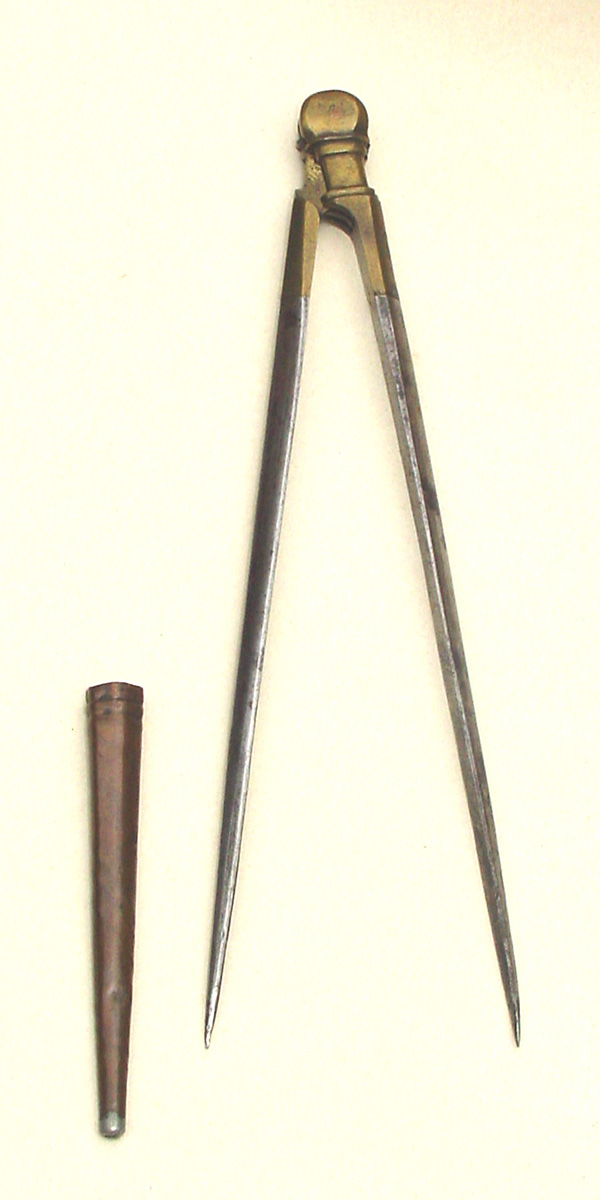 |
EARLY BRASS AND STEEL DIVIDERS, Continental, c. second half 17th century, 9-1/4" (23 cm) overall, rather primitively shaped but with a five-leaf brass hinge. In fine condition complete with an early sheet brass cover for the tips. (8210) $875. |
| Impressive Rule by Jeremiah Watkins | Click on any image for a larger view. Scroll to view more items. |
 |
 |

|
|
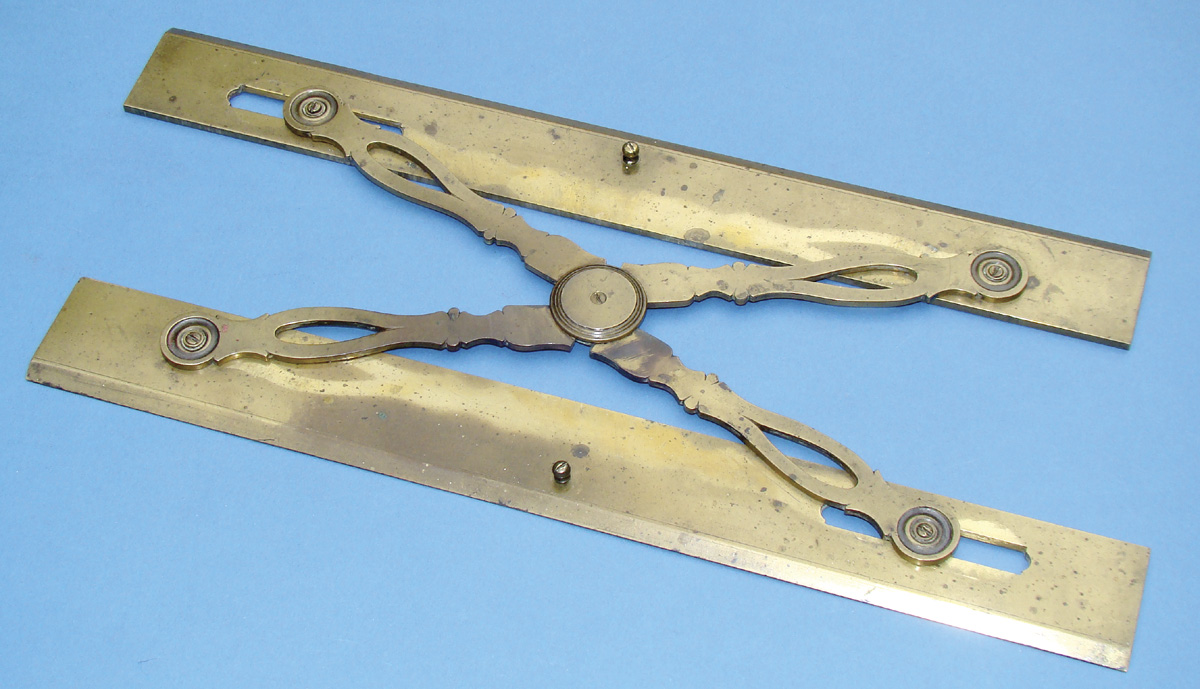
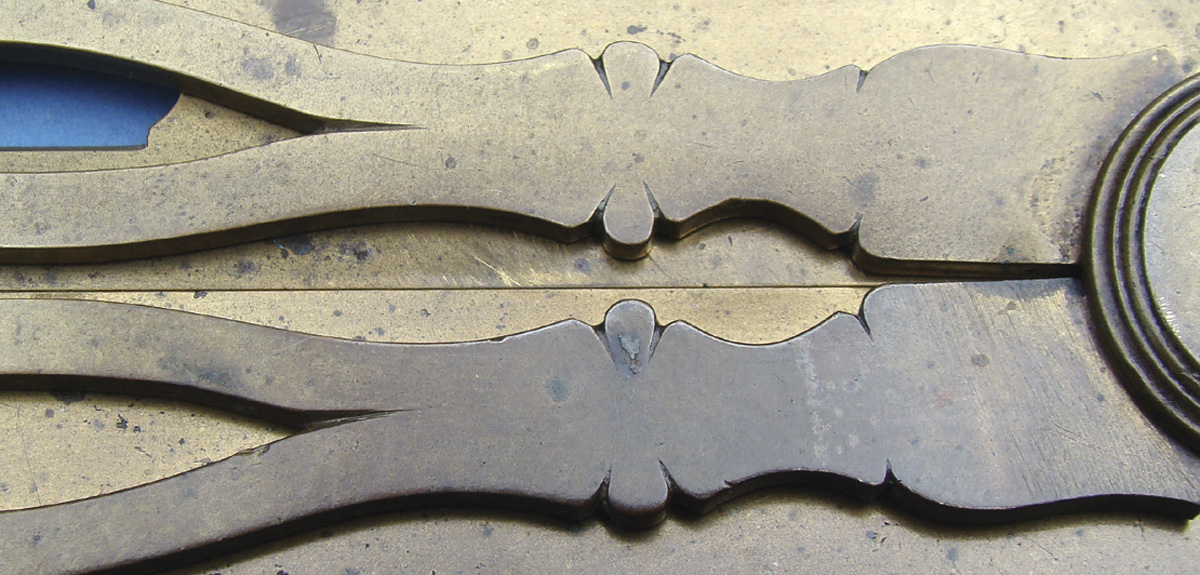
LARGE ELEGANT PARALLEL RULE, English, c. 1800, hand-engraved on the reverse "J. Watkins, Charing Crofs, London." This all brass rule is 12" (30 cm) wide, constructed with a massive scissor hinge elegantly shaped and pierced, designed with opposing slots which provide an offsetting parallel motion as the rule is opened. There are two small knobs for grasping, and both outer edges are beveled for precision in course marking and chart reading. Condition is good noting some stains and darkening, and minor nicks. This is a fine example of an important tool of the early navigator. Jeremiah Watkins was a successor to the well-known Francis Watkins, and is recorded as working under his own name 1798 - 1810. He in turn was followed by Watkins & Hill, who were succeeded in the mid-19th century by Elliott Brothers, and then by English Electric in 1966. Jeremiah was thus an important early link in the two-century history of this succession of quality, innovative instrument manufacturies. (9166) $2400. |
| Cary's "Double" Design, plus History, plus Gold! | Click on any image for a larger view. Scroll to view more items. |
 |
|
|
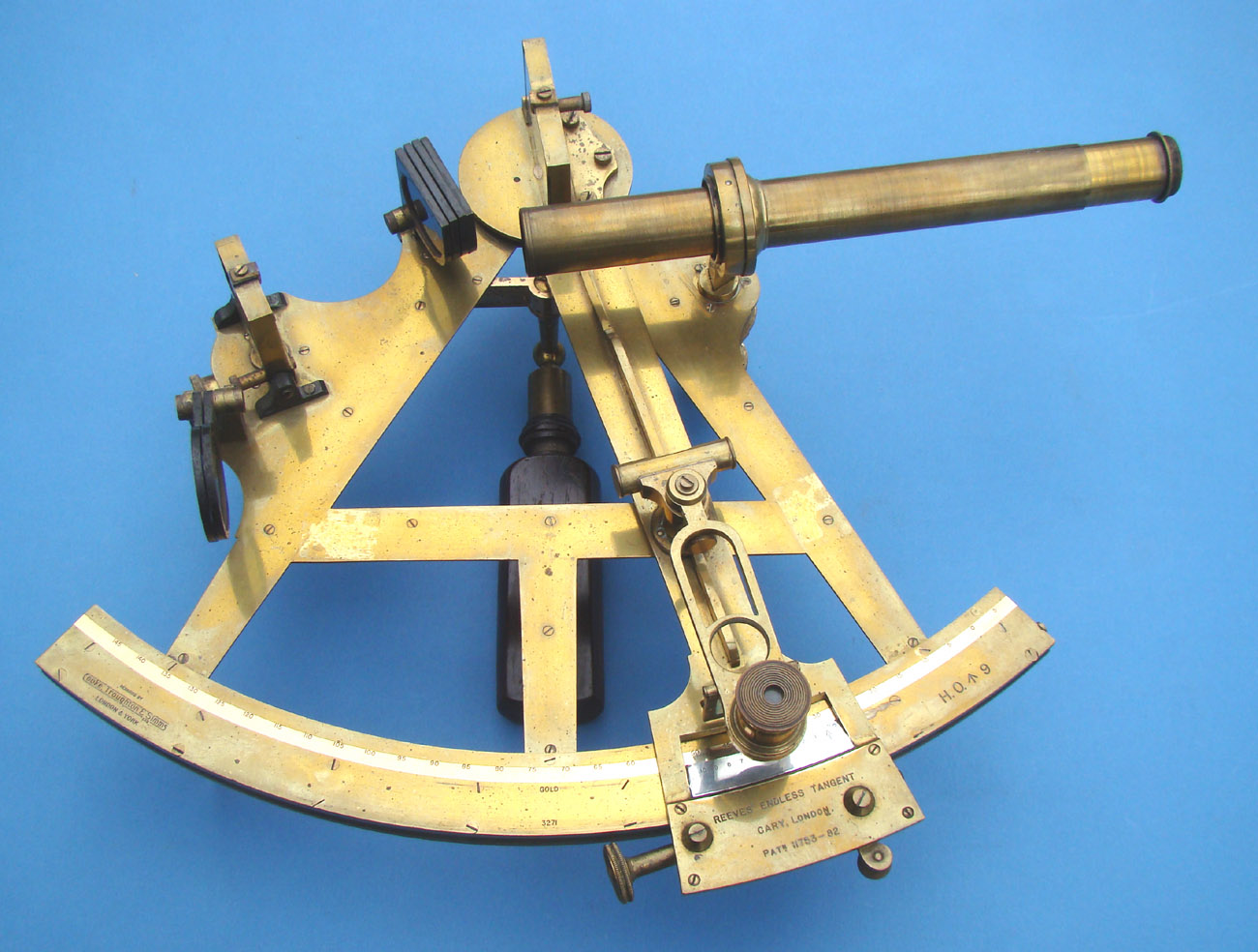
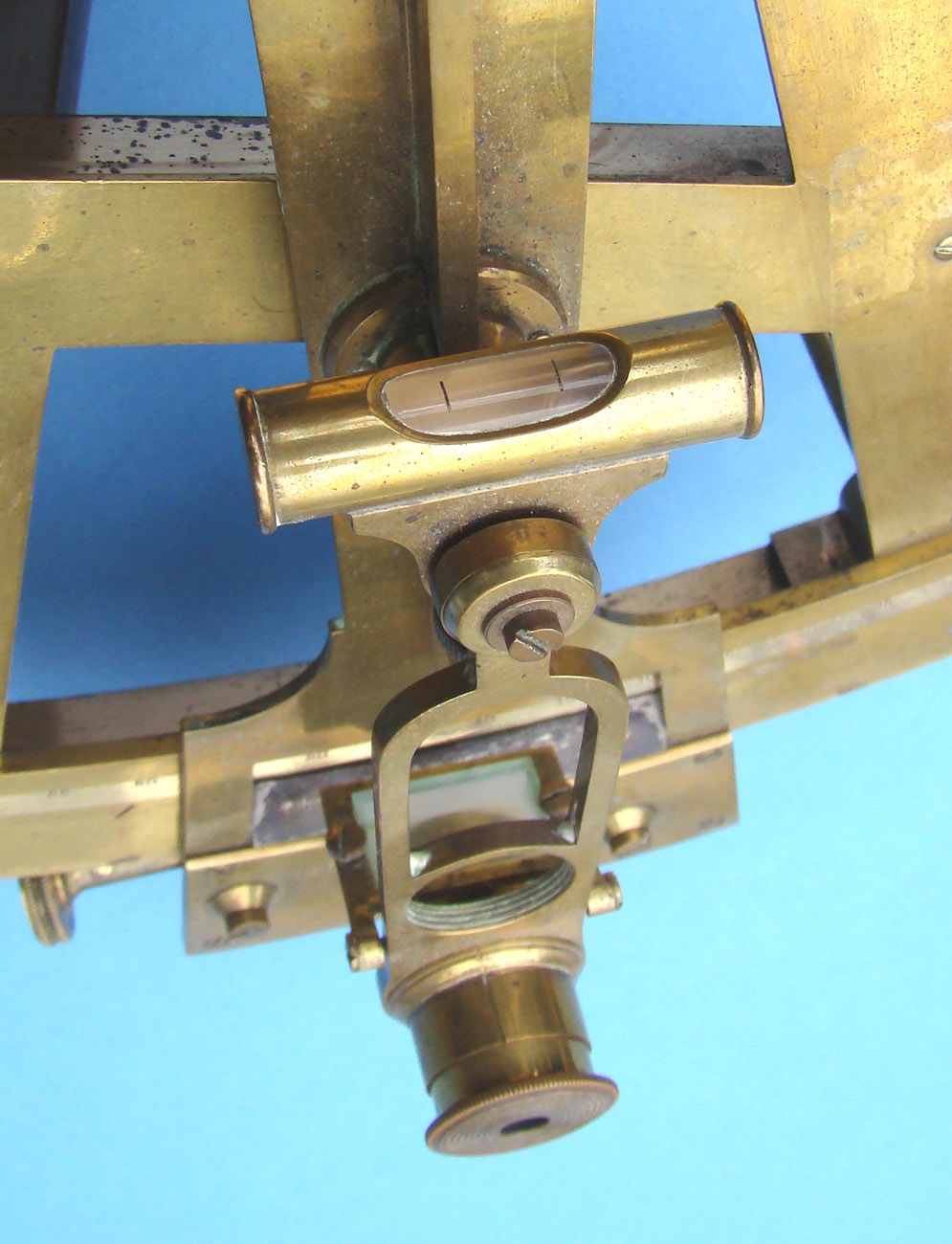
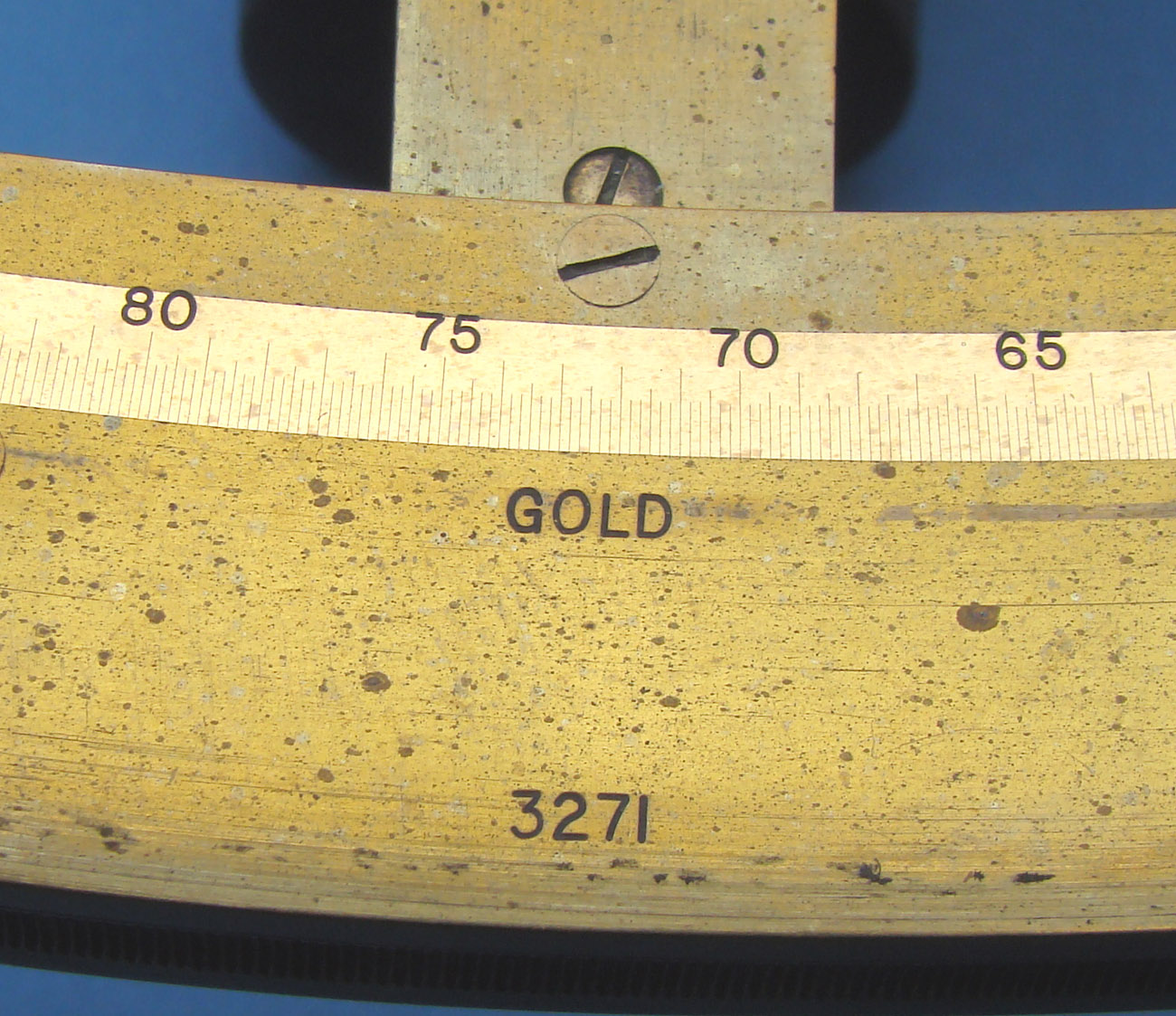
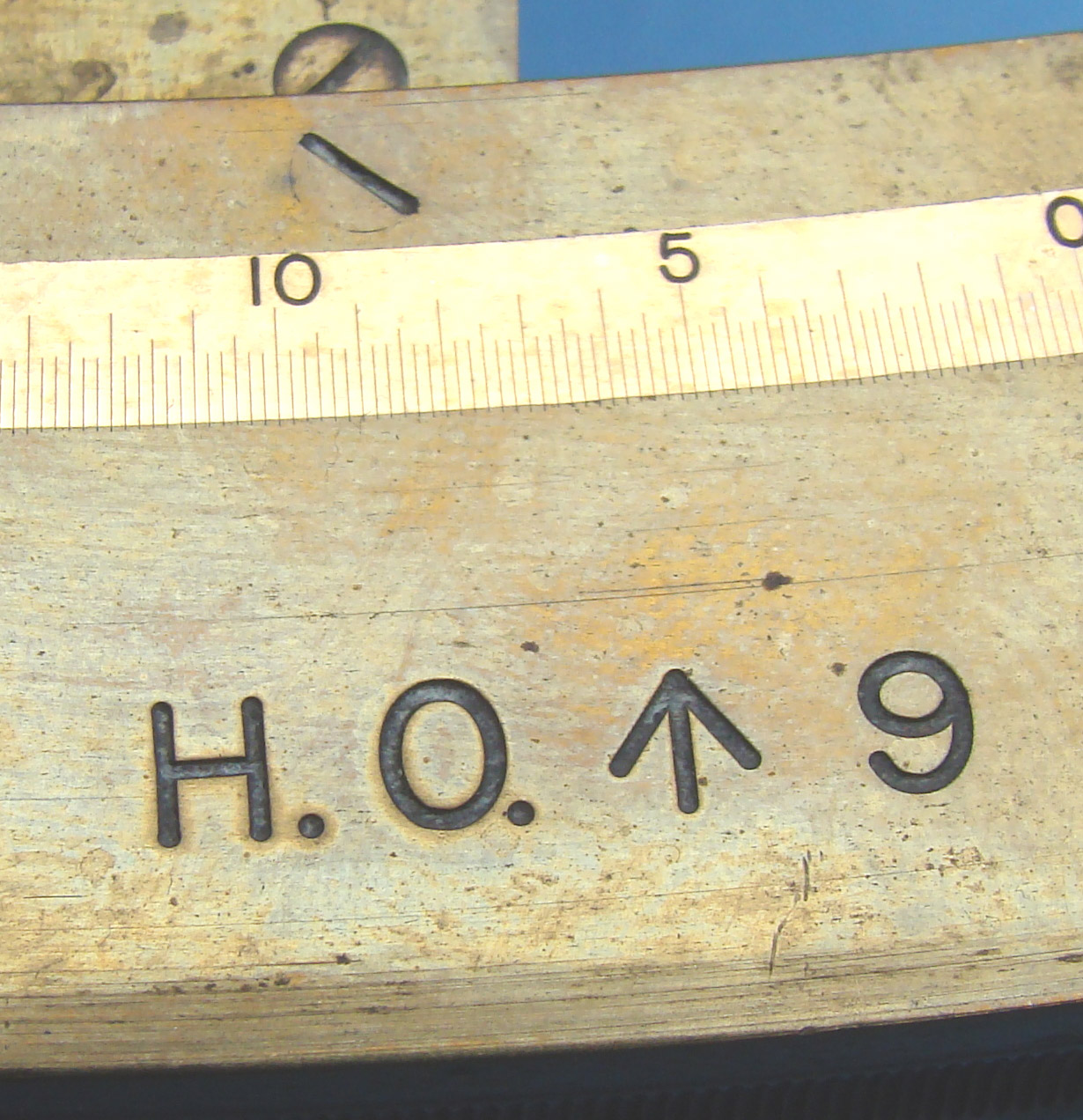
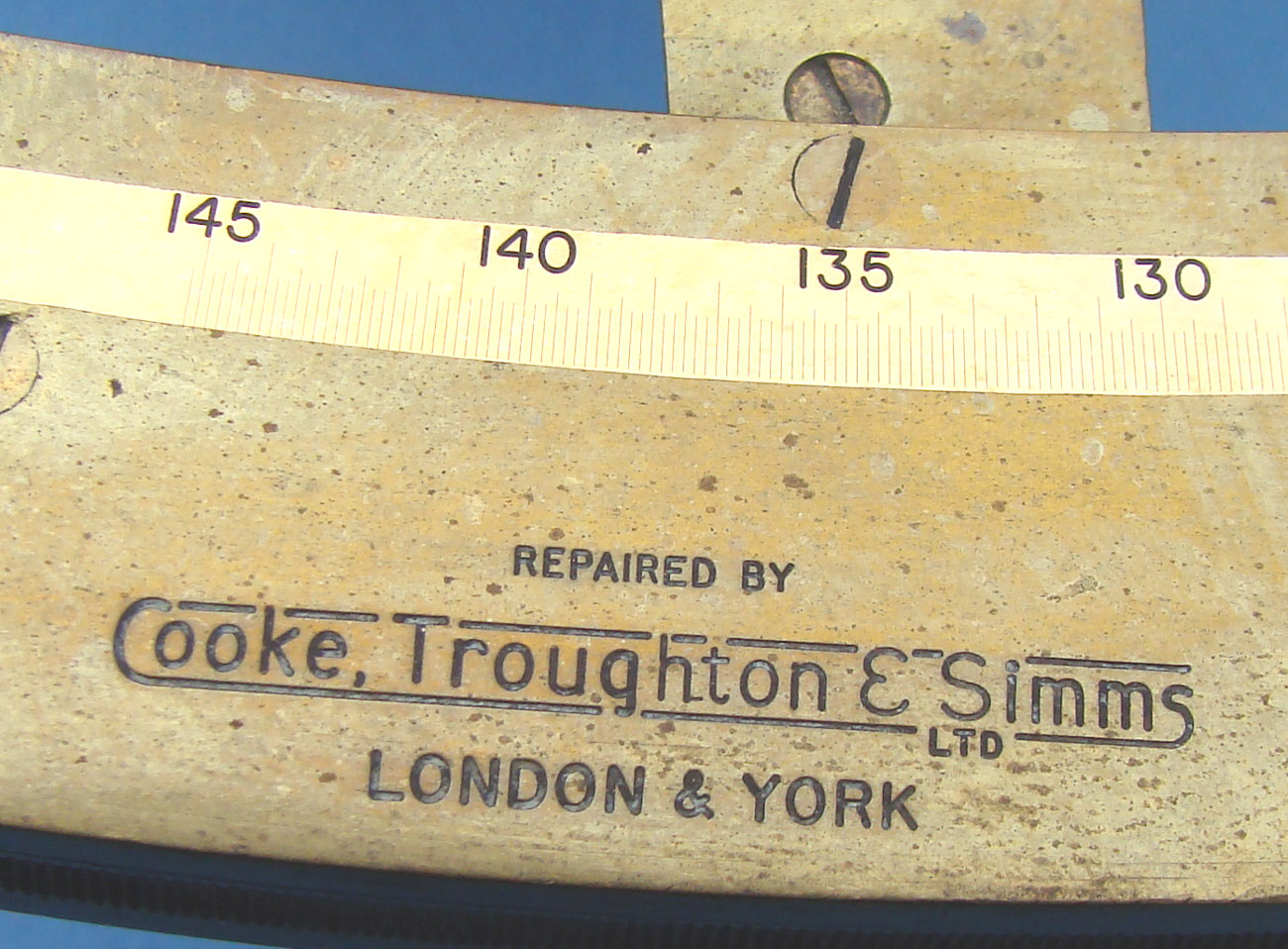
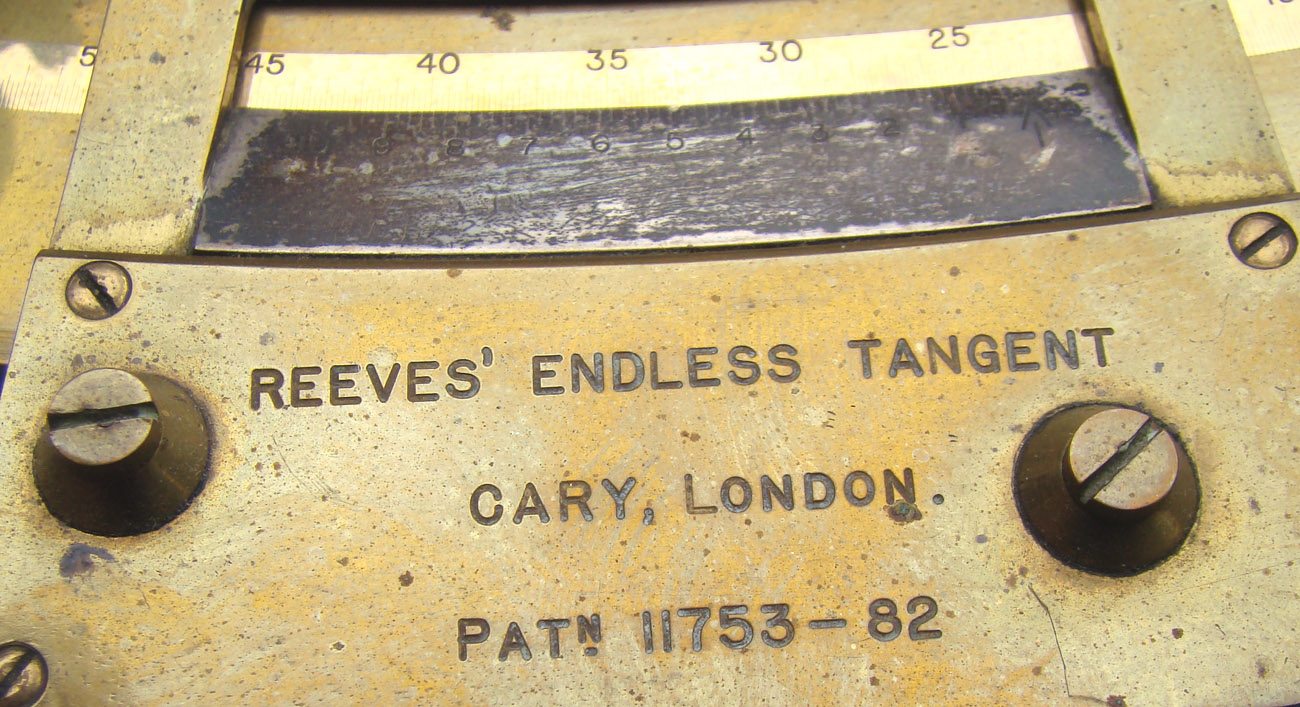
GOLD SCALE SEXTANT BY CARY, English, c. late 19th century, #3271. This elegant sextant is Cary's "partial double frame" design and has a splendid inset scale of gold, divided every ten arcminutes, with a silver vernier reading to ten arcseconds. The instrument has Reeves' endless tangent screw (an 1882 patent), the governmental broad arrow mark, the Hydrographic Office mark, and the repair mark of Cooke, Troughton & Simms. The scale radius is 8"; the overall height 10-1/2" (27 cm). The sextant is equipped with one telescope, four index filters, two horizon filters, scale magnifier, scale diffuser, index arm spirit level, and fine adjustment for horizon mirror. There is no case. Condition is fine, noting a couple of small dents. This is a good example of the rigid but lightweight innovative design by the firm founded in the 18th century by William Cary. Special features here include the quick-release index arm clamp coupled with long tangent screw fine motion with precision readout, and the unusual little spirit level on the index arm, useful when the horizon is obscured or elevated. This sextant must have an interesting history, with its governmental service and documented 20th century repair. A very rare example of the top of the line gold scale on a navigational instrument. (9235) $3950. |
 |
|
 |
|
| Handsome Telescope by Ross, for Gieve | Click on any image for a larger view. Scroll to view more items. |
 |

|
|
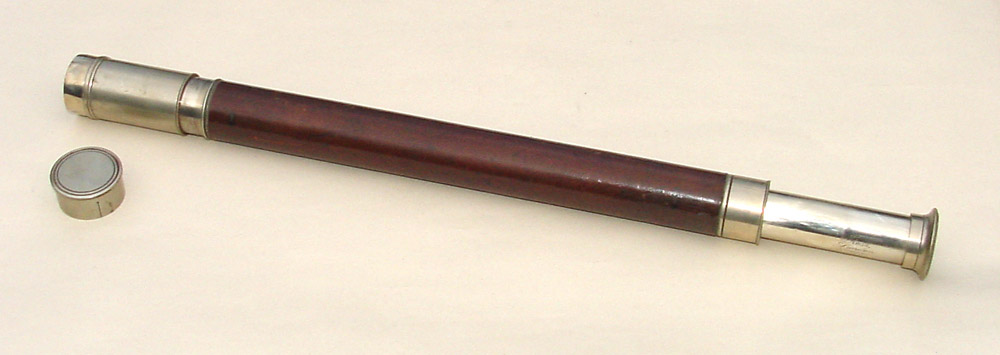
FINE ENGLISH SPYGLASS, c. early 20th century, signed "Ross, London, No. 26235; Made for J. Gieve & Sons, Portsmouth." Opening from 17-1/2" to 25" (44 - 63 cm) by single drawtube and objective shade, the telescope has nickel-plated brass construction, with stitched leather binding to the main tube. It is complete with achromatic doublet objective, erecting eyepiece system, dust cover and dust slide. Condition is very fine giving fine images. The retailers had premises on High St. in Portsmouth, and are known for naval swords as well. (7246) $750. |
| Early Dividers with Maker's Symbols | Click on any image for a larger view. Scroll to view more items. |
 |
 |
|
|
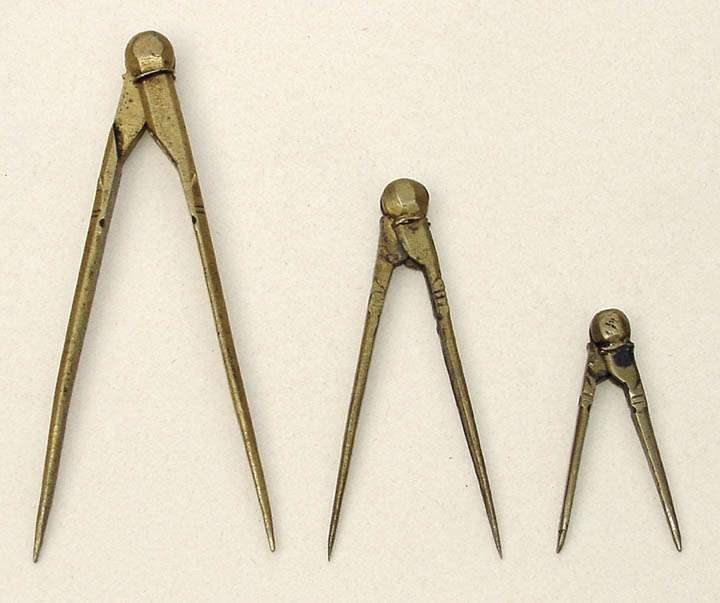
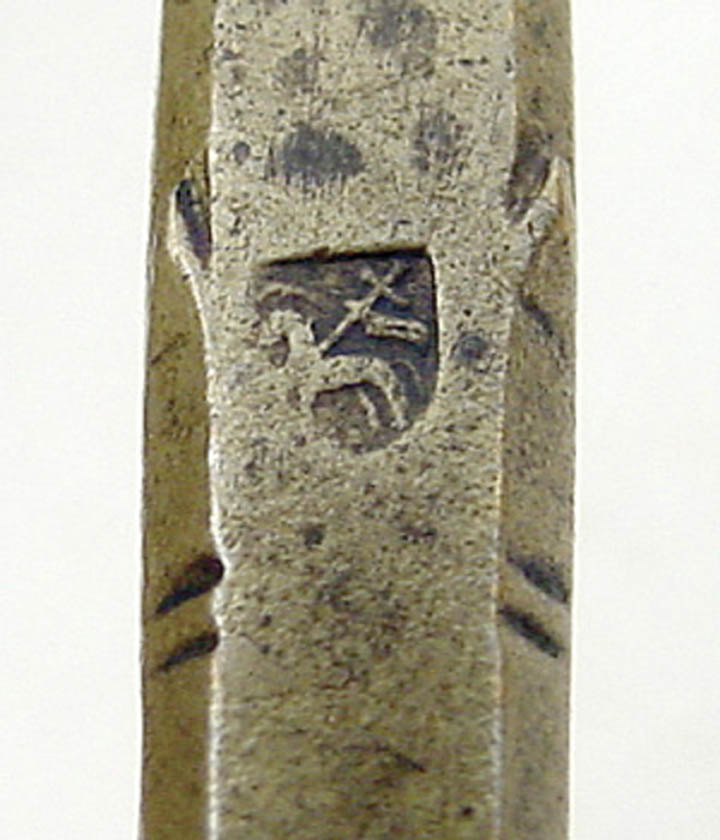
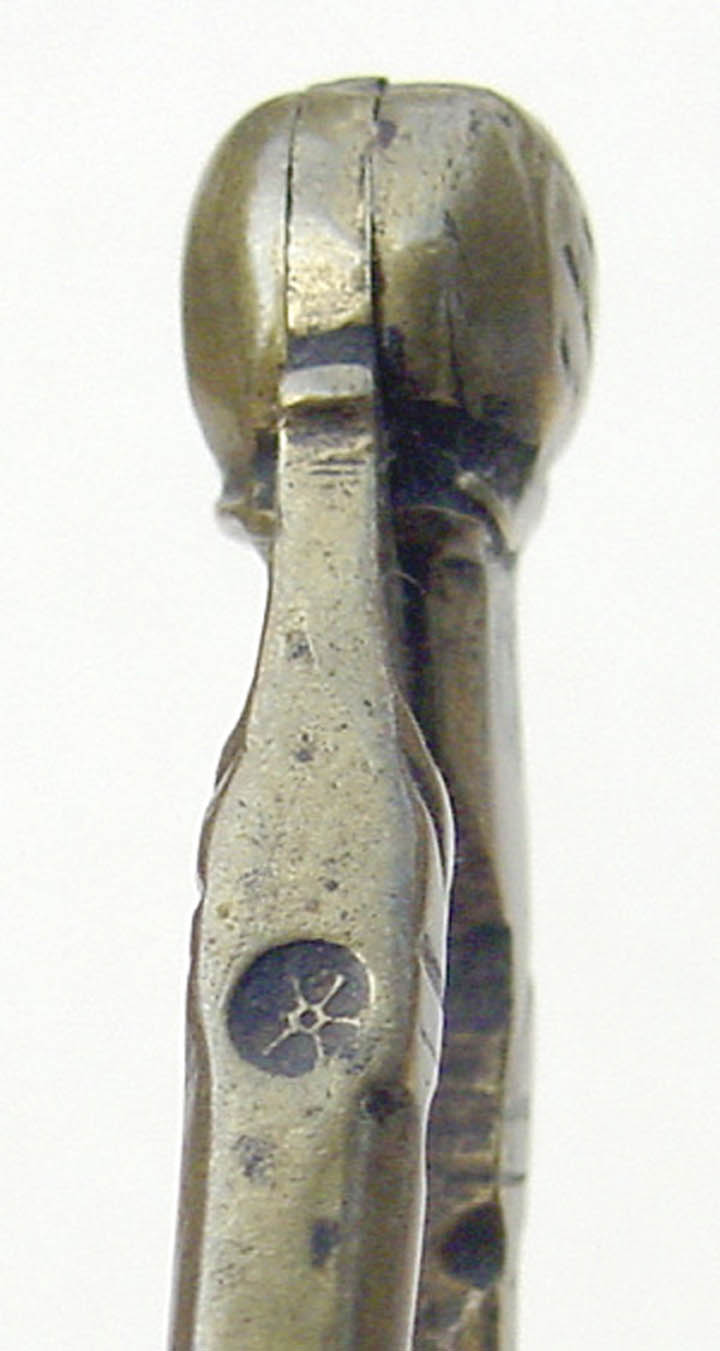
COLLECTION OF EARLY ALL-BRASS DIVIDERS, Continental, 17th / 18th century. Ranging in height from 4" (10 cm) to an almost miniature 1-3/4" (4.4 cm), each of the three is handmade with three-leaf hinge, eight-sided bulbous head, hammered and hand-filed legs, notch decoration on both sides, and maker's punch mark on a leg exterior. The largest has a fine Angus Dei (Lamb of God) punch, the other two a six-spoked wheel. They may well have been crafted in Nuremberg -- Lockner records similar marks used by scale and weight makers. A fine collection, in good condition throughout. (9374) $1950./the collection. |
| Early "Adams-Type" Box Sextant | Click on any image for a larger view. Scroll to view more items. |
 |
|
|
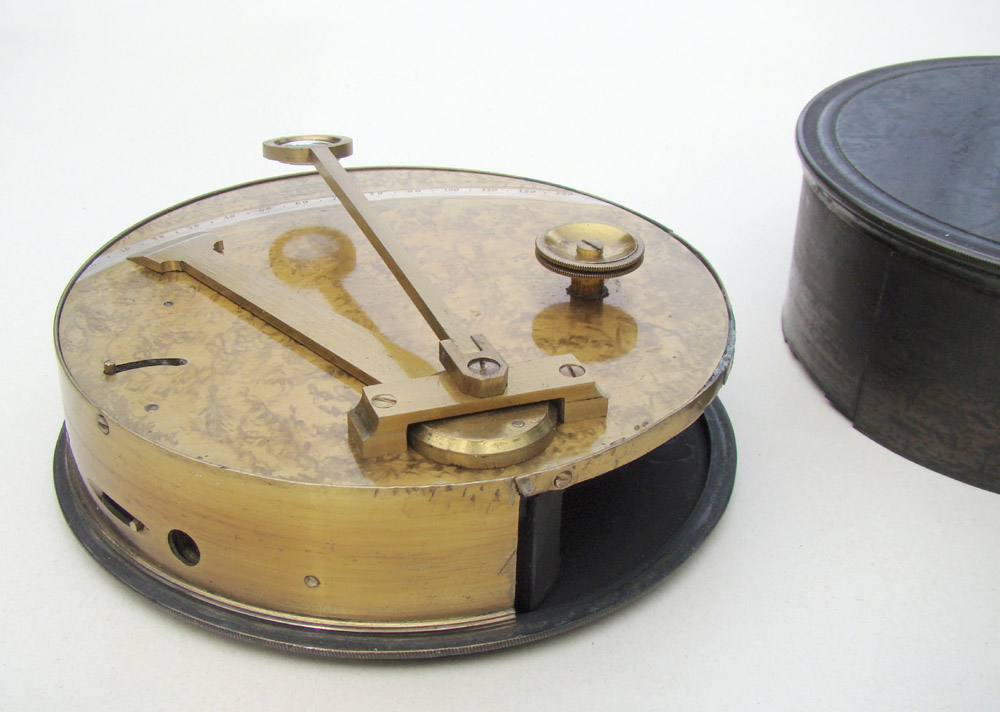
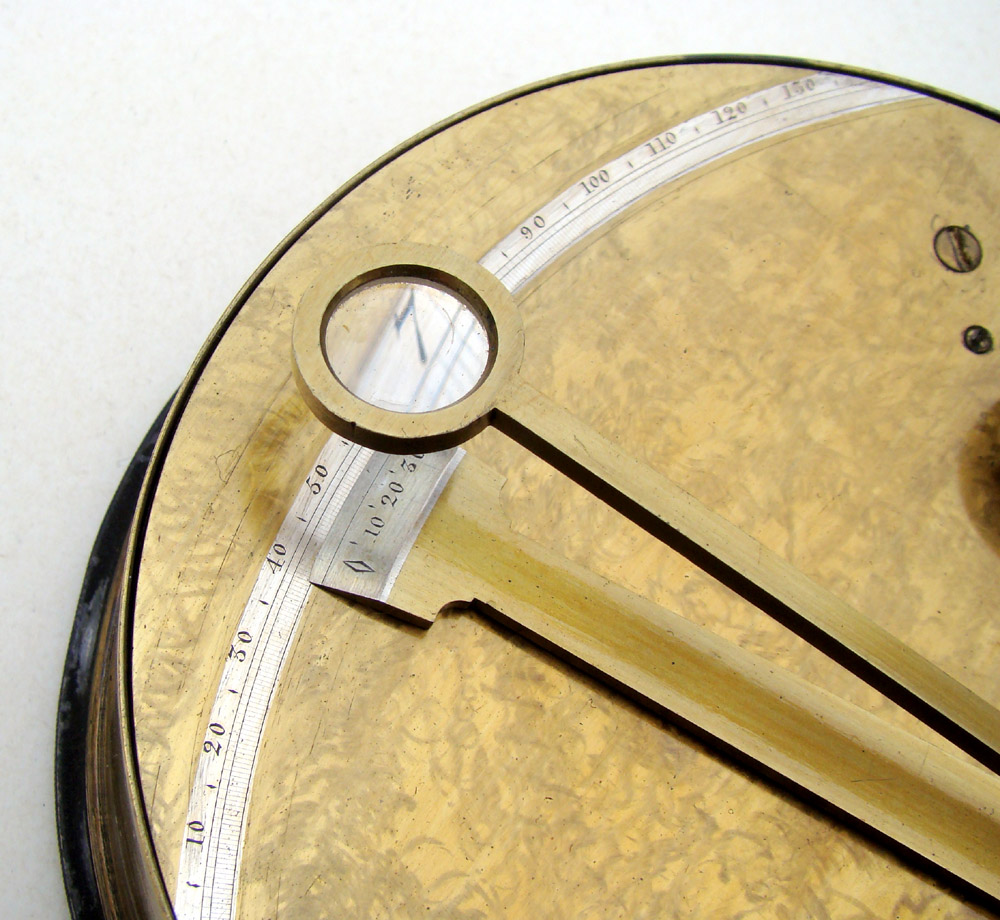
FLAT DRUM SEXTANT, English, c. first half 19th century, constructed of brass, 4-1/4" (11 cm) in diameter and 1-5/8" (3.6 cm) thick, the interior with "wriggle-work" designs and fine clear lacquer finish, the exterior of chemically darkened brass. A geared index arm carries an internal mirror, and is set with a silver vernier divided to one arc-minute. This reads against the 0° - 122° inset silver scale. There is a scale magnifier on long arm, and separately insertable dark red index and horizon filters. The sextant cover can be screwed onto the opposite side to serve as handgrip, and to avoid loss. The instrument itself is quite handsome, and fully functional, but we note a crack and chips to the cover¹s threads, and some edge damage to the sextant surround. The interior lacquer finish is excellent, the exterior rubbed and worn. This is an unusual form of pocket "box" sextant, considerably larger in diameter than most, and yet no thicker. It is similar to that described and illustrated in Adams'/Jones' Geometrical and Graphical Essays of the late 18th century (although here with interior rather than exterior rack work). For an Adams example see Tesseract Catalogue 38 Item 55. (9200) $1450. |
| Fine Measuring Telescope with Divided Objective | Click on any image for a larger
view. Scroll to view more items. |
 |
|
 |
|
|
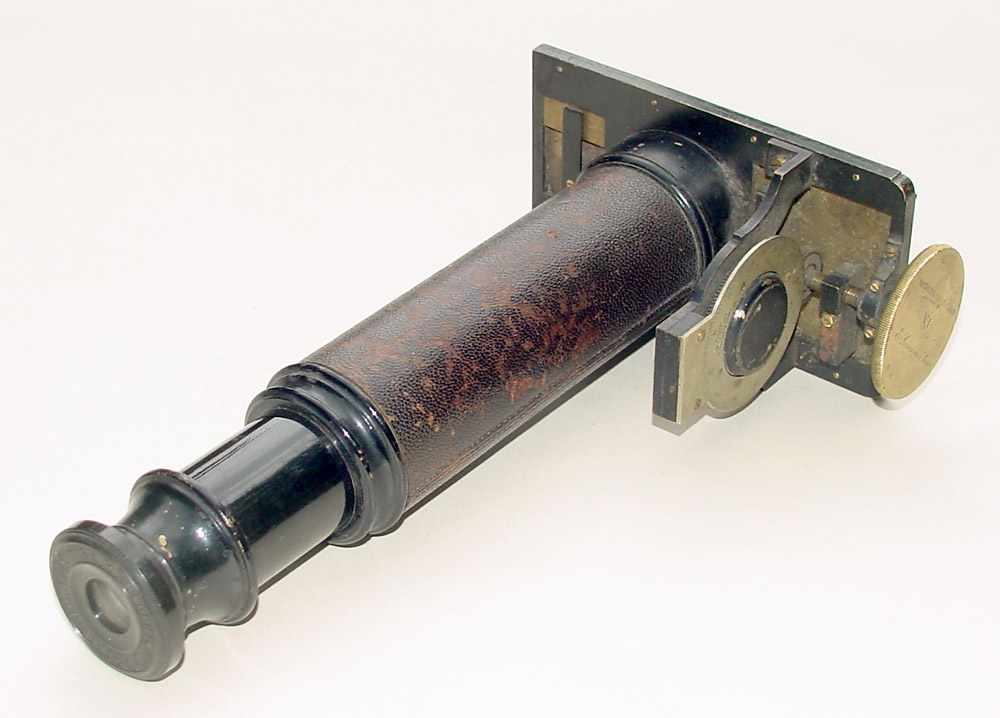
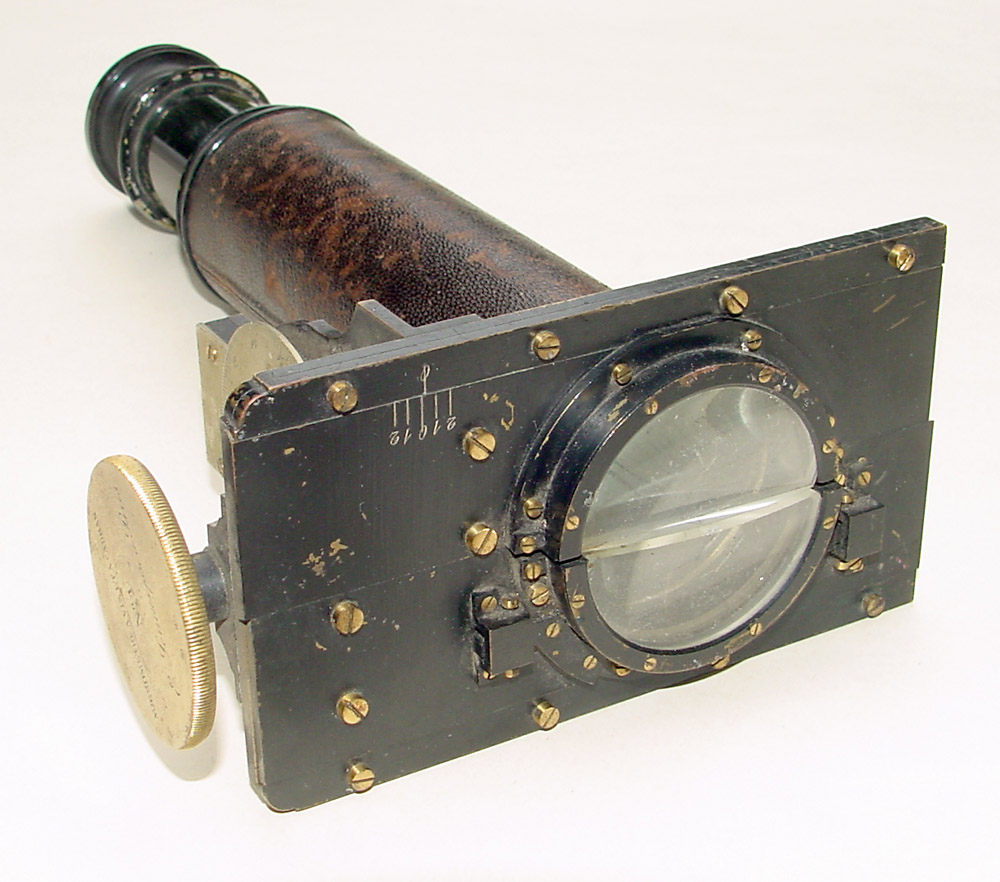
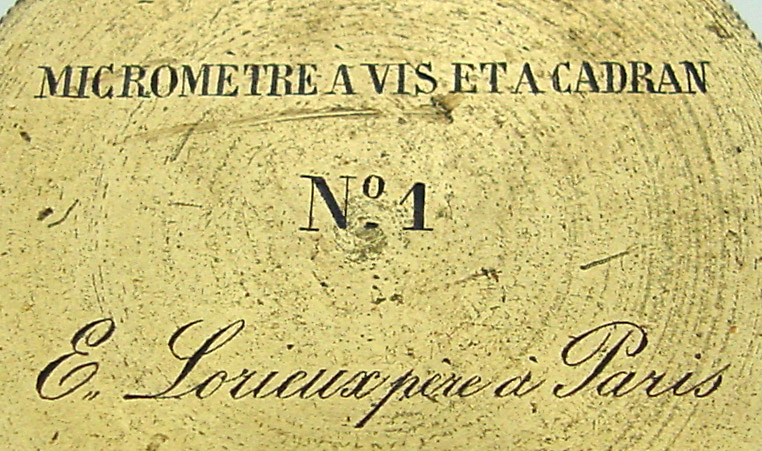
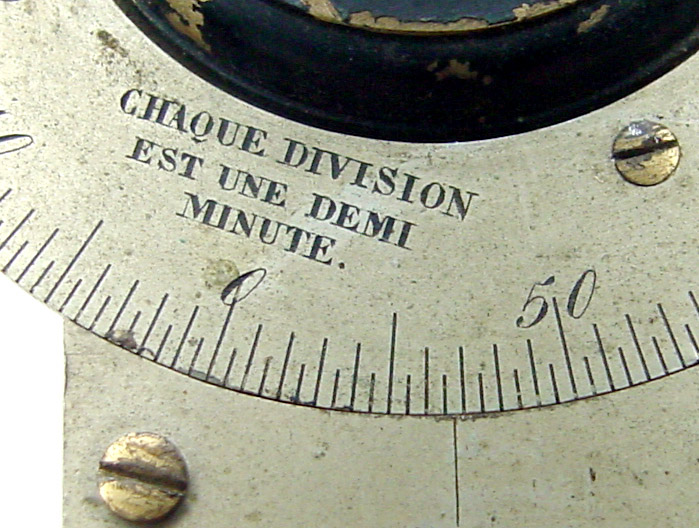
A DIMINUTIVE HAND-HELD SPLIT-LENS RANGEFINDING TELESCOPE, French, c. third quarter 19th century, finely signed "Micrometre a vis et a cadran, No. 1, E. Lorieux pere a Paris" and "Lorieux, Passage Dauphine 13, Paris." With an overall length of 7-3/4" (20 cm), extending to 9-1/4" by single drawtube, the telescope has erecting optics with a 1-3/4" diameter objective. The main tube is leather bound and the brass is generally blackened to minimize reflections. The objective lens itself is split into two semicircular segments mounted independently and driven in opposite directions by long screw micrometer gearing, with geared readout wheel graduated 0(0.5)60 twice and labeled "1 Degre" and with a note that each division represents one-half arcminute (of angular separation between the images). A simple graduated scale to the front indicates the coarse lens separation in degrees (0±2). The front is technically impressive, the blackened brass contrasting with dozens of bright lacquered brass mounting screws in a variety of sizes. Condition is good and functional, noting scuffing to the leather and a few scratches to the lens. In use each half of the objective forms its own image, so one sees any object double. By adjusting the physical separation of the lenses, one can align the two images with the two ends of an object of known height or length, and thus know the range, the distance away. Thus one rather easily and accurately keeps station at sea, or determines the speed of gaining or losing on an enemy vessel, or time to landfall. Edmond Lorieux was apparently trained by Gambey, and c. 1845 established what became a very important manufactory of navigation instruments. He was succeeded by Hurlimann, then by Ponthus and Therode, then Ponthus, and finally Lepetit (see Marcelin). We have catalogued one other micrometric telescope by Lorieux (pere), that one much larger (22" long extended), and labeled a bit differently "Micrometre Lugeol, a cadran de Lorieux," i.e., the Lugeol system, with dial plate readout (Tesseract Catalogue 53 Item 28). (9171) $2950. |
| A Hallmarked Miniature | Click on any image for a larger view. Scroll to view more items. |
 |

|
|
A MINIATURE SOLID SILVER OCTANT, English, 1979, fully hallmarked for London sterling silver of 1979, and with maker's mark. The flat frame measures 5" (13 cm) tall. This diminutive, more-or-less functional "replica" of an 18th century octant has a peepsight, horizon mirror, hinged filter, and index mirror on moving arm. The scale is divided in zenith distance every degree from 90° to 0°, with transversal interpolation, and with readout against the index arm's line of faith which is sub-divided every 10 arcminutes. The arms display floral decor, and the center presents an unusual fish or sea monster. Quality is modest; condition is very fine. Although hardly an antique, at just over 30 years of age, this is nevertheless an amusing, solid silver honestly hallmarked piece which can demonstrate the principles of celestial altitude measurement and transversal interpolation. (9275) $595. |
| For Measuring Range of an Object Passed at Sea | Click on any image for a larger view. Scroll to view more items. |
 |
|
| From English Maker to French Royalist | Click on any image for a larger view. Scroll to view more items. |
 |
|
|
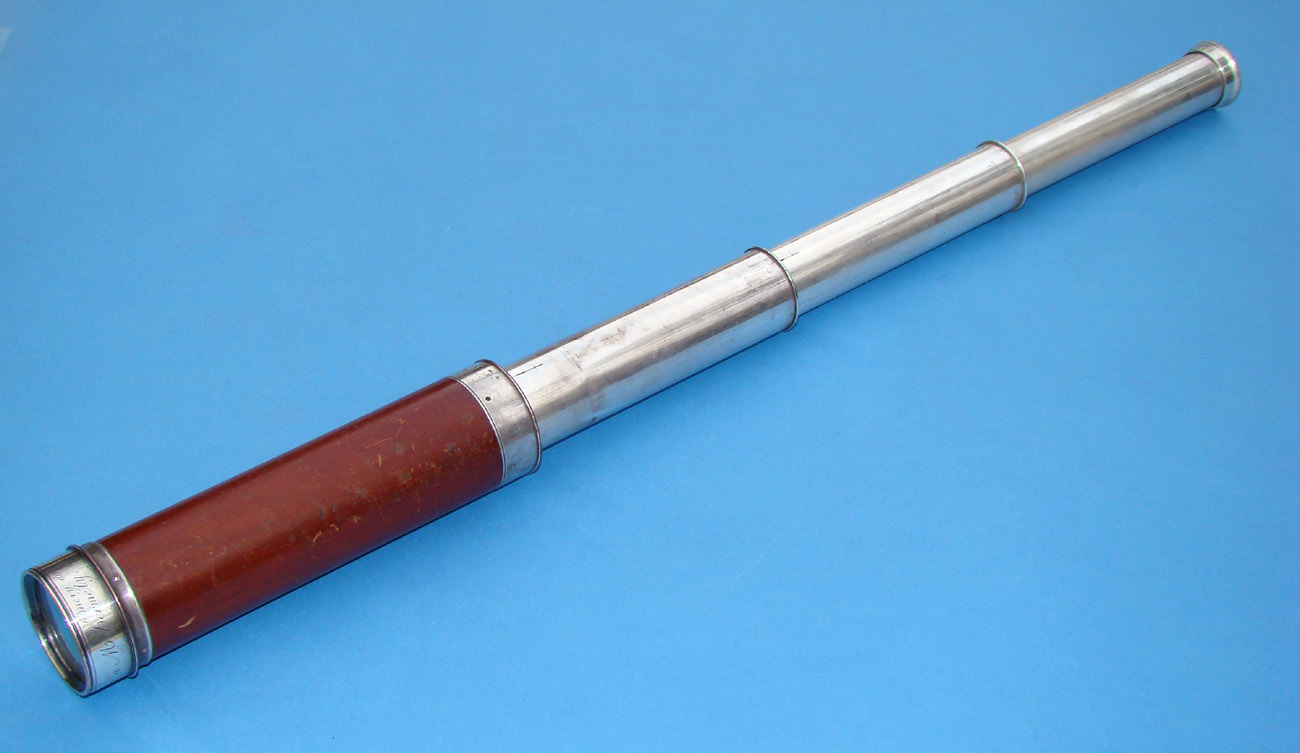
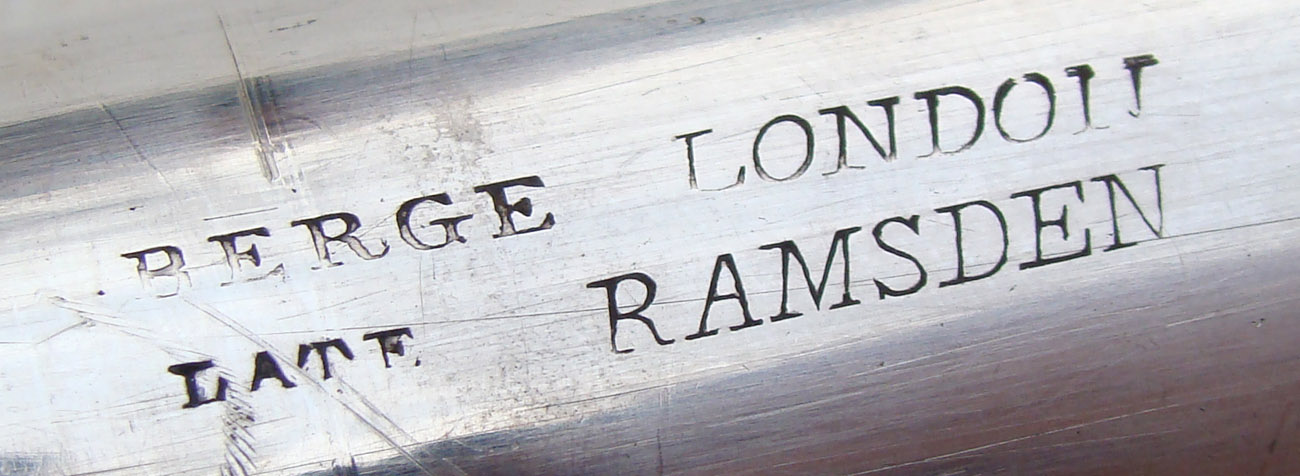
SIGNIFICANT PRESENTATION TELESCOPE IN SHEFFIELD SILVER, English, early 19th century, stamped on the first two drawtubes "Berge, London late Ramsden," and engraved around the objective mount "de M. Berge à M¹r. Emery dit hermély, 1822." The telescope opens from 7" to 20-3/4" (18 to 53 cm) with a mahogany maintube and three drawtubes and mounts of heavy silver over copper. It is fitted with a greenish triplet achromatic objective and erecting optical system giving fine images. Condition is very fine noting the eye cap replaced. |

|
|
This telescope records an interesting history, having
been made by Ramsden¹s successor, Matthew Berge, and presented to the
famous Jean Marie Emery dit Herméley (1769 - 1850). The sailor and later
lieutenant Emery (who went by the name Herméley) served under Georges
Cadoudal in the underground chouanne army, as a Royalist, against the
French Revolution. (9255) $2800.
|
| Lightning at Sea -- An American Patent | Click on any image for a larger view. Scroll to view more items. |
 |
|
|
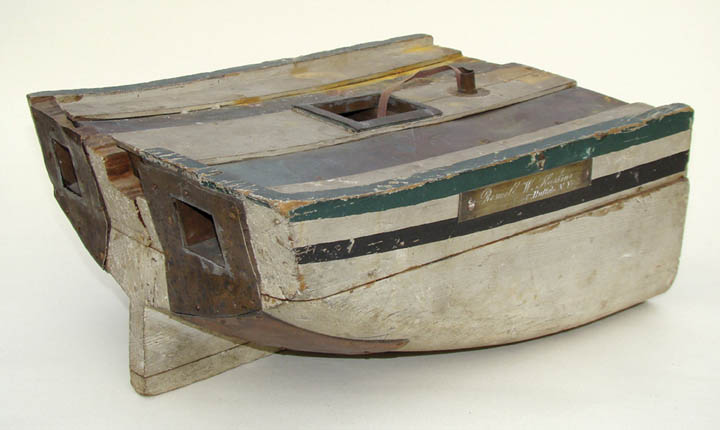
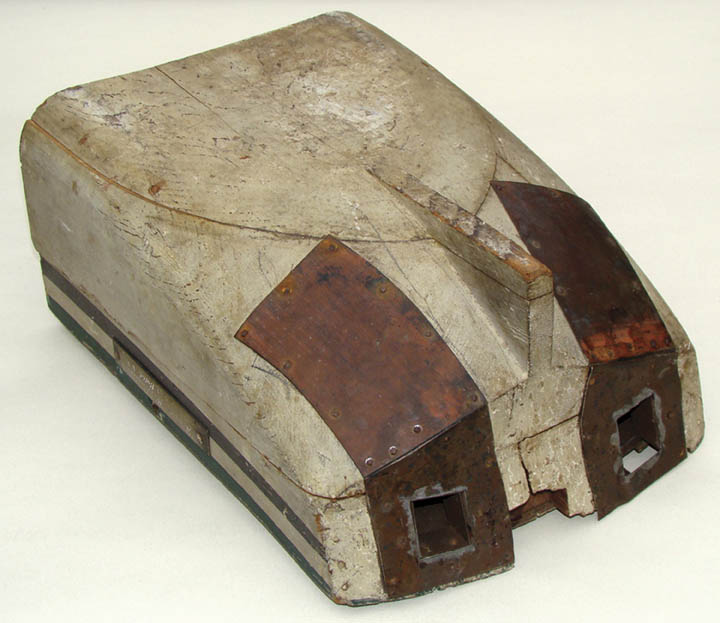
LIGHTNING PROTECTION ON THE WATER, American, 1858, signed "Roswell W. Haskins, Buffalo, N.Y.," comprising the original model submitted to the U.S. Patent Office, as part of the application resulting in the granting of patent 20877, issued 13 July 1858. The model is made of wood, painted, and clad with brass sheeting in various places inside and out. Measuring 12" x 8-1/4" x 5" (30 x 21 x 13 cm), it is in the form of the stern portion of a ship, hollow, and with three open ports. Condition is good noting some scratches to the paint, a few fragments of wood missing, and darkening of the brass sheeting. Haskins writes, in his application, "The nature of my invention relates to protecting vessels from lightning by means of lining all parts of the vessel above the water-line on the inside with metal, and making a proper connection thereof through the cabin-windows and other openings through the vessel to sheets of metal passing down the stern and sides of the vessel to the water." He argues that lightning at sea has perfect electrical conduction through the water, and that when a ship is struck the real danger occurs if there is a gap in the conductive path to the water. A massive spark will jump the gap, often setting fire to flammable cargo, etc. Thus he proposes lining the bases of the masts, the deck of the vessel (under the wood planking), the hatchway and window surrounds, and inside and outside of the vessel down to the water line, all with sheets of copper "so laid on and connected to each other as to form one entire sheet of perfect and uninterrupted conduction from the deck and sides of the vessel inside to the water on the outside." A fine protection against the lightning danger to wooden ships, presented here in the unique model originally supplied, as required, to the U.S. Patent Office. (9284) $1450. |
 |
| Precision Pocket Sextant from Aberdeen Scotland | Click on any image for a larger view. Scroll to view more items. |
|
|
 |
|
|
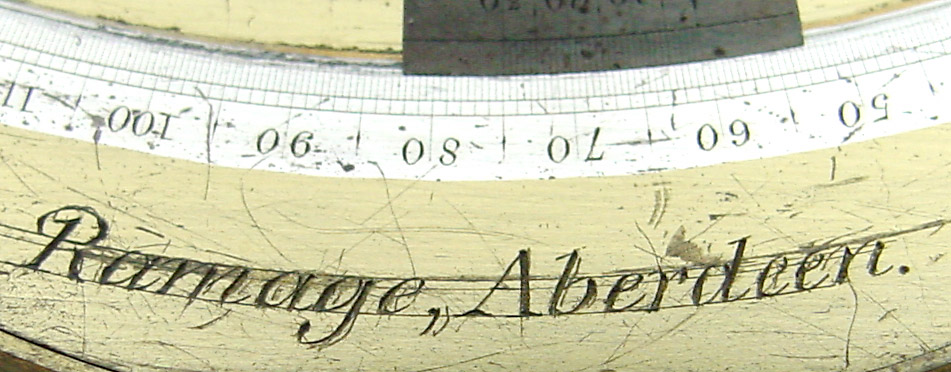
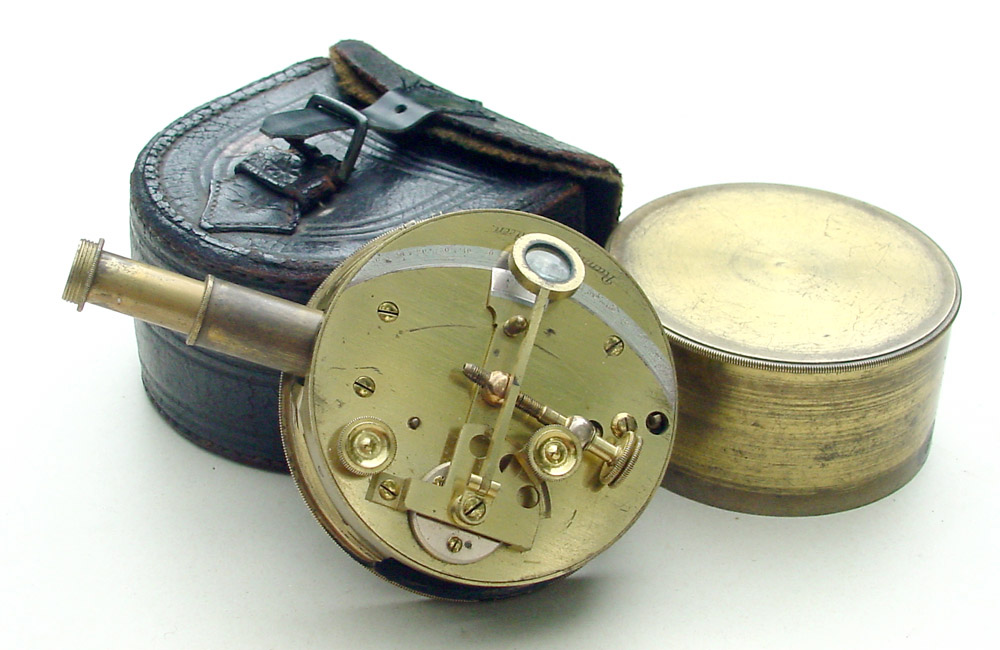
A SCOTTISH BOX SEXTANT WITH TANGENT SCREW FINE ADJUSTMENT, c. 1830, signed "Ramage, Aberdeen." The 3" (7.6 cm) diameter brass drum-shaped sextant has a removable cover that screws onto the back as handle. The finely crafted miniature sextant itself has inlaid silver scale and one-arcminute silver vernier, scale magnifier, swinging index arm and mirror with the most unusual feature of clamp and long tangent screw fine adjustment, insertable red and green filters, optional peephole or single drawtube telescope with screw-on solar filter, and mirror adjusting tool. Condition is very fine with original stitched leather outer case, noting case and cover with some wear. The sextant itself is beautiful with its original bright lacquer finish. This is a fine example of the "snuff box" sextant, useful for exploration on land, navigation at sea especially on small craft or lifeboats, etc. But it is very special for having a precision long-screw fine adjustment to the index arm position. We know of another such instrument, in the National Maritime Museum, that with the same sort of raised quadrantal clamp plate, pierced with three holes, but signed "Adie, Edinburgh." (9191) $1450. |
| Complex Form of "Davis Quadrant" | Click on any image for a larger view. Scroll to view more items. |
 |
|
|
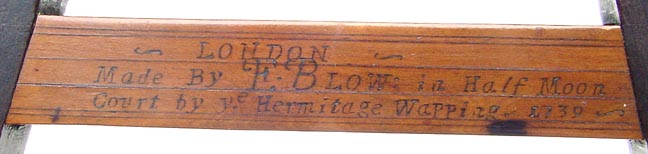
Additionally, the greater arc has a set of solar scales on the reverse. Beginning on 10 March (the vernal equinox, and thus good evidence that this instrument predates the 1752 adoption of the Gregorian calendar in England) there are linear date scales (divided for every day of the year) separately for the sun North and South of the celestial equator, and a corresponding nonlinear scale of solar declination (0 to 23-1/2). Thus a sight vane could be positioned to the date, with readout of the solar declination, and simple determination of one's latitude from a measurement of the sun's altitude at noon. In our experience these scales are found on a very small number of surviving instruments. There are decorative stampings of five-lobed roses, fleur-de-lys, and geometric patterns. Condition is fine noting light wear; there are no sight vanes. The backstaff was a vast improvement on the cross-staff, which required the navigator to sight in two directions simultaneously (not to mention looking directly at the sun). Most observations were in fact to determine the solar meridian altitude, and thus the ship's latitude. Observing with the backstaff, the sum of the readouts on the greater and lesser arcs was the solar altitude. This required correction for the solar declination on the date, provided directly on the scales here, without resort to tables. The maker was Edmund Blow, son of a "hemp dresser," free in the Joiners guild in 1704, instrument maker in Wapping from then until 1739. He is known to have made Napier's bones as well as backstaves, and may have worked exclusively in wood. Another backstaff by him is recorded, a fine example dated 1736 and now in the Whipple Museum. A handsome example, signed, dated, and serial numbered. (8187) $13,500. |
|
 |
|
|
 |
| Innovative Twin-Mirror Full-Circle Outfit | Click on any image for a larger
view. Scroll to view more items. |
 |
|
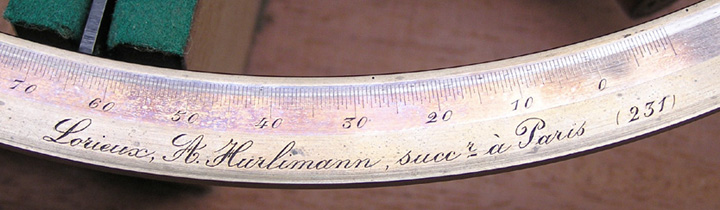
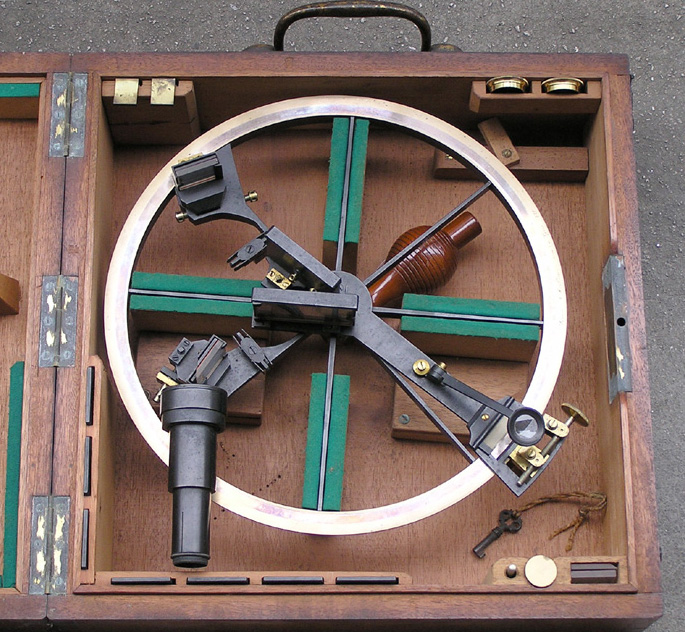
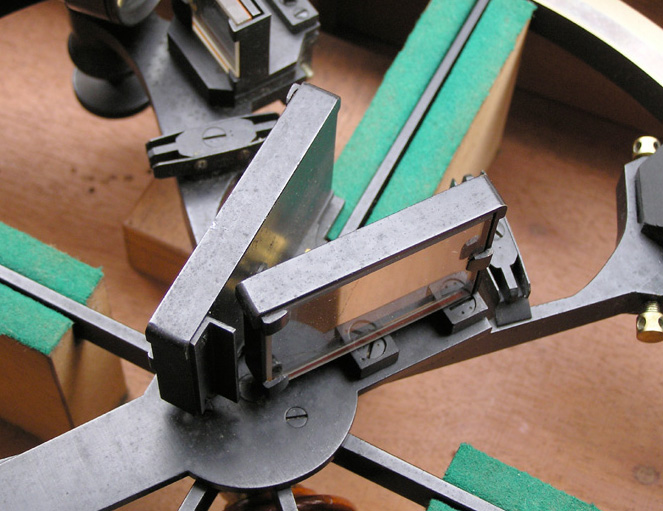
THE HYDROGRAPHIC CIRCLE OF ROLLET DE L'ISLE, French, late 19th century, finely signed "Lorieux, A. Hurlimann, Succ'r a Paris." The 10-1/2" (27 cm) diameter brass circle is fitted with four mirrors, two of them mounted on the rotating index arm and set back-to-back at a fixed angle, a large-light-gathering-power telescope, and a hinged turned wood handle. An inset circular scale is divided every 0.5 from -10 to +200 half-degrees. The index arm has clamp, fine motion tangent screw, vernier to one-fiftieth of a degree, and magnifier. The instrument is equipped with its full complement of accessories, all original: two solar filters, two right angle sights, seven interchangeable filters, two adjusting tools, three spare mirrors, fitted mahogany case 13" (33 cm) square, and key. Only the screwdriver and loupe are lacking. Condition is absolutely superb throughout. The circle functions basically as a sextant, except there are two "horizon" mirrors, and two "index" mirrors, disposed so that one pair is useful at smaller angles, the other pair at larger ones. Readings are possible from 0 degrees straight ahead all the way to 180 degrees directly behind the observer -- as one mirror view becomes foreshortened, the other takes over automatically. This is the remarkable invention of M. Rollet de l'Isle, French hydrographic engineer to the Marine (and world-famous proponent of the Esperanto language). It was still advertised in 1911 (by Ponthus & Therrode, successors to Hurlimann, who in turn was successor to the well-known firm of Lorieux established in 1845), as the model adopted by the French hydrographic marine services. A very rare example of this innovative design, in splendid condition. (8194) $7200. |
|
|
|
|
| Astronomy |
| Microscopy |
| Dialling |
| Navigation |
| Demonstration & Experimentation |
| Calculation |
| Medical |
| Specials |
| Books New and Old |
| Tesseract Catalogues |