|
|
| An Exceptional 17th-Century Sundial | Click on any image for a larger view. Scroll to view more items. |
 |
 |
|
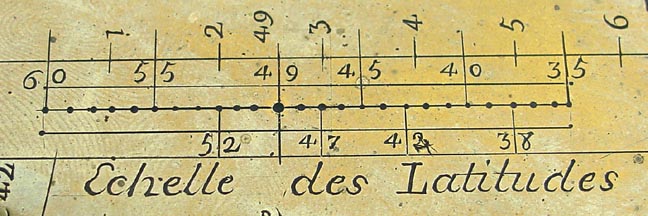
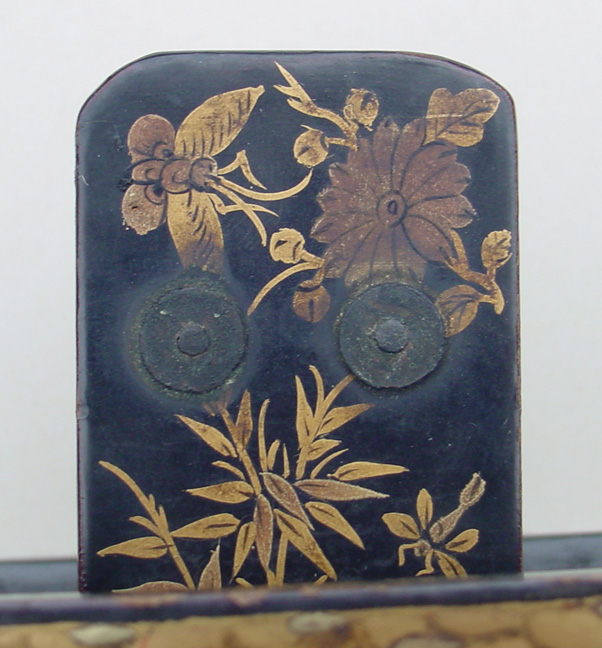
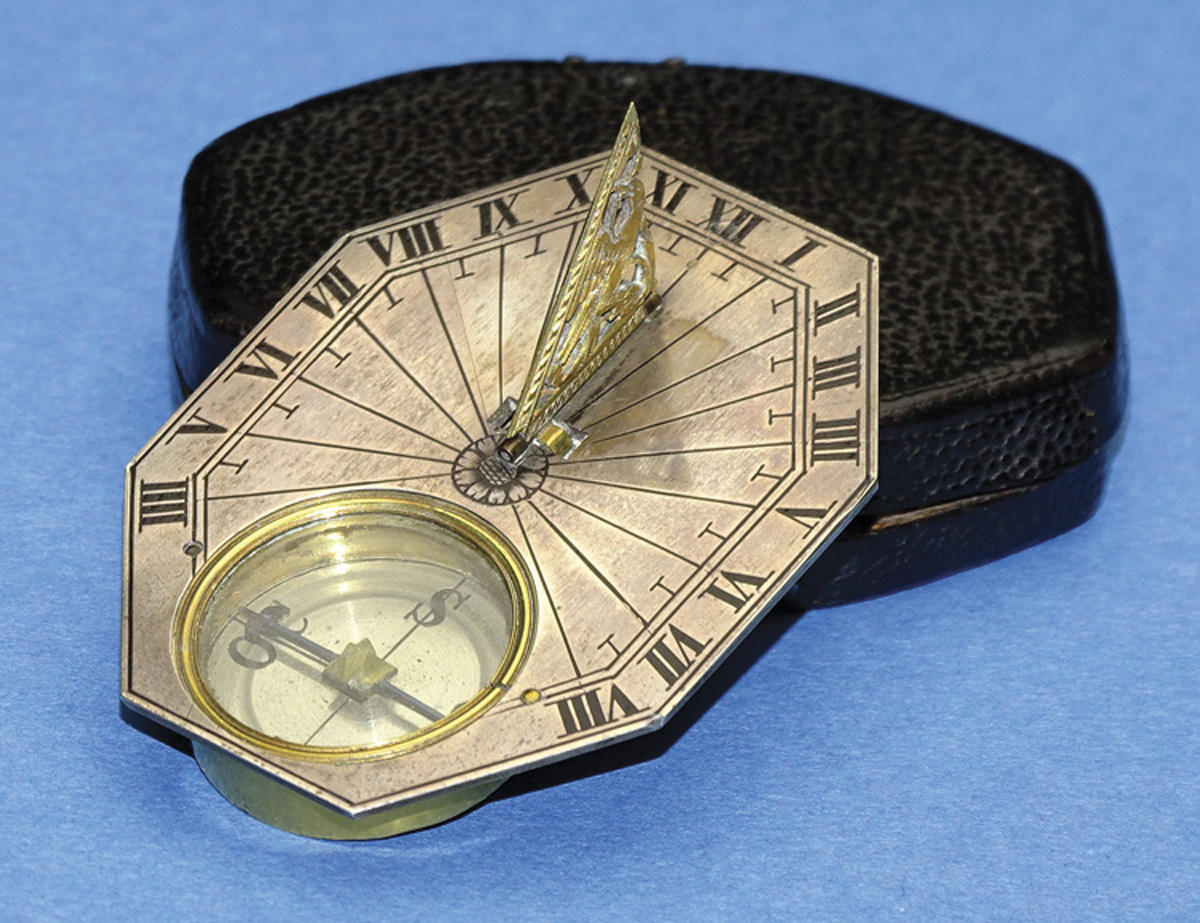
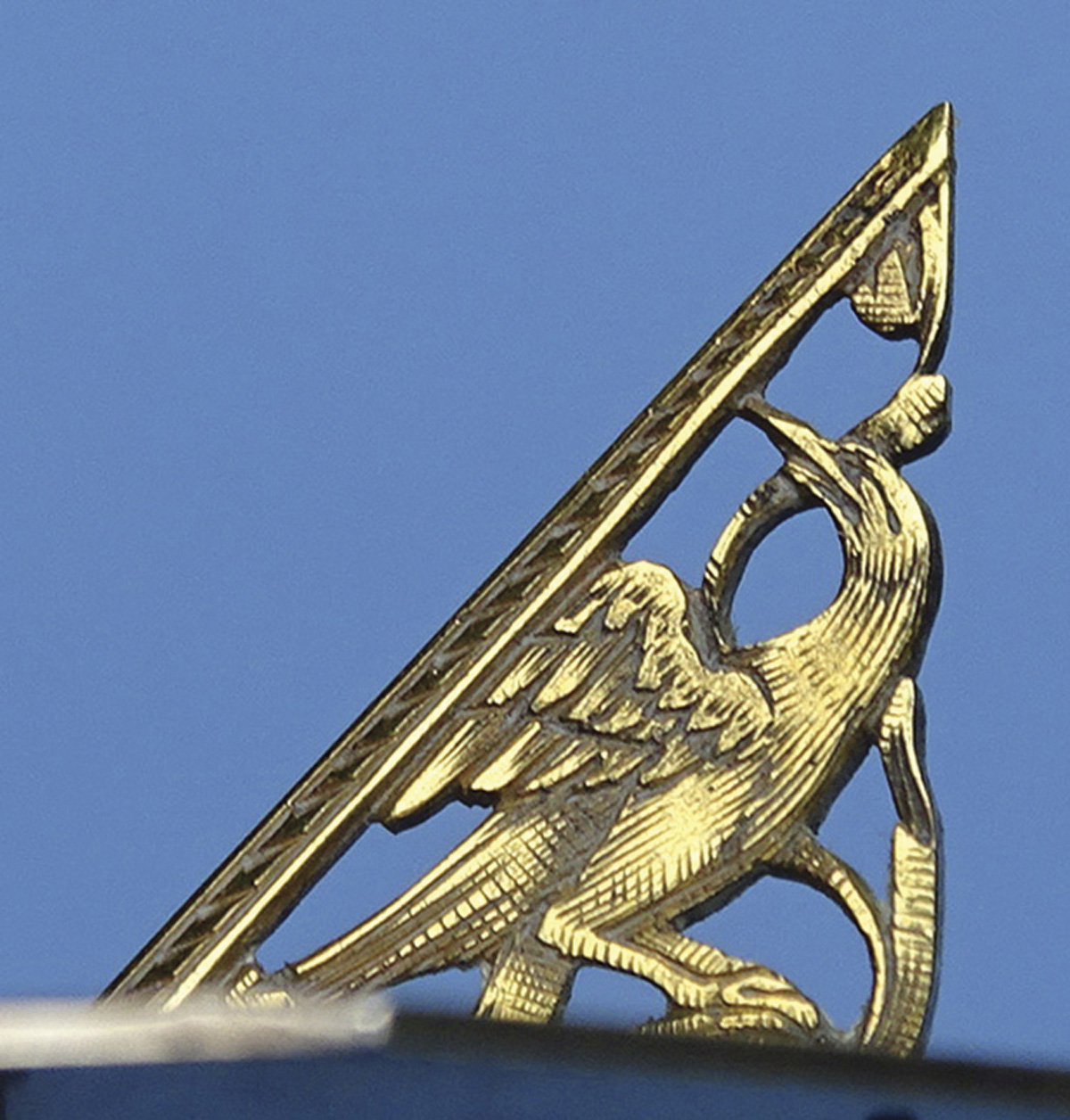
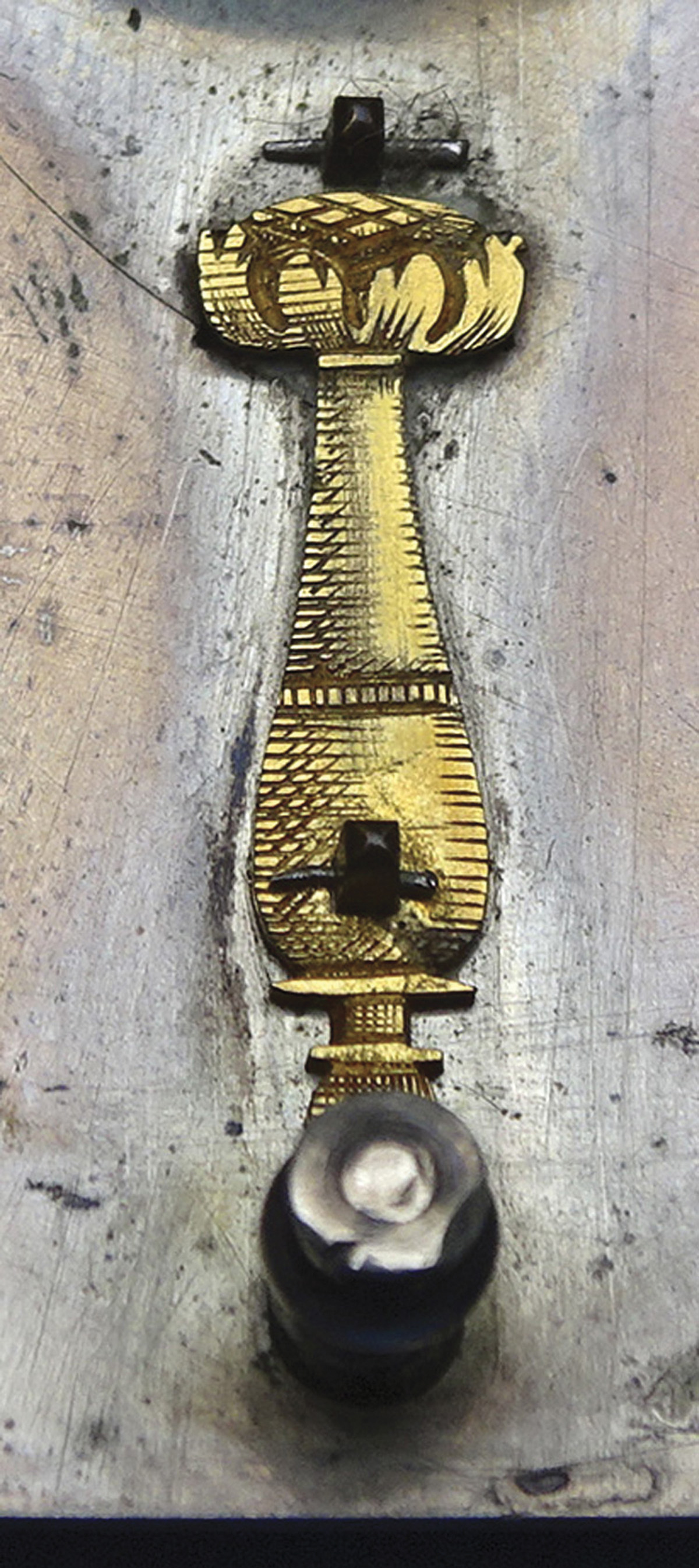
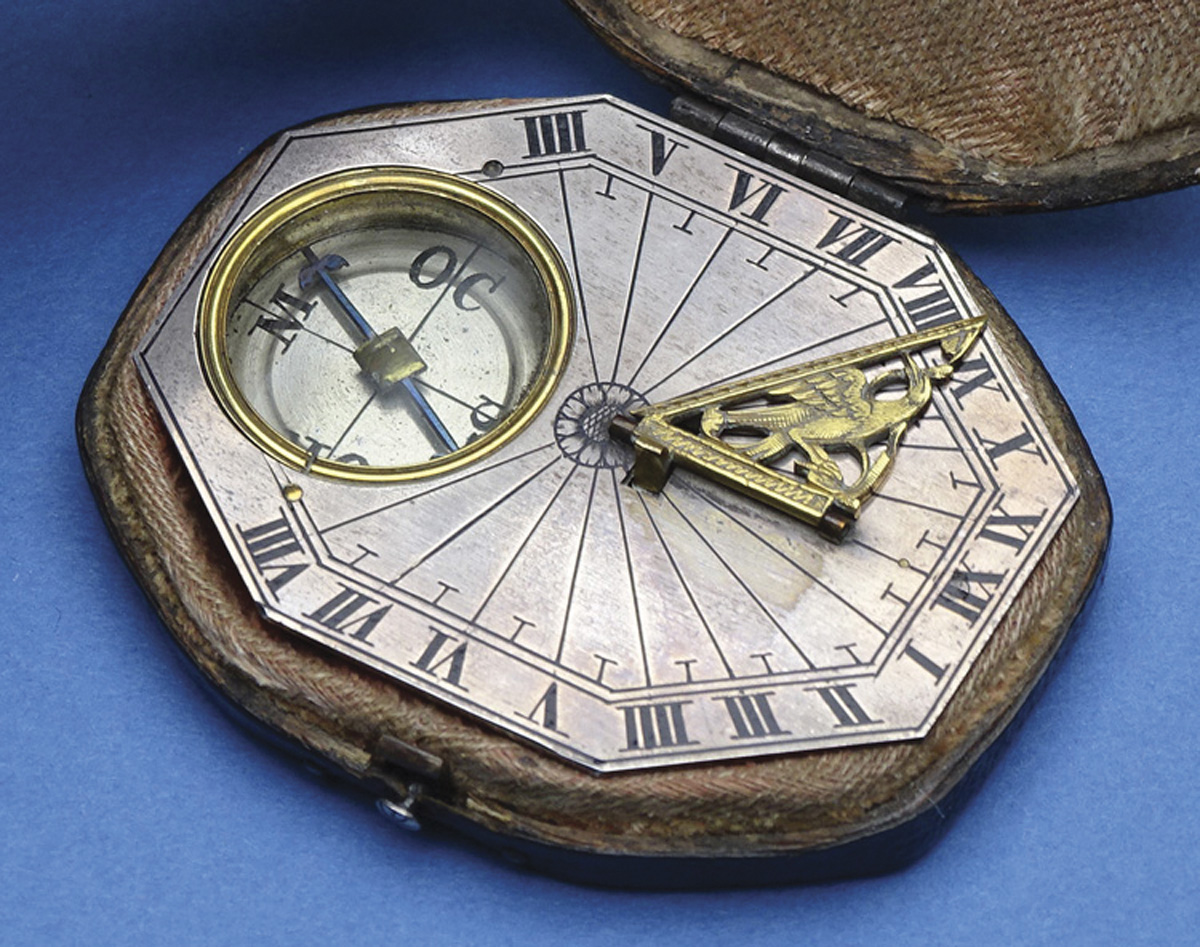
EARLY SILVER AND GILT POCKET DIAL, French, c. third quarter 17th century, unsigned but attributable to Salomon Chesnon (II) of Blois. This jewel-like compass dial has a 1-3/4" x 1-3/8" (45 x 35 mm) silver main plate engraved with a single-latitude chapter ring, divided every half-hour from 4am to 8pm. It is set with a hinged gilt gnomon, pierced and engraved with a splendid backward-looking bird unlike any found on the typical Butterfield-type dials. An inset glazed compass is engraved with Latin abbreviations of the four cardinal directions. The underside is plain but for the distinctive gilt spring plate, here shaped and engraved as a tall (sun?) flower. In excellent original condition throughout, it is complete with the original shaped case lined in silk and velvet, bound in patterned leather, and set with silver fittings. This unsigned dial is crafted in the finest traditions of French workmanship, perhaps typical of Blois which was known for the best of early timepieces. One of the earliest makers of this form was Salomon Chesnon II (1607-1683), son of a clockmaker. An oval dial by him is well illustrated in Cadrans Solaires by Delalande, and an eight-sided one is in the Louvre. Both show many detailed characteristics in common with the present dial, noting especially the "sunflower" spring plates. A beautiful jewel. (10146) $4950. |
 |
 |
| Elegant Time-Telling among Vines and Fruits and Birds, in 17th century Bordeaux | Click on any image for a larger view. Scroll to view more items. |
 |
 |
 |
 |
|
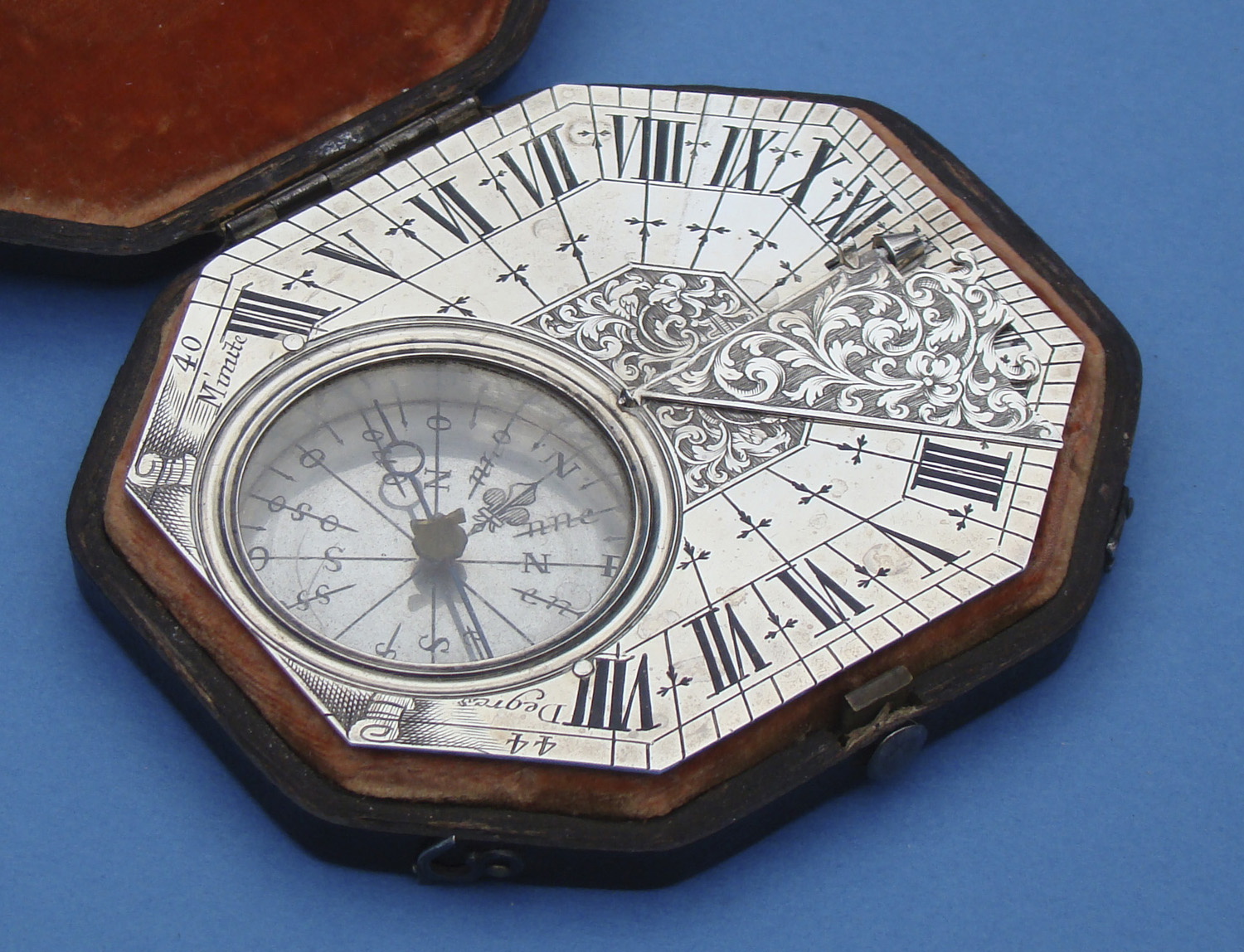
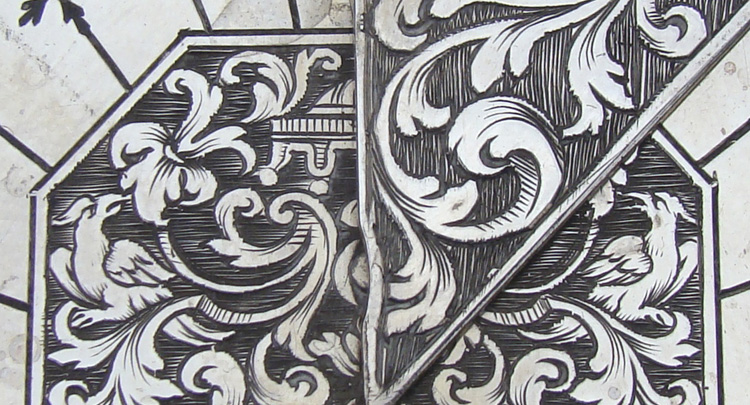
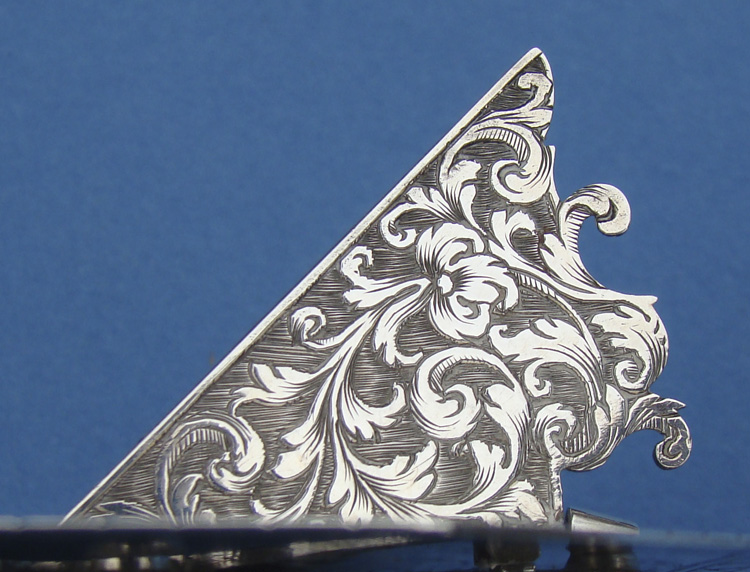
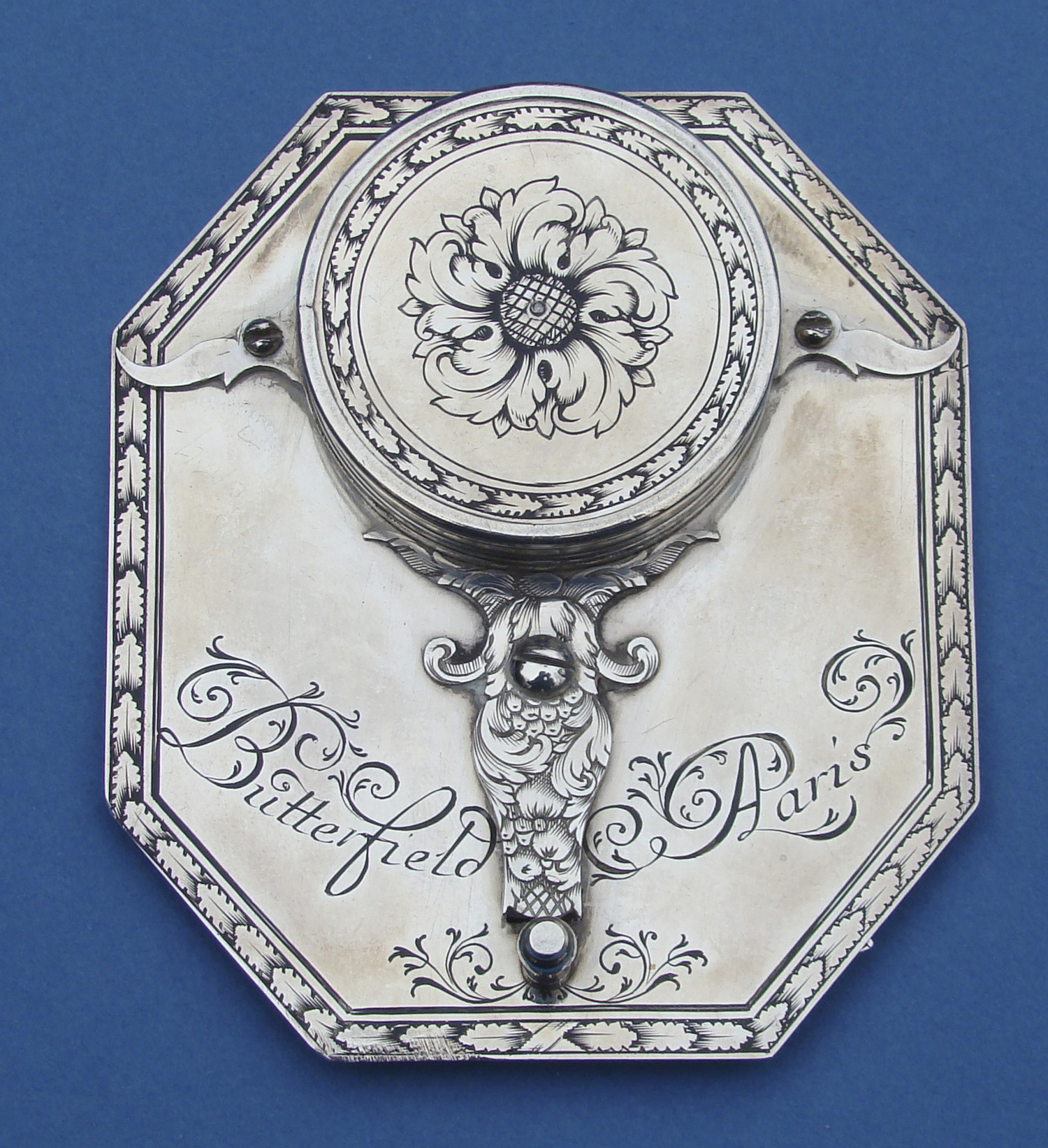
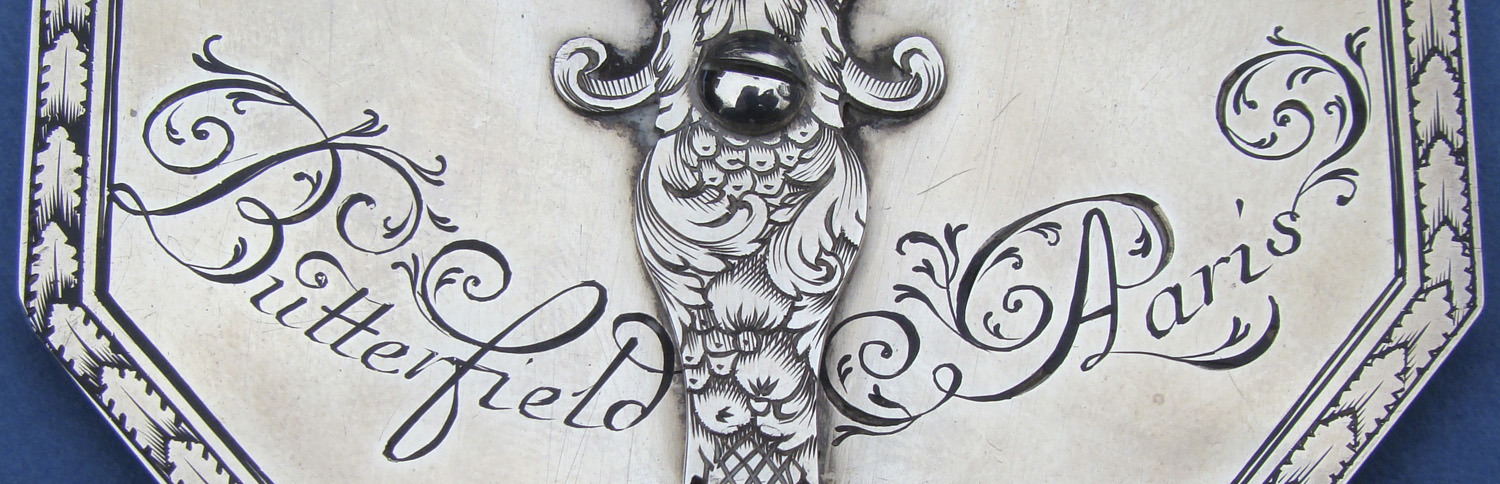
EXCEPTIONAL QUALITY BUTTERFIELD DIAL, French, c. 1680, signed with great flourish "Butterfield à Paris." The dial is solid silver, 2-5/8" x 3-1/16" (67 x 77 mm), and is made for a single latitude, 44°40¹ as marked on the single chapter ring. The main plate is engraved with a fine floral pattern housing two birds, and is set with a folding spring-loaded gnomon deeply engraved with floral designs, and with an inset compass with 32-point rose and delicate needle. The reverse has running leaf tip borders, compass base with fine flower in bloom, and spring plate with a cornucopia of fruit. Condition is excellent, complete with the original fitted case bound in black fishskin, lined in red velvet, and set with silver fittings. The design latitude is just south of Bordeaux center, and thus we have a superlative dial, by the pre-eminent maker, commissioned perhaps by a wealthy wine merchant or ship owner. This is the finest "Butterfield by Butterfield" dial we have been able to offer. (10175) $9800. |
 |
| Time-Telling in 19th century Japan | Click on any image for a larger view. Scroll to view more items. |
 |
 |
|
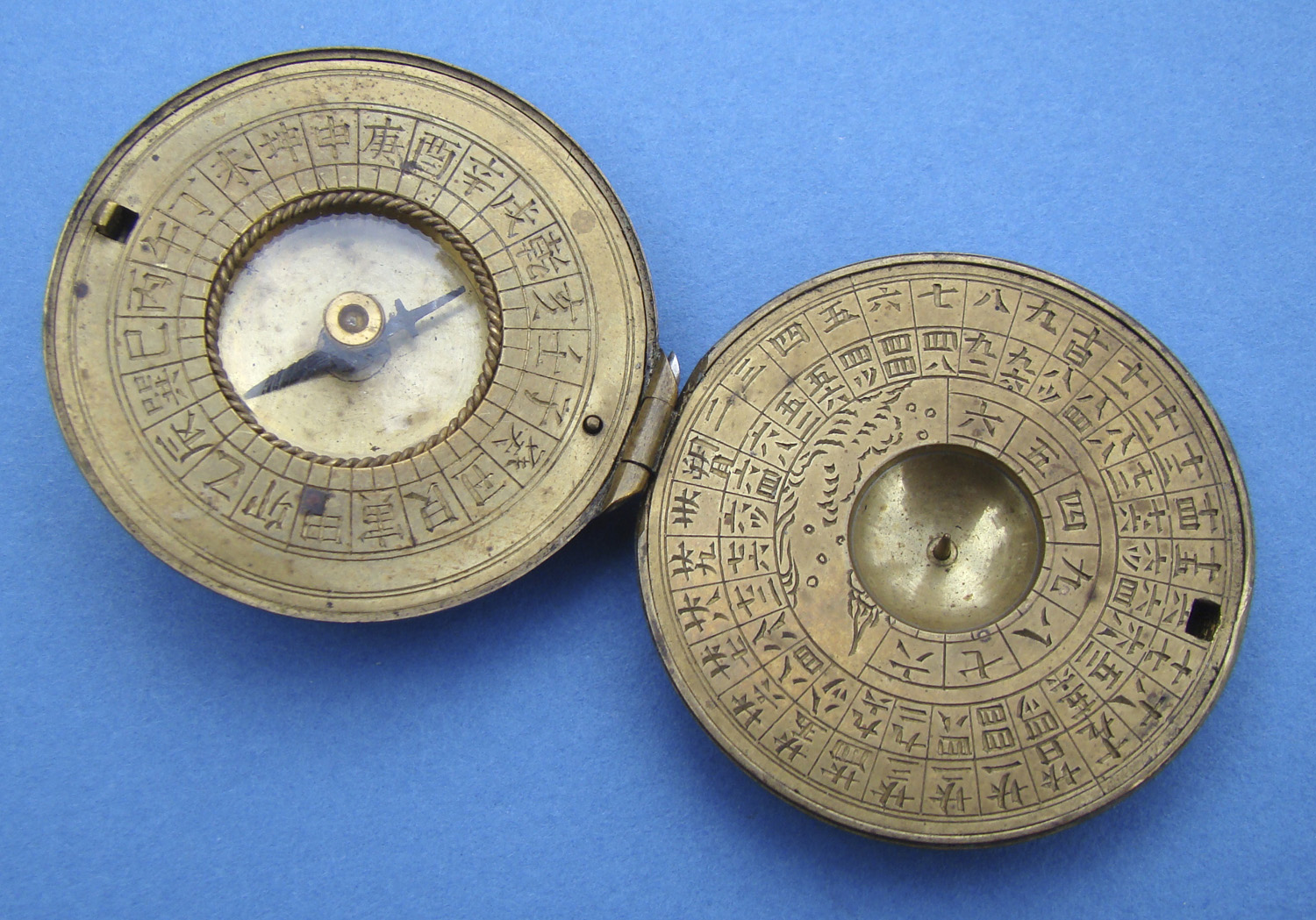
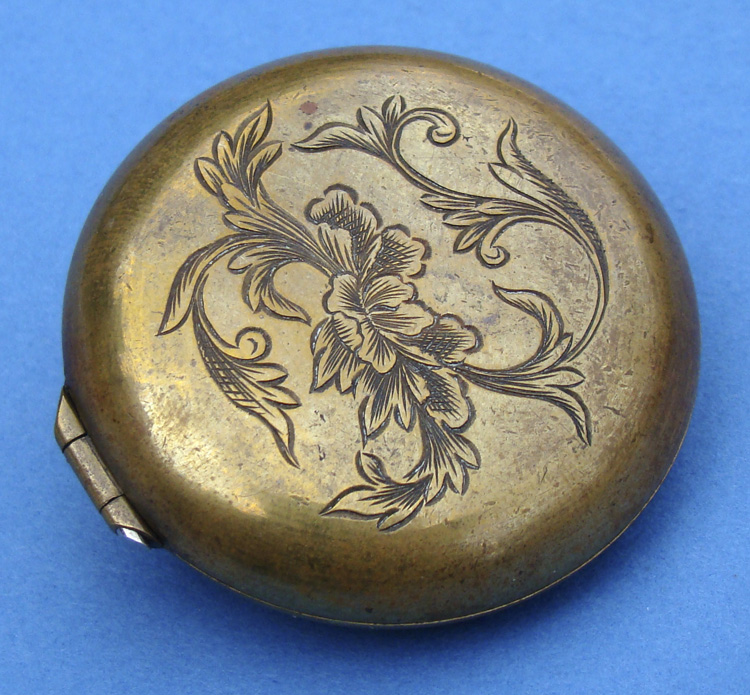
NETSUKE-FORM POCKET COMPASS / SCAPHE SUNDIAL, Japanese, c. first half 19th c. Measuring 1-1/2" (3.7 cm) in diameter, the flattened brass form is like that of a Kagami buta type netsuke. One side has writhing foliate engraving, the other set with a suspension ring. It opens to a compass on one side, surrounded by a circle of 24 directionals, with half divisions, and a scaphe sundial on the other, with two bands of 30 characters each, plus a chapter ring of seven hours, divided to the half hour and numbered clockwise 6, 5, 4, 9, 8, 7, 6. This is the old Japanese system of six daytime temporal hours, starting when clocks struck 6 at sunrise, 9 at noon, finally 6 again at dusk. Condition is very fine, the external brass now with a light brown patina. An excellent example of the Japanese pocket dial. ex: John Read collection (10165) $1350. |
| Time-Telling at 61 degrees North Latitude | Click on any image for a larger view. Scroll to view more items. |
 |
 |
 |
 |
|
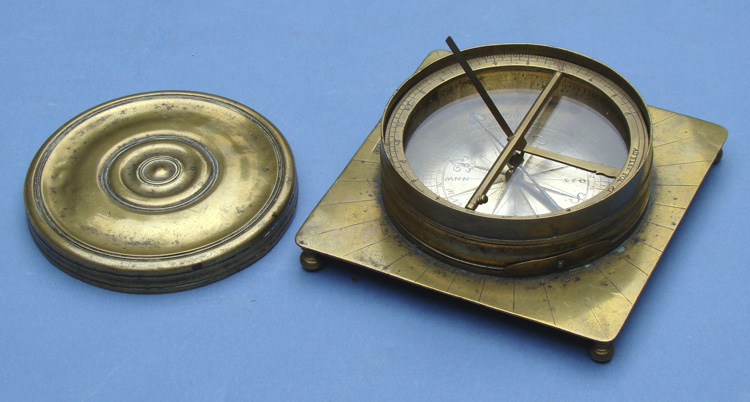
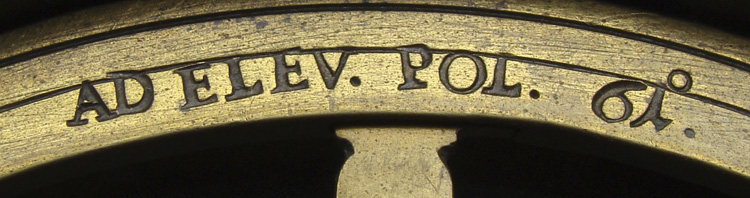
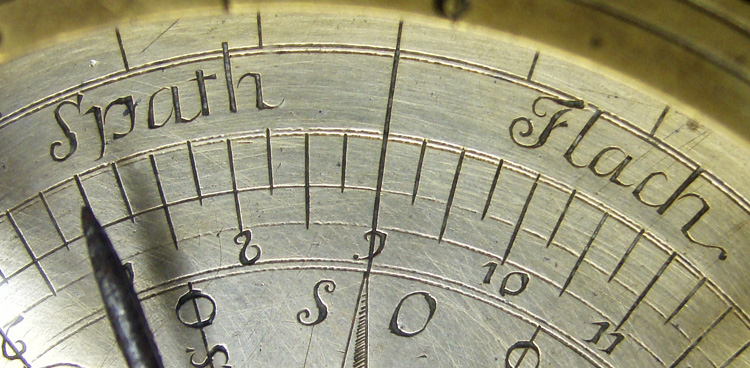
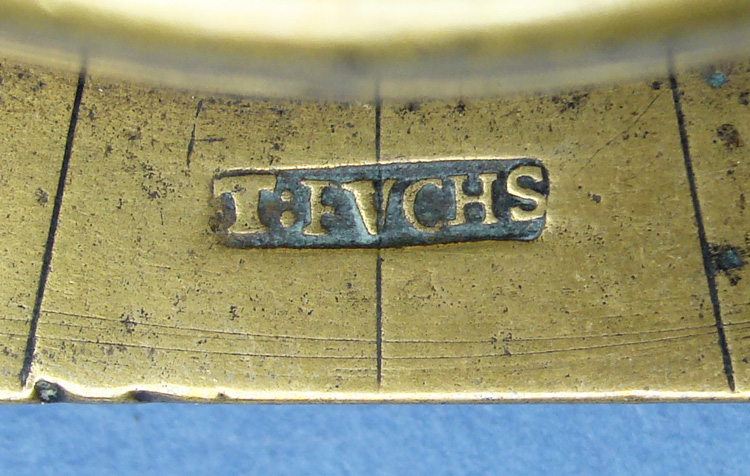
A FINE SWEDISH DIAL, c. 1740, signed "T. Fuchs." The brass main plate is 4" (10 cm) square, supported by four turned feet and divided by 32-point radiating lines. Atop this is mounted a fairly deep glazed compass, with finely engraved silvered face divided in a standard 16-point rose (with directionals NNO, WSW, etc.), and also in a circle of twice-12 hours subdivided by quarter hours, each eighth of the circle marked, clockwise from north: "Stehend, Morgen, Spath, Flach" (and repeating). There is a shaped arrow needle and needle lifter, and above the glass a horizontal sundial with circular chapter ring divided every 5 minutes from 3am to 9pm, and stick gnomon which flips up to the fixed latitude of 61°, and so marked. The finely turned brass cover is present, and all is complete and in fine condition with light wear. The design latitude is even further north than that of Stockholm (59°) and Uppsala (60°). The instrument has interesting features of this area, viz., the scale accommodating longer than usual daylight hours, and the compass well deep enough to accommodate considerable dip in the needle (typically caused by iron deposits in Sweden). Thomas Fuchs was a German maker invited to Sweden by Anders Duhre, and recorded working there c. 1733-1745. He taught instrument making and mathematics at the Laboratorium mathematico-oeconomicum in Uppsala, which he ran, and was eventually appointed Instrument Maker to the University (Pipping, 1991, The Chamber of Physics.) (10135) $4500. |
| Just Set the Date and Point at the Sun | Click on any image for a larger view. Scroll to view more items. |
 |
 |
 |
 |
|
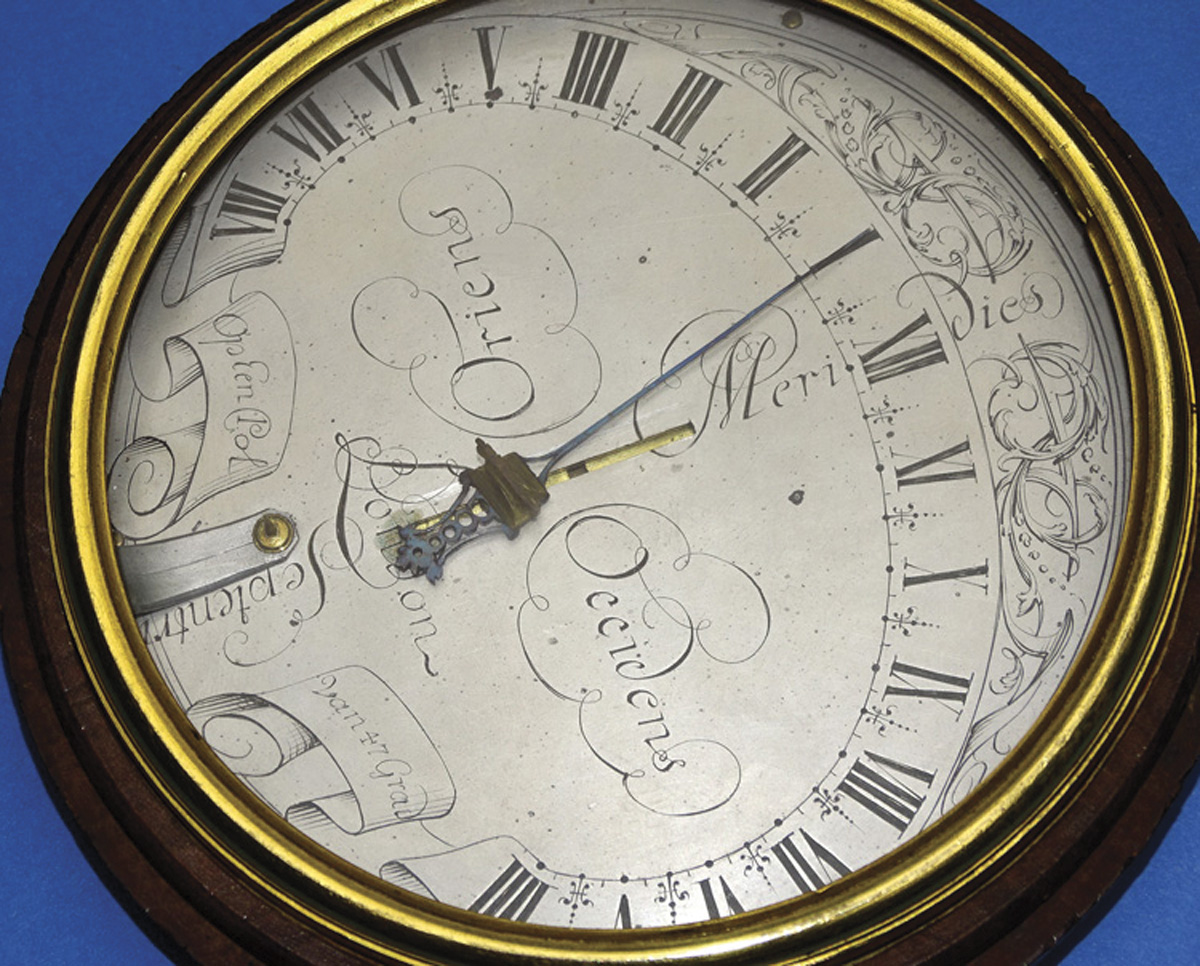
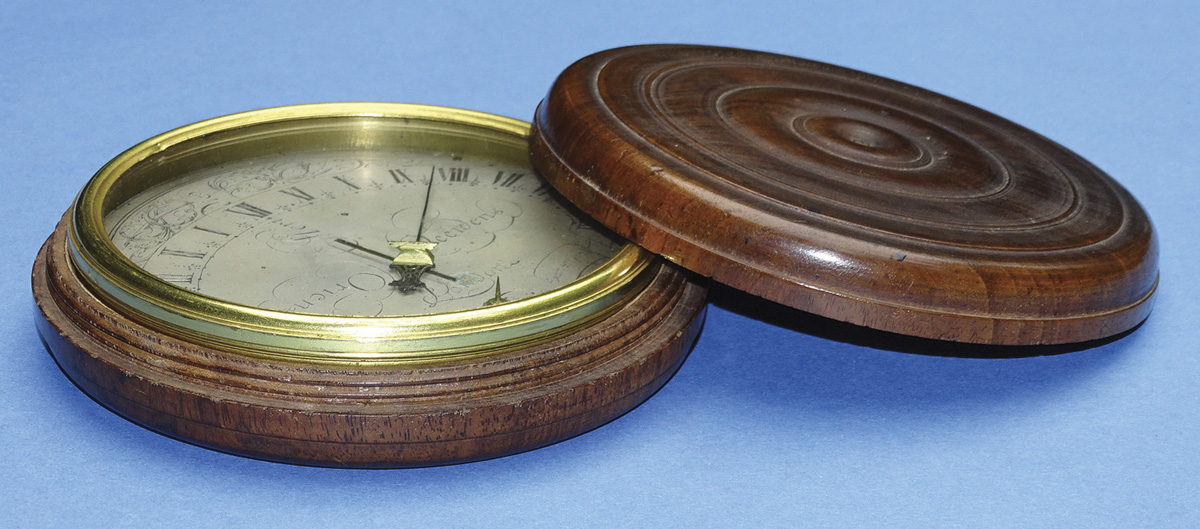
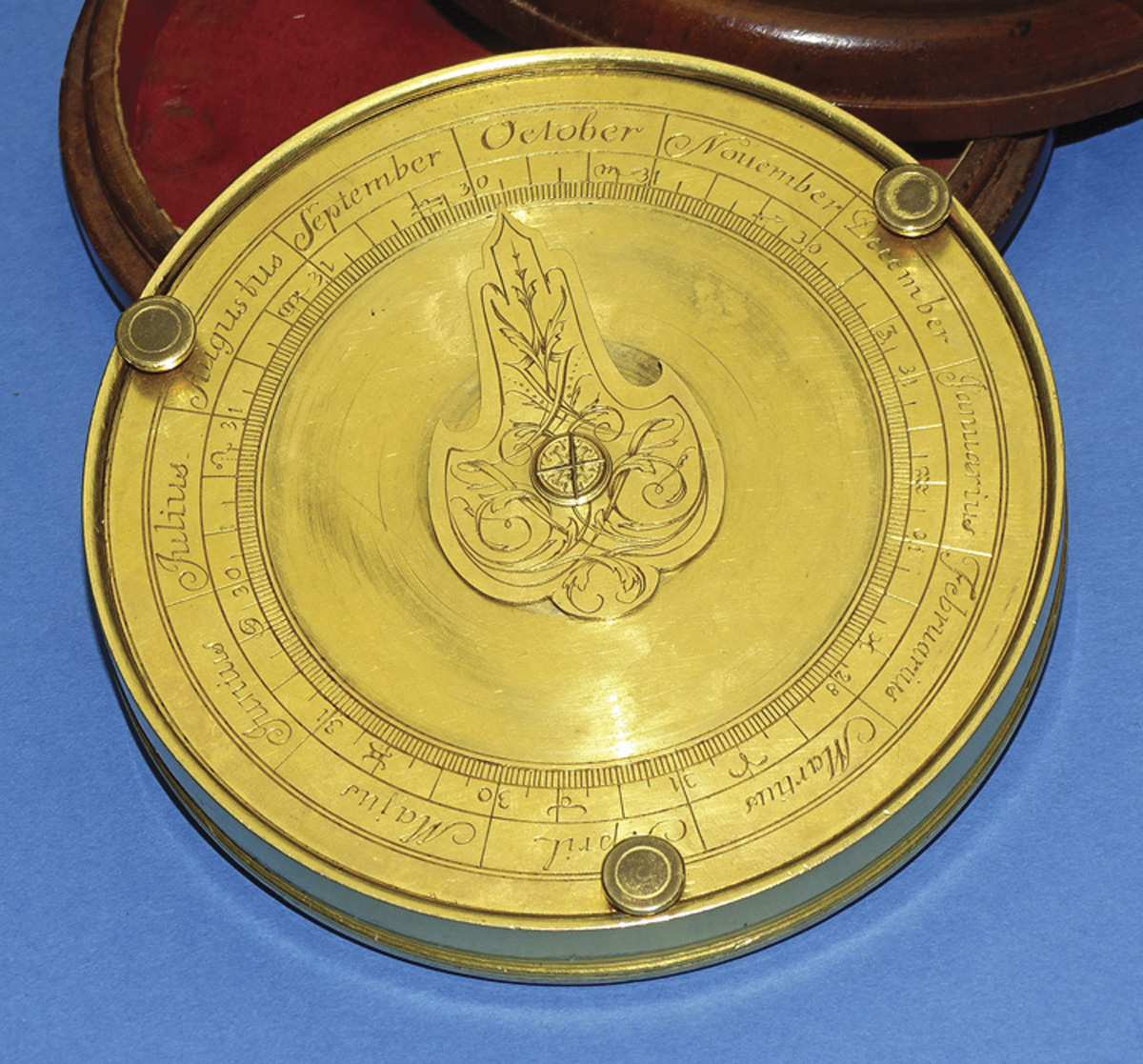
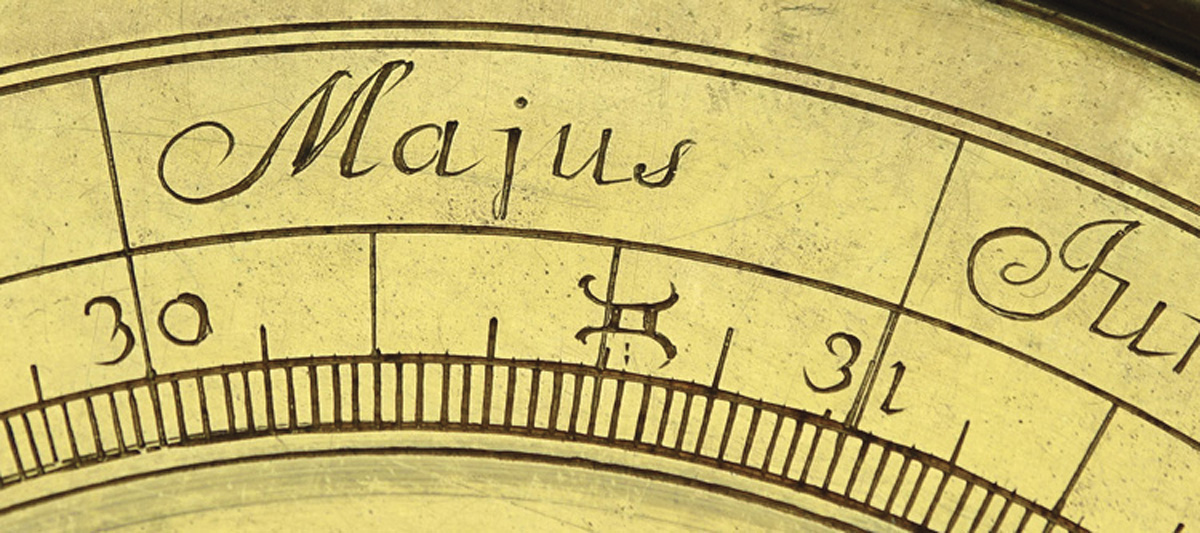
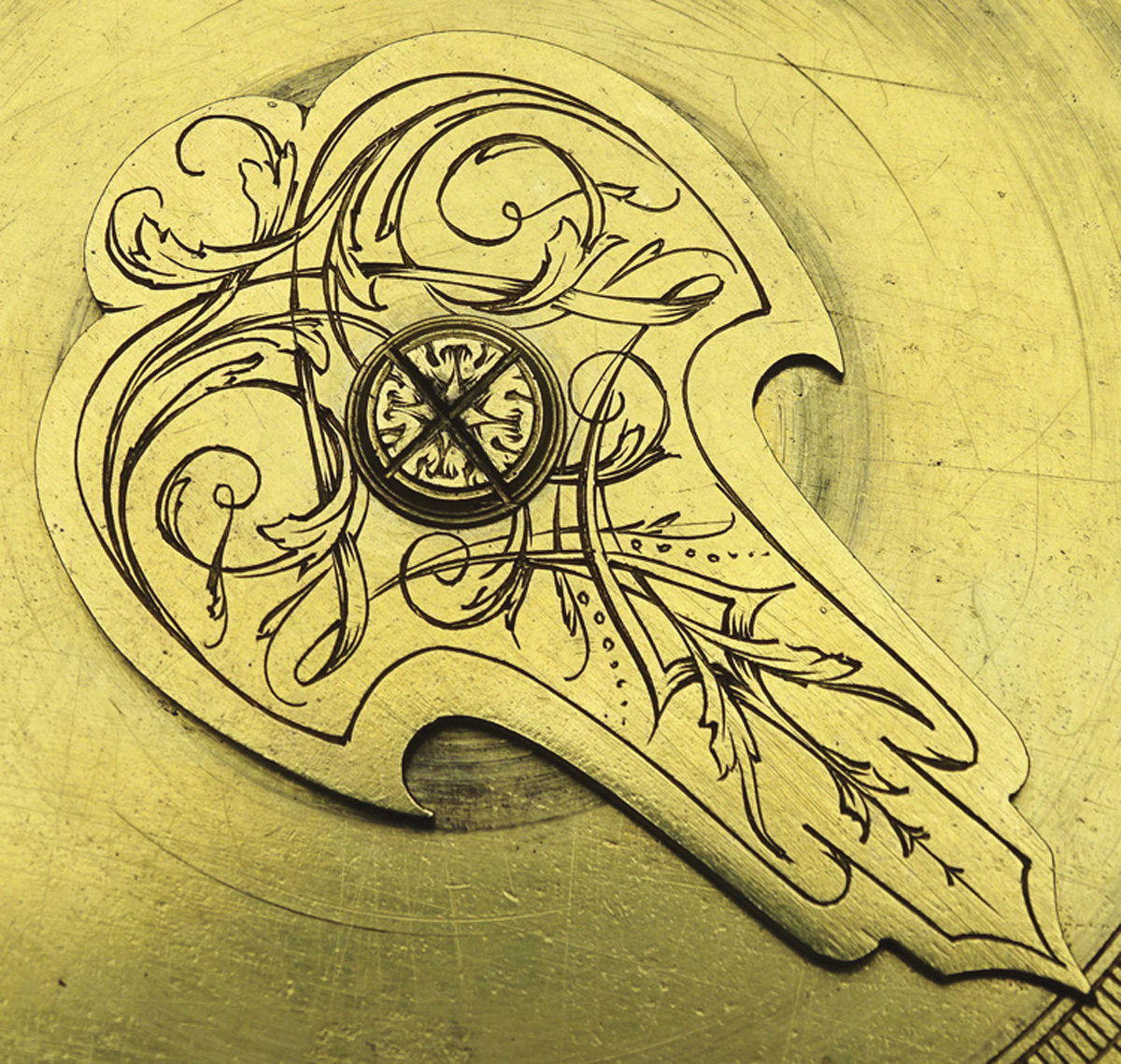
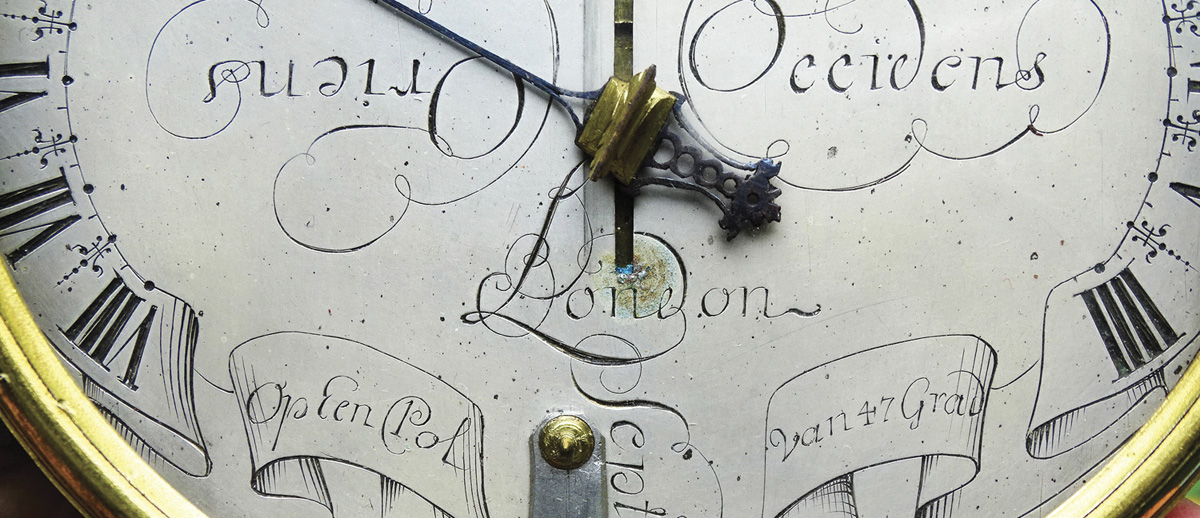
AN EXCEPTIONAL MAGNETIC AZIMUTH COMPASS DIAL, Dutch, c. 1700. The 5" (13 cm) diameter gilt brass body is almost 1" (2.5 cm) thick, standing on three round feet. It has a large glazed compass with silvered dial beautifully engraved with an oval chapter ring, principal compass directions (in Latin), swirling foliate decor, an engraved banner with the inscription "Op Een Pol van 47 Grad" and the enigmatic "London." The compass needle has a slender long arm to one side and finely shaped and pierced short arm to the other. The hub has a central brass knife edge to keep the needle on the pivot. The gnomon is a short pin at the end of a little alignment line. The underside reveals full circle calendar and Zodiacal scales (showing 20 March vernal equinox), and an exquisitely engraved rotatable index which translates the needle pivot along the 12 noon "meridian" line, positioning it for the current date. The dial is contained in its original turned wood case, lined with chamois and with screw-on cover. Condition is excellent noting one discolored spot on the dial face, and the needle needing remagnetization. This is a beautiful example of a direct-reading azimuth dial. After setting the index (and thus the pivot position) to the current date, you point the compass towards the sun (indicated by the little gnomon and fiducial line) and simply read the time by the position of the needle. It is of course laid out for a single latitude, and presumes a magnetic declination offset of 0° (which obtained in much of Europe in the late 17th c.) The dial is unsigned, but design and execution is of very high quality. The months and directions are in Latin, the latitude inscription in Dutch. The latitude of 47° has nothing in common with London (at 51°30'), but rather Bern, Graz, Budapest, etc., leaving us with a small mystery. An exceptional piece (ex: van Damme collection). (10156) $12,500. |
 |
 |
| How to Make a Sundial, etc. | Click on any image for a larger view. Scroll to view more items. |
 |
 |
|
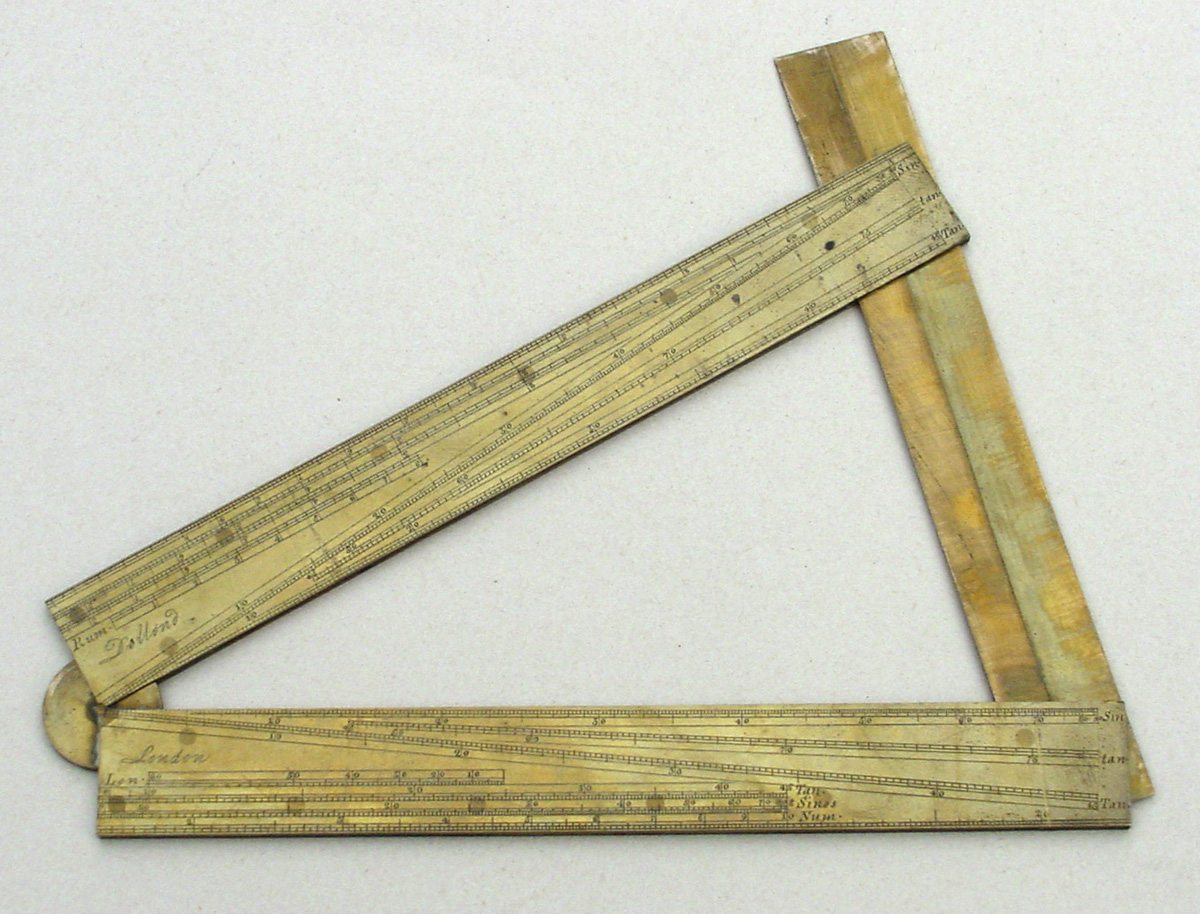
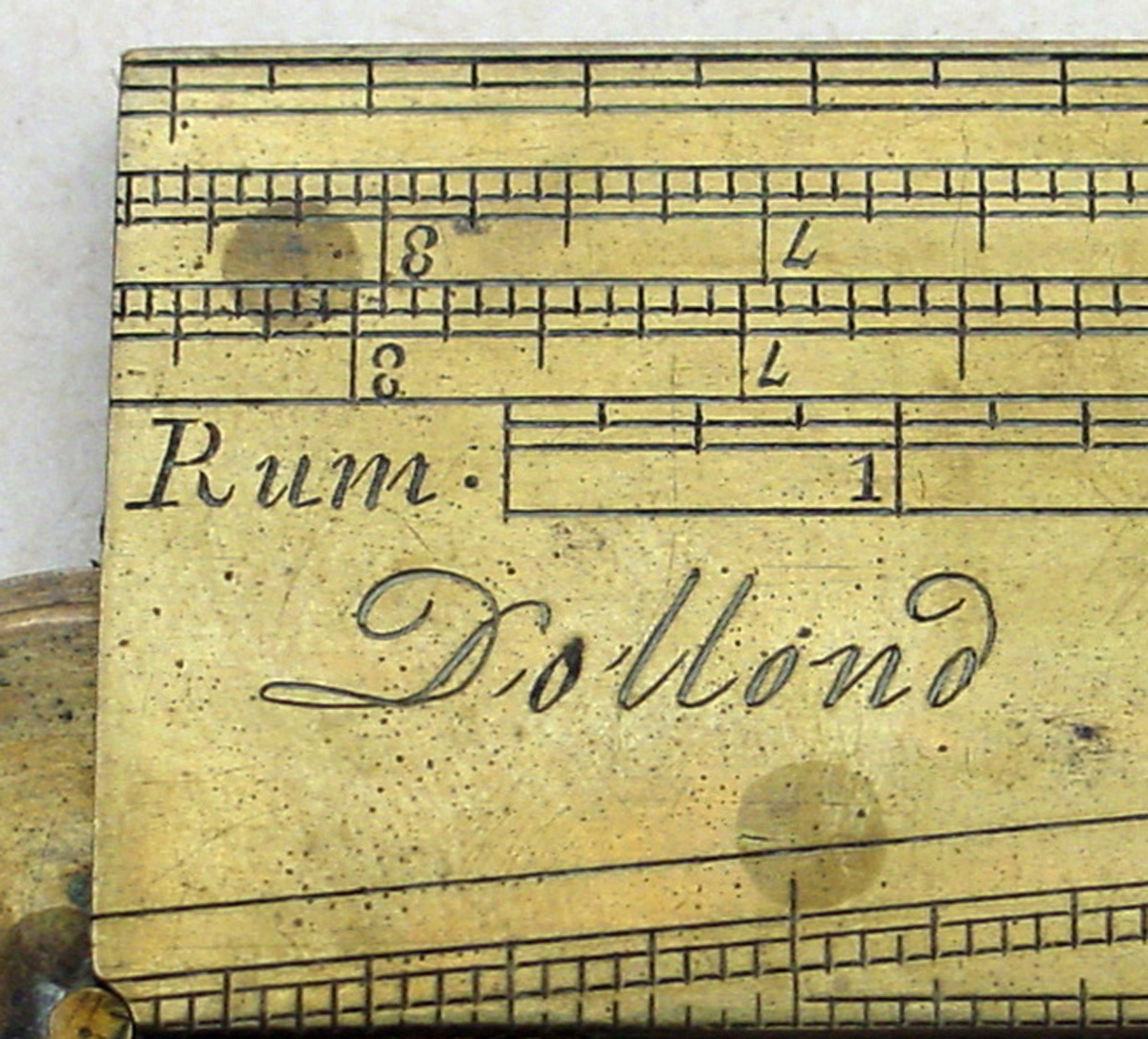
AN EXCEPTIONAL SECTOR, English, late 18th century, signed with flourishes "Dollond, London." The brass sector is 6-3/8" (16 cm) long closed, opening to 12" and equipped with hinged support strut. It is a relatively standard English form with trigonometric scales, logarithmic, etc., but also with a full complement of scales for sundial making (In. Me., Lat., Hou.), for navigation (Rum., Lon., Cho.), etc. All is extremely well divided, and with the tiniest of engraved numerals throughout (some less than 0.02" tall, i.e., less than half a millimeter tall). An exceptional sector, in very fine condition. (8356) $1450. |
| 17th century English Silver | Click on any image for a larger view. Scroll to view more items. |
 |
 |
 |
 |
|
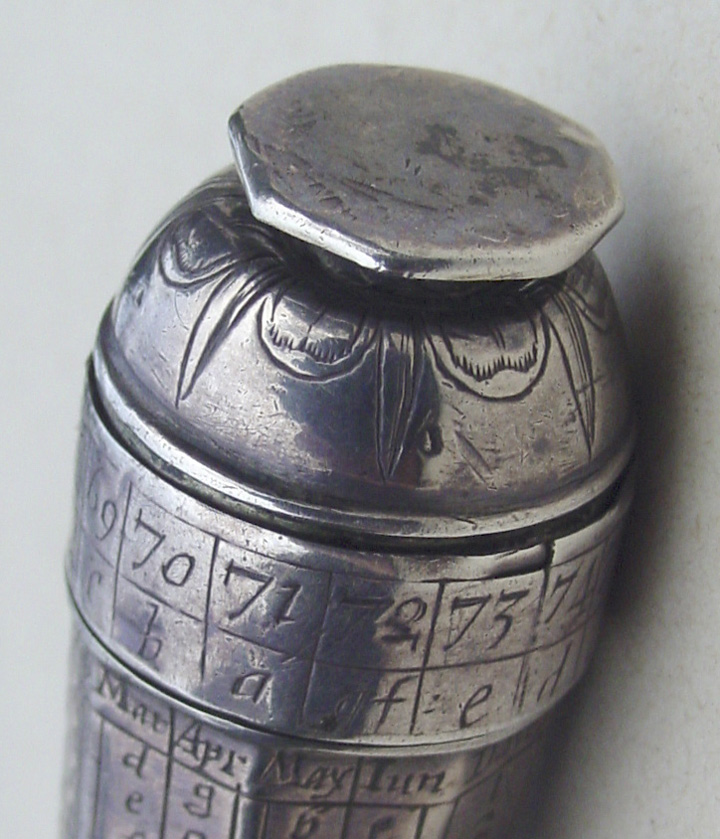
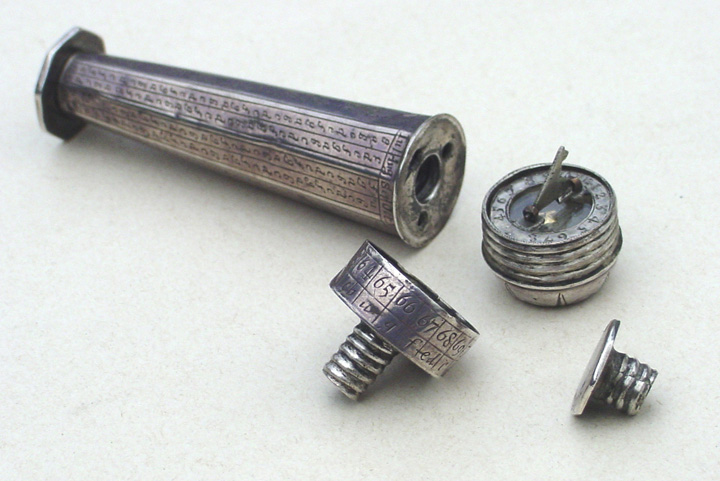
HOROLOGICAL COMPENDIUM IN SILVER, probably English, c. 1663, standing 3-3/16" (8 cm) tall when assembled. Constructed of silver (with some internal fittings of heavy silver plated brass), the compendium disassembles somewhat as a "penner," into five components: (1) a tapered eight-sided body very finely engraved with two columns of "Dayes" from 1 to 31, and twelve columns of repeating sequential day letters "a" through "g"," one column for each "31-day" month of the year. Three internal holes in the body could store very small materials (quill, cutter, wax, etc.); (2) removable cap engraved with the year from 63 to 78, each with corresponding one or two day letters; (3) miniature horizontal sundial with folding gnomon inclined for approx-imately 43° latitude, 5/8" (16 mm) diameter chapter ring (4 am - 8 pm, Northern hemisphere), and glazed compass with tiny arrow shaped needle with shaped brass hub. The base of the sundial, which faces upward when the compendium is assembled, is engraved with a lovely seven-pointed rose; (4) octagonal screw-on cap which could hold a small wick, etc., and which serves as a foot for the sundial; (5) octagonal screw-on base which could hold, for example, a candle. Thus we have a pocket calendrical / horological / compendium which could carry small writing / letter sealing material. Condition is fine, noting several small dents, some wear around the base of the body, and wear to the threads. As to origin, the language is clearly English ("Dayes"); the numeral shapes do have an English look, except for the seraphs on the "1's" and the accentuated tail on some of the "7's." The latter is found, interestingly, on some of Henry Sutton's engraving (see, e.g., Gunther, 1936). The measured sundial latitude, if accurate, is quite interesting, suggesting manufacture for the Mediterranean, or even for the early American colonies (Boston, Albany,...). As to date, the tables give a ready clue, as they present a perpetual calendar for the days of the week. Starting with "a" for 1 January, there is a continuous recurring cycle through the seven letters for the full year. Meanwhile the table on the cap gives the Dominical letters for years 63 through 78. Thus "63" is "d," making 4 January a Sunday, in complete agreement with the Julian calendar in effect in England in 1663. The Dominical letter for 1763, by contrast, and of course under the adopted Gregorian system, is in fact "b." We find further complete correspondence through the years 1663 - 1678, so this perpetual calendar compendium must have been constructed c. 1663, for use over the next 15 years. A remarkable device, of high quality. (7164) $9500. |
| Brandegger's Time-Telling "Sextant" | Click on any image for a larger view. Scroll to view more items. |
 |
 |
 |
 |
|
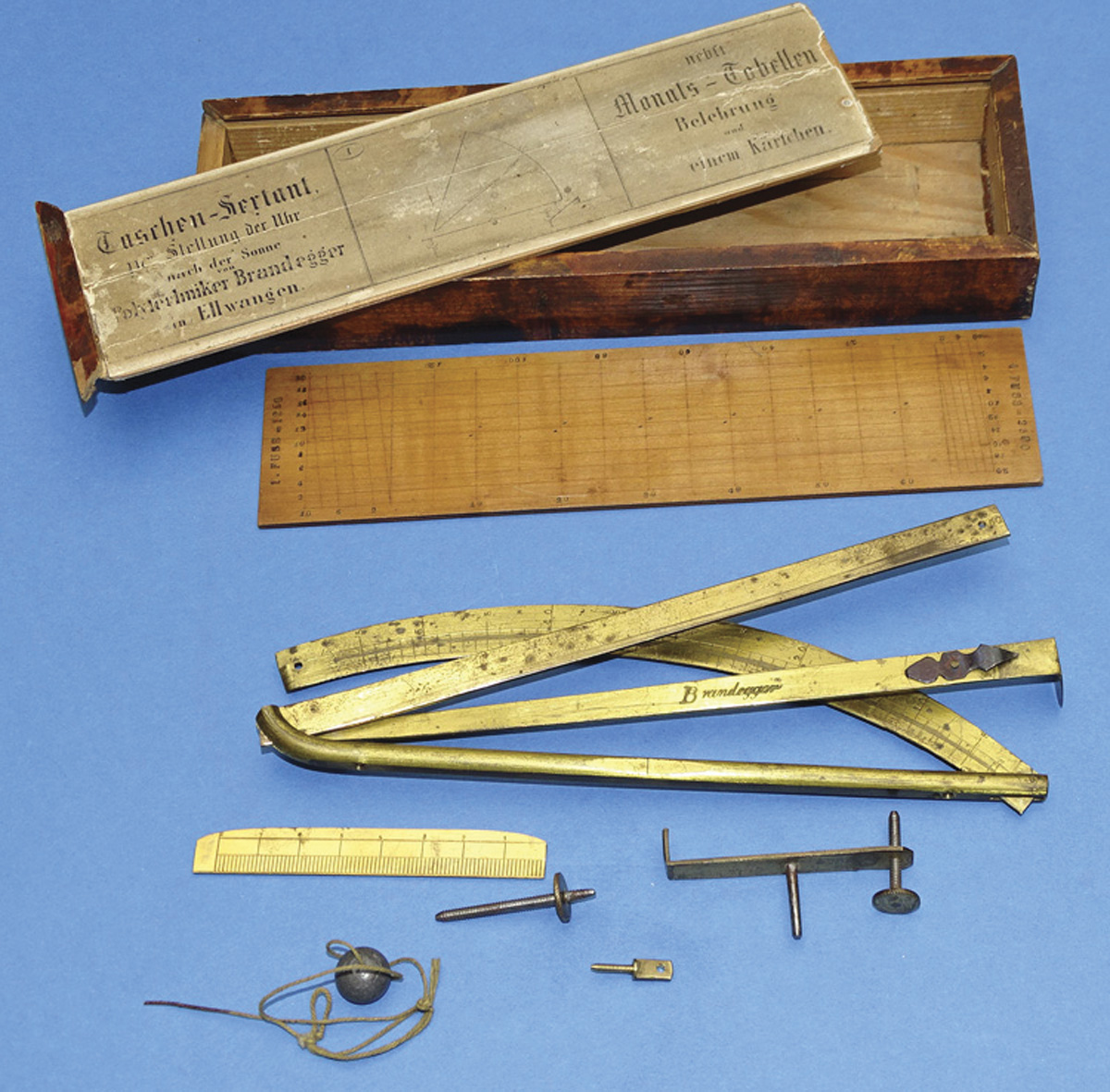
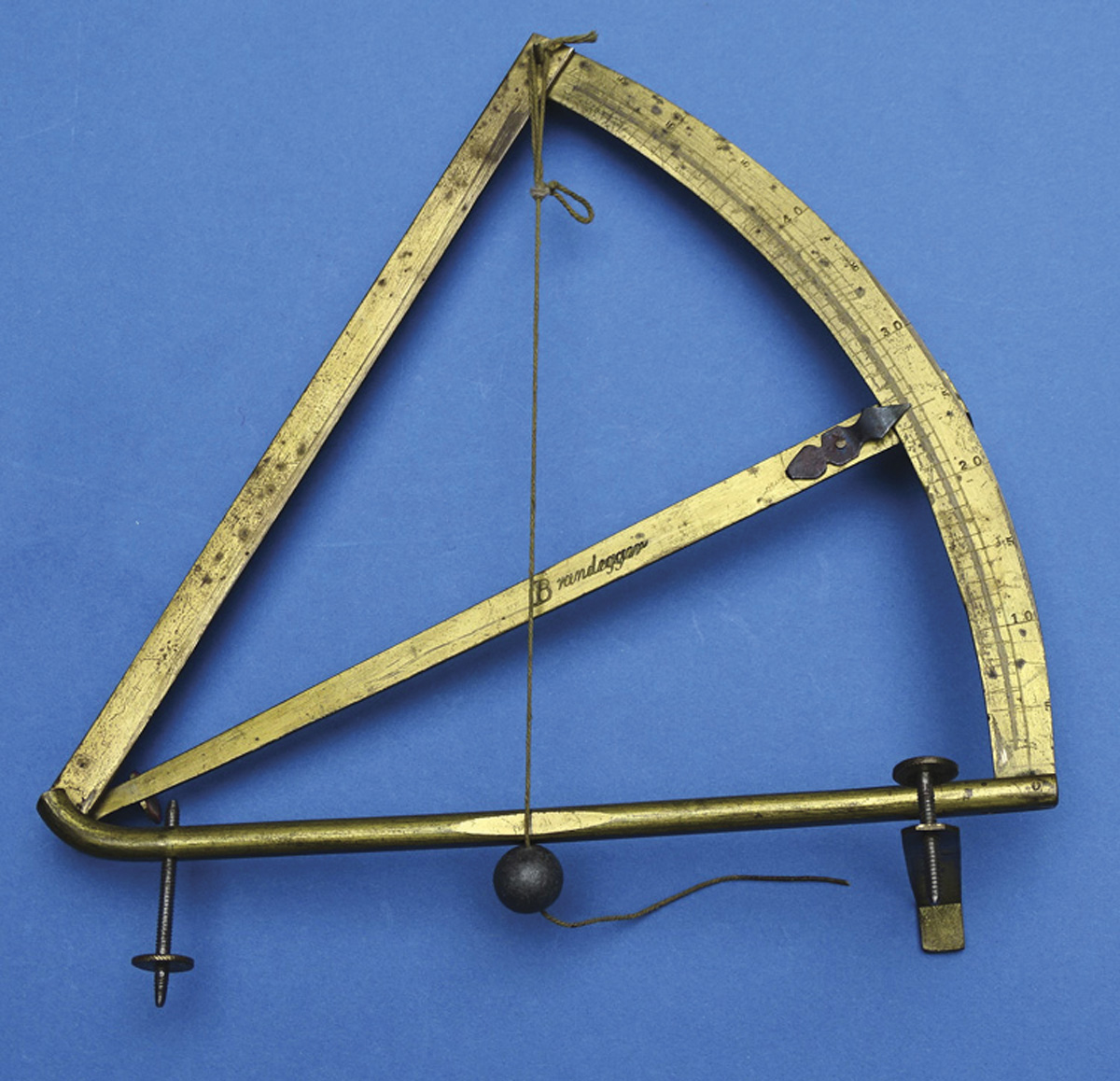
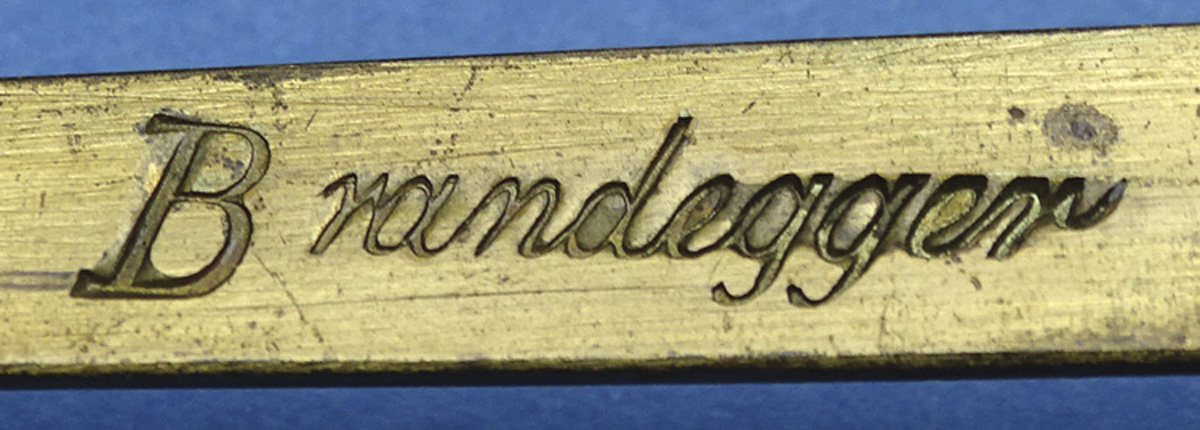
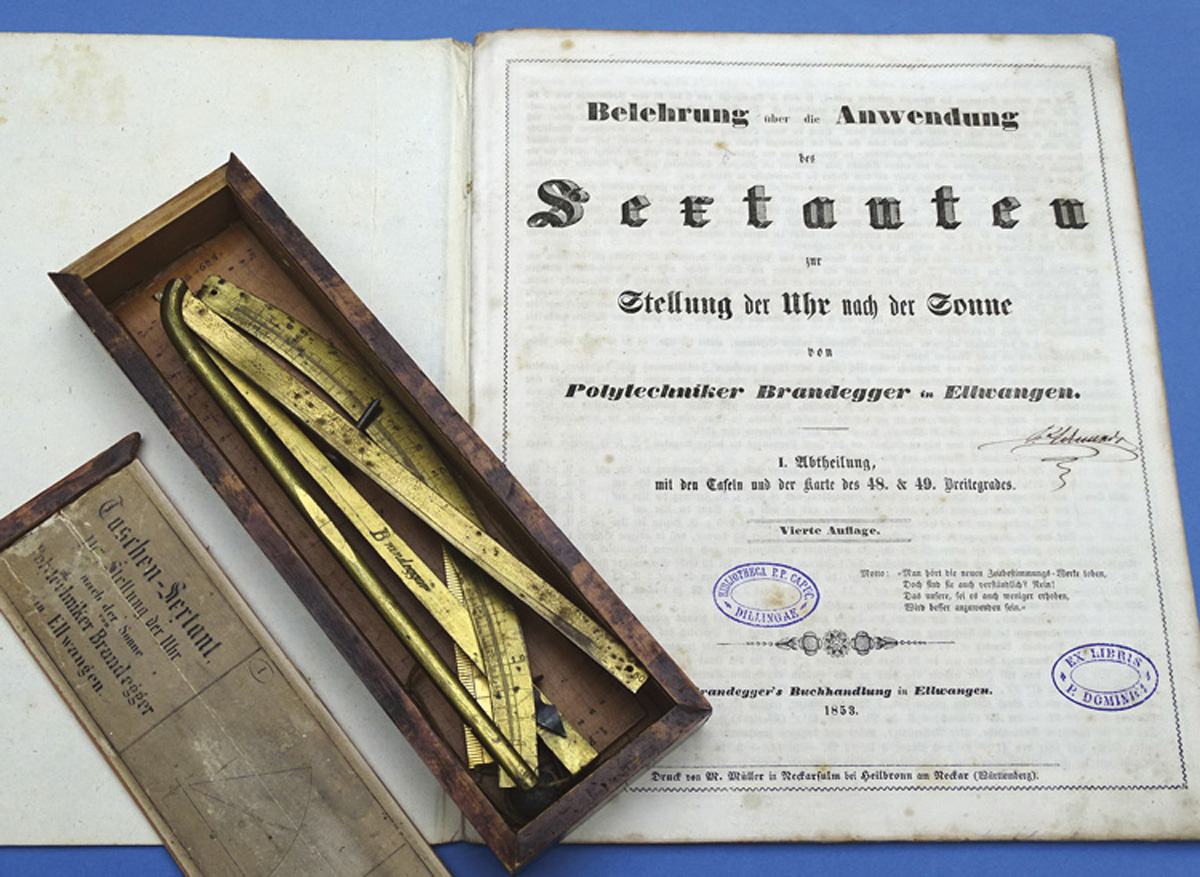
THE "TASCHEN-SEXTANT" -- A PORTABLE SOLAR OBSERVATORY FOR TIME DETERMINATION, German, c. 1850, signed "Brandegger." This 7-3/4" (20 cm) long brass instrument sets up on three feet with twin leveling screws, a 60° arc divided every degree from 5° to 55°, a stabilizing arm from which is hung a plumb line with lead weight, and an adjustable alidade with pinhole and painted target. It all disassembles to fit in its small paint-decorated wood box, the sliding cover with printed paper diagram and identification. Instrument and case are in fine condition noting some wear. Included in the box are wooden and brass chart rules. The maker was J.A. Brandegger (1797 - 1890), Polytechnician in Ellwangen, Germany, who published on this Sextant in 1853, and on his "Inductionsglobus" in 1856. Included here is his original sextant publication, bound in heavy card boards 9" x 11" (23 x 28 cm), with two pages of detailed text, 20 pages of tables, and a latitude map for the 46°- 49° swath across Europe. The book bears an owner¹s signature, and stamps for an owner and for the Capuchin Monastery Library in Dilligen (also in Bavaria, 35 miles from Ellwangen, former residence of the bishops of Augsburg). Brandegger presents (in German) instructions on the application of his sextant to determining time by the sun. (10176) $1450. |
| Sixteenth Century Dial, ex:Gerard Turner Collection | Click on any image for a larger view. Scroll to view more items. |
 |
 |
 |
 |
|
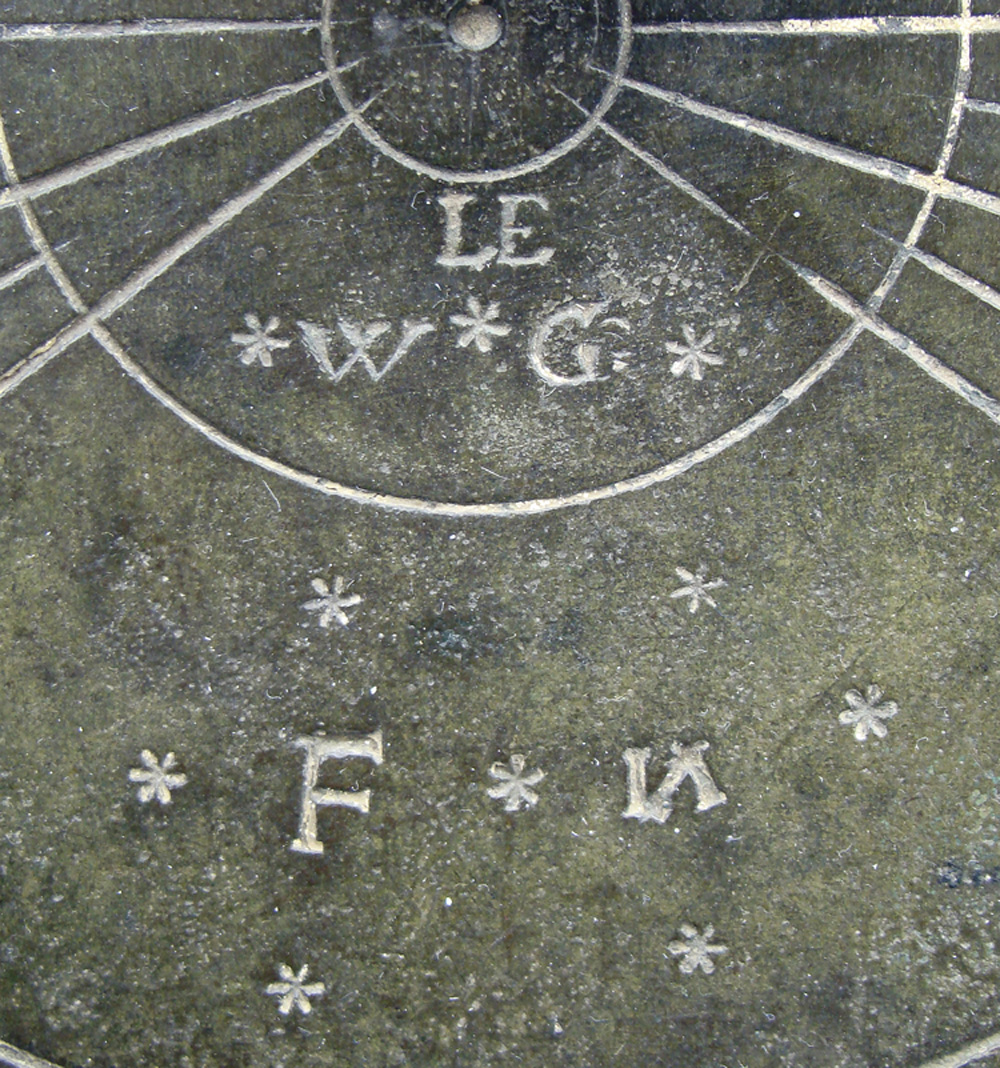
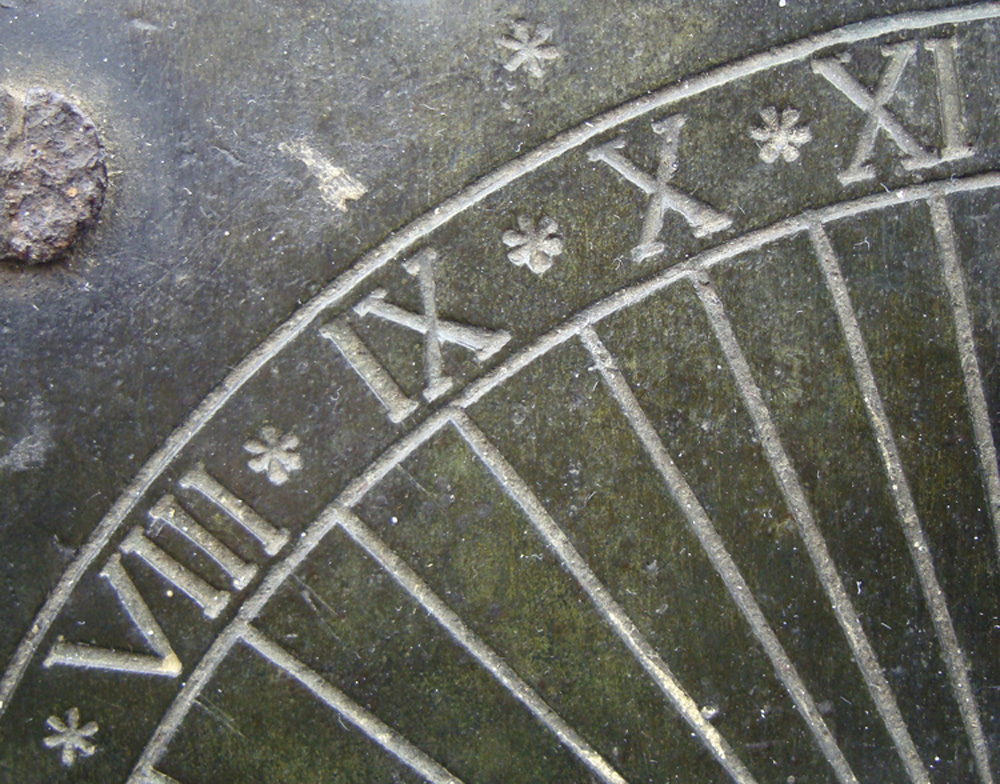
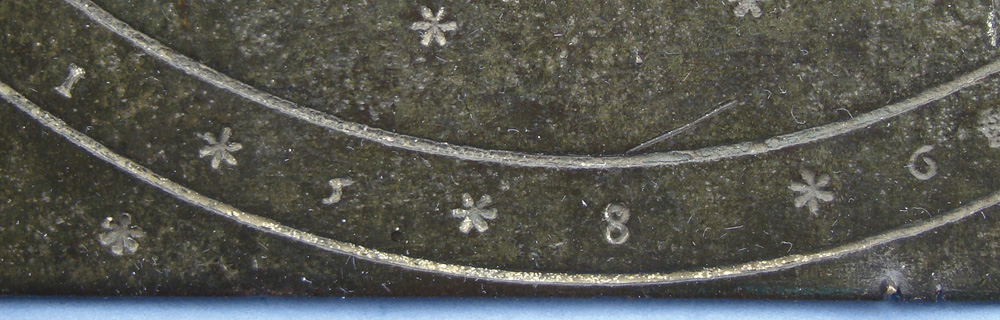
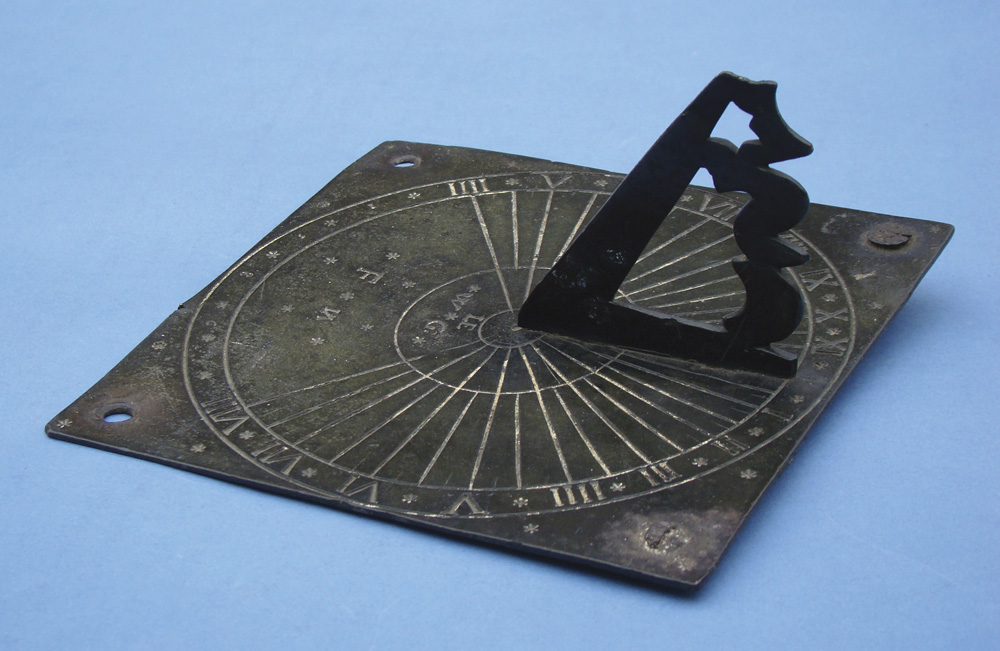
SIXTEENTH CENTURY SUNDIAL, probably Flemish or Wallonian, 1586, signed "LE*W*G*" and "F*N" and dated. Made of hammered brass 5-3/4" (15 cm) square, the dial is well executed, scribed with bold lines every half hour from 4am to 8pm with scratch (layout?) lines at the quarter hours, and hand stamped with the hours, initials, date, and star punch decorations. We note with amusement that the maker produced four "I" punches at the 5pm line, before hammering that out and using his "V" punch. Condition is fine noting some denting and very old loss of the tip of the gnomon. The brass has a fine dark brownish-green patina throughout, and there are remains of very old iron mounting screws. The gnomon angle is approximately 52°, and the hour lines are laid out for a latitude of 51° - 52°. Thus the dial was constructed for a latitude passing through London, Antwerp, Köln, etc. On stylistic and linguistic grounds, it must be Continental, most likely Flemish or Wallonian. Sixteenth century scientific instruments are difficult to find, this one a fine example of the window or garden dial, fully dated, by an as yet unidentified maker. ex: Gerard Turner collection. (10162) $4950. |
| The most complex Astronomical Quadrant | Click on any image for a larger view. Scroll to view more items. |
 |
 |
|
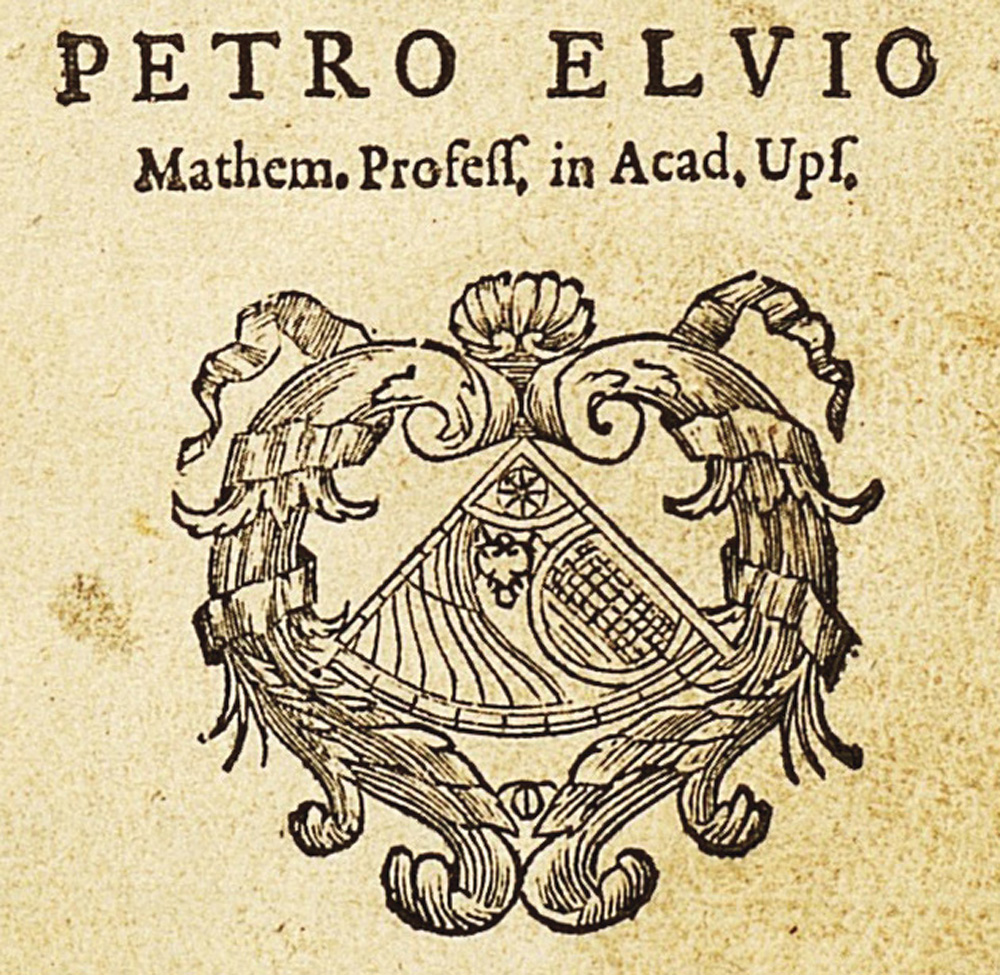
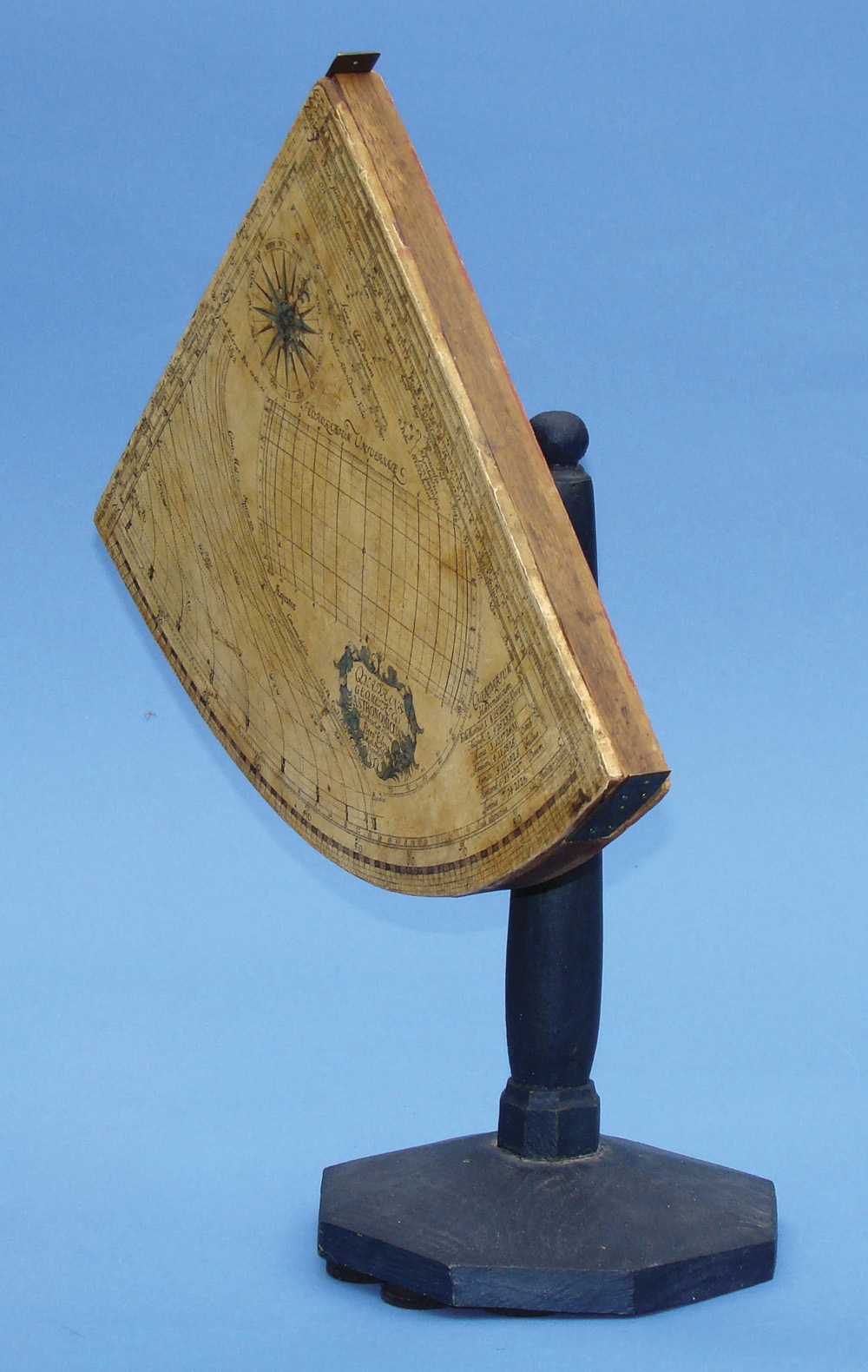
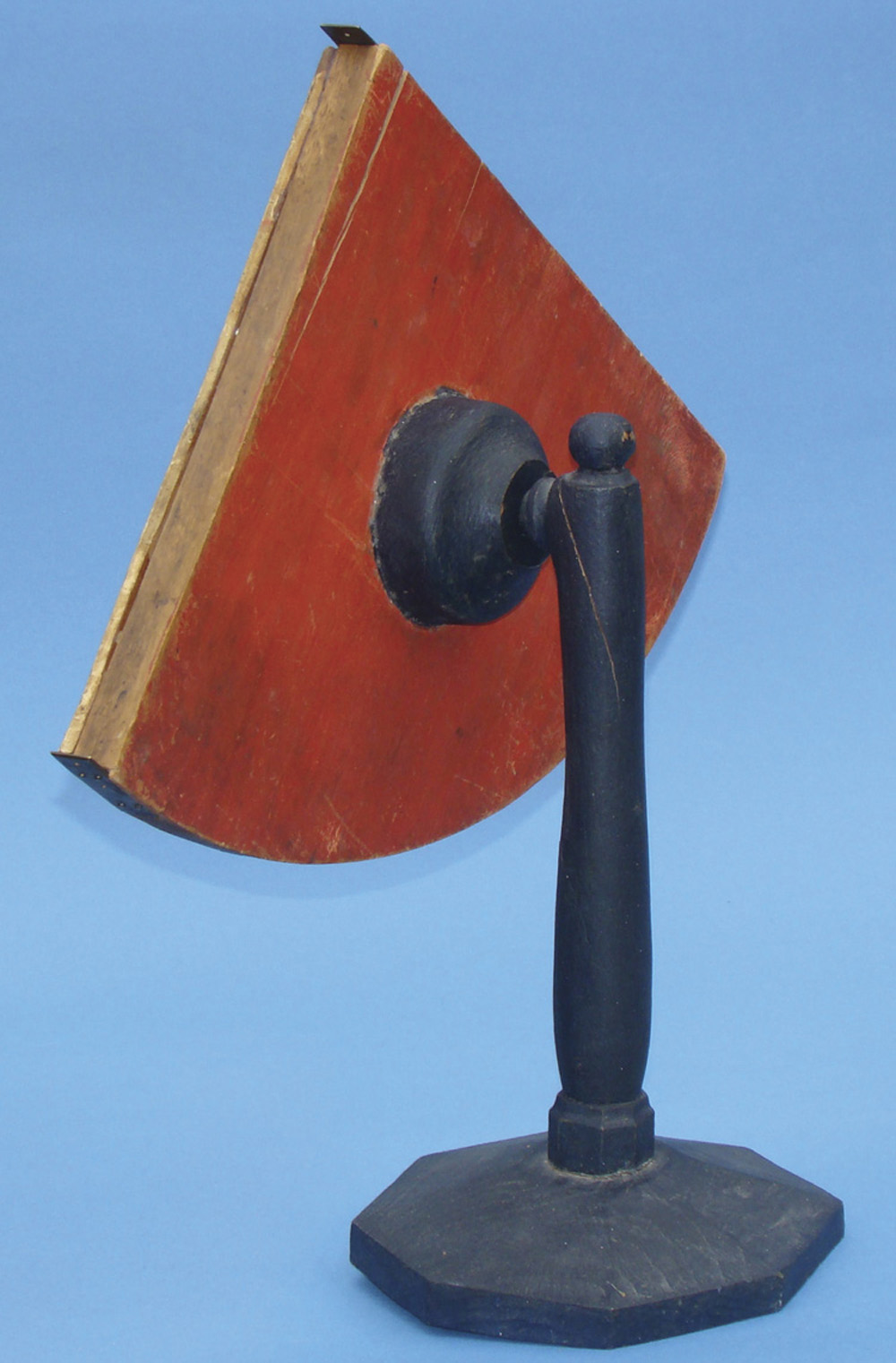
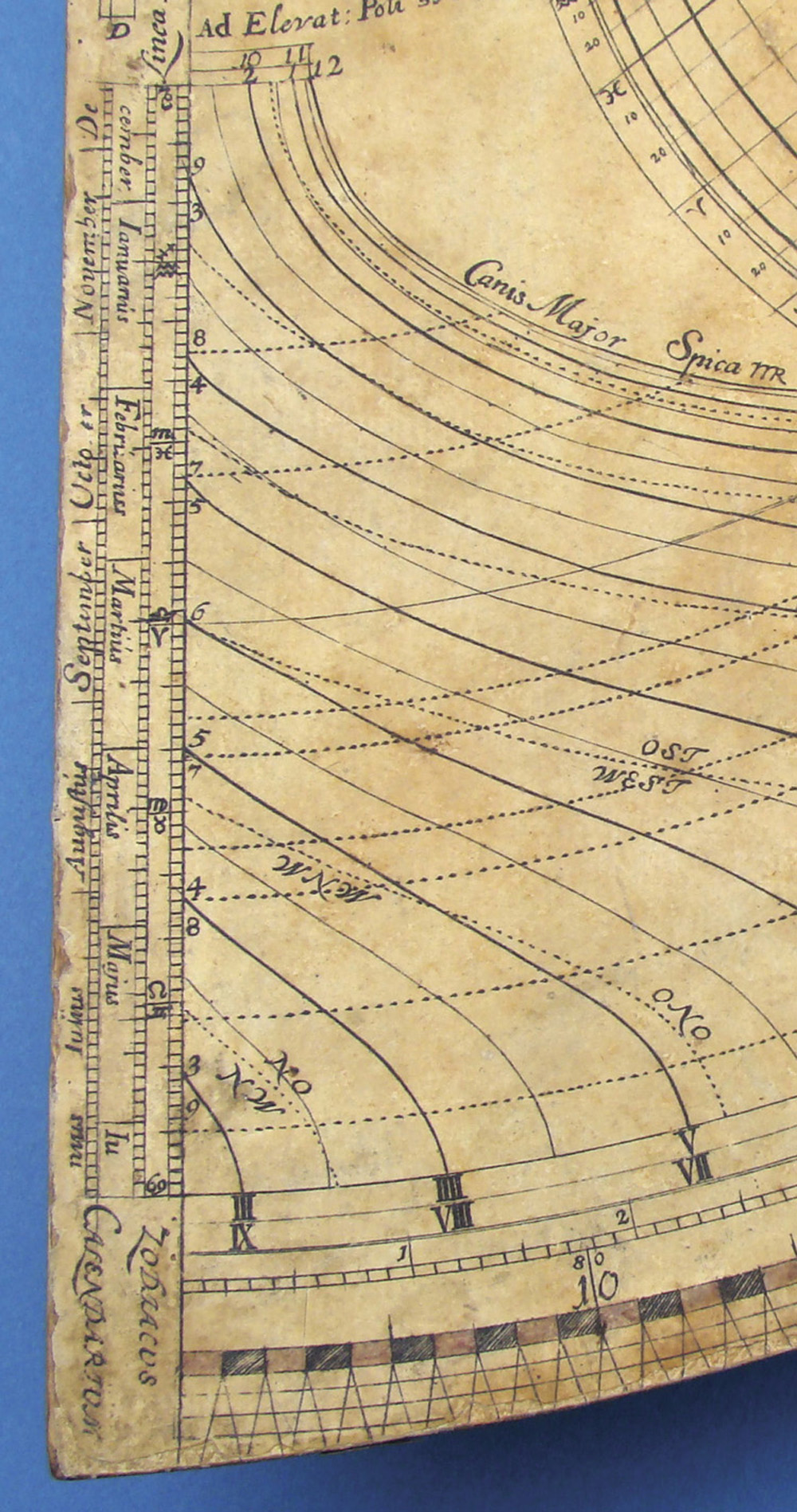
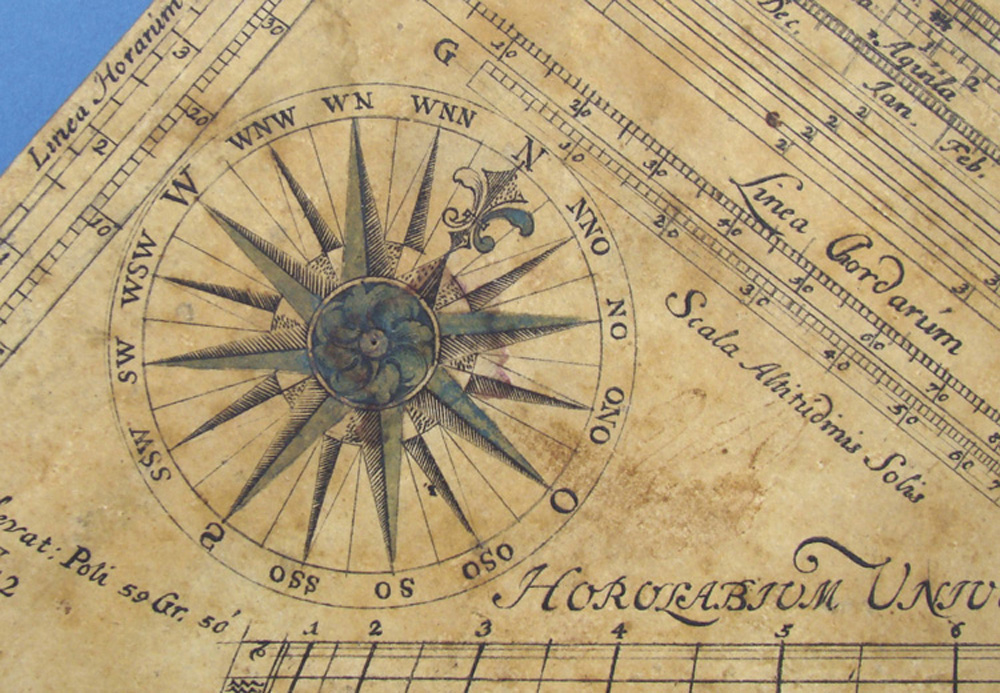
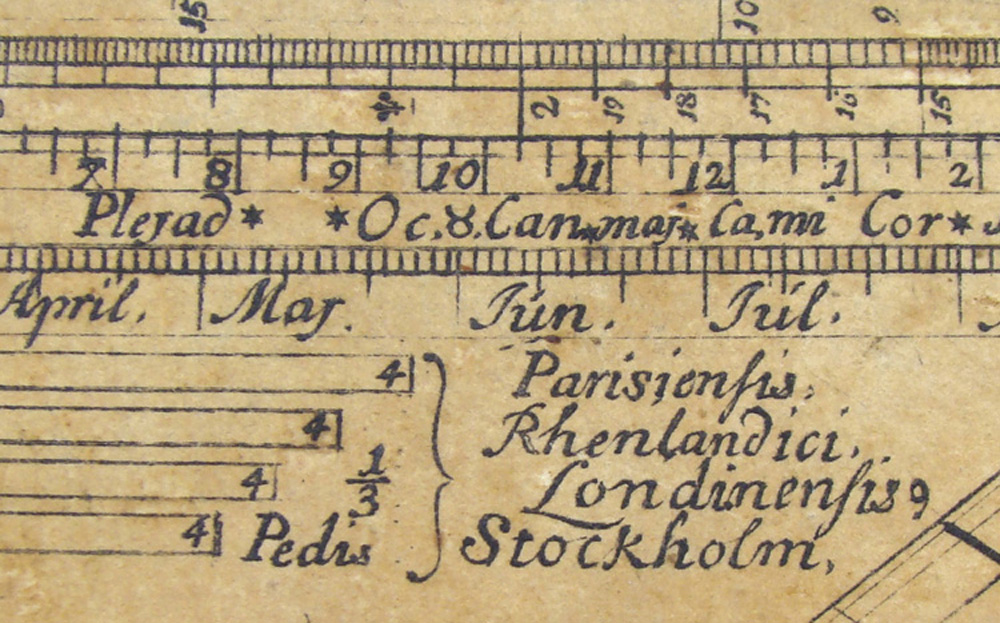
SOPHISTICATED ASTRONOMICAL / HORARY QUADRANT, Swedish, 1708, signed "Quadrans Geometrico Astronomicus Construict et editus a Petro Elvio Math. Profess. Upsal. 1708" and "O L Thelott Sculp." This printed and partially hand colored paper quadrant measures 10-1/2" (27 cm) on a side, and is fitted with twin brass sight vanes and a suspension pin for plumb line, and is rotatable on its mounting to the 11-1/2" tall wood stand with octagonal base. The wood has original red and black coloring. Condition is fine noting slight browning to the paper, and a couple of hairline cracks to the wood. The quadrant itself is extremely sophisticated. It has 90° edge scale with transversal interpolation, nonlinear altimetric scale, horary quadant designed for latitude 59°50¹ with Zodiacal and calendrical edge scales for choosing the date and with eight star locations, universal sundial with secondary degree scale, perpetual calendar, 32-point compass rose, scale of solar altitude, lines of chords, hours, and latitudes, comparison scales for four local foot measures, scale of fixed stars, and lines of tangents, sines, and logarithms. This is the most complex astronomical quadrant we have encountered, and its details were published by Elvius in 1697 (and 1718) in a small book En Kort Underwisning om Then Astronomiske och Geometriske Quadrants.... Petrus Elvius (1660-1718) himself was a Professor of Astronomy and Mathematics and served as rector of Uppsala University. He published more than 18 works between 1697 and 1718. (10113) $29,500. |
 |
 |
 |
 |
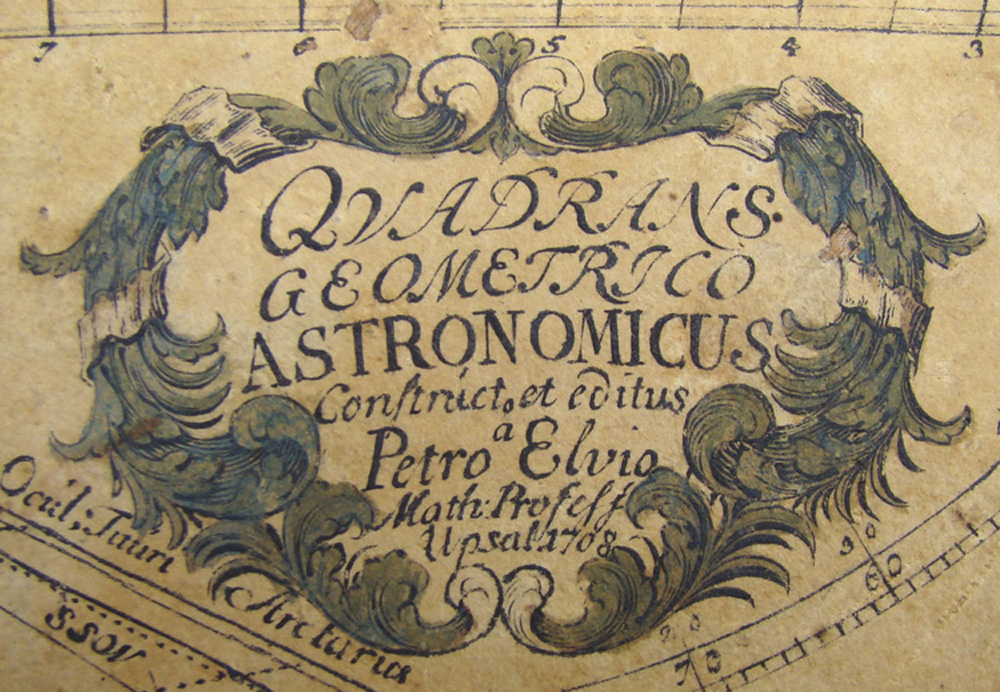 |
(Elvius, 1697) |
| For early British Use in India | Click on any image for a larger view. Scroll to view more items. |
 |
|
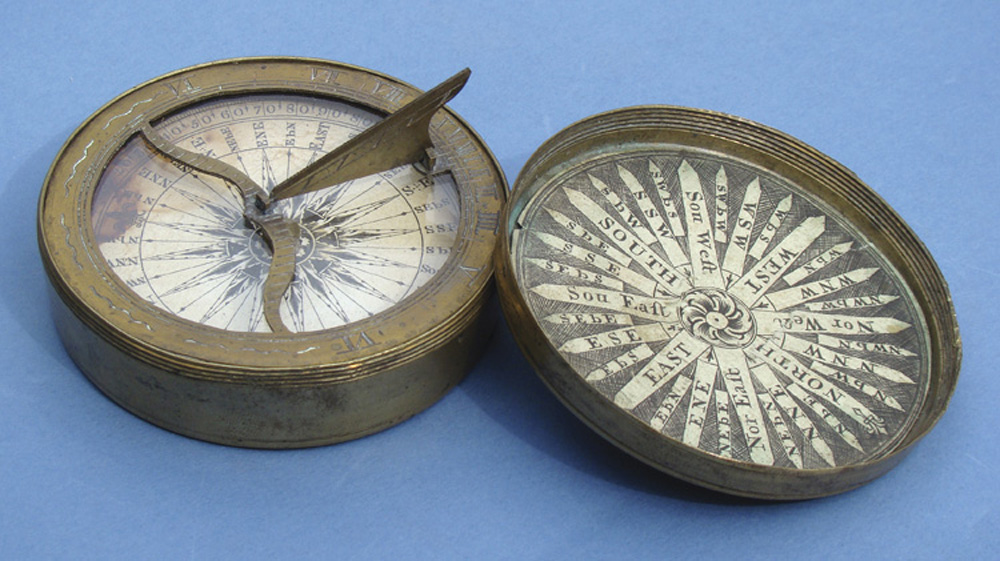
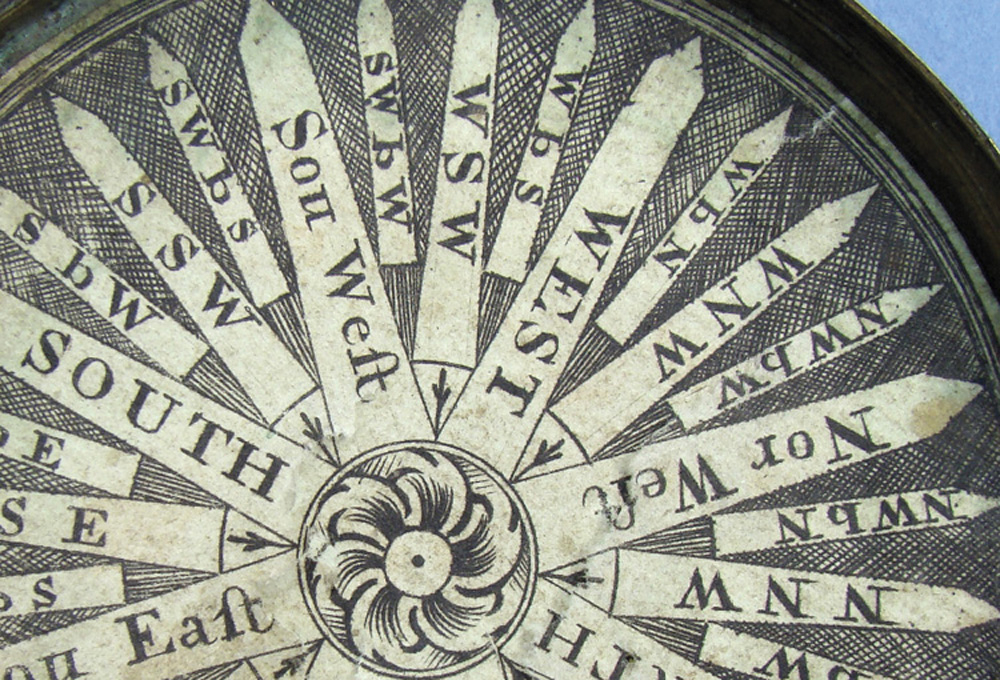
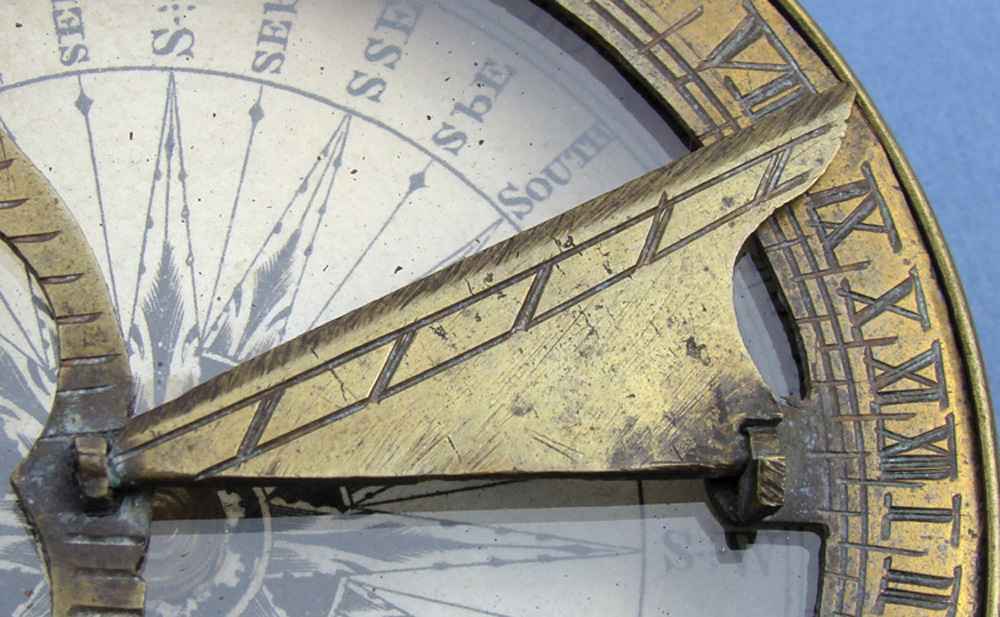
EARLY LOW-LATITUDE POCKET DIAL, English, c.1700. The compass dial is housed in a 3-1/4" (8 cm) brass case, decorated with turned circles, holding within the lid an early printed compass rose. The floating printed compass card has a decorative 32-point compass rose with peripheral degree scale, and is mounted on sheet mica (for stability) over the magnet, and suspended on a brass pivot. A hinged brass gnomon is mounted on the engraved chapter ring, over glass. This shallow gnomon is constructed for a latitude of approximately 26° North, and the hour line divisions are accordingly compressed at midday, and very widely spaced toward sunrise and sunset. The latitude suggests that this rare dial was made for one of the early British expeditions to India. Agra, for example, at 27° latitude, was visited by a representative of the British East India Company as early as 1603. The dial is in generally fine condition, noting some oxide stains to the compass card, and that the cover glass is a later replacement. (10123) $2650. |
 |
 |
| A Charming Relic, 16th/17th c. | Click on any image for a larger view. Scroll to view more items. |
 |
 |
 |
|
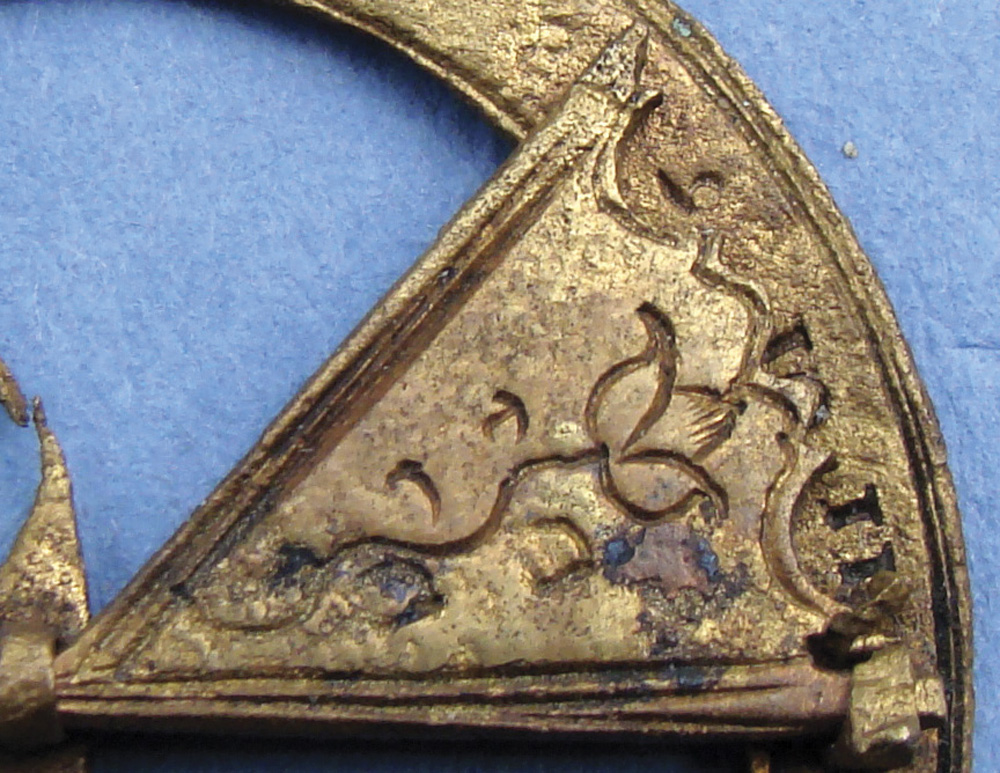
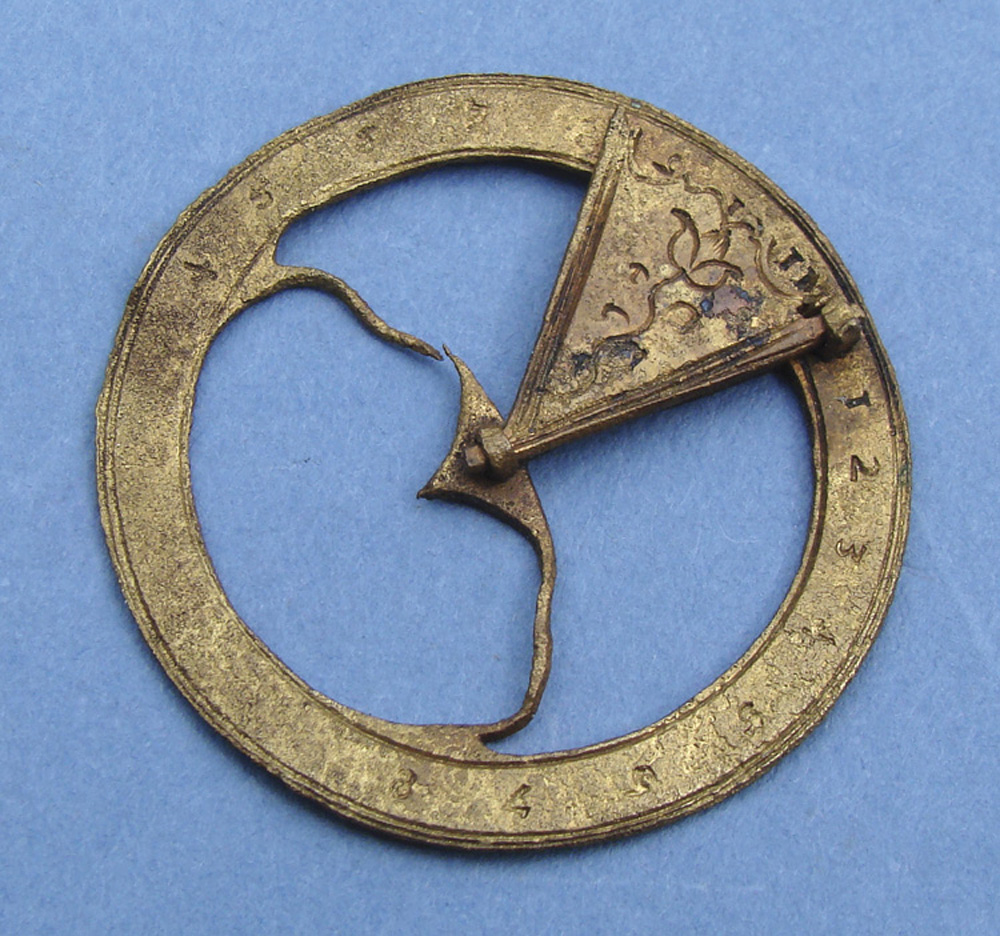
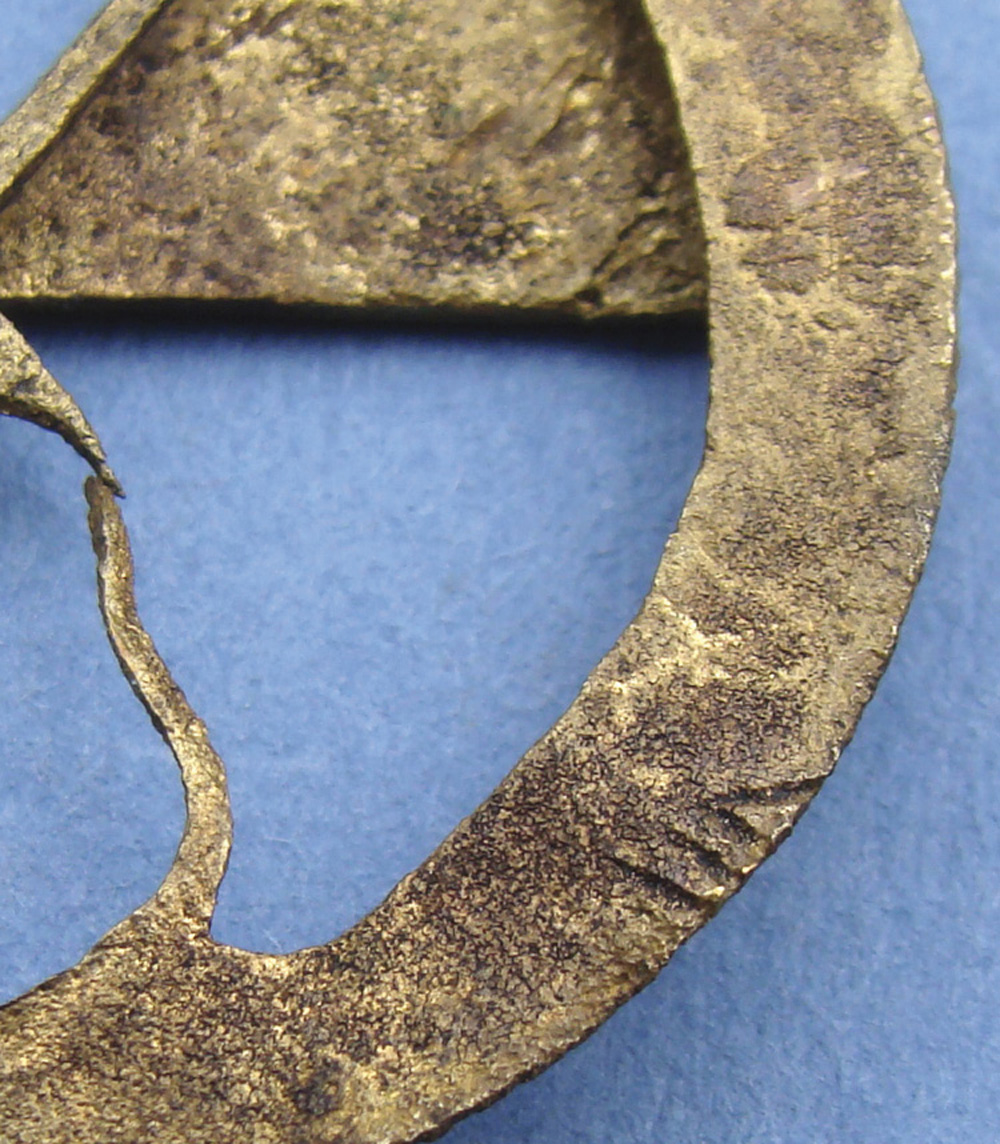
EARLY GILT-BRASS SUNDIAL, probably Dutch, 16th / 17th century. This thin brass chapter ring, only 1-1/4" (3 cm) in diameter, is stamped with the hours from 4am to 8pm. The folding gnomon is outlined, and engraved with a lovely flower. The dial, which would have mounted over a magnetic compass, was recovered from a canal in Amsterdam, and is in reasonably good condition noting some surface etching, and erosion of one of the fine support wires. Gnomon and ring are both engraved "VII," A rare example with its lovely decoration to the gnomon. (10133) $950. |
| 18th century Freemasonry, by A. Dent | Click on any image for a larger view. Scroll to view more items. |
 |
 |
 |
 |
|
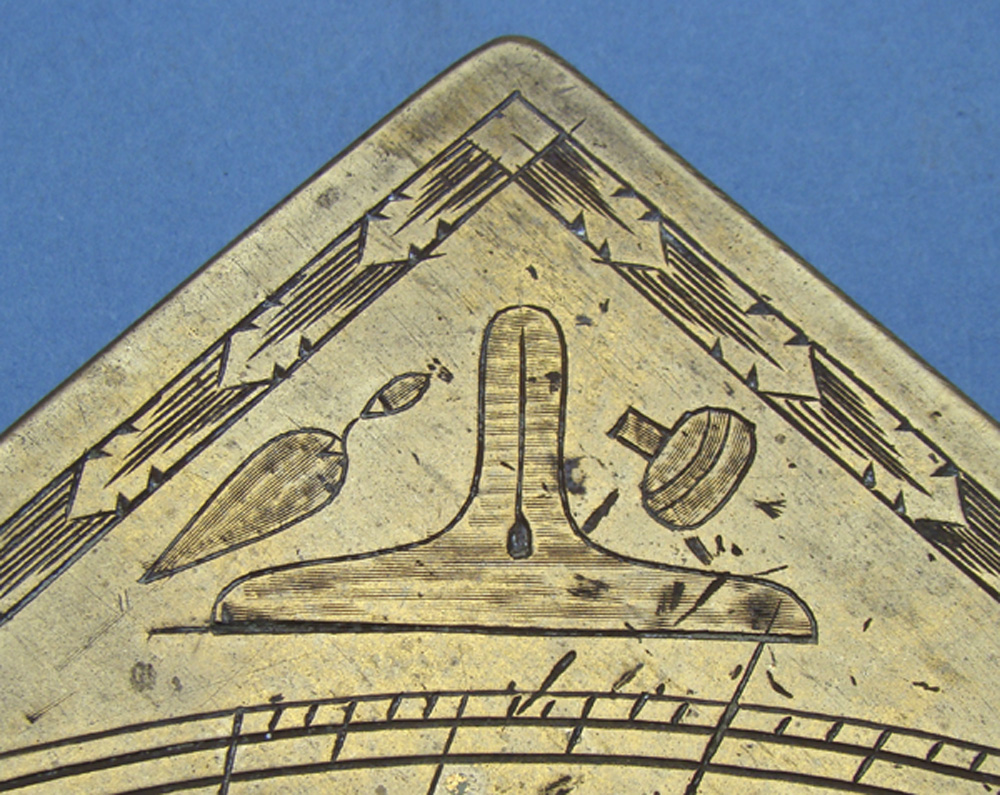
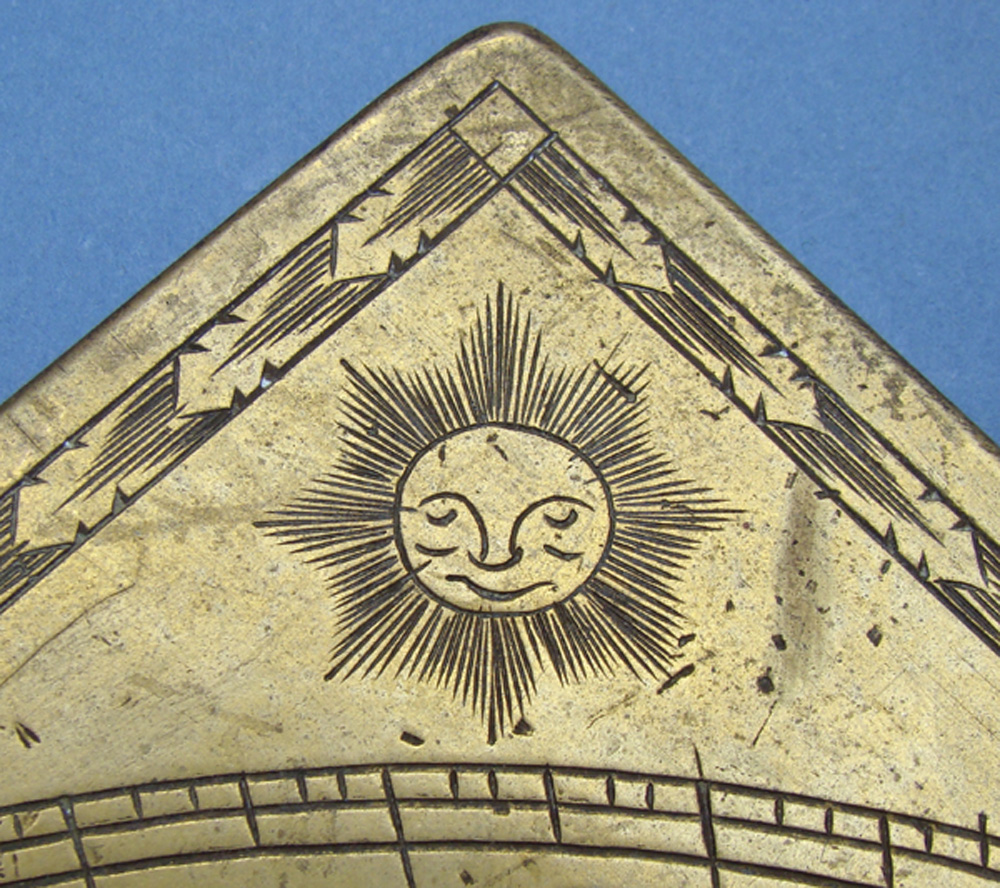
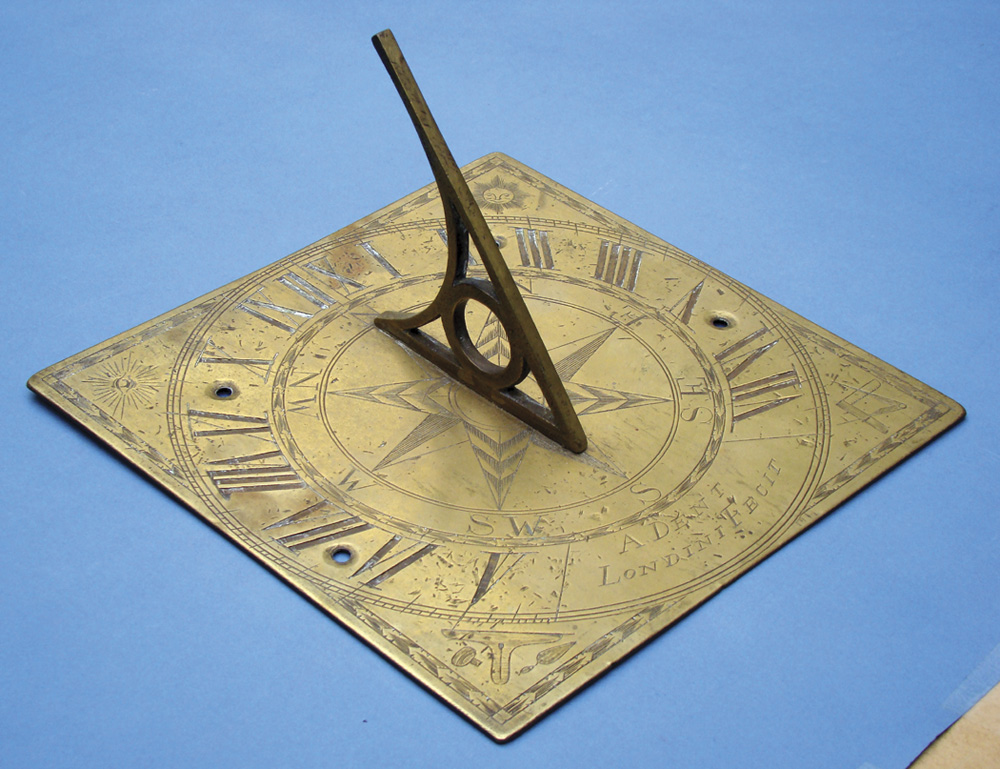
HORIZONTAL SUNDIAL WITH MASONIC SYMBOLS, English, c. second quarter 18th century, signed "A. Dent, Londini Fecit." The 8" (20 cm) square main plate is hand engraved with a chapter ring divided every 5 minutes from 4am until 8pm. The center has a large eight-point compass rose with labeled directionals, and the four spandrels are engraved with symbols of Freemasonry, viz., The Eye of Providence, the Square and Compasses, the Sun, and the Level and Plumb. In addition there is an outer square and inner circle of running-leaf-tip design typical of English work of the period (e.g., that of Thomas Heath, working 1720 - 1753). The plate is set with a pierced brass gnomon, possibly an old replacement. Condition is good noting quite a few nicks to the surface, and four irregularly spaced mounting holes. The top is a mellow tan color; the reverse has a deep greenish brown patina. This is a very rare example of sundial with Masonic symbolism, and by a seemingly unrecorded London maker. There might be a connection with the famous chronometer maker Edward John Dent, born 1790, but the only "A." we find in the Dent family tree is one Anne Dent, born 1742 (see Mercer). None is listed in Baillie or in Clifton. (9118) $2400. |
| Impressive "Inclining/Horizontal" Sundial | Click on any image for a larger view. Scroll to view more items. |
 |
 |
|
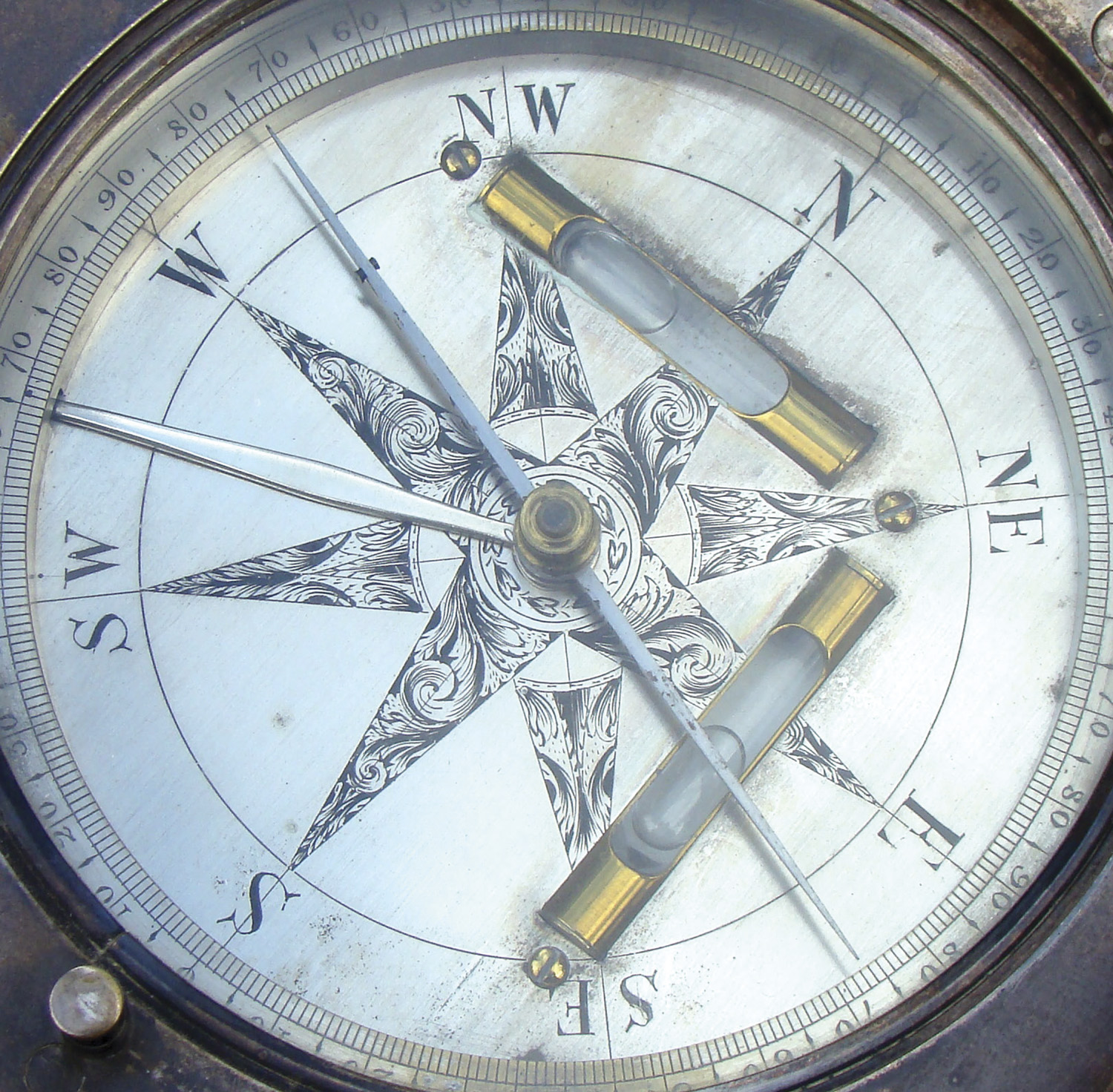
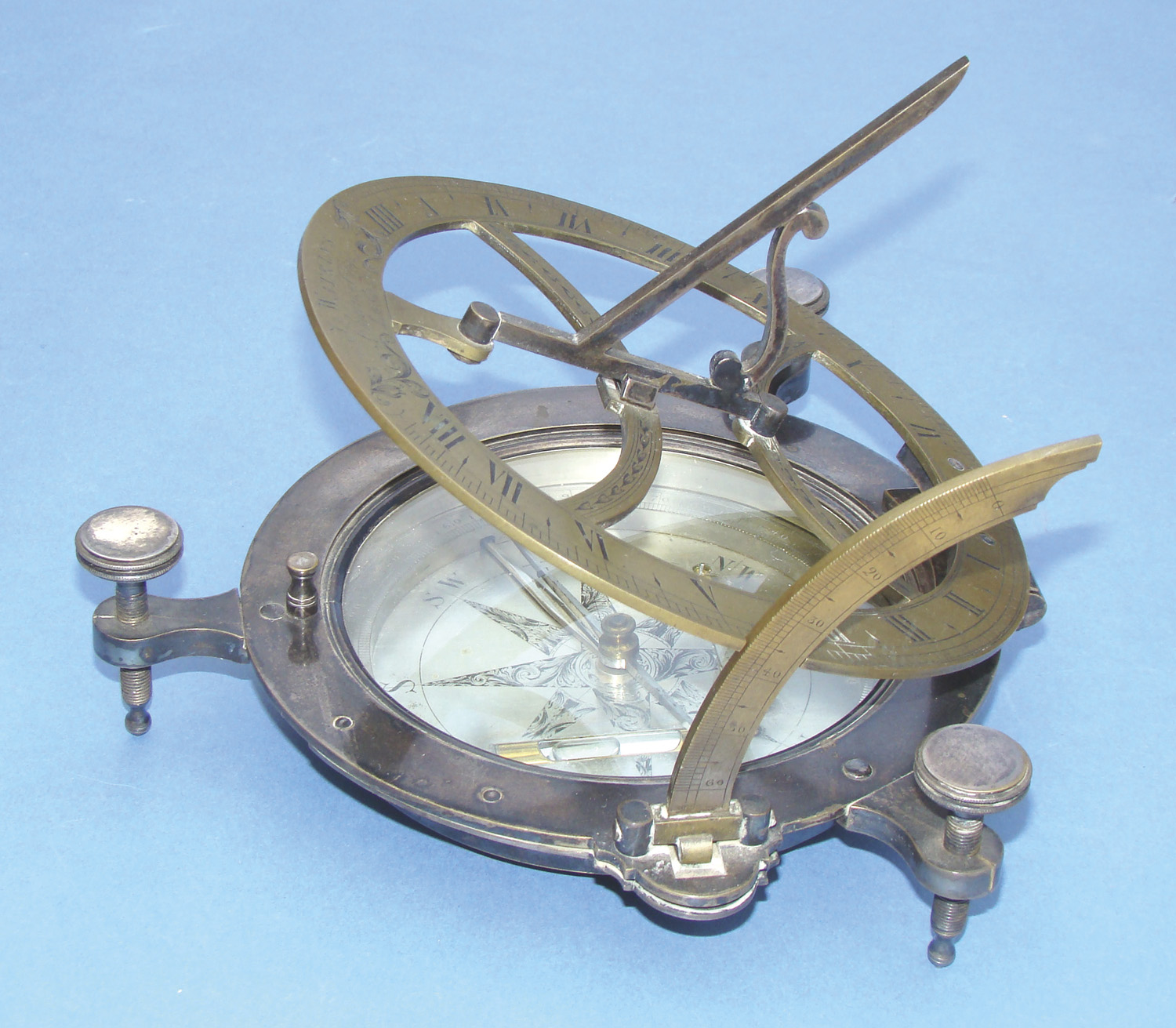
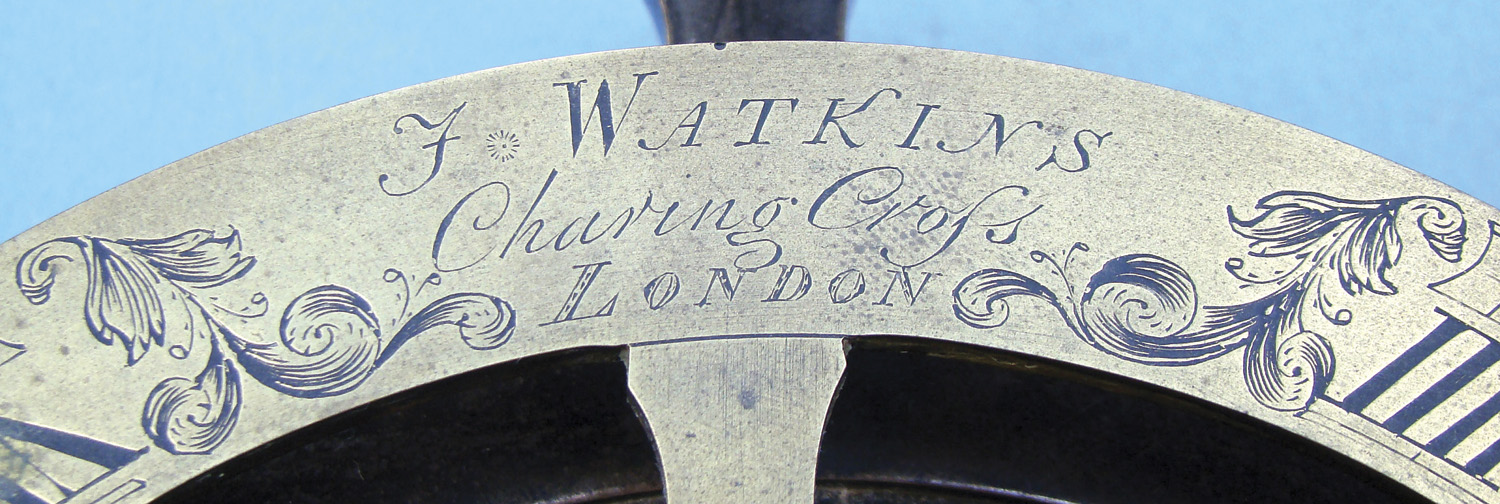
LARGE INCLINING DIAL, English, c. 1800, signed "J. Watkins, Charing Cross, London," made of contrasting natural and silvered brass. Constructed as a horizontal dial with a main plate 5-5/8" (14 cm) across in diameter, there is a hinged gnomon designed for 60° latitude, chapter ring divided every five minutes from 3:45 am until 8:15 pm, and elegant floral and running leaf tip decoration. This dial assembly is hinged above a large glazed compass featuring edge bar needle, lever-activated needle lifter, twin inset spirit levels, lovely eight-point compass rose with floral engraving, and circumferential degree scale. There are three external leveling screws, and a hinged latitude arc divided every half degree from 0° to 60°, permitting the dial plate to be inclined and used correctly at any North latitude within this range. The compass base is hand engraved with a gazeteer of 12 European cities and their latitudes. Condition is very fine noting some wear to the finish. The maker was apparently Jeremiah Watkins, who took over from his relative Francis Watkins, and who was in business under his own name from 1798 until 1810 (see Clifton). Jeremiah held a Royal appointment to the Dukes of York and Clarence, and a Business appointment to the East India Company. An impressive example of this interesting "universal" form. (10141) $2600. |
 |
 |
| A 17th century Double Dial for the Pocket | Click on any image for a larger view. Scroll to view more items. |
 |
|
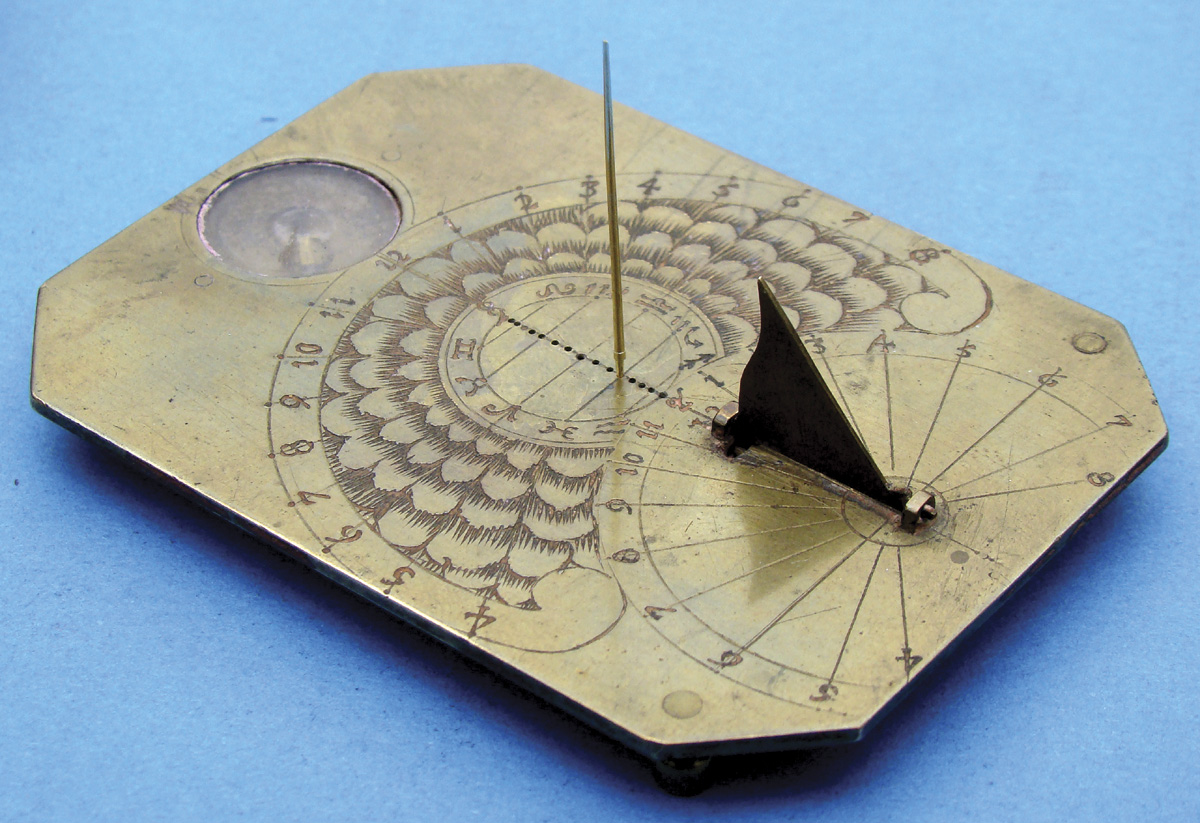
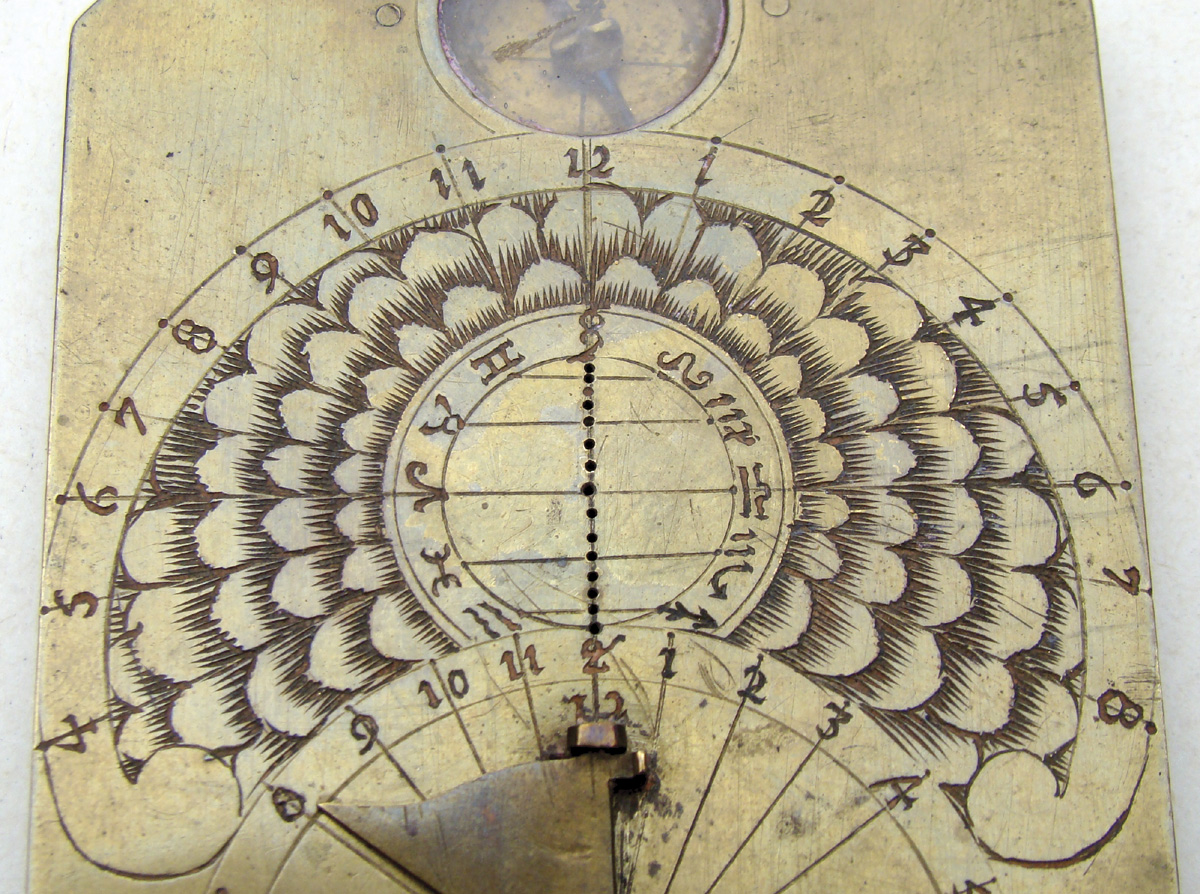
REMARKABLE DOUBLE ANALEMMATIC HORIZONTAL POCKET SUNDIAL, French, c. second half 17th century, the eight-sided all-brass dial plate measuring 2" x 2-11/16" (5 x 7 cm). The plate is engraved with a circular chapter ring divided every hour from 4am to 8pm, with a circular Zodiacal calendar scale, and with a semi-elliptical hour scale divided again from 4am to 8pm. The circular chapter is engraved with radial hour lines, and set with a hinged gnomon; the Zodiacal circle is crossed by a straight meridian line of 14 holes for inserting a vertical pin gnomon at the appropriate date position; and the field within the elliptical chapter is filled with engraved floral petals aligned with the hour lines. There is also a small inset glazed magnetic compass with good early needle and directionals labeled "Nor, Sud, Est, Oest," and bearing an engraved fleur-de-lys north mark. The underside is plain, with two feet, compass box, and gnomon spring. Condition is fine with a separate brass pin gnomon and the original pebbled leather covered wood case lined in white and reddish satin. The double analemmatic dial was described by J.L. Sieur de Vaulezard in 1640. Its big advantage was its independence of knowledge of magnetic north, and thus independence of the magnetic compass. Knowing the date, one places the vertical pin gnomon in the appropriate position, sets the dial on a horizontal surface, and rotates it until both sundials read the same time, which is the correct apparent solar time. This instrument is also equipped with a small compass, for convenience and in fact as a means for determining the magnetic declination, the local difference between astronomical north and magnetic north. The double dial is particularly interesting, and has been constructed in various forms (see for example Thomas Tuttell's version, Tesseract Cat. 50 Item 20). The present miniature variant, with its insertable pin gnomon, and with its pocket case reminiscent of those of Butterfield-type dials, is otherwise unknown to us. (9136) $9500. |
 |
 |
| Hand-Colored Sundial Floating under Glass | Click on any image for a larger view. Scroll to view more items. |
 |
 |
|
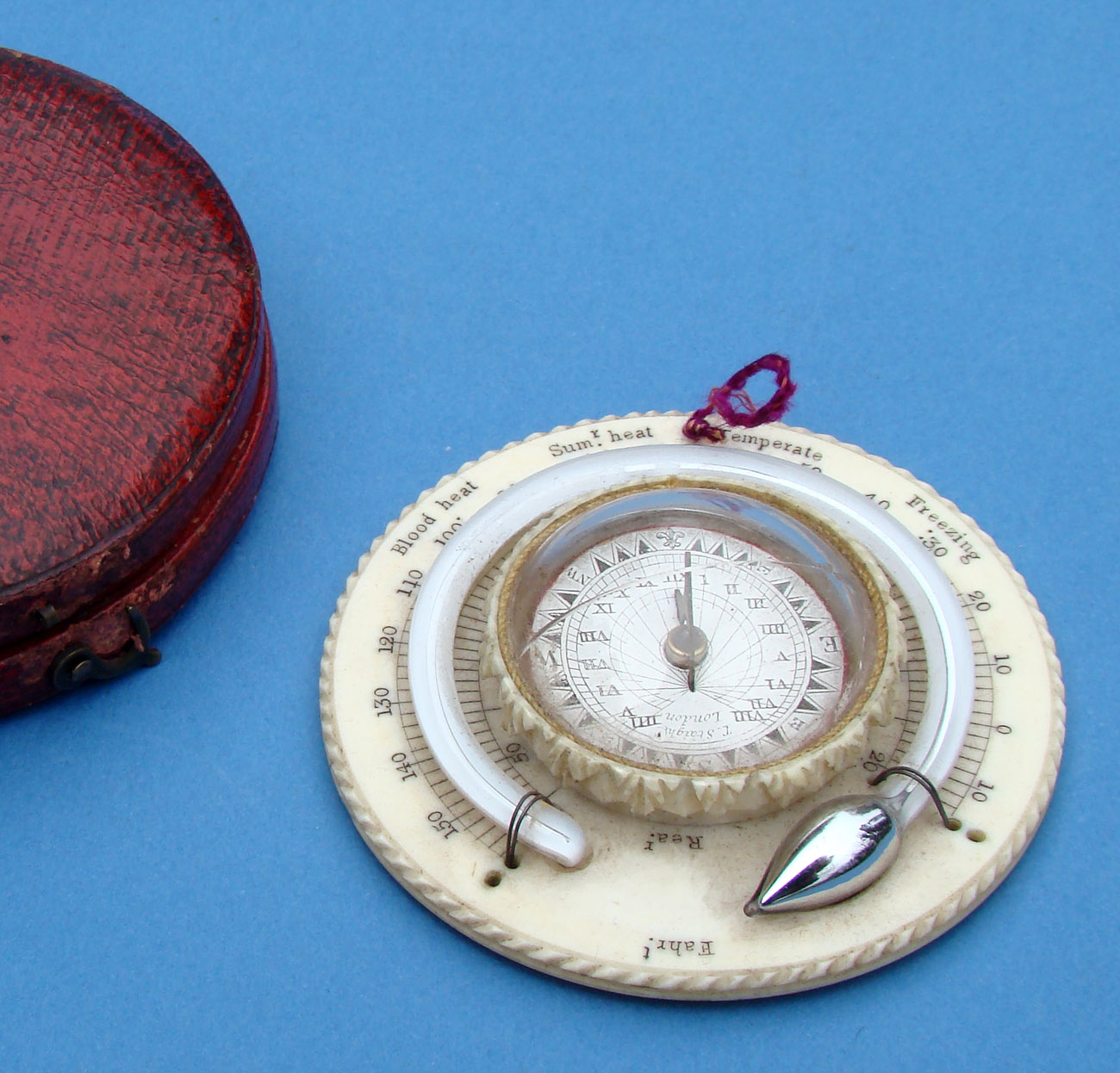
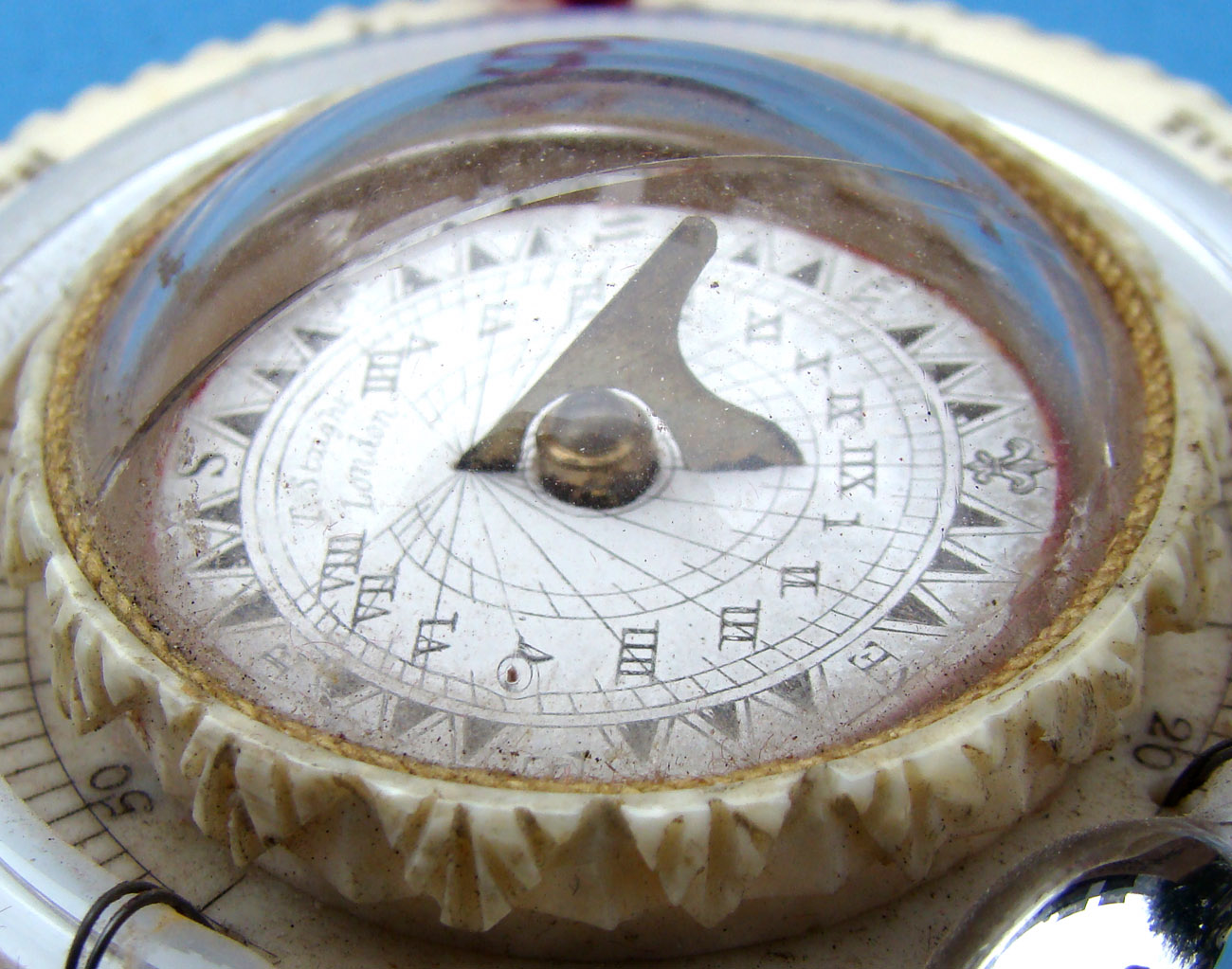
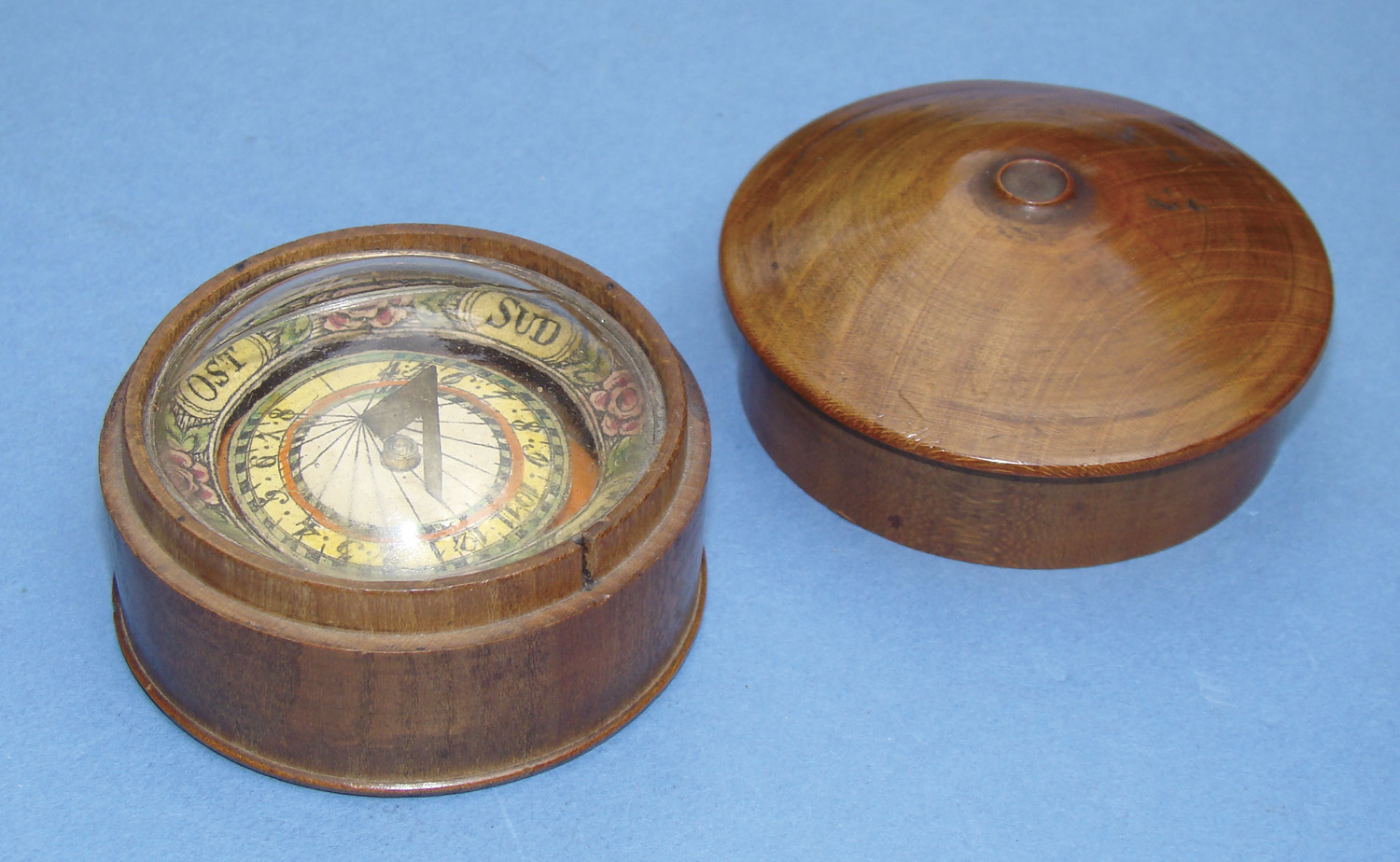
CHARMING FLOATING-GNOMON COMPASS / SUNDIAL, German, c. late 18th / early 19th century. The 2" (5 cm) diameter turned wood case and domed cover contain a lovely little self-orienting sundial. Under domed glass is pivoted an iron needle mounted with circular card set with fixed brass triangular gnomon. The card is printed with 4am to 8pm chapter ring, divided every 15 minutes and finely hand colored; a surrounding fixed ring is printed with the cardinal directions (in German) separated by lovely roses, again all hand colored. Condition is very fine noting a stable break in the glass. A most attractive example of a little pocket sundial which automatically orients itself towards the north. (10161) $595. |
| The 1774 "Newly Invented Sundial" (-B. de Celles) | Click on any image for a larger view. Scroll to view more items. |
 |
 |
 |
 |
|
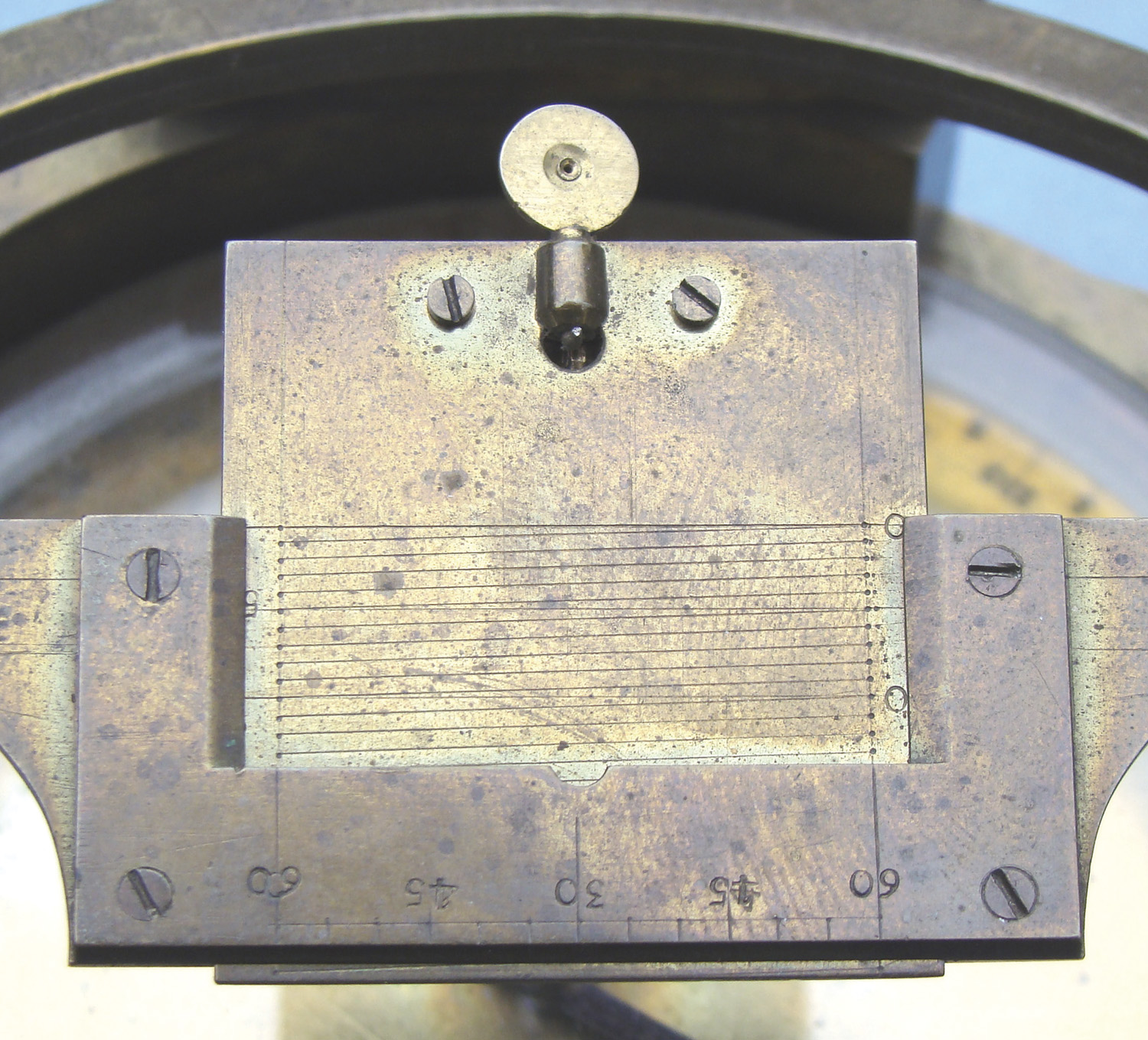
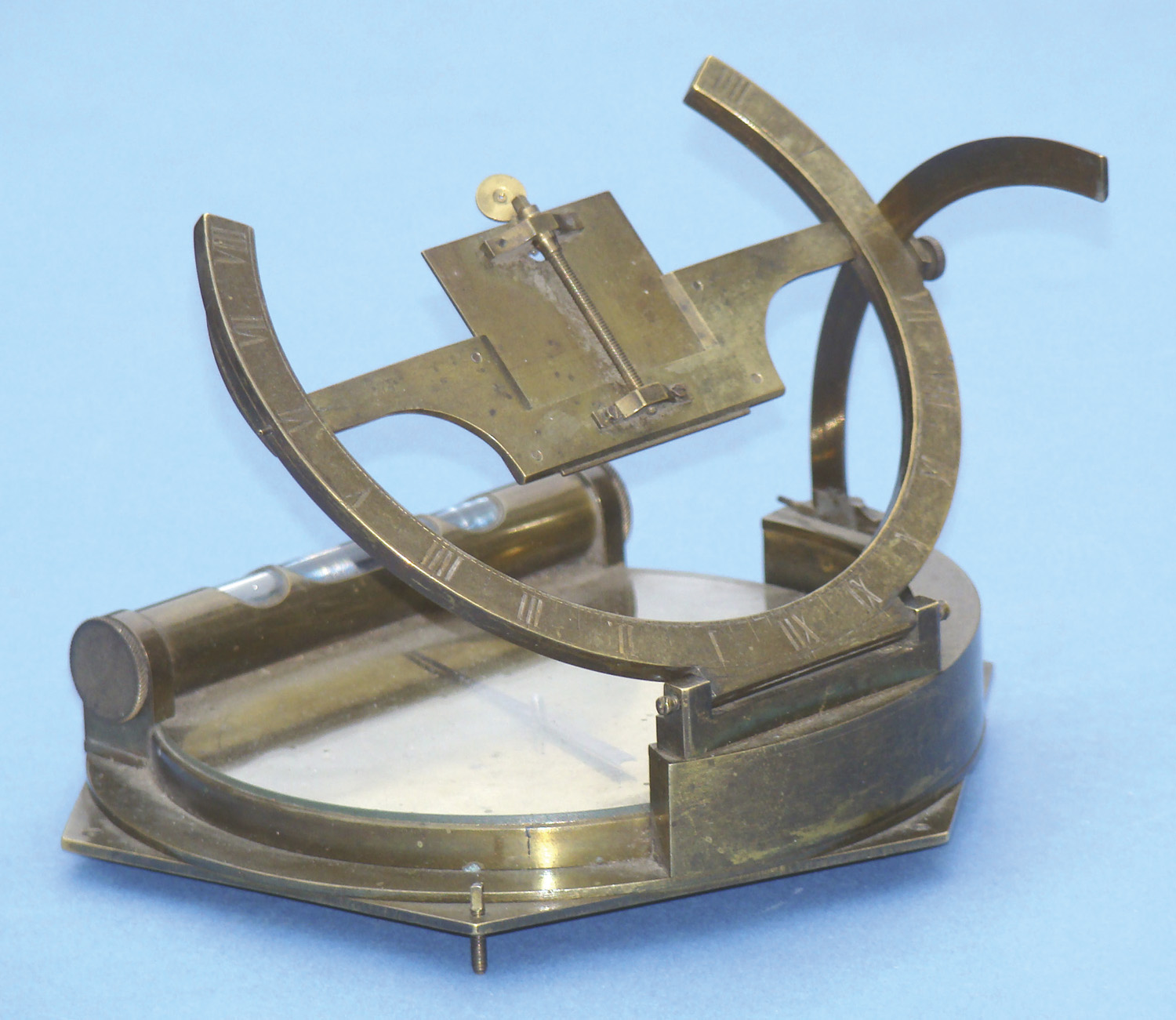
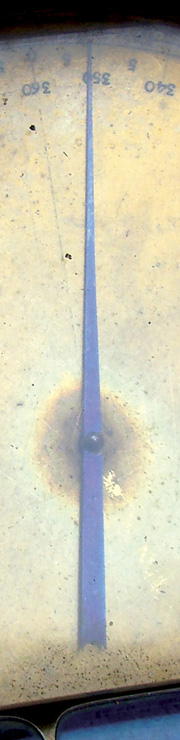
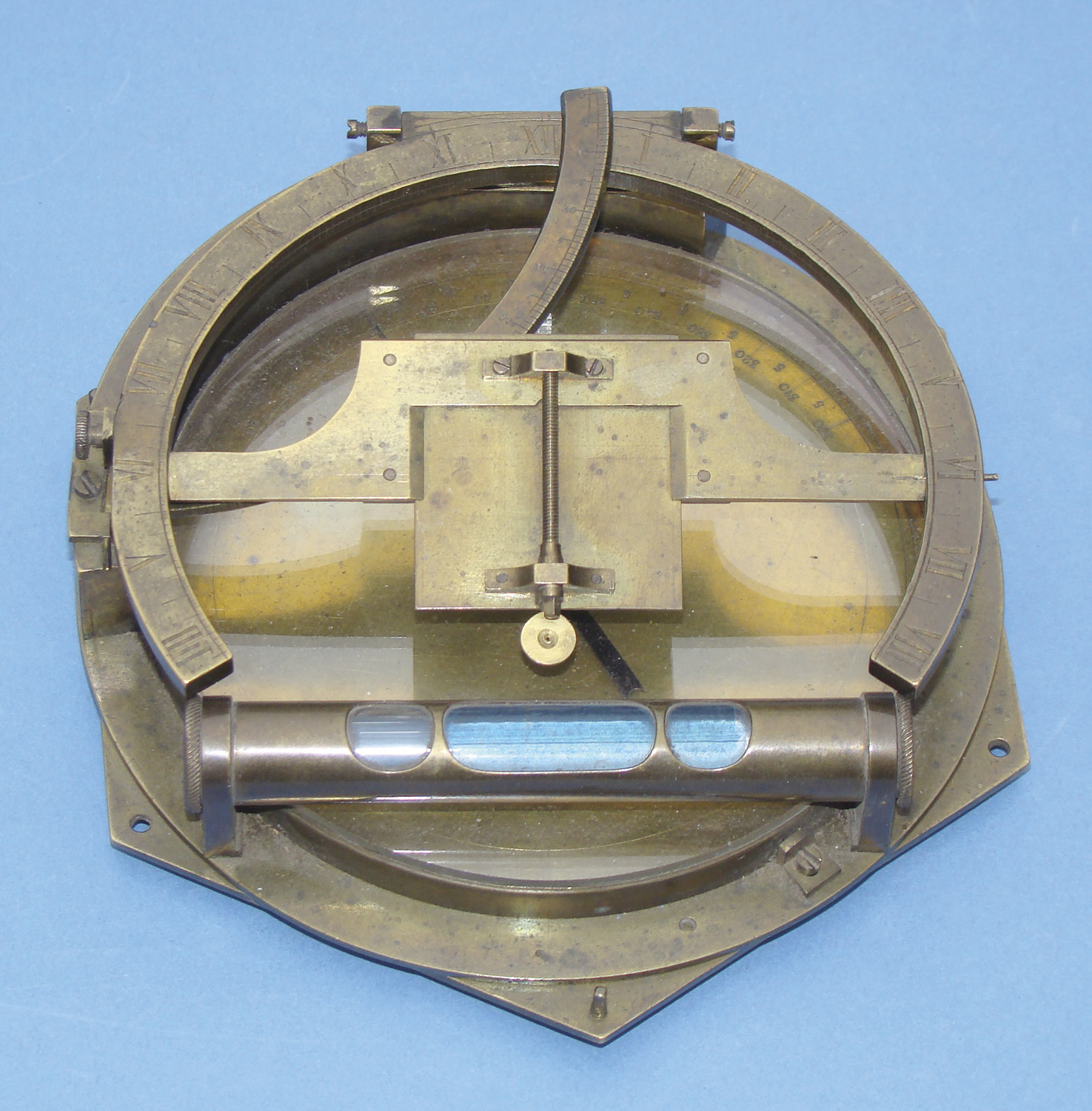
MEURAND-TYPE UNIVERSAL EQUINOCTIAL DIAL FOR DETERMINATION OF MAGNETIC DECLINATION, probably French, c. late 18th / early 19th century. The sundial / compass assembly rotates on a hexagonal baseplate 4-3/8" (11 cm) across and fitted with three leveling screws adjustable by watch key (correct modern one provided). The sundial itself has a hinged chapter ring divided every five minutes from 3:45am to 8:15pm. This equinoctial ring is inclined against a hinged latitude arc divided every degree 0° to 90°. The hour ring has a crossbar carrying the gnomon, which swivels flat for stowage, latchable upwards for summer when the sun is above the celestial equator, and downwards for winter. But rather than the typical needle gnomon, here we have an oculus, a pin hole in a disk swiveling and adjustable vertically for solar declination from 0° to 23-1/2°, with readout by a grid of transversals to better than five arcminutes. Rotating with the sundial assembly is a cylindrical spirit level and a large glazed compass with fine tapered offset needle reading against a declination scale divided every degree from 0° to 60° westwards and from 360° to 300° eastwards. Condition is fine throughout, the brass uniformly browned, one tiny index broken. In practice one levels the instrument, sets the oculus for the exact solar declination (published in date tables, commonly available at the time), and then rotates the dial plate until the little spot of sun falls exactly on the hour circle, and reads the time at that spot. By elevating the oculus to the solar position, and forcing the sunspot to fall on the circle, one has automatically aligned the instrument with geographic north without recourse to a magnetic compass. This innovative sundial is well described (in nine pages) and illustrated (signed "Meurand") in the 2nd (1774) edition of Bedos de Celles' La Gnomonique Pratique. The author describes the practicalities of construction in great detail, and characterizes the instrument as a "newly invented sundial;" We note it was not present in his first edition (1760). The apparent inventor was Antoine-Joseph Meurand probably working with his son Charles-Joseph, both members of the respected Founders' Corporation. But the present dial has a very significant improvement over Meurand's design (for which see the large 1782 example in Tesseract Catalogue 88 item 14), that the addition of a precision magnetic compass. When set up the dial gives the correct solar time, and is then automatically aligned with geographic north. The needle will of course be pointing toward magnetic north, showing immediately the difference between the two, the magnetic declination at that location. An innovative dial. (10151) $5500. |
| Masonic Sundial with Descriptive Gnomon | Click on any image for a larger view. Scroll to view more items. |
 |
 |
|
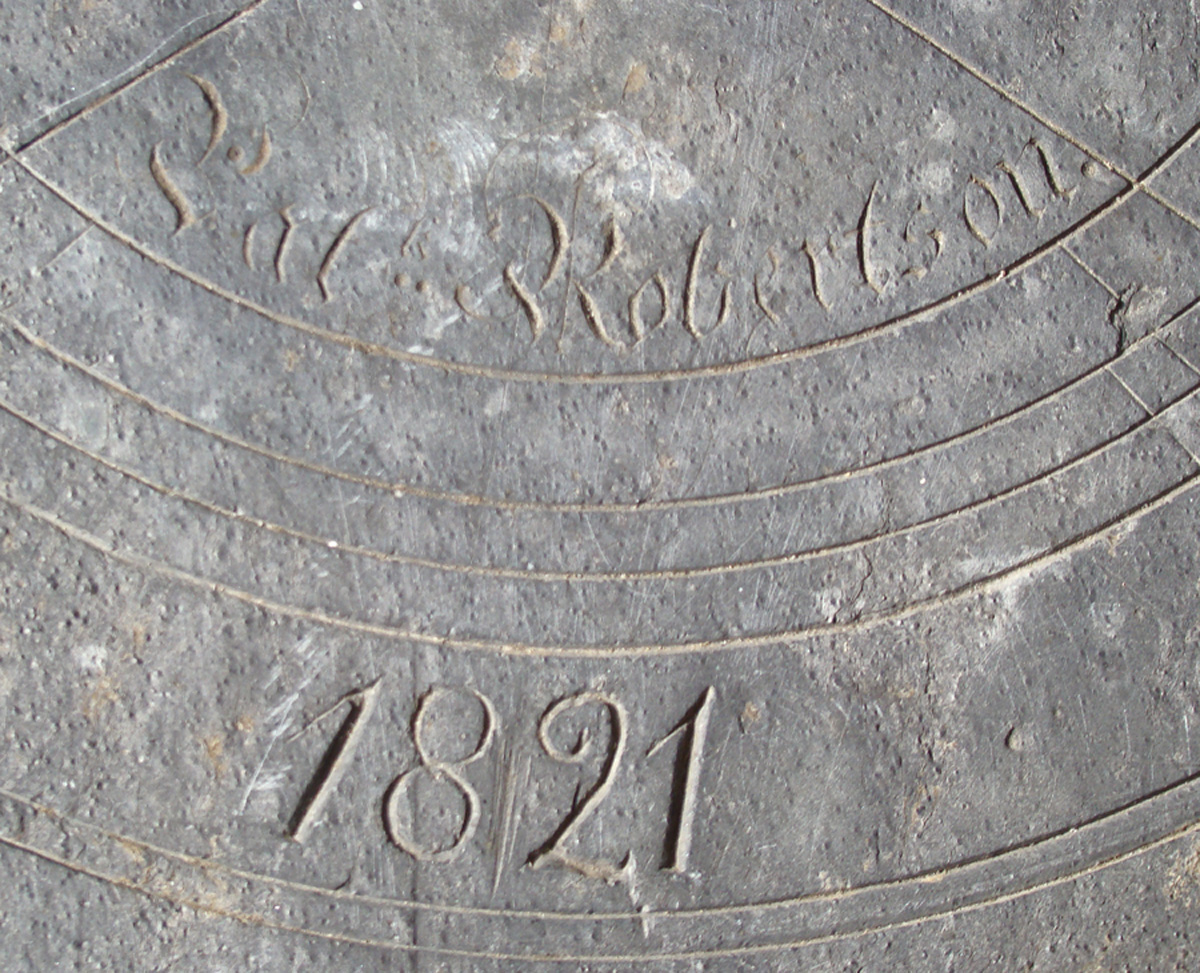
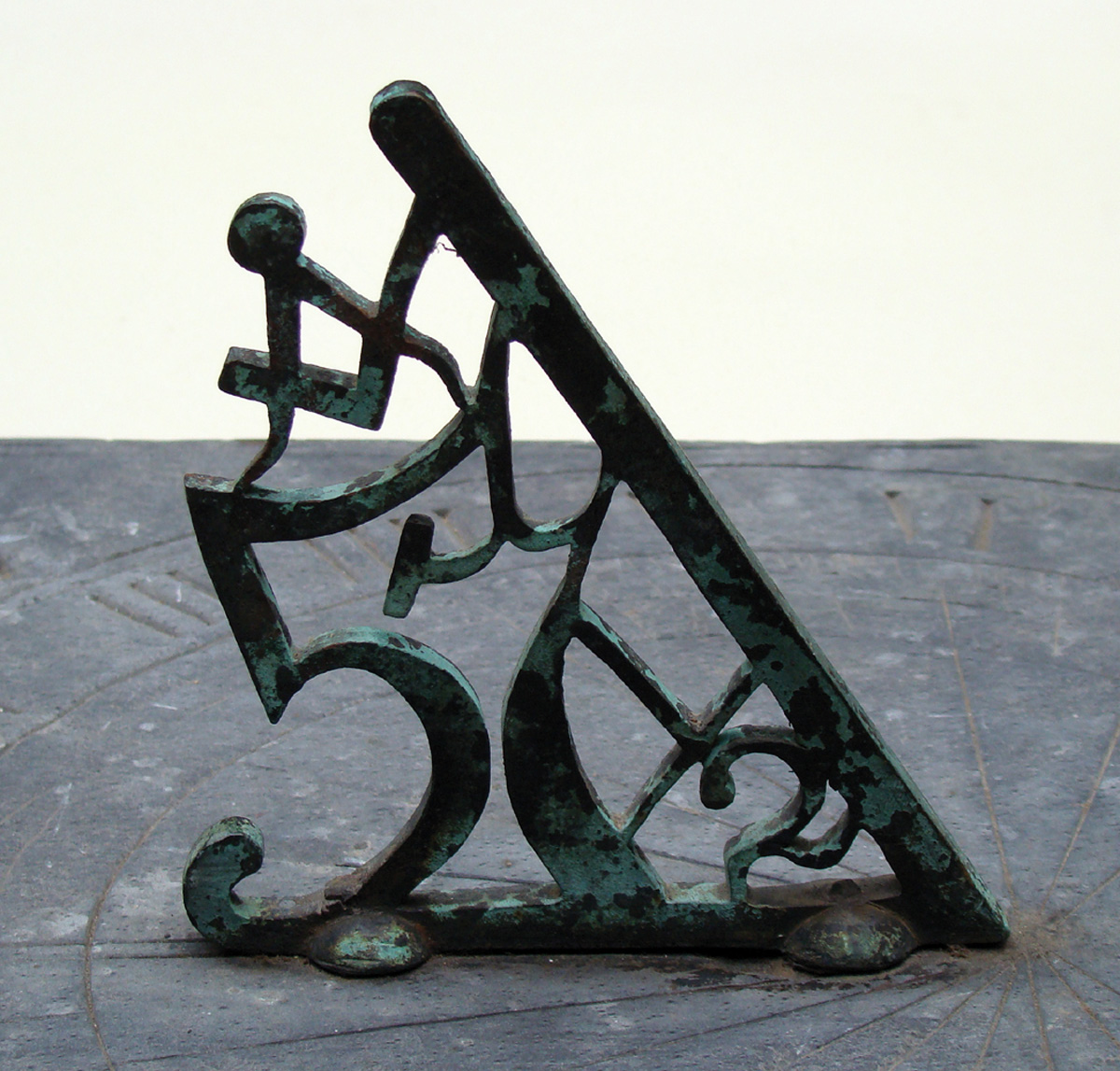
SCOTTISH HORIZONTAL SUNDIAL WITH "LATITUDINAL" GNOMON, 1821, signed "Pat. Robertson, 1821." The sundial is constructed with a sturdy slate base 13-3/4" (35 cm) square and 7/8" (2.2 cm) thick, mounted with 4-3/4" tall pierced brass gnomon. The base is pierced with four mounting holes, and is engraved with the signature and date, and with the circular chapter ring divided every 5 minutes of time from 4am to 8pm. Each hour is labeled with a fascinating system of simplified Roman numeral shapes: "ones" are straight vertical lines, "fives" are shorter slightly-backwards-leaning straight lines, and "tens" are longer steeply-backwards-leaning straight lines, all with slight seraphs. Measuring the gnomon angle, we find it is designed for latitude approximately 56°. The brass has wonderful piercing, showing a compass and square, presumably as Masonic symbols, and with the latitude given in pierced numerals (57.°5). Condition is fine noting some surface wear and chips to the stone, the brass with old brown and green patina. Robertson is a common Scottish name, and Bryden lists two instrument makers and/or sellers by this name, including one Patrick Robertson recorded in Edinburgh in 1778. The latitude is north of even Aberdeen (57°.15) and coincides with that of Inverness in the Scottish Highlands (just downstream from Loch Ness, and very near the site of the Battle of Culloden), and that of Peterhead in easternmost mainland Scotland. An interesting Northern dial. (9126) $3950. |
 |
| Rare 17th century Diptych Sundial from Rome | Click on any image for a larger view. Scroll to view more items. |
 |
 |
|
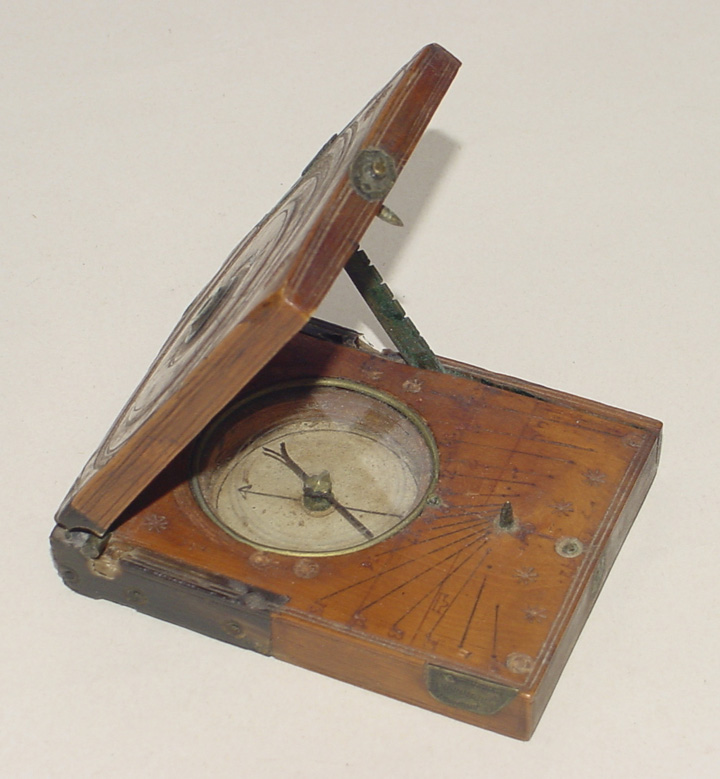
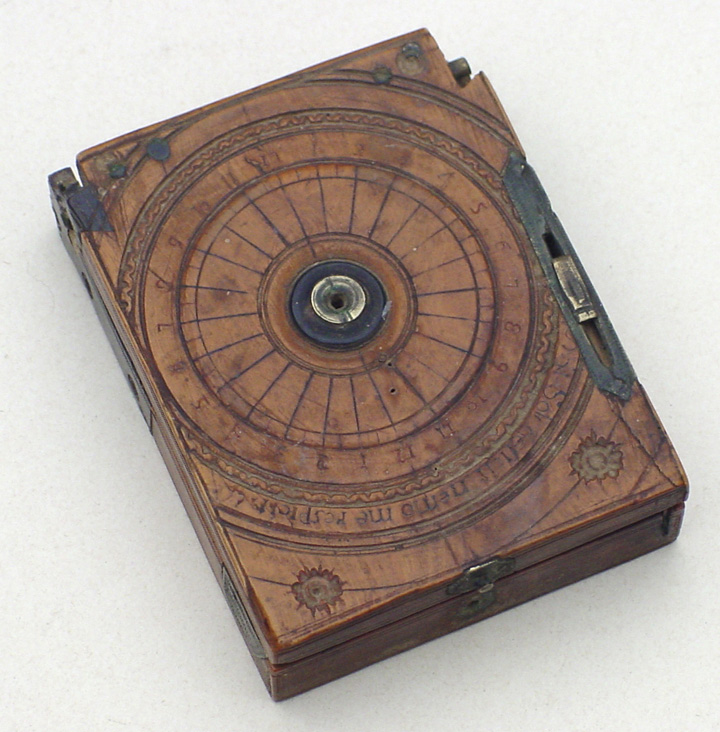
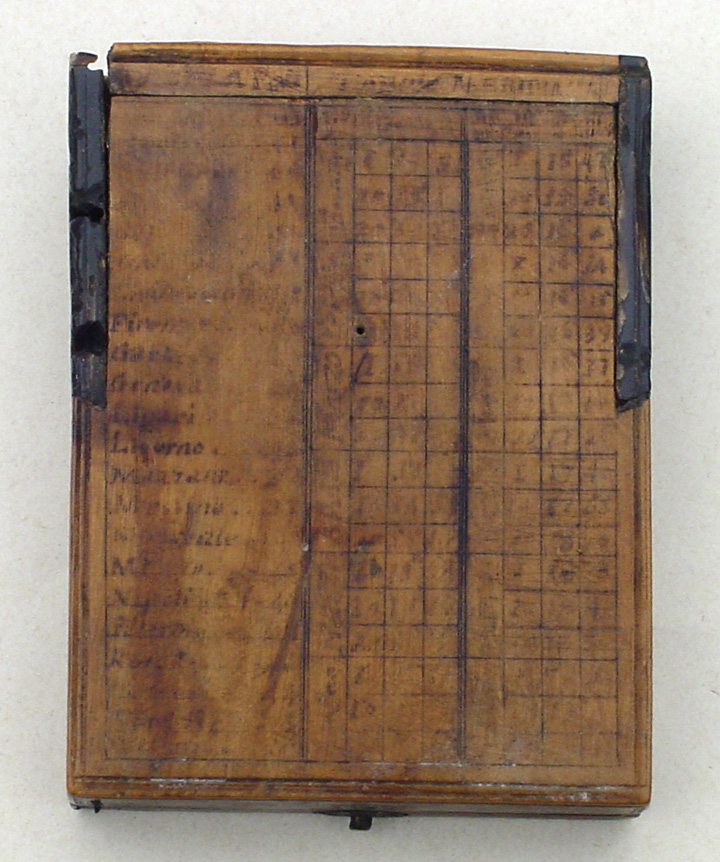
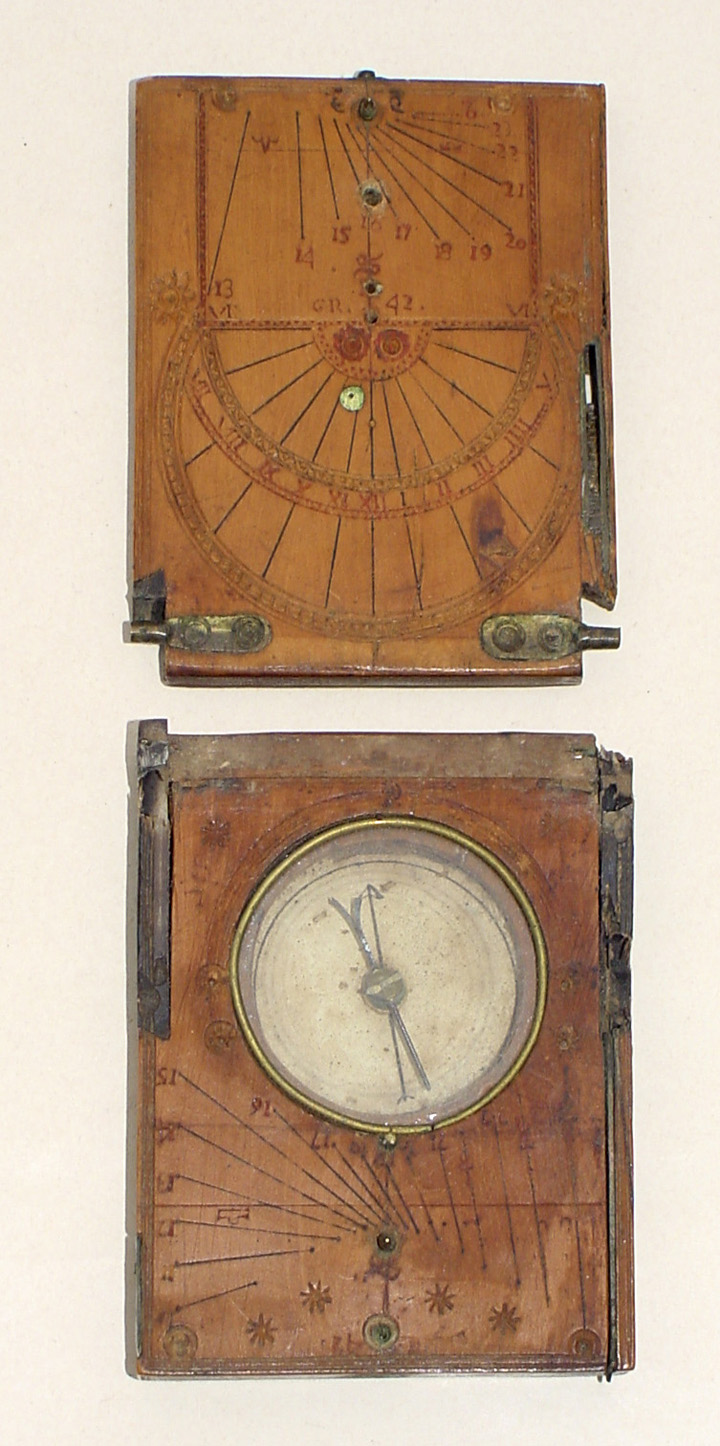
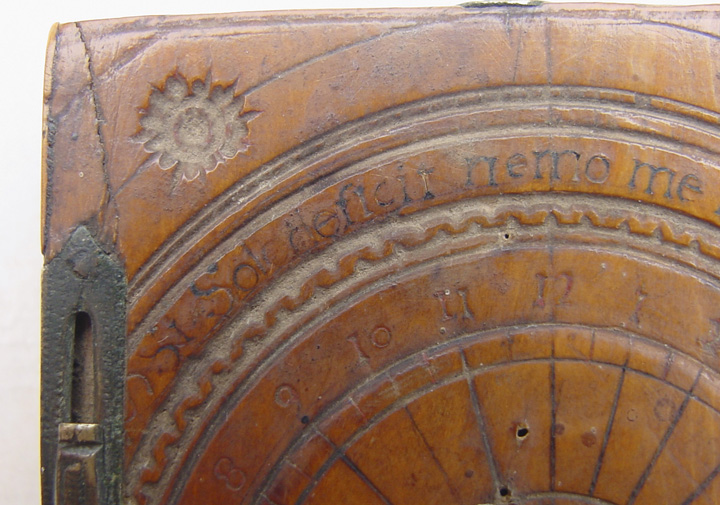
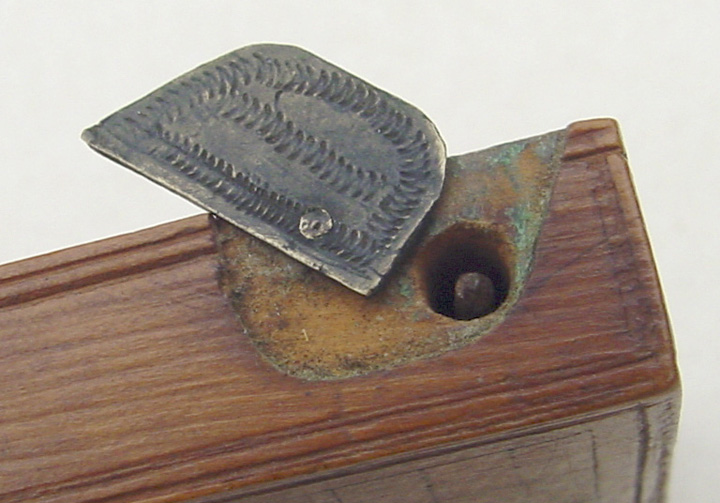
UNUSUAL FRUITWOOD DIPTYCH DIAL, Italian, c. 17th century. Measuring 2-1/2" x 3-1/2" x 7/8" (6.6 x 8.8 x 2.2 cm) closed, the dial is handshaped of lovely fruitwood with fittings of brass and horn, and inset glazed compass with shaped needle and paper marked with magnetic declination. The angle of the lid is adjustable in latitude against a calibrated and notched hinged brass arm engaged by brass slider above. The wood and horn have decorative straight and crenelated outlining, circles, star punches, and rose carvings. Numerals are punched, and the brass has hand cut wiggle-work patterns. Surface Ia has a polar dial divided every half hour for twice twelve hours, with brass hub to hold a vertical pin gnomon which would stow in a lidded compartment in the base. This dial is completed by a Latin motto "Si Solo deficit nemo me respicit," (If the sun withdraws, no one will pay attention to me). Ib has a string gnomon vertical dial divided 6 am to 6 pm, with black lines and red numerals, and marked for the latitude "GR. 42," plus a vertical pin gnomon dial for Italian hours (13 - 23) and stamped with Zodiacal signs. IIa bears again the latitude mark, with a horizontal pin gnomon dial again for Italian hours (10 - 23). IIb is inked with a large table in manuscript, including approximately 20 Italian cities and their latitudes. Workmanship is somewhat primitive and the condition is rather rough, with insect losses to the horn fittings, caus-ing hinge failure, and water losses to the manuscript table on the base. Nevertheless it is a most interesting diptych dial, rare as an Italian example, doubly rare in fruitwood, and unusual for its features especially the slide clamp for latitude setting. We find very few recorded Italian diptych dials, noting in particular the three in the Harvard collection recorded by Lloyd (compared with the 46 German and 32 French examples). The latitude (42°) is that of Rome. (7144) $3950. |
 |
 |
 |
 |
| Direct Reading of "Mean Solar Time" | Click on any image for a larger view. Scroll to view more items. |
 |
 |
 |
|
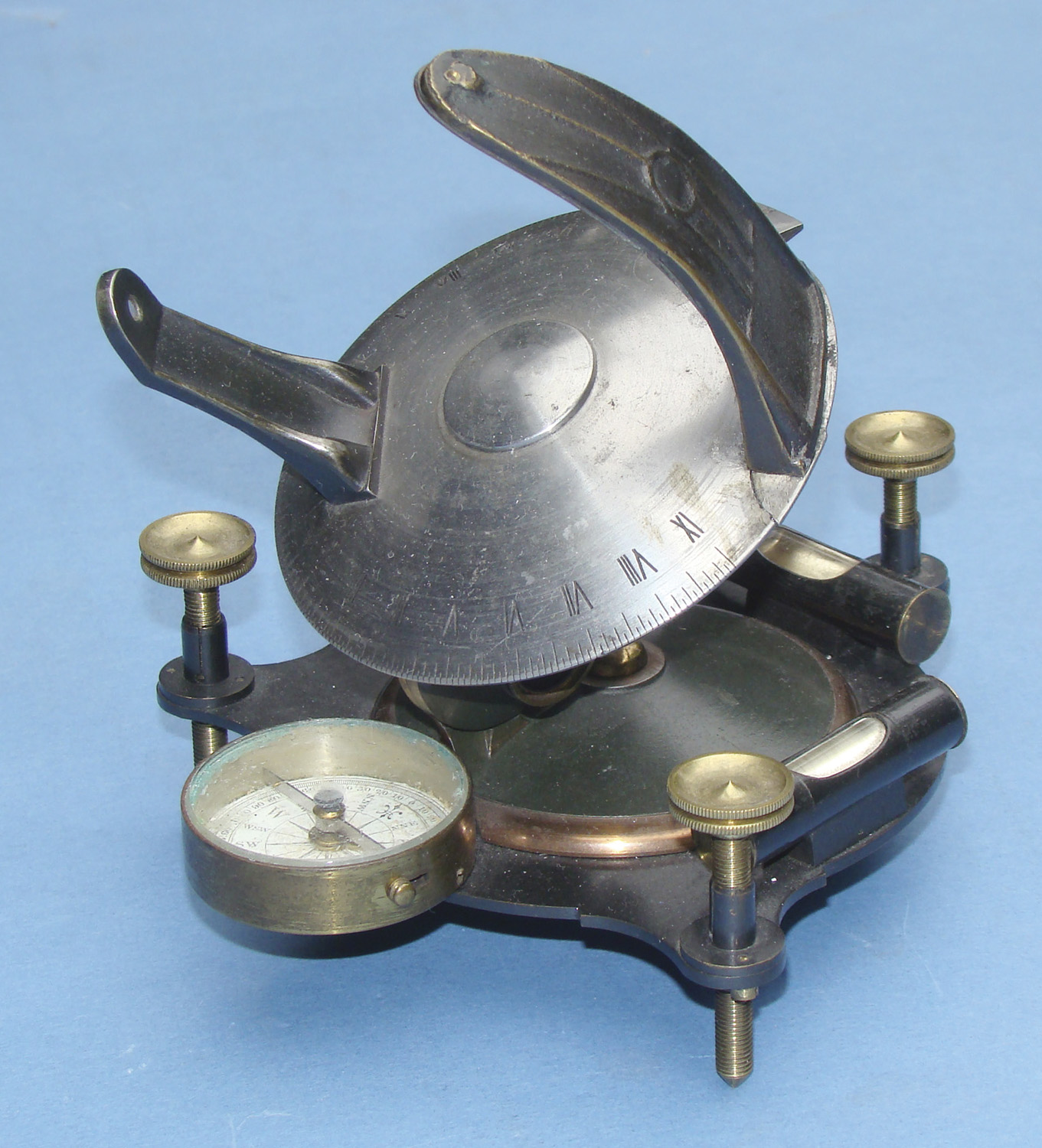
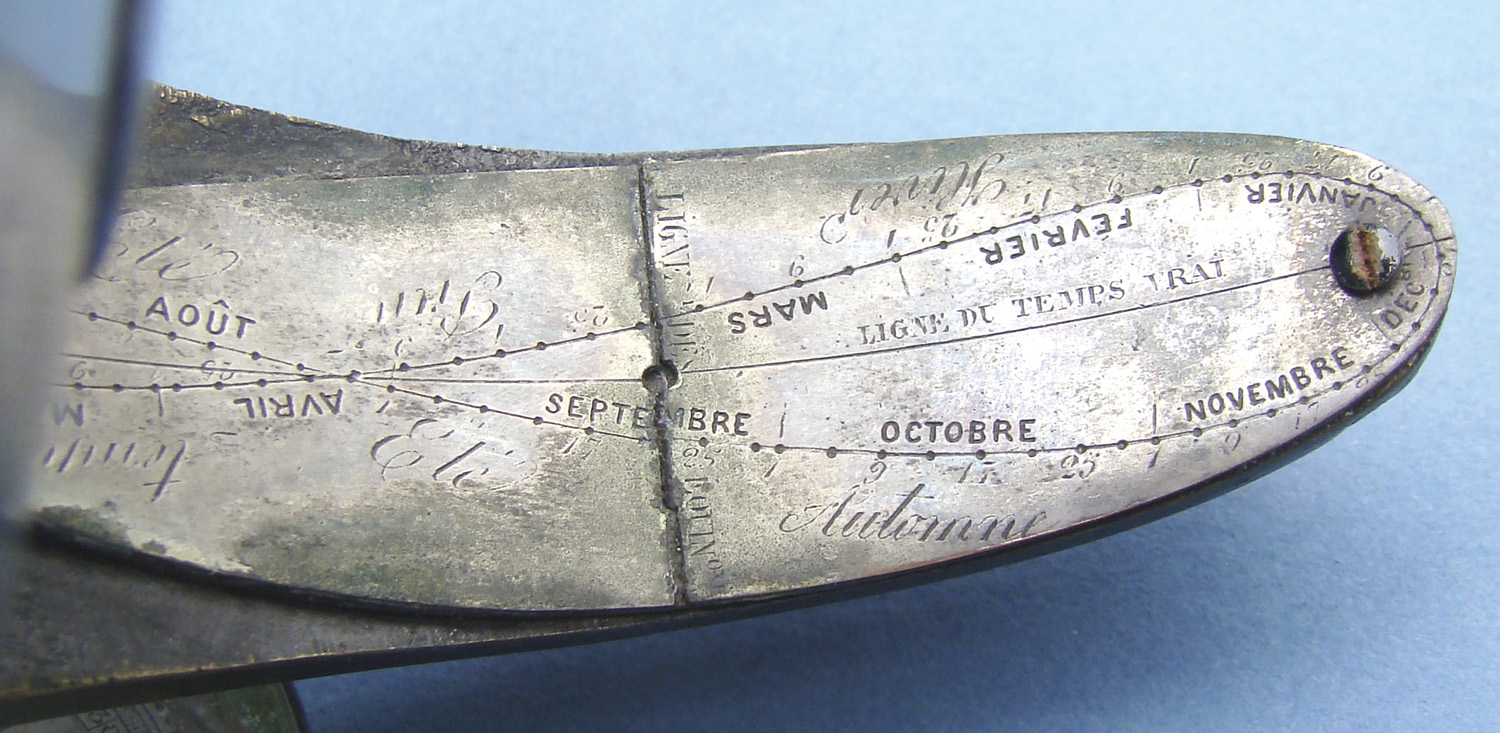
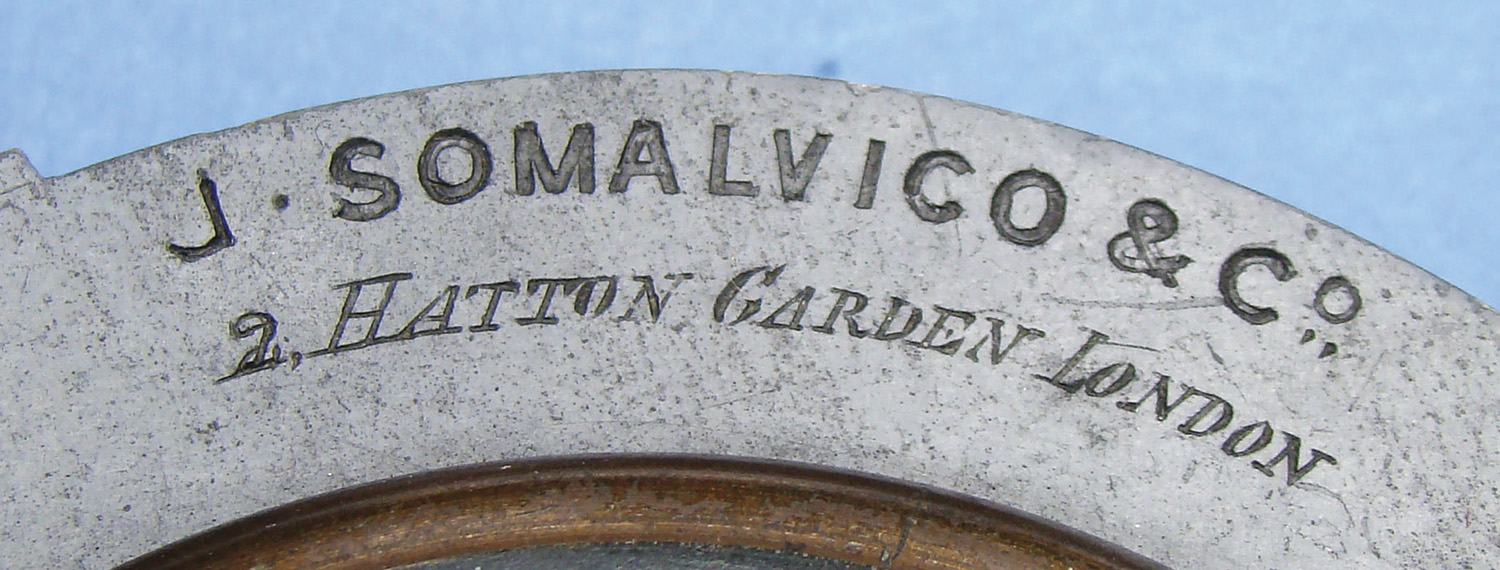
MINIATURE HELIOCHRONOMETER, probably French for the English market, second half 19th century, signed "J. Somalvico & Co., 2 Hatton Garden, London." Finely made of silvered, chemically darkened, and bright lacquered brass, this precision sundial has a round base with three leveling screws, crossed spirit levels, glazed compass with paper rose (in English), edge bar needle and needle lifter, tiltable and clampable dial support (for setting the latitude), and 3" (8 cm) diameter domed chapter ring plate divided every five minutes from 3am to 9pm, with one-minute vernier. This rotating dial plate is fitted with a simple lens on bracket support, and with a target engraved with an analemma divided every fourth day throughout the year and labeled in French with months and seasons. Condition is fine except for two old repairs, one to an edge chip and one to a break in the analemma. To use the heliochronometer, after leveling, orienting north, and setting to one's latitude, one rotates the dial plate until the sun's image falls on the date. The time indicated is then mean solar time, automatically corrected for the "equation of time" (i.e, for the difference on that date between the apparent and the mean position of the sun, resulting from the ellipticity of the Earth's orbit around the Sun). We have seen a very similar but larger one (6" diameter chapter ring) labeled in French and signed "Molteni" for the Paris maker of scientific apparatus, another for the Russian market (Tesseract Catalogue 69 item 14). A handsome, unusual miniature instrument, in fine functional order. (10181) $1800. |
| Finding Geographic North by the Sun | Click on any image for a larger view. Scroll to view more items. |
 |
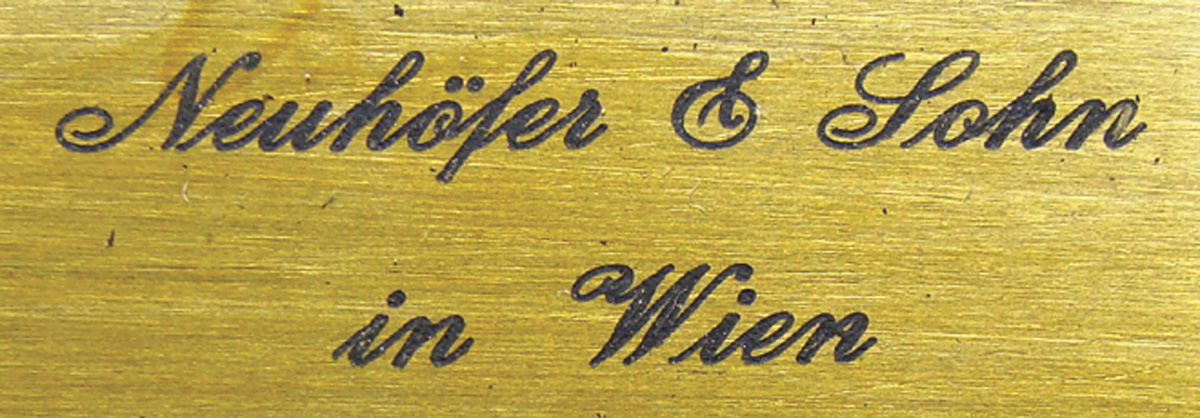 |
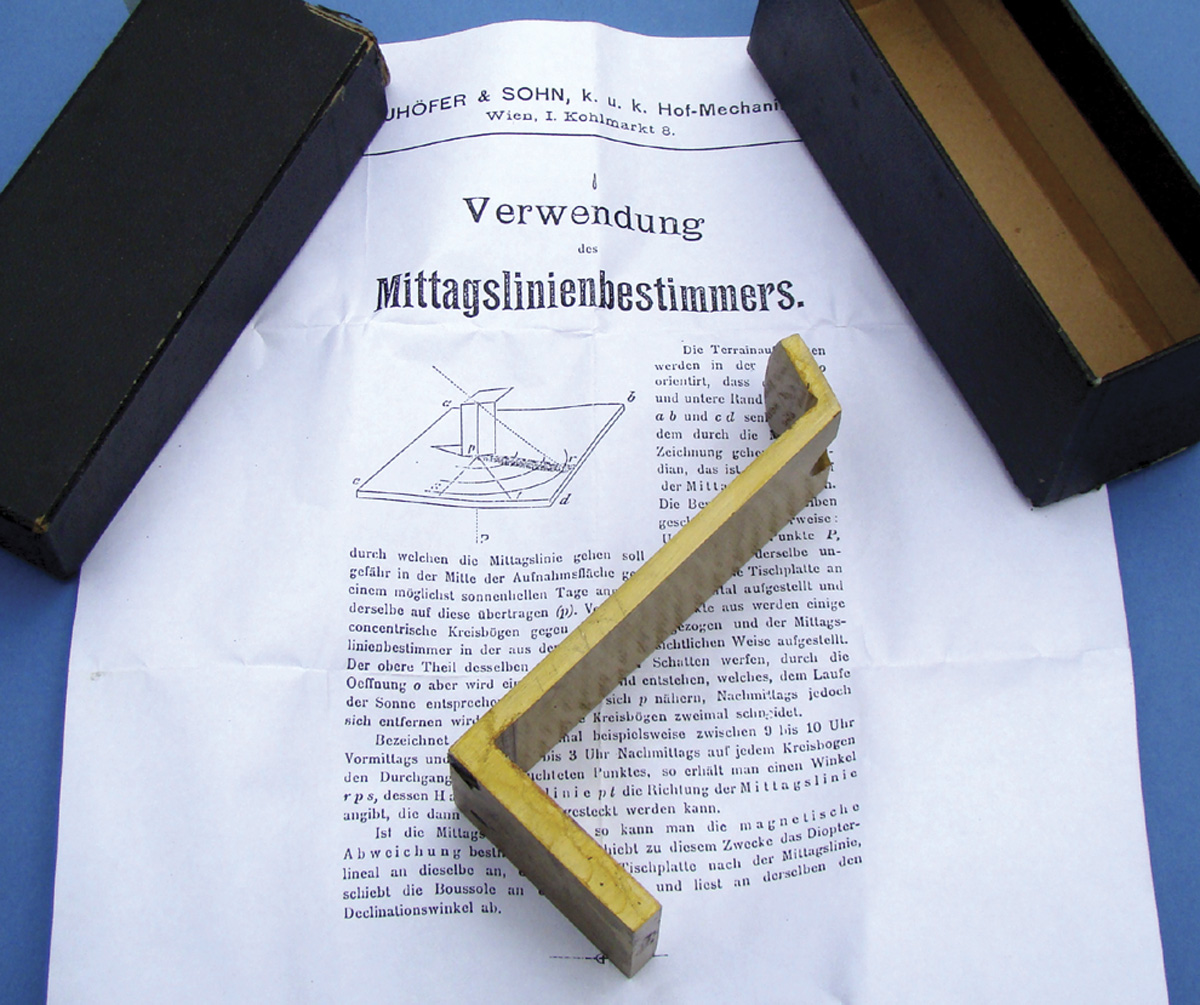
| A MIDDAY-LINE RECKONER, Austrian, c.1900, signed "Neuhöfer & Sohn in Wien." Made of heavy brass, finely machined and standing 4-1/4" (11 cm) high, this unusual form of noon mark has a pinhole on top and a vertical scribe line passing through it and down to the base. In use one can plot, on a leveled plane table, the meridian sun's projection through the pinhole, giving the direction to geographic North. Placing a trough compass along this line immediately gives the magnetic declination, i.e., the local deviation between magnetic North and geographic North. An unusual device, reminiscent of the monumental noon mark projections in cathedrals, in very fine condition complete with instructions and card box. (9146) $750. |
| Safety in the Phrygian Bonnet | Click on any image for a larger view. Scroll to view more items. |
 |
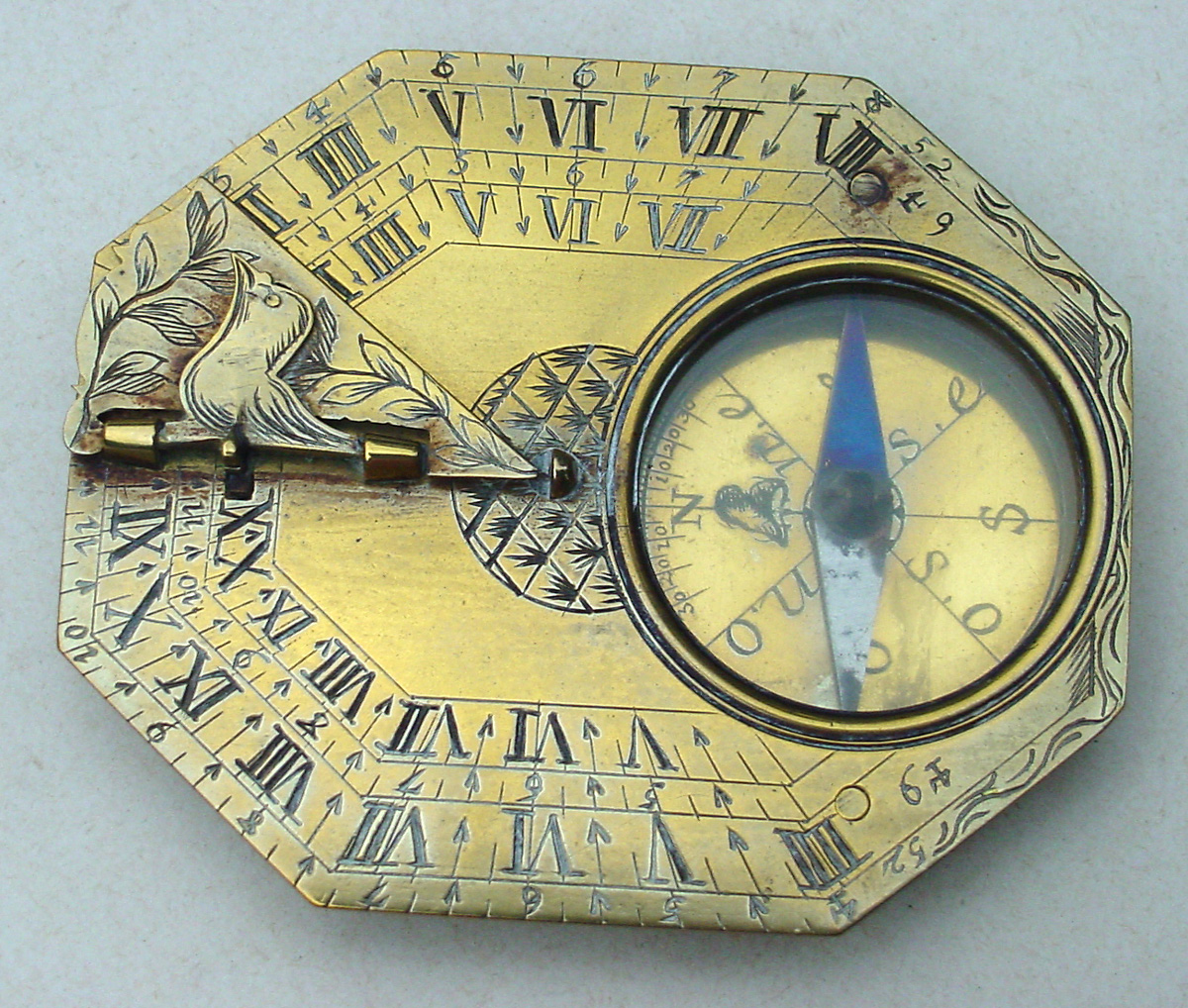 |
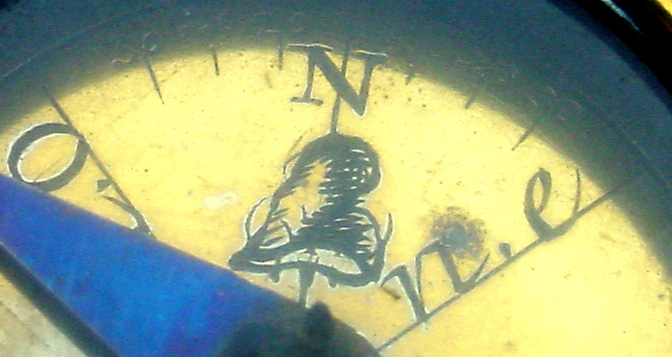
| A REVOLUTIONARY SUNDIAL, French, 18th century, unsigned, of the "Butterfield" type. The eight-sided brass dial measures 2-1/2" x 3" (6 x 8 cm), with folding gnomon adjustable from 40° to 60° North latitude against bird-form support, and inset glazed compass. The upper surface is engraved with four chapter rings for different latitudes, and most distinctive cross-hatched decoration. The underside has a gazetteer of 17 cities and their latitudes, the spring plate also with cross-hatching. The gnomon carries unusual leafy vine decoration. Condition is fine noting the tiny interior tip of the gnomon is broken off, and the glass and needle are probably replacements. In all respects the decoration is special -- this dial was not made by any of the standard makers of the period: Butterfield, Bion, Macquart, Chapotot, etc. But it is the inset compass that carries the most remarkable history. It is divided with an eight point rose labeled with directions, and a magnetic variation scale from 30° E to 30° W. The North point shows traces of an effaced fleur-de-lys (traditionally the symbol of the monarchy in France), re-engraved with a bold Phrygian bonnet (the symbol of liberty adopted during the Revolution, based on the hat worn by the Phrygians of antiquity, in Asia Minor). This directional was obviously re-engraved in the last decade of the 18th century, when it became very unhealthy to be caught carrying a royal fleur-de-lys! (8130) $2950. |
 |
| Incense Tells the Time, in 18th-century Japan | Click on any image for a larger
view. Scroll to view more items. |
 |
|
|
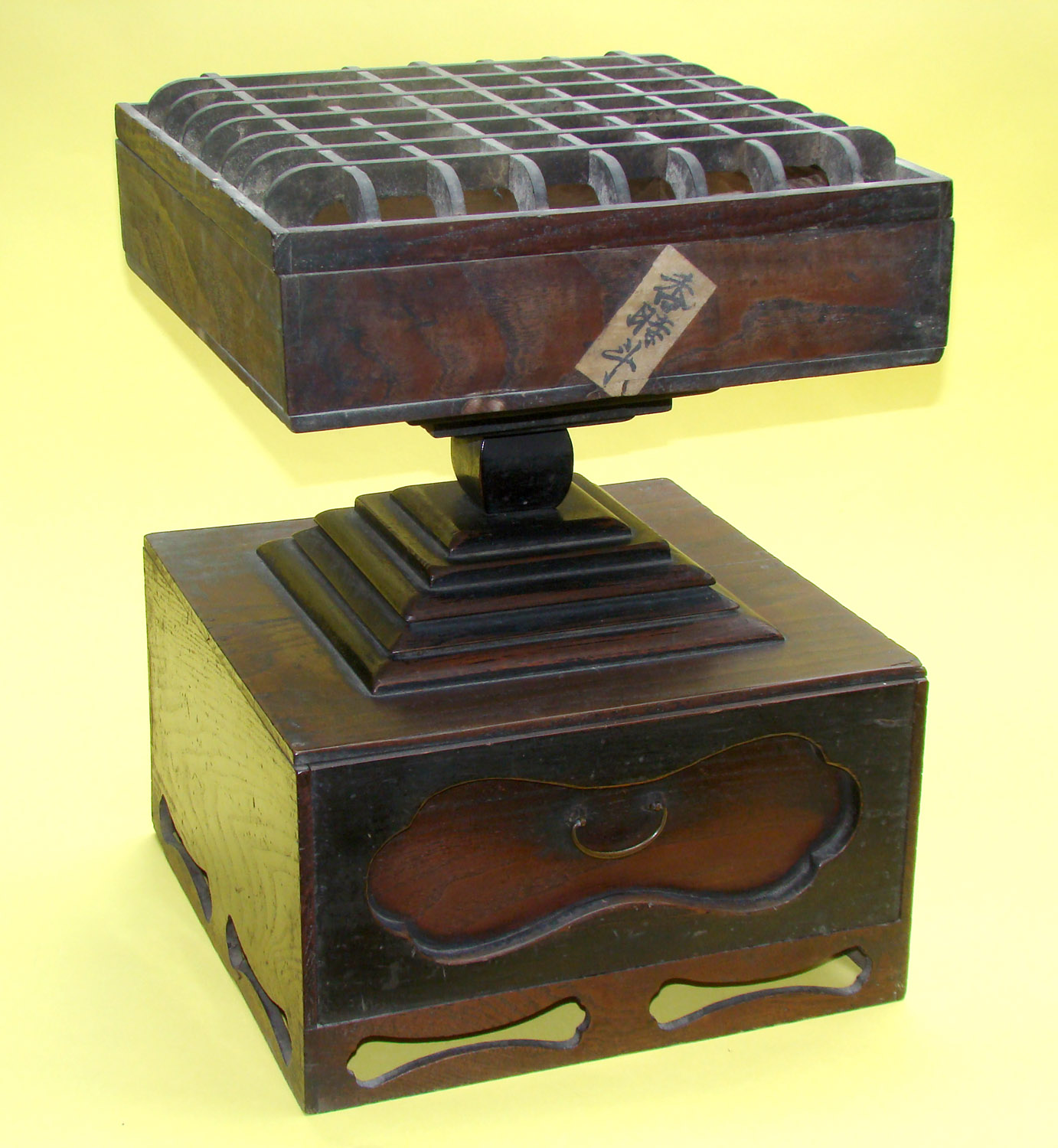
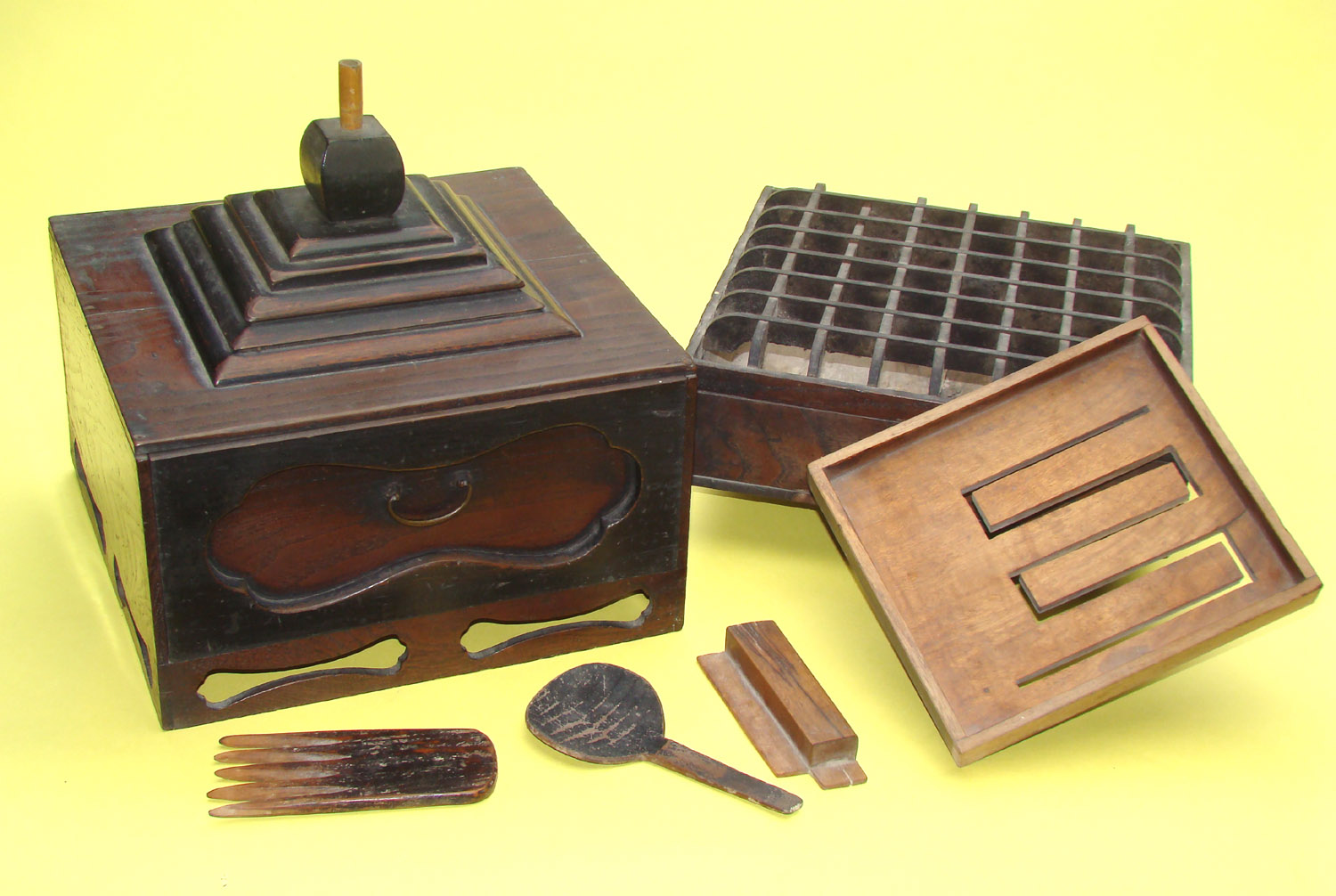
JAPANESE "JOKOBAN" INCENSE CLOCK, Edo period, c. 18th century. This handsome timekeeper is constructed of a beautifully grained and stained light weight wood (probably paulownia or cryptomeria) and measures 11-3/8" (29 cm) square by 15-5/8" (40 cm) tall. The lower section has attractive lozenge-shaped cutouts around the base, and a large matching drawer for tools and accessories. The upper section has a square wooden burning "pan" surmounted by an open wooden latticework cover formed as an 8 x 8 grid; the whole upper section is free to rotate, and lifts off easily. Four wooden tools are included: template, tamper, spatula, and five-tined comb. Condition is fine throughout, noting a couple of minor age cracks and slight heat damage to the pan and cover. The jokoban was used in community life as well as in Buddhist temples, to measure extended spans of time (see Bedini, The Trail of Time, 1994, for comprehensive, lucid discussion of East Asian time measurement by incense burning). After covering the bottom of the pan with a uniform layer of fine wood ashes, and tamping this down, one impressed the template into the ash, then filled the pattern of trails with very slow-burning incense. The template is a "maze" of five long interconnected parallel lines. This was impressed four times, swiveling the pan by 90° each time, resulting in a kind of swastika design for the incense trail. After the incense was ignited at the starting point, the time was determined by the position of the point of burning along the trail; total burn time could be twenty hours. The latticework cover passes heat and smoke, and prevents breezes from accelerating the combustion. The swastika pattern, commonly found on Buddhist inscriptions, represents "many" or "longevity" or "infinity," and "is ordinarily accepted as the accumulation of lucky signs possessing 10,000 virtues" (Bedini). A fine example of this unusual horological device. (9153) $5500. |
| A Most Rare Compass/Sundial | Click on any image for a larger
view. Scroll to view more items. |
 |
|
|
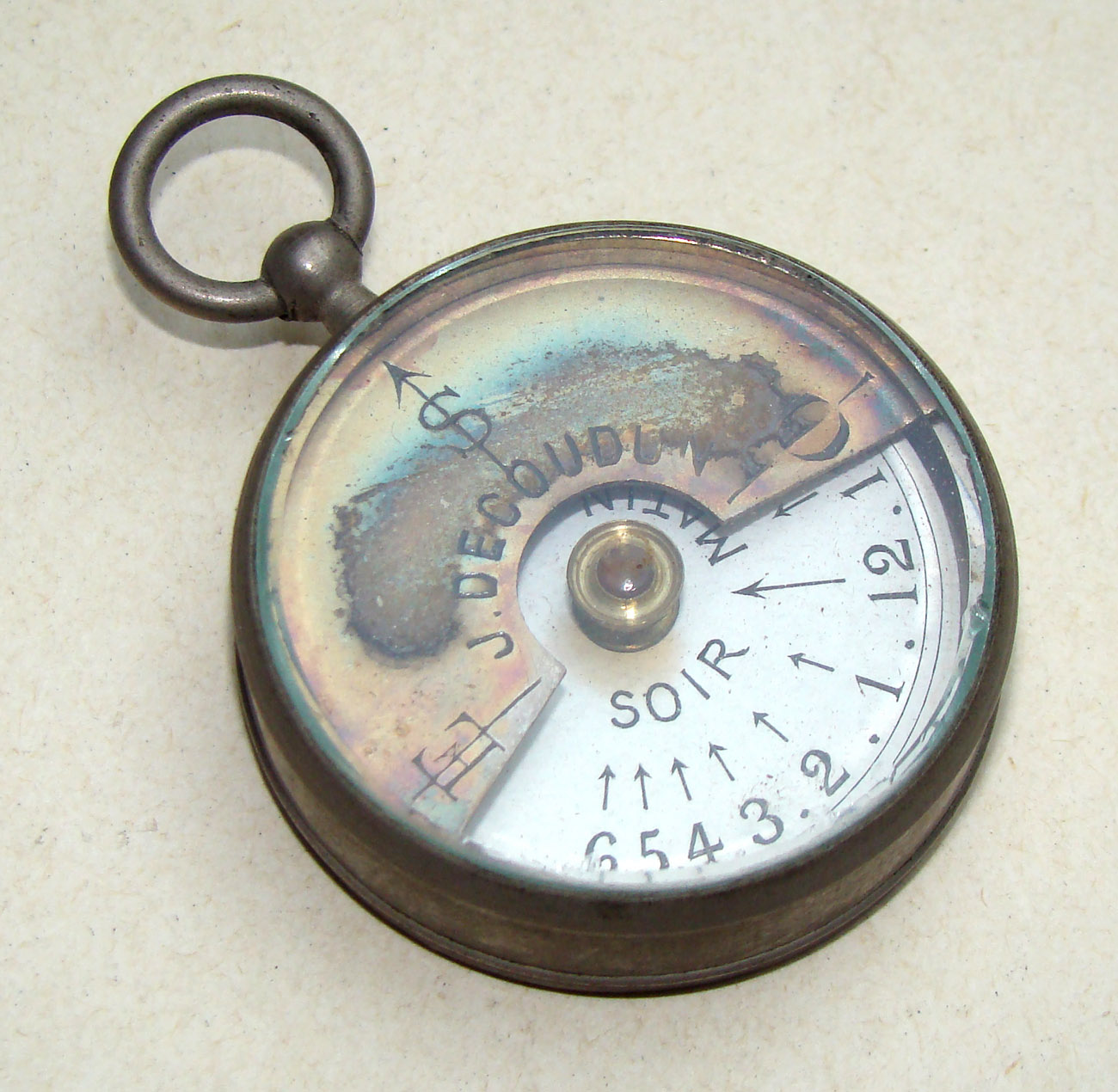
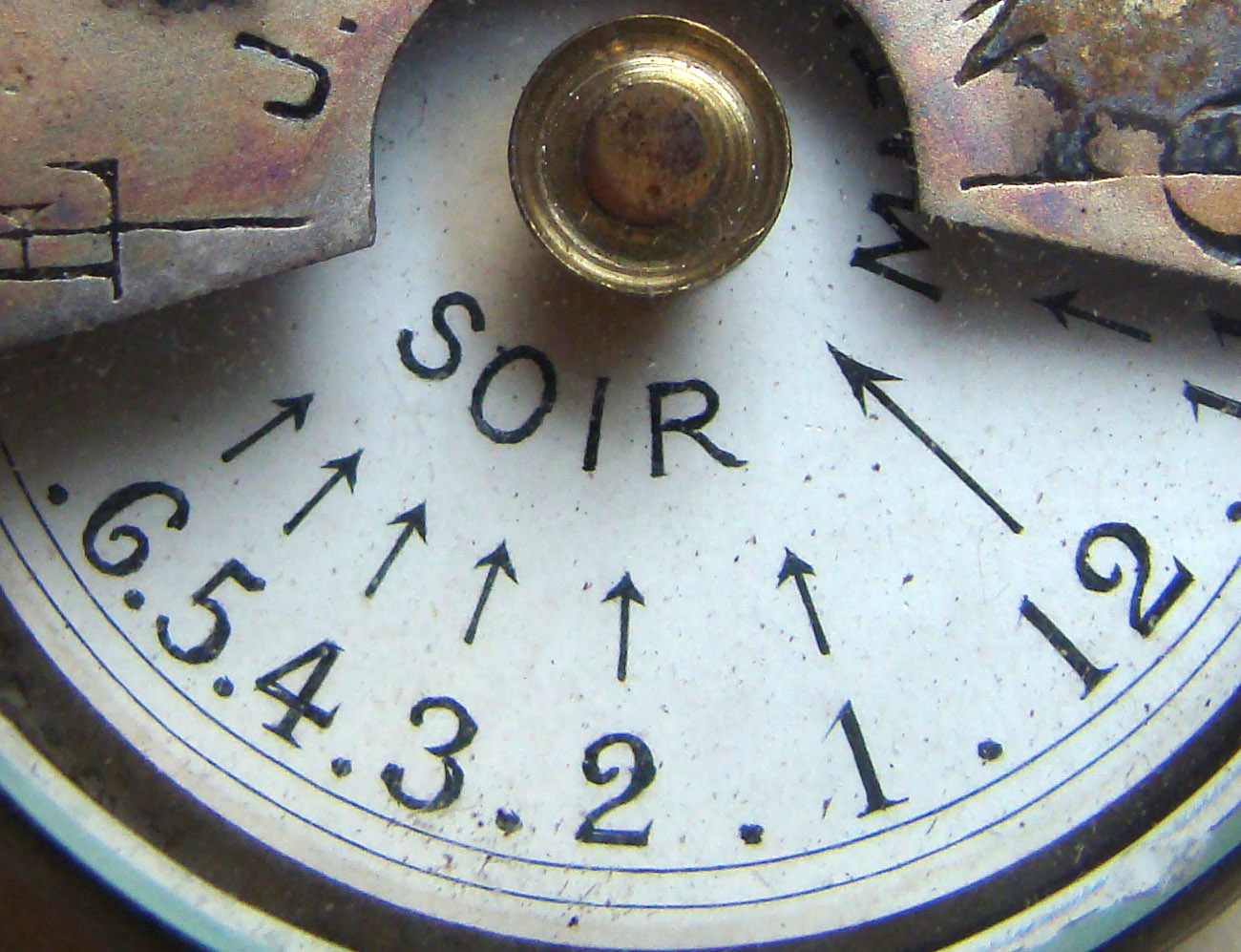
MAGNETIC AZIMUTH SUNDIAL, French, late 19th century, signed "J. Decoudun." The 1-1/8" (3 cm) diameter glazed case is made of plated brass and mounted with pendant ring. It contains a fixed brass arc with compass directionals, and a floating compass card printed with hours from 6am to 6pm and set with stone pivot. Condition is very fine noting some darkening to the silvered arc. In use one aligns the case with the sun, and reads the time from the calibrations on the floating card. The maker is recorded by Marcelin for a sundial -- probably this one -- in a 1986 Paris auction. But Decoudun is known for his 1888 extinction exposure meter, and for a new form of pneumatic hydrometer. He also advertised -- from his 8 rue de Saint-Quentin, Paris, address -- the availability of a safe oil-burning bed reading lamp. This is the only example of his magnetic sundial we have seen. (9143) $495. |
| Elegant 1789 Dial by a Thoughtful Craftsman | Click on any image for a larger view. Scroll to view more items. |
 |
|
 |
 |
|
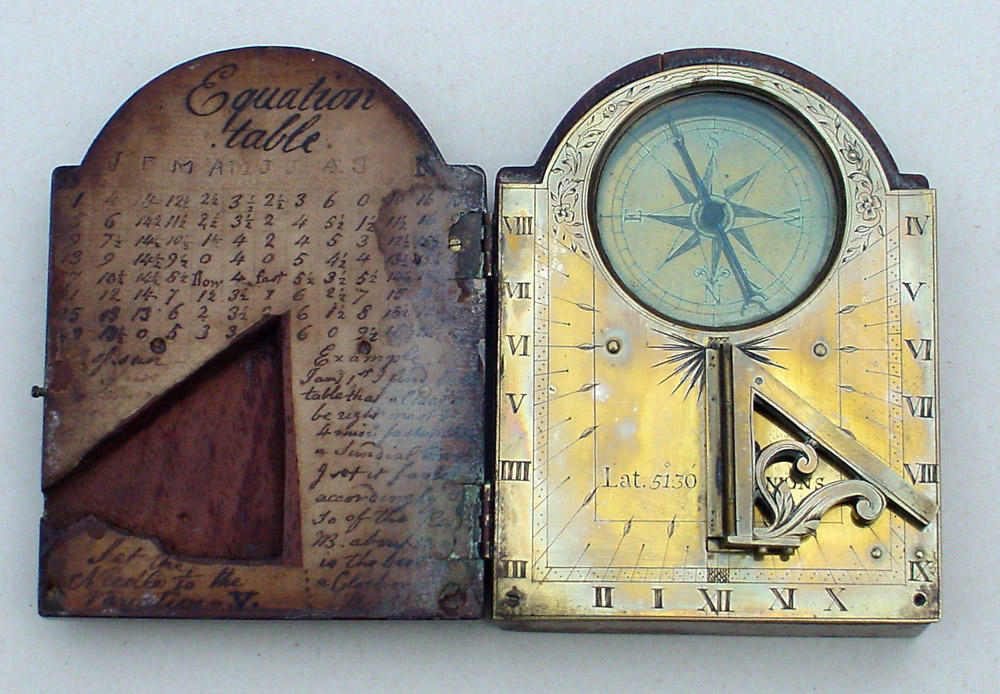
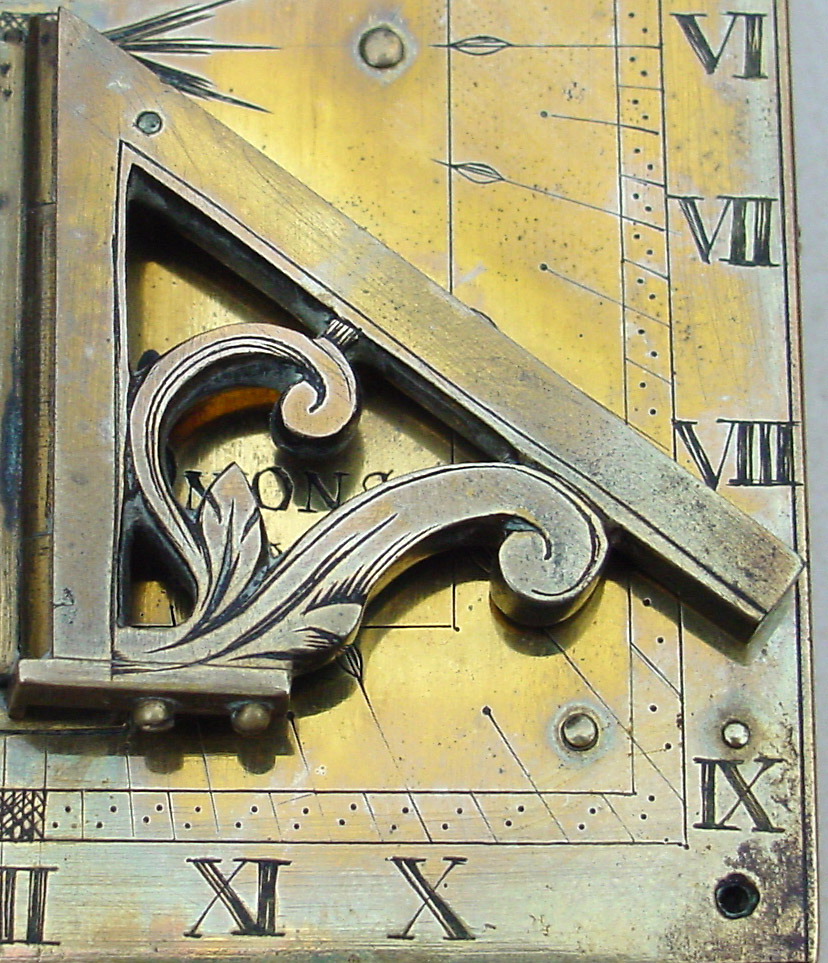
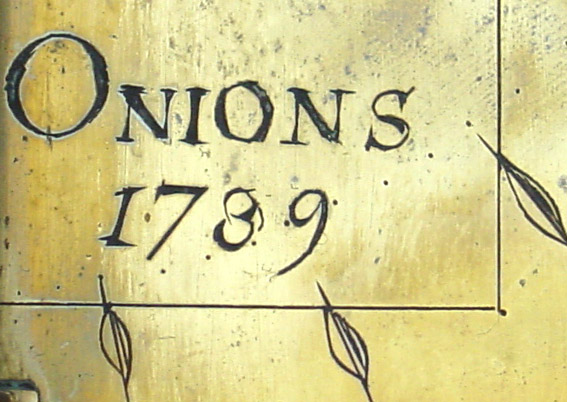
UNUSUAL HORIZONTAL DIAL, English, 1789, signed "Onions,
1789, Lat. 51°30'." The 3" x 4" (8 x 10 cm) brass dial
is set into a tabernacle-shaped fruitwood carrying case, complete with
early handwritten equation of time table. The brass dial itself is beautifully
executed, the folding gnomon pierced and engraved with floral design,
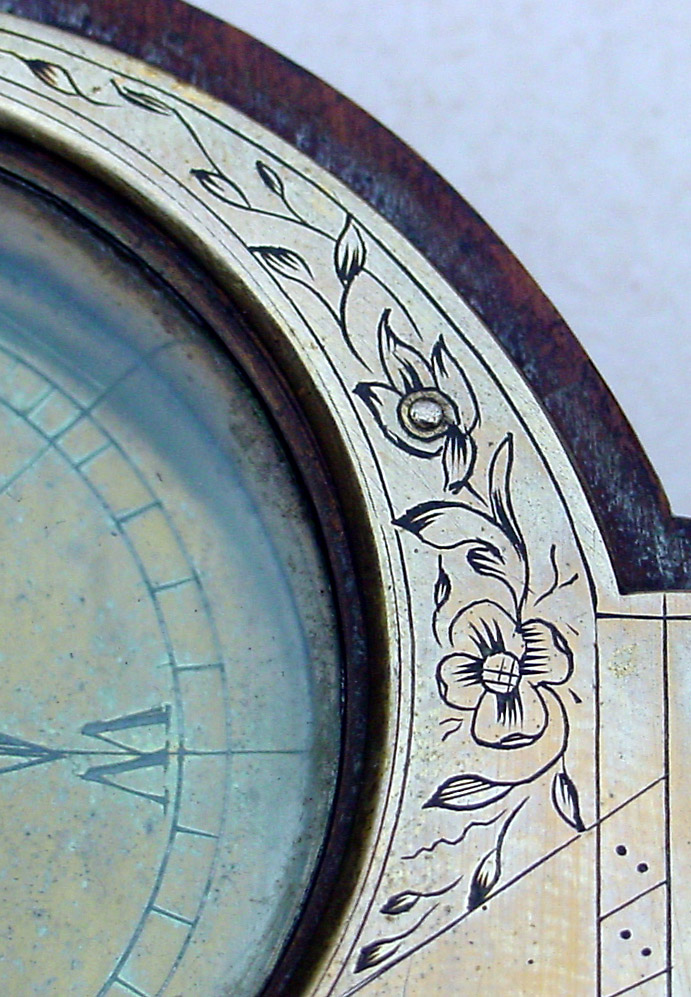
the chapter ring divided every five minutes, the inset compass surrounded
by engraved vines and flowers, the glazed compass itself with engraved
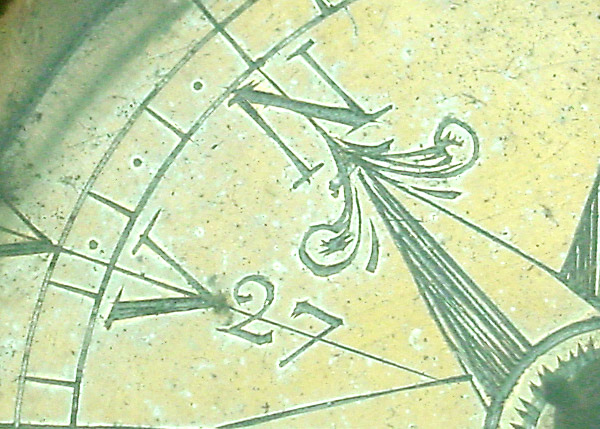
brass compass rose and finely cut needle. To the west of the fleur-de-lys
North point is an engraved "V" and "27," indication
of the point of magnetic variation. (In fact, consulting a plot of variation
vs. time and place, we find, for London, the declination in 1780 was 23°
West and heading further west at about 0.15 degrees per year ‹ as it had
been doing for the previous 200 years. Thus Onions, in 1789, could have
anticipated a variation of 27° about 20 years later, and constructed a
dial made to last. In fact, the actual variation slowed down and, reaching
a peak about 1810, then reversed direction, and now approaches 0° in London.
It never made it close to 27°!) Condition of the dial is very fine, noting
a crack and water (?) damage to the wood base. The maker, presumably Peter
Onions, is listed in Loomis as a clockmaker working in Brosley c.1760.
He gave his own distinctive, rather elegant design to the dial and its
decoration. The overall shape, in fact, mimics that of a standing clock!
Most unusual. (7206) $4950.
|
|
 |
 |
|
| Early English Dialling | Click on any image for a larger
view. Scroll to view more items. |
 |
|
|
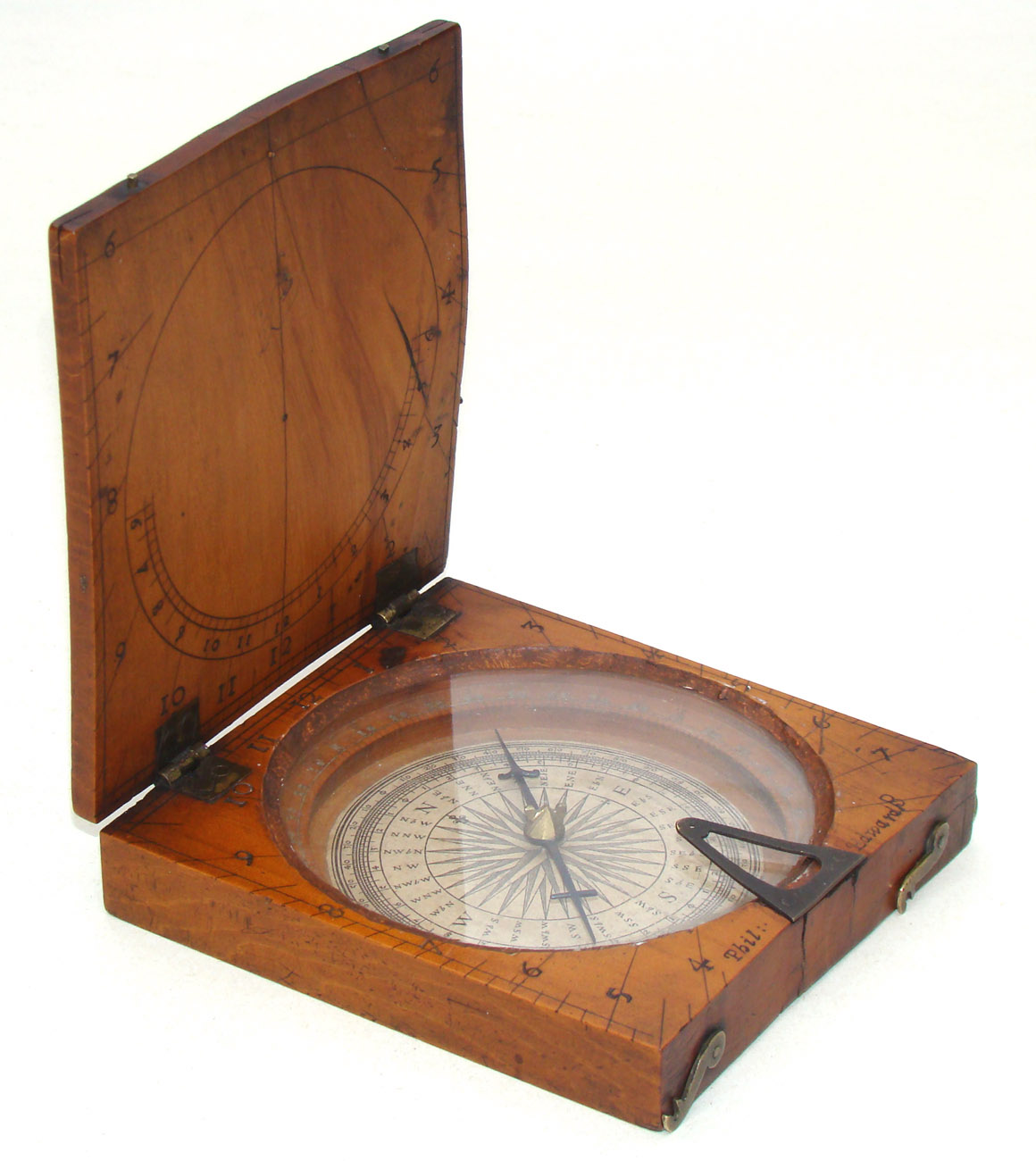
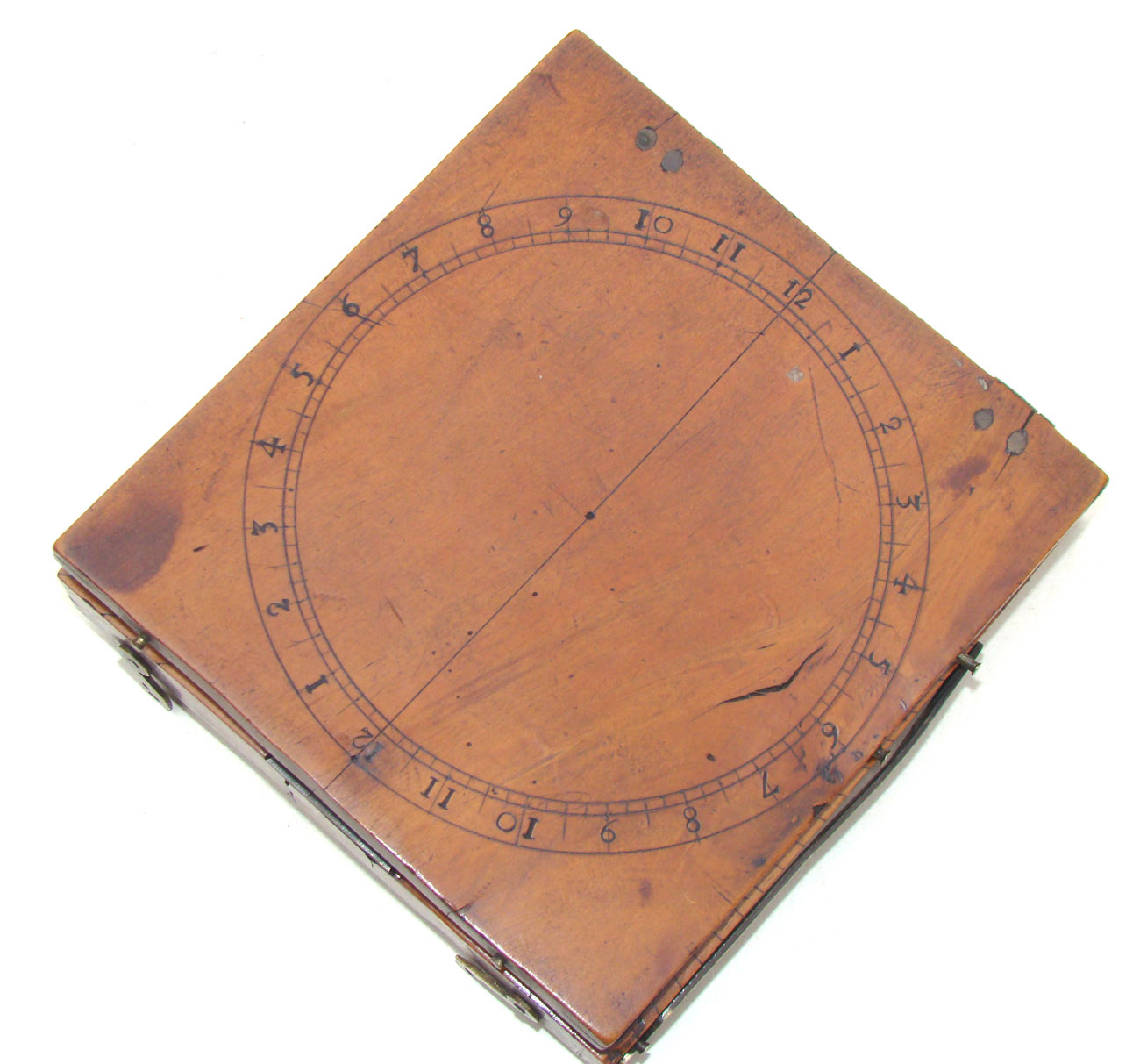
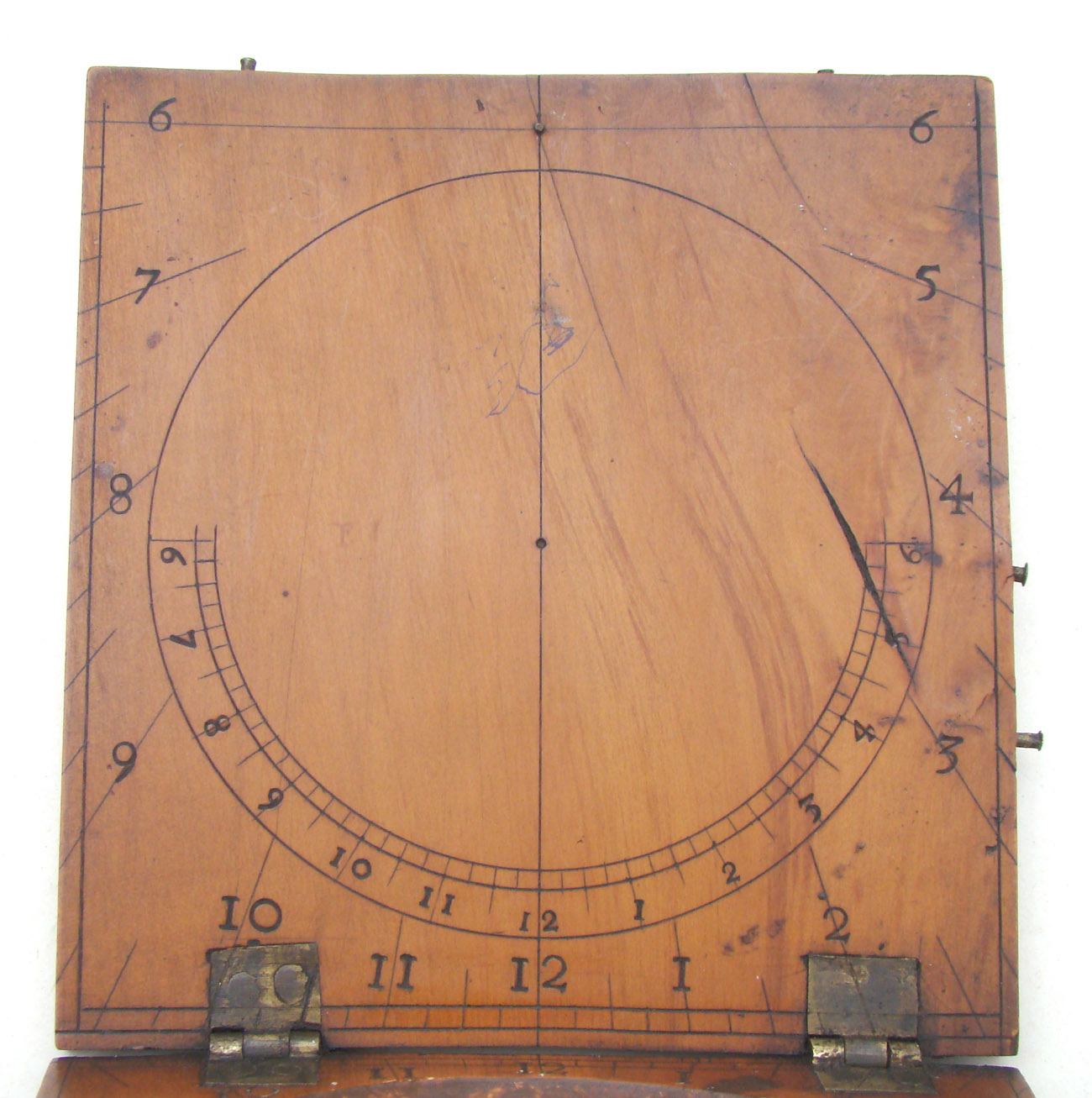
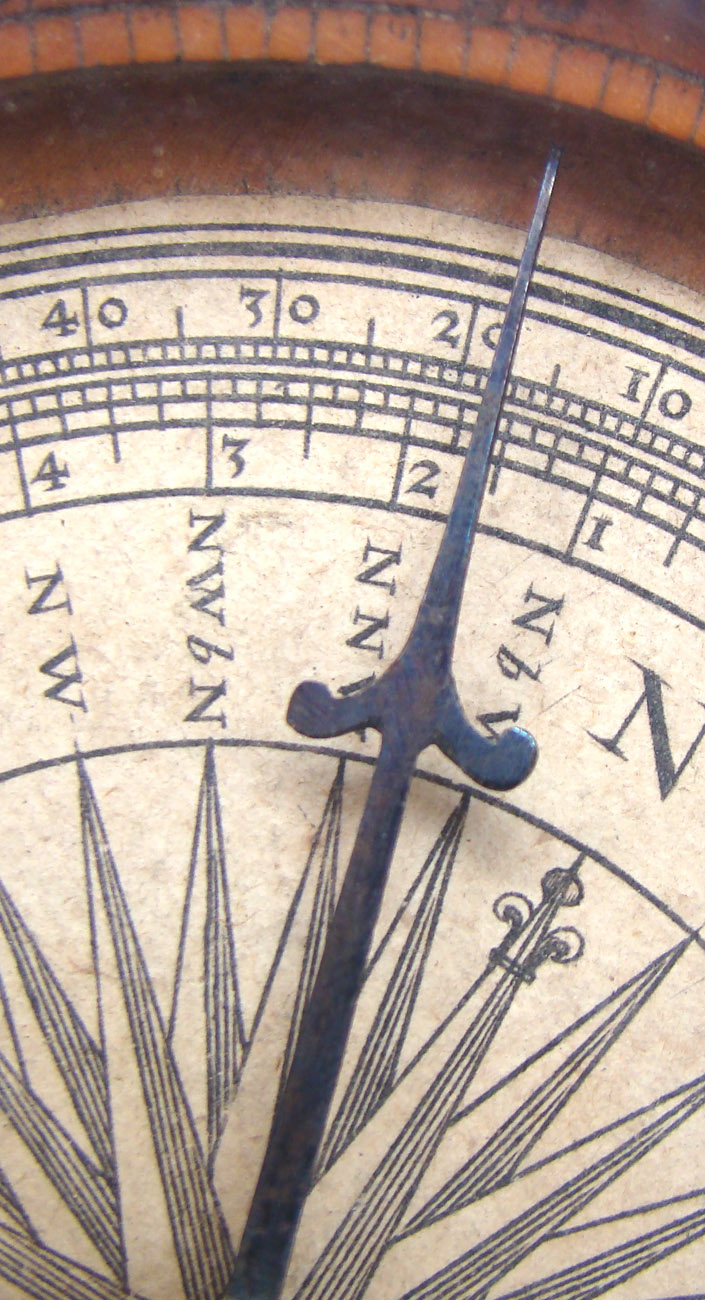
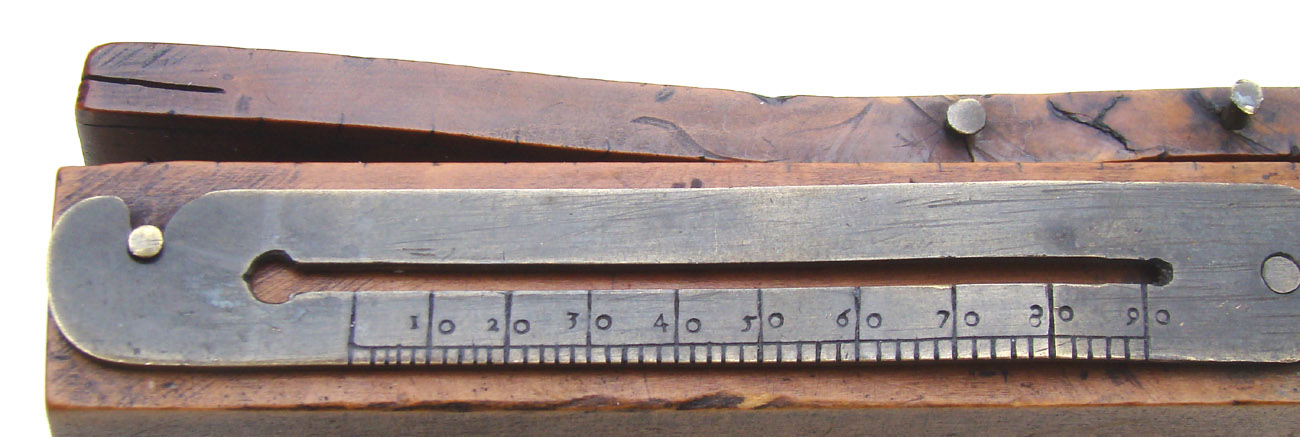
FOUR-SUNDIAL COMPENDIUM, English, c. second half 17th century, signed "Phil. Edwards." Constructed of fine boxwood, this unusual diptych compendium measures 4" x 4-1/4" x 1" (10 x 11 x 2.5 cm) closed. Surface Ia is divided, every quarter hour, with a twice-12 hour scale full circle, and would work in summer, when the sun is above the plane of the equator, with a central straight pin as gnomon. Surface Ib is again divided, half-circle, from 6am to 6pm, functioning similarly in winter. The pin gnomon must be aligned parallel to the earth¹s polar axis, and thus inclined to the horizontal by the user¹s latitude; this inclination is set by a fine brass strut divided every 2° from 0° to 90°, and with central slot engaging a pin. Another dial is inscribed on Ib, this a vertical dial for a fixed latitude (approximately 50° N), divided 6am to 6pm, and maintained vertical by the strut engaging a second pin. The string gnomon for this dial would run from a brass fitting on the base to a hole on top. IIa uses the same gnomon for its horizontal 4 am - 8pm dial, which surrounds the large inset glazed compass required for orienting the sundial exactly towards geographic north. The compass has a fine arrowhead needle, a circumferential scale of degrees, and an interesting printed paper rose with its own degree scale plus 32-point rose with 32 labeled directionals and subdivided to 256 points of the compass. Surface IIb is blank. Condition is very fine except the boxwood badly warped and with hairline cracks. The warping is stable and the instrument fully functional. The maker Phil(ip) Edwards was a fine craftsman (except for his choice of the pieces of boxwood!) but is not listed in the standard references. Clifton records a number of Edwards's as instrument makers, but the only ones of the right time period are Richard (working 1660 -1667) and his wife Mary (working 1668), noting they had as apprentice one John Yarwell! Here the numeral and letter shapes are rather specific to English work of the second half 17th century, and the lack of any indication of magnetic declination on the compass rose suggests it was made c. 1660 - 65, when the declination in London went through zero. (9205) $5500. |
 |
|
 |
 |
| Eighteenth Century Time-Telling | Click on any image for a larger
view. Scroll to view more items. |
 |
|
|
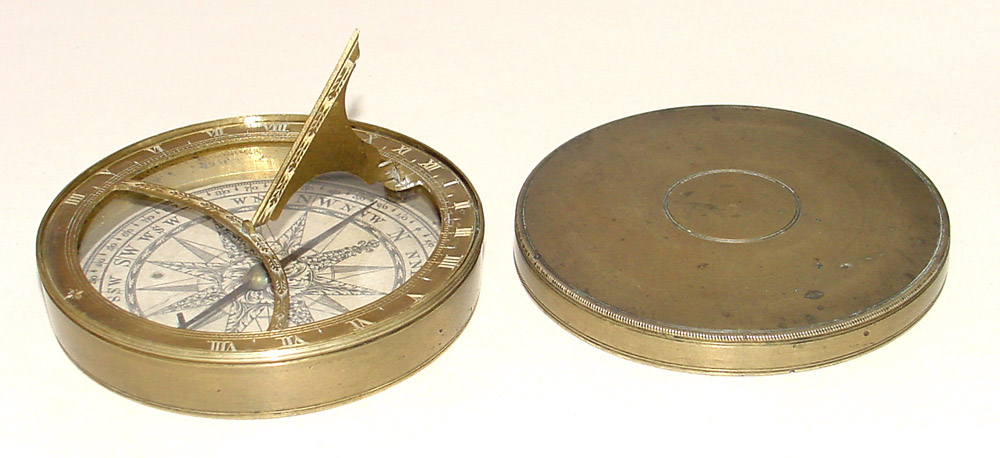
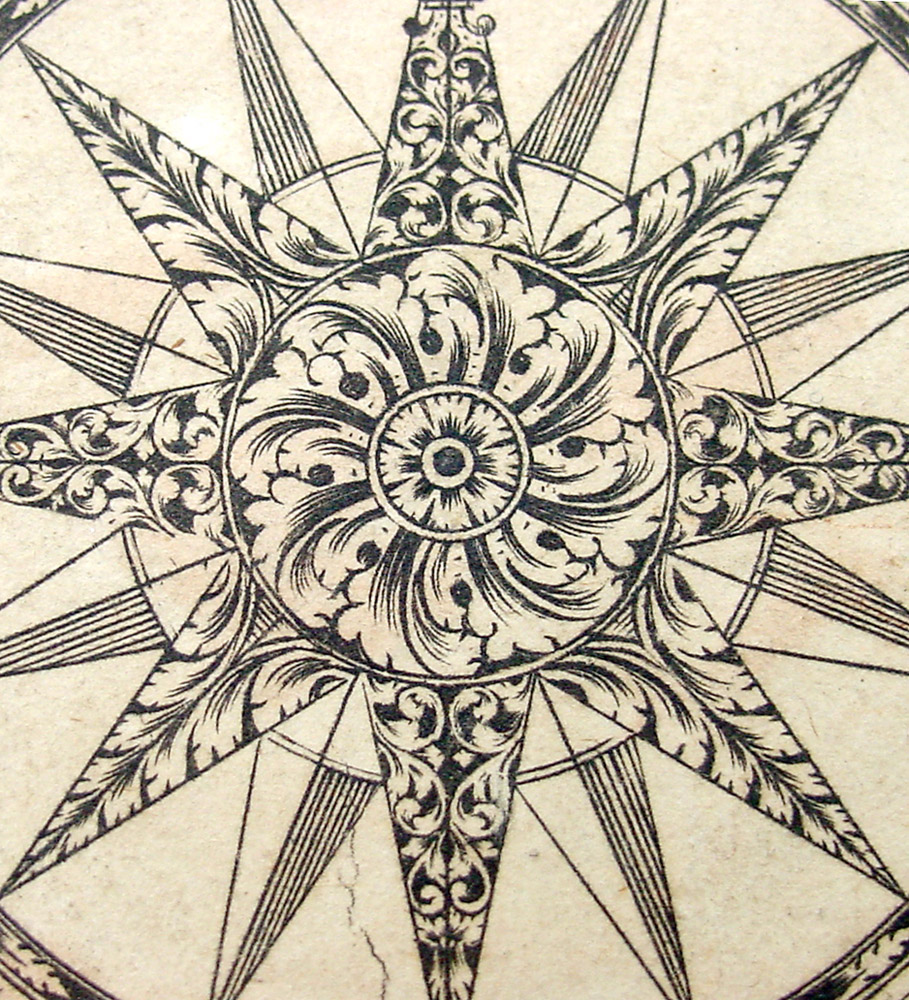
GOOD POCKET COMPASS / SUNDIAL, English, c. second quarter 18th century, the turned brass case and screw-on cover 3-3/8" (8.5 cm) in diameter. The glazed compass is mounted with a beautifully designed and engraved paper rose incorporating 16 directionals, circumferential degree scale, running leaf tip design, and exquisite floral patterns. An identical paper is applied in the lid. The original shaped iron needle has an eight-sided pyramidal brass hub. Atop the glass is a fine brass chapter ring (divided every five minutes from 4am to 8pm) also with leaf tip engraving, and with folding gnomon designed for approximately 51° North latitude (consistent with London design). Condition is fine noting three later small holes in the base, and the case exterior darkening slightly. A very finely crafted instrument. (9121) $975. |
| Superb Craftsmanship with a Camouflaged Date | Click on any image for a larger view. Scroll to view more items. |
 |
 |
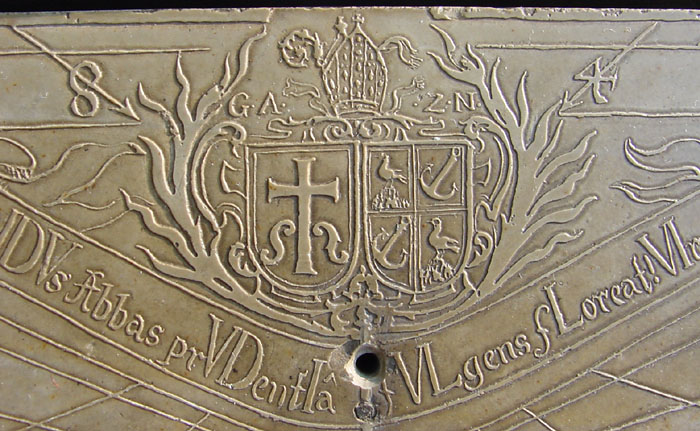
| SOLNHOFER STONE SUNDIAL WITH DATE HIDDEN IN A CHRONOGRAM, German, 1723, bearing arms labeled "GA ZN," the latitude (47°33'), and a Latin motto which conceals the date (1723). The 6-3/4" x 8" (17 x 20 cm) block of very finely grained Solnhofer stone is acid-etched with a fine projection of chapter ring (divided every quarter hour from 4 am to 8 pm) and Zodiacal calendar. It is set with a shaped brass gnomon with oculus for the calendar scale, and is mounted in a dovetailed softwood frame. Condition is very fine throughout, noting an old scratch and some quite small edge chips. Solnhofer stone, found in southern Germany, is particularly suited for fine etching, and often served as lithographer's stone. The specific latitude agrees with almost the southern tip of Germany (e.g., Lindau, Bregenz), and parts of Austria. The date is revealed by adding all of the capitalized letters (taken as Roman numerals) in the motto, a technique used by Renaissance scholars in a period of classical revivalism. A very fine example, deserving of further research into the elaborate heraldic arms with its bishop's(?) miter. (8149) $4950. |  |
 |
|
| Henry Sutton's Design | Click on any image for a larger view. Scroll to view more items. |
 |
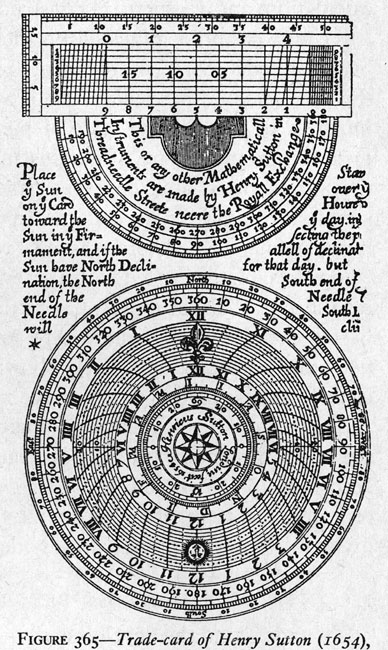 |
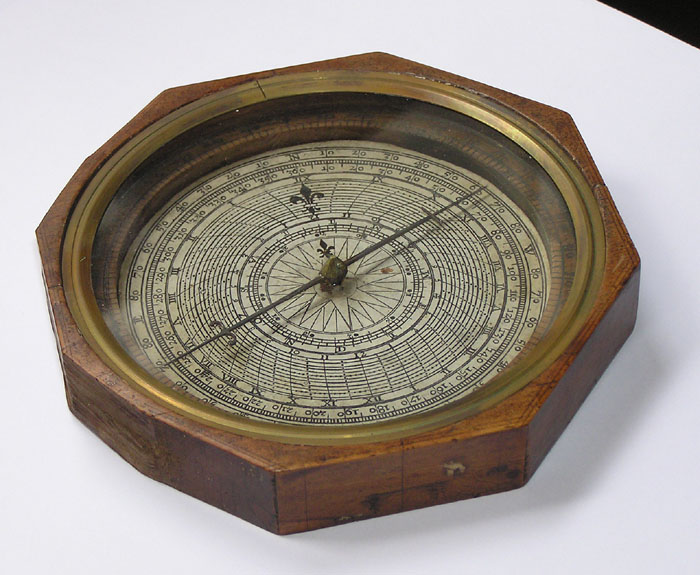
| HENRY SUTTON'S FORM OF MAGNETIC AZIMUTH DIALLING COMPASS, English, c. third quarter 17th century, unsigned. Set in an eight-sided wood mount, 4-3/4" (12 cm) across, the compass has a fine printed card, a most elegantly shaped needle, and a circumferential wooden degree circle. The card has degree scales, twice-12 hour scales, calendar scale, solar declination scale, and 32-point rose. Condition is good noting the wood housing is cut on one side (where it may have attached to a plane table), the glass replaced. A similar dial face is shown on Henry Sutton's 1654 trade card (see Derek Price in Singer et al., 1957), along with instructions to direct the south side of the compass card toward the sun, and read the time where the north end of the compass needle (in summer; south end in winter) crosses the hour lines along the proper parallel of solar declination (as read from the central circular table). A very rare dialling compass. The Museum of the History of Science in Oxford holds a boxwood diptych sundial mounted with a similar compass card, and owns a variant slightly earlier unmounted card signed "Henry Sutton Londini fecit *1653.*" The card design has been discussed in detail by Jim Bennett (Sphaera issue 10). (8138) $4800. |
 |
| Boxwood Version of the Traditional Nuremburg Dial | Click on any image for a larger
view. Scroll to view more items. |
|
|
|
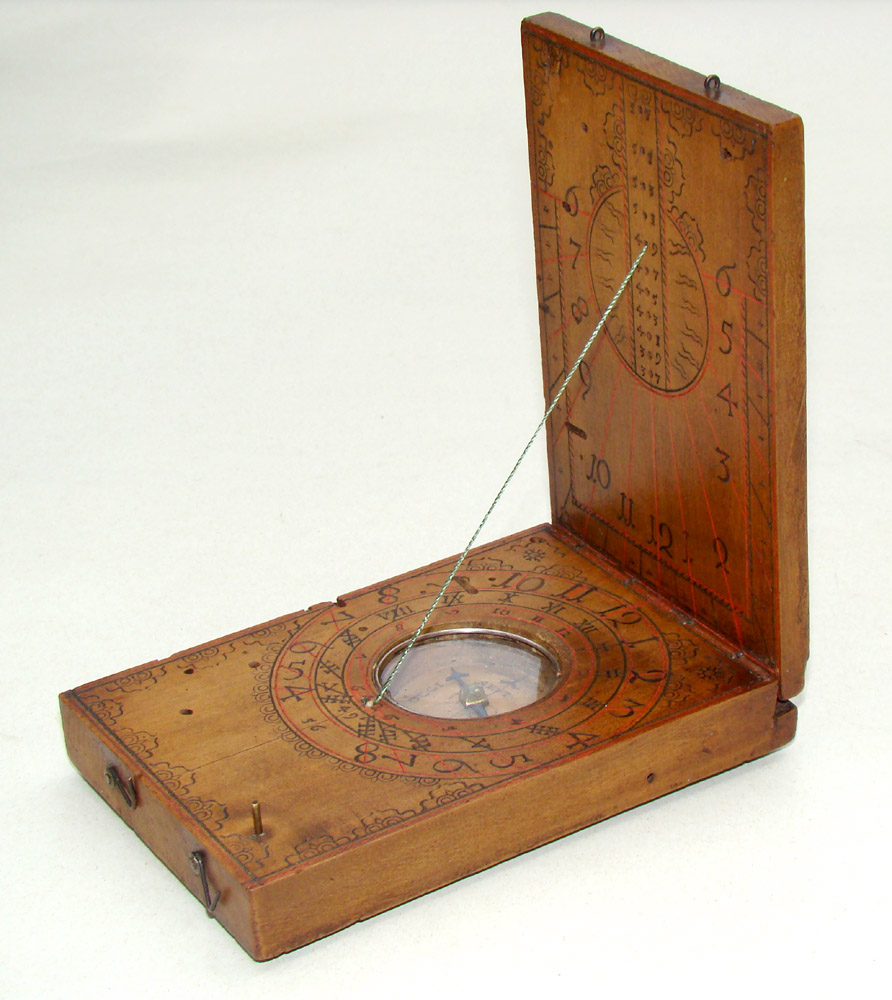
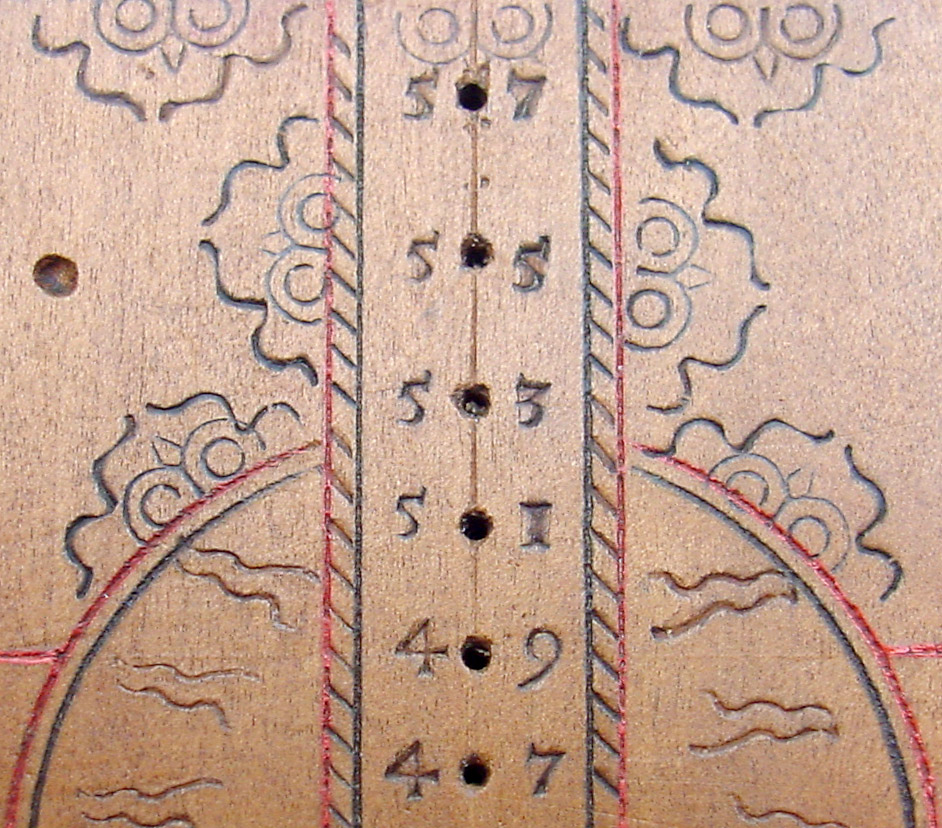
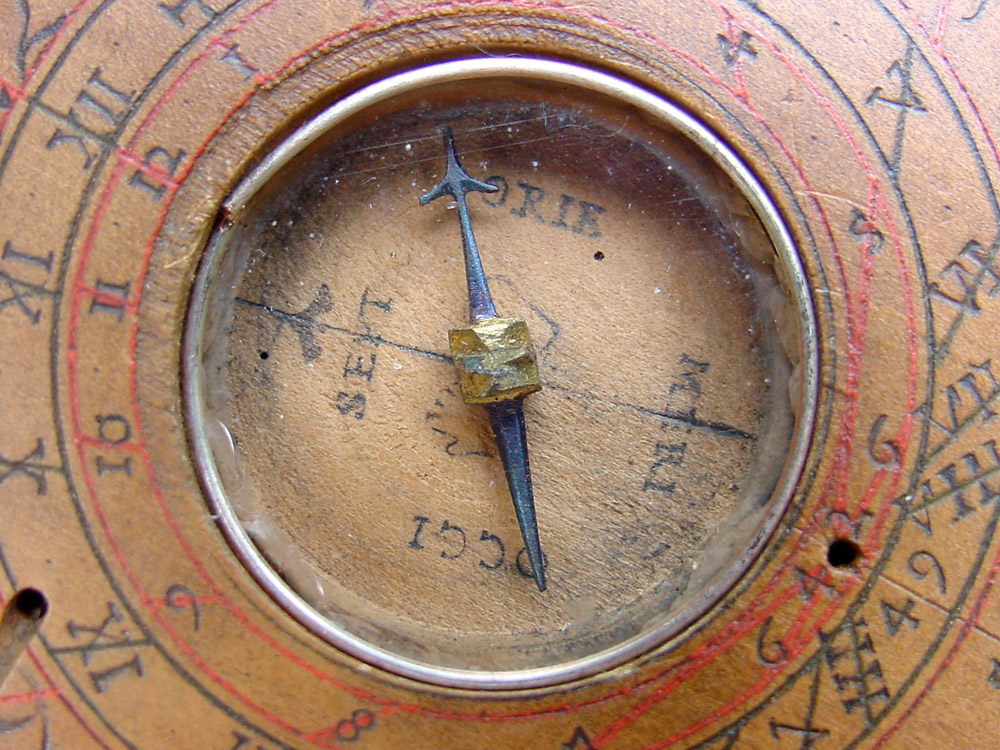
FINE FRUITWOOD DIPTYCH SUNDIAL, German, late 17th / early 18th century, stamped twice in the compass face with a "hand" mark. Measuring 4" x 2-3/4" x 3/4" (10 x 7 x 2 cm) closed, the dial is constructed of two fruitwood panels, hinged at one end. The exterior surfaces are plain, the interior punched and engraved with vertical and horizontal sundials, the numerals and decorative designs punched in black, the straight and circular lines scored then colored in contrasting red and black. The horizontal dial has three chapter rings, the hour lines spaced appropriately for 42°, 49°, and 56° North latitude. At its center is an inset glazed compass marked with principal directions "SEPT, MERI, ORIE, OCCI" and with North point showing approximately 14° magnetic declination westward (consistent with our dating of the instrument). The vertical dial has but a single chapter ring, designed for 49° North. Both dials use a string as gnomon; its bottom end is fixed, but the top can be strung through any one of eleven holes corresponding to latitudes 37° to 57°. The surfaces are decorated with numerous simulated floral patterns, each cleverly composed with a small set of punches. This diptych dial is in very fine condition, noting some old worm holes, and loss of one little foot and two simple wire clips. The dial surfaces are excellent. This instrument represents the near end of the era of production of pocket diptych sundials in Nuremberg, for use as portable timekeepers and as devices for adjusting clocks and watches. Some of the earliest ones were made of wood, as were some of the latest. Gouk (1988) notes that very few wooden diptych dials exist, and records two early 16th century ones -- dated 1511 and 1513. In between were over two hundred years of predominantly ivory ones, in a thriving commercial activity in Southern Germany. The maker of the present dial was probably a member of the prolific Karner family, which spanned five generations of dial making. The "hand" stamp is Gouk's mark #22; this mark is found on her Catalogue #46, a small diptych combining ivory and wood, and attributed to the Karner family. (9131) $1950. |
 |
|
| Unusual Sighting Sundial of 1816 | Click on any image for a larger view. Scroll to view more items. |
 |
 |
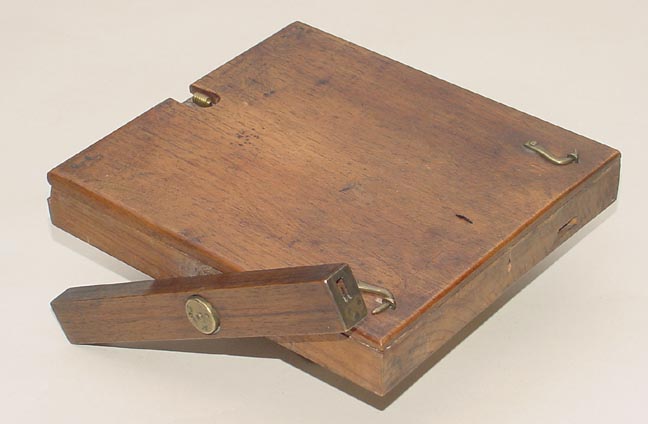
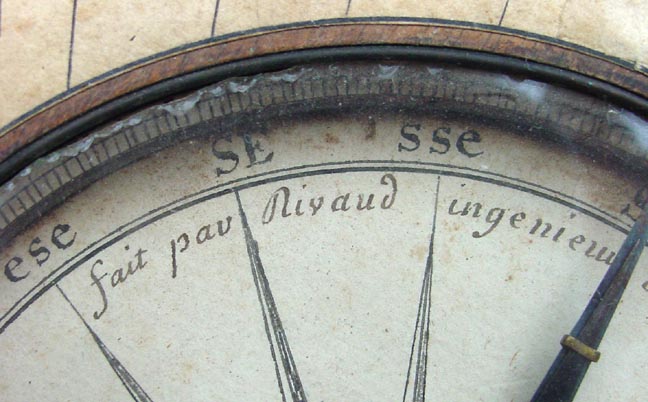
| FRENCH SUNDIAL / THEODOLITE, 1816, signed "fait par Rivaud ingenieur le 20 mai 1816" (made by Rivaud, engineer, May 20, 1816). Made of walnut, 6-3/8" (16 cm) square and 1" thick overall, this multipurpose instrument has hinged lid with string gnomon and plumb line; horizontal chapter ring divided every quarter hour from 6am to 6pm; inset glazed compass with 360 scale divided each degree, 16-point rose, doubled needle, and automatic needle lifter; and side-mounted inclinable rectangular walnut tube with brass sights. All the layout and divisions are done by hand in ink on paper over wood. Condition is fine noting light soiling. An uncommon instrument by an unlisted maker. (8147) $1950. |
 |
|
| An Impressive Precision Dial by Jacques Le Maire | Click on any image for a larger view. Scroll to view more items. |
 |
 |
|
 |
|
|
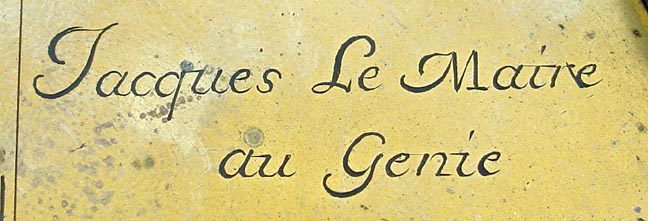
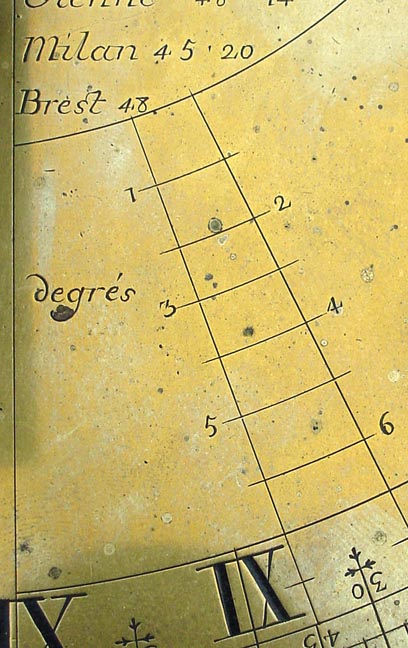
JULIEN LE ROY'S IMPROVED HORIZONTAL SUNDIAL, French, c. 1740, signed "Jacques Le Maire de La Societe des Arts, au Genie a Paris." The substantial brass dial plate measures 7-1/4" x 9-3/4" (18 x 25 cm) overall, and is set with a glazed compass with fine eight-point rose, a broad 49-degree gnomon pierced with four pinholes and with slots to support the brass plumb on silk cord, and four pommel-headed leveling screws. The compass rose can be rotated by external pointer reading against a 0(1)20 degree scale of "declinaison occidentale" (west declination). The periphery of the dial plate is engraved with a full chapter ring, divided every five minutes from 4am to 8pm. The plumb bob hangs against a scale of latitudes, divided every degree from 35 to 60, for using the dial at other locations, with the plate tilted up or down using the long leveling screws. A list of 20 European cities and their latitudes is finely engraved on the surface. As described, this is a significant, finely crafted horizontal sundial of rather standard form. But it has additional very special features. There are three radial scales reading outwards in units from 0 to 9. And two index stubs extend an inch beyond the dial plate to the north and south, exactly in line with the 12 noon line. This is an example of the precision sundial developed by Julien Le Roy (1686 - 1759), the premiere French clockmaker of the time, first president of the Societe des Arts. New designs of clocks and watches were achieving much improved precision, on a consistent basis, and there was a need to reset and regulate them with the true standard, i.e., sundials of high precision. In 1734, Julien Le Roy presented his new design, which was communicated to the Royal Society of London in 1736 by Desaguliers (see A. Turner, 1988, for a transcription of Desagulier's translation). For high precision a dial must be accurately leveled, and the gnomon oriented truly parallel to the earth's axis (and therefore suitably inclined and oriented to true geographic north). Le Roy's index stubs and three radial scales (called the Meridional scale and the scales of Correspondent Heights) met this need. In use the dial is placed on a horizontal table, sometime before noon, set to the latitude, and rotated until a sun-spot falls on one of the numbered intersections of the Meridional center line scale. One scribes lines on the table, along the two stubs, and connects them. Then after noon one turns the dial and, when the same pinhole casts a spot on the same intersection, draws a second line on the table. Bisecting the angle between the two lines gives the true direction to geographic north, and the dial should be set along this bisection line. To verify that it is the true meridian, one waits a few days, then checks whether a morning and afternoon passage of a particular sun-spot crosses the morning and afternoon scales of Correspondent Heights in exactly the same positions. If not, the whole process is repeated until correct. The present dial was crafted to Le Roy's specifications by Jacques Le
Maire (working 1714 - 1762), instrument maker and fellow member of the
Societe des Arts. An important instrument, in very fine condition throughout.
(8117) $19,500. |
| Time-Telling by Incense Trails | Click on any image for a larger view. Scroll to view more items. |
 |
|
 |
 |
|
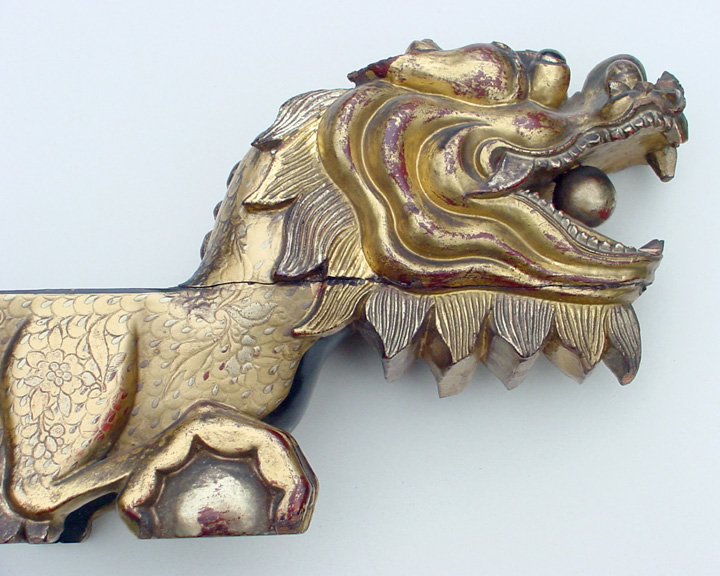
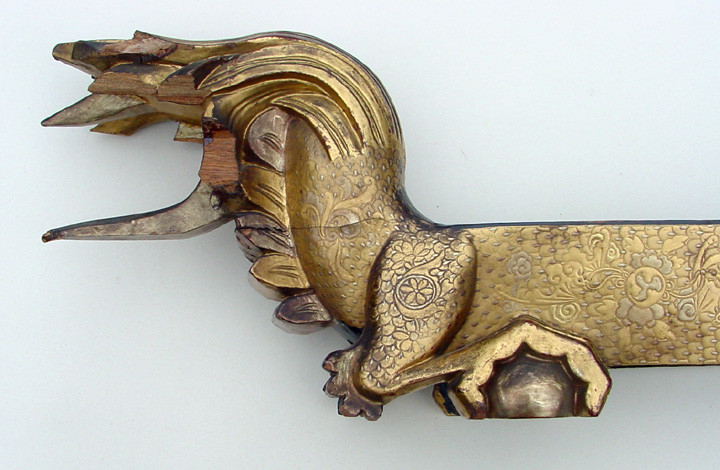
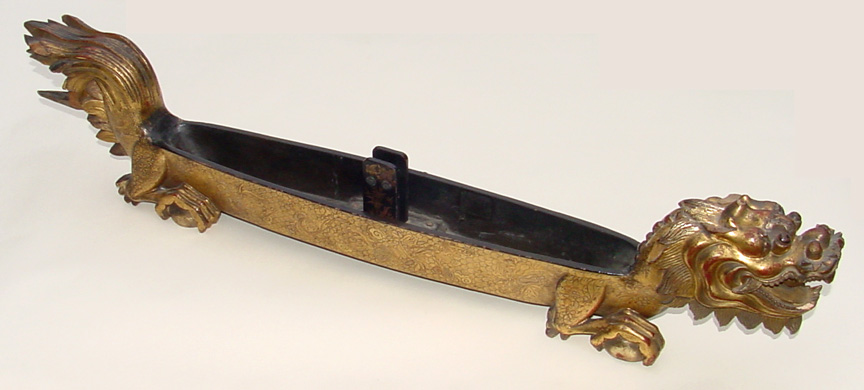
DRAGON BOAT TIMEKEEPER, Chinese, c. 19th century, made of finely carved wood, 34" (86 cm) long. The well-carved dragon has dramatic head and tail, and floral decoration throughout, and is clutching balls (pearls?) in mouth and feet. It is finished in contrasting gold and black lacquer, showing traces of red pigment underneath. Condition is good, noting several losses to the wood, including one foot. In the hollow center is a decorated wood support with two short horizontal metal rods -- from this would presumably have hung a wire basket, or perhaps a pewter pan, to support a straight stick of incense. Overall this dragon boat presents extremely well and dramatically. This is a good example of the "dragon boat alarm" described
in great detail by Bedini in his book The Trail of Time -- Time measurement
with incense in East Asia (1994). Various forms are known, some serving
as simple "clocks" by noting the burnt length of incense, some
used with thin threads laid cross-wise over the incense, the threads supporting
tiny bells which fell noisily below the vessel as each thread burned through,
and some on wheels to cross the dinner table. Bedini finds reference to
the dragon boat alarm as early as 1100 A.D., and into much more recent
times. (8225) $6950. |
 |
| Finding your way in the French Countryside | Click on any image for a larger view. Scroll to view more items. |
 |
|
|
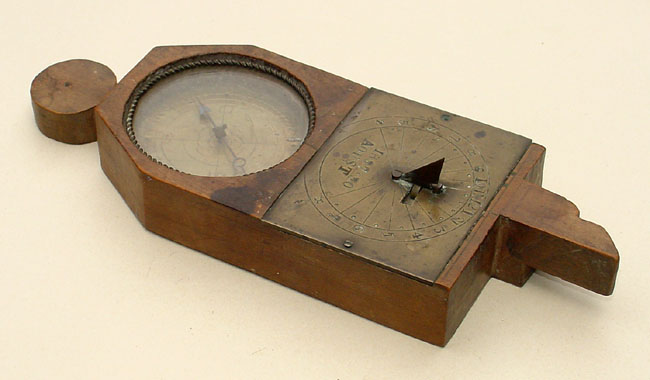
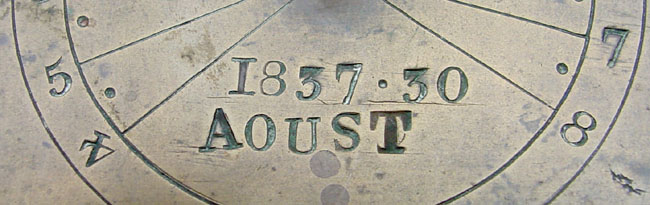
UNUSUAL PORTABLE COMPASS / SUNDIAL, French, 1837, stamped "1837 . 30 Aoust" on the brass. This traveler's instrument is carved from a single block of dense wood (walnut?) 9-1/4" (23 cm) long, with knob handle and shaped alignment index. It has an inset glazed compass with finely shaped arrow-head needle and with brass compass plate divided every five degrees and offset for 27° west declination. The adjacent horizontal sundial has brass base plate divided every 30 minutes, and small folding gnomon. Condition is fine, with a "folk art" quality. We have not seen another compass / sundial instrument of this particular form. It is clearly French, with the early spelling of "August," and the directions E and O (for Est and Ouest). The extreme western declination (the difference in compass direction between magnetic north and "true" geographic north) of 27° was in fact never realized. About 1580, the declination had an extreme eastern value of approximately 12° (in London and Paris); it then moved westward for 230 years, reaching a peak of 23° west c. 1810, before heading back east. But some dial makers apparently extrapolated the long and rather linear increase, to arrive at values which were never reached (and see Tesseract Catalogue 76 item 20 for an English dial with 27° west declination). (8168) $1950. |
 |
| Astronomy |
| Microscopy |
| Dialling |
| Navigation |
| Demonstration & Experimentation |
| Calculation |
| Medical |
| Specials |
| Books New and Old |
| Tesseract Catalogues |